Educational only: This reference explains how a precious metals IRA works under published law and regulator guidance. It does not recommend a company, custodian, depository, dealer, product, or allocation, and it is not financial, tax, or legal advice. Customers should speak to a financial or tax advisor before making decisions. Goldco does not offer tax or legal advice. Past performance does not guarantee future results.
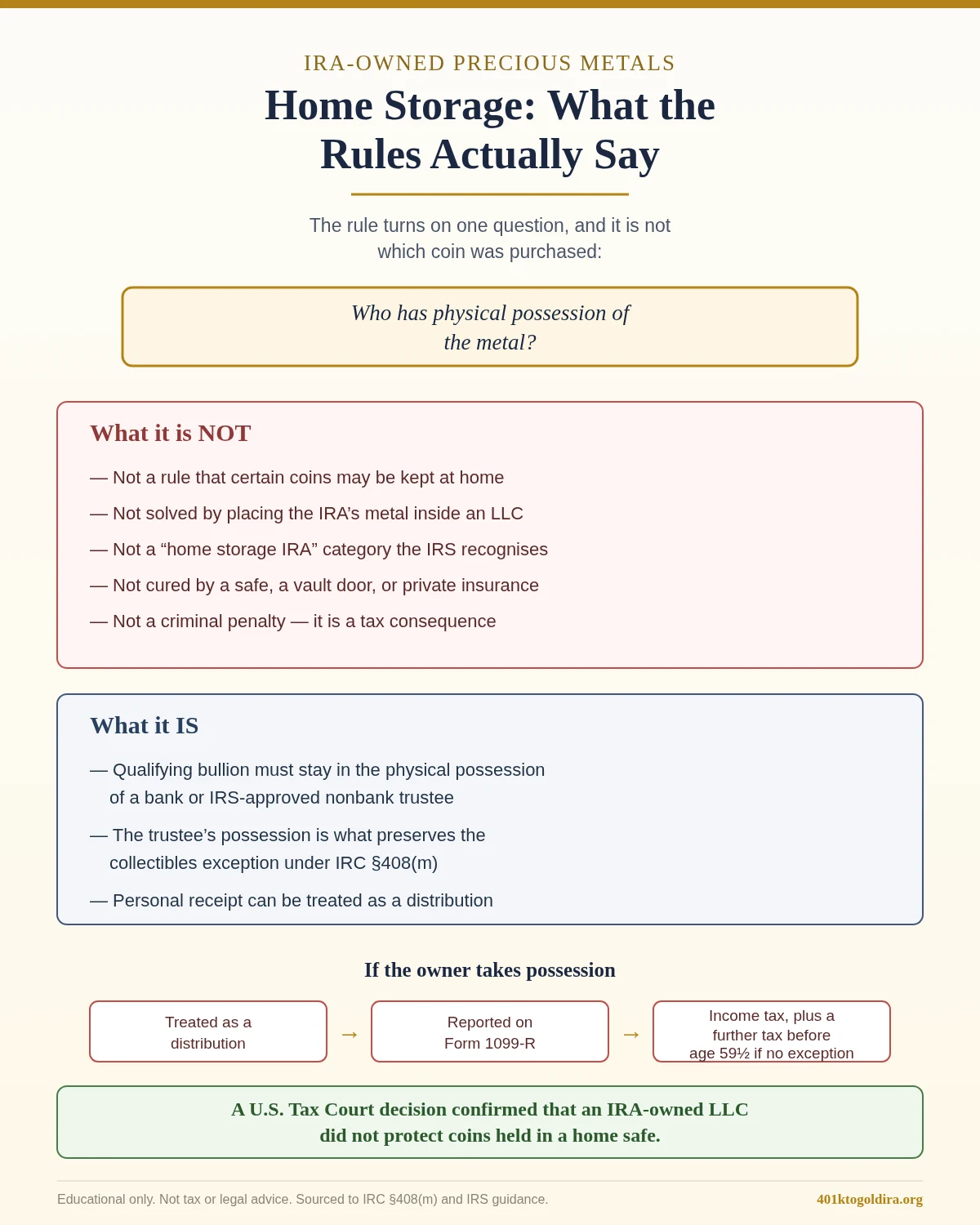
In McNulty v. Commissioner, the U.S. Tax Court held that taking personal delivery of IRA-owned American Eagle coins produced taxable distributions of $411,380 — even though an IRA-owned LLC had bought the coins and the owner stored them in a home safe.
Source: McNulty v. Commissioner, 157 T.C. No. 10 (2021), Docket No. 1377-19 — $374,000 (2015 gold) plus $37,380 (2016 silver). Searchable via the U.S. Tax Court DAWSON system. The case was a tax matter; it did not create a criminal penalty for home possession.
Key takeaways
- A precious metals IRA is not a special tax account. It is a traditional, Roth, SEP, or SIMPLE IRA whose permitted assets include certain coins or qualifying bullion.
- The IRS approves some nonbank trustees and custodians. It does not approve a dealer, a coin, a marketing offer, a price, or a vault merely because an approved custodian uses it.
- IRC §408(m) generally treats an IRA's acquisition of a collectible as a distribution. Certain coins and bullion are excluded when the statutory conditions are met.
- "Self-directed" means a broader asset menu and owner-directed decisions. It does not permit personal possession of IRA-owned metal.
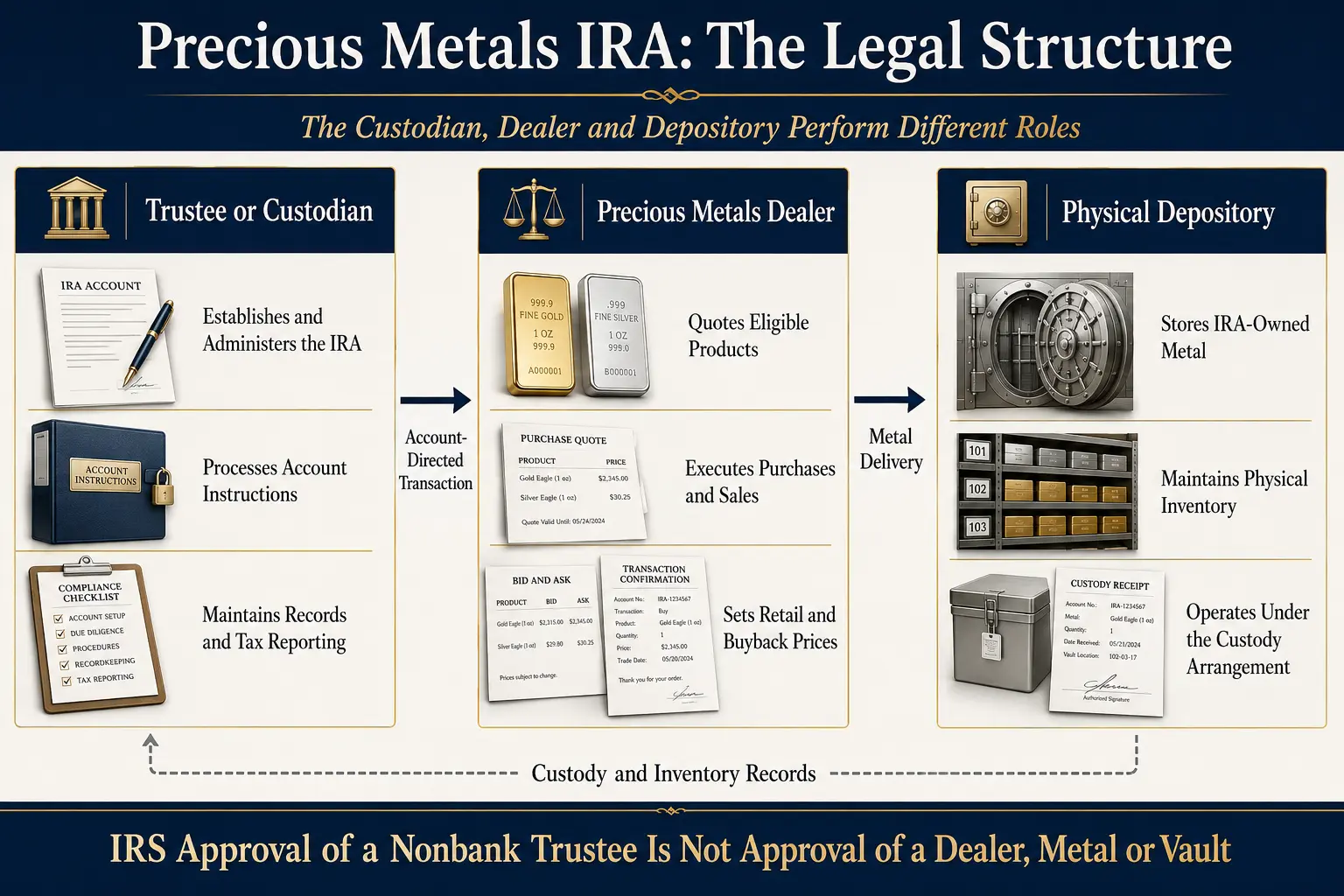
- A custodian, a dealer, and a depository are three different parties performing different functions. Marketing pages often blur those roles.
- Physical metal can carry dealer spreads plus administration, storage, insurance, valuation, and liquidation costs that ordinary brokerage assets may not have.
- There is no independently verified universal metals allocation, average Gold IRA fee, average dealer spread, or standard depository insurance limit. This page says so rather than inventing one.
What Is a Precious Metals IRA?
A precious metals IRA is an individual retirement arrangement governed by IRC §408 whose assets include certain physical gold, silver, platinum, or palladium. The legal account remains an IRA; the metal is simply an asset held within it. IRC §408(a) requires an individual retirement account to be a U.S. trust created for the exclusive benefit of an individual or that individual's beneficiaries, and its trustee must be a bank or another qualified person that satisfies Treasury requirements (Cornell LII — 26 U.S.C. §408).
The phrases "Gold IRA" and "precious metals IRA" are commercial shorthand. Neither creates a separate tax category in the Internal Revenue Code. Depending on the structure selected, the account may be a traditional IRA, Roth IRA, SEP-IRA, or SIMPLE IRA that happens to hold metals.
A self-directed IRA holding precious metals describes the structure more precisely. Investor.gov defines a self-directed IRA as an IRA held by a custodian that permits a broader set of assets than most conventional custodians, potentially including real estate, private placements, commodities, and precious metals (Investor.gov). A conventional brokerage IRA and a self-directed metals IRA can therefore carry the same traditional or Roth tax classification. The difference is the permitted asset menu and the administration that nonstandard assets require.
What Does "IRS-Approved" Actually Mean?
The phrase "IRS-approved Gold IRA depository" is usually too broad, and the imprecision matters.
The Code and Treasury regulations focus on the legal trustee or custodian of the IRA. Under IRC §408(a)(2), the trustee may be a bank or another person that demonstrates to the Treasury Secretary's satisfaction that the trust will be administered consistently with §408. The regulation treats the custodian of a qualifying custodial account as the trustee for this purpose (Cornell LII — §408; Cornell LII — Treas. Reg. §1.408-2).
Does the IRS approve nonbank custodians? Yes. A nonbank entity can apply for IRS approval under Treasury Regulation §1.408-2(e), and the IRS maintains a current list of approved nonbank trustees and custodians that changes as approvals are added, withdrawn, or revoked (IRS). The process is substantive: an applicant must provide clear and convincing evidence concerning continuity, an established U.S. location, fiduciary experience, financial responsibility, accounting capacity, written fiduciary procedures, bonding, net worth, independent audits, and separate fiduciary records. The IRS states that the minimum fidelity bond and initial net-worth amounts are each at least $250,000, although other asset-based requirements can also apply (IRS — application procedures).
What that approval does not mean. IRS approval of a nonbank trustee is not approval of a particular gold or silver product, a metals dealer, the price or spread a dealer charges, an investment recommendation, a physical depository as a standalone business, a home-storage arrangement, or the legitimacy of an asset promoter. An IRS announcement describing nonbank approvals states explicitly that a notice of approval is not an endorsement of any investment and that the IRS does not review or approve investments (IRS — Internal Revenue Bulletin 2011-37).
A precise description is therefore: "The IRA trustee or custodian is a bank or an IRS-approved nonbank trustee." The claim to avoid is: "The vault and all metals sold through it are IRS-approved." The IRS list is public and searchable — the verification method sets out how to check any such claim in a few minutes. Readers comparing providers may find the provider transparency scorecard and the depository directory useful for checking which entity actually performs which role.
What Is the Collectibles Rule?
IRC §408(m) is the legal center of a physical-metals IRA. The section generally defines collectibles to include artwork, rugs, antiques, metals, gems, stamps, coins, alcoholic beverages, and other tangible personal property specified by Treasury. When an individually directed IRA or plan account acquires a collectible, the account owner is generally treated as receiving a distribution equal to the account's cost of acquiring it (Cornell LII — §408; IRS — collectibles in individually directed accounts).
The IRS states that the deemed distribution occurs in the year the collectible is acquired and should be reported on Form 1099-R. If the taxable deemed distribution occurs before age 59½, the taxable amount may also be subject to the 10% additional tax unless an exception applies (IRS Topic 557). Related consequences are covered in more depth on the gold IRA tax mistakes page.
Which Coins and Bullion Are Excluded From the Collectibles Rule?
IRC §408(m)(3) creates two main exceptions.
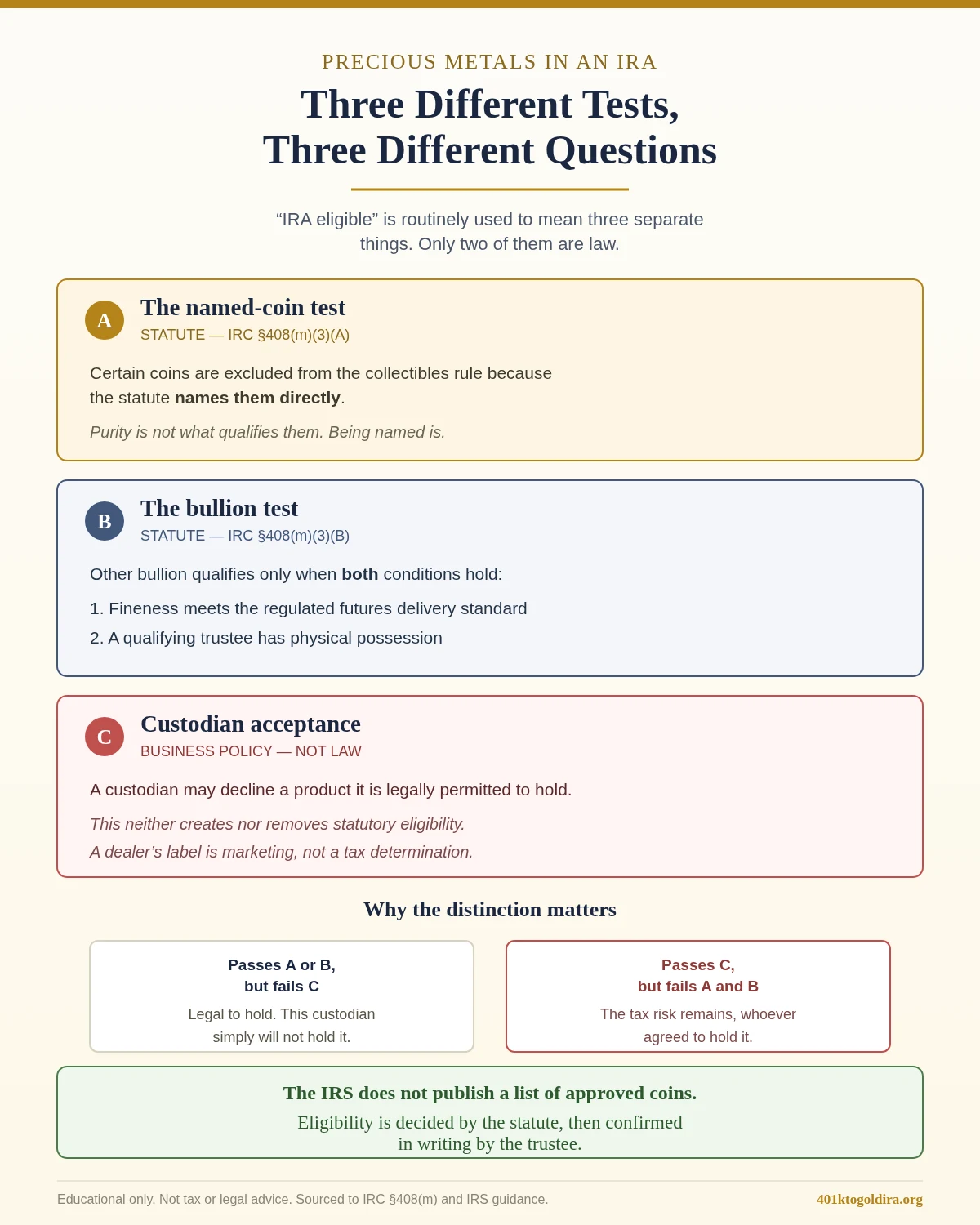
1. The named-coin exception. The statute expressly excludes gold coins described in 31 U.S.C. §5112(a)(7), (8), (9), and (10); the silver coin described in §5112(e); platinum coins described in §5112(k); and coins issued under the laws of a state (Cornell LII — §408). The four gold provisions describe the one-ounce, half-ounce, quarter-ounce, and tenth-ounce American Eagle gold coins. The U.S. Mint states that these coins contain 91.67% gold, even though they contain their stated weight in fine gold — their statutory eligibility comes from being named, not from meeting a commonly quoted .995 threshold (Cornell LII — 31 U.S.C. §5112; U.S. Mint).
2. The bullion exception. Gold, silver, platinum, or palladium bullion may be excluded from the collectibles definition when its fineness equals or exceeds the minimum fineness required by a contract market for metal deliverable under a regulated futures contract, and the bullion is in the physical possession of a trustee described in §408(a) (Cornell LII — §408).
Are the familiar .995, .999, and .9995 figures written into §408(m)? No. Section 408(m) does not hard-code fixed percentages; it incorporates the deliverable-metal standards of regulated futures markets by reference. The current IRS public pages reviewed for this guide do not publish a definitive four-row table of universal IRA fineness thresholds — the IRS describes "bullion of a certain fineness" and directs readers back to §408(m) (IRS; IRS Publication 590-B). Many commercial pages publish such a table as though it were an IRS rule. The more defensible statement is that qualifying bullion must meet or exceed the minimum fineness required for delivery under an applicable regulated futures contract, and that the trustee should confirm the exact product's eligibility in writing. Product-by-product classification, including the coins where published sources contradict each other, is set out in the IRA-eligible precious metals reference.
Are the American Buffalo and the palladium Eagle automatically covered? Not by the named-coin exception. That exception points to §5112(a)(7)–(10), while the one-ounce 99.99% American Buffalo appears at §5112(a)(11) and the .9995 palladium coin at §5112(a)(12) — neither is expressly named in §408(m)(3)(A). Those products may potentially qualify through the separate bullion exception when its fineness and possession conditions are satisfied, but that potential route should not be converted into a blanket product-eligibility claim without written confirmation from the trustee (Cornell LII — §5112; U.S. Mint — American Buffalo). Metal purity alone does not replace the other §408(m) conditions.
What Happens When IRA-Owned Metal Is Kept at Home?
Personal possession can cause the metal to be treated as distributed. The IRS states that qualifying bullion must remain in the physical possession of a bank or approved nonbank trustee, and its IRA FAQ applies that rule even when an IRA-owned limited liability company purchases the metal (IRS — IRA FAQs). Publication 590-B similarly cautions that qualifying coins must be in the possession of the IRA custodian or trustee (IRS Publication 590-B).
What McNulty established. In McNulty v. Commissioner, 157 T.C. No. 10 (2021), Docket No. 1377-19, an IRA invested through a single-member LLC in American Eagle coins. The taxpayer, who managed the LLC, took delivery at the family residence and stored the coins in a home safe. The Tax Court held that personal receipt of the coins produced taxable IRA distributions equal to their cost — $374,000 for the 2015 gold coins and $37,380 for the 2016 silver coins, a combined $411,380. Additional 2016 gold coins and separate prohibited transactions involving the husband were also addressed (U.S. Tax Court — DAWSON opinion search).
The decision was a tax case. It did not hold that every custody error is a crime, and it did not create a universal criminal penalty for home possession. It held that the taxpayer's receipt and control of the IRA-owned coins caused taxable distributions, and it sustained accuracy-related penalties. The practical comparison between compliant storage and home storage is set out on the depository versus home storage page and the storage legality matrix.
How Does a Precious Metals IRA Work?
A typical transaction involves separate legal and operational stages.
Step 1 — An IRA is established with a qualified trustee or custodian. The account may be traditional or Roth. The trustee must be a bank or a qualifying nonbank trustee approved under Treasury Regulation §1.408-2(e) (Cornell LII; IRS list).
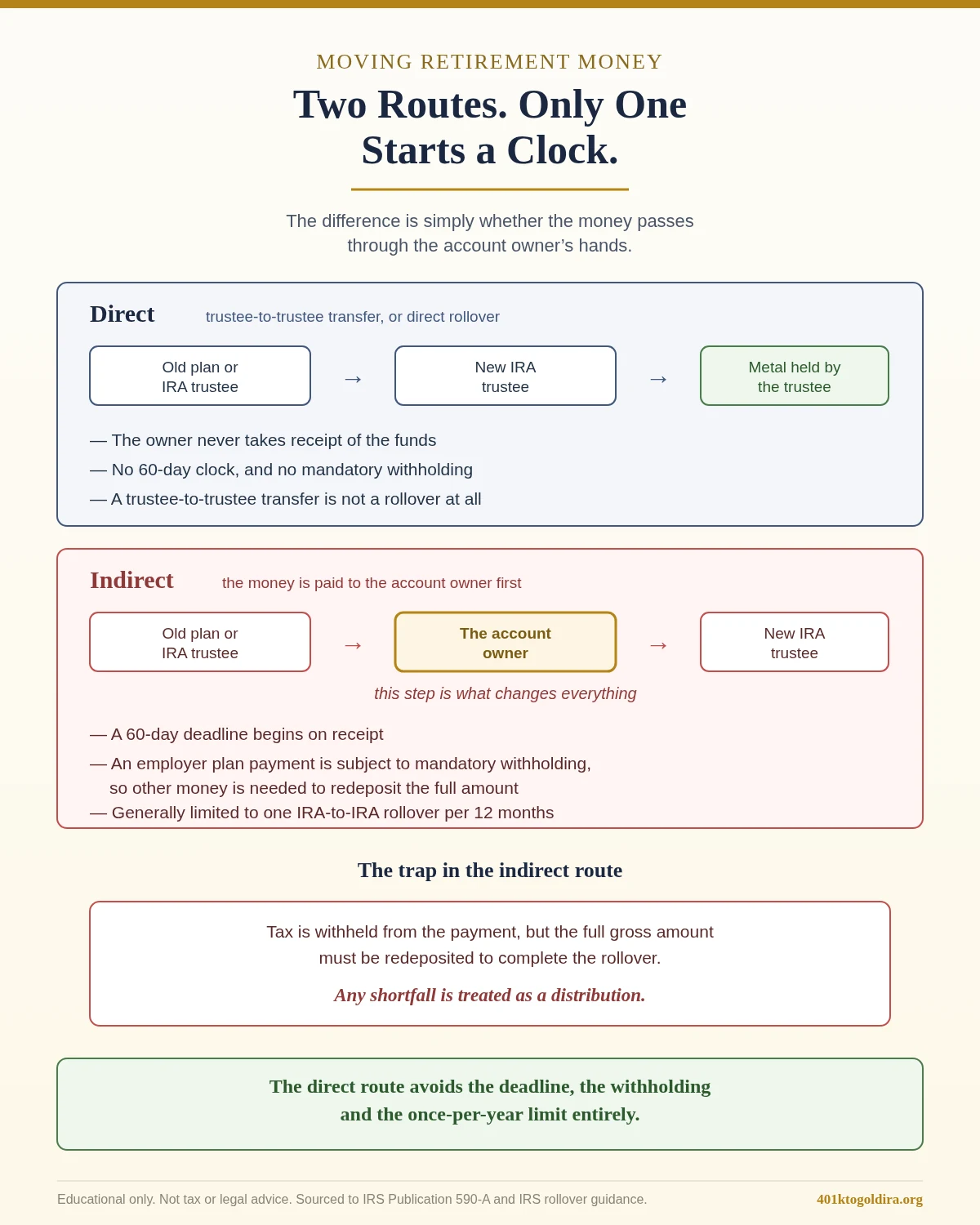
Step 2 — The account receives money. Funding may come from a regular annual contribution, a trustee-to-trustee IRA transfer, a direct rollover from an employer plan, a 60-day rollover, or a taxable Roth conversion where applicable. A trustee-to-trustee transfer is not treated as a rollover and is not restricted by the one-rollover-per-12-month rule (IRS Publication 590-A). The mechanics are covered step by step in the rollover guide.
Step 3 — The account owner directs an acquisition. The owner selects an asset from among those the custodian permits, and the custodian processes the transaction using IRA funds. "Self-directed" does not mean the owner personally buys the metal, reimburses the IRA later, or takes delivery.
Step 4 — The metal enters the custody arrangement. Qualifying bullion must remain in the physical possession of the trustee described in §408(a). A physical vault may perform storage services under the trustee's arrangement, but the contractual and legal relationships require verification (IRS — IRA FAQs).
Step 5 — The custodian administers the IRA. Administration may include transaction processing, recordkeeping, annual valuation, tax reporting, distributions, and RMD support. Self-directed custodians generally do not evaluate whether the asset is a sound purchase, whether the dealer's price is reasonable, or whether a promoter's claims are accurate (Investor.gov; NASAA).
Step 6 — The metal is sold or distributed. The account may direct a sale, leaving cash inside the IRA, or request a distribution of cash or property. An in-kind distribution transfers the metal out of the IRA and generally reports its fair market value as the distribution amount (IRS Publication 590-B). The in-kind distribution calculator and the distribution benchmark cover the practical timelines.
How Can a Rollover or Transfer Fund the Account?
Trustee-to-trustee transfer. The existing IRA trustee sends assets directly to the receiving trustee. The IRS states this is not a rollover, is generally tax-free, and is not affected by the one-rollover-per-year rule (IRS Publication 590-A).
Direct rollover. An employer-plan administrator sends an eligible distribution directly to the receiving IRA. No mandatory federal withholding applies to the direct rollover amount. The plan-side eligibility and tax-character questions that come first are covered in the 401(k) to Gold IRA rollover guide (IRS — rollovers).
60-day rollover. When an eligible distribution is paid to the individual, the amount generally must be deposited into an eligible account within 60 days. An employer-plan payment made to the individual is generally subject to 20% mandatory withholding, so other money may be needed to roll over the full gross distribution (IRS Topic 413). The withholding shortfall calculator illustrates the gap this can create.
One-rollover-per-12-month rule. Only one IRA-to-IRA 60-day rollover is generally permitted across all of an individual's IRAs during a 12-month period. The rule does not apply to trustee-to-trustee transfers, traditional-to-Roth conversions, plan-to-IRA rollovers, IRA-to-plan rollovers, or plan-to-plan rollovers. Required minimum distributions, hardship distributions, and certain periodic payments are among the amounts that cannot be rolled over (IRS; IRS Topic 413).
What Makes a Precious Metals IRA Self-Directed?
"Self-directed" describes the investment authority and permitted asset menu. It is not a separate Code section granting personal control over IRA property. A self-directed custodian may permit alternative assets that many mainstream providers decline to administer; the account owner chooses the investment, while the custodian holds and administers the IRA (Investor.gov).
What self-direction permits. Subject to custodian policy and federal law: selection of qualifying precious-metal products; selection among dealers the custodian accepts; instructions to buy, sell, or distribute assets; and a broader asset menu than a conventional brokerage IRA.
What self-direction does not permit. It does not permit personal possession of IRA-owned bullion, personal use of IRA assets, buying property from or selling property to the IRA owner, borrowing from the IRA, pledging the IRA as security, ignoring prohibited-transaction rules, or treating custodian acceptance as government endorsement. The IRS lists borrowing from an IRA, selling property to it, pledging it as security, and using IRA money to acquire property for personal use among possible prohibited transactions (IRS — prohibited transactions).
How Does a Self-Directed IRA Hold Gold?
A self-directed IRA holds gold the same way it holds any other permitted asset: the account owner directs the purchase, and the IRA itself takes ownership through its custodian. The owner never buys the metal personally and never takes delivery of it. The distinction matters because the moment the owner holds the bullion, the arrangement stops being an IRA holding and becomes a distribution.
Three conditions have to hold at once for gold in a self-directed IRA:
- The custodian must accept the asset class. A self-directed custodian is one that permits physical metals; many mainstream brokerage custodians do not. That is a business policy, not a legal restriction, and it varies by provider.
- The specific product must qualify. Eligibility is decided product by product under IRC §408(m), turning on fineness and the custody arrangement. Being gold is not enough, and a metal type being offered does not make every product in it eligible.
- The metal must be held by the trustee or custodian. The statute requires physical possession by a bank or an IRS-approved nonbank trustee. Home storage of IRA-owned bullion is the failure case set out above.
What self-direction actually changes is who chooses. In a conventional IRA the provider sets a menu; in a self-directed IRA the owner selects the product and the dealer, within whatever the custodian will accept. The custodian executes instructions and reports to the IRS. It does not evaluate the dealer, the price paid, or whether the purchase was sensible — a point Investor.gov makes directly, and the reason the due diligence scorecard exists.
The practical sequence is covered in the 401(k) rollover guide for employer plans and the IRA transfer guide for money already in an IRA. Which products qualify is set out in IRA-eligible precious metals.
What Are the Separate Roles of the Custodian, Dealer, and Depository?
Three different parties perform three different jobs, and conflating them is one of the most common sources of confusion in this market.
Trustee or custodian. The legal IRA administrator. It maintains the account, processes instructions, reports transactions, and holds IRA assets under the account structure.
Metals dealer. The dealer sells or buys metal and sets its retail and repurchase prices. Dealer compensation may be embedded in the difference between the retail price and the buyback price. FINRA and the CFTC identify this difference as the dealer spread and advise obtaining the retail price, fees, commissions, and buyback price in writing (FINRA and CFTC — 10 things to ask). Documented premium and spread ranges by product type are collected on the dealer markup data page.
Depository or storage facility. The depository physically stores metal under a contractual custody arrangement, and its role is not automatically identical to that of the IRA trustee. A proper review should establish which legal entity is the IRA trustee, which entity owns or operates the facility, whether the vault acts as trustee, agent, or subcontracted storage provider, how ownership records identify the IRA's metal, what insurance policy applies, who receives insurance proceeds, and how audits and inventory reconciliations are performed. No government source located for this guide established a universal insurance limit, audit standard, or storage contract for every precious-metals IRA.
What do segregated, allocated, and commingled storage mean? These labels are not classifications created by §408(m). In industry usage they can refer to how metal is identified, separated, or recorded within a facility, and their exact meaning depends on the storage agreement, title records, fungibility rules, withdrawal process, and insurance policy. Because no uniform government definition was found, one provider's terminology should not be treated as a legal standard; the segregated versus commingled storage page explains the contract language, while the legal distinction that matters is custody versus personal possession.
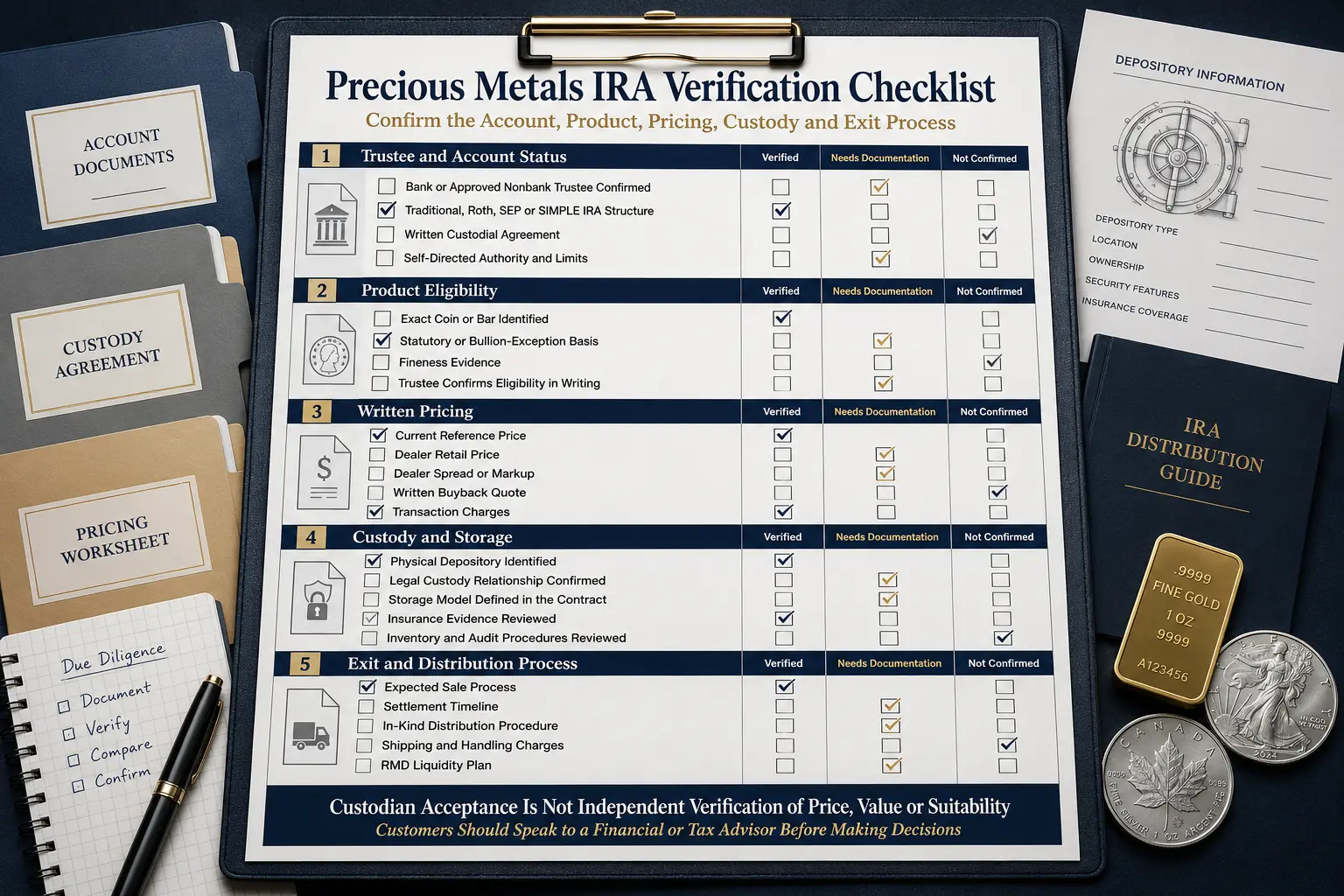
Custodian acceptance is not independent verification of price, value, or suitability.
How Do Distributions and RMDs Work With Physical Metal?
Traditional, SEP, and SIMPLE IRA owners generally begin required minimum distributions at the applicable statutory age, which SECURE 2.0 sets by birth year: age 73 for owners born 1951 to 1959, and age 75 for owners born in 1960 or later (IRS — RMD FAQs; IRS Internal Revenue Bulletin 2026-06). Roth IRA owners do not have lifetime RMDs, although beneficiary rules apply after death. The Roth-specific rules, including the two five-year periods and when a move into a Roth account is a conversion, are set out in the Roth Gold IRA guide.
An RMD requires a distribution, but it does not invariably require a metal sale. Depending on the account and custodian procedures, the IRA may distribute existing cash, sell enough metal to create cash, or distribute metal in kind at its reportable fair market value. An RMD itself cannot be rolled into another tax-deferred account.
Physical assets can complicate deadlines because they may require valuation, dealer bids, custodian instructions, shipping, or title transfer. NASAA warns that alternative assets in self-directed IRAs may have limited liquidity, which can matter when distributions or RMDs are due (NASAA). Planning approaches are covered on the RMD strategy page, and inherited-account rules on the inherited gold IRA rules page.
How Are Contributions and Taxes Handled in 2026?
Contribution limits. For 2026, combined traditional and Roth IRA contributions are limited to $7,500 for an eligible person under age 50, or $8,600 for an eligible person age 50 or older — or taxable compensation for the year, if lower. Rollover contributions do not count against the limit (IRS — IRA contribution limits). These figures are current-year-specific and require annual review.
Traditional IRA treatment. Contributions may be deductible, partly deductible, or nondeductible depending on income, filing status, and workplace-plan coverage. Earnings generally remain tax-deferred inside the IRA, and distributions are generally taxable except to the extent they represent after-tax basis (Publication 590-A; Publication 590-B).
Roth IRA treatment. Roth contributions are not deductible. Qualified Roth distributions are generally tax-free when statutory requirements are met, and income limits can restrict direct Roth contributions (IRS Topic 451).
The presence of gold or silver does not create a different tax regime. The traditional or Roth classification controls the account's general contribution and distribution treatment.
Early distributions. A taxable IRA distribution received before age 59½ is generally subject to regular income tax and a 10% additional tax unless an exception applies (IRS Topic 557). A deemed distribution caused by acquiring an impermissible collectible or taking improper possession may therefore create both ordinary income and the additional tax when the owner is under 59½ and no exception applies. The withdrawal tax estimator illustrates the arithmetic.
How Do Prohibited Transactions Apply?
IRC §4975 prohibits specified dealings between a plan and a disqualified person, including selling, exchanging, or leasing property between the plan and a disqualified person; lending money or extending credit; furnishing goods, services, or facilities; transferring plan assets for a disqualified person's use or benefit; fiduciary self-dealing; and a fiduciary receiving personal consideration from a party dealing with the plan (Cornell LII — 26 U.S.C. §4975).
Disqualified persons can include fiduciaries, service providers, certain employers and employee organizations, 50% owners, specified family members, and related entities. When an IRA owner or beneficiary engages in a prohibited transaction, the account can cease to qualify as an IRA as of the first day of that tax year and may be treated as distributed at fair market value (Cornell LII — Treas. Reg. §1.408-1; Publication 590-B). The disqualified-person classes, the exact statutory family boundary and the separate consequence routes are set out in the self-directed IRA prohibited transactions reference.
Why "home storage IRA" and checkbook-LLC claims carry risk. The central issue is control. A checkbook LLC may give an account owner practical control over an LLC bank account, but that does not override §408(m)'s physical-possession requirement for qualifying bullion or §4975's prohibited-transaction rules. The IRS applies the possession rule when an IRA-owned LLC acquires bullion, and McNulty demonstrates that LLC title did not protect the taxpayer after personal receipt and control of the coins. The accurate rule is not that every LLC inside an IRA is prohibited — the risk arises when the owner's control, possession, self-dealing, or personal benefit violates the custody or prohibited-transaction rules. The full structure, including what a checkbook-control LLC manager can and cannot do, is set out in the checkbook-control IRA LLC guide.
What Are the Potential Advantages and Drawbacks?
The case for holding metal in an IRA is conditional rather than settled: diversification may help some portfolios, while the inflation-hedge and crisis-protection claims are materially narrower than the marketing versions. The drawbacks are more structural — no income, dealer spreads, layered account costs and custody constraints apply regardless of price direction. Each claim is graded against the underlying evidence in the Gold IRA pros and cons appraisal, and the cost side in the fees guide and the gold IRA versus gold ETF comparison.
What Enforcement History Should Retirement Savers Understand?
Regulators have repeatedly warned that precious-metals retirement promotions can target older workers and retirees. CFTC and FINRA guidance states that precious-metals IRA fraud frequently targets this group because they often hold larger retirement balances, and warns about inflated prices, overstated safety, large spreads, undisclosed compensation, nonexistent metal, and excessive fees (FINRA and CFTC).
Red Rock Secured. The SEC alleged that Red Rock Secured and three executives persuaded retirement-account holders to sell securities and purchase gold or silver coins while representing markups as 1% to 5%. The amended complaint alleged that actual markups reached as much as 130% and that at least 700 investors lost more than $50 million. In April 2024, defendants consented — without admitting or denying the allegations — to final judgments requiring more than $76.4 million in combined disgorgement, interest, and penalties (SEC Litigation Release 25996). A parallel CFTC and state-regulator order required approximately $38.98 million in restitution, $5.1 million in disgorgement, and $12.25 million in civil penalties; overlapping payments were subject to offsets, so the SEC and CFTC figures should not be added together as if they were separate victim losses (CFTC).
Safeguard Metals. A 2023 CFTC and state-regulator order found liability in a nationwide scheme that received approximately $68 million from about 450 people, many using retirement savings (CFTC). A September 2025 final judgment ordered Safeguard Metals and its owner to pay $25.6 million in restitution and a $25.6 million civil monetary penalty, with a separate SEC judgment imposing overlapping monetary relief offset between the actions (CFTC; SEC Litigation Release 26307).
These actions document particular misconduct. They do not establish that every metals IRA, dealer, or self-directed custodian is fraudulent. A fuller record is maintained on the scam and enforcement tracker, and common sales patterns on the warning signs page.
Which Commonly Repeated Figures Could Not Be Verified?
The following figures appear routinely across this market but could not be verified from primary or independent sources for this guide. They are listed here rather than repeated as fact.
- A fixed four-metal IRS fineness table. Section 408(m) incorporates regulated-futures deliverability standards rather than listing four permanent percentages, so the familiar commercial table should not be attributed directly to the IRS without current contract-level verification.
- An average annual Gold IRA custodian fee. No official nationwide database of self-directed precious-metals IRA fees was found.
- An average depository storage or insurance charge. These are contract-specific and no government average was located.
- A normal dealer premium or spread. Regulators document spreads and extreme enforcement examples, but no reliable universal market average was found.
- A universal depository insurance limit. Coverage depends on the actual policy, insured parties, exclusions, deductibles, sublimits, and claims process.
- A standard meaning of segregated, allocated, or commingled storage. These are provider-contract terms, not definitions supplied by §408(m).
- The number or total value of U.S. precious-metals IRAs. No official current dataset separating metals IRAs from other IRAs was found.
- A recommended precious-metals allocation. No primary authority establishes one percentage suitable for all retirement savers.
Frequently Asked Questions
Is a precious metals IRA a legitimate retirement account? Yes, when it is an IRA established under §408, administered by an eligible trustee or custodian, and operated in compliance with the collectibles, custody, distribution, and prohibited-transaction rules.
Does the IRS approve Gold IRA investments? No. The IRS may approve a nonbank entity to act as trustee or custodian, but it states that the approval is not an investment endorsement and that it does not review or approve investments.
Can IRA-owned gold be stored in the owner's home? The IRS states that qualifying bullion must be in the physical possession of a bank or approved nonbank trustee. Personal possession can result in a taxable distribution.
Is every gold coin eligible? No. The statute names certain coins and creates a separate bullion exception. Product eligibility depends on the exact statutory category, fineness, and custody conditions.
Does a self-directed custodian verify the investment? Generally, no. SEC, FINRA, and NASAA guidance warns that self-directed custodians ordinarily administer assets but do not evaluate the investment's quality, legitimacy, valuation, or promoter.
Does gold inside an IRA avoid RMDs? Not when held in a traditional, SEP, or SIMPLE IRA. Those accounts remain subject to the normal RMD rules. Roth IRA owners do not have lifetime RMDs.
Can an RMD be taken in physical metal? An IRA may distribute property rather than cash, subject to custodian procedures and fair-market-value reporting. The taxable value is not avoided merely because the distribution is in kind.
Does a transfer count against the one-rollover-per-year limit? A direct trustee-to-trustee IRA transfer is not a rollover and does not count against the limit.
Terms used throughout this guide are defined in the gold IRA glossary, and the research tools are collected on the calculators page. Readers comparing providers may also find the questions to ask before opening an account useful.
This page is educational and does not recommend any company, custodian, depository, dealer, product, or allocation. Tax and legal outcomes depend on individual circumstances, and rules change. Customers should speak to a financial or tax advisor before making decisions. Goldco does not offer tax or legal advice. Past performance does not guarantee future results. Figures identified as current-year-specific require annual review.