Gold IRA Dealer Markup Data 2026: Spread & Premium Benchmarks by Product
A sourced benchmark of Gold IRA dealer markups and spreads: what regulators report for bullion, numismatic, and premium coins, the buyback discount, enforcement-case figures, and the formula to check any quote against the data.
View the Markup Data →Educational only: This page records published dealer pricing from named primary sources. It does not provide financial, tax, or legal advice. Customers should verify current written pricing directly. Past performance does not guarantee future results.
Key figure
A CFTC advisory puts bullion at spot plus 5%–10% and numismatic coins at 40%–200% above spot. In SEC v. Red Rock Secured, premium-coin markups were alleged at 120%–130% above the dealer's own cost.
Sources: CFTC customer advisory (CARES Act era, c. 2020, no published revision date) and the SEC complaint. Enforcement figures are allegations about one named firm, not market averages.
Key takeaways
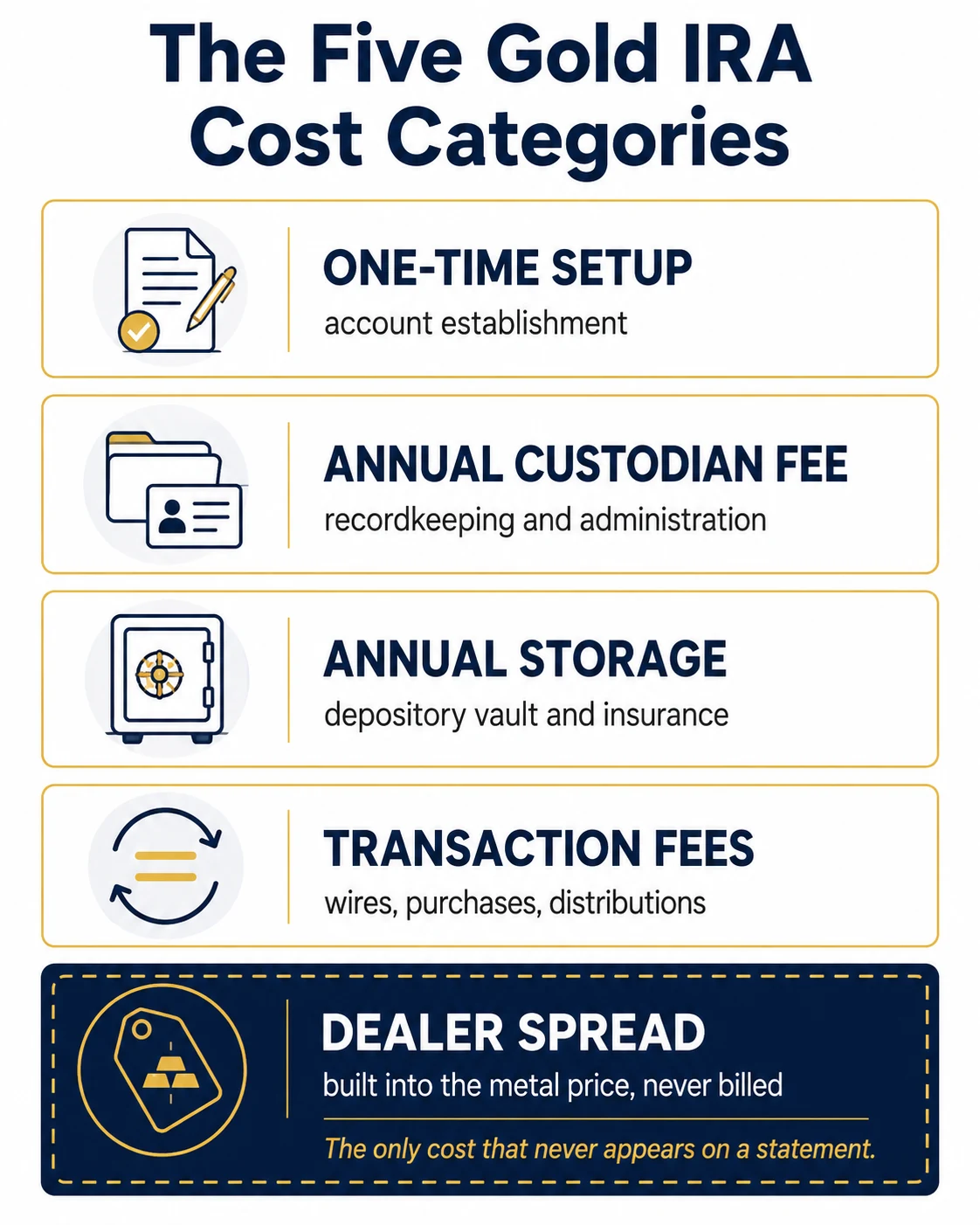
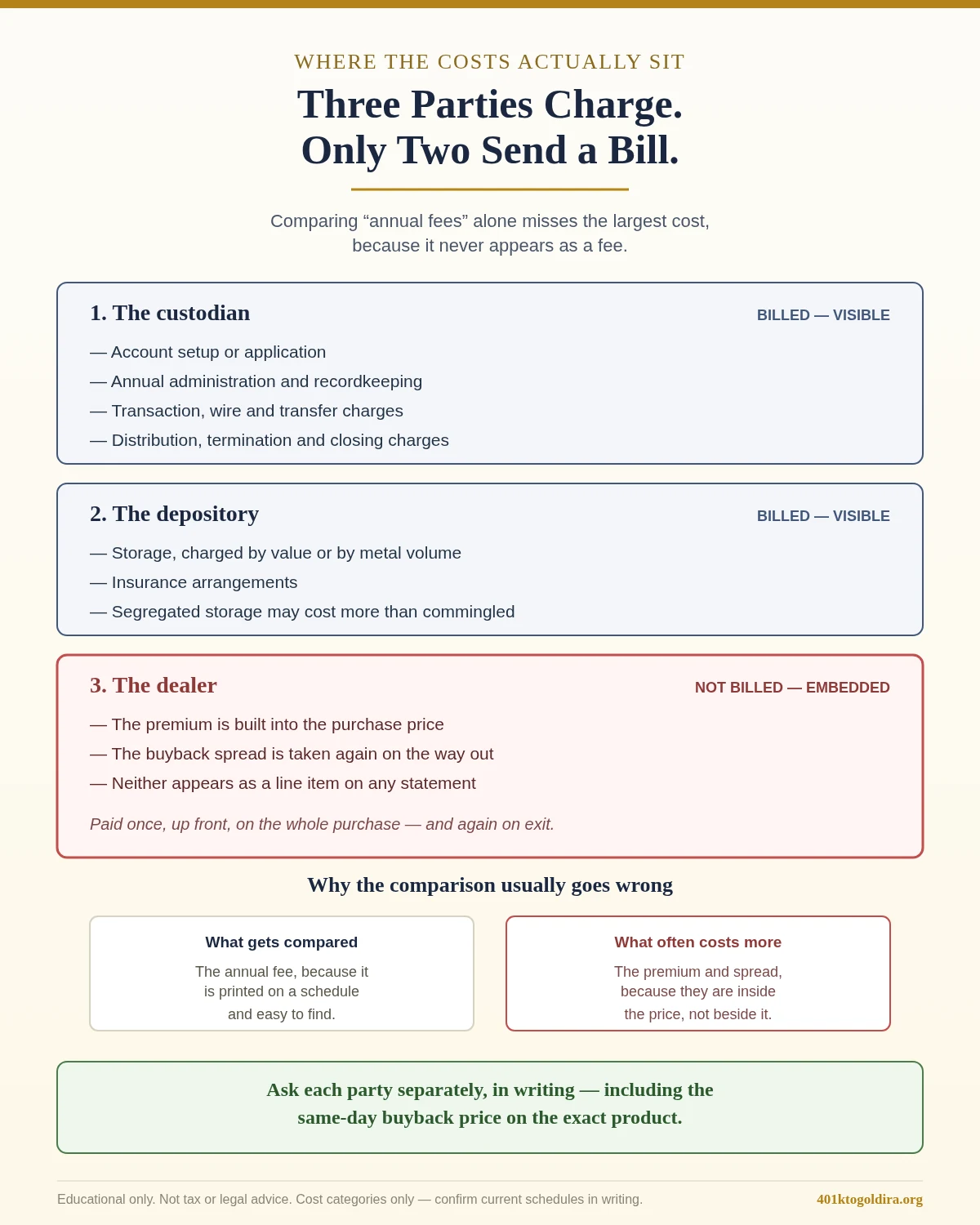
- The dealer’s compensation is embedded in the price of the metal rather than billed as a fee, which is why it does not appear on a custodian or depository fee schedule and is frequently the largest single cost in the transaction.
- A CFTC customer advisory states bullion is priced at spot plus 5%–10%, while numismatic coins can carry premiums of 40%–200% above spot. That advisory dates from the CARES Act period and is a dated regulator statement rather than a current market average.
- No federal regulator publishes a current, maintained benchmark of what dealers charge. Where specific percentages appear in primary documents, they are usually findings about a firm under investigation, which cannot be inverted into a normal range.
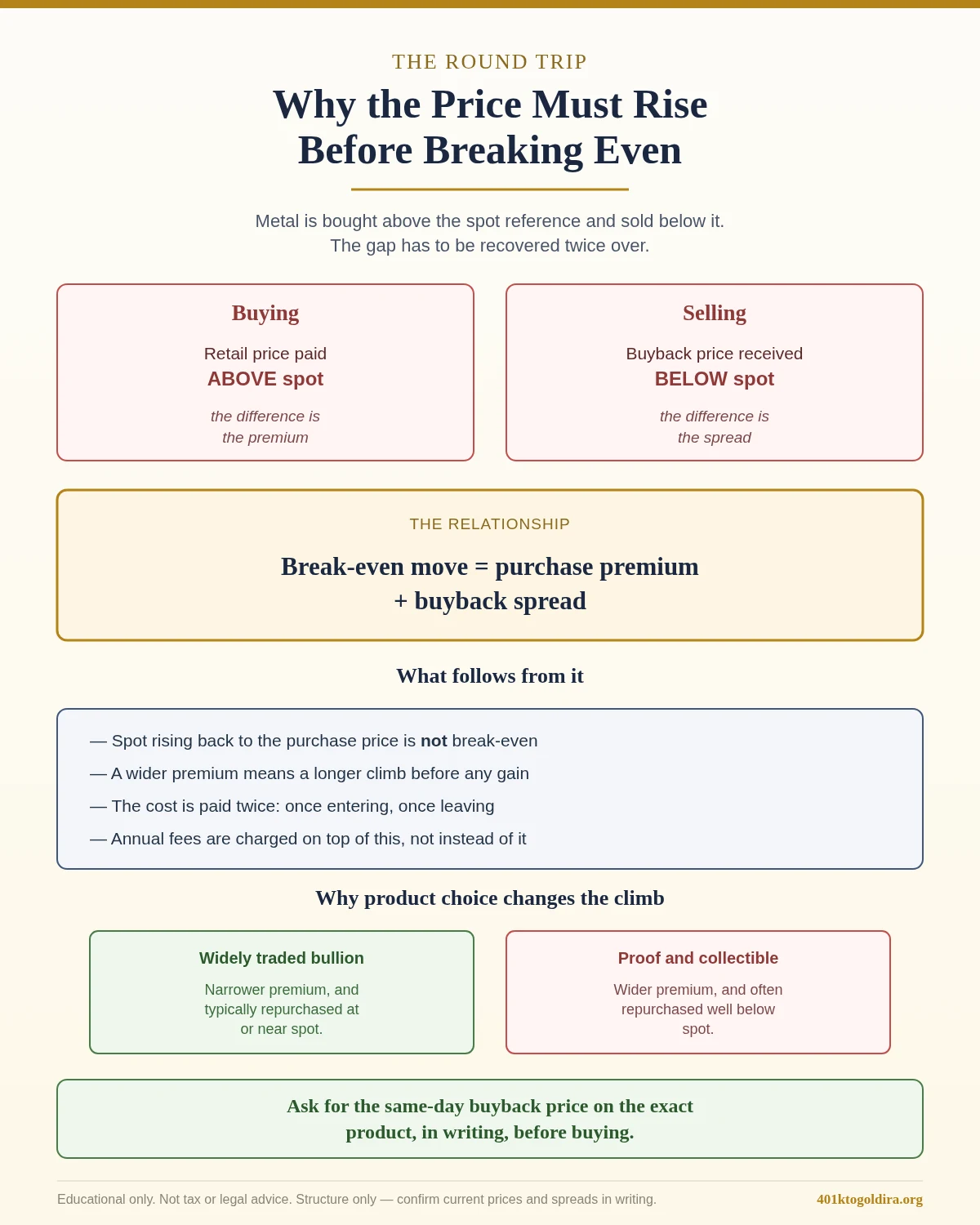
- A position does not break even when the metal price recovers the entry premium alone. The entry premium and the exit buyback spread must both be recovered, so the round-trip cost is the sum of the two.
- Premium is quotable before purchase. A written quote showing the spot reference, the price per unit and the resulting premium percentage can be requested from any dealer, and the CFTC and FINRA both direct investors to obtain pricing terms in writing.
- No dealer in this market publishes a usable per-product markup schedule, so a buyer cannot calculate the cost of a transaction from published information alone and must request it directly. A broad range stated in a customer agreement cannot price a specific purchase.
Quick Answer: What Gold IRA Dealers Actually Charge Over Spot
The dealer markup is the gap between the spot price of metal and the price a customer pays, and it is usually the single largest cost in a Gold IRA. The honest answer to “what is typical” is that no federal regulator publishes a current, maintained benchmark of dealer markups. What exists is a CFTC customer advisory stating that bullion is priced at spot plus a premium of 5% to 10% and that numismatic coins can carry premiums of 40% to 200% above spot — a dated statement from the CARES Act period rather than a live market average. Beyond that, the specific percentages in primary documents come from enforcement actions against named firms, which describe alleged misconduct and cannot be read as a normal range. The buyback price is then generally below spot, widening the round-trip cost.
What Regulators State About Markups and Spreads
Each figure below is quoted from the specific advisory or bulletin that contains it. These are dated regulator statements about product classes, not guarantees and not current averages — actual pricing varies by dealer, product, order size, and date, and must be obtained in writing.
| Product type | What the regulator states | What it means | Primary source | Source re-checked |
|---|---|---|---|---|
| Bullion (coins or bars of a stated weight and purity) | spot plus a 5%–10% premium | The advisory states bullion prices are based on the spot market price plus a markup or premium of between 5 and 10 percent. | CFTC advisory (c. 2020) | 2026-08-31 |
| Numismatic (rare or collectible) coins | 40%–200% above spot | The same advisory says customers are often encouraged to buy numismatic coins with premiums that can range from 40 to 200 percent above the spot price. | CFTC advisory (c. 2020) | 2026-08-31 |
| Dealer spread (buy price vs sell-back price) | under 20% to over 300% | The joint CFTC and FINRA bulletin states some fraudulent dealers have charged spreads of more than 300 percent while other dealers may charge less than 20 percent. This is a contrast between extremes, not a typical range. | CFTC / FINRA bulletin | 2026-08-31 |
| Buyback (sell-back) pricing | below spot | A dealer will always sell metal above the spot price and buy it back below the spot price. The wider the round-trip spread, the more prices must rise before a profit is possible. | CFTC / FINRA bulletin | 2026-08-31 |
The CFTC advisory containing the 5%–10% and 40%–200% figures is CARES Act era (c. March 2020) and carries no published revision date. Treat it as a dated regulator statement, not a 2026 market average. The source re-checked column records the date each cited document was last opened at source and the quoted wording re-read inside it.
What Enforcement Cases Allege About Named Dealers
These figures are kept deliberately separate from the regulator table above. They describe allegations against specific firms, established through court and agency filings. A markup found in a fraud case is evidence about that firm’s conduct, not evidence of what the wider market charges. The SEC judgment against Red Rock Secured was entered without the defendants admitting or denying the allegations, and the parallel CFTC matter resolved by consent order.
| Case | Figure alleged | Context | Primary source | Source re-checked |
|---|---|---|---|---|
| SEC v. Red Rock Secured (2023) | typically 120%–130% alleged | The complaint alleges premium coins carried a markup typically 120 to 130 percent above Red Rock's cost to acquire the coins, and almost always above 100 percent. Measured against dealer cost, not against spot. | SEC complaint | 2026-08-31 |
| SEC v. Red Rock Secured — outcome | $76.4M judgment | Final judgments requiring more than $76.4 million in combined disgorgement, interest and penalties, entered without the defendants admitting or denying the allegations. | SEC litigation release | 2026-08-31 |
| CFTC v. Red Rock Secured — consent order | 3%–5% on common bullion | The consent order records that on common bullion the firm charged mark-ups of approximately 3 to 5 percent above its own cost of goods sold. That is one firm's margin over its own cost, not a market premium over spot. | CFTC consent order | 2026-08-31 |
| SEC v. Safeguard Metals (2022) | ~30% to over 100% alleged | The SEC alleges an average markup of approximately 64 percent on silver coin sales, ranging from about 30 percent to over 100 percent, while the firm's own customer agreement disclosed far narrower ranges. | SEC complaint | 2026-08-31 |
Each linked filing was re-opened at source on the date shown and its case caption matched against the citation. The SEC v. Safeguard Metals complaint is the document published with SEC press release 2022-17.
One detail from the Red Rock consent order deserves emphasis, because it is the easiest figure on this page to misuse. The order records that the firm charged roughly 3% to 5% on common bullion above its own cost of goods sold. That is a margin over the dealer’s wholesale cost, not a premium over spot, and it describes a company that regulators sued. It is not a benchmark for what a fair bullion quote looks like, and it should never be presented as one.
A second theme runs through both cases: the dealers’ own written disclosures did not match their conduct. Safeguard’s customer agreement disclosed operating margins the SEC alleges were untrue. Red Rock’s revised agreement stated markups could range from 5% to 120% without specifying any actual per-product figure, while its highest-markup coin also carried its highest sales commission. A signed agreement describing a range is not the same as a quote showing the number for the product being bought.
Product Classes and Why the Label Matters
The most useful thing a first-time buyer can learn is not a premium table but the product classification, because the class determines both the pricing behaviour and whether the item can legally sit in an IRA. This page does not publish per-product premium percentages: no regulator maintains a per-SKU premium table, and premium is quote-specific. The classification below follows how the CFTC and FINRA define these categories.
| Product class | How regulators define it | Pricing behaviour | IRA status |
|---|---|---|---|
| Bullion coins and bars | Coins or ingots sharing a common investment-grade purity and weight. | Priced from spot plus a premium. The CFTC advisory range above applies to this class. | Eligible when fineness requirements are met |
| Numismatic coins | Coins that are genuinely rare or collectible, valued for rarity rather than metal content. | Premiums far above bullion. Harder to value objectively and less liquid. | Generally NOT eligible |
| “Semi-numismatic” coins | CFTC and FINRA describe this as a made-up industry term with no special meaning. Sold as collectible but typically not rare. | No benchmark range is published, and none should be inferred. The label itself is a warning sign. | Generally NOT eligible |
| Proof / proprietary / “exclusive” coins | Newly minted collectible proofs and dealer-exclusive products. | Quote-specific. Enforcement cases below show what markups have been alleged on products sold this way. | Often NOT eligible |
Two points matter most. First, the joint CFTC and FINRA bulletin is blunt about one label in particular: “semi-numismatic” is described as a made-up industry term that really has no special meaning, applied to coins sold as collectible that typically are not rare and carry no additional value. Publishing a benchmark premium for that category would lend it a legitimacy regulators explicitly deny it. Second, proof and “exclusive” products are exactly where high-pressure sales conversations tend to steer, and where the enforcement figures above were alleged. The cost of holding the metal once bought is set separately by the custodian and depository schedules compared in the fees benchmark. Past performance does not guarantee future results.
The Premium Formula (Check Any Quote)
To test a dealer quote, calculate the premium percentage yourself. The formula is published in the CFTC customer advisory:
premium % = (sales price − spot price) ÷ spot price × 100Spot prices are quoted per troy ounce, so convert the spot price to the equivalent weight of the coin being compared before applying the formula. The advisory places bullion at spot plus 5% to 10%; a result far outside that, on something being sold as ordinary bullion, is worth questioning in writing rather than treating as automatically disqualifying. This page deliberately does not publish a threshold at which a markup “becomes” a red flag, because no regulator sets one. An interactive version of this math is on the markups and spreads guide and the fee calculator.
Why the Markup Outweighs Annual Fees
Annual custodian and storage fees are visible and recurring, but the dealer markup is embedded in the purchase price and applied once at the full account size. On a large rollover, a single-digit difference in markup can exceed several years of annual fees combined. The buyback discount then applies a second time at sale. This is why written, itemized pricing — spot, premium, and buyback estimate on the same day — matters more than a headline promotion.
Buyback and Liquidation: The Second Half of the Spread
The purchase markup is only one side. When metals are sold back, dealers generally pay below spot, and higher-premium products can carry the widest gap because their resale market is thinner. Federal advisories suggest asking, before purchase, what the dealer would pay if the customer sold the same metals back the next day. That single question converts an abstract spread into a concrete number.
Methodology
Every percentage on this page is quoted from the specific primary document that states it, and the two categories are kept apart on purpose. Regulator-stated ranges come from the CFTC customer advisory on gold and silver schemes (bullion at spot plus 5%–10%, numismatic at 40%–200% above spot, and the premium formula) and from the joint CFTC and FINRA investor bulletin (the under-20% to over-300% spread contrast, buyback behaviour, and the definitions of bullion, numismatic and “semi-numismatic”). Enforcement figures come from the SEC complaint and litigation release in SEC v. Red Rock Secured, the parallel CFTC consent order, and the SEC complaint in SEC v. Safeguard Metals; all are allegations about named firms, resolved without admissions.
Three constraints are applied deliberately. First, no per-product premium percentages are published, because no regulator maintains a per-SKU premium table and any such figure would be an unsourced estimate. Second, enforcement figures are never presented as market norms: a markup alleged against a firm under investigation describes that firm, not the industry. Third, no red-flag threshold is asserted, because no regulator publishes one; the page gives the reader the formula and the regulator’s stated ranges and leaves the judgement with them.
A correction is worth recording openly. An earlier version of this page attributed bullion, numismatic and semi-numismatic ranges to the CFTC precious-metals hub page, which contains no percentages, and credited the premium formula to a state regulator. Both attributions were wrong; the figures and the formula come from the CFTC advisory now linked in the table. Actual pricing varies by dealer, product, order size and date, and customers should always confirm current written pricing directly with a provider.
How to Cite This Page
Source: 401ktogoldira.org — Gold IRA Dealer Markup Data 2026.
https://401ktogoldira.org/gold-ira-dealer-markup-data/
Frequently Asked Questions
What is a typical Gold IRA dealer markup?
No federal regulator publishes a current, maintained benchmark. A CFTC customer advisory from the CARES Act period states that bullion is priced at spot plus a premium of 5 to 10 percent, and that numismatic coins can carry premiums of 40 to 200 percent above spot. Specific percentages found in enforcement filings, such as the 120 to 130 percent alleged in SEC v. Red Rock Secured, describe firms accused of misconduct and are not market averages.
How do I calculate the premium on a gold quote?
Use premium percent equals sales price minus spot price, divided by spot price, multiplied by 100, converting the spot price to the equivalent weight of the coin first. The CFTC advisory that publishes this formula places bullion at spot plus 5 to 10 percent. This page does not publish a threshold at which a markup becomes a red flag, because no regulator sets one.
Why does the dealer spread matter more than annual fees?
The markup is embedded in the purchase price and applied once at large scale, so it can exceed years of annual custodian and storage fees combined. The buyback discount then applies again at sale.
Are numismatic coins allowed in a Gold IRA?
Most collectible and numismatic coins do not qualify for an IRA because eligibility is based on metal fineness, not rarity. Only certain bullion coins and bars meeting purity standards are allowed.
Which gold products have the lowest premium over spot?
Standard bullion bars and common sovereign bullion coins sit in the lowest-premium class, and the CFTC advisory places bullion generally at spot plus 5 to 10 percent. Fractional sizes, proof coins and dealer-exclusive products carry higher premiums with weaker resale. No regulator publishes a per-product premium table, so the premium for a specific coin or bar must be obtained in writing from the dealer.
Update Log
- 31 August 2026: Every regulator and enforcement source was re-opened at source and its case caption or wording matched against the citation, and the date recorded per row. The SEC v. Safeguard Metals link was corrected: the previous URL resolved to an unrelated penny-stock case rather than the Safeguard complaint. The unsupported per-product premium bands that remained in the visible FAQ were removed, so the visible answer and the FAQ schema now both describe product classes and direct the reader to obtain the exact written premium.
- 2026 update: Removed the per-product premium and buyback spread table. The percentages in it were not published by any regulator, and sourcing was tightened to regulator-defined product classes instead.
- 2026: Initial dealer-markup data asset published with sourced product-type markup ranges, the premium formula, buyback spread context, methodology, and FAQ schema.
How to cite this data
A record of what federal regulators actually state about precious-metals dealer markups held in an IRA — the CFTC advisory ranges for bullion and numismatic coins, the CFTC and FINRA spread guidance, and the markups alleged in SEC v. Red Rock Secured and SEC v. Safeguard Metals — with regulator statements and enforcement allegations kept separate, and an explicit statement that no maintained industry benchmark exists. Compiled by 401ktogoldira.org. https://401ktogoldira.org/gold-ira-dealer-markup-data/
Article reviewed and edited by Daniel — independent precious-metals retirement researcher.