
Affiliate disclosure: Some links on this page may be sponsor links. The site owners may be compensated if customers request information from companies mentioned here. This page is educational only and does not provide financial, tax, or legal advice. Customers should speak with a financial or tax advisor before making retirement-account decisions. Past performance does not guarantee future results.
A missed 60-day rollover deadline can turn an entire retirement transfer into a taxable distribution — and, for account holders under age 59½, add a 10% early-distribution penalty unless an exception applies.
Source: IRS — Rollovers of Retirement Plan and IRA Distributions. The 60-day rule is the single most consequential Gold IRA tax mistake because it is a hard deadline with limited waiver relief.
Key takeaways
- A direct trustee-to-trustee transfer avoids the 60-day clock entirely; an indirect rollover starts it — confusing the two is the most common error. For an employer plan, the 401(k) to Gold IRA rollover guide sets out which route applies and why the payee line decides it.
- The 60-day deadline is strict, and the once-per-12-months IRA-to-IRA rollover limit applies across all IRAs, not per account. Both are set out in Rollovers of retirement plan and IRA distributions.
- Home storage of IRA metals and prohibited transactions can each be treated as a full taxable distribution. The tax treatment of an early distribution is described in IRS Topic no. 413, Rollovers from retirement plans.
- Traditional Gold IRAs are subject to RMDs at the applicable age — 73, rising to 75 for people born in 1960 or later; missing one carries its own excise tax.
- A salesperson is not a tax advisor — every figure here should be confirmed against current Internal Revenue Service guidance and a qualified professional.
Quick Answer: The Most Common Gold IRA Tax Mistakes
The most common gold ira tax mistakes include confusing direct transfers with indirect rollovers, missing the 60-day rollover deadline, violating the once-per-year rollover rule, buying non-approved metals, storing IRA metals at home, triggering prohibited transactions, ignoring RMDs, taking distributions without tax planning, misunderstanding Roth vs traditional treatment, and treating sales materials as tax advice.
Each mistake can create taxable events, penalties, or a loss of IRA tax treatment. The safer pattern is to use direct custodian processes where possible, verify metals eligibility, keep IRA metals in approved storage, document valuations, and involve a qualified tax advisor before acting.
Mistake 1: Confusing Transfers and Rollovers
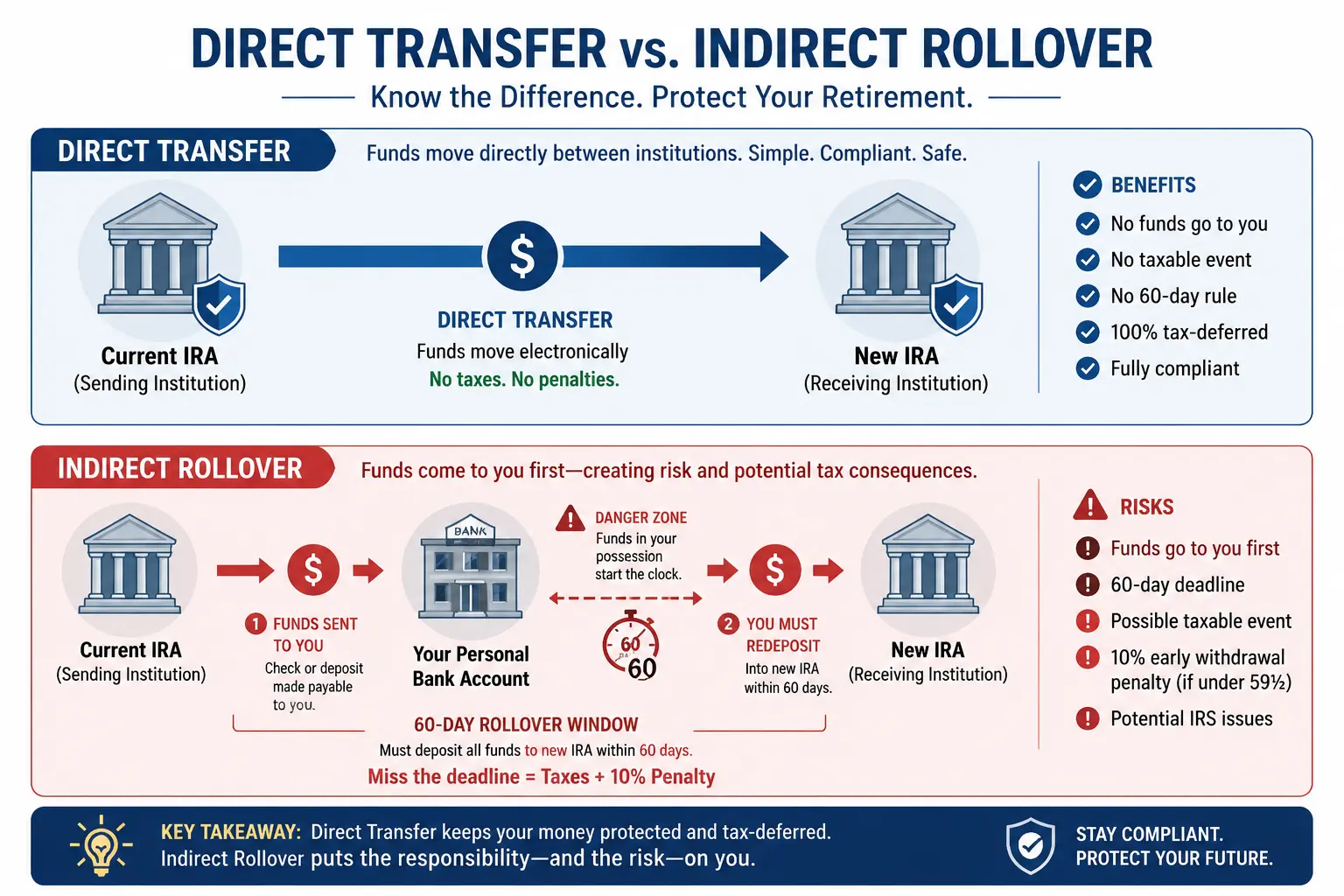
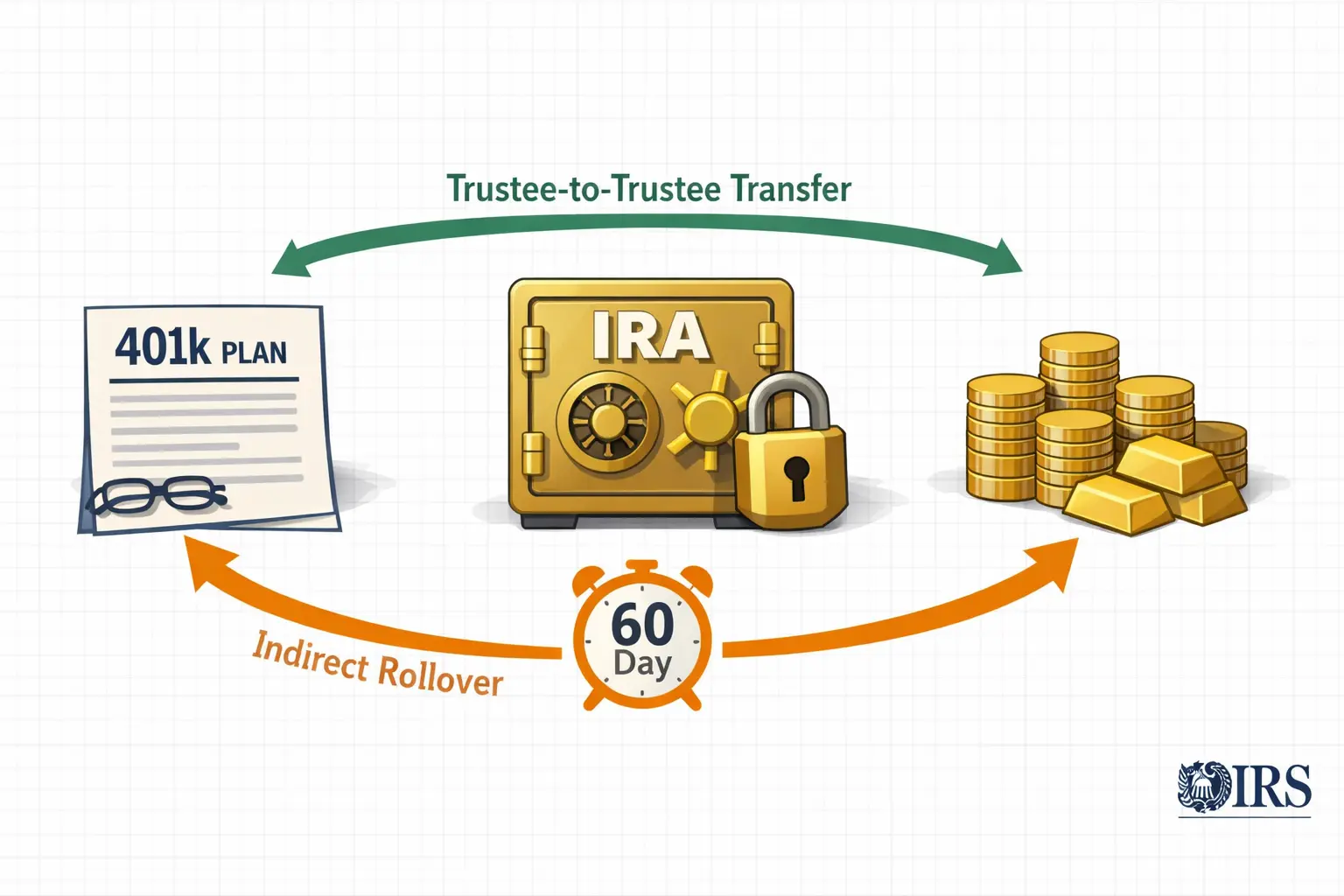
A core tax-risk pattern is treating trustee-to-trustee transfers and rollovers as the same thing. A direct transfer generally moves IRA assets from one custodian to another without the account holder taking possession of the funds. An indirect rollover pays funds to the account holder, who then has a limited period to redeposit them into another IRA.
Direct transfers between IRA custodians usually avoid the 60-day rollover clock and the once-per-year IRA rollover rule. Indirect rollovers can become taxable if the timing or frequency rules are missed. For employer-plan moves, direct plan-to-IRA rollovers are often used to reduce handling risk.
Related educational guides include 403(b) to Gold IRA Rollover and TSP to Gold IRA Rollover. Customers should speak with a qualified tax advisor before making rollover decisions.
Mistake 2: Missing the 60-Day Rollover Deadline
The 60-day rollover rule can create one of the most expensive Gold IRA rollover tax mistakes. When funds are distributed to the account holder and intended for redeposit into another IRA, the redeposit generally must happen within 60 days to avoid taxation.
If the deadline is missed, the distribution may be treated as taxable income and may also trigger an early-distribution penalty for account holders under age 59½ unless an exception applies. In a Gold IRA context, delays can happen when funds are mailed, held, or processed slowly during the move to a precious metals custodian.
Customers should speak with a qualified tax advisor before choosing an indirect rollover path.

Mistake 3: Violating the Once-Per-Year Rollover Rule
The once-per-year rollover rule generally limits indirect IRA-to-IRA rollovers to one per 12-month period per taxpayer. This is different from direct trustee-to-trustee transfers, which do not count against that limit.
Investors who use multiple indirect rollovers to move between custodians or adjust Gold IRA arrangements can accidentally create taxable distributions. This is especially risky when several accounts or custodians are involved. Customers should confirm treatment with a qualified tax advisor before attempting repeated rollover activity.
Gold IRA Rollover and Tax Mechanics Video
Understanding transfer and rollover mechanics is a major step in avoiding precious metals IRA tax mistakes.
Gold IRA educational video
Video published by Goldco on YouTube — a company this site has an affiliate relationship with. Embedded as a third-party explanation; not produced, endorsed or independently verified by this site.
Mistake 4: Buying Non-Approved Metals
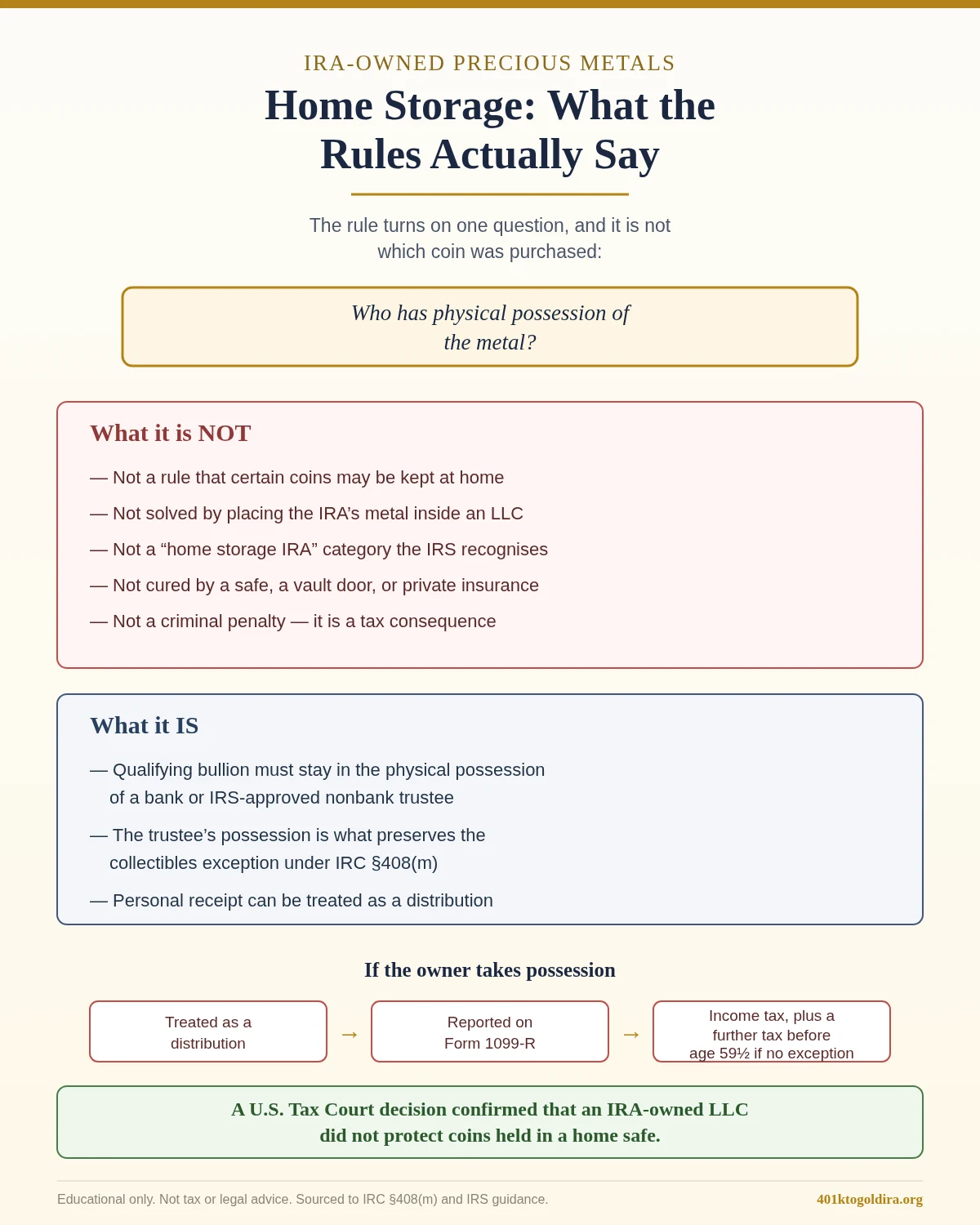
Gold IRAs must follow the statutory rules for permitted metals, which flow from the collectibles rule at 26 U.S. Code § 408 — Individual retirement accounts and are explained on the collectibles rule in IRC §408(m) page and are applied product by product in the IRA-eligible metals reference. Gold, silver, platinum, and palladium generally need to meet purity requirements, and many collectible or numismatic products do not qualify. Buying the wrong metal or product can cause the purchase to be treated as a distribution or non-qualifying investment.
Investors often avoid this issue by asking the custodian and dealer to confirm IRA eligibility in writing before purchase. Customers should speak with a qualified tax advisor before making decisions.
Mistake 5: Storing IRA Metals at Home
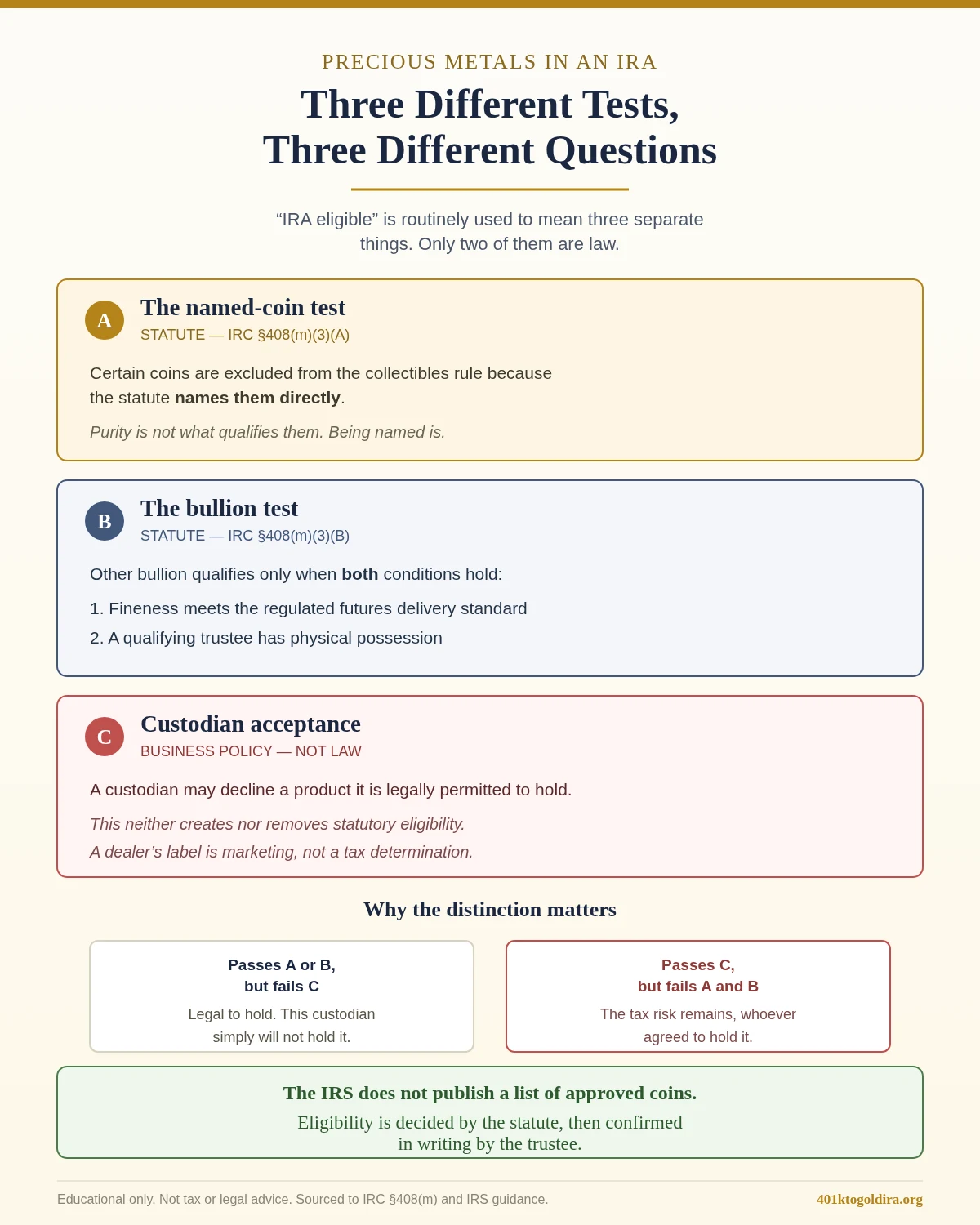
Home storage Gold IRA tax risk arises when IRA metals are held personally instead of by an approved trustee or depository. The statute requires qualifying bullion to remain in the physical possession of a bank or an IRS-approved nonbank trustee, and the Internal Revenue Service publishes the list of approved nonbank trustees and custodians. The custody requirement itself sits in 26 U.S. Code § 408(m)(3).
Personal possession arrangements can be treated as distributions, potentially creating taxes and penalties. Marketing claims about home storage should be reviewed carefully with qualified professionals before any account structure is used.
Mistake 6: Triggering Prohibited Transactions
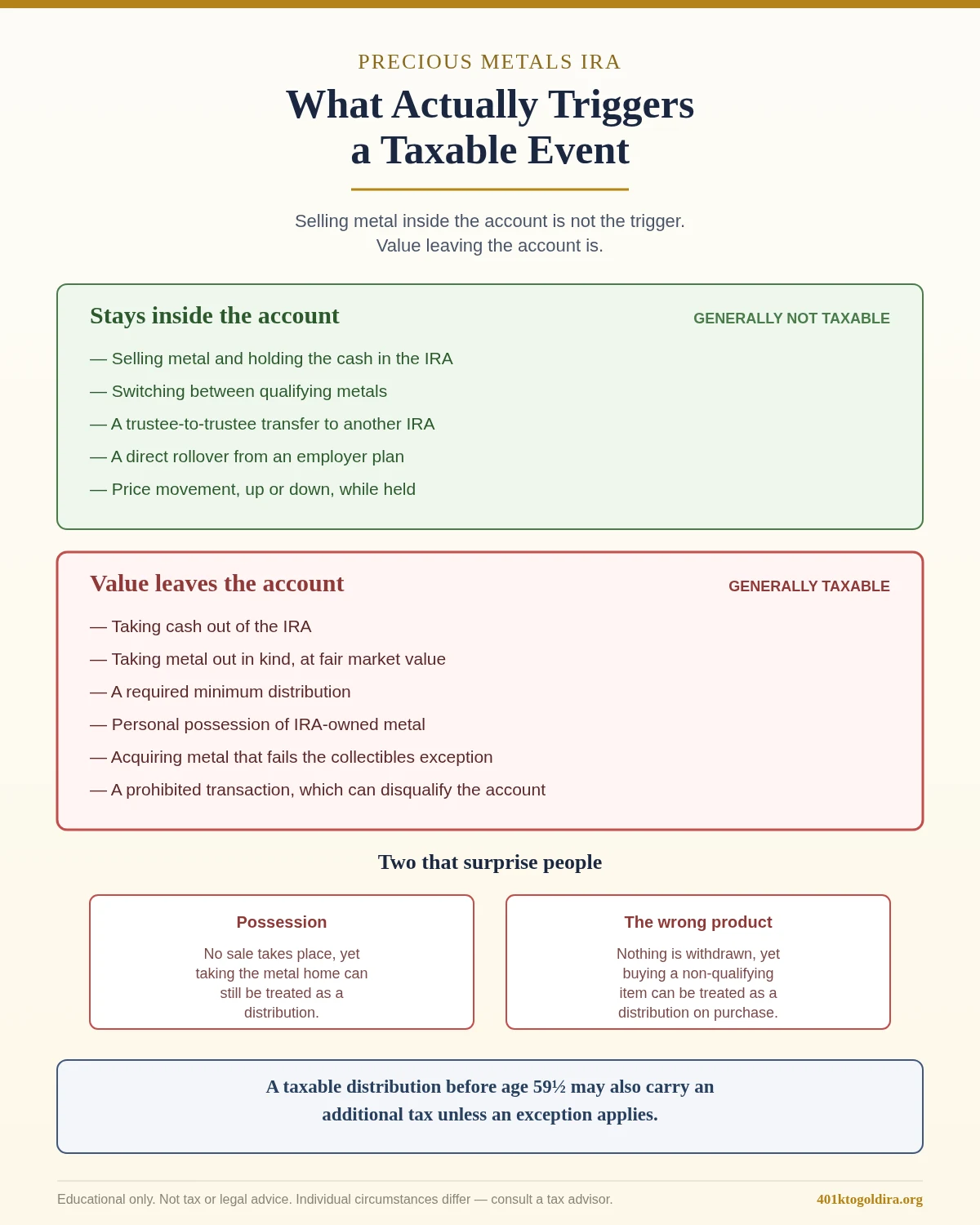
Self-directed IRAs are subject to rules that prohibit certain transactions with disqualified persons. In a Gold IRA context, examples can include using IRA metals as collateral, personally benefiting from IRA assets outside the IRA, or engaging in transactions between the IRA and related parties in ways the rules do not allow.
A prohibited transaction can cause severe tax consequences, including loss of IRA tax-advantaged status. Customers should speak with a qualified tax advisor before engaging in complex self-directed IRA arrangements.
Mistake 7: Ignoring RMDs
Traditional Gold IRAs are subject to required minimum distribution rules, just like other traditional IRAs. Ignoring RMDs, miscalculating year-end metal values, or waiting too long to liquidate metals can create penalty risk.
Physical metals add valuation and liquidity steps because the account may need cash or an in-kind distribution to satisfy the required amount. The Gold IRA RMD Strategy guide explains those mechanics in more detail. Customers should speak with a qualified tax advisor before making RMD decisions.
Mistake 8: Taking Distributions Without Tax Planning
Traditional Gold IRA distributions are generally taxed as ordinary income. Early distributions may also trigger additional tax unless an exception applies. In-kind metal distributions are valued at market price and can create taxable income even though the account holder receives metals rather than cash. The Gold IRA early withdrawal penalty guide explains which statutory exceptions work for IRAs and which employer-plan exceptions do not carry over.
Large or poorly timed distributions can affect taxable income, Medicare premiums, tax brackets, or broader retirement income planning. The Gold IRA withdrawal & tax estimator illustrates the possible ordinary tax and the 10% early-distribution additional tax on a distribution, though it is an educational estimate only. Customers should speak with a qualified tax advisor before taking distributions.
Mistake 9: Misunderstanding Roth vs Traditional Tax Treatment
Traditional and Roth Gold IRAs have different tax patterns. Traditional Gold IRAs generally involve tax-deferred growth and taxable distributions, plus RMDs. Roth IRAs are funded with after-tax dollars and may allow qualified tax-free withdrawals, with no lifetime RMDs for the original account owner.
Confusing these rules can create mismatched expectations about retirement withdrawals. Choosing between Roth and traditional treatment is a tax-planning decision, not just a product choice.
Mistake 10: Relying on a Salesperson for Tax Advice
Gold IRA companies and representatives may explain account setup, metals products, and custodian processes, but tax advice should come from qualified tax professionals. Sales materials should not be treated as IRS guidance or personalized tax advice.
If Goldco or other companies are reviewed or recommended on a site, standard language applies: Goldco does not offer tax or legal advice. Customers should speak with a qualified tax advisor before making decisions.
FAQ
What are the most common Gold IRA tax mistakes?
Common mistakes include confusing transfers with rollovers, missing the 60-day rollover deadline, violating the once-per-year rollover rule, buying non-approved metals, storing IRA metals at home, triggering prohibited transactions, ignoring RMDs, taking distributions without tax planning, misunderstanding Roth vs traditional treatment, and relying on salespeople for tax guidance.
How can investors avoid the 60-day rollover trap with Gold IRAs?
Using trustee-to-trustee transfers rather than indirect rollovers can avoid the 60-day deadline in many IRA-to-IRA moves. If funds are paid to the account holder, careful deadline tracking is required.
Why is home storage risky for Gold IRA metals?
IRA-held bullion generally must remain with a bank or approved trustee/depository. Personal storage arrangements can create taxable distribution risk.
What happens if a Gold IRA buys non-approved metals?
Purchasing metals that do not meet the statutory fineness and custody tests can be treated as a distribution or non-qualifying investment, potentially undermining IRA status. The governing text is 26 U.S. Code § 408(m), and general account rules are set out in the Retirement Plans FAQs regarding IRAs.
How are RMDs handled when an IRA holds physical gold?
RMDs for traditional Gold IRAs must be calculated using year-end fair market values and satisfied through cash distributions, partial liquidation, or in-kind distributions when supported.
Are Roth Gold IRAs subject to RMDs?
Roth IRAs generally do not require lifetime RMDs for the original owner. Inherited Roth IRAs may have separate rules.
How do prohibited transactions affect Gold IRAs?
Prohibited transactions can cause severe tax consequences, including the possibility that IRA assets are treated as distributed and taxable.
Where can investors learn more about rollovers into and out of Gold IRAs?
Educational resources such as the gated Gold IRA Rollover Survival Guide, 403(b) to Gold IRA Rollover, and TSP to Gold IRA Rollover provide structural overviews that can be used alongside IRS materials and professional advice.
Customers should speak with a qualified tax advisor before making decisions.