Gold IRA vs Gold ETF vs Physical Gold: After-Fee Comparison
Three ways to hold gold for retirement, compared on the factors that decide it: ongoing cost, purchase markup, real ownership, liquidity, and tax treatment. This is the "should I just buy GLD in my Roth instead?" question, answered with data rather than a sales pitch.
View the Comparison →
Educational only: This page compares account structures in general terms and does not provide financial, tax, or legal advice. Customers should verify current pricing directly. Past performance does not guarantee future results.
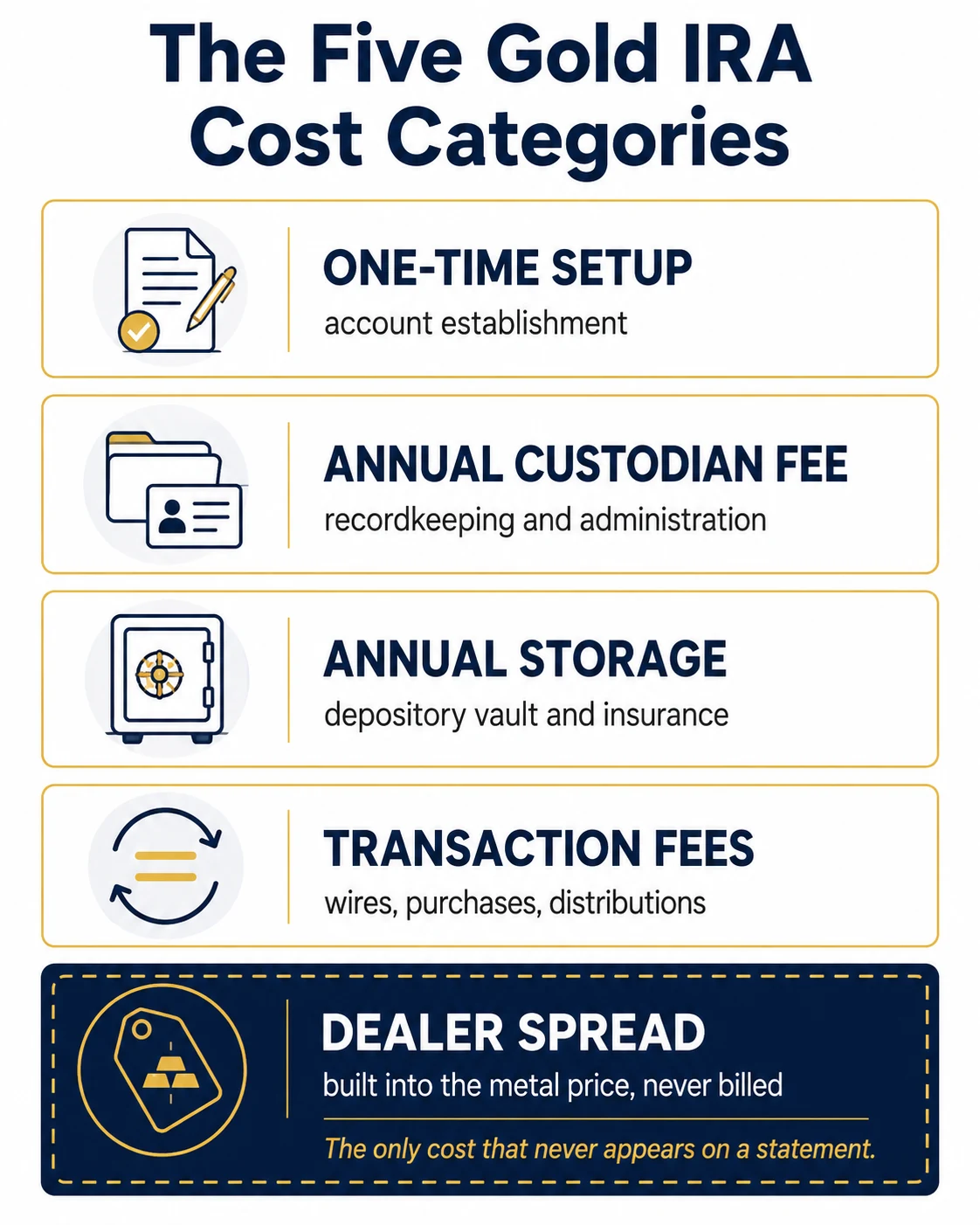
Three named gold trusts publish recurring sponsor fees of 0.10%, 0.25% and 0.40% a year, and their shares sell in seconds — but the share is a beneficial interest in the trust, not bullion held for the shareholder. A physical Gold IRA charges whatever its custodian’s published schedule sets — one observed GoldStar Trust commingled example totals $215 a year — plus a one-time dealer premium, and the IRA holds qualifying bullion through its trustee or custodian.
Sponsor fees from each trust’s own current SEC filing: GLDM 0.10%, IAU 0.25%, GLD 0.40%, cited as three named examples rather than a universal range. The IRA annual figure is one observed example — GoldStar Trust Company, Account Application — Alternative Investments, Fee Schedule, GTC Rev. 01/2026, observed 25 September 2026 ($90 annual precious-metals maintenance plus $125 commingled storage) — not a market average. Tax treatment per IRS rules.
Quick Answer: It Depends on Ownership and Balance
For low-cost, liquid gold exposure inside a retirement account, a physically backed gold ETF can be held through an ordinary traditional or Roth IRA, and the trusts reviewed here publish annual sponsor fees of 0.10%, 0.25% and 0.40%. A physical Gold IRA adds custodian, storage and dealer transaction costs, but the IRA itself holds qualifying bullion through its trustee or custodian rather than only fund shares; under a flat schedule the percentage cost falls at larger balances. Personally owned bullion provides direct possession but sits outside the IRA wrapper and is subject to taxable-account rules, including the federal collectibles-rate framework for long-term gains. The right wrapper depends on the legal form of exposure that matters to the saver and on account size.
Gold IRA vs Physical Gold: What Is the Difference?
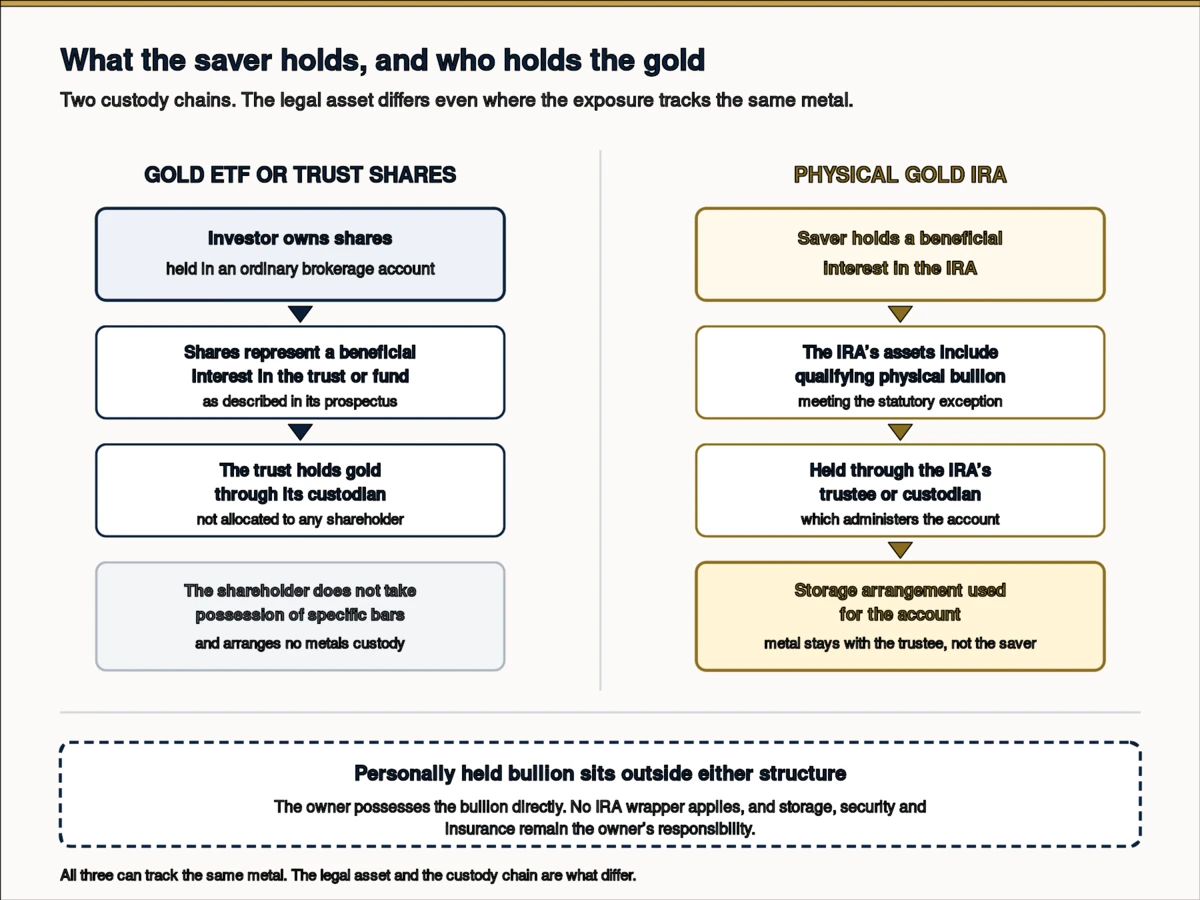
A Gold IRA holds qualifying bullion inside an IRA through its trustee or custodian and the account’s storage arrangement. Personally owned physical gold is held outside the IRA and may be possessed directly. Both involve physical metal, but custody, tax treatment, storage responsibility, liquidity, transaction costs and distribution mechanics differ.
Custody and possession
A physical Gold IRA is still an IRA. Its qualifying bullion is held through a trustee or custodian satisfying IRC §408, and the statutory bullion exception requires physical possession by that trustee. Personally owned bullion sits outside that structure and may be held directly by the individual. The legality of personal possession, and where a home safe does and does not fit, is set out in Gold IRA custody versus personal possession.
Tax treatment
Traditional or Roth IRA tax rules attach to the IRA wrapper. Personally owned bullion does not inherit IRA treatment merely because the same bar type could qualify for an IRA. For long-term gain in a taxable account, bullion can fall within the maximum 28% collectibles-rate category under IRC §1(h); that is a maximum rate category rather than a flat tax automatically applied, and a taxpayer’s actual rate can be lower. Short-term holdings follow ordinary short-term capital-gain treatment instead.
Transaction cost and storage
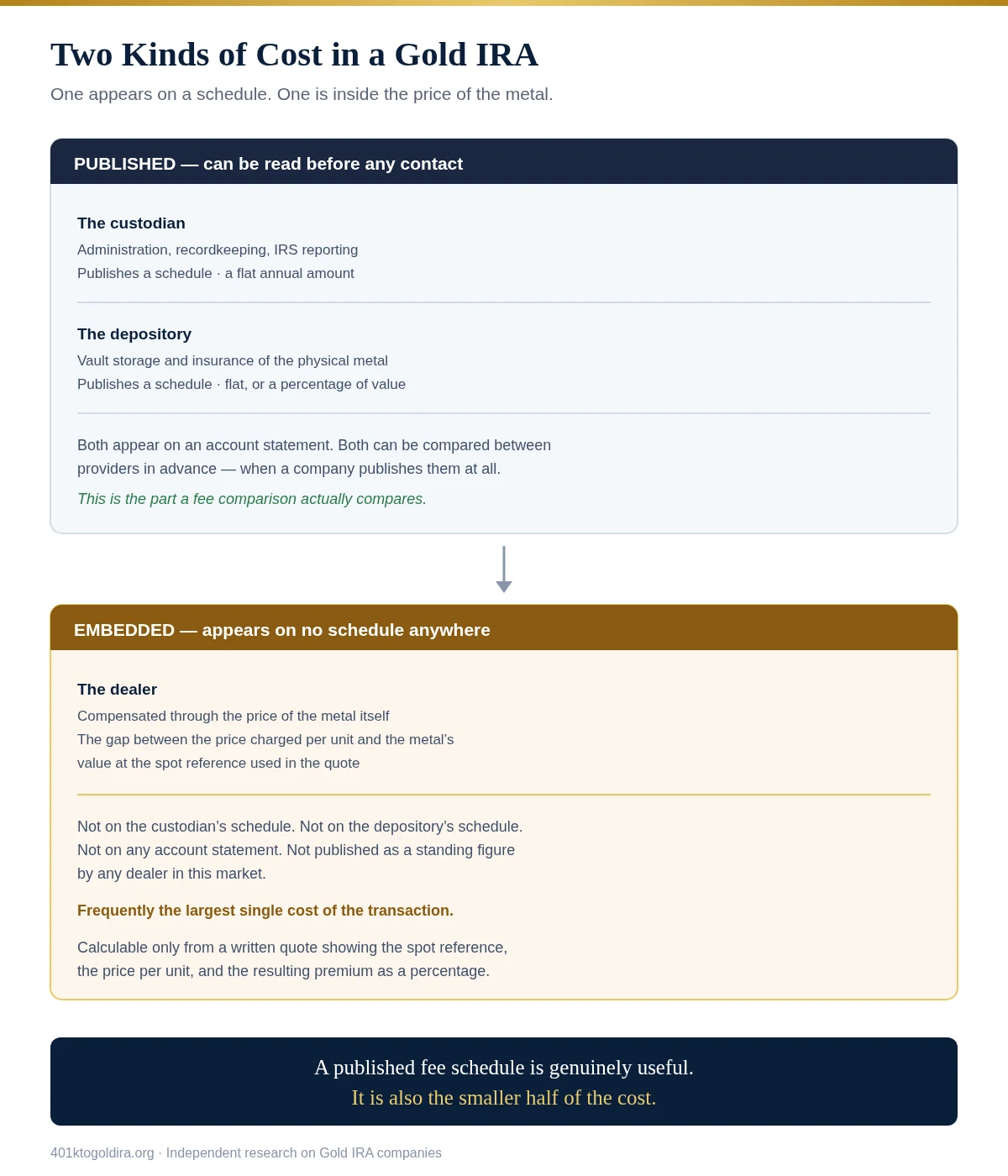
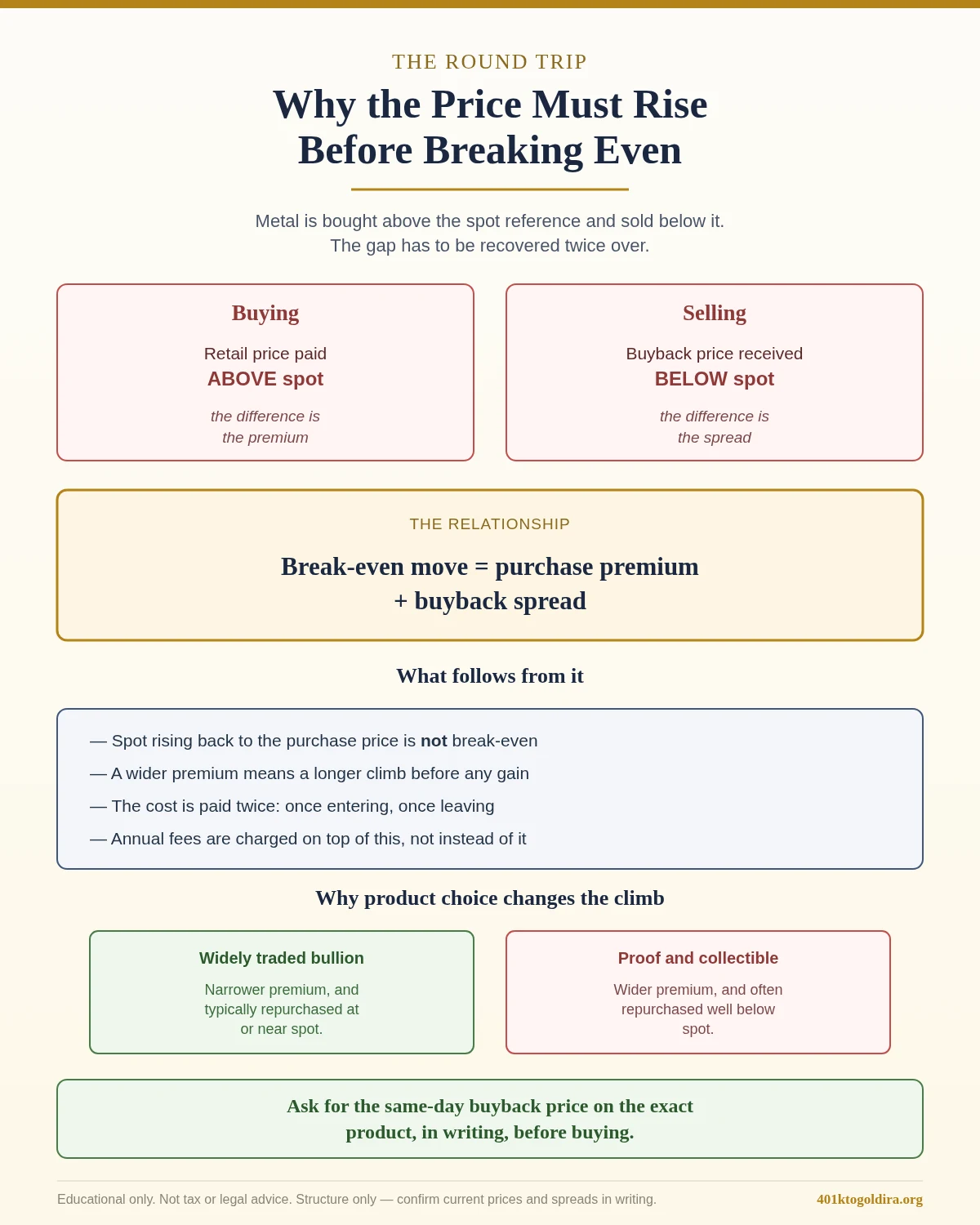
Both IRA-held bullion and personal bullion are bought through a dealer, so both carry quote-specific purchase premiums and resale spreads. The Gold IRA additionally carries the custodian and storage schedule applicable to the account, while personal bullion places any private storage, security and insurance burden on the owner. What regulators actually state about dealer premiums and buyback spreads is documented separately.
Liquidity and distributions
Personal bullion can be sold directly to a chosen buyer or dealer. IRA-held bullion must move through the account’s administrative process, and an in-kind distribution of IRA property remains a retirement-account distribution: IRA distribution rules apply even when property rather than cash leaves the account, as set out in IRS Publication 590-B.
Product choice
Choosing between bar sizes and formats is a separate product decision; readers weighing personally held bars against IRA-held metal can compare gold bars versus a Gold IRA.
Gold IRA vs Gold ETF vs Physical Gold: Factor Comparison
Each row isolates one decision factor. Cost figures are typical reported ranges from fund prospectuses and provider/depository fee schedules; tax treatment follows IRS rules.
| Factor | Physical Gold IRA | Gold ETF (in IRA) | Personal Bullion | What it means |
|---|---|---|---|---|
| Ongoing cost | set by the custodian's schedule; flat in some, tiered by account value in others | named examples publish 0.10% (GLDM), 0.25% (IAU) and 0.40% (GLD) a year | storage/insurance if used; none if self-held | ETF cost always scales with balance. A flat IRA schedule does not, so it grows more efficient as the balance rises; a value-tiered one does scale. |
| Purchase markup | quote-specific; worked model uses 5% | brokerage commission ~$0 + tiny spread | quote-specific; worked model uses 5% | The physical premium applies to both IRA metal and personal bullion; ETFs avoid it. No dealer publishes it as a usable per-product schedule, so it must be obtained in writing for the specific product. |
| What the saver holds | a beneficial interest in an IRA whose assets include qualifying physical bullion held through the trustee or custodian | shares representing a beneficial interest in the gold-holding trust or fund described by its prospectus | personally owned physical bullion | The exposure may all track gold, but the legal asset, custody chain and possession rights are different. |
| Liquidity | days (custodian + dealer settle) | seconds (sell like a stock) | varies (find a buyer/dealer) | ETFs are the most liquid; a Gold IRA takes a settlement process. |
| Tax wrapper | traditional or Roth IRA treatment applies to the account; distribution rules depend on the IRA type | traditional or Roth IRA treatment applies when the shares are held inside the IRA | taxable account; long-term gain may fall within the maximum 28% collectibles-rate category | The IRA wrapper, not the fact that the exposure is gold, controls retirement-account taxation. |
| Best fit | a retirement-account objective requiring qualifying bullion held through the IRA structure | exchange liquidity, brokerage simplicity and low published recurring charges | direct possession outside the retirement-account system | None is universally superior; the decision turns on legal form, custody, tax wrapper, liquidity and cost. |
The Cost Crossover: Why Balance Decides It
The single most useful insight is that ETF cost always scales with the balance, while a Gold IRA’s annual cost depends on the structure of its custodian’s schedule. A 0.25% ETF expense ratio costs $25 per year on $10,000 but $250 on $100,000. Against a flat schedule — GoldStar Trust’s current commingled option totals $215 a year at any balance — the ETF is cheaper at small balances and the two cross as the balance grows. Against a value-tiered schedule such as Equity Trust’s, the IRA total rises with the balance too, so they converge far more slowly. The Gold IRA additionally carries a one-time dealer premium the ETF avoids. This is why the fee question cannot be answered without an account size and a named schedule. Model it on the fee calculator, and see both structures compared in the fees benchmark.
After-Fee Cost in Dollars: $25k, $50k, $100k Over 1–20 Years
The tables below show the total cost of ownership in dollars for each route, holding the balance constant to isolate cost (all three track the gold price, so returns are set aside here). They make the trade-off concrete: the ETF's percentage fee is tiny at first but compounds every year, while the physical routes are dominated by the one-time dealer premium paid up front.
Illustrative assumptions (not quotes): ETF sponsor fee 0.25%/yr, which is IAU’s published rate used as the worked illustration; Gold IRA custodian + storage $215/yr, which is one observed example — GoldStar Trust Company, Account Application — Alternative Investments, Fee Schedule, GTC Rev. 01/2026, observed 25 September 2026 ($90 annual precious-metals maintenance plus $125 commingled storage) — and not an industry average; plus a one-time 5% dealer premium, and the same 5% one-time premium on personal bullion with no ongoing fee. That 5% is an illustration, being the conservative end of the dated CFTC advisory band of 5%–10% for bullion from the CARES Act period; it is not a current market average and no dealer publishes a usable per-product schedule to check it against. A value-tiered custodian schedule would produce higher totals that rise with the balance. Balance held constant to isolate cost. Actual figures vary by fund, provider, and product.
| $25,000 held | 1 yr | 5 yr | 10 yr | 20 yr |
|---|---|---|---|---|
| Gold ETF (in IRA) | $62 | $312 | $625 | $1,250 |
| Physical Gold IRA | $1,465 | $2,325 | $3,400 | $5,550 |
| Personal Bullion | $1,250 | $1,250 | $1,250 | $1,250 |
| $50,000 held | 1 yr | 5 yr | 10 yr | 20 yr |
|---|---|---|---|---|
| Gold ETF (in IRA) | $125 | $625 | $1,250 | $2,500 |
| Physical Gold IRA | $2,715 | $3,575 | $4,650 | $6,800 |
| Personal Bullion | $2,500 | $2,500 | $2,500 | $2,500 |
| $100,000 held | 1 yr | 5 yr | 10 yr | 20 yr |
|---|---|---|---|---|
| Gold ETF (in IRA) | $250 | $1,250 | $2,500 | $5,000 |
| Physical Gold IRA | $5,215 | $6,075 | $7,150 | $9,300 |
| Personal Bullion | $5,000 | $5,000 | $5,000 | $5,000 |
Reading the tables: the ETF is the lowest-cost route in every scenario here on these assumptions, because the one-time dealer premium on physical metal is large relative to years of a small ETF fee. The physical premium is what buys real ownership. Two things shift the picture: a lower dealer premium narrows the gap sharply, and on ongoing annual cost alone the flat $215 schedule modelled here undercuts a 0.25% ETF above roughly $86,000 ($215 GoldStar commingled example ÷ 0.25% IAU sponsor fee, not a general crossover) — so a large, long-held, low-premium position is where physical ownership costs least relative to the ETF. A value-tiered custodian schedule moves that crossover much higher or removes it entirely. Model a specific case on the fee calculator.
What Changes When Gold Exposure Is Held Through an ETF?
A physically backed gold trust gives the shareholder a security interest defined by the prospectus rather than personal possession of specific bars. Current SEC filings for GLD and IAU describe the shares as fractional undivided beneficial interests in the trust or its net assets, while the trust’s gold is held through its custodian. That structure removes the need for the retirement saver to arrange precious-metals IRA custody and storage, but it is legally different from an IRA whose assets include qualifying bullion, and different again from bullion held personally outside an IRA. Storage forms within an IRA are covered in segregated vs commingled storage, and how the account works end to end in the beginner’s guide.
Who Each Wrapper Fits
A gold ETF inside an IRA may fit a saver prioritising exchange liquidity, simple brokerage administration and low published recurring fund charges. A physical Gold IRA may fit a saver whose retirement-account objective specifically requires qualifying physical bullion held through the IRA trustee or custodian structure, and who accepts the additional custodian, storage and transaction costs. Personal bullion may fit a buyer prioritising direct possession outside the retirement-account system. None is universally superior; the decision turns on legal ownership form, custody, tax wrapper, liquidity, costs and the role the gold exposure is intended to play. The quiz is educational and makes no recommendation.
Methodology
This comparison isolates decision factors rather than forecasting gold’s price. ETF sponsor fees are taken from each trust’s own current SEC filing and cited as three named examples rather than a universal range: 0.10% for SPDR Gold MiniShares Trust, per Note 4 of World Gold Trust’s Form 10-Q for the six months ended 31 March 2026, filed 5 May 2026; 0.25% for iShares Gold Trust, per its Form 10-K; and 0.40% for SPDR Gold Shares, per SPDR Gold Trust’s Form 10-K. Those filings also describe the shares as fractional undivided beneficial interests in the trust or its net assets. SEC and EDGAR requests may require a declared user-agent, so a blocked automated fetch is an access limitation rather than evidence that a filing is unavailable. The Gold IRA annual figure is one observed example — GoldStar Trust Company, Account Application — Alternative Investments, Fee Schedule, GTC Rev. 01/2026, observed 25 September 2026 — used as a labelled example rather than a market average, because current schedules include both flat and value-tiered structures; the standalone indexed fee-schedule PDF can differ by revision, so the revision is named here to keep the observation unambiguous; the dealer premium is quote-specific and is not presented as a range at all, because no dealer publishes it as a usable per-product schedule — the worked model uses a 5% illustration, which is the conservative end of the dated CFTC customer advisory band of 5%–10% for bullion from the CARES Act period, and is not a current market average; tax treatment follows current IRS rules on IRAs and on collectibles. Each figure maps to a named source or a labelled illustration rather than a per-provider quote. Fees, expense ratios, and rules change; confirm current figures before acting.
Primary sources
- SPDR Gold Trust, Form 10-K — 0.40% sponsor fee; shares as units of fractional undivided beneficial interest in and ownership of the trust.
- iShares Gold Trust, Form 10-K — 0.25% sponsor fee; shares as fractional undivided beneficial interests in the trust’s net assets.
- World Gold Trust, Form 10-Q, Note 4, six months ended 31 March 2026, filed 5 May 2026 — 0.10% sponsor fee for SPDR Gold MiniShares Trust.
- IRC §408 and IRC §1(h), Cornell Legal Information Institute.
- IRS Publication 550 and IRS Publication 590-B.
- CFTC and FINRA — 10 things to ask before buying physical gold, silver or other metals.
- GoldStar Trust Company, Account Application — Alternative Investments, Fee Schedule, GTC Rev. 01/2026, observed 25 September 2026. Cited as plain text; one observed example, not a market average.
How to Cite This Page
Source: 401ktogoldira.org — Gold IRA vs Gold ETF vs Physical Gold Comparison.
https://401ktogoldira.org/gold-ira-vs-gold-etf/
Frequently Asked Questions
Is a gold ETF cheaper than a Gold IRA?
On recurring published charges, the named gold trusts reviewed for this page currently charge 0.10% to 0.40% a year, while a physical Gold IRA uses the custodian and storage schedule applicable to that account and also incurs the dealer’s transaction price. One observed GoldStar Trust commingled example totals $215 a year under its January 2026 schedule. These are named examples, not universal market averages.
Does a gold ETF give the shareholder ownership of specific gold bars?
Generally no. Current GLD and IAU SEC filings describe investors as owning shares that represent fractional undivided beneficial interests in the trust or its net assets. The trust holds gold through its custodian. That differs from personally held bullion and from an IRA whose assets include qualifying bullion held through the IRA trustee or custodian structure.
Can a gold ETF be held in a Roth IRA?
Yes, if the brokerage and account permit that security. The Roth IRA remains the tax wrapper and the ETF shares remain the investment held inside it. This does not turn the ETF shares into personally allocated bullion and does not create the specialised precious-metals custody arrangement used when an IRA holds qualifying physical bullion.
Which is better, a Gold IRA or a gold ETF?
Neither is universally better. A gold ETF emphasises exchange liquidity, brokerage simplicity and a published percentage-based fund charge. A physical Gold IRA holds qualifying bullion through the IRA trustee or custodian structure and adds custodian, storage and dealer transaction costs. The relevant choice depends on the desired legal form of exposure, account type, liquidity needs, balance and cost structure.
What is the difference between a Gold IRA and personally owned physical gold?
A Gold IRA keeps qualifying bullion inside an IRA under the trustee or custodian structure, so IRA tax and distribution rules apply. Personally owned bullion sits outside the IRA and can be possessed directly, but storage responsibility and taxable-account treatment remain with the owner. The same metal can therefore have very different custody and tax consequences depending on the wrapper.
Update Log
- 2026: Initial wrapper comparison published with the factor table, cost-crossover analysis, methodology, and FAQ schema.
- 2026: Added after-fee dollar tables ($25k / $50k / $100k over 1–20 years) with a labeled-assumptions box, isolating total cost of ownership across the three wrappers.
- 25 September 2026: Added an anchored “Gold IRA vs physical gold” section answering that comparison directly, with an original ownership-and-custody diagram. Ownership language corrected throughout: the IRA holds qualifying bullion through its trustee or custodian and the saver holds a beneficial interest, rather than personal title or possession while the metal remains in the account; ETF shares are described precisely as a beneficial interest in the trust per its prospectus; and “approved depository” wording was removed, since the statutory test is physical possession by the trustee. ETF sponsor fees are now cited as three named examples from each trust’s own SEC filing (0.10%, 0.25%, 0.40%) rather than a universal range, the 0.25% illustration is identified as IAU’s published rate rather than a midpoint, the GoldStar example names its schedule revision and observation date, and the collectibles sentence now states a maximum-rate category rather than a flat 28% tax. Core calculations unchanged.
- 31 August 2026: Rebased the worked cost model on a named published schedule. The previous annual assumption was the midpoint of a market-wide range that no schedule supports, and the claim that Gold IRA fees are flat market-wide was withdrawn: current schedules include both flat and value-tiered structures. The tables now use GoldStar Trust’s flat commingled example, labelled as one schedule rather than an industry average, and the crossover balance was recomputed accordingly.
Article reviewed and edited by Daniel — independent precious-metals retirement researcher.