In-Kind Gold IRA Distribution Calculator
This calculator estimates roughly how many ounces of metal would be needed to satisfy a target distribution — such as a required minimum distribution — if the distribution is taken in kind (as physical metal) at an entered price per ounce. It is an educational estimate based on the inputs, not a custodian instruction, a valuation, or a tax calculation.
Open the Calculator →Educational only: This tool produces a rough illustration based on assumptions the user enters. It is not financial, tax, or legal advice, not a custodian instruction, not a metal valuation, and not a determination of any required minimum distribution or its tax. Metal is distributed in whole coins or bars, dealers apply their own valuations, and prices move constantly. Customers should confirm any distribution and its tax treatment with their custodian and a qualified tax professional. Goldco does not offer tax or legal advice. Past performance does not guarantee future results.
Quick Answer: What This Calculator Estimates
When metal is taken out of a Gold IRA as physical coins or bars rather than as cash, it is called an in-kind distribution. A common reason is a required minimum distribution: an account holder may want to know roughly how much metal a given dollar distribution represents. This calculator divides a target distribution amount by an entered price per ounce to estimate the ounces involved, and it can convert an account balance and a distribution percentage into that target first. Because metal is distributed in whole coins or bars of specific weights and dealers value at their own prices, the result is a rough teaching estimate, not the exact quantity a custodian would move.
In-Kind Distribution Estimator
Enter either a target distribution amount directly, or an account balance and a distribution percentage to derive it, plus a price per ounce. The tool estimates the ounces needed. All figures are illustrative estimates based on the inputs only.
Confirm with the custodian and a tax professional. This estimate does not value your specific coins or bars, does not calculate your RMD, and does not determine the tax on the distribution. The custodian handles valuation and the actual in-kind transfer.
The ounce estimate is simply the target amount divided by the entered price per ounce. Real distributions move whole coins or bars of set weights (for example one-ounce or fractional coins), so the custodian may distribute a slightly higher or lower value to reach a whole-unit amount. Different products also carry premiums over the spot price, so a dealer's valuation can differ from a round spot figure.
What Is an In-Kind Distribution?
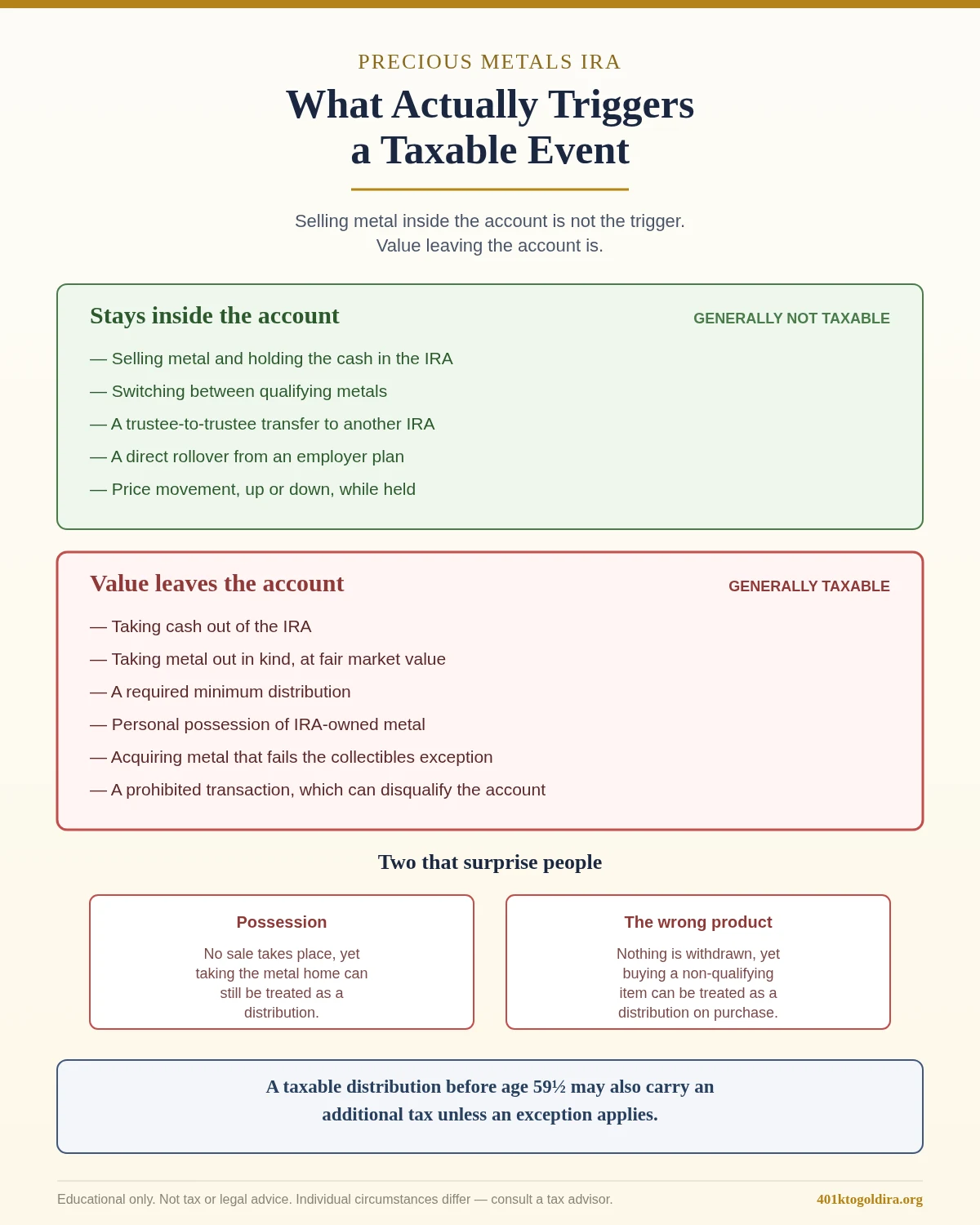
An in-kind distribution takes the IRA asset out as property — physical coins or bars — instead of selling it for cash first. IRS Publication 590-B refers to distributions of IRA assets as money or other property, and a custodian may permit specific coins or bars to be distributed to the account holder. The fair market value of the metal at distribution is generally the reportable distribution amount (Internal Revenue Service, Publication 590-B). After an in-kind distribution completes, the metal becomes personally owned property outside the IRA.
Taking metal in kind does not avoid tax. A traditional IRA distribution is generally taxable whether taken as cash or as metal, and the fair market value is the amount included in income. The withdrawal & tax estimator illustrates the possible tax side, and the cash-from-Gold-IRA guide compares taking cash versus metal.
Using It for a Required Minimum Distribution
A traditional Gold IRA is subject to the same required minimum distribution rules as other traditional IRAs. A custodian may allow an in-kind distribution of coins or bars to help satisfy the RMD, subject to its procedures and valuation. This calculator can turn a prior year-end balance and a distribution percentage into a target amount, then estimate the ounces that amount represents — but the actual RMD figure comes from the IRS life-expectancy tables applied to the account, not from a flat percentage. The Gold IRA RMD calculator estimates the required amount using the Uniform Lifetime Table, and the Gold IRA RMD strategy guide explains how metals RMDs are satisfied.
Whether to take the RMD as cash or in metal, and whether to hold the metal personally afterward, are separate decisions with their own storage, insurance, and tax considerations. Customers should speak to a financial or tax advisor before making decisions. Goldco does not offer tax or legal advice.
Compare the full toolkit
This is one of several educational calculators covering fees, RMDs, allocation, break-even, and more.
See All Calculators →Frequently Asked Questions
What does the in-kind distribution calculator do?
It estimates roughly how many ounces of metal would be needed to satisfy a target distribution amount — such as a required minimum distribution — at an entered metal price per ounce. It is an educational estimate based on the inputs, not a custodian instruction or a tax calculation.
What is an in-kind distribution?
An in-kind distribution takes metal out of the IRA as physical coins or bars rather than as cash. The fair market value of the metal distributed is generally the reportable distribution amount, so an in-kind distribution does not avoid the tax that applies to a cash distribution.
Does taking metal in kind avoid taxes?
No. A traditional IRA distribution is generally taxable whether it is taken as cash or as metal. The fair market value of the metal is the reportable amount. A tax professional should confirm the tax treatment.
Can an RMD be satisfied with metal instead of cash?
A custodian may allow an in-kind distribution of specific coins or bars to help satisfy a required minimum distribution, subject to its procedures and valuation. Whether the account holder wants to hold the metal personally afterward is a separate decision.
Is the ounce estimate exact?
No. Metal is distributed in whole coins or bars of specific weights, dealers value at their own prices, and metal prices move constantly, so the actual distribution will differ from a simple amount-divided-by-price estimate.
Methodology and Limitations
Methodology. If the target is set directly, that dollar amount is used. If it is set by percentage, the target is the account balance multiplied by the distribution percentage. The estimated ounces are the target amount divided by the entered price per ounce. The tool also shows the value of rounding up to the next whole ounce, since metal moves in whole units.
Assumptions and limitations. This is a simple division, not a valuation or an RMD calculation. Real in-kind distributions move whole coins or bars of specific weights, carry product premiums over spot, and are valued by the custodian or dealer at their own prices on the distribution date. The percentage option is a convenience for deriving a target amount and is not the IRS RMD method, which uses life-expectancy tables. The tool does not calculate tax, does not determine an RMD, and does not instruct any distribution. All inputs are assumptions chosen by the user. This tool is educational only and should support discussion with the custodian and a qualified tax professional rather than serve as the basis for a decision. Past performance does not guarantee future results.
Tool reviewed and edited by Daniel M. — editor, 401kToGoldIRA.org. Educational only; not tax or legal advice, and not a custodian valuation. Distribution treatment sourced to IRS Publication 590-B.