Educational only: Prohibited-transaction questions are unusually fact-specific, and outcomes turn on relationships, percentages and conduct that a general page cannot establish. This reference explains the federal framework from published statutes, Treasury regulations, IRS guidance and court decisions. It is not financial, tax or legal advice. An account owner considering a related-party transaction, a compensation arrangement, a personal guarantee, a co-investment or an unusual custody structure should obtain qualified advice before acting.
Key takeaways
- No asset is prohibited by its label. The rules apply to parties and conduct, not to categories of investment.
- The statutory family class is narrow: spouse, ancestor, lineal descendant, and the spouse of a lineal descendant. Siblings and cousins sit outside it — which is not the same as being safe.
- “Direct or indirect” is doing real work. Routing an arrangement through an entity does not end the analysis.
- Attribution is calculated, not assumed. Constructive-ownership rules can make a seemingly unrelated entity disqualified.
- The owner's consequence is account disqualification, not the excise tax. Section 4975(c)(3) provides that exemption expressly.
- Correction is not a reset button for an account that has already ceased to be an IRA.
- Precious-metals custody failures live in a different provision. A §408(m) problem is not automatically a §4975 problem.
The Two Questions That Decide Every Case
Self-directed IRAs are often discussed as though certain assets are forbidden. That is the wrong starting point, and it produces both false alarm and false comfort. Section 4975 applies to transactions, parties and benefits. An IRA can hold an unconventional asset without that fact alone creating a prohibited transaction, and an entirely ordinary-looking transaction can be prohibited because of who is on the other side.
The practical screen is therefore always two steps:
- Who is involved? Is any person or entity in the arrangement a disqualified person under §4975(e)(2), once the family definition and the ownership-attribution rules have been applied?
- What does the arrangement do? Does it create a sale, lease, loan, extension of credit, provision of services, a transfer or use of IRA assets for a disqualified person, fiduciary self-dealing, or personal consideration flowing to a fiduciary?
Both steps matter, and in that order. A commercial transaction with a genuinely unrelated counterparty may sit outside §4975 entirely. The same transaction with a disqualified person may not.
Who Is a Disqualified Person?
Section 4975(e)(2) begins with status. A fiduciary is a disqualified person, as is a person providing services to the plan. The definition then extends to specified employers and employee organisations, certain substantial owners, the statutory family class, entities held at the majority threshold, and specified officers, directors, substantial shareholders, highly compensated employees, partners and joint venturers (Cornell LII — 26 U.S.C. §4975).
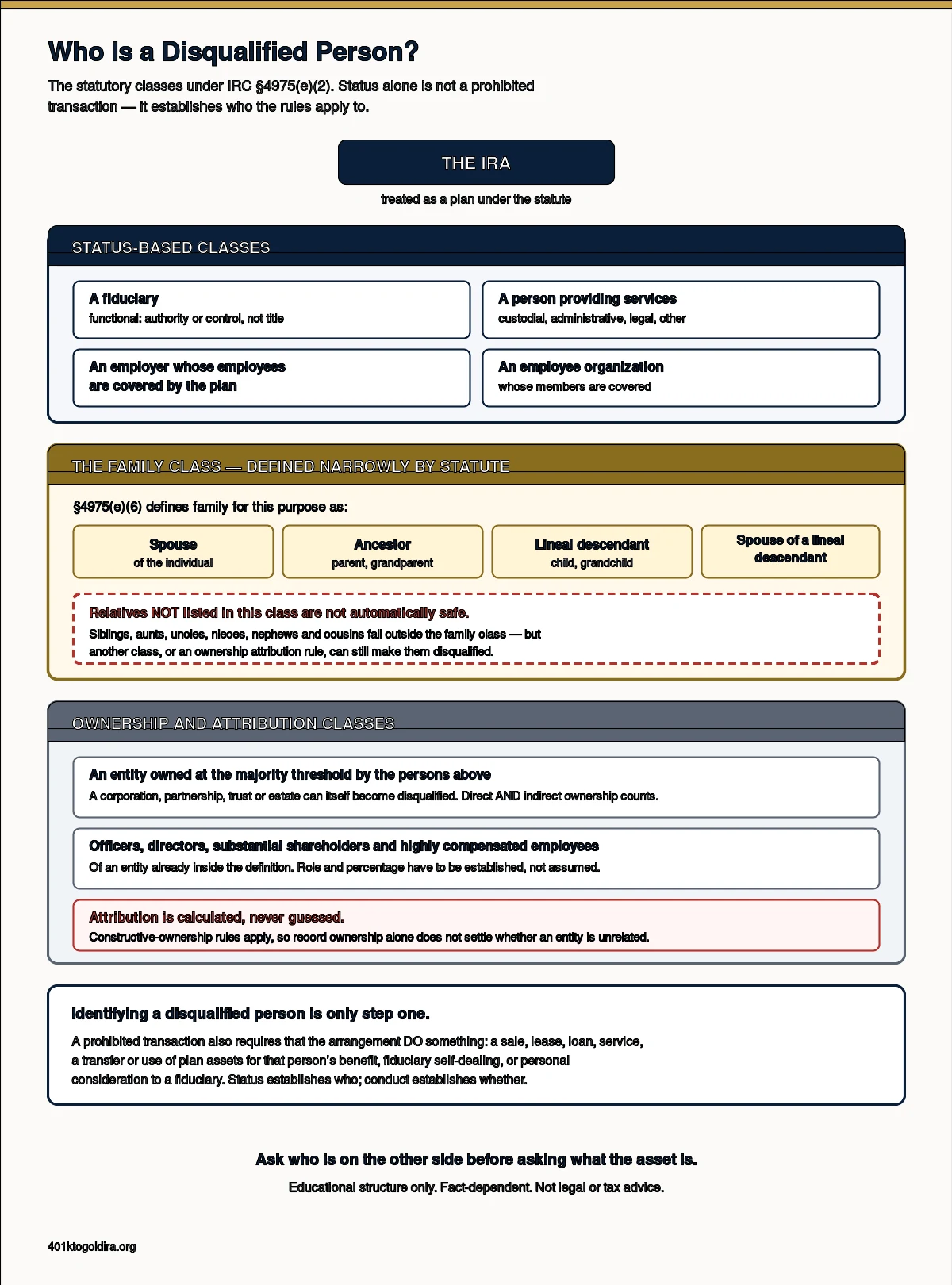
Ask who is on the other side before asking what the asset is.
An IRA owner can be a fiduciary because of what the owner does
Section 4975(e)(3) defines fiduciary status functionally: a person is a fiduciary by exercising discretionary authority or control over plan management, by exercising authority or control over plan assets, by performing specified investment-advice functions, or by having discretionary responsibility in administration. It is about function, not job title.
That matters directly in a self-directed IRA, where the owner typically directs the investments. The Department of Labor reached exactly that conclusion in Advisory Opinion 2011-04A, treating an IRA owner with sole discretion to direct investments as a fiduciary and therefore a disqualified person.
Fiduciary status is not itself misconduct. It establishes who the person is for the analysis. A prohibited transaction still requires the second step.
The Family Boundary Is Narrower Than Most Summaries Suggest
This is one of the most frequently misreported points in the self-directed IRA market, in both directions.
Section 4975(e)(6) defines family for this purpose as an individual's spouse, ancestor, lineal descendant, and any spouse of a lineal descendant. On the face of the statute, that captures parents and grandparents as ancestors, children and grandchildren as lineal descendants, and the spouses of children or grandchildren.
Siblings, aunts, uncles, nieces, nephews and cousins are not listed in that family class.
The correct conclusion is precise, and it is not the comfortable one. Those relatives are not disqualified solely under the family category. They are not thereby established as safe counterparties. A separate service relationship, fiduciary function, ownership position, officer role or attribution rule could still make a particular relative a disqualified person on the facts. The defensible practice is to test every category rather than stop at the family tree.
Entities, Ownership and Attribution
The Code also reaches controlled entities. A corporation, partnership, trust or estate can itself be a disqualified person when the specified majority threshold of voting power, value, capital or profits interest, or beneficial interest is owned or held — directly or indirectly — by persons already inside the definition.
Indirect ownership is not a matter of impression. Sections 4975(e)(4) and (5) import constructive-ownership concepts, with modifications that include using the narrower §4975 family definition for attribution purposes. In a closely held arrangement, the percentages need to be calculated before anyone concludes an entity is unrelated, and layered structures can produce results that record ownership alone does not reveal.
What Transactions Are Prohibited?
Section 4975(c)(1) reaches any direct or indirect:
- sale, exchange or lease of property between the plan and a disqualified person;
- lending of money or other extension of credit between them;
- furnishing of goods, services or facilities between them;
- transfer to, or use by or for the benefit of, a disqualified person of the plan's income or assets;
- dealing by a fiduciary with the plan's income or assets in the fiduciary's own interest or account; or
- receipt by a fiduciary of consideration for the fiduciary's own account from a party dealing with the plan in connection with plan income or assets.
The first three are straightforward to picture. The last three exist to stop the analysis becoming a form-over-substance exercise: personal benefit and fiduciary conflict remain relevant even where a transaction is routed through an entity or a third party. That is also why the phrase “direct or indirect” carries so much weight in the decided cases.
Fact Patterns by Asset Class
Real estate
Personal use or occupancy. An owner using IRA-owned property as a residence, holiday property or other personal facility raises the transfer-or-use and self-dealing categories, because plan assets are being used for a disqualified person's benefit. IRS guidance lists buying property for present or future personal use with IRA funds among its examples of possible prohibited transactions (IRS — prohibited transactions).
“Sweat equity” is not a one-line rule. A great deal of secondary material states flatly that an owner may never lift a tool, mow a lawn or paint a wall. The primary authorities reviewed do not support that universal formulation. Treasury Regulation §54.4975-6 provides that uncompensated fiduciary services do not, in and of themselves, constitute the self-dealing or personal-consideration categories — while other provisions and the surrounding facts can still apply. The honest position is that this is fact-dependent, not that it is freely permitted.
Renting to family. A lease with a family member inside the statutory class falls within the sale-exchange-lease category. For a relative outside that class, status should not be assumed from kinship alone; the other categories and the attribution rules still need testing.
Collateral and guarantees. Where an owner uses the IRA itself as security for a loan, §408(e)(4) treats the portion so used as distributed. A personal guarantee of debt connected to an IRA-owned business is a different route to a similar problem — see the lending section below.
Private business interests
Controlled entities. Where persons inside the definition own the specified majority of a corporation, partnership, trust or estate, directly or indirectly, the entity can itself be a disqualified person. The attribution calculation comes before the transaction is classified, not after.
Owner compensation. In Ellis v. Commissioner, the Eighth Circuit affirmed that wages paid to the IRA owner-manager of an IRA-owned business were prohibited transactions on that record (Ellis v. Commissioner, 787 F.3d 1213 (8th Cir. 2015)). The services exemption did not rescue the arrangement, and the reason matters for anyone contemplating a similar structure: that exemption does not reach fiduciary self-dealing or a fiduciary's receipt of personal consideration.
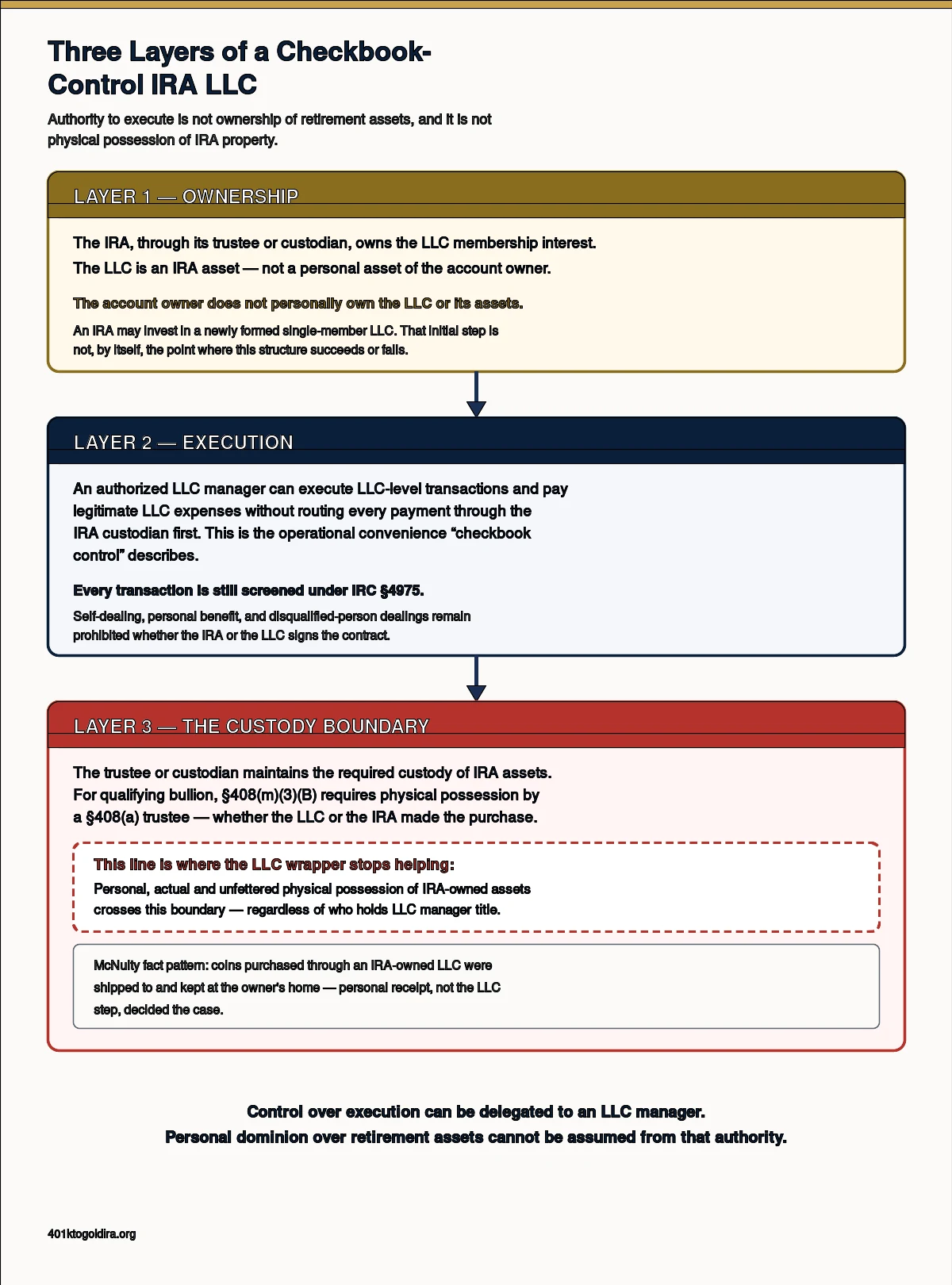
Forming a new entity. Swanson v. Commissioner supports a narrow, formation-stage proposition — that a newly formed entity with no shares or shareholders was not already a disqualified person at the moment the IRA acquired newly issued ownership. It is not, and should not be presented as, blanket approval of checkbook-control arrangements or of the dealings that follow once ownership exists. Later compensation, leases, guarantees, transfers and personal benefits each require their own analysis.
Lending, notes and guarantees
Lending between the IRA and a disqualified person is squarely within the second category, in either direction. IRS guidance identifies borrowing money from an IRA among its examples.
The guarantee question is where the word “indirect” does its work. In Peek v. Commissioner, decided together with Fleck, the Tax Court treated the taxpayers' personal guarantees of a company loan as indirect extensions of credit to the IRAs, and the accounts holding the company stock ceased to be IRAs (U.S. Tax Court — Peek, Docket No. 5951-11; consolidated with Fleck, Docket No. 6481-11). A guarantee is not a transfer of money, which is precisely why the statutory language reaches beyond direct payments.
Precious Metals Sit in a Separate Provision
This distinction is worth stating plainly because the two regimes are routinely merged.
Section 408(m) governs collectibles. An IRA's acquisition of a collectible is generally treated as a distribution, subject to exceptions for specified coins and for qualifying bullion, and the bullion exception carries its own trustee-possession condition. That is a different statute, with a different trigger and a different consequence, from the §4975 prohibited-transaction rules.
McNulty v. Commissioner is the clearest available illustration. The Tax Court found taxable distributions arising from the owner's personal possession of American Eagle coins — and the Commissioner conceded that she had not engaged in a §4975 prohibited transaction with respect to her IRA, its LLC investment, or the coin purchase (U.S. Tax Court — McNulty, Docket No. 1377-19). A custody failure produced a taxable event without a prohibited transaction being established at all.
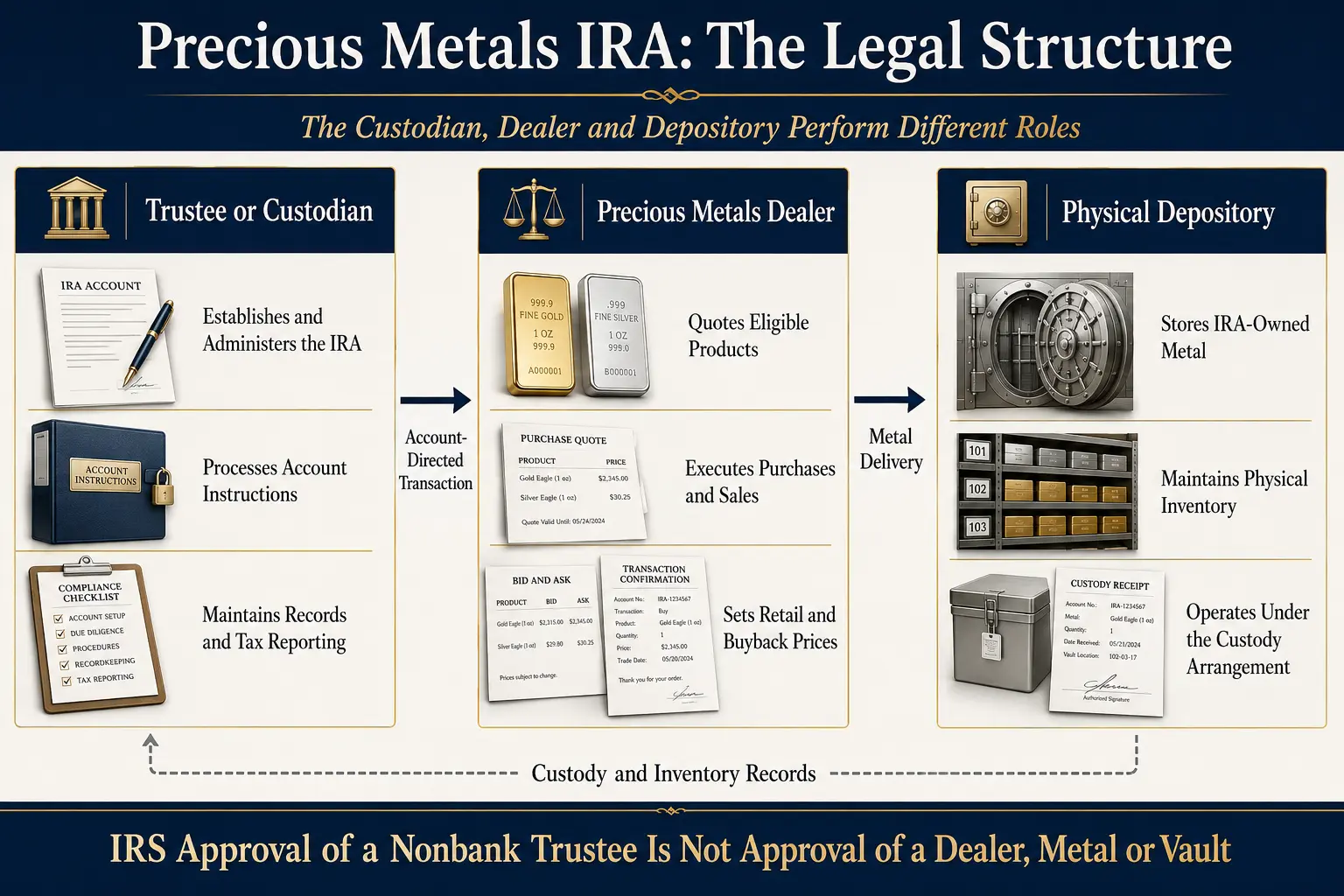
The practical consequence: do not reason from “this is a metals problem” to “this is a §4975 problem,” or the reverse. The product-eligibility question is covered in IRA-eligible precious metals, and the account structure in the precious metals IRA reference.
The Two Consequences — and the Provision Most Pages Miss
There are two distinct consequence routes, and which one applies depends on who engaged in the transaction.
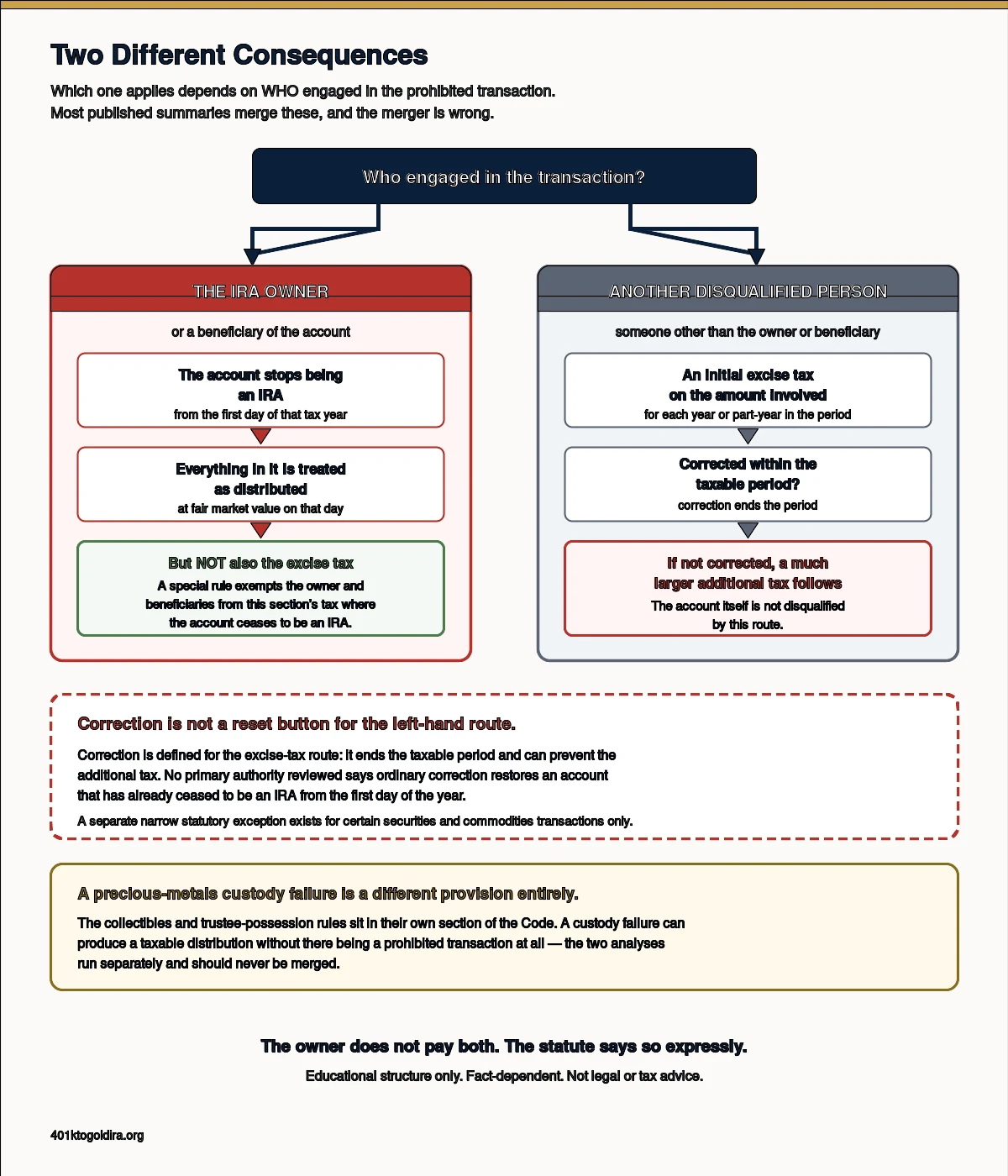
The owner does not pay both. The statute says so expressly.
Route one: the owner or beneficiary — the account itself
Where the individual for whose benefit the IRA is established, or a beneficiary, engages in a prohibited transaction with the account, §408(e)(2) provides that the account ceases to be an IRA as of the first day of that taxable year. Section 408(d)(1) then applies as though the fair market value of all the assets had been distributed on that day. Treasury Regulation §1.408-1(c)(2) sets out the same mechanism.
The retroactivity to the first day of the year is the part that surprises people: the consequence does not begin at the moment of the transaction.
Route two: another disqualified person — the excise tax
A participating disqualified person who is not the owner or beneficiary faces the excise-tax regime instead: an initial tax on the amount involved for each year or part-year in the taxable period, and, if the transaction is not corrected within that period, a substantially larger additional tax. The statute defines both “amount involved” and “taxable period,” the latter ending at the earliest of a deficiency notice, assessment, or completed correction.
The reconciliation
A great deal of published material states that an IRA owner who commits a prohibited transaction suffers account disqualification and owes the excise taxes. The Code addresses this directly, and says otherwise.
Section 4975(c)(3) provides that the individual for whose benefit an IRA is established, and that individual's beneficiaries, shall be exempt from the tax imposed by that section with respect to a transaction concerning the account, where the account ceases to be an IRA by reason of §408(e)(2)(A), or where §408(e)(4) applies.
That special rule protects the owner and beneficiaries from the excise tax in those circumstances. It does not rewrite the position of a separate disqualified person who also participated — Treasury Regulation §1.408-1(c)(3) confirms that such a person remains subject to the §4975 taxes.
Once a deemed distribution occurs, ordinary IRA distribution rules govern how much is actually taxable, which depends on the account's basis. Where the includible amount is received before age 59½, the additional tax under §72(t) can apply unless an exception is available — the exceptions are set out on the early withdrawal penalty page.
Correction, and What It Cannot Fix
Correction has a statutory meaning: undoing the transaction to the extent possible and placing the plan in a financial position no worse than if the disqualified person had acted under the highest fiduciary standards. Timely correction ends the taxable period and can prevent the additional tax.
That is a rule about the excise-tax route. The primary authorities reviewed for this page do not state a general rule that ordinary correction reverses the loss of IRA status once §408(e)(2) has operated from the first day of the year. This page therefore does not represent correction as restoring a disqualified account, and readers should be sceptical of material that does.
A separate and narrow statutory exception exists for certain transactions involving the acquisition, holding or disposition of a security or commodity, where correction occurs within a defined period and the statutory limitations are satisfied. It is specific, it does not extend to the fiduciary self-dealing categories, and it should not be described as a general short-window fix for self-directed IRA mistakes.
Exemptions
Section 4975(d) contains a long list of statutory exemptions. Many are built for employer plans, institutional trading, banking arrangements or specific legacy transactions rather than the ordinary self-directed IRA, and reading the list as a menu of permissions is a mistake.
Three concepts matter most here:
- Necessary services. A reasonable arrangement for office space, or for legal, accounting or other services necessary to establish or operate the plan, can be exempt where no more than reasonable compensation is paid.
- But there is no shield for fiduciary conflict. Treasury Regulation §54.4975-6 states expressly that the services exemption does not exempt fiduciary self-dealing or a fiduciary's receipt of personal consideration. This is precisely why owner-manager compensation is hazardous, and why Ellis turned out as it did.
- Participant entitlement. Receiving a benefit to which a person is entitled as a participant or beneficiary is exempt where it is computed and paid on the same terms applied to others.
The Department of Labor separately administers a prohibited-transaction exemption process and publishes both class and individual exemptions. A class exemption applies only to transactions and parties meeting its stated conditions, and an individual exemption applies only to the parties and transactions it covers. An exemption should be identified by name, checked for current status, and read condition by condition — not assumed to exist because an arrangement seems commercially reasonable.
A Pre-Transaction Screening Sequence
- List every party to the proposed arrangement, including entities, and anyone who will benefit from it indirectly.
- Test each against §4975(e)(2), applying the statutory family definition rather than an ordinary-language one.
- Calculate ownership and attribution for every entity involved, rather than relying on record ownership.
- Identify what the arrangement does against the six categories, asking specifically whether it is an indirect version of one of them.
- Check for personal benefit flowing to anyone inside the definition, including use, occupancy, compensation, credit support and non-cash advantage.
- Where metals are involved, run the §408(m) analysis separately — product eligibility and custody are their own questions.
- Obtain advice before executing anything near a boundary. The consequence for an owner attaches to the whole account and back-dates to the start of the year.
Frequently Asked Questions
What makes a transaction prohibited in a self-directed IRA?
Two things together. First, a disqualified person must be involved, as defined by IRC §4975(e)(2) after the family and ownership-attribution rules are applied. Second, the arrangement must do something the statute prohibits: a sale, exchange or lease; a loan or extension of credit; furnishing goods, services or facilities; transferring or using plan assets for a disqualified person's benefit; fiduciary self-dealing; or a fiduciary receiving personal consideration. The asset class alone does not decide it.
Are all my relatives disqualified persons?
No. The statutory family class in §4975(e)(6) is narrower than ordinary usage: a spouse, an ancestor, a lineal descendant, and the spouse of a lineal descendant. Siblings, aunts, uncles, nieces, nephews and cousins are not listed in that class. That does not make them safe to transact with, because another class or an ownership-attribution rule can still make a particular person disqualified on the facts.
Can an IRA owner do repair work on IRA-owned property?
The primary authorities reviewed do not support a blanket rule that an owner can never perform any work. Treasury Regulation §54.4975-6 states that uncompensated fiduciary services do not, in and of themselves, constitute the self-dealing or personal-consideration categories, while other provisions and the surrounding facts can still matter. This is fact-dependent and should be discussed with a qualified adviser rather than resolved from a general rule.
Does paying fair market value fix a related-party transaction?
Not by itself. The prohibition is defined by the parties and the conduct, not by the price. A specific statutory exemption may contain its own fair-value or adequate-consideration conditions, but fair pricing is not a general cure for a transaction that falls within one of the prohibited categories.
Does the IRA owner pay the 15% and 100% excise taxes as well as losing the account?
Generally not for the same owner-caused transaction. IRC §4975(c)(3) expressly exempts the individual for whose benefit the IRA is established, and that individual's beneficiaries, from the tax imposed by that section where the account ceases to be an IRA under §408(e)(2)(A). A separate disqualified person who participated can still face the excise-tax consequences.
What actually happens to the IRA if the owner engages in a prohibited transaction?
Under §408(e)(2), the account ceases to be an IRA as of the first day of that taxable year, and §408(d)(1) then applies as though the fair market value of all the assets had been distributed on that day. Treasury Regulation §1.408-1(c)(2) states the same mechanism. How much of that deemed distribution is taxable depends on the account's basis and the ordinary IRA distribution rules.
Can a prohibited transaction be corrected and the IRA restored?
Correction is defined for the excise-tax route: it ends the taxable period and can prevent the additional tax. The primary authorities reviewed do not state a general rule that ordinary correction reverses the loss of IRA status once §408(e)(2) has applied from the first day of the year. This page does not represent correction as restoring a disqualified account.
Can an IRA owner take a salary from a business the IRA owns?
That is high-risk and fact-specific. In Ellis v. Commissioner the Eighth Circuit affirmed that wages paid to the IRA owner-manager were prohibited transactions on that record. The services exemption does not automatically rescue the arrangement, because Treasury Regulation §54.4975-6 states it does not exempt fiduciary self-dealing or a fiduciary's receipt of personal consideration.
Is personally guaranteeing a loan for an IRA-owned company a problem?
It can be. In Peek v. Commissioner, decided with Fleck, the Tax Court treated the taxpayers' personal guarantees of a company loan as indirect extensions of credit to the IRAs, which falls within the lending category. The word "indirect" in the statute is what reaches an arrangement routed through an entity.
Is holding gold personally a prohibited transaction?
Those are separate legal questions and should not be merged. The collectibles and trustee-possession rules sit in §408(m), a different provision with its own consequence. In McNulty v. Commissioner the Tax Court found taxable distributions arising from the owner's personal possession of coins, while the Commissioner conceded that she had not engaged in a §4975 prohibited transaction with respect to her IRA, its LLC investment or the coin purchase.
Bottom Line
A workable compliance framework for a self-directed IRA is not a list of forbidden assets. It is a two-stage transaction screen: identify every disqualified person, applying the statutory definitions and the attribution rules rather than intuition; then identify what the arrangement actually does with the account's assets, credit, services and benefits.
The consequences are asymmetric and worth understanding before rather than after. An owner-caused prohibited transaction can end the account's IRA status retroactively to the first day of the year, while a separate disqualified person faces the excise-tax regime instead. Because attribution, compensation, guarantees and indirect benefits are all fact-intensive, and because several points here are genuinely unsettled in the primary sources, advice on the specific facts is worth more than any general rule.
The structural question of how an IRA-owned LLC and checkbook control work — including the owner-manager's fiduciary position — is covered separately in the checkbook-control IRA LLC guide. Terms used here are defined in the gold IRA glossary.
This page is educational and does not evaluate any reader's facts, relationships or proposed transaction. Prohibited-transaction outcomes depend on parties, percentages, conduct and documentation that a general reference cannot establish, and several questions addressed here are not settled by the primary sources. Readers should consult a qualified tax professional or attorney before entering a transaction that may involve a disqualified person. Past performance does not guarantee future results.