Affiliate disclosure: Some links on this page may be sponsor links. The site owners may be compensated if customers request information from companies mentioned here. This page is educational only and does not provide financial, tax, or legal advice. Customers should treat it as a research starting point and speak with a financial or tax advisor before making retirement-account decisions.
Quick Answer: What Questions Matter Most Before Opening a Gold IRA?
Before opening a Gold IRA, investors benefit most from questions that reveal whether the account fits their goals, what fees and markups apply, how rollovers avoid tax mistakes, and how easy it may be to exit later. The most protective questions highlight total annual fees, dealer spreads, storage details, buyback policies, and any public complaints or lawsuits against the provider.
In practice, independent guides and regulators stress that Gold IRAs are self-directed accounts with extra moving parts, so asking detailed Gold IRA questions up front can reduce surprises later. Past performance does not guarantee future results.
Why Asking Questions First Matters
The custodian half of that enquiry has its own document sequence, set out in what to check before selecting a custodian. Gold IRAs involve several parties: a custodian, a metals dealer, a depository under the trustee's control, and the retirement saver. Each party may charge fees or influence which metals are bought, which is why Gold IRA due diligence is essential before any rollover or new funding.
Regulators such as the U.S. Commodity Futures Trading Commission urge investors to ask for full fee disclosure, to understand storage and insurance, and to review how dealers earn commissions and spreads. Consumer-focused articles also warn that unclear markups, collectible coin pitches, and rushed rollover advice can lead to high costs and tax problems.
How Gold IRAs Work and Why Pre-Opening Due Diligence Matters
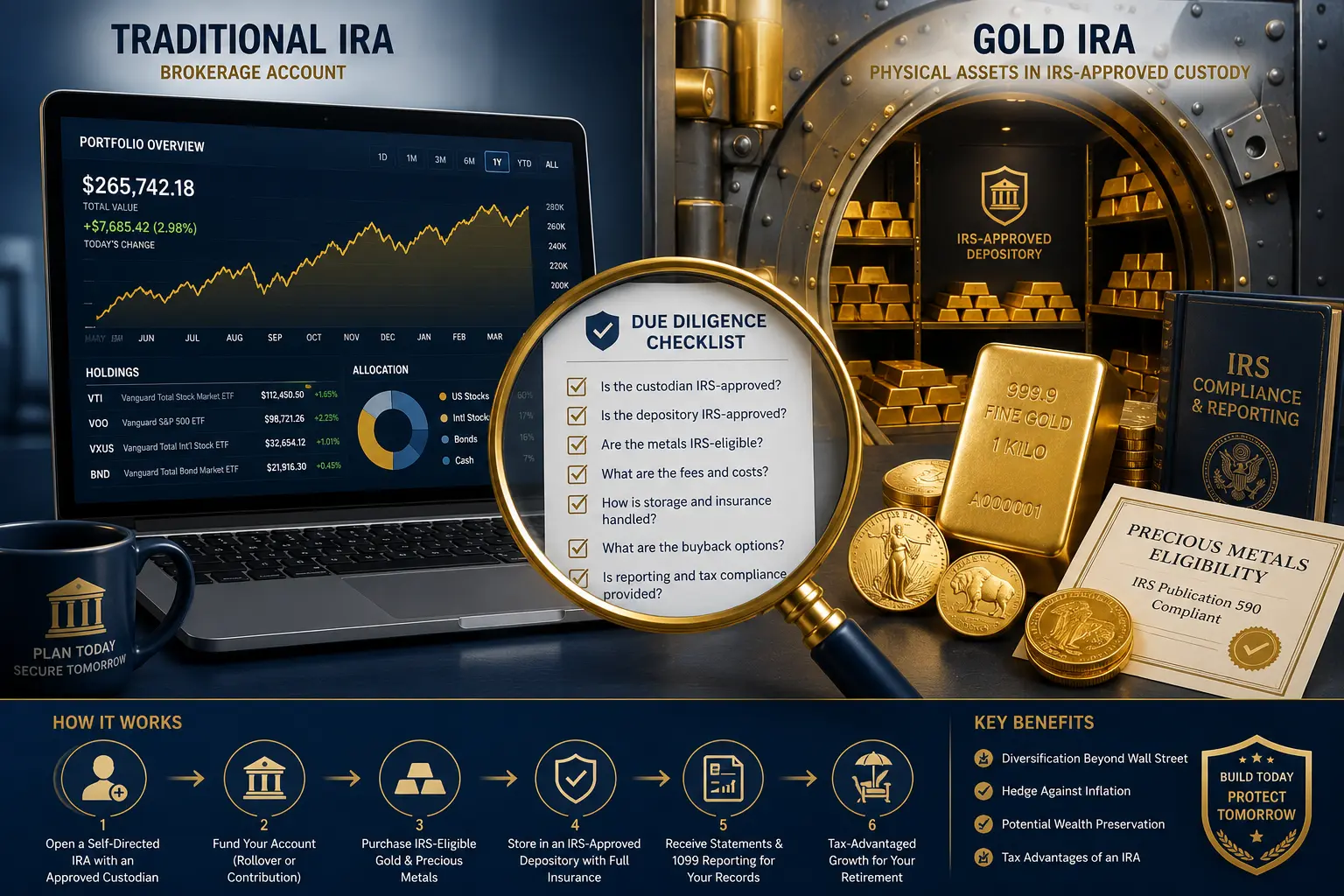
A Gold IRA is a type of self-directed IRA that holds physical gold and other precious metals that qualify under IRC §408(m) instead of only stocks or bonds. The account is opened with an approved custodian, funded through contributions or rollovers, and metals are purchased from dealers then stored at a depository under the trustee's control.
Because Gold IRAs involve self-directed structures, storage rules, and metals eligibility under IRS code 408(m), the setup is more complex than a standard brokerage IRA. Independent guides emphasize checking fees, eligible metals, and rollover methods carefully so the account does not trigger unnecessary taxes or penalties.
Educational Gold IRA video
Video published by Goldco on YouTube — a company this site has an affiliate relationship with. Embedded as a third-party explanation; not produced, endorsed or independently verified by this site.
Key Questions to Ask Before Opening a Gold IRA: Fit and Suitability
Fit and suitability questions help retirement savers decide whether a Gold IRA belongs in their overall plan before discussing products or promotions.
1. Is a Gold IRA suitable for this investor's retirement goals?
Gold IRAs may suit investors who want part of their retirement savings in physical precious metals, but they are not appropriate for every situation. A suitability discussion should consider age, risk tolerance, income needs, time to retirement, and whether precious metals complement or conflict with existing allocations.
Advisors often suggest treating precious metals IRAs as diversifiers rather than core holdings, so this question sets the tone for realistic expectations instead of all-in decisions.
2. What percentage of retirement assets would be allocated to precious metals?
Independent allocation guides usually mention gold allocations in the single-digit to low-double-digit percentage range for many diversified portfolios. Asking about percentage allocation helps investors see whether the proposed Gold IRA share is modest or outsized relative to other assets.
This question also opens discussion about how the Gold IRA may interact with stock, bond, and cash holdings and whether the metals allocation remains flexible over time. The Gold IRA Allocation Calculator can help model scenarios before a professional review.
Fees and Markups: Gold IRA Fees Questions and Dealer Spreads
Transparent Gold IRA fees questions are often the first line of defense against high costs, hidden charges, and confusing dealer spreads.
3. Which fees are one-time and which are annual?
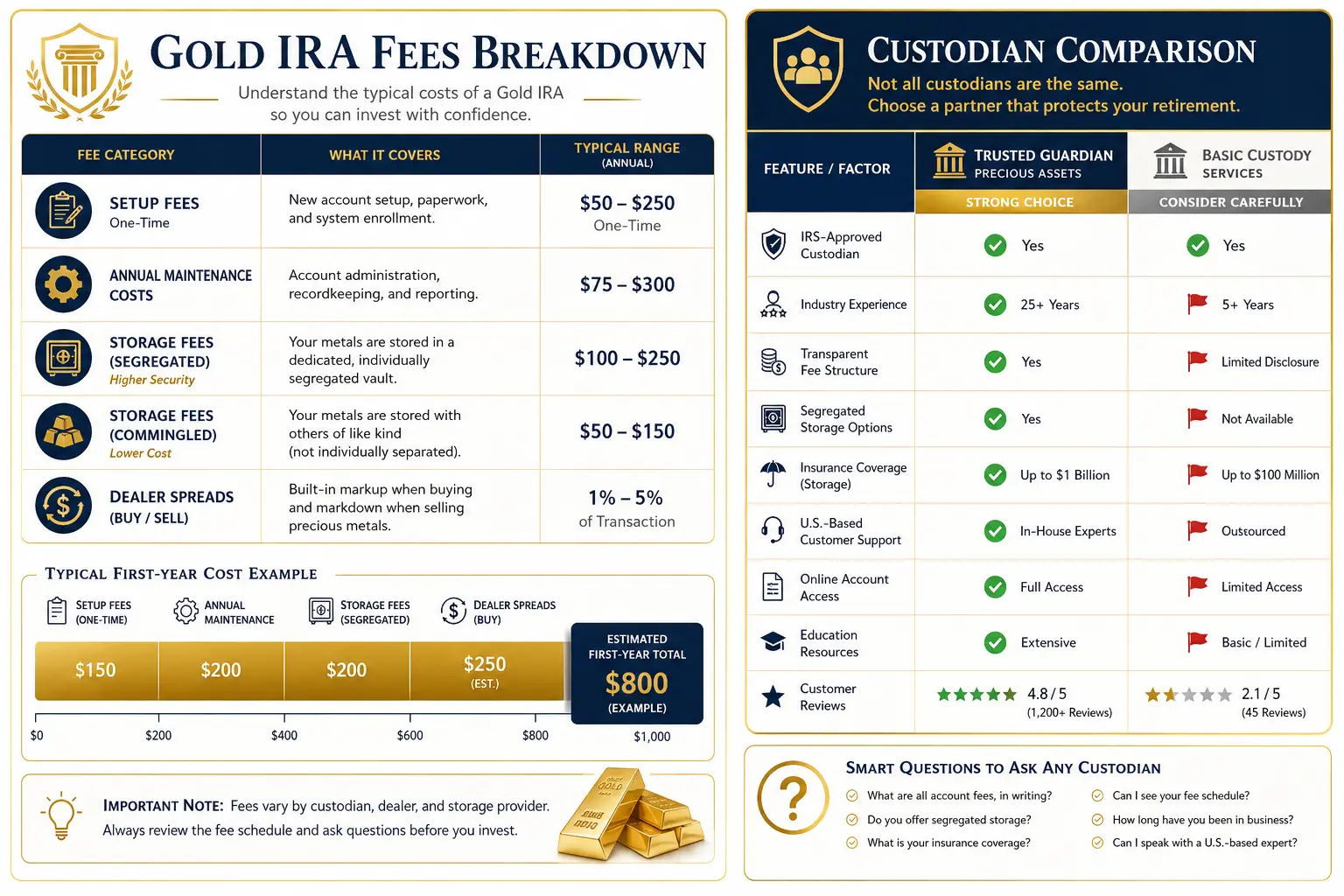
Gold IRA fee breakdowns usually include one-time account setup charges, annual custodian fees, annual storage fees, and transaction costs when buying or selling metals. Asking which fees are one-time versus ongoing helps investors estimate total costs over several years, not just at the point of sale.
Guides from financial publishers show that maintaining a Gold IRA can cost several hundred dollars annually, especially once custodian and depository fees are added. The Gold IRA Fees and Hidden Costs Guide explains the main fee categories.
4. What is the dealer markup or spread on metals?
Dealer markup is the difference between the metal's spot price and the retail purchase price charged to the investor. Consumer articles warn that some Gold IRA companies charge high markups on specialty coins, while more transparent firms may target much lower ranges.
Regulators and independent guides recommend asking explicitly, "What is the dealer markup or spread on metals?" and requesting numeric examples on common coins and bars. This question is central to any Gold IRA checklist because high markups make it harder for retirement savers to break even. The Gold IRA markups and spreads guide covers this cost in more detail.
5. Are fees shown in writing before funding?
The CFTC and other consumer resources strongly encourage getting all fees, commissions, and price details in writing before transferring funds into a Gold IRA. Written fee schedules help investors compare providers, spot unusual charges, and avoid surprise fees after the rollover is complete.
Any reluctance to provide written fee disclosures is often treated as a red flag that calls for more research or a different provider.
Custodian and Storage: Gold IRA Custodian Questions and Storage Questions
Custodian and storage questions clarify who holds the IRA, where metals live, and how those metals are protected under IRS rules.
6. Which custodian holds the IRA?
Gold IRAs must be opened with an IRS-approved custodian, which may be a bank, trust company, or specialized IRA provider. Asking which custodian holds the IRA helps investors research the firm's history, licensing, fees, and ability to handle self-directed precious metals.
Independent guides recommend choosing custodians with clear reporting, online account access, and experience with metals rollovers instead of lightly tested or unfamiliar providers.
7. Which depository stores the metals?
IRS rules require that Gold IRA metals be stored at an approved depository, not at home. Asking which depository stores the metals allows investors to verify the facility's approval status, insurance coverage, audit practices, and relationships with major custodians.
8. Is storage segregated or commingled?
Gold IRA storage usually comes in two main forms: segregated and commingled. With segregated storage, specific bars and coins purchased for the IRA are held separately under the client's name; commingled storage pools similar products with those of other account holders.
Fee schedules show that segregated storage often costs more per year than commingled storage, but some investors prefer the extra clarity. Asking this question helps retirement savers weigh cost against control when comparing storage options.
9. Which metals are IRS-approved?
Under IRS code 408(m), only certain bullion bars and coins that meet purity standards and product rules can be held inside an IRA. Asking which metals are IRS-approved ensures the provider focuses on eligible bullion rather than products that could create prohibited transactions.
10. Are collectible coins being recommended?
Collectible coins and numismatic products often carry higher markups and may not qualify for IRA treatment under IRS rules. Independent articles warn that heavy promotion of collectible coins in a Gold IRA context can indicate a sales-driven focus rather than investor-driven education.
This question helps investors notice whether the conversation stays anchored on bullion that qualifies under IRC §408(m) or drifts into collectibles that may not fit a retirement plan.
Rollover and Tax Rules: Gold IRA Rollover Questions
Rollover and tax questions protect investors from penalties, unintended distributions, and misunderstood withdrawal rules.
11. How does the rollover process avoid taxable mistakes?
Improper rollovers can trigger taxable distributions, early withdrawal penalties, or loss of tax-advantaged status. Guides emphasize that direct custodian-to-custodian rollovers often reduce risk compared with indirect rollovers paid to the investor.
This question should prompt explanations about using direct transfers, observing the 60-day rule for any indirect rollover, and ensuring the full balance reaches the new IRA in time.
12. What happens if the investor is still employed with the plan sponsor?
Some employer plans, such as 401(k)s, may not allow in-service distributions or rollovers while the employee is still working for the plan sponsor. Asking what happens if the investor is still employed clarifies whether partial rollovers, age-based in-service options, or other limitations apply.
13. What are the withdrawal rules?
Gold IRAs follow IRA withdrawal rules, including age thresholds and penalties. Withdrawals before age 59½ may face ordinary income tax plus a 10% early withdrawal penalty unless exceptions apply.
Asking about withdrawal rules also helps investors understand how distributions are processed, whether metals can be taken in kind, and how taxes may apply at different ages.
14. How are RMDs handled with physical metals?
Required minimum distributions (RMDs) apply to traditional IRAs once investors reach certain ages. Handling RMDs with physical metals can involve selling enough bullion to meet the required amount or distributing coins and bars in kind and valuing them for tax purposes.
This question helps retirement savers plan how a Gold IRA will meet RMD obligations without disrupting the metals allocation more than necessary. Customers should speak to a financial or tax advisor before making decisions.
Buyback and Exit Planning: Gold IRA Buyback Policy and Dealer Spread
Exit planning questions address how investors may sell metals later, what spreads apply, and how quickly accounts can be closed or reduced.
15. What happens if the investor needs cash later?
Gold IRAs are intended as long-term retirement vehicles, but investors may need to raise cash for other purposes. Asking what happens if cash is needed later explores how quickly metals can be sold, how proceeds are delivered, and whether partial liquidations affect fee structures.
This is important because physical metals must be sold back at dealer bid prices, and spreads may limit flexibility compared with more liquid securities.
16. Is there a written buyback policy?
A written buyback policy describes whether the provider offers to repurchase metals, under what conditions, and how pricing works. Consumer resources recommend reading buyback policies carefully and avoiding assumptions that any dealer will always repurchase at favorable rates.
This question helps ensure the investor understands exit options before entering the Gold IRA decision checklist.
17. How are sell prices determined?
Sell prices, or buyback prices, are usually based on spot prices minus a spread that varies by product and market conditions. Guides indicate that round-trip costs (purchase markup plus sell spread) on popular bullion can run several percentage points, and spreads may be wider for less liquid items.
Asking how sell prices are determined encourages providers to explain their pricing formula, typical spreads on common products, and how investors can compare buyback quotes with external spot benchmarks.
Company Reputation and Complaints: Gold IRA Red Flags
Reputation questions focus on complaints, enforcement actions, and how sales staff are compensated.
18. What complaints appear in public records?
Independent consumer coverage recommends checking Better Business Bureau reports, state attorney general records, and third-party review sites for complaint patterns. Asking what complaints appear in public records encourages providers to discuss past issues and how they were addressed.
This question also gives investors a starting point for deeper research, including reading detailed articles such as Goldco Lawsuit 2026 or fee reviews for specific companies.
19. Who receives compensation from the sale?
Knowing who receives compensation and how they are paid helps investors understand incentives and potential conflicts of interest. Regulators encourage asking whether sales staff, lead traders, or advisors receive commissions, and whether those payments are built into spreads or separate fees.
Articles on Gold IRA scams emphasize that heavy focus on high-markup products, aggressive pitches, and vague answers about compensation should prompt caution and further comparison shopping.
20. What happens if the account balance is below the provider minimum?
Gold IRA companies often have minimum starting balances that can range from around $5,000 to $25,000, $50,000, or more, depending on the provider, and some publish no fixed minimum at all. Asking what happens if the account balance falls below the provider minimum clarifies whether extra fees apply, whether the account can remain open, or whether closure may be required.
This question matters for investors considering withdrawals, RMDs, or partial rollovers that might change the ongoing economics of the account.
21. What should a tax or financial advisor review first?
Independent guides often encourage consulting an outside tax or financial advisor before making major rollover decisions or shifting retirement allocations. Asking what an advisor should review first highlights key documents such as fee schedules, rollover instructions, tax implications, and product lists.
Customers should speak to a financial or tax advisor before making decisions.
A Scoring Checklist Investors Can Use Before Choosing a Provider
A simple Gold IRA decision checklist can help investors compare providers in a structured way instead of relying on impressions alone.
One practical Gold IRA investor checklist might score each provider on:
- Fit and suitability (0–5 points): Does the provider ask about retirement goals, risk tolerance, and allocation, or only about account size?
- Fee transparency (0–5 points): Are setup, annual, storage, and trading fees disclosed clearly in writing? Are markups and spreads quantified with examples?
- Custodian and storage quality (0–5 points): Is the custodian established and approved? Is the depository widely used, insured, and audited, with clear segregated or commingled options?
- Rollover and tax guidance (0–5 points): Does the provider explain direct versus indirect rollovers, 60-day rules, and withdrawal implications without promising tax outcomes?
- Buyback and exit terms (0–5 points): Are buyback policies written, and are exit spreads reasonable compared with industry averages?
- Reputation and complaints (0–5 points): How do public reviews, BBB files, and any enforcement records look?
Investors can adapt this framework using the interactive Gold IRA Due Diligence Scorecard and the Gold IRA Dealer Comparison Worksheet on this site.
Red Flags That Require More Research
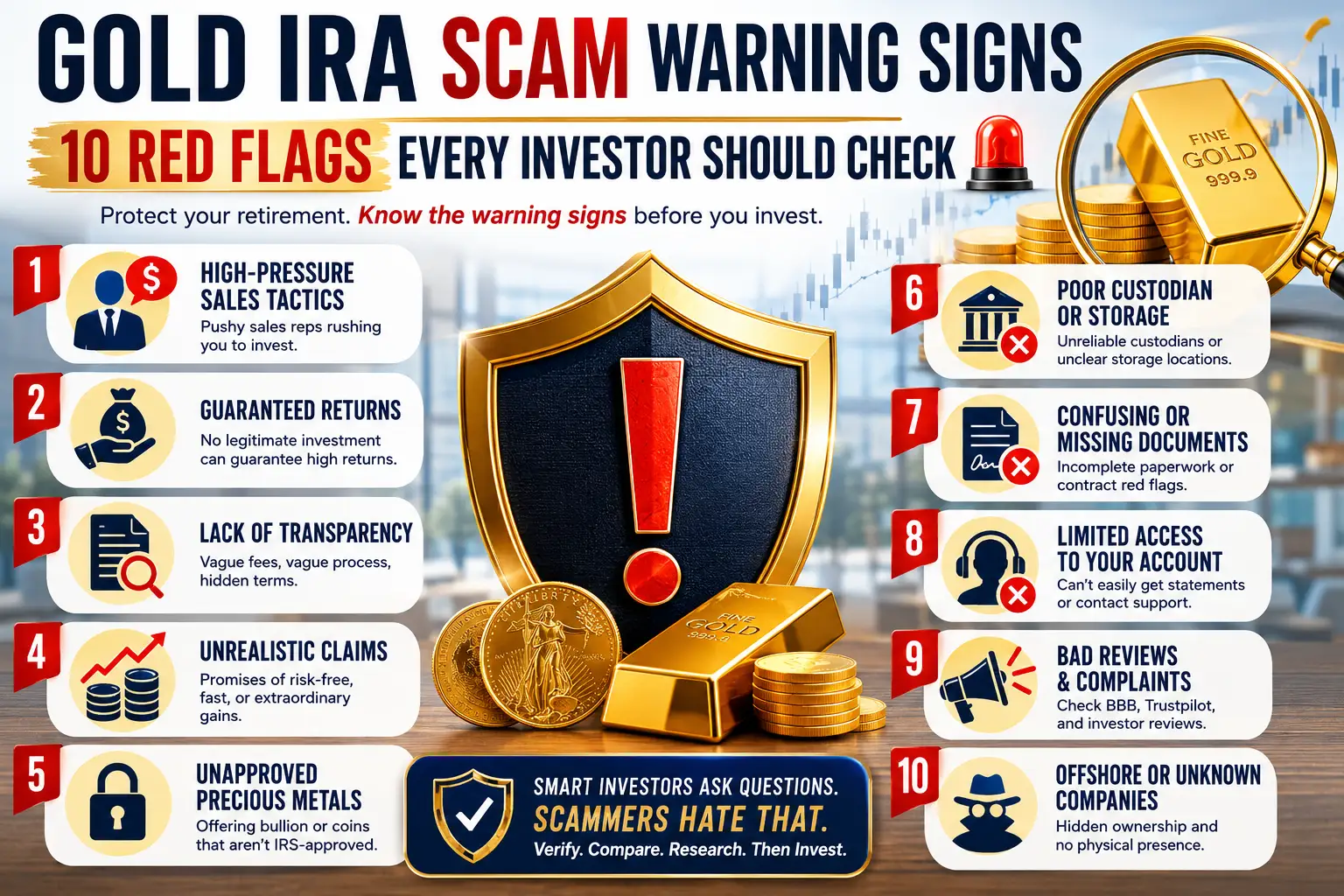
Independent coverage of Gold IRA scams and enforcement actions highlights several red flags that suggest slowing down and asking more questions.
- Unsolicited contacts and pressure tactics: Cold calls, unsolicited emails, and urgent pitches are frequent elements in metals fraud cases.
- Refusal to disclose fees and markups in writing: Providers that avoid written fee schedules or resist questions about spreads often leave investors exposed to high costs.
- Heavy emphasis on collectible coins in IRAs: Strong promotion of high-markup numismatic products instead of IRA-eligible bullion can indicate misaligned incentives.
- Encouragement to move all retirement funds into gold quickly: Pressure to transfer an entire retirement balance into a Gold IRA, especially under urgent framing, suggests the provider may not prioritize diversification.
- Persistent complaints and unresolved issues: Large numbers of complaints, unaddressed BBB files, or coverage of lawsuits may warrant closer review.
Internal resources such as Goldco Lawsuit 2026, Gold IRA Scam Warning Signs, and fee-focused pages like American Hartford Gold Fees 2026 can help investors compare how different companies handle disputes and charges.
Turn the 21 questions into a score
The Due Diligence Scorecard helps compare providers across fees, storage, rollover support, buyback terms, and public records.
Open the Scorecard →Internal Next Steps: Calculator, Quiz, Comparison Workbook, Provider Scorecard
After building a Gold IRA decision checklist, many retirement savers take a few low-commitment steps to compare scenarios and providers.
- Modeling allocations: The Gold IRA Calculator allows investors to compare metals-diversified scenarios with a stock-only baseline and see how different precious metals allocations might have behaved historically.
- Clarifying provider fit: The 2-minute Gold IRA matching quiz narrows provider matches based on retirement timing, savings band, and priorities.
- Comparing companies side by side: The Best Gold IRA Companies page, plus detailed reviews such as Goldco Review 2026, Augusta Precious Metals Review 2026, and Noble Gold Review 2026, help investors see how fees, service models, and minimums differ across firms.
- Using workbooks and scorecards: The Gold IRA Dealer Comparison Worksheet and Gold IRA Due Diligence Scorecard provide frameworks for recording answers to the 21 questions for each provider.
FAQ
What is a Gold IRA in simple terms?
A Gold IRA is a self-directed individual retirement account that holds physical gold and other precious metals that qualify under IRC §408(m) instead of only traditional securities. The account is managed by a custodian, funded through contributions or rollovers, and metals are stored at an approved depository.
Why are Gold IRA fees often higher than regular IRAs?
Gold IRAs add specialized custody and storage for physical metals, which can lead to setup fees, annual administration charges, vault costs, and dealer markups. Maintaining the account can cost several hundred dollars per year, especially when balances are modest.
What is the difference between segregated and commingled Gold IRA storage?
Segregated storage holds the investor's specific bars and coins separately under that account's name, while commingled storage pools similar products with other accounts. Segregated storage often costs more but may offer clearer identification.
Are home storage Gold IRAs allowed?
Home storage arrangements marketed as Gold IRAs can create prohibited transactions and tax risk because IRS rules require IRA metals to be held by an approved trustee or depository. Independent guides generally recommend avoiding home storage for IRA metals.
How do rollovers into Gold IRAs avoid penalties?
Direct custodian-to-custodian rollovers move funds without making the investor the payee, which helps avoid withholding and reduces penalty risk. Indirect rollovers must be completed within 60 days and require redeposit of the full distribution amount to avoid taxes and penalties.
What typical questions should investors ask about Gold IRA markups?
Key Gold IRA provider questions include asking for specific percentage markups on common bullion items, how spreads compare with industry averages, and how the provider earns profit on each sale. Independent sources suggest that very high markups on specialty coins are a common concern.
Can Gold IRAs hold silver, platinum, or palladium?
Gold IRAs are often set up as broader precious metals IRAs that can hold IRA-eligible silver, platinum, and palladium products alongside gold when eligibility rules are met. Eligibility depends on purity, product type, and custodian policies.
What happens to Gold IRA metals at retirement?
At retirement, investors can sell metals for cash distributions or, in some cases, take in-kind distributions of coins and bars, which are then valued for tax purposes. Standard IRA rules for required minimum distributions and income taxation apply depending on account type.
How do public complaints and lawsuits factor into Gold IRA due diligence?
Patterns of complaints, unresolved BBB issues, enforcement actions, or lawsuits can signal potential problems with fees, delivery, or sales practices. Reviewing these records and reading independent fee and lawsuit coverage is a core part of Gold IRA provider due diligence.
Are Gold IRAs suitable for every investor?
Gold IRAs may suit some retirement savers looking for precious metals exposure, but they are not universally suitable. Suitability depends on goals, risk tolerance, income needs, and comfort with the costs and complexity of self-directed precious metals accounts.
Article reviewed and edited by Daniel — independent precious-metals retirement researcher.