Educational only: This page explains federal retirement-account tax structure and precious-metals rules from published law and regulator guidance. It does not recommend a company, custodian, depository, dealer, product or allocation, and it is not financial, tax or legal advice. Some links elsewhere on this site may be sponsor links and the site owners may be compensated if customers request information from companies mentioned there. Customers should speak with a qualified financial or tax advisor before making retirement-account decisions. Past performance does not guarantee future results.
Treasury regulations state that each Roth IRA owner has only one five-taxable-year period for all the Roth IRAs of which that person is the owner. Opening a new self-directed Roth IRA to hold metals does not start a second owner-level clock.
Source: 26 CFR §1.408A-6, A-2 — “each Roth IRA owner has only one 5-taxable-year period … for all the Roth IRAs of which he or she is the owner”. See also IRS Publication 590-A. A separate five-taxable-year period is determined for each conversion under a different rule, explained below.
Key takeaways
- “Roth Gold IRA” is not a tax category. It is shorthand for a self-directed Roth IRA that holds qualifying physical metals. The Internal Revenue Code does not create a separate account type for it.
- Roth status does not change what may be held. The same §408(m) coin and bullion tests apply, because §408A(a) treats a Roth IRA in the same manner as an individual retirement plan except where §408A says otherwise.
- Existing Roth to self-directed Roth is not a conversion. A conversion moves money out of a non-Roth IRA. Roth money that moves to another Roth IRA was Roth before the move and stays Roth.
- Pre-tax money to Roth is the taxable route. From a traditional IRA it is a conversion; from a workplace plan it is a taxable qualified rollover contribution. Either way the previously untaxed amount is generally included in income.
- Two different five-year rules exist, and confusing them is the most common Roth error: one owner-level period for qualified distributions, and a separate period for each conversion used in the early-distribution rules.
- Roth does not loosen custody. Qualifying bullion must be in the physical possession of the IRA trustee. There is no Roth home-storage exception.
- The tax wrapper does not remove the costs. Purchase premium, dealer spread, storage, insurance and administration all reduce the amount that ever reaches a qualified distribution.
Transfer or Conversion? The Fork That Decides the Tax
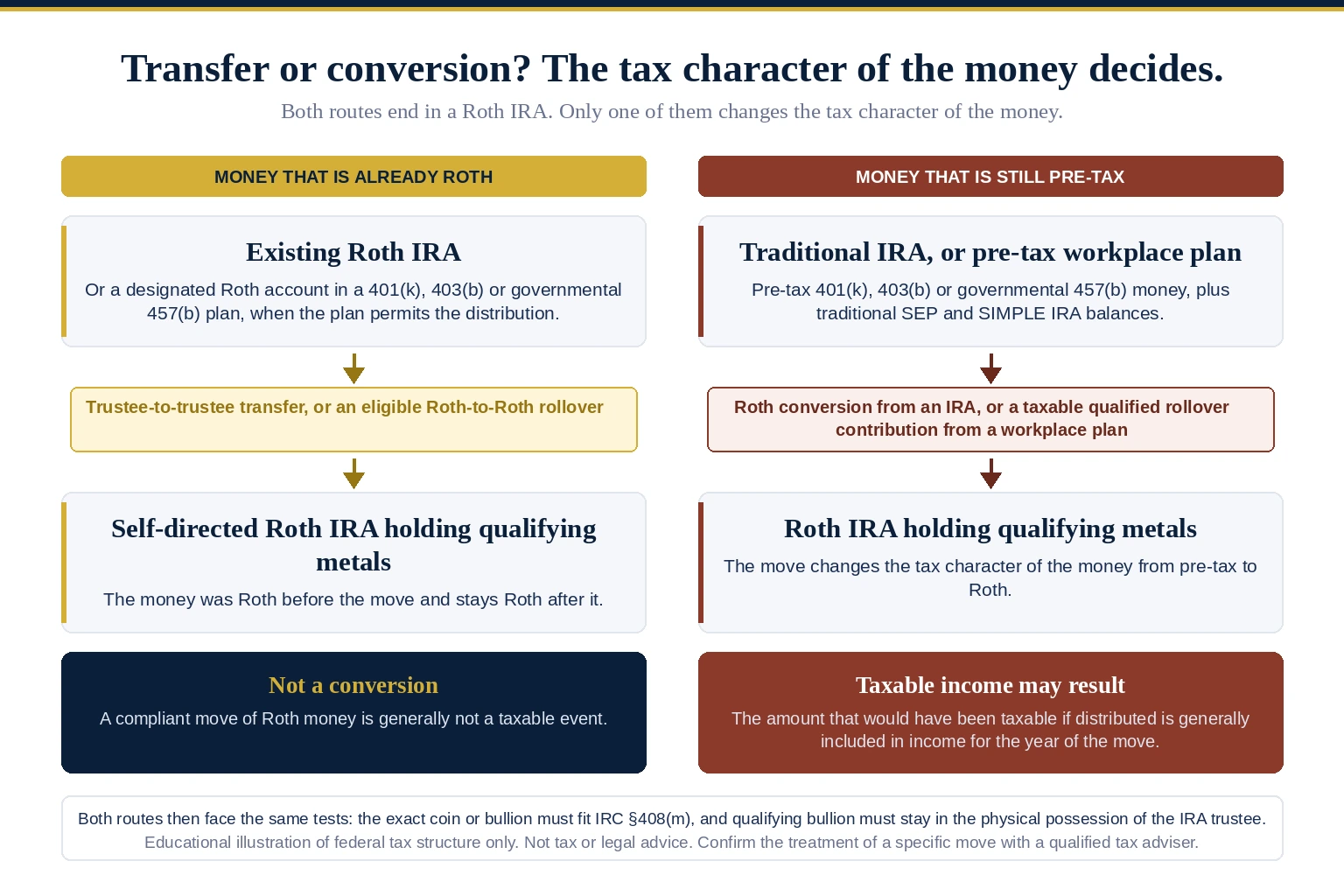
Almost every wrong answer in this area comes from treating two different transactions as one. The controlling text is Treasury Regulation §1.408A-4, which defines what a conversion is. A-1(c) confirms that a conversion is still a conversion “even if” it is accomplished by a trustee-to-trustee transfer, so the paperwork label does not decide the question. A-5 draws the other boundary in a single sentence: “Only amounts in another IRA can be converted to a Roth IRA” (26 CFR §1.408A-4).
Read together, those two answers settle the fork. Money that is already inside a Roth IRA cannot be “converted”, because a conversion is a movement out of a non-Roth IRA. Money that is still pre-tax has to change character to reach a Roth IRA, and that change is what produces income.
| Where the money is now | What the movement is called | Federal tax result if done correctly |
|---|---|---|
| An existing Roth IRA | Roth-to-Roth trustee transfer, or an eligible Roth-to-Roth rollover — not a conversion | The money was Roth before the move and stays Roth. A compliant move is generally not a taxable event. |
| A designated Roth account in a 401(k), 403(b) or governmental 457(b) plan | Direct rollover from a designated Roth account to a Roth IRA | A Roth-to-Roth movement of already-taxed contributions rather than a conversion of pre-tax dollars. Plan rules govern whether the distribution is available. |
| A traditional, SEP or SIMPLE IRA | Roth conversion under §1.408A-4 | The amount that would have been taxable if distributed is generally included in gross income for the conversion year. |
| Pre-tax money in a 401(k), 403(b) or governmental 457(b) plan | Taxable qualified rollover contribution — not a statutory conversion, because only IRA amounts can be converted | Practically similar: the previously untaxed amount is generally included in gross income for the year of the rollover. |
The fourth row is the one most often stated loosely. Because §1.408A-4 A-5 restricts the word “conversion” to amounts in another IRA, pre-tax workplace-plan money moved into a Roth IRA is more accurately described as a taxable qualified rollover contribution. The distinction rarely changes the arithmetic, but on a page whose entire subject is what a word means, the precise term is the honest one.
How an Existing Roth IRA Reaches Physical Metals
For a saver whose money is already Roth, the sequence is structural rather than tax-driven:
- Open a self-directed Roth IRA with a bank or an IRS-approved nonbank trustee that permits the asset class. The account is a Roth IRA; the self-direction describes the permitted asset menu, not a different tax status.
- Request a Roth-to-Roth trustee-to-trustee transfer from the existing Roth IRA. Because the money never reaches the account owner, this is the cleanest mechanism and it is not a conversion.
- The trustee executes the purchase under the account’s procedures once funds are available. The owner directs; the IRA buys and owns.
- The metal enters the custody arrangement, which for qualifying bullion means the physical possession of the trustee described in §408(a).
One warning if a 60-day rollover is used instead. An individual is generally limited to one IRA-to-IRA 60-day rollover in any 12-month period, counting all traditional, Roth, SEP and SIMPLE IRAs together. A failed second rollover can create taxable income, a possible early-distribution tax and an excess contribution. Trustee-to-trustee transfers sit outside that limit entirely, as do Roth conversions and plan-to-IRA rollovers (IRS — rollovers of retirement plan and IRA distributions). This is a strong practical reason to ask for a direct transfer.
The account, dealer and depository roles are set out in more detail in the precious metals IRA reference, and the step-by-step movement mechanics in the IRA to gold and silver transfer guide. For a source-by-source map of which accounts can move where, see the rollover eligibility matrix.
Roth 401(k), Roth 403(b) and Governmental Roth 457(b)
A designated Roth account is not a Roth IRA. It is a separate account inside a workplace plan, and the IRS states that a 401(k), 403(b) or governmental 457(b) plan may permit employees to designate contributions as Roth contributions (IRS — designated Roth account). All three are covered here rather than split across near-duplicate pages, because the analysis is the same for each.
The first question is never the plan type. It is the character of the dollars leaving the plan:
- Designated Roth money to a Roth IRA. A direct rollover from a designated Roth account to a Roth IRA is a Roth-to-Roth movement. It is not a conversion of pre-tax dollars, and the IRS reporting instructions provide for a zero taxable amount on a direct rollover of that kind (IRS — Instructions for Forms 1099-R and 5498).
- Pre-tax money to a Roth IRA. The same movement performed with pre-tax dollars is a taxable qualified rollover contribution, and the taxable amount is reported. “Direct rollover” does not mean “tax-free” when the tax character changes.
The plan has to allow the distribution first. A rollover is only possible when the plan permits a distribution, which for an employed participant often depends on age, separation from service or a specific plan provision. The tax rules do not override the plan document. A 403(b)-specific walkthrough is on the 403(b) to gold IRA rollover page, and the 401(k) case, including the designated Roth route, is covered in the 401(k) to Gold IRA rollover guide.
The workplace Roth clock does not travel. The years spent in a designated Roth account do not count towards the Roth IRA five-taxable-year period. If the saver already established a Roth IRA in an earlier year, that earlier Roth IRA clock is the one that applies after the rollover, which is another reason the owner-level rule below matters more than the new account’s opening date (IRS — FAQs on designated Roth accounts).
Once the money is inside the Roth IRA, the §408(m) eligibility and custody rules govern any metals purchase. The workplace plan itself never needs to hold bullion for the Roth IRA to hold it afterwards.
The Two Five-Year Rules Are Not the Same Rule
This is the point at which otherwise careful readers go wrong, because both rules are described as “the five-year rule”.
1. The owner-level qualified-distribution period. Treasury Regulation §1.408A-6 A-2 states that each Roth IRA owner has only one five-taxable-year period for all of that owner’s Roth IRAs. It begins with the first taxable year for which a contribution was made to any Roth IRA of that owner, or the year of the first conversion contribution if that came earlier (26 CFR §1.408A-6). Publication 590-A makes the same point from the other direction: rolling an amount from one Roth IRA to another does not change the five-year period used to determine qualified distributions (IRS Publication 590-A).
So a saver whose clock started years ago does not restart it by opening a self-directed Roth IRA for metals. A qualified distribution still needs both conditions: the five-taxable-year period and a qualifying event such as reaching age 59½, disability, death or the statutory first-home condition (IRS Publication 590-B).
2. The per-conversion period. Section 1.408A-6 A-5(c) provides that a five-taxable-year period is separately determined for each conversion contribution. That period is used in applying the additional tax on certain early distributions under §72(t) to converted amounts. It does not replace the owner-level clock, and it does not turn a Roth-to-Roth transfer into a conversion.
The practical consequence: converting pre-tax money shortly before taking a distribution is a materially different position from holding long-standing Roth money, even inside the same account. Anyone in that position should work the timing through with a tax adviser before the metal is bought, not afterwards.
Contribution Limits, RMDs and Ordering Rules
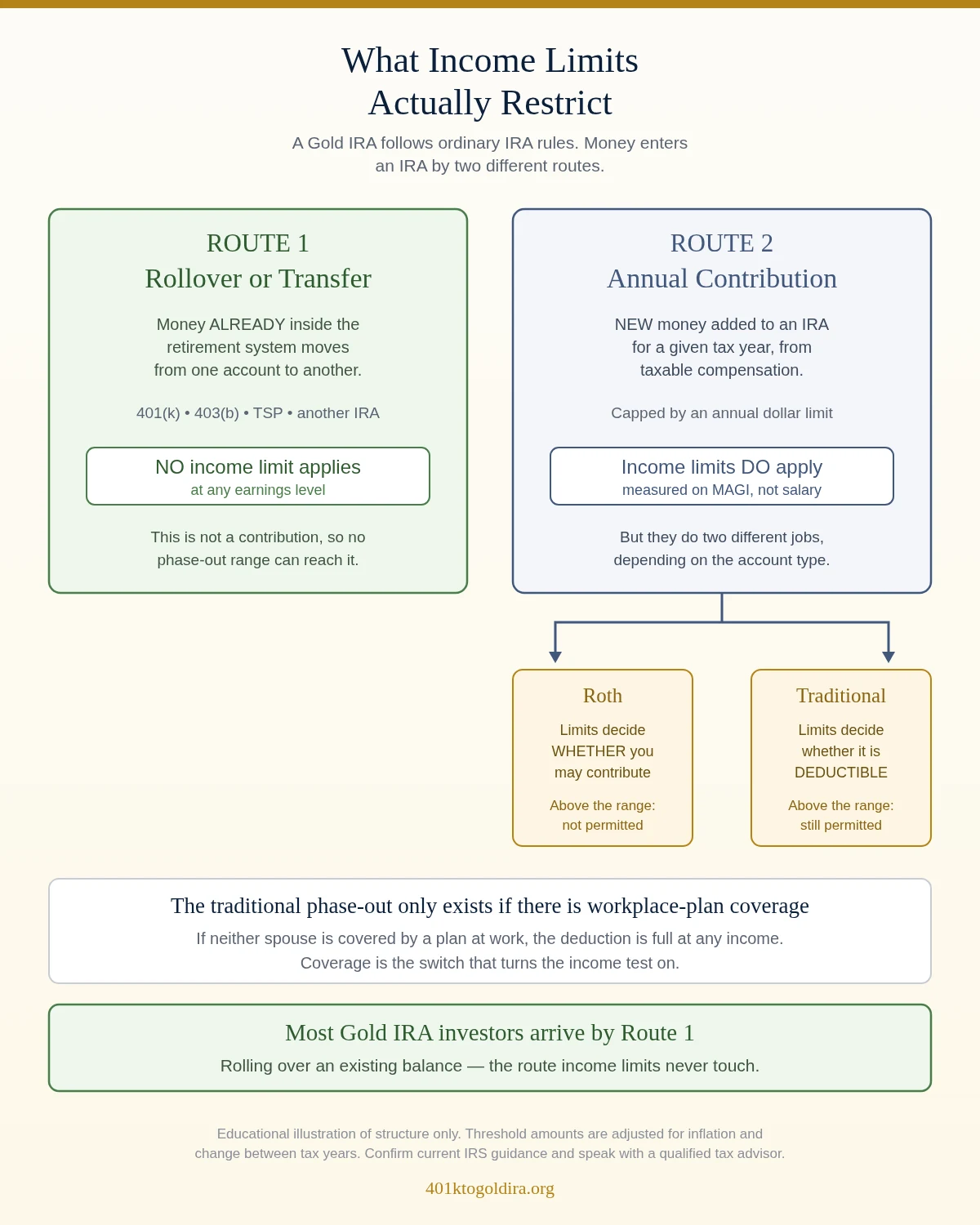
Income limits do not reach a transfer. Modified adjusted gross income limits restrict regular annual Roth contributions. A trustee-to-trustee movement of existing Roth money between Roth IRAs is not a new contribution, so a saver who is above the phase-out range for contributions can still have an entirely separate question about moving Roth money that is already there. The current-year phase-out ranges and the reduced-contribution calculation are set out on the gold IRA income limits page rather than duplicated here, because those figures are indexed annually.
No lifetime RMD for the original owner. The IRS states that withdrawals are not required from Roth IRAs while the account owner is alive; beneficiaries are subject to separate post-death rules (IRS — required minimum distributions). For physical metal this removes one specific pressure that exists in a traditional IRA, where an owner can be forced to sell or distribute metal to satisfy a lifetime distribution. It does not remove storage charges, valuation obligations or the ordinary reasons an owner might want liquidity. Traditional-account timing is covered on the gold IRA RMD strategy page.
Ordering rules apply to nonqualified distributions. Treasury Regulation §1.408A-6 A-8 and A-9 order the amounts coming out of a Roth IRA before it is qualified: regular contributions first, then conversion and rollover contributions on a first-in, first-out basis, then earnings, with all of the owner’s Roth IRAs aggregated for the purpose (26 CFR §1.408A-6; IRS Publication 590-B).
This is the reason “Roth means tax-free” is a slogan rather than a rule. A qualified distribution can be excluded from gross income. A nonqualified one has to be worked through the ordering rules, the applicable five-year periods and the early-distribution rules, and the answer depends on what the account contains and when it got there.
What Qualifies, and Why Roth Status Changes Nothing
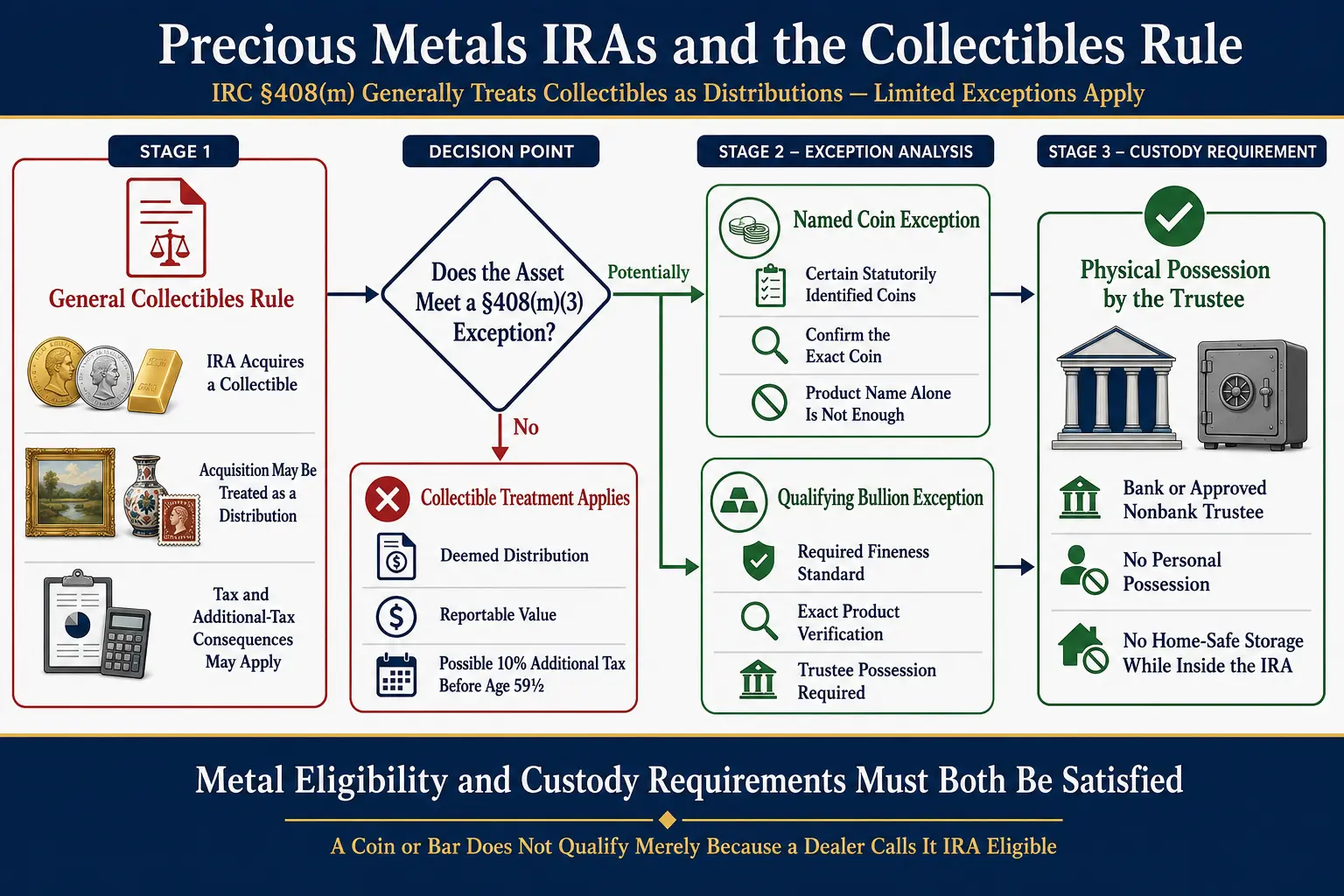
IRC §408A(a) provides that, except where §408A says otherwise, a Roth IRA is treated in the same manner as an individual retirement plan. Section 408(m) contains the collectibles rule and its precious-metals exceptions, and it does not contain a separate Roth list (26 U.S.C. §408A; 26 U.S.C. §408).
So the eligibility questions are exactly the ones a traditional IRA faces:
- What is the exact item? A coin must fit a statutory coin exception — certain named U.S. coins, or coins issued under the laws of a state. Otherwise the asset has to qualify as bullion.
- If it is bullion, does it meet the fineness test? Section 408(m)(3)(B) ties the standard to the minimum fineness required for metal deliverable under a regulated futures contract, rather than hard-coding a percentage.
- Is the custody condition satisfied? The bullion exception expressly requires physical possession by a trustee described in §408(a).
Publication 590-B similarly recognises that an IRA can hold specified U.S. gold and silver coins, certain platinum coins and qualifying bullion, rather than treating every metal purchase as a collectible distribution. Product-level classification is collected on the IRA-eligible precious metals reference.
Proof coins: what the statute does not say
Section 408(m) contains no blanket rule making a coin ineligible merely because it is described as a “proof”. That is a statement about what the statute does not say, and it is easy to over-read.
It does not establish that any particular proof product qualifies. The exact coin still has to be tested against a statutory exception, the trustee should state in writing the basis on which it accepts the item, and the position should be confirmed with a qualified tax adviser before purchase. Sales language such as “proof”, “collectible”, “numismatic” or “special issue” is marketing vocabulary, not a tax classification.
Custody: a Roth IRA creates no home-storage exception
Section 408(a) requires the IRA trustee to be a bank or another person demonstrating to the Treasury Secretary’s satisfaction that the trust will be administered consistently with the statute. Section 408(m)(3)(B) then requires qualifying bullion to be in the physical possession of that trustee. Publication 590-B states the operational rule plainly: the coins must be in the possession of the custodian or trustee of the IRA. The IRS IRA FAQ adds that the highly refined bullion exception depends on physical possession by a bank or an IRS-approved nonbank trustee (IRS — IRA FAQs).
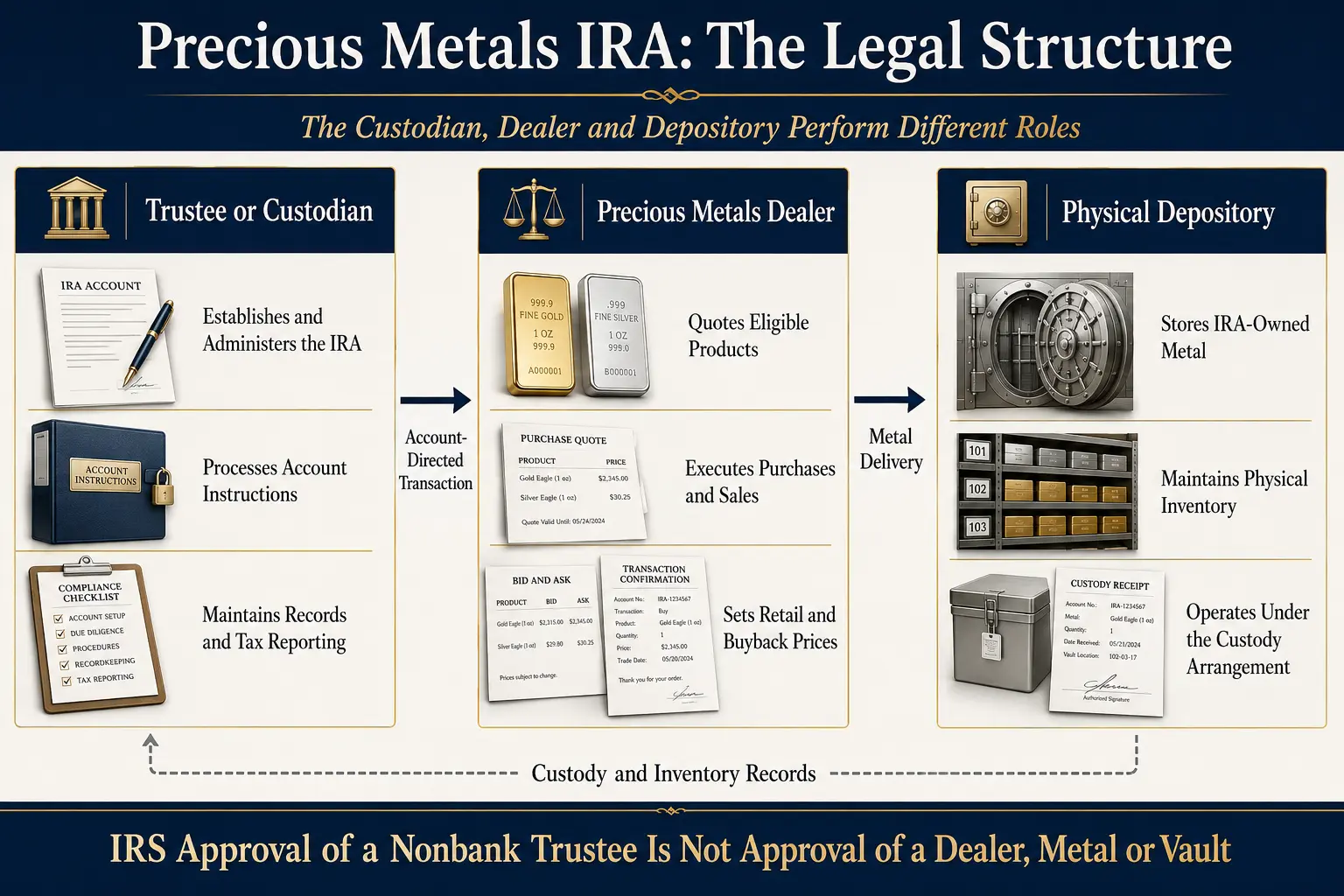
The terminology deserves care, because it is routinely inflated in marketing. The Code and the IRS qualify the trustee or custodian relationship. They do not create a category of “IRS-approved gold”, “IRS-approved coins” or “IRS-approved depositories”. A vault may perform physical storage within a trustee’s custody arrangement without that making the facility or the metal itself government-approved. The verification method is on the approved depository verification page, and the storage comparison on depository versus home storage.
McNulty v. Commissioner, 157 T.C. No. 10 (2021), is often cited as an illustration of what happens when an owner takes personal possession of IRA-owned coins. It is mentioned here only as illustration and carries none of the weight of the conclusion above, which rests on §408(m)(3)(B), Publication 590-B and the IRS FAQ. The docket, 1377-19, can be searched through the U.S. Tax Court DAWSON system.
A separate regime also applies regardless of §408(m). Section 4975 covers, among other things, the transfer or use of plan assets for the benefit of a disqualified person. Passing the product test does not immunise a transaction from the prohibited-transaction rules (26 U.S.C. §4975).
Moving Pre-Tax Money Into a Roth IRA That Holds Metals
This is the transaction most often blurred with a Roth-to-Roth transfer, and it is the one that generates a tax bill. The account-label question behind it is covered separately in rollover IRA vs Roth IRA.
From a traditional, SEP or SIMPLE IRA. This is a conversion. Treasury Regulation §1.408A-4 A-7 provides that the amount treated as distributed on conversion, to the extent it would be includible in income if distributed, is included in gross income. A-1(c) confirms the treatment applies whether the conversion is done by rollover, by trustee-to-trustee transfer, or with the same trustee. Publication 590-A covers the same ground for filers (26 CFR §1.408A-4; IRS Publication 590-A).
The tax attaches to the conversion year, not to the later year in which the Roth IRA happens to buy metal. If the traditional IRA is liquidated to cash and the cash converted, the conversion amount is the amount converted; the subsequent purchase inside the Roth IRA is an investment transaction, not a second conversion.
From a workplace plan. Because only amounts in another IRA can be converted, pre-tax 401(k), 403(b) or governmental 457(b) money moved to a Roth IRA is a taxable qualified rollover contribution. The previously untaxed amount is generally included in income for the year of the rollover.
The pro-rata rule when after-tax basis exists. A taxpayer generally cannot isolate after-tax basis in one traditional IRA and declare only that account converted. Form 8606 aggregates the value of all traditional IRAs, including traditional SEP and SIMPLE IRAs, in its basis computation, so a conversion from an account containing nondeductible basis is commonly part taxable and part not (IRS — Instructions for Form 8606). Pre-tax money still sitting in a 401(k) is not part of that IRA aggregation until it is moved into an IRA. The interaction is worked through on the income limits page and, for timing, on Roth conversions and market downturns.
The calculation belongs before the metal purchase, not reconstructed afterwards.
If the Metal Itself Is Converted In Kind
Where a traditional self-directed IRA already owns metal and the property itself is moved to a Roth IRA, the conversion needs a value. The operative authority is §408(d) together with Treasury Regulation §1.408A-4 A-7, which brings the amount that would be includible in income into gross income.
What could not be located matters as much as what could. No metals-specific valuation formula was found in the primary sources reviewed for this guide. The detailed valuation methods in §1.408A-4 A-14 are written for individual retirement annuities and annuity contracts, not for bullion, and should not be generalised into a bullion rule. Nor should “spot price times weight” be assumed to be the reported tax value.
The practical course is therefore procedural rather than arithmetic. Before an in-kind conversion, ask the custodian to state in writing:
- the value it will report for the exact metal being converted;
- the source of that value and the date on which it is taken;
- which tax forms will reflect the conversion, and when they will be issued.
Then confirm the treatment with a qualified tax adviser before the asset moves. If a custodian cannot explain its reporting method clearly, that is itself a reason to pause.
The Honest Tension: Tax-Free Growth Against Premium, Spread and Storage
The Roth attraction is straightforward. A qualified distribution can be excluded from gross income, so a saver who expects long-horizon appreciation may value a tax-free exit highly.
Physical metal introduces a cost problem that no tax rule touches. The CFTC advises buyers to obtain fees, costs, commissions and the agreed retail price in writing before signing, highlights storage, insurance and administrative charges, and explains that the difference between what a dealer sells at and buys back at determines how far the metal price must move before the customer is merely even (CFTC — 10 things to ask before buying physical gold, silver or other metals).
Stated plainly:
- Roth treatment can make qualified future gains tax-free;
- a purchase premium reduces how much metal each retirement dollar buys in the first place;
- storage, insurance and administration reduce net compounding every year they are charged;
- a buy/sell spread means the metal may have to appreciate before the position recovers its round-trip friction;
- physical metal can be slower to convert to cash than exchange-traded assets, and no repurchase policy should be treated as a guaranteed future price.
A tax exclusion applies to whatever balance survives those costs. If the drag is large enough, it can consume a meaningful part of the benefit the saver expected from tax-free appreciation.
A CFTC customer advisory issued during the CARES Act period described bullion commonly offered at a premium of roughly 5–10 per cent over spot, and numismatic coins promoted at 40–200 per cent above spot. Those are historical regulator examples from that advisory. They are not a 2026 benchmark, not a market average, and not a prediction of what any dealer charges today. For observed current figures use the site’s own research on markups and spreads, the dealer markup data and the fees benchmark.
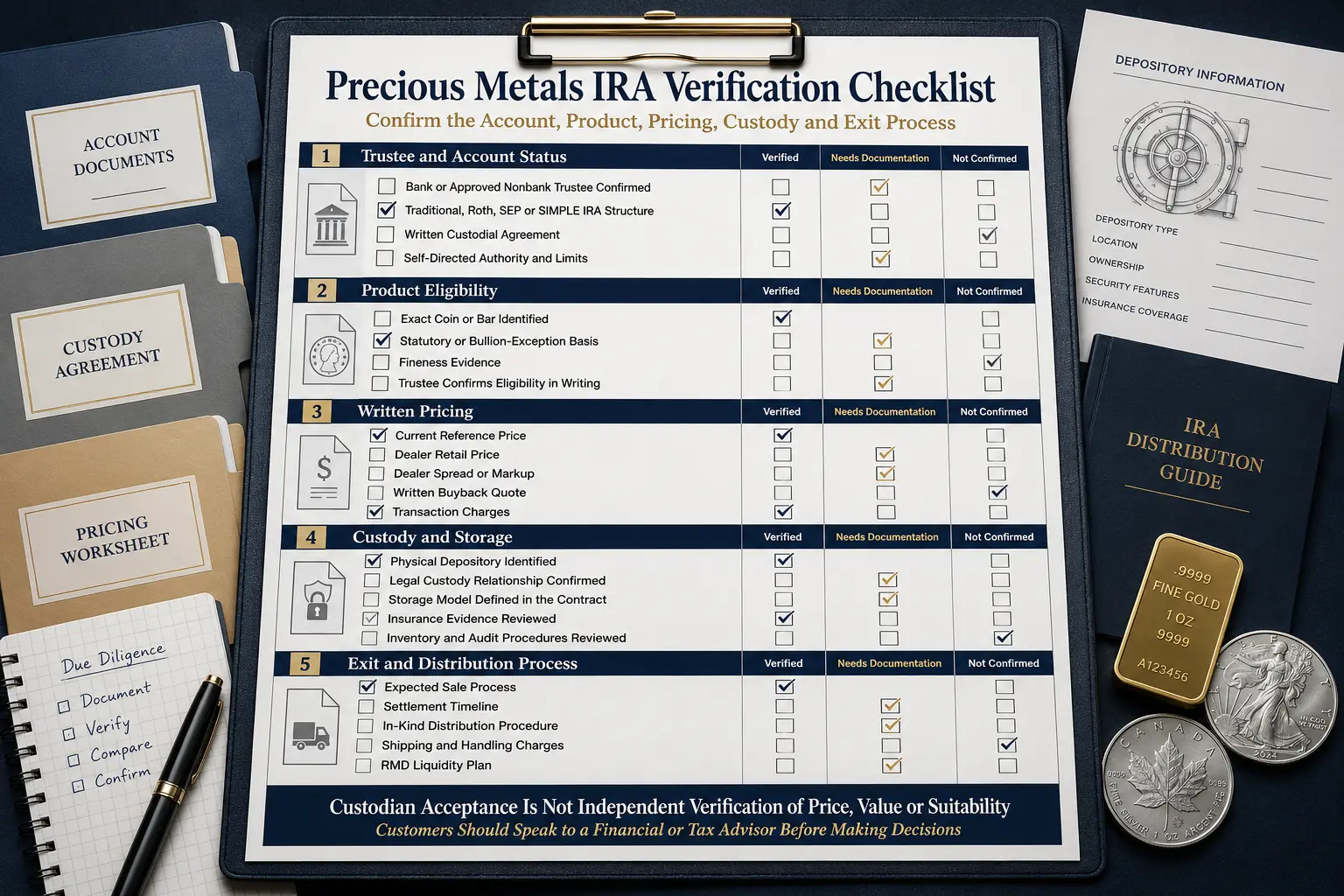
What to Get in Writing Before Funding
For a Roth saver, the paperwork should make the tax character, the product, the custody and the exit economics independently verifiable. Request:
- The account registration language. It should identify the receiving account as a Roth IRA. Where the money is already Roth, ask both trustees to describe the movement as a Roth-to-Roth transfer or eligible rollover rather than a conversion.
- The legal trustee identity and status. If the entity is not a bank, verify its approved nonbank trustee status directly rather than relying on a dealer’s description.
- The exact coin or bar before purchase. Product name, metal, weight, identifying description, and the basis on which the trustee says it fits §408(m).
- The custody and storage agreement. Which entity is the legal trustee, where the metal is stored, who may give withdrawal instructions, and how IRA ownership is documented.
- Written pricing before the order. The reference metal price used, the actual retail price, every transaction charge, and what the dealer would pay to repurchase the same item at that moment — understood as a quote, not a guarantee.
- All recurring charges, itemised. Account administration, storage, insurance-related charges, transaction fees, shipping and any termination or distribution charge.
- The valuation policy. How fair market value is established and reported for in-kind conversions or distributions, with the source and date.
- The liquidation and in-kind distribution procedure. Normal timescales, required documentation, and what happens when cash is needed quickly.
- The prohibited-transaction policy. How the trustee handles transactions involving the owner, family members or controlled businesses.
The quote checklist and the questions to ask before opening an account put the same discipline into a printable form.
What This Guide Could Not Establish
Stating the limits is part of the analysis:
- No metals-specific in-kind conversion valuation formula was located in the primary sources reviewed. The detailed methods that exist in §1.408A-4 A-14 are annuity-specific.
- No enforcement matter was located in which the precious-metals rule turned on the account being a Roth IRA rather than an IRA generally. That is a negative search result rather than proof that none exists; general precious-metals IRA enforcement does exist.
- No separate Roth fineness or custody standard was found, and the statute points the other way: §408A(a) applies the general IRA framework and §408(m) contains one metals exception rather than a Roth version.
Readers who have finished the legal and cost work and now want to compare commercial options can use the site’s gold IRA company comparison or the gold IRA quiz. Neither is the evidence base for anything on this page, and neither replaces advice from a qualified tax adviser.
Sources
Primary sources were preferred throughout: the Internal Revenue Code and Treasury regulations first, then IRS publications, forms and guidance, then regulator consumer guidance. Company marketing and affiliate review pages were not used as legal authority. All links below were checked on 31 August 2026.
- 26 U.S.C. §408A — a Roth IRA is treated in the same manner as an individual retirement plan except where §408A provides otherwise.
- 26 U.S.C. §408 — the trustee requirement in §408(a), and the collectibles rule and precious-metals exceptions in §408(m), including the physical-possession condition in §408(m)(3)(B).
- 26 CFR §1.408A-4 — A-1(c) on conversions accomplished by trustee-to-trustee transfer, A-5 limiting conversions to amounts in another IRA, and A-7 on income inclusion.
- 26 CFR §1.408A-6 — A-2 on the single owner-level five-taxable-year period, A-5(c) on the separate period for each conversion, and A-8 and A-9 on distribution ordering and aggregation.
- IRS Publication 590-A — contributions, conversions, and confirmation that a Roth-to-Roth rollover does not change the five-year period used for qualified distributions.
- IRS Publication 590-B — qualified distributions, distribution ordering, permitted coins and bullion, and the requirement that IRA coins remain in the possession of the custodian or trustee.
- IRS — Retirement plans FAQs regarding IRAs — the highly refined bullion exception and possession by a bank or IRS-approved nonbank trustee.
- IRS — Approved nonbank trustees and custodians — the published list against which a nonbank trustee claim can be checked.
- IRS — Designated Roth account and FAQs on designated Roth accounts — designated Roth accounts in 401(k), 403(b) and governmental 457(b) plans, and the independent five-year periods.
- IRS — Instructions for Forms 1099-R and 5498 — reporting for direct rollovers from a designated Roth account to a Roth IRA, and the treatment of Roth-to-Roth movements.
- IRS — Rollovers of retirement plan and IRA distributions — the one-rollover-per-12-month limit and the movements it excludes.
- IRS — Required minimum distributions — no lifetime withdrawals required from a Roth IRA while the owner is alive.
- IRS — Instructions for Form 8606 — aggregation of traditional IRA values in the basis and pro-rata computation.
- 26 U.S.C. §4975 — prohibited transactions involving disqualified persons, which apply separately from §408(m).
- CFTC — 10 things to ask before buying physical gold, silver or other metals — written pricing, dealer spread, storage, insurance and administrative costs.
- U.S. Tax Court — DAWSON — docket search, including McNulty v. Commissioner at docket 1377-19, mentioned in this guide only as illustration.
Tax rules and indexed figures change between years. Any figure or rule should be confirmed against current IRS guidance for the relevant tax year before it is relied on.
Frequently Asked Questions
Can a Roth IRA hold physical gold?
A Roth IRA can hold physical gold, silver, platinum or palladium that fits one of the statutory exceptions in §408(m) and satisfies the custody rules, when the trustee permits the asset. Roth status does not create a separate eligibility list and does not relax the custody rule. The exact coin or bullion decides, not the account type.
Is moving an existing Roth IRA to a gold IRA a Roth conversion?
No. A conversion moves an amount out of a non-Roth IRA. Money already in a Roth IRA is already Roth, so moving it to another Roth IRA that permits metals is a transfer or Roth-to-Roth rollover, and a compliant move is generally not a taxable event.
Does opening a new self-directed Roth IRA restart the five-year rule?
Not the owner-level clock. Treasury Regulation §1.408A-6 A-2 gives each Roth IRA owner one five-taxable-year period across all of that owner’s Roth IRAs. A separate period is determined for each conversion contribution under A-5(c), but that is a different rule serving the early-distribution provisions.
Is pre-tax 401(k) money moved into a Roth IRA a conversion?
Not in statutory terms. Only amounts in another IRA can be converted, so pre-tax workplace-plan money moved to a Roth IRA is a taxable qualified rollover contribution. The practical effect is similar, because the previously untaxed amount is generally included in income for that year.
Can Roth IRA gold be stored at home?
Not while relying on the bullion exception. Section 408(m)(3)(B) requires qualifying bullion to be in the physical possession of a trustee described in §408(a), and Publication 590-B states that IRA coins must be in the possession of the custodian or trustee. There is no Roth home-storage exception.
Do Roth income limits stop a Roth IRA transfer?
No. Income limits apply to regular annual Roth contributions. A trustee-to-trustee transfer of existing Roth money between Roth IRAs is not a contribution, so the contribution phase-out is not the test for it.
Do Roth IRA owners have to take required minimum distributions?
The IRS states that the original owner is not required to take withdrawals while alive; beneficiaries remain subject to post-death rules. For an illiquid asset such as metal, that removes one reason an owner might otherwise have to sell, without removing storage, administration or transaction costs.
Are proof gold coins allowed in a Roth IRA?
The statute does not categorically disqualify every coin described as a proof, but that does not establish that any particular product qualifies. The exact coin must be tested against a statutory exception, the trustee should give its written basis for accepting it, and a qualified tax adviser should confirm the position.
How is physical metal valued in an in-kind Roth conversion?
An in-kind conversion needs a value under §408(d) and Treasury Regulation §1.408A-4 A-7. No metals-specific formula was located in the sources reviewed, and the detailed methods in A-14 are annuity-only. Ask the custodian to state in writing the value it will report, its source and its date, then confirm with a tax adviser.
Does a Roth Gold IRA make withdrawals tax-free?
A qualified Roth distribution may be excluded from gross income. A nonqualified distribution is analysed under the ordering rules, the applicable five-year periods and the early-distribution rules, so “tax-free at withdrawal” is too broad to be relied on as a general statement.
This page explains federal tax and legal structure. It does not determine whether physical precious metals are suitable for any particular saver, does not recommend a company, custodian, depository, dealer or product, and does not replace individualised tax or legal advice. Tax outcomes depend on individual circumstances and rules change. Customers should speak with a qualified financial or tax advisor before making retirement-account decisions. Past performance does not guarantee future results.