Gold IRA Provider Transparency Scorecard
Ten publicly verifiable disclosure criteria an investor can apply to any Gold IRA provider — does it publish fees, name its custodian and depository, put buyback terms in writing? This scores transparency, not reputation: it measures how openly a company discloses checkable facts, so any provider can be compared objectively.
View the Scorecard →Educational only: This scorecard measures publicly verifiable disclosure, not quality, suitability, pricing, or reputation, and it makes no claim about any specific company. It is not financial, tax, or legal advice and not a recommendation. Customers should verify each item against the provider's own materials and public records, and speak with a financial or tax advisor. Goldco does not offer tax or legal advice. Past performance does not guarantee future results.
Two of the five most frequently reviewed Gold IRA providers publish a recurring annual cost on their own website. None publishes it at the URL a customer would try first. Checked 10 September 2026.
Spot check of criterion 1 across American Hartford Gold, Augusta Precious Metals, Goldco, Birch Gold Group and Noble Gold Investments, each against its own domain. Full results and method in the fee-disclosure check below. This is a finding about published disclosure only — it says nothing about any company's pricing, conduct or quality.
Key takeaways
- As of 10 September 2026, 2 of 5 frequently reviewed Gold IRA providers published enough on their own website for a prospective customer to work out the recurring annual cost without speaking to a salesperson. Birch Gold Group states a $235 annual total; Noble Gold states figures totalling $285.
- 0 of 5 publish it at the conventional
/gold-ira-fees/path. Every one of those requests fails, so a customer looking in the obvious place finds nothing at any of the five. - Where a schedule exists, the charges are not necessarily the dealer's. Birch introduces its list as fees “for the custodian and depository that most customers of Birch Gold Group use”. Augusta describes the same charges as belonging to the custodian and depository while publishing only typical industry ranges rather than its own numbers.
- Both providers that publish a schedule also publish a second, conflicting figure elsewhere on the same website.
- The scorecard measures disclosure only: whether a checkable fact is published, never whether a company is good, fairly priced or suitable.
- All ten criteria are publicly verifiable — two people scoring the same provider on the same day should reach the same result.
- Every finding is dated, because published pages change; a company can gain or lose a point by editing its website.
- Non-disclosure at a checked location is a fact about a web page at a date — not evidence of concealment or misconduct.
Quick Answer: What This Scorecard Measures (and What It Doesn't)
This is a neutral, self-scoring framework: an investor applies ten disclosure criteria to any Gold IRA provider and awards one point per criterion the company publicly and verifiably meets. A parallel framework for the custodian specifically, covering legal status and the governing agreement, is set out in how to compare Gold IRA custodians without ranking them. It measures transparency — how openly a provider discloses checkable facts like fees, custodian, depository, and buyback terms. It deliberately does not score quality, price competitiveness, suitability, or reputation, and it makes no claim about any named company. A transparent provider is simply easier to evaluate; the investor still has to compare the actual fees and terms and check public records. The point is objectivity: every item is verifiable, so two people scoring the same provider should reach the same result.
The Fee-Disclosure Check: What Five Providers Actually Publish
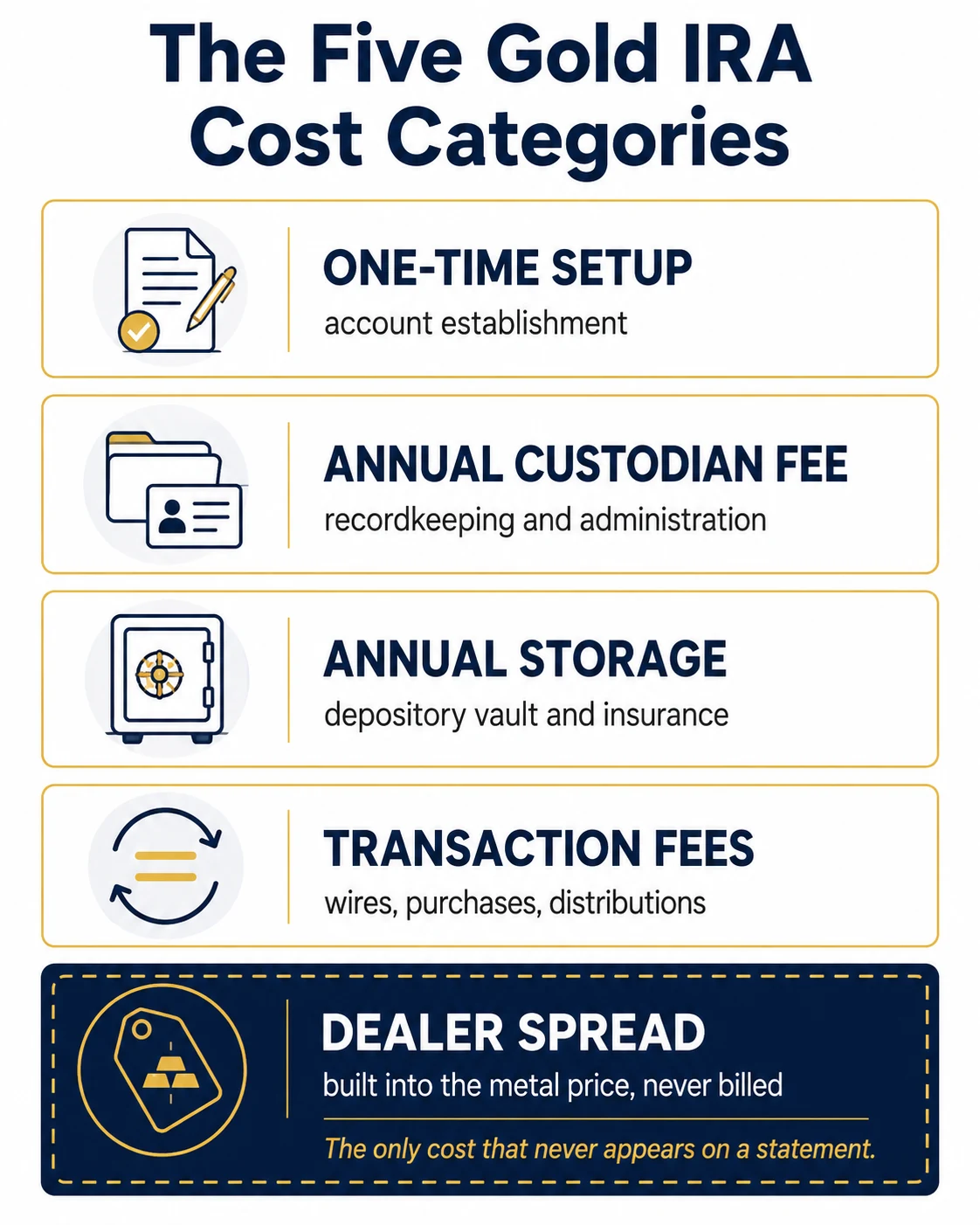
Criterion 1 asks whether setup, annual custodian and storage fees are stated in writing on the provider's own site. To establish whether that is a realistic expectation or an unusual one, each provider's own website was searched for a published recurring annual cost — not one predetermined URL — and the party imposing each charge was recorded alongside it. The conventional /gold-ira-fees/ path was also requested on each domain and recorded separately, because where a company publishes is a different question from whether it publishes.
| Provider | Page carrying the disclosure | Recurring cost determinable? | Who imposes the charge | What the company publishes |
|---|---|---|---|---|
| Birch Gold Group | birchgold.com/precious-metals-ira/ | Yes — recurring cost stated | Custodian and depository | The main Precious Metals IRA page lists $50 account set-up, $30 wire, $110 storage/insurance and $125 management, and states a $235 annual total. Birch introduces the list as fees "for the custodian and depository that most customers of Birch Gold Group use" — the charges are attributed to those parties, not to Birch. A second figure of $100 storage appears on its Gold IRA and Silver IRA sub-pages, so two storage figures are live at once. The conventional /gold-ira-fees/ path returns a 404. |
| Noble Gold Investments | noblegoldinvestments.com/invest/gold-ira/ | Yes — recurring cost stated | Not attributed | The Gold IRA product page lists $50 set-up, $30 wire, $125 annual maintenance and $160 annual metals storage. Noble's Support page publishes a different schedule for the same product — $80 set-up, $125 custodial services and $150 segregated storage, a $275 recurring total — and cautions that an advertised $160 annual fee "typically refers to commingled storage", which it says it does not recommend. Neither page states which storage type the $160 buys. The conventional /gold-ira-fees/ path returns a 404. |
| Goldco | goldco.com/gold-ira/ | No — no amount published | n/a | The Gold IRA guide carries live metal spot prices and IRS contribution limits but no set-up, custodian or storage amount. The conventional /gold-ira-fees/ path returns a 404. |
| Augusta Precious Metals | augustapreciousmetals.com/gold-ira/ | No — industry ranges only | Custodian and depository (described generally) | The Gold IRA page describes four layers of cost and gives typical industry ranges — an annual custodian fee "typically $75–$150 per year" and an annual storage fee "typically $100–$150 per year" — while stating set-up "varies by custodian". These are market ranges attributed to third parties rather than Augusta's own schedule. The page is unusually direct about the spread, calling it "the cost nobody talks about clearly". A Gold & Silver IRA fee-sheet PDF the company previously published now returns a 404. |
| American Hartford Gold | americanhartfordgold.com/gold-ira/ | No — no amount published | n/a | The Gold IRA URL redirects to /gold-ira-comparison/, an evaluation guide containing no fee amount of any kind. Its Gold IRA material discusses fees in general terms and advises readers to "look for fee disclosures"; part of the FAQ is served as an image rather than searchable text. |
Result: 2 of 5, as checked on 10 September 2026. Birch Gold Group and Noble Gold Investments each publish enough on their own site for a prospective customer to reach a recurring annual figure without speaking to a salesperson. Goldco and American Hartford Gold publish no amount at all. Augusta Precious Metals publishes typical industry ranges attributed to custodians and depositories rather than its own schedule.
Two qualifications matter more than the headline count. First, none of the five publishes at the conventional /gold-ira-fees/ path, so the disclosure that exists is not where a customer would look for it. Second, both providers that publish a figure also publish a conflicting one elsewhere on the same website — Birch states $110 storage on its main IRA page and $100 on its Gold IRA and Silver IRA sub-pages; Noble states a $285 recurring total on its product page and $275 on its Support page. Publishing a schedule and publishing a single consistent schedule are not the same achievement.
Because published pages change, each finding is a dated observation of what was served on the date checked. An earlier version of this page reported 0 of 5 by testing only the conventional fee-page URL. That test measured URL naming convention rather than disclosure, and understated what two of these companies actually publish; it was replaced on 10 September 2026.
Download the Scorecard Criteria and Fee-Check Findings (CSV)
Sources last reviewed: 10 September 2026. Each provider’s own website was checked for a published recurring cost on that date; the separate conventional-path check carries its own 9 July 2026 date, and both are recorded in the CSV. Published pages change without notice, so confirm anything material against the provider’s current page.
What this check does and does not establish
It establishes that a reader looking for published fees at the conventional URL on any of these five sites will not find them there. That is a factual observation about published web pages, checkable by anyone in a browser.
It does not establish that any company conceals its fees, charges more than a competitor, or behaves improperly. A fee figure may be disclosed elsewhere on a site, inside a requested information kit, in account-opening documents, or verbally. This check looked for a published schedule at the expected location and recorded what was returned. Nothing here is a judgement about pricing, conduct or quality.
Why it matters anyway. Fees in this market genuinely vary by account size, custodian, depository, live promotion and negotiation, so a single published number could not be accurate for every reader. But that explains variation, not absence. The practical consequence is that a reader cannot compare providers on cost from published information alone, and must obtain figures in writing for a specific account before comparing — which is exactly what CFTC and FINRA guidance advises.
The American Hartford Gold fees page documents one of these cases in detail, including how third-party sources reporting that company's fees contradict each other. Criterion 3 — naming the custodian — can be taken further: the IRS trustee verification method shows how to check a named custodian against the IRS's own published list, and why a "depository under the trustee's control" badge is not the same claim.
The 10 Transparency Criteria
Award one point for each criterion a provider publicly and verifiably discloses. Check the provider's own website and documents, plus public records such as BBB and regulator profiles.
| # | Criterion | What to check (publicly verifiable) | Why it matters |
|---|---|---|---|
| 1 | Published fee schedule | Are setup, annual custodian, and storage fees stated in writing on the site (not 'call for pricing')? | Opaque pricing is the most common cost complaint; a written schedule is the baseline of transparency. |
| 2 | Dealer markup / premium disclosure | Does the provider explain how metal is priced over spot, or give example premiums? | The dealer premium is often the largest cost and the least disclosed. |
| 3 | Named custodian | Is the self-directed IRA custodian named, not just implied? | The custodian holds the account; naming it lets an investor verify it independently. |
| 4 | Named depository | Is the approved depository named, with segregated/commingled options explained? | Storage location and form are verifiable facts a transparent provider states. |
| 5 | Buyback terms in writing | Is there a written buyback policy, including how the buyback price is set? | Exit terms decide real cost; a written policy beats a verbal assurance. |
| 6 | Minimum investment stated | Is the minimum initial investment published? | A stated minimum lets investors self-select without a sales call. |
| 7 | Metal eligibility clarity | Does the provider distinguish IRS-eligible bullion from collectible/proof products? | Clarity here reduces the risk of high-premium 'exclusive coin' upsells. |
| 8 | Public complaint record | Is there a checkable BBB / regulator profile, and does the provider acknowledge it? | A verifiable complaint record (and how complaints were handled) is public information. |
| 9 | Custody & storage compliance statements | Does the provider state that metal is held by a qualified custodian at an approved depository (not home storage)? | A transparent provider aligns with IRS custody expectations rather than marketing 'home storage'. |
| 10 | Clear, non-pressure disclosures | Are risks, fees, and 'past performance' disclosures present, without urgency or fear tactics? | Balanced disclosure signals a compliance-minded operator. |
Criterion 3 — whether a provider names its custodian — now has a companion dataset: the custodian & depository relationship database records which providers actually disclose those relationships, with evidence tiers and dates. The fee-disclosure norms sit alongside the actual cost data in the fees benchmark.
How to Score a Provider (Step by Step)
- Open the provider's own website and any published fee or policy documents.
- Check public records: the BBB profile and relevant regulator databases (SEC, CFTC, state securities regulators).
- For each of the ten criteria, award one point only if the item is publicly and verifiably disclosed. If it requires a phone call to learn, it does not score.
- Total the points out of ten. Treat it as a transparency comparison across providers, not a quality ranking.
- Then dig into the actual numbers — a transparent provider still has to have competitive fees and fair buyback terms.
Pair this with the written questions in 21 questions to ask before opening a Gold IRA, log providers side by side in the comparison workbook, and put real numbers to the fee criteria with the fee calculator and fees benchmark.
Why Transparency Is Scored Separately From Quality
A company can disclose everything and still be expensive, and a company can be reticent yet fair. Mixing the two produces subjective, disputable ratings. By scoring only publicly verifiable disclosure, this framework stays objective and defamation-safe: it never asserts that a provider is good, bad, overpriced, or untrustworthy — only whether specific facts are openly published. That keeps the tool useful for comparison while leaving quality and suitability judgments to the investor and their advisor. Red flags that go beyond disclosure are covered separately in scam warning signs.
How to Cite This Page
Two of the five most frequently reviewed Gold IRA providers — Birch Gold Group and Noble Gold Investments — publish enough on their own website for a prospective customer to determine the recurring annual cost without speaking to a salesperson, as checked on 10 September 2026. None of the five publishes it at the conventional /gold-ira-fees/ path, and both providers that publish a figure also publish a conflicting one elsewhere on the same site. Compiled by 401ktogoldira.org from direct observation of each company's own website.
Source: 401ktogoldira.org — Gold IRA Provider Transparency Scorecard (10 disclosure criteria).
Publisher: 401ktogoldira.org
URL: https://401ktogoldira.org/gold-ira-provider-transparency-scorecard/
Sources last reviewed: 10 September 2026 (conventional-path check 9 July 2026)
Accessed: state the date you retrieved the page, as published provider pages change without notice.
To cite one provider or criterion rather than the page, append its row anchor to the URL — for example #row-check-goldco or #row-crit-named-custodian. Row anchors are derived from the provider name or criterion text, not row position, so they stay stable when rows are reordered or renumbered.
Methodology
The fee-disclosure check. Five providers were selected as those most frequently reviewed across major comparison coverage. For each, the conventional fee-page path was requested on the company's own domain and the response recorded — HTTP status, any redirect target, and what appeared in place of a schedule. No inference was involved: the table reports what each request returned. Sites change, so the check is reproducible rather than permanent, and any reader can repeat it in a browser. The check covers one criterion at one location; it is not a full audit of every page on those sites, and a fee figure disclosed elsewhere would not have been captured.
The scorecard defines ten disclosure criteria drawn from the cost, custody, and due-diligence factors covered across this site. Each criterion is binary and publicly verifiable: it is met only if the information is openly published by the provider or available in a public record, without a sales call. The framework scores disclosure transparency only; it does not weight criteria, rate quality, assess suitability, or make claims about any specific company. It is educational, and scoring outcomes depend on what each provider publishes at the time of checking, which can change. Confirm every item directly and consult a professional before deciding.
Frequently Asked Questions
What is a Gold IRA provider transparency scorecard?
It is a neutral checklist of ten publicly verifiable disclosure criteria — such as whether a provider publishes its fees, names its custodian and depository, and states buyback terms — that an investor can apply to any Gold IRA company. It scores disclosure and transparency, not quality, suitability, or reputation.
Does a high transparency score mean a company is the best choice?
No. The scorecard measures how openly a provider discloses verifiable information, not whether its prices are competitive or whether it suits any individual. A transparent provider is easier to evaluate, but investors should still compare fees, buyback terms, and public records, and speak with a financial or tax advisor.
How should the scorecard be used?
Apply the ten criteria to each provider being considered, checking the provider's own website and public records such as BBB or regulator profiles. Award one point per criterion that is publicly and verifiably met. Use the result to compare how transparent providers are, then dig deeper on fees and terms.
Where does the information to score a provider come from?
Only from publicly verifiable sources: the provider's own published website and documents, and public records such as BBB profiles and regulator databases. The scorecard deliberately excludes anything that would require a sales call or private information, so it stays objective and checkable.
Update Log
- 24 September 2026: Structural citation pass — descriptive IDs added to the remaining headings, stable per-row anchors derived from the provider name and criterion text, row-header scopes, table captions, the two citation blocks consolidated into one, a visible review date, and Dataset metadata describing the variables, method and downloadable CSV. No provider, finding, criterion or observation date was re-checked or changed by this pass; the findings still carry their 10 September and 9 July observation dates, and the CSV is unchanged.
- July 2026: Initial transparency scorecard published with the ten disclosure criteria, scoring method, methodology, and FAQ schema. Five-provider fee-disclosure check performed July 9, 2026.
- 10 September 2026: Criterion 1 re-measured and the headline finding corrected. The original check requested one conventional fee-page URL (
/gold-ira-fees/) on each domain and reported 0 of 5. That tested URL naming convention rather than disclosure: Birch Gold Group and Noble Gold Investments each publish a recurring annual cost elsewhere on their own sites, so the finding understated actual disclosure. The check now searches each provider's own website for a published recurring cost, records the party imposing each charge, and reports the conventional-path result separately. Result revised to 2 of 5. - August 2026: Key-takeaways summary, dated-observation framing and downloadable CSV added; schema completed. The July 9 fee-check findings stood at that point; they were superseded by the 10 September re-measurement recorded above, which establishes the current 2-of-5 disclosure result. The July 9 conventional-path observation is retained separately and remains accurate as a record of what that one URL returned on that date. Re-checking is a periodic task, since any provider can change its result by editing its site.
Reviewed and edited by Daniel M. — editor, 401kToGoldIRA.org. How figures on this site are produced and checked is set out in the research methodology, and errors are handled under the corrections policy.