IRA-Eligible Precious Metals: Coins, Bars and the Three Tests That Decide
Published pages contradict each other on this question — one lists the Chinese Gold Panda as eligible, another lists it as not approved. The contradictions are not random. They come from blending three separate questions into one: whether a product is named by statute, whether it may satisfy the separate bullion test, and whether a particular custodian will accept it. This reference separates them, traces each product to a government or statutory source, and states plainly where no primary authority resolves the answer.
View the Classification Table →Educational only: This reference describes statutes, regulator materials and a public court decision in general terms. It is not legal or tax advice, not a statement of how any law applies to an individual, and not a recommendation of any product, dealer, custodian or depository. Customers should speak to a qualified tax professional or attorney. Goldco does not offer tax or legal advice. Past performance does not guarantee future results.
Exactly four gold coin denominations are named in the IRA statute — and the American Gold Eagle, at 91.67% gold, is among them while the .9999 American Gold Buffalo is not.
IRC §408(m)(3)(A) cross-references the four gold coins described in 31 U.S.C. §5112(a)(7)–(10). The Buffalo is authorised at §5112(a)(11), which the IRA statute does not name. Purity alone does not decide eligibility.
Key takeaways
- The IRS publishes no approved-coin list. The statute names certain coins and creates a separate bullion test. A dealer's "IRA eligible" label is a marketing statement, not a tax determination.
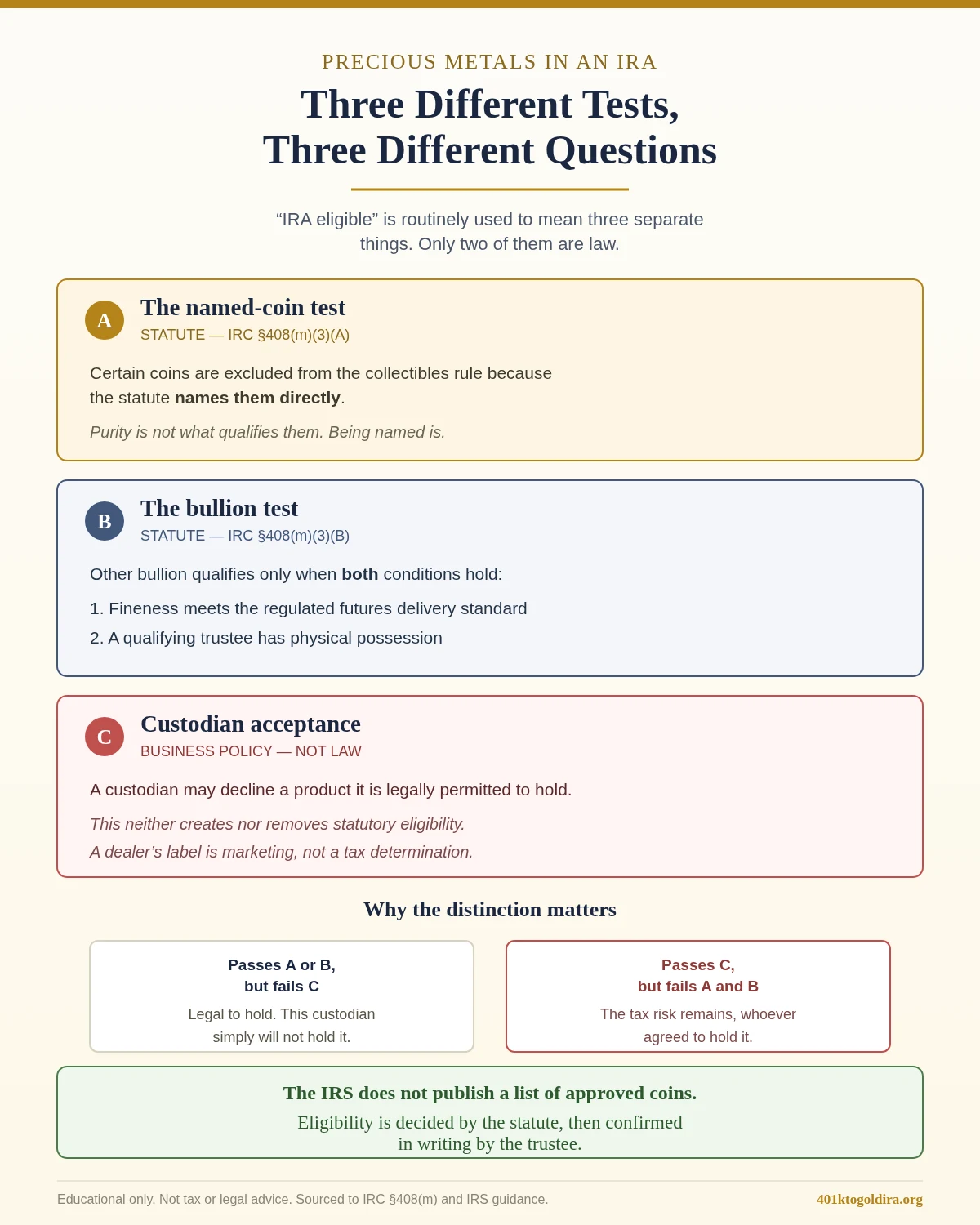
- Three different questions get blended into one — named-coin status, bullion fineness, and custodian acceptance. Only the first two are law.
- The familiar .995/.999/.9995 table is not the whole rule. It reflects the bullion exception only, which is why a 91.67% Gold Eagle has a stronger statutory basis than a .9999 Gold Buffalo.
- Subsection numbers matter. The Gold Buffalo sits at §5112(a)(11) and the Palladium Eagle at §5112(a)(12) — neither is cross-referenced by §408(m)(3)(A).
- One central question is genuinely unresolved: whether a non-named sovereign coin qualifies through the bullion exception. No located IRS ruling or Tax Court decision settles it.
- Year matters. Pre-2013 Britannias, historic Pandas and older Kangaroo issues can differ from current specifications.
- Custodian acceptance cannot cure a statutory failure — and eligibility does not survive personal possession.
What Are the Three Separate Tests?
Almost every contradiction in published material traces back to treating these as one question. They are three, and a product can pass one while failing another.
Test A — Is the product named by statute?
IRC §408(m)(3)(A) excludes from the collectible definition: gold coins described in 31 U.S.C. §5112(a)(7), (8), (9) or (10); the silver coin described in §5112(e); platinum coins described in §5112(k); and coins issued under the laws of a state (Cornell LII — 26 U.S.C. §408). These qualify because Congress cross-referenced them, not because they pass a purity table. The American Gold Eagle is 91.67% gold — below the .995 threshold used by the bullion test — yet all four denominations are expressly named.
Two omissions matter. The American Gold Buffalo is authorised at §5112(a)(11), which §408(m)(3)(A) does not cross-reference. The American Palladium Eagle is described at §5112(a)(12) and issued under §5112(v), neither of which is named. Being a U.S. Mint coin is not sufficient.
Test B — Does the product satisfy the bullion exception?
IRC §408(m)(3)(B) excludes gold, silver, platinum or palladium bullion when its fineness equals or exceeds the minimum required for delivery under a regulated futures contract, and the bullion is in the physical possession of a trustee described in §408(a). Both conditions apply; fineness alone is not enough.
| Metal | Current regulated-contract minimum | Contract source |
|---|---|---|
| Gold | .995 | COMEX Rule 113 |
| Silver | .999 | COMEX Rule 112 |
| Platinum | .9995 | NYMEX Rule 105 |
| Palladium | .9995 | NYMEX Rule 106 |
The exchange rules also require approved brands and prescribe deliverable units, but those are exchange-delivery conditions. The statutory text imports the minimum fineness, not the entire contract specification. These thresholds are date-sensitive and should be re-checked against the rulebook in force on any verification date.
Test C — Will the trustee or custodian accept it?
This is a business-policy question, not a tax one. The IRS states that IRA trustees may impose investment restrictions beyond those imposed by IRA law (IRS — IRA FAQs). It follows that a product may have a strong statutory basis and still be declined; that custodian acceptance cannot convert a statutory collectible into qualifying bullion; and that an inventory label or dealer statement is not a tax determination. Written pre-purchase confirmation from the actual trustee remains an important operational safeguard — but it is a safeguard, not a legal cure.
Does the Bullion Exception Cover Non-Named Coins?
This is the central unresolved question, and it is why so much published material disagrees.
The statute defines collectibles to include both "any metal" and "any stamp or coin." It then creates a specific exception for named coins at §408(m)(3)(A), and a separate exception for qualifying "bullion" at §408(m)(3)(B). Two readings are possible. On a substance reading, a sovereign coin produced and traded principally for its metal content can be bullion, so a sufficiently fine foreign coin may qualify. On a structural reading, because Congress separately listed coins as collectibles and then created a specific named-coin exception, non-named coins may not automatically enter through the bullion door.
No final regulation, revenue ruling, published IRS FAQ or Tax Court opinion was located in this review that squarely decides the question. The IRS distinguishes "certain" coins from qualifying bullion but does not publicly resolve the coin-form boundary product by product (IRS — collectibles in individually directed accounts).
Qualifying-fineness coins that are not named are therefore classified here as potential bullion-exception products, with definitive coin-form treatment not established by the located primary authorities. That is not a statement that they are prohibited. It is a statement that the categorical answer published elsewhere cannot be independently established from primary sources.
Which Products Can Be Classified From Primary Sources?
Each row records the official issuer specification, which statutory route applies, and what could and could not be established. Verification status is the most important column. Specifications and contract thresholds change, so any figure should be re-checked against the issuer or rulebook before it is relied on.
| Product | Issuer | Type | Official fineness | Which test | Notes | Verification status |
|---|---|---|---|---|---|---|
| American Gold Eagle — 1 oz, ½, ¼, 1/10 | U.S. Mint | Coin | 91.67% gold | A — Named coin | All four denominations expressly cross-referenced. Proof versions are collector versions of the same statutory coins. | Definitive named-coin fit |
| American Silver Eagle | U.S. Mint | Coin | .999 silver, 1 oz | A — Named coin | §5112(j) expressly contemplates proof versions of coins authorised under §5112(e). | Definitive named-coin fit |
| American Platinum Eagle | U.S. Mint | Coin | .9995 platinum | A — Named coin | §5112(k) expressly authorises both bullion and proof platinum coins. Historic fractionals need year-specific checks. | Definitive named-coin fit |
| American Gold Buffalo | U.S. Mint | Coin | .9999 gold, 1 oz | B — Potential bullion | Authorised under §5112(a)(11), which §408(m)(3)(A) does NOT name. Fineness passes; coin-form treatment unresolved. | Fineness passes; coin-form answer not located |
| American Palladium Eagle | U.S. Mint | Coin | .9995 palladium, 1 oz | B — Potential bullion | Authorised under §5112(a)(12) and §5112(v), not the platinum subsection §5112(k). | Fineness passes; coin-form answer not located |
| Gold Maple Leaf | Royal Canadian Mint | Coin | .9999 gold | B — Potential bullion | 1 oz through 1/20 oz. Fractional size does not change fineness, but no named-coin treatment exists. | Fineness passes; coin-form answer not located |
| Silver Maple Leaf | Royal Canadian Mint | Coin | .9999 silver, 1 oz | B — Potential bullion | Exact year and version should be confirmed. | Fineness passes; coin-form answer not located |
| Gold Vienna Philharmonic | Austrian Mint | Coin | .9999 gold | B — Potential bullion | 1 oz through 1/25 oz; all current listed sizes exceed .995. | Fineness passes; coin-form answer not located |
| Silver Vienna Philharmonic | Austrian Mint | Coin | .999 silver, 1 oz | B — Potential bullion | Packaging variations do not alter stated composition; record exact product identity. | Fineness equals threshold; coin-form answer not located |
| Australian Gold Kangaroo | Perth Mint | Coin | .9999 gold | B — Potential bullion | Current 2026 one-ounce product verified. Older "Nugget" and Kangaroo years need individual checks. | Current fineness passes; historical series unresolved |
| Perth Mint gold bars | Perth Mint | Cast or minted bar | .9999 gold | B — Bullion | Exact bar, weight, assay markings and current specification must be documented. No statutory minimum retail bar size. | Strong statutory bullion fit when trustee possession is satisfied |
| Chinese Gold Panda | China Gold Coin issuer | Coin | min .999 (30 g product) | B — Potential bullion | Shanghai Gold Exchange confirms the 30 g Panda at minimum 99.9%. Older ounce-denominated years need exact-year verification. | Fineness passes; U.S. coin-form treatment not located |
| Gold Britannia — 2013 onward | The Royal Mint | Coin | .9999 gold | B — Potential bullion | Pre-2013 gold Britannias were 22-carat and require exact-year treatment. | 2013-current fineness passes |
| Silver Britannia — 2013 onward | The Royal Mint | Coin | .999 silver | B — Potential bullion | Earlier .958 versions fall below the current .999 silver threshold. | 2013-current passes; earlier versions do not |
| Gold Libertad | Banco de México | Coin | .999 gold | B — Potential bullion | 1 oz through 1/20 oz. Brilliant-uncirculated and proof versions both listed at .999. | Fineness passes; coin-form answer not located |
| Silver Libertad | Banco de México | Coin | .999 silver | B — Potential bullion | Satin and proof-like versions share the listed fineness. Larger and kilo products verify separately. | Fineness passes; coin-form answer not located |
| Generic / private-mint bars | Product-specific | Bar or ingot | Product-specific | B — Potential bullion | Gold ≥.995, silver ≥.999, platinum/palladium ≥.9995. Manufacturer, markings, assay and trustee possession must be established. | Potentially qualifying; no blanket conclusion |
| Generic / private-mint rounds | Product-specific | Round (not sovereign currency) | Product-specific | B — Potential bullion | A private round cannot enter through the named-coin test at all. | Product-specific determination required |
| Gold Krugerrand | Rand Refinery / South Africa | Coin | 916.67 gold | Neither A nor B | Bullion and proof treatment does not change the sub-.995 composition. Fractionals share the issue. | Below threshold and not named |
| British Gold Sovereign | The Royal Mint | Coin | .9167 gold | Neither A nor B | Verified 22-carat composition sits below .995. | Below threshold and not named |
| Pre-1933 U.S. gold coins | U.S. Mint | Circulating / collectible | Generally .900 from 1837 | Neither A nor B | Numismatic grade or collector value does not create a statutory exception. | Generally below .995 and not among the named Eagles |
Sources per row: IRC §408 · 31 U.S.C. §5112 · U.S. Mint bullion programs · Royal Canadian Mint · Austrian Mint · Perth Mint · Shanghai Gold Exchange · The Royal Mint · Banco de México · South African Government Gazette.
How Should Proofs and Burnished Coins Be Treated?
For the named American Eagles, the authorising statutes expressly contemplate proof versions: §5112(j) covers proof versions of coins authorised under §5112(e), and §5112(k) expressly covers platinum bullion and proof coins. The U.S. Mint likewise identifies Gold and Silver Eagle proofs as collector versions of the corresponding bullion programs (U.S. Mint). "Burnished" or "uncirculated" is a finish designation rather than a separate metal category — but the exact SKU, authorising program, denomination, year and certificate should still be documented, and no conclusion should rest on a dealer's use of the word.
For non-named coins, proof treatment does not move a Gold Buffalo, Palladium Eagle, Panda, Maple Leaf, Libertad or Britannia into §408(m)(3)(A). They remain subject to the same unresolved question as their ordinary bullion versions. A numismatic premium does not reduce the statutory risk, and it can make product identification and custodian policy more restrictive.
Do Fractional Sizes Change the Answer?
Size and fineness are separate questions. All four American Gold Eagle denominations are expressly named, fractionals included. Current fractional Maple Leafs and Philharmonics carry the same qualifying fineness as their one-ounce counterparts but remain subject to the non-named coin-form uncertainty. A fractional bar is not automatically excluded — §408(m)(3)(B) refers to minimum fineness, not minimum retail weight — though a trustee may impose its own minimum-size or manufacturer requirements. Fractional Krugerrands and Sovereigns retain their sub-.995 composition and do not pass the gold threshold.
Are Silver Bars IRA Eligible? Requirements and Checks
A silver bar is IRA eligible only when three conditions hold at once: its fineness meets the statutory bullion threshold, a qualifying trustee holds it in physical possession, and the custodian administering the account agrees to accept that specific product.
No silver bar is named by statute. The named-coin route in §408(m)(3)(A) covers coins only, so every bar — however reputable its refiner — must qualify through the bullion exception in §408(m)(3)(B) instead.
That exception sets fineness by reference to the minimum a contract market requires for metals deliverable against a regulated futures contract. For silver that minimum is .999, set by COMEX Rule 112 at Section 112101, so a .999 or finer bar satisfies the fineness element while a .925 sterling or .900 coin-silver bar does not.
Meeting the threshold settles one element and nothing more. Fineness is a property of the metal, not a judgment about the product, the manufacturer or the account.
The possession clause in the same subparagraph is an additional requirement that can disqualify an otherwise qualifying bar. The bullion must be in the physical possession of the trustee, which excludes home storage, a personal safe deposit box, and any arrangement in which the owner can take delivery. The consequences of acquiring a nonqualifying item apply in full to a bar that fails on possession alone.
Custodian acceptance is the third and most practical constraint. A custodian may decline a bar that plainly satisfies the statute, because it maintains its own approved-product and approved-refiner lists, and nothing in the Code obliges it to accept every qualifying item.
This is why a dealer's “IRA approved silver bars” label is not dispositive. The phrase has no federal definition and no issuing authority behind it: it is a merchandising category, and a product sold under it by one dealer can still be refused by a custodian at the next.
Verifying a specific bar is a short, ordered task:
- Record the exact product identity: refiner, stated fineness, weight, and serial or assay markings.
- Confirm the stated fineness is .999 or finer from the refiner's own product specification rather than a retailer listing.
- Ask the custodian in writing whether that exact product is accepted, before purchase rather than after.
- Confirm the metal moves directly into the trustee's possession at the depository the custodian uses.
- Keep the assay documentation and the custodian's written acceptance with the account records.
What cannot be established from primary sources is any blanket conclusion about a refiner. Accreditation records change, hallmarks are counterfeited and withdrawn, and a brand qualifying in one year's product line does not thereby qualify in another. Bars are verified individually or not at all.
What Does Refiner Accreditation Actually Establish?
The LBMA Good Delivery lists for gold and silver, the LPPM lists for platinum and palladium, and CME's exchange-approved brand lists all establish something real: who manufactured a bar, whether the manufacturer meets recognised refining standards, whether the product is operationally acceptable to a vault or exchange, and whether claimed markings are credible.
None of them is an IRS product approval. Accreditation does not replace the statutory fineness test, the trustee-possession requirement, exact product identification, written custodian acceptance, or the legal analysis where the product is a non-named coin. Exchange approval establishes suitability for exchange delivery under contract rules; the tax statute imports the minimum fineness, not the brand list.
Why Do Published Pages Contradict One Another?
Five structural errors account for most of it.
1. Treating a purity chart as the complete law. The .995/.999/.9995 table reflects the bullion exception and does not govern the named-coin exception — which is why the 91.67% Gold Eagle can have a stronger basis than the .9999 Gold Buffalo.
2. Treating every sufficiently pure coin as conclusively qualifying bullion. That assumes the unresolved proposition above. No located authority establishes it for the Panda, Maple Leaf, Philharmonic, Libertad, Britannia, Buffalo or Palladium Eagle.
3. Treating custodian inventory policy as federal tax law. A trustee can decline a permitted asset, and the IRS expressly recognises that ability. An acceptance list describes operations, not the boundary of §408(m).
4. Ignoring subsection numbers. §408(m)(3)(A) names only §5112(a)(7)–(10). The Buffalo sits at (a)(11), the Palladium Eagle at (a)(12). Those differences are decisive.
5. Ignoring year-specific composition changes. Post-2012 Britannias differ from earlier versions; current metric Pandas differ from historic ounce-denominated products. A family name is not enough — exact year, denomination, metal, finish and official specification are required.
What Verification Process Should a Saver Follow?
A defensible verification file would contain:
- Exact product identity — issuer, year, denomination, weight, finish, and product code where available.
- Official specification — the government-mint or issuer page showing metal and fineness.
- Applicable statutory route — named coin, bullion exception, or neither.
- Current contract threshold — the relevant CME/COMEX/NYMEX rule in force on the verification date.
- Manufacturer evidence for bars or rounds — hallmark, serial number, assay documentation, accreditation.
- Written trustee acceptance naming the exact product — not merely stating that "gold coins" or "approved bullion" may be held.
- Trustee-controlled custody records — purchase, shipment, vaulting and title showing the metal remained under qualifying IRA administration.
The quote checklist and the due-diligence scorecard cover the surrounding purchase questions.
What Happens If an IRA Acquires a Nonqualifying Collectible?
IRC §408(m)(1) treats the acquisition as a distribution equal to the account's cost of acquiring the collectible. The IRS states that the deemed distribution occurs in the year of acquisition, should be reported on Form 1099-R, is generally taxed as ordinary income, and may attract the 10% additional tax where the participant is under 59½ and no exception applies. Related errors are covered on the gold IRA tax mistakes page.
Eligibility does not survive personal possession. In McNulty v. Commissioner, 157 T.C. No. 10 (2021), Docket No. 1377-19, an IRA invested through an LLC in American Eagle coins — coins that are themselves expressly named by statute. The taxpayer took physical receipt and kept them at the family residence. The Tax Court treated the personal receipt and control as taxable distributions: $374,000 of gold-coin purchases in 2015 and $37,380 of silver in 2016, a combined $411,380. The reasoning reached beyond the possession clause in §408(m)(3)(B) — general trustee, custody, safekeeping and non-commingling requirements applied even to named coins. The opinion is searchable through the U.S. Tax Court DAWSON system. Storage arrangements are compared on the depository versus home storage page and the storage legality matrix.
Which Products and Figures Could Not Be Determined?
This section is the point of the page. Where a categorical answer is published elsewhere but cannot be established from primary sources, it is recorded here rather than repeated.
- Chinese Gold Panda. The current 30 g product's minimum .999 fineness is supported by the Shanghai Gold Exchange and exceeds the .995 threshold. What remains unresolved is whether a non-named sovereign coin is conclusively bullion under §408(m)(3)(B). Resolving it would require published IRS guidance on non-named bullion coins, controlling judicial authority interpreting "bullion", or a product-specific published ruling.
- Gold Buffalo and Palladium Eagle. Both meet the applicable fineness thresholds but sit outside the named subsections. The same coin-form question applies.
- Maple Leafs, Philharmonics, Kangaroos, Libertads and post-2012 Britannias. Current official fineness can be established; definitive product-level U.S. tax treatment could not be, from any located published federal authority.
- Historic Panda and Australian Nugget/Kangaroo variants. A complete year-by-year product history was not established from a single accessible official archive. Evaluate by year and denomination, not series name.
- Historic American Platinum Eagle fractional issues. The platinum subsection is broad, but a year-by-year official dataset for every historic fractional was not completed.
- Every private-mint round or bar. No blanket conclusion is possible. Counterfeits, altered bars, withdrawn accreditations and obsolete hallmarks require individual verification.
- A total count of qualifying coins. No honest fixed number can be published — the statute includes an open category for state-issued coins plus a product-specific bullion exception, and custodians maintain differing policies.
What Is the Most Defensible Conclusion?
The law does not support a single universal list assembled from dealer inventories. What can be said with confidence:
- The four American Gold Eagle denominations, the American Silver Eagle, qualifying platinum coins under §5112(k), and qualifying state-issued coins have a direct named-coin basis.
- Bars and clearly identifiable bullion can have a strong §408(m)(3)(B) basis when they meet the current metal-specific threshold and remain in the physical possession of a qualifying trustee.
- The Gold Buffalo, Palladium Eagle and sufficiently fine foreign bullion coins meet the numerical thresholds but present an unresolved classification question, because they are coins not expressly named.
- Krugerrands, Sovereigns, pre-2013 lower-fineness Britannias and typical pre-1933 U.S. gold coins fail the current thresholds and lack a named-coin basis.
- Custodian acceptance is a separate business decision and should be obtained in writing before any transaction.
- Personal receipt or home control of IRA-owned metal can create a taxable-distribution problem even where the coin itself is permitted.
How to Cite This Page
401ktogoldira.org, IRA-Eligible Precious Metals: Coins, Bars and the Three Tests That Decide. https://401ktogoldira.org/ira-eligible-precious-metals/
Methodology
Product specifications were taken from the issuing government mint or central bank. Fineness thresholds were taken from the current CME/COMEX/NYMEX rulebooks. Statutory text was read from the Internal Revenue Code and 31 U.S.C. §5112 via Cornell LII. Accreditation status was checked against the LBMA and LPPM Good Delivery lists. Dealer inventories, custodian marketing pages and affiliate review sites were not treated as tax authority and are not cited. Where a categorical answer is published elsewhere but could not be established from these sources, it is recorded in the unverified section rather than repeated. Futures-contract specifications, approved-brand lists, mint product pages and accreditation lists change over time and should be re-checked against the issuing source before reliance.
Frequently Asked Questions
Does the IRS publish a list of approved IRA coins? No. The Code names certain coins by cross-reference and creates a separate exception for bullion meeting a futures-contract fineness threshold. A dealer's inventory label is not a tax determination.
Is the American Gold Eagle eligible even at 91.67% gold? Its four denominations are expressly cross-referenced in §408(m)(3)(A). It qualifies because the statute names it, not because it meets a purity threshold — and it sits below the .995 fineness used by the bullion test.
Is the American Gold Buffalo eligible? Its .9999 fineness exceeds the threshold, but it is authorised at §5112(a)(11), which §408(m)(3)(A) does not cross-reference. Whether a non-named coin qualifies through the bullion exception was not resolved by any located authority. Written trustee confirmation matters here.
Is the Chinese Gold Panda eligible? Published pages contradict each other. The current 30 g product's minimum .999 fineness exceeds the threshold, but no located primary authority resolves whether a non-named sovereign coin conclusively qualifies as bullion.
Are Krugerrands eligible? The 916.67 composition falls below the .995 minimum and the coin is not named. Custodian confirmation cannot cure a fineness failure.
Does a custodian accepting a product make it eligible? No. The IRS recognises that trustees may impose restrictions beyond those in IRA law. Acceptance describes that custodian's operations; it cannot convert a statutory collectible into qualifying bullion.
Are proof coins eligible? For the named Eagles, the authorising statutes expressly contemplate proof versions. For non-named coins, proof status does not change the unresolved question.
Does LBMA accreditation make a bar eligible? No. Good Delivery and exchange-brand lists establish refining standards and market acceptability, not IRS approval.
Eligibility decides what may be held; premium decides what it costs. A qualifying coin bought at a wide premium can still take years to break even. The break-even calculator models the purchase premium and buyback spread together, and the dealer markup data sets out how premiums differ between common bullion and proof or collectible products.
The statutory framework behind this reference is set out on the precious metals IRA hub. Terms are defined in the glossary.
Educational only. This page does not recommend any company, custodian, depository, dealer, product or allocation, and is not legal, tax or financial advice. Statutory interpretation described here reflects the published primary sources located during research; it is not a legal opinion and individual circumstances differ. Fineness thresholds, mint specifications and accreditation lists change and must be re-verified. Customers should speak to a qualified tax professional or attorney before acting. Goldco does not offer tax or legal advice. Past performance does not guarantee future results.