Affiliate disclosure: Some links on this page may be sponsor links. The site owners may be compensated if customers request information from companies mentioned here. This page is educational only and does not provide financial, tax, or legal advice. Customers should speak with a financial or tax advisor before making retirement-account decisions. Past performance does not guarantee future results.
Gold IRA RMD Rules: Age 73 or 75 Under SECURE 2.0
For a traditional Gold IRA, the applicable RMD age depends on birth year: 73 for owners born 1951 to 1959 and 75 for owners born in 1960 or later under SECURE 2.0.
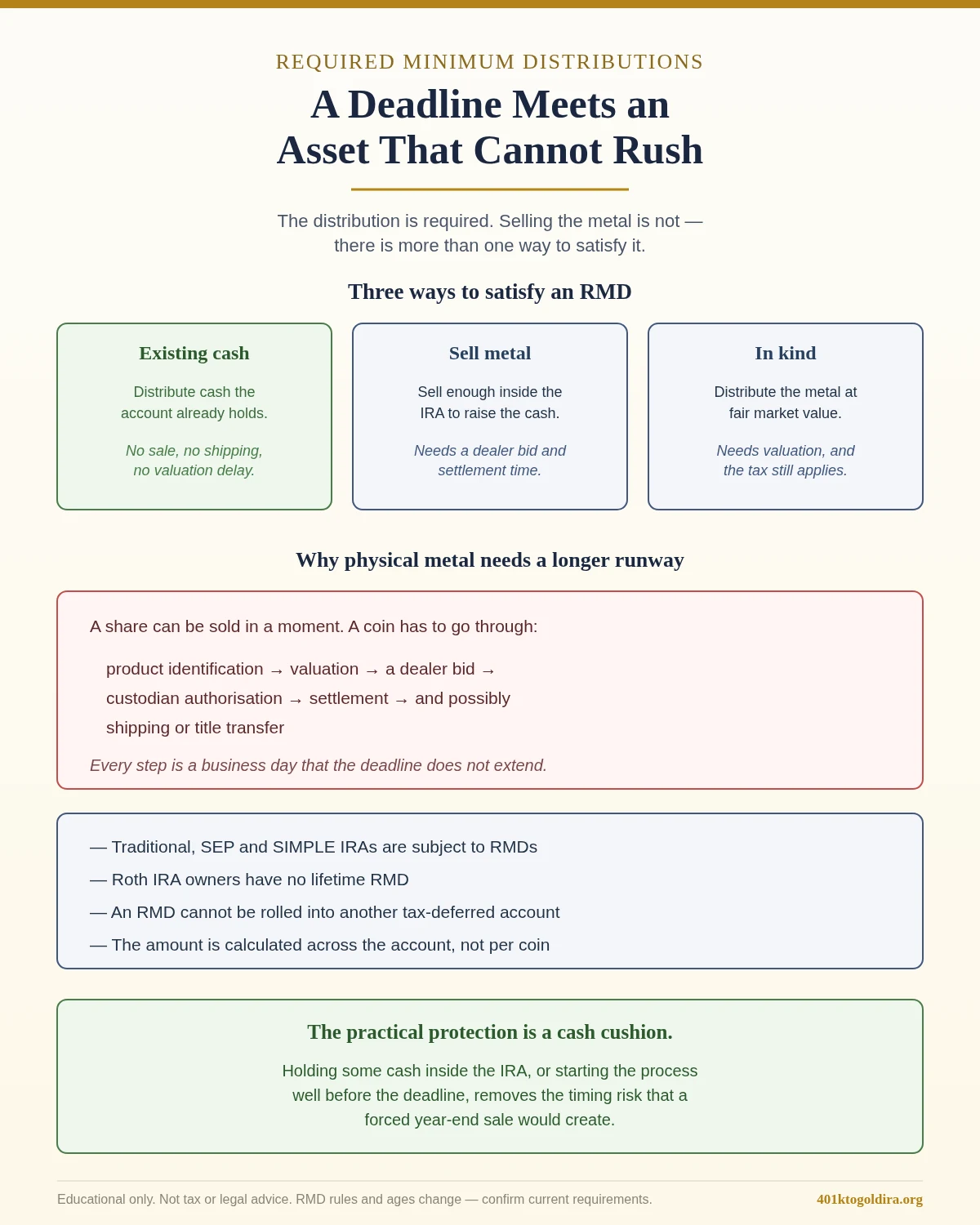
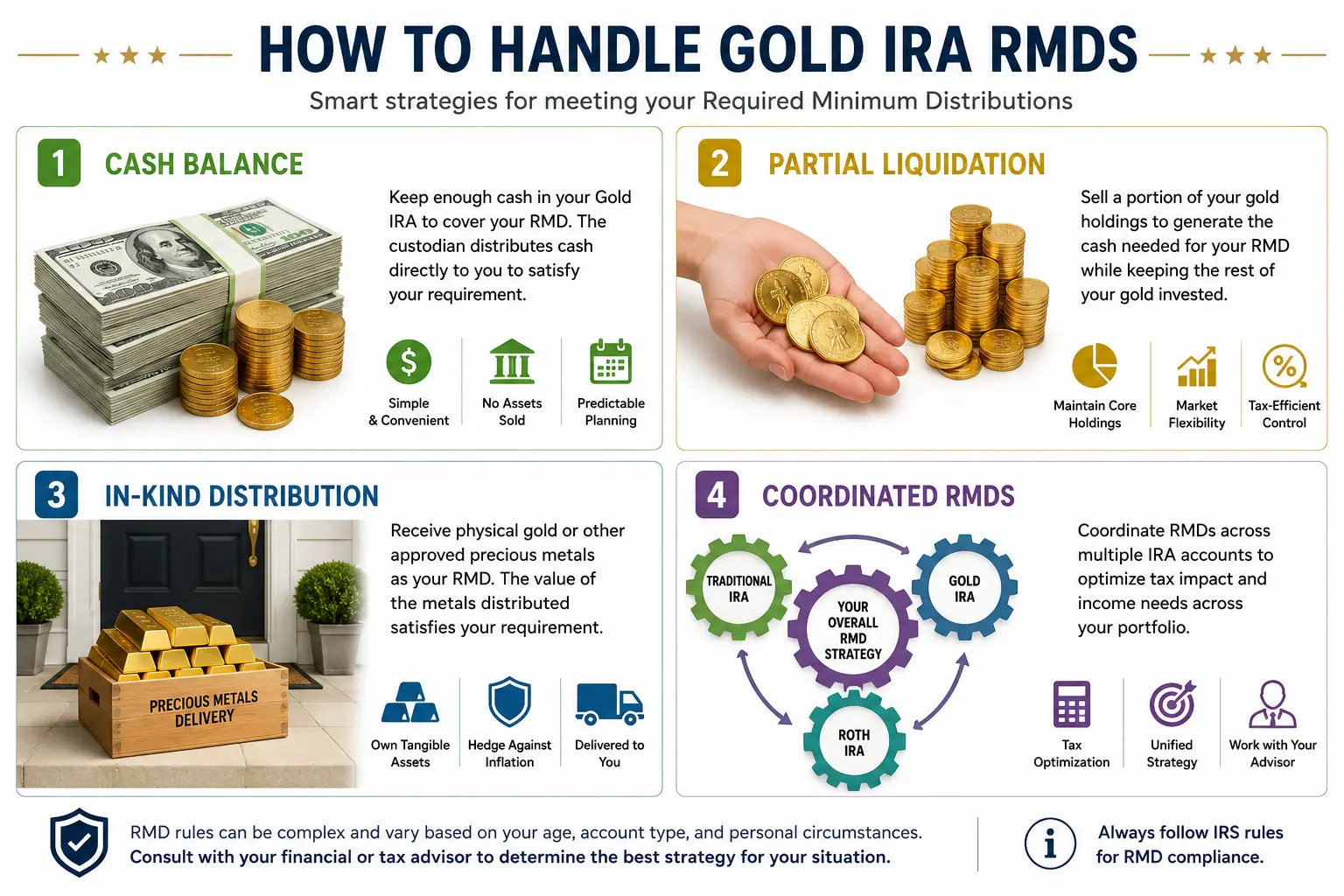
A gold ira rmd strategy typically uses one or more approaches: holding enough cash inside the IRA to cover annual RMDs, selling a portion of metals inside the IRA to generate cash, taking an in-kind distribution of physical metals, or coordinating RMDs across multiple traditional IRAs where aggregation rules allow.
Because required minimum distributions are mandatory, the practical goal is to avoid last-minute sales, valuation errors, missed deadlines, and unnecessary transaction costs. The right process depends on IRA type, age, account balance, custodian procedures, metal valuation, and broader tax circumstances.
What an RMD Is
A required minimum distribution is the minimum amount that must be withdrawn each year from certain retirement accounts once the account holder reaches the required age. Traditional IRAs, including traditional Gold IRAs, are generally subject to RMD rules. Roth IRAs generally do not have lifetime RMDs for the original account owner.
Under current IRS guidance, the applicable RMD age is 73 for owners born 1951 to 1959 and 75 for owners born in 1960 or later under SECURE 2.0. The first RMD may be delayed until April 1 of the year after the year in which the applicable age is reached, but delaying can cause two RMDs in one calendar year. Later annual RMDs generally must be taken by December 31.
The amount is calculated using the prior year-end account balance and an IRS life expectancy factor. For Gold IRAs, that prior year-end balance must include the fair market value of the physical metals held by the account.
Why Physical Metals Make RMD Planning More Complicated
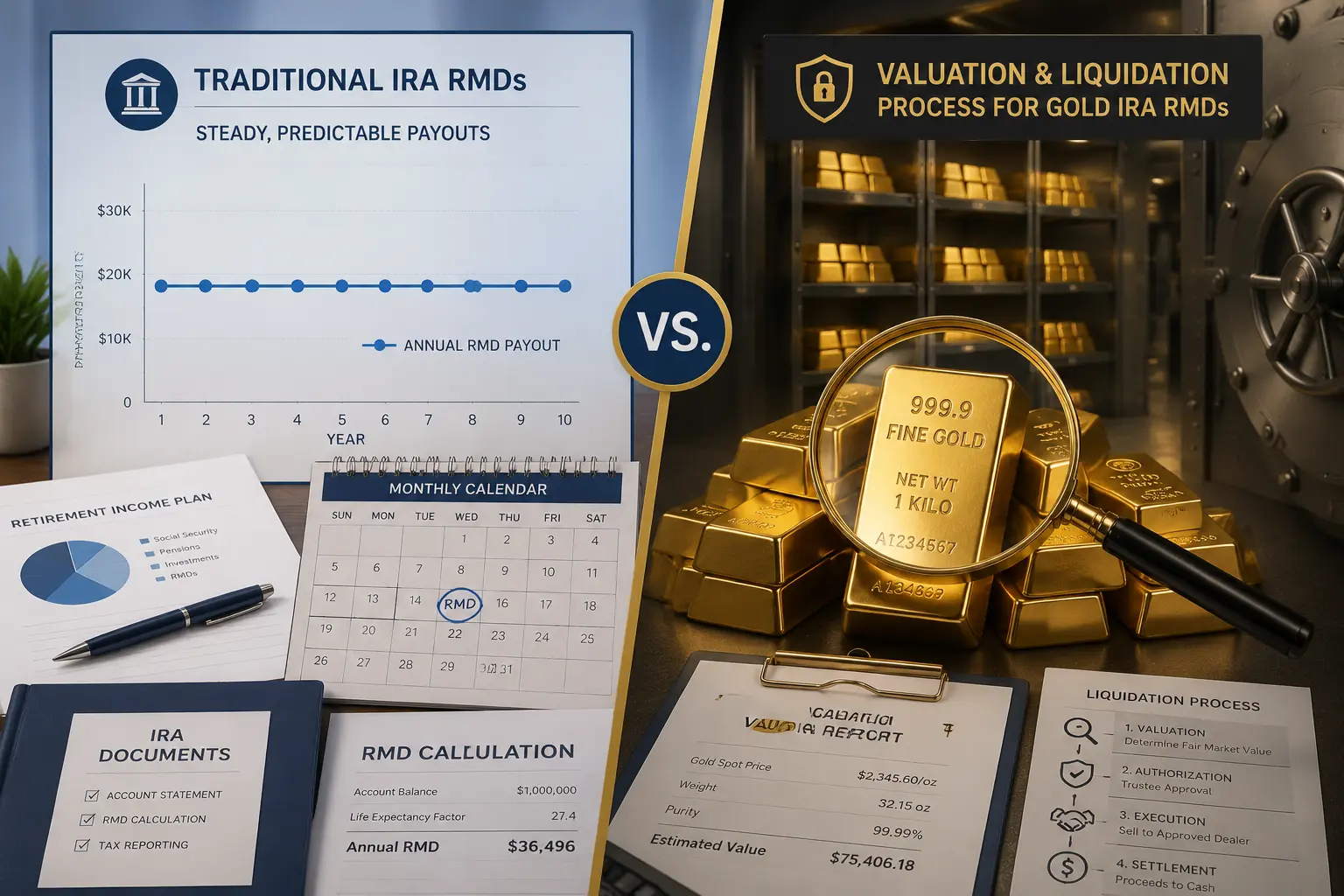
Cash and marketable securities can usually be sold or distributed in exact dollar amounts. Physical precious metals are less exact. Coins and bars must be valued, sold, or distributed in units, and the custodian must document the distribution correctly.
Several issues make precious metals IRA RMD planning more complex:
- Valuation: metals need fair market valuation for year-end balances and for any in-kind distribution.
- Liquidity: cash may need to be raised through partial metal liquidation before the RMD deadline.
- Spreads: sell prices may reflect dealer bid prices, not the retail price originally paid.
- Logistics: in-kind distributions require depository, custodian, shipping, and insurance coordination.
- Tax reporting: distributions may generate Form 1099-R reporting and ordinary-income treatment for traditional IRAs.
Customers should speak with a financial or tax advisor before making decisions about RMDs, tax treatment, or IRA distributions.
Strategy 1: Hold Enough Cash for RMDs
One conservative Gold IRA RMD strategy is maintaining a cash reserve inside the IRA. This can allow annual required distributions to be made in cash without selling metals each year.
The process usually starts by estimating future RMDs using prior year-end balances and IRS tables. The account then keeps enough liquidity to cover expected distributions. The metals allocation remains in place while the cash portion handles near-term withdrawal needs.
This approach can simplify annual administration, but it also means part of the account is not held in physical metals. That trade-off should be considered as part of the broader retirement allocation plan.
Strategy 2: Partial Metal Liquidation
Another strategy is selling a portion of the Gold IRA metals inside the IRA to generate enough cash for the RMD. This method may fit accounts that prefer to stay mostly invested in metals but do not want physical delivery each year.
Choosing when in retirement to begin selling gold shapes this decision as much as the RMD calculation itself. Partial liquidation usually involves calculating the RMD, requesting a sale through the custodian or dealer channel, confirming bid pricing and any transaction fees, and distributing the resulting cash. The account may remain invested in remaining metals after the sale.
Timing matters. A last-minute sale close to the RMD deadline can create stress if markets are volatile, if a custodian has processing delays, or if product-specific liquidity is limited. The Gold IRA exit strategies guide explains related liquidity and buyback questions.
Strategy 3: In-Kind Distribution
An in-kind distribution sends physical metals from the IRA to the account holder rather than selling them for cash first. When used for an RMD, the fair market value of the distributed metals counts toward the required amount.
For traditional IRAs, the value of an in-kind distribution is generally included in taxable income, similar to a cash distribution. In-kind treatment changes the form of the distribution, not the basic tax concept.
This method can appeal to investors who want to keep holding metals personally after satisfying RMD rules. It also requires careful valuation and coordination because distributing too little may leave an RMD shortfall. The in-kind distribution calculator can estimate roughly how many ounces a target distribution represents at an entered metal price, though the custodian handles the actual valuation.
Strategy 4: Coordinate RMDs Across Multiple IRAs Where Allowed
Investors with multiple traditional IRAs may be able to calculate RMDs separately for each IRA and satisfy the total required amount from one or more traditional IRAs. This can matter when one account holds physical metals and another account holds more liquid assets.
For example, an investor may calculate the Gold IRA's RMD but take the aggregate IRA distribution from a non-metal traditional IRA if aggregation rules allow and the custodian confirms the process. Employer plan RMDs, such as some 401(k) accounts, generally follow different rules and often must be handled separately.
Because aggregation rules depend on account type, customers should confirm details with custodians and tax professionals before relying on a non-metal IRA to satisfy a Gold IRA-related RMD calculation.
Valuation, Timing, and Paperwork Issues
RMD strategy depends on accurate IRA valuation. The RMD calculation starts with the account value as of December 31 of the prior year. For self-directed IRAs holding physical metals, custodians typically need year-end fair market values for the metals and any cash balance.
In-kind distributions add another valuation moment: the fair market value on the distribution date. That value determines how much of the RMD requirement is satisfied and the amount generally reported as taxable income for traditional IRAs.
Paperwork also matters. Custodians may issue tax forms such as Form 1099-R for distributions, including in-kind distributions. Account holders should keep records of RMD calculations, sale confirmations, distribution dates, valuations, and any advisor guidance.
The SECURE 2.0 guide explains the birth-year schedule, the Gold IRA RMD calculator can illustrate the math, and the cash-access guide covers liquidity choices. These educational resources can help frame planning questions before speaking with providers or advisors.
Beneficiary and Inherited IRA Considerations
Inherited Gold IRA RMD rules can be more complex than lifetime RMD rules. Beneficiary treatment depends on whether the beneficiary is a spouse, non-spouse individual, eligible designated beneficiary, trust, estate, or another party.
Spouse beneficiaries often have more flexibility, including treating the inherited IRA as their own in some cases. Many non-spouse beneficiaries face a 10-year distribution window under current inherited IRA rules, though annual RMD requirements during that period can depend on several factors.
Inherited accounts may also require decisions about whether heirs liquidate metals for cash or receive metals in kind. The Inherited Gold IRA Rules guide explains those issues in more detail.
Gold IRA RMD Video and Tools
After understanding how required minimum distribution rules intersect with physical metals, many retirement savers use educational tools to model scenarios before speaking with providers.
Gold IRA educational video
Video published by Goldco on YouTube — a company this site has an affiliate relationship with. Embedded as a third-party explanation; not produced, endorsed or independently verified by this site.
FAQ
At what age do RMDs start for Gold IRAs?
Traditional Gold IRAs follow the same RMD age rules as other traditional IRAs. The applicable age depends on birth year: 73 for those born 1951 to 1959, and 75 for those born in 1960 or later under SECURE 2.0 (IRS — RMD FAQs). The first RMD may be delayed until April 1 of the following year, but that can create two RMDs in one calendar year.
How are RMD amounts calculated when an IRA holds physical metals?
RMD amounts are calculated using the prior year-end account balance, including the fair market value of metals and other assets, divided by an IRS life expectancy factor.
Can RMDs from a Gold IRA be taken in physical gold instead of cash?
Yes, when the custodian and depository support in-kind distributions. The fair market value of the distributed metals counts toward the RMD and may be taxable for traditional IRAs.
Does taking in-kind RMD distributions avoid taxes?
No. For traditional IRAs, an in-kind distribution generally triggers the same income-tax concept as a cash distribution. The value of assets distributed is included in taxable income.
Can RMDs for a Gold IRA be satisfied from another IRA?
In many cases, traditional IRA RMDs can be aggregated and taken from one or more traditional IRAs. Employer-plan RMDs usually have separate rules. Custodians and tax professionals should confirm account-specific treatment.
What happens if RMDs are missed for a Gold IRA?
Missed or insufficient RMDs may trigger an IRS excise tax. Timely planning, documentation, and professional review can help reduce avoidable errors. If an amount has already been missed, the missed-RMD correction and waiver procedure sets out the current steps from the primary sources.
Are Roth Gold IRAs subject to RMDs?
Roth IRAs generally do not have lifetime RMD requirements for the original account owner, although inherited Roth IRA rules may differ.
How do inherited Gold IRA RMD rules work?
Inherited Gold IRA rules depend on beneficiary type and timing. Spouses may have more flexible options, while many non-spouse beneficiaries must follow inherited IRA distribution timelines such as the 10-year rule.
Customers should speak with a financial or tax advisor before making RMD, withdrawal, rollover, or beneficiary decisions.