How to Verify an IRS-Approved IRA Custodian — and Why a Depository Is Not Automatically One
The phrase "IRS-approved" appears throughout precious-metals marketing, attached to vaults, coins, dealers and companies. The IRS does publish an approval list — but it lists something narrower than most readers assume. This page sets out what that list actually covers, what it cannot establish, and the free public check that settles the question in a few minutes.
Go to the Verification Steps →Educational only: This page describes statutes, regulations and public records in general terms. It is not legal or tax advice, not a statement of how any rule applies to an individual, and not a recommendation or criticism of any company, depository, custodian or product. Customers should speak to a qualified tax professional or attorney. Goldco does not offer tax or legal advice. Past performance does not guarantee future results.
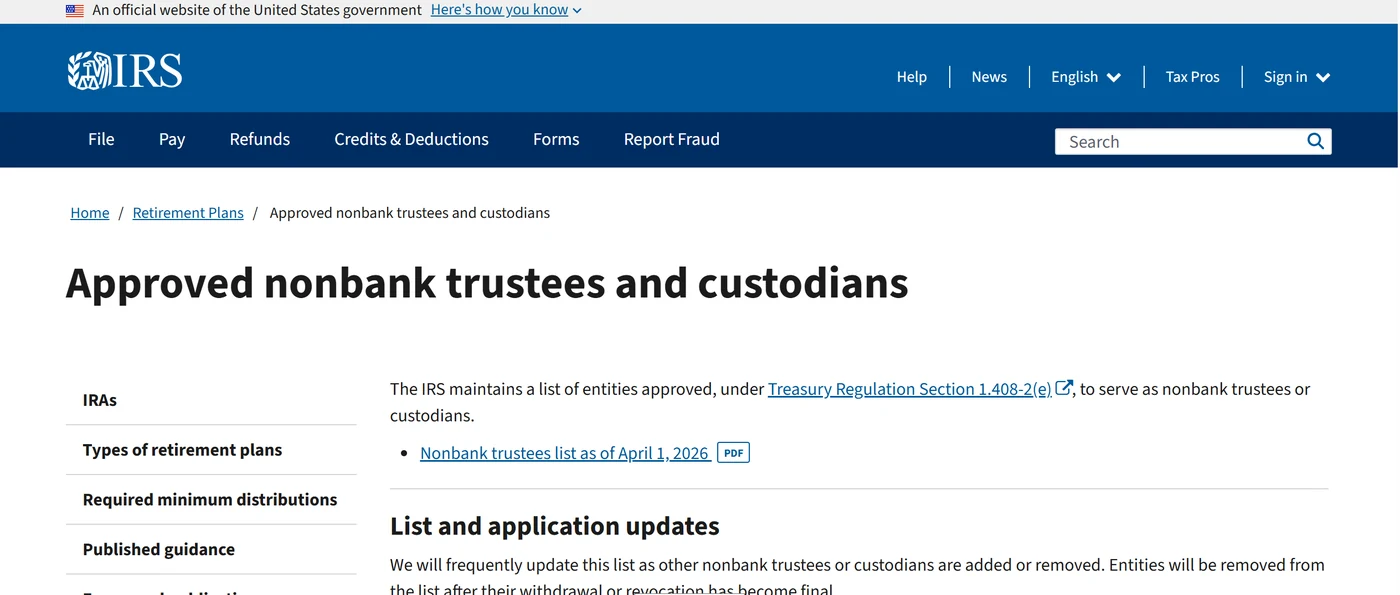
The IRS list of approved nonbank trustees and custodians contains 73 entities — and it creates no category at all for "IRS-approved depositories".
A count of distinct legal entities in the current IRS file (approved nonbank trustee list), published under Treasury Regulation §1.408-2(e). The IRS replaces this file as entities are added or removed, so the count is point-in-time and should be repeated when the file changes. Buildings, vault addresses, warehouse operators, dealers and coins do not appear on it, because it is a list of fiduciaries rather than facilities or products.
Key takeaways
- The IRS approves qualifying legal entities to act as nonbank trustees or custodians. It does not issue a general approval category for vault buildings or storage locations (IRS — approved nonbank trustees and custodians).
- A bank can qualify as an IRA trustee without appearing on the list at all. IRC §408(a)(2) permits a "bank" as defined in §408(n), or another person approved under the nonbank process (Cornell LII — 26 U.S.C. §408).
- Approval is not an endorsement of an investment. The IRS states plainly: "The Internal Revenue Service does not review or approve investments" (Internal Revenue Bulletin 2011-37).
- The exact legal entity name matters. The list identifies entities by legal name, address and approval date; a marketing name may not match, and a similarly named affiliate may not be the approved entity (IRS list).
- An approved nonbank trustee must give the account holder a copy of its written approval notice before accepting the fiduciary account — so requesting it is a normal step (Treas. Reg. §1.408-2(e)(7)(iii)).
- A depository is checked through the trustee relationship, not a badge. IRC §408(m)(3)(B) requires qualifying bullion to remain in the physical possession of a trustee described in §408(a) (Cornell LII).
- Approval is not permanent. The IRS updates the list as entities are added or removed, and removes entities once a withdrawal or revocation becomes final (IRS).
What Does the IRS Actually Approve?
The phrase "IRS-approved" routinely collapses four separate questions into one: whether the legal trustee is qualified to administer an IRA; whether a storage facility is acting as a contracted vault or is itself the trustee; whether a particular coin or bar falls within the statutory exceptions to the collectibles rule; and whether a dealer, price or recommendation carries any federal endorsement. Only the first is answered by the IRS approval process.
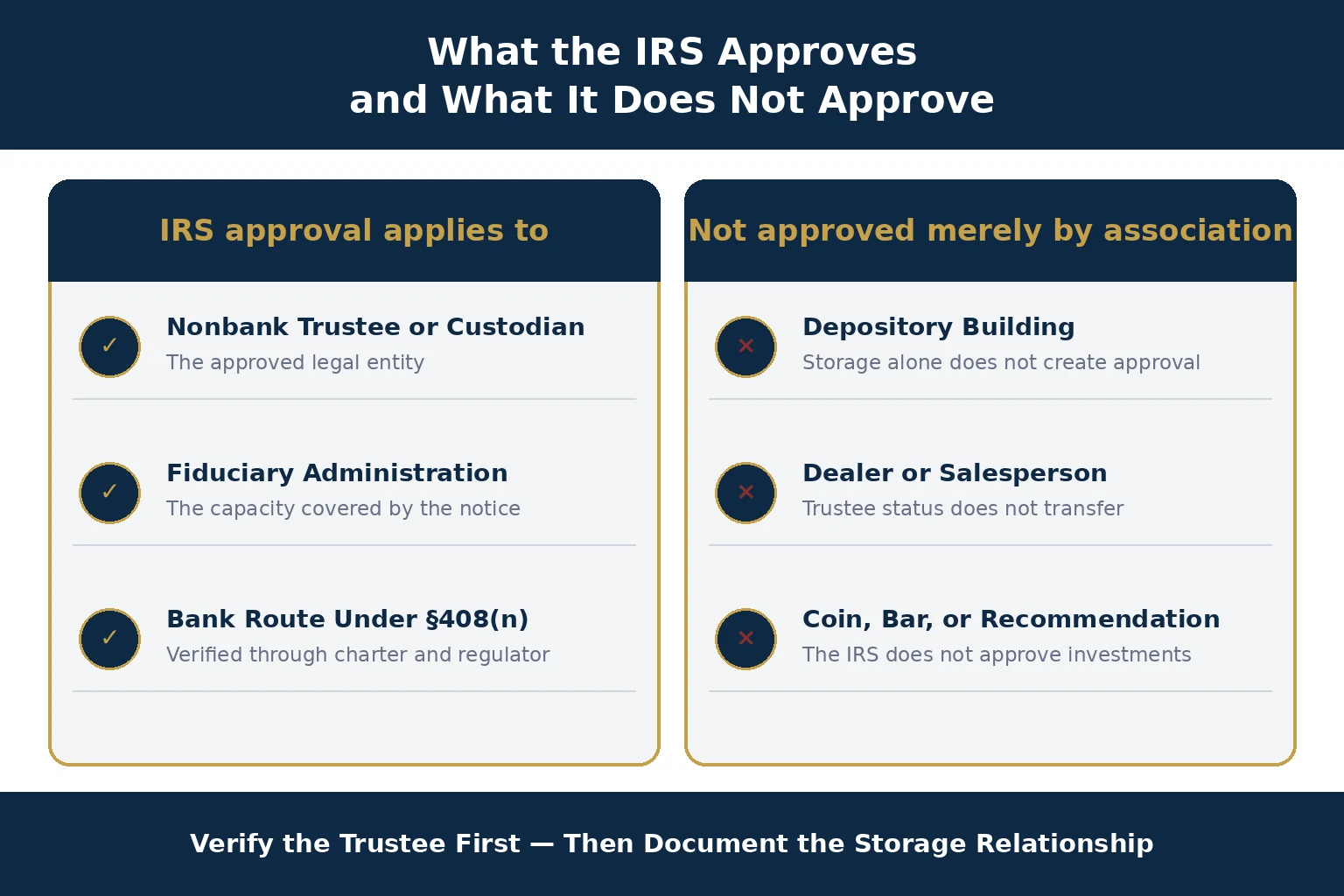
The approval concerns the trustee as a legal fiduciary
IRC §408(a) defines an individual retirement account as a U.S. trust created for an individual or their beneficiaries, whose trustee must be a bank or another person that satisfies the Treasury Secretary that the trust will be administered consistently with §408. Custodial accounts receive parallel treatment under §408(h) (Cornell LII).
Treasury Regulation §1.408-2(e) supplies the nonbank route. An applicant must demonstrate fiduciary ability, continuity, an established U.S. location, fiduciary experience, financial responsibility, accounting capacity, fitness to handle retirement funds and written rules of fiduciary conduct (Treas. Reg. §1.408-2). The IRS application page requires "clear and convincing proof" of compliance and identifies minimum thresholds including at least $250,000 of initial net worth and at least $250,000 of fidelity-bond coverage for employees performing fiduciary duties (IRS — application procedures). Those are qualification thresholds for the applicant; they are not insurance limits protecting an IRA owner's metal.
Approval can also be limited. §1.408-2(e)(6) recognises passive trustees whose authority is constrained by the written trust instrument, so the notice of approval may describe the capacity in which an entity may act. Presence on the list is therefore not a substitute for reading the actual approval notice and custodial agreement.
Approval is not an endorsement of a metal, dealer or strategy
Once that status is confirmed, the factors that can actually be compared are set out in the guide to choosing a Gold IRA custodian by documentary evidence. The IRS announcement accompanying the list states that written approval is not an endorsement of investments handled by the approved entity, then states directly: "The Internal Revenue Service does not review or approve investments" (IRB 2011-37). That single sentence forecloses several common leaps: approval of a custodian does not approve a dealer it works with, every asset it is willing to hold, the price quoted, or whether a product satisfies §408(m). Product eligibility is a separate analysis, set out in the IRA-eligible precious metals reference.
Does the IRS Approve Precious-Metals Depositories?
The IRS page is titled "Approved nonbank trustees and custodians", and the linked PDF lists legal entities approved to perform those fiduciary roles. It describes no separate application or list for buildings, vault addresses, warehouse operators or depositories merely because they store bullion.
A storage company's legal entity could separately qualify as a bank or receive nonbank-trustee approval. Where that is so, the accurate claim concerns that entity's status as a trustee — not an approval granted because it operates a vault.
In many arrangements the trustee administers the account while a different company physically stores the metal under contract, as depository, subcustodian or bailee. The statutory question remains whether qualifying bullion is in the physical possession of the trustee described in §408(a) — not whether a marketing page labels a storage address "IRS-approved". The IRS describes the bullion exception in the same terms: qualifying metal escapes the collectibles definition when a bank or approved nonbank trustee keeps physical possession of it (IRS — collectibles in individually directed accounts).
No federal source publishes a directory linking each trustee to the vaults it uses. That relationship has to be established from the account documents: the custodial agreement naming the trustee, the depository agreement, the trustee's storage instructions, the depository acknowledgment, insurance and inventory descriptions, statements identifying the account owner as the IRA rather than the individual, and liquidation procedures requiring trustee authorisation. A depository name on a storage receipt does not identify the trustee; a trustee's name on Form 5498 does not identify the facility. Both sides need documenting.
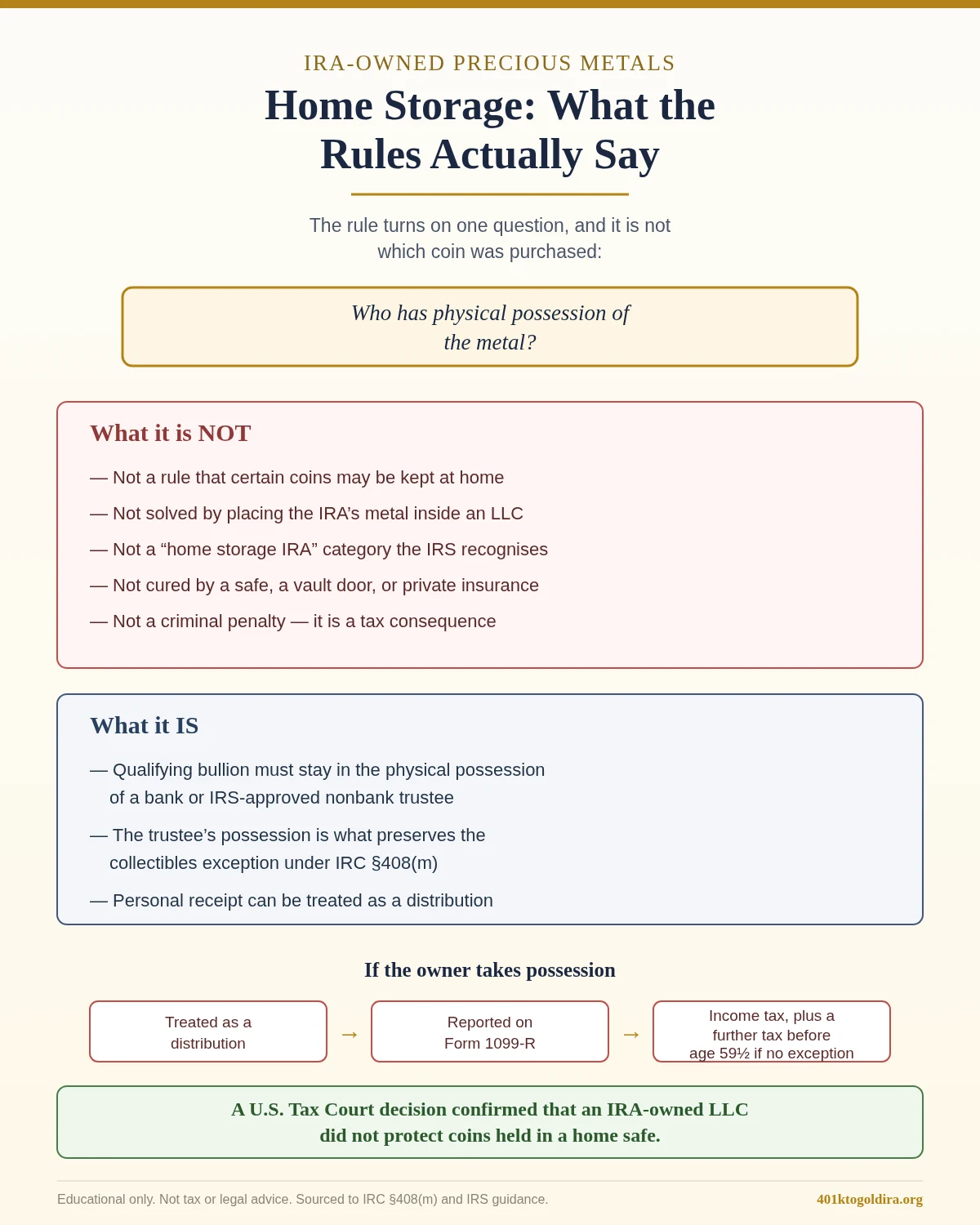
Why Can a Legitimate Custodian Be Absent From the List?
Because the statute creates two routes, and the published PDF covers only one. IRC §408(a)(2) permits the trustee to be a "bank" as defined in §408(n), or another person demonstrating satisfactory administration through the nonbank process. §408(n) defines "bank" to include a bank described in IRC §581, an insured credit union, and a corporation subject under state law to supervision and examination by the state banking commissioner or equivalent (Cornell LII). IRS Publication 590-A summarises the permitted categories as a bank, federally insured credit union, savings and loan association, or IRS-approved entity (Publication 590-A).
So absence from the PDF is a fork in the investigation, not an automatic failure. The next question is whether the entity qualifies through the bank route — and "state-chartered" is not a complete answer on its own. The charter, regulator, entity name and active status should be matched independently using official tools: FDIC BankFind, the OCC institution search, NCUA tools, and the CSBS directory of state bank agencies.
How Can a Claim Be Checked in a Browser?
Seven steps, all free and public.
1. Identify the legal IRA trustee or custodian. Inspect the custodial or trust agreement, adoption agreement, transfer form or account-opening disclosure. The entity named "trustee" or "custodian" is the one to verify — not the dealer, the representative, the storage facility, the parent company or the marketing brand, all of which may carry different names. The trustee should also be identifiable on Form 5498 and account statements.
2. Open the IRS list. The IRS page links to a PDF giving each approved legal name, address and approval date. Use the browser's Find command, and test variants: full legal name, name without punctuation, former legal name, "doing business as" name, and a parent or subsidiary name only where the account documents establish that entity as trustee.
3. Match more than the name. Check the address, the approval date, the entity name in the custodial agreement, any corporate-name changes or mergers, and the entity named on tax documents. A partial brand match is not enough — a similarly named affiliate may not be the approved entity. The IRS requires approved trustees to notify it of changes affecting the accuracy of their application, including name and address changes.
4. Request the actual approval notice. Treas. Reg. §1.408-2(e)(7)(iii) states an approved nonbank trustee must not accept a fiduciary account until the beneficiary or plan administrator has been furnished with a copy of the written approval notice. Check it for exact legal name, effective date, approved capacity, any limitation to passive-trustee functions, and consistency with the current agreement. A badge, certificate graphic or link to the general IRS list is not a substitute for the entity's own notice.
5. If the entity is absent, test the bank route. Ask in writing whether the entity qualifies as a bank under §408(n) rather than as an approved nonbank trustee, and which authority charters and supervises the exact legal entity. Expect a charter number, regulator or registry entry, then check it. If neither route can be documented, the claim is unresolved — and a retirement account should not be funded on an unexplained label.
6. Identify the depository's actual role. Which entity is the trustee; which stores the metal; whether the storage entity is the trustee, an affiliate, a subcustodian, a bailee or an independent contractor; which agreement authorises the arrangement; in whose name the vault inventory is recorded; who can instruct movement or liquidation; who issues Forms 5498 and 1099-R; who handles annual valuation; which insurance policy applies and who is the named insured; and what happens if the trustee changes storage providers.
7. Get it in writing before funding. A single request covers it: "Please identify the full legal name of the IRA trustee or custodian; state whether it qualifies as a bank under IRC §408(n) or as an IRS-approved nonbank trustee under Treasury Regulation §1.408-2(e); provide the applicable charter record or written IRS approval notice; identify the physical storage entity and facility; and provide the document establishing the trustee's custody and control over the stored metal." Retain the response with the account-opening documents.
What Does Presence on the List Prove — and What Does It Not?
Seven questions readers routinely expect the list to answer. It answers one of them.
| Question | What the public record can establish | What it cannot establish alone | Verification status |
|---|---|---|---|
| Is the legal entity an approved nonbank trustee or custodian? | The exact legal name appears in the current IRS PDF with an address and approval date. | Whether the approval carries limits not visible in the list, or whether the account documents actually name that entity. | Verify PDF and approval notice |
| Is the entity a qualifying bank instead? | A federal or state charter and regulator record may establish the bank route under IRC §408(n). | Whether the specific IRA agreement and metal-custody arrangement comply with every applicable rule. | Verify charter and agreement |
| Is a depository "IRS-approved"? | A storage company may separately be a bank or approved nonbank trustee if its legal entity meets one of those routes. | The IRS sources reviewed create no general approval category for a vault merely because it stores metal. | Identify trustee and contractual role |
| Is a metal product permitted? | IRC §408(m) provides statutory exceptions for specified coins and qualifying bullion. | The nonbank-trustee list does not approve individual coins, bars, refiners or dealer inventory. | Apply product-level test separately |
| Is the dealer approved? | Securities, commodities, state and business records may disclose registrations and enforcement history. | Trustee approval does not extend to a dealer, salesperson, affiliate, price or recommendation. | Search dealer separately |
| Is the provider low-cost or suitable? | Written fee schedules, quotes and agreements supply inputs for comparison. | IRS approval does not evaluate pricing, spread, service, suitability or performance. | Complete independent due diligence |
| Will approval remain in force permanently? | The current list is evidence of currently published status. | The IRS can suspend or revoke approval, and an entity can withdraw. | Recheck before funding and periodically |
How Is "IRS-Approved" Commonly Misused?
Four recurring patterns, described structurally. No company is named, and none of this asserts that any particular firm has made an inaccurate claim — the point is to give a reader the accurate formulation to compare against whatever they are shown.
| Phrase | The imprecise pattern | The accurate formulation |
|---|---|---|
| "IRS-approved depository" | A storage building or vault operator is described as IRS-approved without identifying the IRA trustee. | The IRA trustee is [legal entity], qualifying under [bank charter / nonbank approval]. Metal is stored with [storage entity] under the attached custody agreement. |
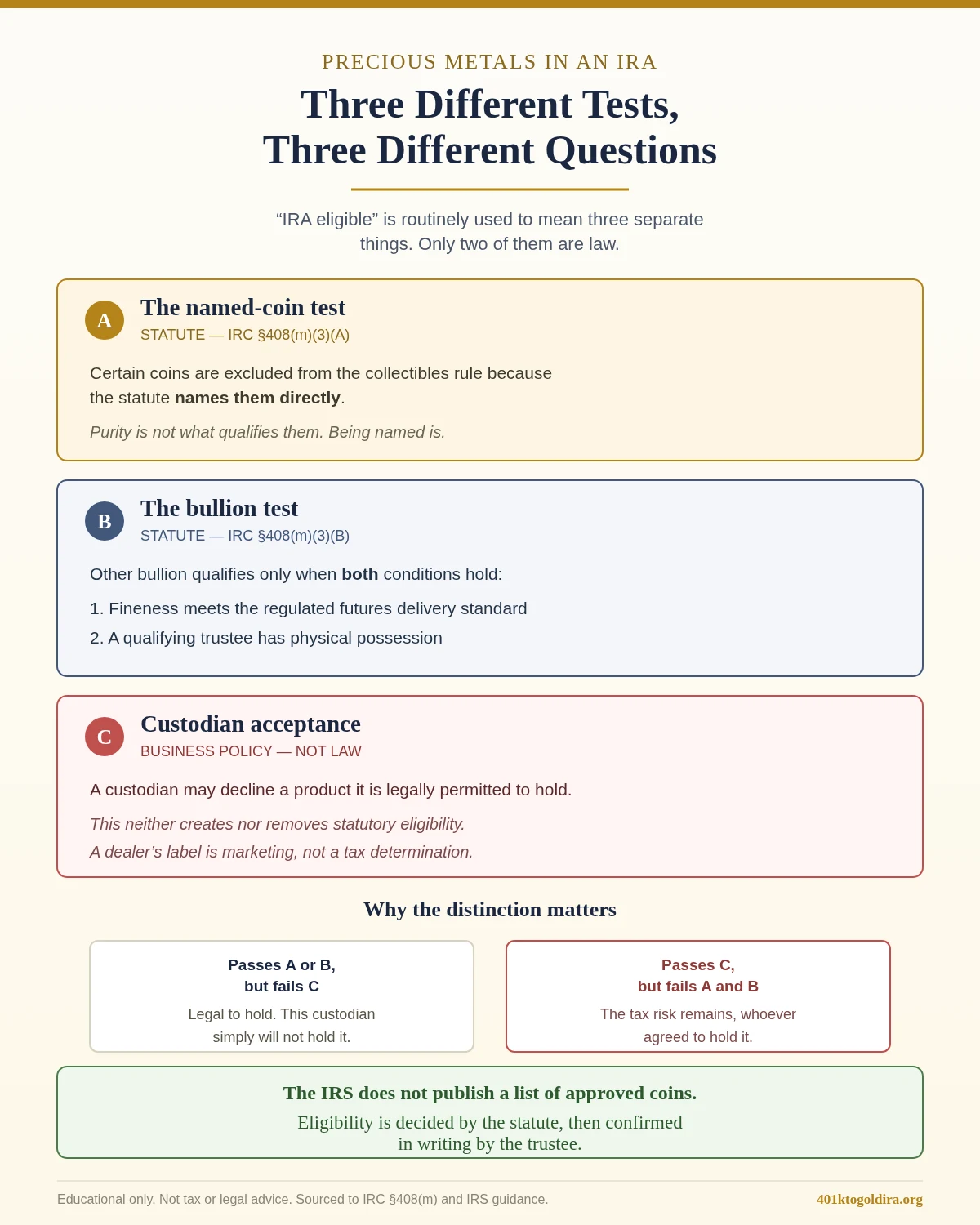
| "IRS-approved coins" | Dealer inventory is presented as a list of products approved by the IRS. | The product is evaluated under the statutory exceptions in IRC §408(m)(3), using its exact form, year, fineness and custody arrangement. |
| "IRS-approved dealer" | A dealer implies federal approval because it works with an approved trustee. | The dealer is a separate commercial party. Trustee approval does not extend to it, its pricing or its recommendations. |
| "IRS-approved" with no entity named | A badge or certificate graphic asserts approval without stating which legal entity holds it. | Name the entity, state the route, and provide the approval notice or charter record. |
The distinction between statutory eligibility and a provider's operational acceptance runs through all four, and is set out product by product in the eligible-metals reference:
Which Other Public Records Are Worth Checking?
Trustee status is one question among several. Enforcement and registration history sit in separate databases, all free: SEC litigation releases, CFTC enforcement actions, state securities regulators, BBB profiles, and the state banking or trust-company registries listed above. Documented precious-metals enforcement history is compiled on the scam and enforcement tracker.
What Could Not Be Verified From Primary Sources?
- A federal directory linking trustees to depositories. No IRS or other federal source reviewed publishes a map of which trustee uses which vault. That relationship can only be established from account documents.
- Whether any given approval carries limitations. The public list shows name, address and approval date. Restrictions such as passive-trustee status appear in the entity's own approval notice, which is not published centrally.
- A complete list of qualifying banks. The PDF covers the nonbank route only. There is no single federal file enumerating every bank, insured credit union and state-supervised corporation eligible to serve as an IRA trustee.
- Insurance adequacy. The $250,000 net-worth and fidelity-bond thresholds are applicant qualification requirements, not coverage limits for an account holder's metal. No universal insurance standard for IRA-held bullion was located.
- The permanence of any listing. The count and contents are point-in-time. The IRS replaces the file as entities are added or removed.
Methodology
The headline figure is a count of distinct legal entities in the IRS-published PDF of approved nonbank trustees and custodians, taken from the file linked on the IRS page and headed "Nonbank Trustees Approved as of April 1, 2026". The PDF was downloaded directly from irs.gov and its text extracted; each entity occupies one row carrying a name, address and approval date. Counting rows bearing an approval date gives 73, and de-duplicating the extracted legal names gives the same figure, confirming no entity is double-counted across page breaks. It counts entities, not locations or brands, and it is point-in-time: the IRS replaces the file as entities are added or removed, so the count should be repeated against the current file rather than relied on indefinitely.
Statutory text was read from the Internal Revenue Code and Treasury Regulations via Cornell LII. Procedural requirements come from the IRS application-procedures page and Internal Revenue Bulletin 2011-37. Bank-route verification tools are the official regulator databases named above. Dealer, depository and custodian marketing pages were not treated as authority and are not cited. Where a claim could not be established from primary sources, it is recorded above rather than repeated.
How to Cite This Page
The IRS publishes a list of approved nonbank trustees and custodians — 73 entities in the current file — under Treasury Regulation §1.408-2(e). It publishes no approval category for depository buildings, dealers, coins or bullion products, and states that it does not review or approve investments. Compiled by 401ktogoldira.org from IRS and Cornell LII sources. https://401ktogoldira.org/verify-irs-approved-depository/
Frequently Asked Questions
Does the IRS approve precious-metals depositories? It publishes a list of approved nonbank trustees and custodians. The sources reviewed create no separate approval category for vault buildings or storage addresses. A storage company's legal entity could separately qualify as a fiduciary, but that approves the entity, not the building.
How many entities are on the list? The current file contains 73 approved nonbank trustees and custodians — a point-in-time count that should be repeated whenever the IRS updates the file.
Can a legitimate custodian be absent from it? Yes. Banks, insured credit unions and state-supervised trust corporations qualify through IRC §408(n) and do not appear on the nonbank list. Absence is a fork in the investigation, not a failure.
Does approval mean the IRS endorses the investment? No. The IRS states that approval is not an endorsement of investments handled by the entity, and that it does not review or approve investments.
What document proves a nonbank trustee's approval? The written notice of approval, which the regulation requires be furnished to the account holder before the fiduciary account is accepted. Requesting it is routine.
Why does the exact legal name matter? The list identifies entities by legal name, address and approval date. Marketing names differ, and a similarly named affiliate may not be the approved entity.
Is approval permanent? No. The IRS updates the list as entities are added or removed, and removes them once a withdrawal or revocation is final.
The trustee, dealer and depository structure is explained on the precious metals IRA hub. Terms are defined in the glossary.
Educational only. This page does not recommend, endorse or criticise any company, custodian, depository, dealer or product, and makes no claim that any named or unnamed firm has made an inaccurate statement. It describes public records and how to read them. Statutory interpretation reflects the primary sources located during research; it is not a legal opinion, and individual circumstances differ. Lists, thresholds and regulator records change and must be re-checked. Customers should speak to a qualified tax professional or attorney before acting. Goldco does not offer tax or legal advice. Past performance does not guarantee future results.