Rollover Withholding Shortfall Calculator
When an eligible employer-plan distribution is paid to the participant instead of sent directly to the receiving account, tax is generally withheld first. To roll over the full original amount within 60 days, that withheld portion has to be replaced from other funds. This calculator illustrates that shortfall. It is an educational estimate, not a tax calculation.
Open the Calculator →Educational only: This tool produces an illustration based on assumptions the user enters. It is not financial, tax, or legal advice, and it does not calculate income tax, penalties, or state withholding. Withholding, rollover eligibility, and timing rules depend on the plan and current law. Customers should speak with a qualified tax professional and the plan administrator before taking a distribution or rollover. Goldco does not offer tax or legal advice. Past performance does not guarantee future results.
Quick Answer: What This Calculator Shows
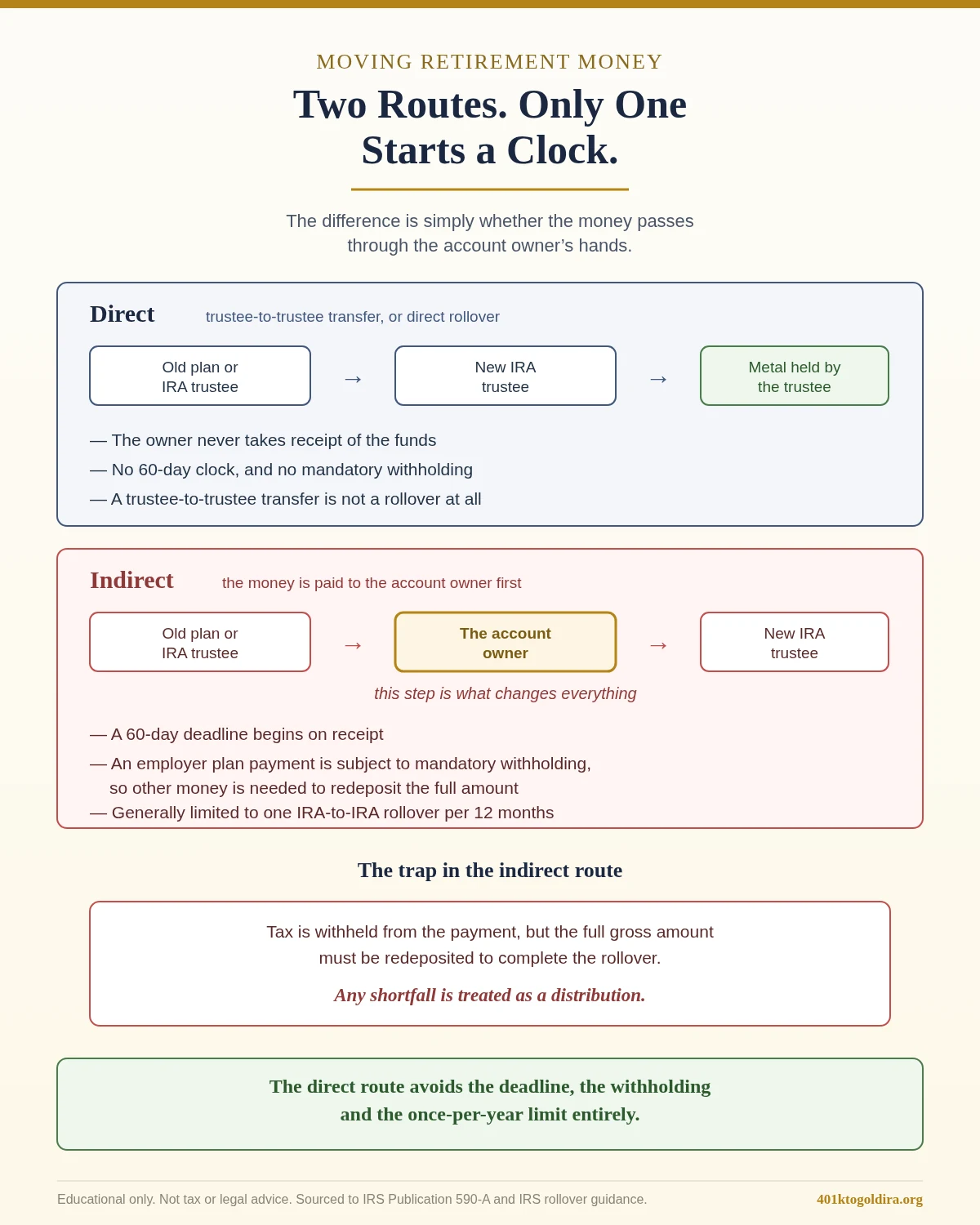
There are two ways to move money out of an employer plan. In a direct rollover, the plan sends the funds straight to the receiving IRA or plan, and no federal tax is withheld from the transfer. In an indirect rollover, the distribution is paid to the participant, and an eligible rollover distribution paid this way is generally subject to 20% mandatory federal withholding. The participant then has 60 days to roll the money over — but only the reduced amount actually arrived. To roll over the full original amount, the participant must add the withheld portion back from other savings. This calculator shows that out-of-pocket shortfall, and what happens to the rollover if it is not replaced.
Withholding Shortfall Estimator
Enter the gross distribution and the withholding rate (federal mandatory withholding on an eligible rollover distribution paid to the participant is generally 20%). The tool shows the cash received, the shortfall to complete a full rollover, and the taxable amount if the shortfall is not replaced. All figures are illustrative estimates based on the inputs only.
A direct rollover usually avoids this. Having the plan send funds straight to the receiving IRA or plan generally means no withholding, so no shortfall to replace. Confirm the rollover method with the plan administrator and a tax professional before acting.
The withheld tax is a prepayment credited on the participant's tax return, not necessarily a final tax. But it does not arrive in the rollover, so completing a full rollover within 60 days requires replacing it from other funds. The tool does not calculate the participant's actual income tax, any early-distribution penalty, or the final refund or balance due.
Not rolling it over at all? The 401(k) withdrawal tax and penalty calculator estimates what a cash withdrawal actually costs: the income tax across the 2026 bands, the possible 10% additional tax, this 20% withholding, and the balance due or refund at filing. Deciding whether to take the money at all? The lump sum vs annuity calculator compares a pension lump sum against the monthly payment it replaces, including break-even age and the return the lump sum would need to sustain.
Why Is 20% Withheld From a Plan Distribution?
The IRS explains that an eligible rollover distribution paid directly to the participant from an employer plan is generally subject to 20% mandatory federal income tax withholding, even when the participant intends to complete a 60-day rollover. By contrast, a direct rollover — where the plan sends the distribution straight to the receiving IRA or eligible plan — is generally not subject to that withholding (Internal Revenue Service). This is why the paid-to-you route creates the gap: the plan is required to hold back tax before the participant ever receives the money.
IRA-to-IRA transfers and direct rollovers are the common ways savers move retirement money without triggering this withholding. For an employer plan specifically, whether the payment is made to the receiving custodian or to the participant is what decides the outcome — set out in the 401(k) to Gold IRA rollover guide. The Gold IRA rollover calculator and the rollover guide cover the funding routes in more detail.
A Worked Example
Suppose a participant takes a $100,000 eligible rollover distribution paid to them. At 20% withholding, $20,000 is held back and $80,000 is received. To roll over the full $100,000 within 60 days — and keep the entire balance tax-deferred — the participant must deposit $100,000 into the receiving account, which means adding $20,000 from other savings to the $80,000 received. If they instead roll over only the $80,000 they received, the remaining $20,000 is generally treated as a taxable distribution for the year, and may also face an additional tax if the participant is under 59½ and no exception applies. A direct rollover would have moved the full $100,000 with no withholding to replace.
Compare the full toolkit
This is one of several educational calculators covering fees, RMDs, allocation, break-even, and more.
See All Calculators →Frequently Asked Questions
What does the rollover withholding shortfall calculator do?
It illustrates the out-of-pocket amount a saver may need to add to complete a full rollover when an eligible employer-plan distribution is paid to them and tax is withheld. To roll over the entire original amount within 60 days, the withheld tax must be replaced from other funds. It is an educational estimate, not a tax calculation.
Why is 20% withheld from a plan distribution?
The IRS states that an eligible rollover distribution paid directly to the participant from an employer plan is generally subject to 20% mandatory federal withholding, even when the participant intends a 60-day rollover. A direct rollover paid to the receiving IRA or plan generally avoids that withholding.
How can the withholding be avoided?
A direct rollover — where the plan sends the money straight to the receiving IRA or plan rather than to the participant — generally avoids the 20% withholding. This calculator shows why the indirect, paid-to-you route can create a shortfall.
Is the withheld amount lost?
The withheld tax is a prepayment credited on the tax return, not an automatic loss. But to roll over the full original amount within 60 days, the participant must replace the withheld portion from other funds; otherwise that portion is generally treated as a taxable distribution.
Does this tool calculate my actual tax?
No. It only illustrates the withholding gap and the amount needed to complete a full rollover. It does not calculate income tax, penalties, or state withholding. A tax professional should confirm the treatment.
Methodology and Limitations
Methodology. Tax withheld is the gross distribution multiplied by the federal withholding rate, plus any optional state withholding rate. Cash received is the gross distribution minus the total withheld. The out-of-pocket shortfall to complete a full rollover equals the total withheld, since that amount must be replaced from other funds to deposit the full gross into the receiving account. The taxable amount left behind, if the shortfall is not replaced, equals the total withheld portion that was not rolled over.
Assumptions and limitations. This tool illustrates the withholding gap only. The mandatory 20% figure applies to eligible rollover distributions paid to the participant from an employer plan; other distribution types and IRA distributions can follow different withholding rules. The tool does not calculate the participant's income tax, any early-distribution additional tax, the final refund or balance due, or state-specific rules, and it does not determine whether a distribution is an eligible rollover distribution or whether the 60-day window applies. All inputs are assumptions chosen by the user. This tool is educational only and should support discussion with the plan administrator and a qualified tax professional rather than serve as the basis for a decision. Past performance does not guarantee future results.
Tool reviewed and edited by Daniel M. — editor, 401kToGoldIRA.org. Educational only; not tax or legal advice. Withholding rule sourced to the IRS rollovers page.