Segregated vs Commingled Storage for a Gold IRA
Storage is one of the most misunderstood parts of a Gold IRA. Customers often see the words "segregated" and "non-segregated" on a quote without a clear explanation of what changes between them, or what the cost difference is. This page explains both terms in plain English, lists typical third-party depository cost ranges, includes an interactive segregated vs commingled storage cost calculator, and gives customers a written-question checklist to take to any precious metals company.
Skip to the Cost Calculator →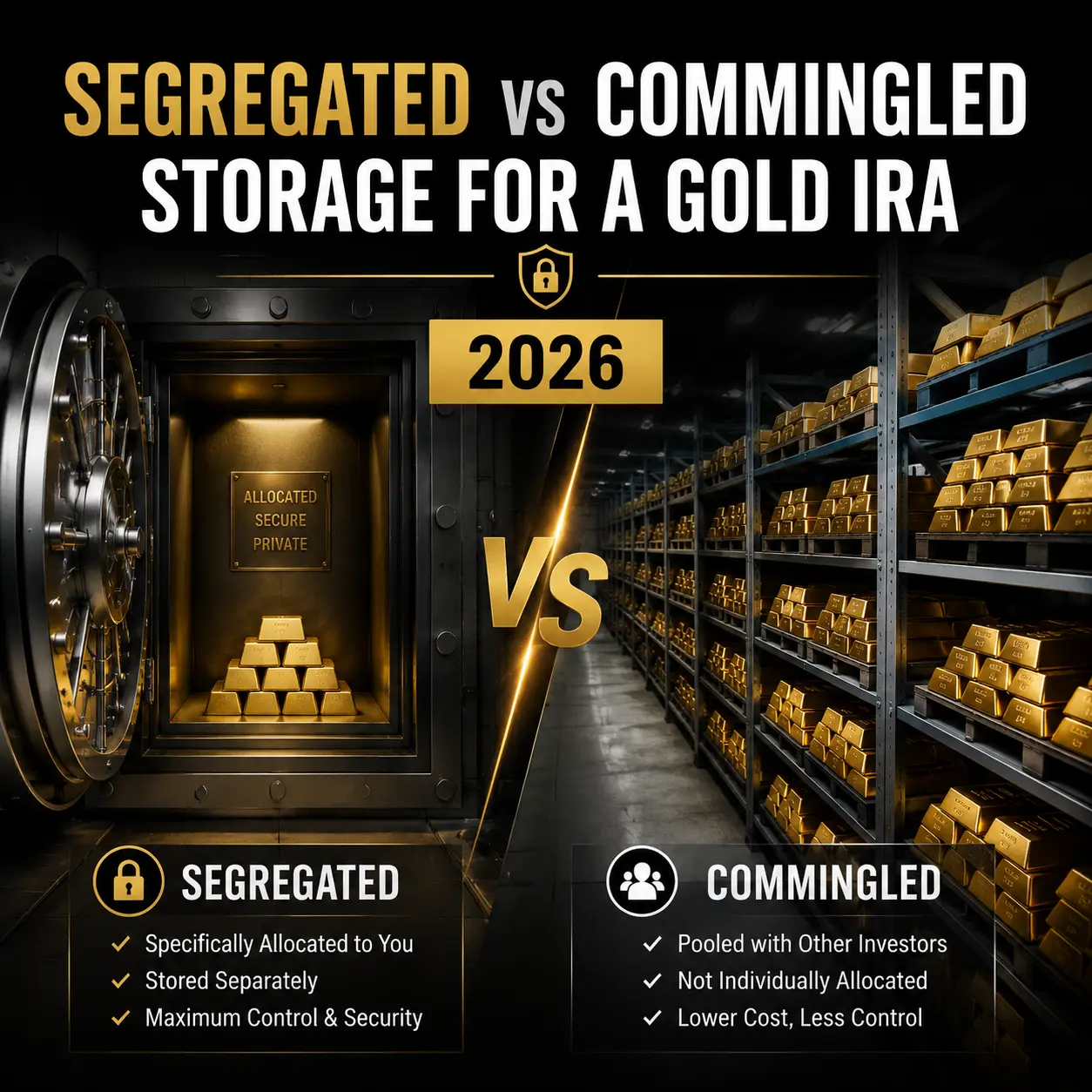
Affiliate disclosure: Some links on this page may be sponsor links. The site owners may be paid if customers request information from companies mentioned here. This page is educational only, not financial, tax, or legal advice. Customers should verify current written terms directly with the relevant precious metals company, custodian, and depository. Past performance does not guarantee future results.
Quick Answer
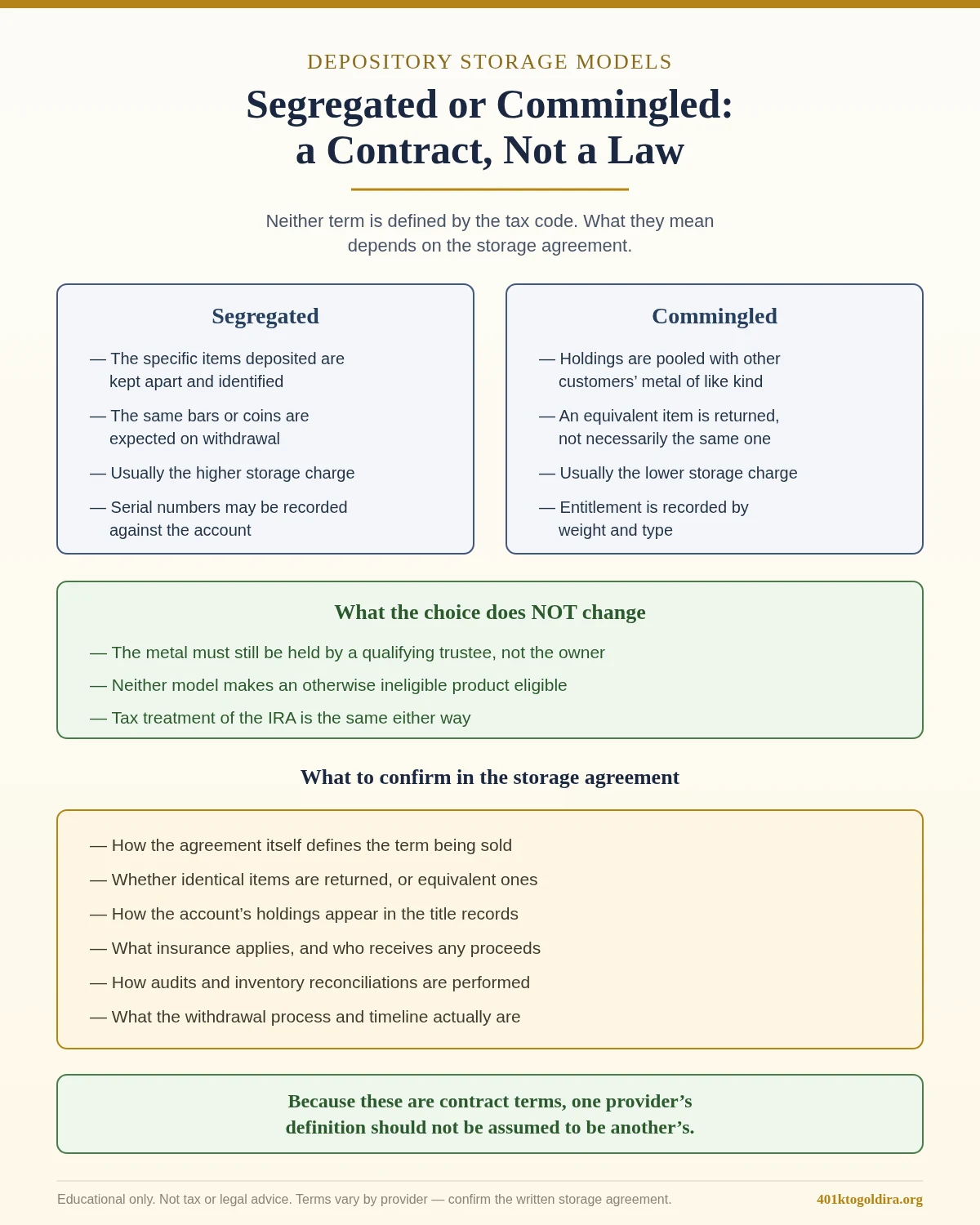
Segregated storage means a customer's metals are kept physically separate from other customers' metals inside a depository under the trustee's control, typically in a labeled location with the customer's name or account on the holding. Commingled (also called non-segregated or allocated-pool) storage means the customer's metals are stored alongside metals owned by other customers of the same type, with depository records tracking who owns how much.
Both options are common for self-directed Precious Metals IRA customers. Annual depository charges are generally assessed by the independent depository selected for the account, not by the precious metals company. Customers should confirm current rates directly with the assigned custodian and depository before opening or funding the account.
Storage Terms in Plain English
| Term | Plain-English meaning | What customers typically see on paperwork |
|---|---|---|
| Segregated | Customer-owned metals stored separately from other customers' metals inside the depository. | Labels, bin identifiers, or vault locations tied to the customer's name or IRA account. |
| Commingled / Non-segregated | Customer-owned metals stored together with other customers' metals of the same product type, with depository records tracking ownership. | Statements show ounces or units owned, not a unique physical location. |
| Allocated | Specific metals are recorded as belonging to the customer, whether segregated or commingled. | Account statements list the specific coins or bars owned. |
| Unallocated | The customer holds a claim against the depository or institution, not specific metals. | Generally not used for IRS-approved Precious Metals IRA holdings — customers should verify directly. |
Typical Third-Party Depository Storage Costs
Annual depository storage costs vary by depository, account size, product type, and whether the storage is segregated or commingled. Public materials and provider fee explainers commonly describe ranges similar to the example below, but customers should request current written rates from the assigned custodian and depository.
- Commingled (non-segregated) storage: Provider fee explainers commonly cite example annual costs in the range of $100 to $150, depending on the depository and account terms.
- Segregated storage: Provider fee explainers commonly cite example annual costs in the range of $150 to $300, depending on the depository, product type, and account size.
These figures are examples reported in public materials, not current quotes. Customers should request current written rates before opening or funding a self-directed Precious Metals IRA.
Compare written fee quotes side by side
The Gold IRA Fees & Hidden Costs Guide and the Gold IRA Company Comparison Workbook help customers log written quotes from any precious metals company, line by line.
Get the Fees Guide →Segregated vs Commingled Storage Cost Calculator
The segregated vs commingled storage cost calculator below estimates the annual and cumulative difference between the two storage options, using figures the user enters. It also shows the break-even account size at which a percentage-based commingled fee would match a flat segregated fee. Every input is chosen by the user, so the result is an illustrative estimate, not a depository quote.
The default figures are illustrative examples only, not depository rates. For flat fees the account balance does not change the charge; for percentage-based fees the cost is applied to the balance each year. The estimate excludes custodian fees, dealer spreads, insurance billed separately, taxes, and metal price movement. It does not conclude that either storage option is appropriate. For a full storage cost projection, see the Gold IRA storage fee calculator; for the wider legal, insurance and audit comparison, see the storage-options guide.
Who Charges Storage Fees
Annual storage costs are generally assessed by the independent depository selected for the account, not by the precious metals company that helped coordinate the purchase. Customer agreements, custodian terms, and depository terms should be reviewed for current fee schedules. Customers should not assume that a precious metals company controls or sets these third-party costs.
IRS-Approved Depositories Customers May See
Self-directed Precious Metals IRAs typically work with depositories used under a trustee's custody arrangements. Customers should confirm the specific depository assigned to their account with the custodian, and request current written terms from the depository directly. Common depositories referenced in public materials include:
- Delaware Depository
- Brink's Global Services USA
- International Depository Services (IDS) of Delaware and IDS of Texas
- Texas Bullion Depository (state-chartered, used by some custodians)
Customers should verify that the assigned depository is IRS-approved for Precious Metals IRA storage, and should review insurance, audit, and reporting practices through the depository's own materials.
Practical Differences Customers Care About
Cost
Segregated storage is typically priced higher than commingled storage because the depository allocates a specific labeled space to the customer's metals. Customers should weigh the additional cost against personal preferences and any depository policies on retrieval, audit, and distribution.
Retrieval and distribution
When an in-kind distribution from a Precious Metals IRA is taken, the depository ships specific coins or bars to the customer or to another approved party. Customers should ask the custodian and depository how distributions are handled for both segregated and commingled holdings, and what documentation is provided.
Audit and reporting
Depositories typically provide periodic statements and may publish audit policies. Customers should review reporting frequency, audit practices, and how holdings are reconciled with custodian records before relying on any storage description.
Insurance
Depository insurance terms vary. Customers should request a written description of insurance coverage, limits, and any exclusions from the depository directly. Insurance terms are set by the depository, not by the precious metals company.
Common Misunderstandings
- "Segregated storage is the same as home storage." No. Segregated storage at a depository under the trustee's control is still depository storage. "Home storage" arrangements for IRA-owned metals carry significant tax and legal risk and are outside the scope of this educational page.
- "Commingled means my metals are mixed with junk metal." No. Commingled depository storage means customer-owned metals of the same product type are stored together with depository records tracking ownership. Customers should request a written explanation of how holdings are tracked.
- "The precious metals company decides my storage fee." Not directly. Storage fees are generally assessed by the independent depository selected for the account. Customers should request the depository's current written rate.
- "All depositories cost the same." No. Costs vary by depository, account size, product type, and storage option. Customers should compare written rates before opening an account.
Written-Question Checklist Before Choosing Storage
- Which depository under the trustee's control will be assigned to the account?
- What is the current annual storage cost for commingled storage at that depository?
- What is the current annual storage cost for segregated storage at that depository?
- Are storage costs assessed by the depository or by the precious metals company?
- How are holdings tracked and reported on customer statements?
- How is an in-kind distribution handled for both segregated and commingled holdings?
- What insurance coverage is provided, and what are the limits and exclusions?
- How often are audits performed, and are audit summaries available to customers?
- Are there additional charges for shipping, retrieval, or distribution?
- Can the customer change depositories or storage options after the account is open, and what would that involve?
How This Page Was Built
This page is based on the site's existing Gold IRA Fees & Hidden Costs Guide, provider-specific fee articles, and public materials describing typical depository storage terms. Customers should request live written information directly from the assigned custodian and depository because storage rates, depositories, insurance terms, and audit practices can change.
Article reviewed and edited by Daniel — independent precious-metals retirement researcher.
Further Reading
Gold IRA Storage Fee CalculatorEstimate total depository storage cost drag over the full holding period. Gold IRA Fees & Hidden Costs GuideGet the free PDF guide covering storage, administration, and markup questions.
 Gold IRA Quote ChecklistUse a 15-point checklist before accepting any written provider quote.