Gold IRA Scam & Enforcement Tracker: SEC, CFTC & FTC Cases
Precious-metals retirement fraud is not anecdotal — it is on the public record. This tracker compiles named federal enforcement actions, judgment amounts, the leading home-storage court case, and the sales tactics regulators repeatedly cite, with links to the agencies that hold the records.
View the Enforcement Data →Educational only: This tracker summarises public enforcement records from named primary sources. It does not provide financial, tax, or legal advice. Case descriptions summarize public records; allegations are noted as allegations. Past performance does not guarantee future results.
Across just two federal precious-metals cases, courts found at least 1,400 people paid approximately $137 million — most of it retirement savings.
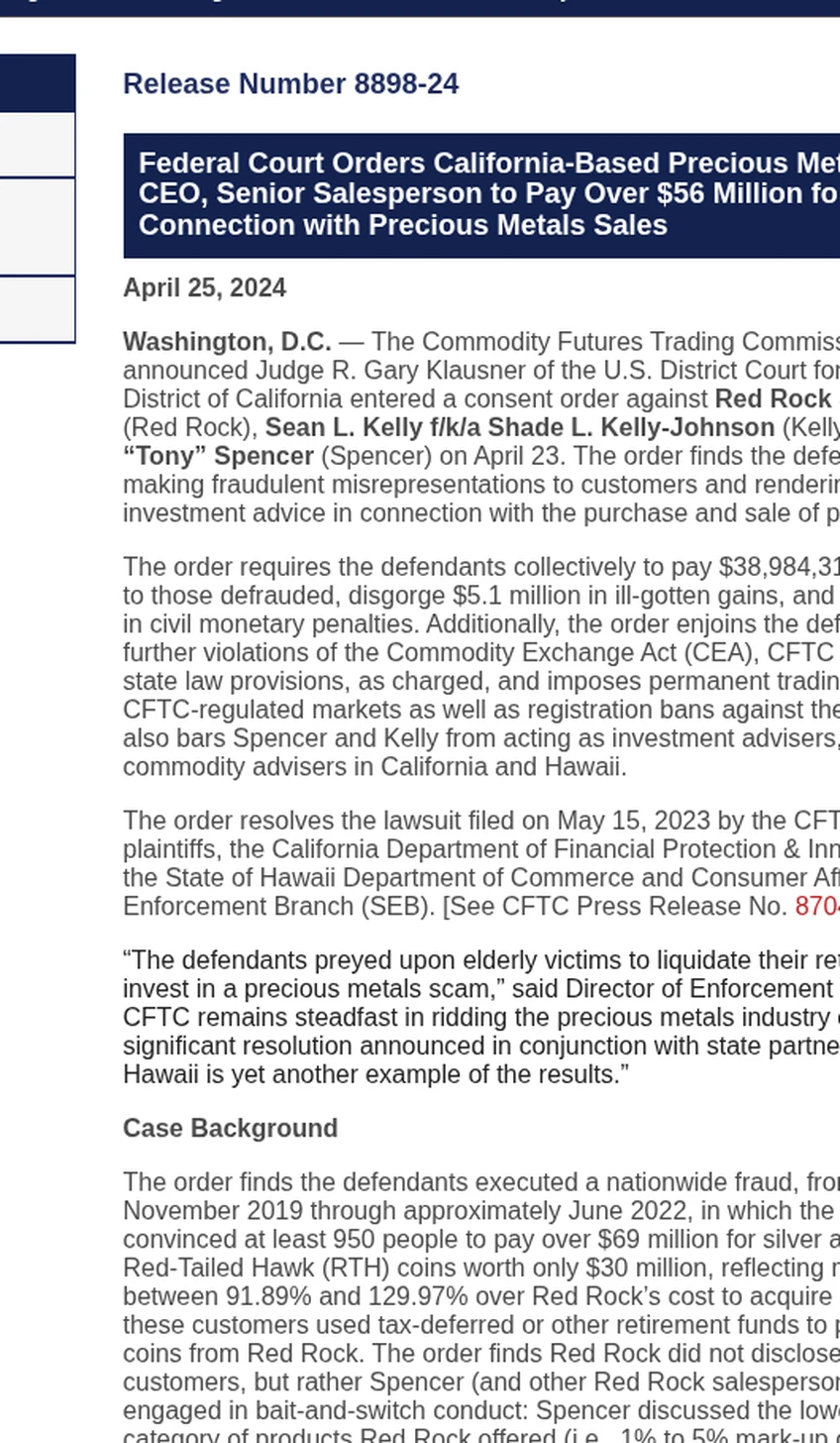
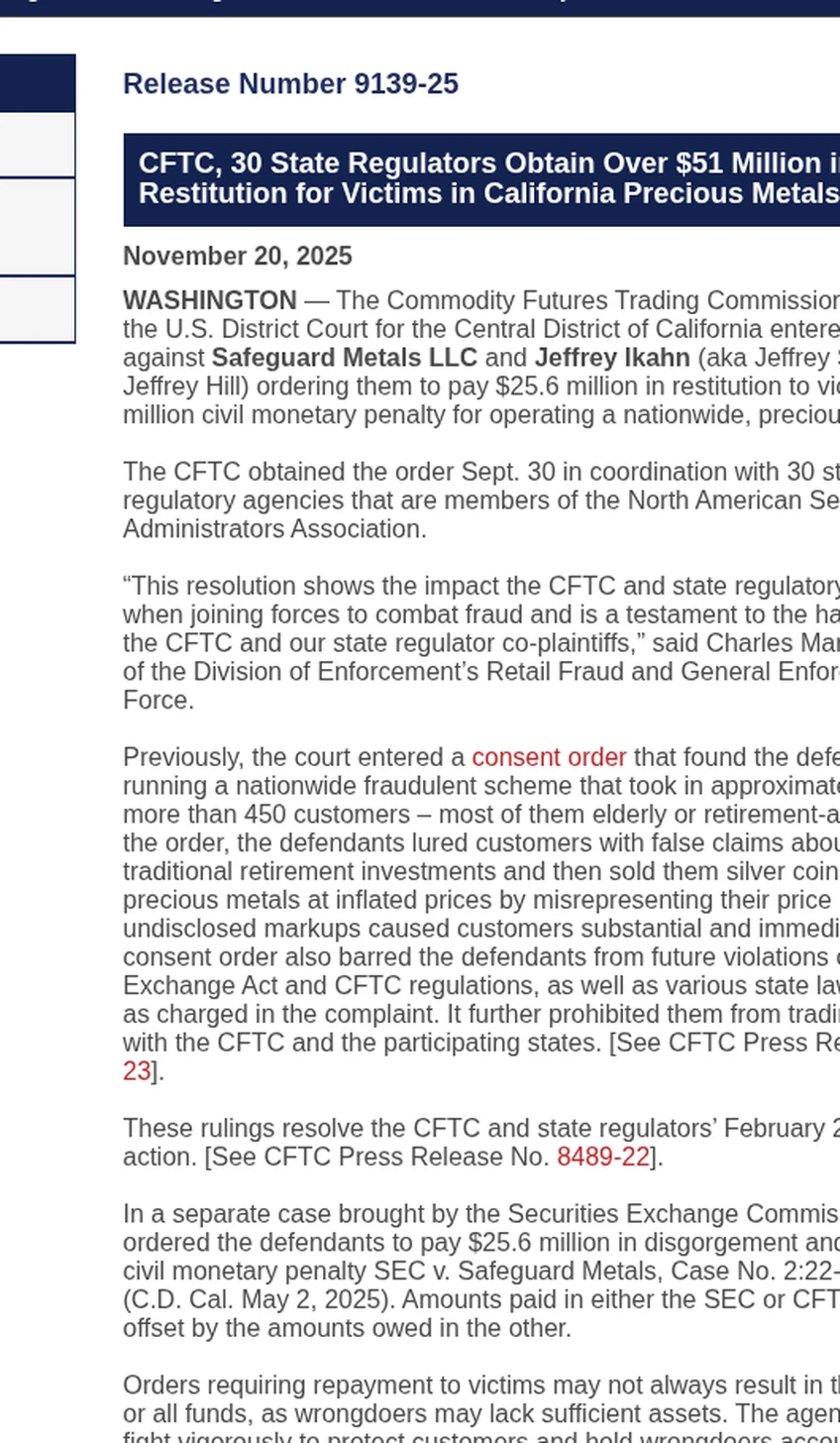
Assembled from the two consent orders. In Red Rock Secured the CFTC states that the order finds the defendants convinced at least 950 people to pay over $69 million for coins worth only $30 million — markups of 91.89% to 129.97% over cost, and "most of these customers used tax-deferred or other retirement funds" (CFTC Release 8898-24). In Safeguard Metals the court found a scheme that took approximately $68 million from more than 450 customers, "most of them elderly or retirement-aged" (CFTC Release 9139-25). Customer counts and amounts paid are summed across two separate companies with separate victim pools. Judgment amounts are deliberately not summed — the CFTC's own release states that "amounts paid in either the SEC or CFTC actions will be offset by the amounts owed in the other," so adding them would double-count the same money.
Key takeaways
- In Red Rock Secured the CFTC states that the order finds the defendants convinced at least 950 people to pay over $69 million for coins worth only $30 million — markups of 91.89% to 129.97% over the company's cost — and that "most of these customers used tax-deferred or other retirement funds" (CFTC Release 8898-24). The 950 figure appears in the agency’s release rather than in the text of the order itself.
- The Safeguard Metals order found a nationwide scheme that took approximately $68 million from more than 450 customers, "most of them elderly or retirement-aged", who were lured with false claims about the risk of traditional retirement investments (CFTC Release 9139-25).
- Judgment totals across agencies cannot be added. The Red Rock consent order provides that the firm receives dollar-for-dollar credit against restitution for restitution or disgorgement paid in the SEC action, and the CFTC states of Safeguard that "amounts paid in either the SEC or CFTC actions will be offset by the amounts owed in the other" (CFTC Release 9139-25). Summing agency judgments therefore double-counts the same money, which is why published sector totals vary so widely.
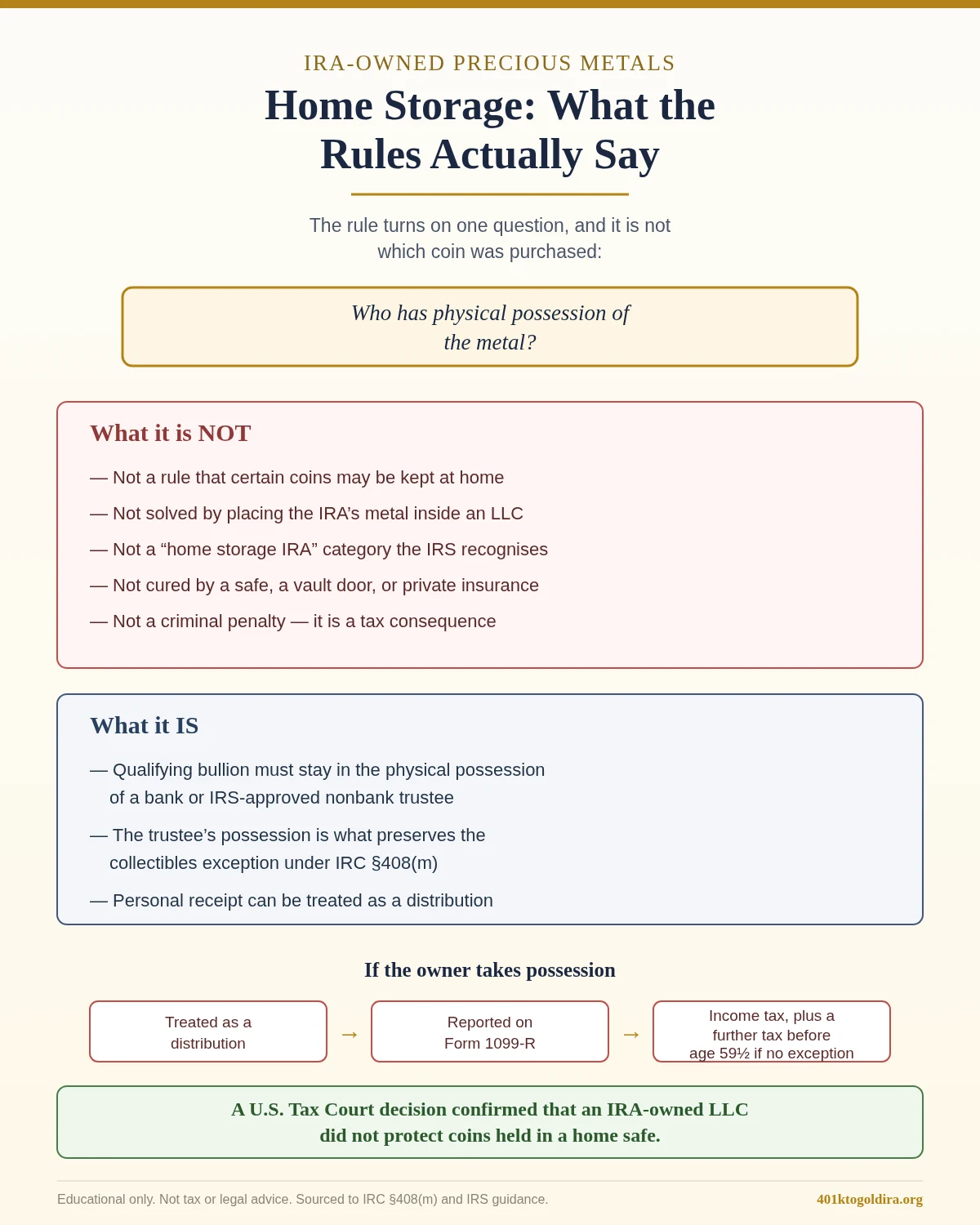
- Receiving physical custody of IRA-owned American Eagle coins produced $411,380 in taxable distributions, irrespective of the owner’s status as manager of the IRA-owned LLC that held title (McNulty v. Commissioner, 157 T.C. No. 10, docket 1377-19, filed 18 November 2021).
- Regulators identify fear-based urgency, bait-and-switch into high-markup coins, and "free silver" offers as recurring tactics, and advise obtaining price and spread figures in writing before purchase (FINRA and CFTC).
- CFTC material on precious-metals fraud warns that high costs and markups can make a profit unlikely regardless of metal price movement (CFTC — precious metals fraud).
- These are named federal actions on the public record, not estimates of sector-wide loss. Losses never reported to a regulator are not captured here.
Quick Answer: The Fraud Is Documented, Named, and Sourced
Reddit threads asking "is a Gold IRA a scam?" rarely get a sourced answer — just opinions. The reality is that precious-metals retirement fraud appears repeatedly in federal enforcement records, and the scale is measurable.
Two federal cases alone account for at least 1,400 people and approximately $137 million. In Red Rock Secured the CFTC states that the order finds the defendants convinced at least 950 people to pay over $69 million for coins worth only $30 million — markups of 91.89% to 129.97% over the company's cost — and that "most of these customers used tax-deferred or other retirement funds". In Safeguard Metals the 25 October 2023 consent order found a nationwide scheme that took approximately $68 million from more than 450 customers, "most of them elderly or retirement-aged". Neither figure is an estimate: both come from the CFTC's own releases reporting findings of liability.
Those counts are additive because Red Rock and Safeguard are separate companies with separate victim pools. The judgment amounts are not additive, and this page does not add them. The CFTC states it directly: "amounts paid in either the SEC or CFTC actions will be offset by the amounts owed in the other." Summing agency judgments counts the same money twice, which is why published totals for this sector vary so widely.
Alongside the money, the U.S. Tax Court's McNulty decision established that receiving physical custody of IRA-owned coins triggers a taxable distribution. These are not warnings — they are outcomes on the public record.
Named Enforcement Actions & Records
Each entry summarizes a public regulator or court record. Allegations are described as allegations; judgments as judgments. Follow the source link to the agency that holds the record.
| Case / record | Key figure | What the record shows | Source |
|---|---|---|---|
| SEC v. Red Rock Secured (2023) | 950+ people · >$69M paid · $76.4M judgment | CFTC Release 8898-24 states that the order finds the defendants convinced at least 950 people to pay over $69M for coins worth only $30M, reflecting markups of 91.89% to 129.97% over cost, and that most of those customers used tax-deferred or other retirement funds. The SEC's separate amended complaint alleged that at least 700 investors lost more than $50M; those complaint figures remain allegations. In April 2024 defendants consented — without admitting or denying the SEC's allegations — to final judgments requiring more than $76.4M in combined disgorgement, interest and penalties. The CFTC consent order provides that Red Rock receives dollar-for-dollar credit against restitution for restitution or disgorgement paid in the SEC action. Cited in plain text: SEC Litigation Release No. 25996 (SEC v. Red Rock Secured, LLC, No. 2:23-cv-03682-RGK-PVC (C.D. Cal.)). | CFTC consent order |
| CFTC / NASAA v. Safeguard Metals (2022) | 450+ investors · ~$68M solicited | A consent order entered 25 October 2023 found liability in a nationwide scheme that received approximately $68M from more than 450 people, many using retirement savings, via fear-based sales and large markups on silver coins (CFTC Release 8812-23). A September 2025 final judgment ordered $25.6M in restitution and a $25.6M civil monetary penalty, with a separate SEC judgment imposing overlapping relief subject to offset (CFTC Release 9139-25). | CFTC / state regulators |
| McNulty v. Commissioner (2021, Tax Court) | taxable distribution + penalties | McNulty v. Commissioner, 157 T.C. No. 10, docket 1377-19, filed 18 November 2021. The Tax Court held that Mrs McNulty received taxable distributions when she received physical custody of the American Eagle coins, irrespective of her status as manager of the IRA-owned LLC. The decision turns on physical custody; the court expressly declined to reach the commingling question, so it is not authority that every arrangement marketed as 'home storage' fails for some other reason. | U.S. Tax Court |
| FTC older-adult fraud reporting | $600M (2020) to $2.4B (2024) | The FTC's annual report to Congress on protecting older adults states that in 2024 older adults reported losing far more money to investment scams than to any other fraud type, and that total reported fraud losses among adults aged 60 and over rose roughly fourfold, from about $600 million in 2020 to $2.4 billion in 2024. | FTC |
| CFTC and FINRA investor bulletin | spreads under 20% to over 300% | The joint bulletin states some fraudulent dealers have charged spreads of more than 300 percent while other dealers may charge less than 20 percent, and warns against moving retirement funds into metals on an unsolicited pitch. It is a contrast between extremes, not a typical range. | CFTC / FINRA |
Sales Tactics Regulators Repeatedly Cite
Across these actions, the same playbook recurs. Recognizing the tactic is the most practical protection a retirement saver has.
| Tactic | What it looks like | Flagged by |
|---|---|---|
| Fear-based urgency | Economic-collapse or dollar-crash framing to rush a rollover. | CFTC / FTC |
| Bait-and-switch to premium coins | Quote on bullion, then steer to high-markup 'exclusive' or proof coins. | SEC (Red Rock) |
| 'Free silver' / bonus metals | Bonus offers that mask the markup funding them. | CFTC / FINRA |
| Home-storage 'IRA' pitch | Claims you can legally store IRA metals at home (McNulty says otherwise). | U.S. Tax Court |
| Affinity / celebrity marketing | Political, religious, or celebrity trust cues in place of pricing disclosure. | CFTC |
The detailed red-flag checklist is on the scam warning signs page, the bonus-metals tactic is examined in the free silver warning, and the markup mechanics behind the enforcement cases are quantified in the dealer markup data.
Check a quote before it becomes a case. The markup patterns in these actions — coins priced far above melt value — are measurable before purchase. The break-even calculator shows how far the metal price must rise to recover a given premium and buyback spread, and the quote checklist sets out what to request in writing.
Methodology: how the combined figures were assembled
The investor count and the solicited-or-lost total are compiled from the agencies' own filings, not from secondary reporting. Each component and its source is set out below so the arithmetic can be checked.
| Case | People | Amount paid | Basis | Primary source |
|---|---|---|---|---|
| Red Rock Secured | at least 950 | over $69M | CFTC release, characterising the order’s finding | CFTC 8898-24 |
| Safeguard Metals | more than 450 | approximately $68M | Consent order finding | CFTC 9139-25 |
| Combined | at least 1,400 | approximately $137M | Sum across two separate companies | — |
The primary records themselves
Both figures come from consent orders announced by the CFTC. The releases are reproduced below so the numbers can be read in the agency's own words rather than taken on trust.
What is deliberately excluded. Judgment and penalty amounts are not summed. Each case produced parallel SEC and CFTC actions whose monetary relief overlaps and is subject to offset, so adding those figures would count the same money more than once. The combined total above reflects amounts solicited or lost as found or alleged by the agencies, which is the measure that can be added without double-counting.
What the figure is not. It is not a total for the sector. It covers two named federal cases, not every precious-metals enforcement action, and not losses that were never reported to a regulator. The CFTC order states the Red Rock payment total, while Release 8898-24 states that the order finds at least 950 people were convinced to pay it; Safeguard’s figures are consent-order findings. The separate figures in the SEC’s amended complaint (at least 700 investors, more than $50 million) are allegations the defendants neither admitted nor denied, and are not the basis of the combined total.
Sources last reviewed: 24 September 2026; SEC Litigation Release No. 25996 could not be re-opened on that date.
How to Cite This Page
Two federal precious-metals consent orders — Red Rock Secured and Safeguard Metals — together account for at least 1,400 people and approximately $137 million paid, most of it retirement savings. Compiled by 401ktogoldira.org from CFTC releases 8898-24 and 9139-25.
Source: 401ktogoldira.org — Gold IRA Scam & Enforcement Tracker: SEC, CFTC & FTC Cases.
Publisher: 401ktogoldira.org
URL: https://401ktogoldira.org/gold-ira-scam-enforcement-tracker/
Accessed: state the date you retrieved the page, as enforcement records and agency pages change.
To cite one record rather than the page, append its row anchor to the URL — for example #row-case-sec-v-red-rock-secured-2023 or #row-combined-total. Row anchors are derived from the record itself, not row position, so they stay stable when rows are added or reordered.
The Home-Storage Trap (McNulty)
One structure deserves its own note because the marketing is so persistent: the "home storage" or "checkbook LLC" Gold IRA, pitched as a way to legally keep IRA metals at home. In McNulty v. Commissioner, 157 T.C. No. 10, docket 1377-19 (filed 18 November 2021), the Tax Court held that Mrs McNulty received taxable distributions when she received physical custody of the American Eagle coins, irrespective of her status as manager of the IRA-owned LLC that held title. Read the holding precisely: it turns on physical custody, and the court expressly declined to reach the commingling question, so it does not establish that every arrangement marketed as "home storage" fails for some further reason. Separately, the general rule that IRA assets sit with a bank or approved non-bank trustee is set out in IRS Publication 590-B. Storage rules are covered in segregated vs commingled storage.
Worked examples of the method
Two pages on this site apply the process below to a named company from start to finish, and they reach opposite results, which is the point of running it rather than assuming an answer. The Lear Capital public record sets out a state attorney general action, a multi-state regulatory resolution and a Chapter 11 filing, each separated and sourced to the agency release or court docket. The Preserve Gold public record documents searches that returned no matching court or enforcement record at all, and states plainly which databases were checked and which paid indexes were not exhausted.
How to Verify a Company Yourself
Before funding, a retirement saver can check the public record directly: the SEC's Investor.gov and FINRA's BrokerCheck for registration, the CFTC and National Futures Association for metals- and commodities-related complaints, the FTC for fraud reporting, and state securities regulators and attorneys general for local actions and complaint history. A company's own transparency — whether it publishes fees, names its custodian and depository, and puts buyback terms in writing — is itself a signal. The written-question checklist is in questions to ask before opening a Gold IRA.
Methodology
This tracker compiles named enforcement actions and court records involving precious-metals retirement products from public sources: SEC litigation releases, CFTC enforcement records and consent orders, U.S. Tax Court decisions, and the FTC’s annual report to Congress on protecting older adults. Figures (judgment amounts, solicited totals, alleged markups) are drawn from the public filings and are described in the terms the record uses — allegations as allegations, judgments as judgments. This page does not accuse any company beyond what public records state, and does not aggregate a total industry loss figure because no single official dataset isolates "Gold IRA fraud" cleanly; instead it links each named record to the agency that holds it. Details should be verified against the primary source before republication.
Frequently Asked Questions
How common are Gold IRA scams?
Precious-metals retirement fraud is well documented in regulator records. Named federal actions include SEC v. Red Rock Secured (a roughly $76.4 million judgment; CFTC Release 8898-24 states the order finds at least 950 people paid over $69 million) and a CFTC and state action against Safeguard Metals, whose order found approximately $68 million taken from more than 450 customers, largely from retirement savings. FTC data shows investment-fraud losses among older adults rising.
Are home storage Gold IRAs legal?
Receiving physical custody of IRA-owned metals is treated as a taxable distribution. In McNulty v. Commissioner, 157 T.C. No. 10, docket 1377-19, filed 18 November 2021, the U.S. Tax Court held that the taxpayer received taxable distributions when she received physical custody of the American Eagle coins, irrespective of her status as manager of the IRA-owned LLC that held title. The decision turns on physical custody, and the court expressly declined to reach the commingling question. IRA assets are generally held by a bank or approved non-bank trustee.
What are the biggest Gold IRA enforcement cases?
Two frequently cited federal actions are SEC v. Red Rock Secured (CFTC Release 8898-24 states the order finds markups of 91.89% to 129.97% over cost, alongside a roughly $76.4 million judgment) and the CFTC and state action against Safeguard Metals (approximately $68 million solicited from more than 450 customers, largely retirement savings). Both targeted retirement savers.
What sales tactics do regulators warn about?
Regulators repeatedly cite fear-based urgency, bait-and-switch into high-markup premium coins, "free silver" bonus offers that mask markups, illegal home-storage pitches, and affinity or celebrity marketing used in place of clear pricing disclosure.
Update Log
- 24 September 2026: Source review and corrective pass. The Red Rock figures are attributed to CFTC Release 8898-24, which states that the order finds at least 950 people paid over $69 million at markups of 91.89%–129.97% over cost; that 950 figure appears in the agency’s release rather than in the text of the order, and the page now says so. Allegation caveats are confined to the SEC amended complaint. The combined amount reads “approximately $137 million”. Safeguard’s liability finding is now cited to the 25 October 2023 consent order (Release 8812-23), with Release 9139-25 retained for the September 2025 final judgment and its “more than 450 customers” wording. Offset mechanics are cited to the Red Rock consent order PDF, which grants dollar-for-dollar credit against restitution for amounts paid in the SEC action. The McNulty citation moved to the official docket page (157 T.C. No. 10, docket 1377-19, filed 18 November 2021) and the holding is narrowed to physical custody, noting that the court expressly declined the commingling question. The FTC citation moved to the agency’s annual report to Congress, and an unsupported claim that precious-metals pitches are a recurring FTC-tracked channel was deleted rather than weakened. The SEC litigation release is cited in plain text without a hyperlink, because every official SEC path is blocked from this datacentre and no alternative official release page was reachable; its title and date are not asserted. The FINRA written-advice sentence no longer includes buyback, and the CFTC precious-metals-fraud page is cited for high costs and markups rather than spread wording. Structure: descriptive heading IDs, stable per-row anchors, row-header scopes, table captions, one consolidated citation block, and Dataset metadata describing the variables and method.
- 2026: Initial enforcement tracker published with named SEC/CFTC/Tax Court records, the sales-tactic table, verification resources, methodology, and FAQ schema.
How figures on this site are produced and checked is set out in the research methodology, and errors are handled under the corrections policy. Article reviewed and edited by Daniel — independent precious-metals retirement researcher.