Gold IRA Withdrawal & Tax Estimator
This educational estimator illustrates how a traditional IRA distribution might be taxed, using assumptions the user enters. It can show possible ordinary income tax and the 10% early-distribution additional tax that may apply before age 59½. It is not a tax calculation, not a filing tool, and not a determination of eligibility for any exception — a qualified tax professional should confirm every figure.
Open the Estimator →Important — educational estimate only: This tool produces a rough illustration based on assumptions the user enters. It is not tax advice, not a tax calculation, not a withholding instruction, and not a determination of whether any early-distribution exception applies. Actual tax depends on total income, filing status, deductions, credits, state rules, basis, and current federal law, none of which this tool evaluates. Customers should speak with a qualified tax professional before taking or reporting an IRA distribution. Goldco does not offer tax or legal advice. Past performance does not guarantee future results.
Quick Answer: What This Estimator Shows
A Gold IRA is a self-directed IRA holding physical metals, and its distributions follow the same federal tax rules as other IRAs. When a traditional IRA distribution is taken, the taxable portion is generally included in income and taxed at ordinary rates, and a distribution before age 59½ may also face an additional 10% tax unless an exception applies. This estimator lets a user enter a distribution amount, an assumed federal marginal rate, an assumed state rate, and whether an early-distribution exception may apply, then shows a rough illustration of the possible ordinary tax, the possible 10% additional tax, and the estimated amount remaining. Because it uses only the assumptions entered, it is a teaching tool for understanding the moving parts — not a calculation of an actual tax bill.
Distribution Tax Estimator
Enter the distribution and your assumptions. Every output is an illustrative estimate based only on those inputs. This is not a tax determination.
Consult a tax professional. This estimate does not determine your actual tax, your bracket, your state's rules, or whether any early-distribution exception applies to you. Confirm every figure with a qualified tax advisor before acting.
The estimate applies the assumed federal and state marginal rates to the full taxable distribution as a simplification. Real tax uses graduated brackets, total income, filing status, deductions, credits, and basis, so an actual result will differ. Roth distributions are assumed to be qualified and tax-free here; a non-qualified Roth distribution can be partly taxable. An in-kind distribution is taxed on the metal's fair market value.
Is a Gold IRA Distribution Taxable?
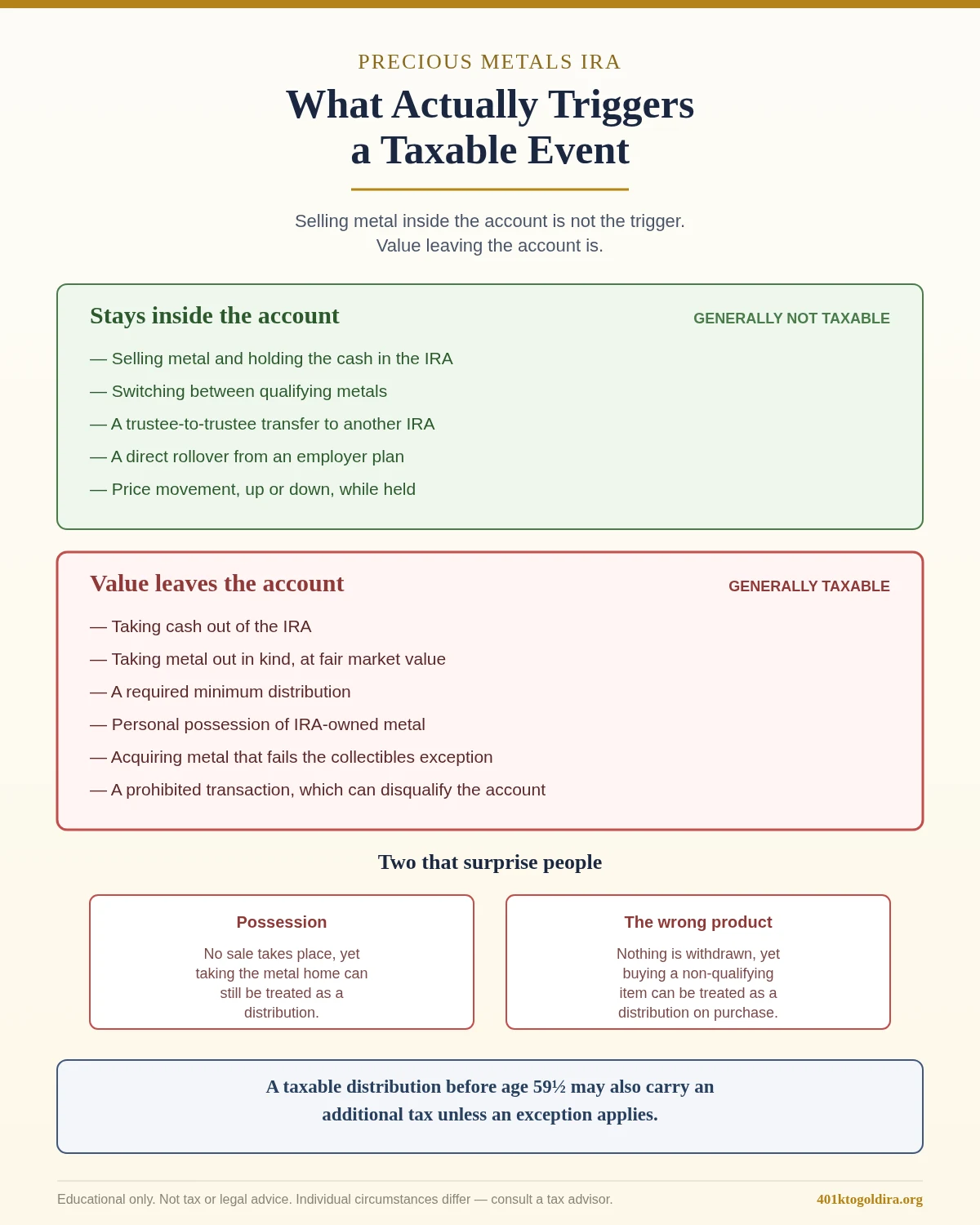
For a traditional IRA, distributions are generally included in taxable income for the year received, and the taxable portion is taxed at ordinary income rates. The IRS explains that amounts in a traditional IRA, including gains, are generally not taxed until distributed (Internal Revenue Service; Internal Revenue Service, Publication 590-B). A qualified Roth IRA distribution can be tax-free because Roth contributions are made with after-tax money and qualified earnings are not taxed, though a non-qualified Roth distribution can be partly taxable.
Taking metal instead of cash does not avoid the tax. An in-kind distribution of coins or bars is generally treated as a distribution of the metal's fair market value, and that value is the reportable distribution amount. The mechanics of turning IRA metal into cash or taking it in kind are covered in the cash-from-Gold-IRA guide and the Gold IRA RMD strategy guide.
When Does the 10% Early-Distribution Tax Apply?
The IRS states that the taxable part of an IRA distribution taken before age 59½ is generally subject to an additional 10% tax on top of ordinary income tax, unless a statutory exception applies (Internal Revenue Service). The Gold IRA early withdrawal penalty guide explains those exceptions, including the rules that apply to IRAs and the employer-plan exceptions that do not carry over. Whether any exception applies depends entirely on the taxpayer's facts and current law — which is why this tool cannot decide it for anyone. The toggle in the estimator only lets a user see how the number would change under an assumption; it is not a ruling that an exception applies.
This distinction matters most for anyone considering a distribution before 59½. The additional tax can meaningfully reduce the amount that remains, so the decision deserves a conversation with a tax professional before, not after, the distribution. The Gold IRA tax mistakes guide covers common errors in this area.
Compare the full toolkit
This is one of several educational calculators covering fees, RMDs, allocation, break-even, sequence risk, and more.
See All Calculators →How to Use the Estimate Responsibly
- Treat it as a teaching tool. It shows how the pieces — taxable amount, marginal rate, state tax, and a possible 10% — fit together, not what a return will actually owe.
- Use realistic assumptions. A marginal rate is not the average rate on a whole return, and a large distribution can push income into a higher bracket that a single assumed rate does not capture.
- Confirm the exception question with a professional. The under-59½ toggle is an assumption only. Only a qualified advisor can confirm whether an exception applies.
- Account for withholding separately. A distribution may have federal (and sometimes state) tax withheld at payout, which is a prepayment, not the final tax. The final tax is settled on the return.
- Plan the timing. Spreading distributions across years, or waiting until after 59½, can change the result. A professional can model the specific situation.
Customers should speak to a qualified tax professional before taking or reporting an IRA distribution. Goldco does not offer tax or legal advice.
Frequently Asked Questions
What does the Gold IRA withdrawal and tax estimator do?
It produces an educational illustration of how a traditional IRA distribution might be taxed, using assumptions the user enters — the distribution amount, an assumed federal marginal tax rate, an assumed state rate, and whether the 10% early-distribution additional tax may apply before age 59½. It is not a tax calculation, a filing tool, or a determination of eligibility for any exception.
Is a Gold IRA distribution taxable?
Traditional IRA distributions are generally included in taxable income, and the taxable portion may be subject to ordinary income tax. Qualified Roth IRA distributions can be tax-free. An in-kind distribution of metal is generally taxed on its fair market value; taking metal instead of cash does not avoid the tax.
When does the 10% early-distribution tax apply?
The IRS states that the taxable part of a distribution taken before age 59½ is generally subject to an additional 10% tax unless a statutory exception applies. Whether an exception applies depends on the taxpayer's facts and current law.
Does this tool tell me if I qualify for an exception?
No. It cannot determine eligibility for any early-distribution exception. It only lets a user toggle an assumption to see how the estimate would change. A tax professional should confirm whether an exception applies.
Can this tool be used to file taxes?
No. It is educational only and does not produce a tax return, a withholding instruction, or an official calculation. Customers should speak with a qualified tax professional before taking or reporting a distribution.
Methodology and Limitations
Methodology. For a traditional IRA, the estimator treats the full distribution as taxable and multiplies it by the assumed federal marginal rate plus the assumed state rate to produce a possible ordinary income tax. If the age entered is under 59½ and the user has not assumed an exception, it adds 10% of the taxable amount as a possible early-distribution additional tax. The estimated amount remaining is the distribution minus the estimated total tax. For a Roth IRA, the tool assumes a qualified, tax-free distribution and shows no tax; a non-qualified Roth distribution is not modeled.
Assumptions and limitations. This is a deliberately simplified illustration. It applies flat assumed marginal rates to the entire distribution rather than graduated brackets, and it ignores total household income, filing status, deductions, credits, the standard deduction, IRA basis, the actual list of early-distribution exceptions, net investment income considerations, and interactions with items such as Medicare premiums or the taxation of Social Security. It does not determine eligibility for any exception, does not calculate withholding, and does not produce a tax return. All inputs are assumptions chosen by the user, so no figure represents an actual tax result. This tool is educational only and should support discussion with a qualified tax professional rather than serve as the basis for a decision.
Tool reviewed and edited by Daniel M. — editor, 401kToGoldIRA.org. Educational only; not tax or legal advice, and not a tax determination. Tax rules sourced to the IRS Publication 590-B and the IRS early-distribution exceptions page.