U.S. Gold IRA Depository Directory: Locations, Storage Models, and Verification Sources
This gold ira depository list separates verified public facts from dealer claims. It identifies U.S. depository operators commonly discussed for precious-metals IRA storage, then records only what can be traced to depository, regulator, custodian, or official company sources.
View the Directory →Educational only: This directory is not a ranking, recommendation, legal opinion, or custody approval. It records public-source statements and verification status. Customers should speak to a financial or tax advisor before making decisions. Goldco does not offer tax or legal advice. Past performance does not guarantee future results.
This first edition verifies six U.S. depository operators or storage networks from primary, regulator, or custodian sources — and deliberately excludes or parks operators where public IRA evidence is weak.
Compiled from depository pages, Texas Comptroller material, IRS trustee guidance, SEC no-action material, and custodian election forms. Three of the six are fully verified from primary sources; two are only partly verifiable and are labelled as such. Verification status is recorded per row rather than assumed.
Key takeaways
- This is not a ranking: the table records source-backed facts and caveats, not a “best depository” verdict.
- IRS wording matters: IRS approval applies to trustees and custodians; a vault facility is not automatically approved because an affiliate list says so. The verification method sets out how to check any "IRS-approved" claim against the IRS's own published list in a few minutes.
- Primary sources win: depository pages, regulator pages, and custodian forms carry more weight than dealer blogs or listicles.
- Partly verified rows stay partly verified: Brink’s is a real vault/logistics provider, but the IRA-specific details found publicly are less complete than for several dedicated depositories.
- Use this with a custodian: storage availability, fees, insurance, and procedures should be confirmed in writing before any IRA purchase.
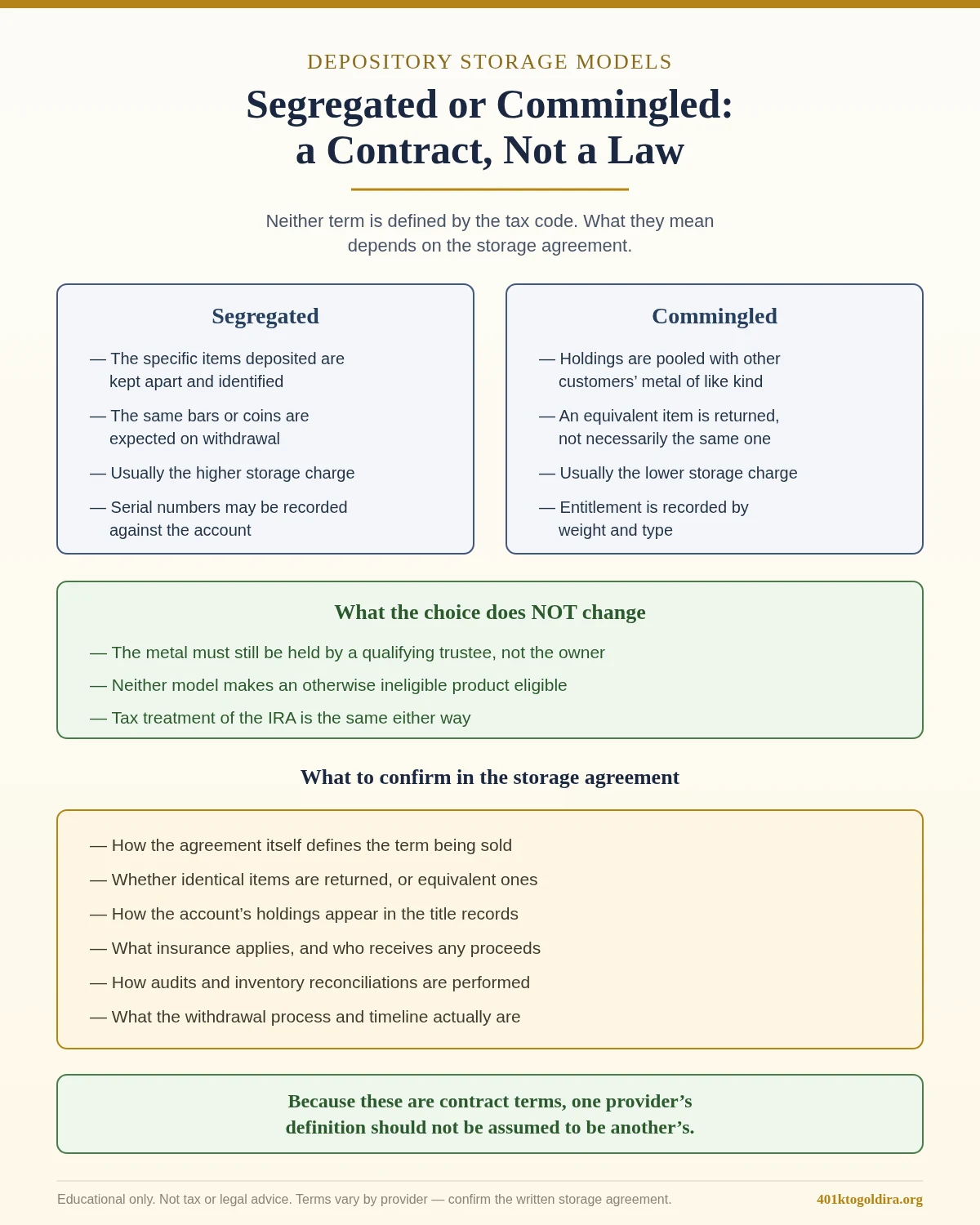
Storage is a recurring cost, not a one-off. Segregated storage generally costs more than commingled, and the difference compounds across a long holding period. The storage fee calculator models that gap, and the segregated versus commingled page explains what each term actually means in a storage agreement — the definitions are contract terms, not tax-code categories.
How to cite this directory
A source-verified directory of six U.S. depository operators used for IRA-held precious metals, with per-row verification status drawn from depository pages, Texas Comptroller material, IRS trustee guidance, SEC no-action material and custodian election forms. Compiled by 401ktogoldira.org. https://401ktogoldira.org/gold-ira-depository-list/
Key takeaways
- This first edition verifies six United States depository operators or storage networks from primary, regulator or custodian sources. Three are fully verified from primary sources and two are only partly verifiable, which is recorded on the row rather than smoothed over.
- Verification status is stated per operator. A directory that presented all six as equally confirmed would be easier to read and would misrepresent the evidence behind half of it.
- Operators were excluded or parked where public IRA evidence is weak. A depository being real and reputable is not the same as there being public evidence of its use for IRA-held metal.
- The phrase “IRS-approved depository” does not match the legal framework. The IRS approves nonbank trustees and custodians under Treasury regulation; a vault building is not the subject of an approval, and metals are tested against the statute.
- Storage is a recurring cost rather than a one-off, and segregated storage generally costs more than commingled storage because the specific bars or coins allocated to the account are held separately.
- Sources are logged per claim, drawn from depository pages, Texas Comptroller material, IRS trustee guidance, SEC no-action material and custodian election forms. Any operator’s current terms should be confirmed directly before relying on them.
What does this directory verify?
This directory verifies public facts about depository operators, U.S. locations, storage models, IRA or custodian connections, insurance statements, audit language, and source quality. It does not certify that any physical building is approved by the IRS, and it does not rank depositories by safety or suitability.
That distinction matters because many public pages compress several different ideas into the phrase “depository under the trustee's control.” The IRS framework focuses on banks and approved nonbank trustees or custodians. A vault may be used by a custodian, but the vault facility, the trustee, and the dealer are not always the same legal entity. The IRS approved nonbank trustees and custodians list is the controlling starting point for trustee/custodian status.
U.S. Gold IRA Depository Directory
The table below uses public sources available in 2026. “Verified” means the core facts were found from primary, regulator, or custodian sources. “Partly verified” means the operator is real and relevant, but one or more IRA-specific details rely on less complete public documentation.
| Depository / operator | Location(s) | Public status source | IRA / custodian connection | Storage model evidence | Insurance / audit statements | Verification |
|---|---|---|---|---|---|---|
| Delaware Depository Delaware Depository · SEC · Equity Trust | Wilmington, Delaware; Boulder City, Nevada | Company page verifies depository services, locations, allocated custody language, storage models, insurance, and exchange-approved storage. SEC no-action material identifies Depository Trust Company of Delaware LLC d/b/a Delaware Depository. | Equity Trust publicly announced expanded precious-metals storage options with Delaware Depository. | Segregated and non-segregated storage are publicly described by the depository. | The company states all-risk coverage through London underwriters and describes internal controls/audit practices. | Verified |
| International Depository Services (IDS of Delaware / IDS of Texas) IDS Group · IDS IRA-eligible metals | New Castle, Delaware; Dallas, Texas | IDS describes itself as a full-service precious-metals depository group and states public locations and accreditations. | IDS publishes IRA-eligible precious-metals storage material naming IDS of Delaware and IDS of Texas. | IDS states segregated storage for accounts; its IRA materials describe IDS of Delaware and IDS of Texas as segregated-storage facilities. | IDS states precious-metals insurance through Lloyd’s of London and describes security/audit controls. | Verified from company sources |
| Texas Bullion Depository / Lone Star Tangible Assets LP Texas Bullion Depository · Texas Bullion Depository IRA Storage · Texas Comptroller | Leander, Texas | Texas public sources describe Texas Bullion Depository as a state-administered bullion depository operated under contract with the Texas Comptroller. | The official IRA Storage Services page states that Lone Star Tangible Assets LP received IRS nonbank-trustee approval and names Equity Trust as an IRA custodian partner. | The official IRA page states that IRA metals are held in segregated storage. | The site and Texas Comptroller material describe security, insurance, state oversight, and audits at a high level. | Verified |
| CNT Depository CNT Depository · Entrust CNT Depository Election Form | U.S. facility; city/state not fully verified from the public depository page used here | CNT describes CNT Depository as an exchange-licensed storage facility and weighmaster, with depository services for precious metals. | CNT lists IRA storage as a service; an Entrust depository election form supports a custodian relationship for IRA storage. | CNT states that metals stored with CNT Depository are allocated and segregated. The Entrust form describes segregated IRA storage. | CNT states Lloyd’s of London insurance, monthly internal audits, annual external audits, and private customer audits by arrangement. | Partly verified |
| Dakota Depository Company Dakota Depository security · Dakota Depository resources | Fargo, North Dakota | Dakota Depository describes itself as a precious-metals depository in the Upper Midwest and publishes security and FAQ materials. | Dakota Depository says it can store precious metals for certain IRA, 401(k), Coverdell Education Savings, and Health Savings accounts. | The FAQ defines custody storage as allocated and segregated and describes how customer metals are held separately. | The company states all-risks insurance and describes inspections, controls, and security procedures. | Verified |
| Brink’s Global Services / Brink’s US Brink’s US · Entrust Brink’s Depository Election Form | Public Brink’s pages describe a U.S. and global vault/logistics network; specific U.S. IRA vault cities were not verified from Brink’s own public precious-metals page. | Brink’s US describes secure precious-metals vaulting, logistics, bonded warehouses, and private-client storage. | IRA use is supported mostly by custodian/dealer forms rather than a detailed Brink’s IRA page. This directory treats the IRA connection as partly verified. | Brink’s describes precious-metals storage and inventory management, but public pages reviewed do not provide a full IRA-specific segregated vs. commingled description. | Brink’s describes bonded warehouses and secure logistics, but public pages reviewed do not publish full IRA-specific coverage terms. | Partly verified |
What does “IRS-approved” mean for metals custody?
IRS guidance describes an approval framework for banks and nonbank trustees or custodians. It does not operate as a simple public list of physical vault buildings. For that reason, this directory avoids saying a facility is approved merely because a dealer or listicle uses that phrase. When a company says it has nonbank trustee status, this page treats that as a statement about the legal entity, not the bricks-and-mortar vault by itself.
The safest workflow is document-driven, and the wider custodian-selection framework places this storage question in its sequence: an IRA owner asks the current custodian to identify the available storage facility, legal custody arrangement, storage model, fees, distribution rules, insurance language, and audit practices in writing. The storage-options comparison checklist shows the questions to ask before funds move.
Which operators were excluded or parked?
Loomis International was not included in the main table as a verified IRA depository because the public pages reviewed confirm precious-metals vaulting and logistics, but not a clear IRA-specific storage program from Loomis or a custodian source. It can be revisited if a current custodian or Loomis page documents IRA storage clearly.
First State Depository is not a current directory row. It appears in recent public material mainly as a cautionary fraud case, not as a verified current IRA storage option. The case belongs in a risk note: depository due diligence should look for documented audits, insurance, segregation, legal custody, and custodian oversight. It does not belong beside active storage options.
How was this directory verified?
The directory started with visible search results and known IRA-storage names, then reduced the list to facts that could be checked against primary or near-primary sources. Depository websites were used for operator descriptions, locations, storage models, insurance statements, and audit language. Regulator or official-public sources were used for legal status where available. Custodian pages and election forms were used only to show that a custodian publicly connects an operator to IRA storage.
Affiliate listicles, dealer pages, and generic SEO articles were not used as proof of legal status, insurance, storage model, or facility approval. They can identify a research lead, but not establish an operational fact.
How should an IRA owner use this list?
The list should be used as a starting point, not as a final instruction. Before a retirement account funds a metals purchase, the account holder should ask the custodian to confirm the current storage options in writing. The written confirmation should identify the depository, the legal custodian or trustee, the storage model, storage and insurance fees, distribution process, and whether the same bars or coins will be returned for segregated storage.
Storage is only one part of the total cost. The storage fee calculator, segregated vs. commingled guide, and storage legality matrix cover related choices in more detail.
Assumptions and limitations
This page cannot independently audit vaults, insurance policies, internal controls, or custodian contracts. It records public statements available in 2026 and marks weaker evidence as partly verified. Public pages change, custodians add or remove storage partners, and promotional claims may lag behind current agreements. The directory should be re-checked periodically, especially before treating any storage relationship as active.
Source log
- Delaware Depository — Storage and transfer services — primary/company.
- SEC — Depository Trust Company of Delaware no-action material — regulator/legal-entity context.
- Equity Trust — Delaware Depository storage expansion — custodian.
- International Depository Services — IDS official site — primary/company.
- IDS — IRA-eligible precious-metals storage article — company.
- Texas Bullion Depository — Official site — primary/state depository.
- Texas Bullion Depository — IRA Storage Services — primary/state depository.
- Texas Comptroller — Texas Bullion Depository gold IRA coverage — regulator/state source.
- CNT — CNT Depository services — primary/company.
- Entrust Group — CNT Depository Election Form — custodian/PDF.
- Dakota Depository — Security overview — primary/company.
- Dakota Depository — Forms and FAQ — primary/company.
- Brink’s US — Precious metals storage and logistics — primary/company.
- Entrust Group — Brink’s Depository Election Form — custodian/PDF.
- IRS — Approved nonbank trustees and custodians — regulator.
Update history
- 2026: Initial directory built from Perplexity Deep Research leads, then cleaned to primary/regulator/custodian sources only. Loomis parked pending IRA-specific proof. First State Depository moved to caution context rather than active directory row.
FAQ
Are Gold IRA depositories approved by the IRS?
IRS approval formally applies to banks and approved nonbank trustees or custodians, not automatically to every physical vault facility. A depository may be used by an approved trustee or custodian, but that is a different fact from saying the building itself is approved by the IRS.
Which facts should be verified before using a depository?
The custodian should confirm the current storage facility, legal custody arrangement, storage model, insurance language, audit process, fees, and distribution procedure in writing.
Is this directory a ranking of depositories?
No. The directory is a source log and verification tool, not a ranking, recommendation, or safety score.
Reviewed and edited by Daniel M. — editor, 401kToGoldIRA.org.