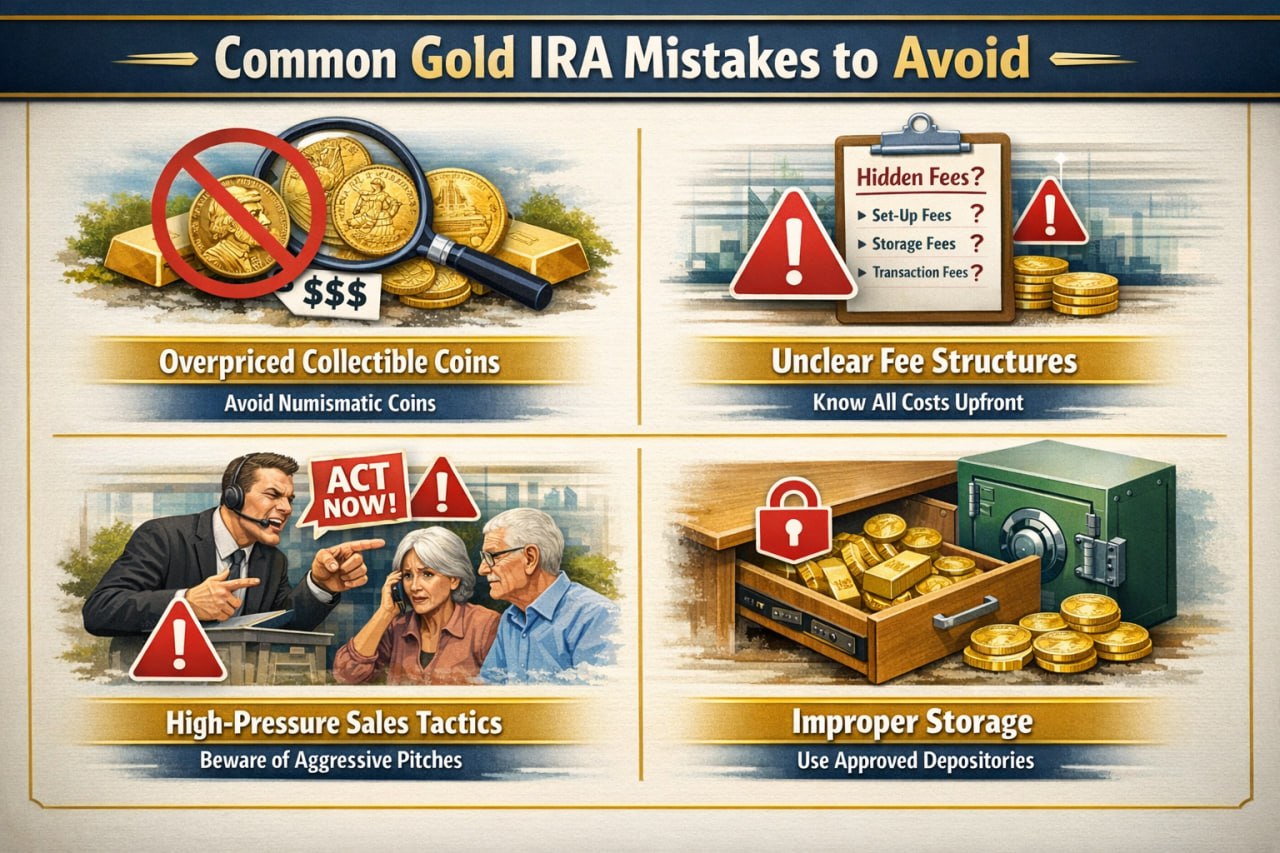
Gold IRA Storage Options: Legality, Cost & Risk Matrix
Four ways people consider storing Gold IRA metal — approved depository (segregated or commingled), a bank safe-deposit box, or home storage — compared on the four things that actually decide it: legal standing, cost, insurance, and audit trail. Sourced to IRS rules and the McNulty Tax Court decision, not to a sales pitch.
View the Matrix →Educational only: This page describes IRS rules and a public court decision in general terms. It is not legal or tax advice and not a statement of how any law applies to an individual. Customers should speak to a qualified tax professional or attorney about storage-structure questions. Goldco does not offer tax or legal advice. Past performance does not guarantee future results.
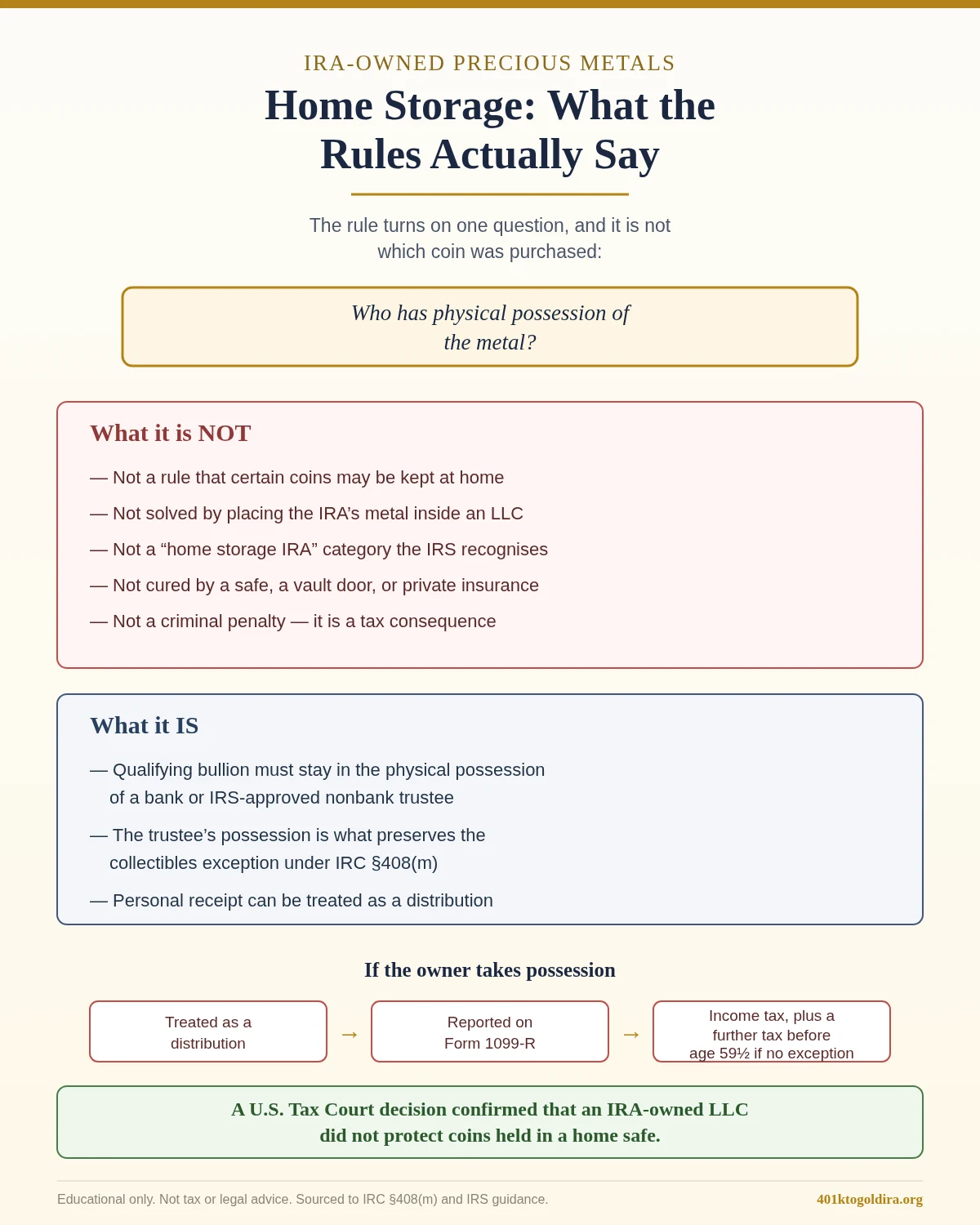
Approved-depository storage is the IRS-compliant route. The "home storage IRA" pitch carries documented tax risk: in McNulty v. Commissioner (2021), taking possession of IRA metal at home was treated as a taxable distribution.
Storage rules per IRC and IRS guidance on IRA custody; home-storage risk per the U.S. Tax Court decision in McNulty v. Commissioner (2021).
Key takeaways
- Storage at an approved depository under the custodian’s control is the compliant route. The arrangement matters legally, not just practically, because it determines whether the IRA still holds the asset.
- The “home storage IRA” pitch carries documented tax risk. In McNulty v. Commissioner (2021) the United States Tax Court treated taking physical possession of IRA metal at home as a taxable distribution, and that decision is the clearest public statement of the consequence.
- A taxable distribution is not a fine or a penalty added to the account. It means the amount is treated as having left the IRA, with the tax and any early-distribution consequences that follow from that treatment.
- Segregated and commingled storage are both compliant. The difference is whether the specific bars or coins allocated to the account are stored separately or held as part of a pooled holding, and depositories price the two differently.
- A safe deposit box at a bank is not a substitute for depository storage in this context, because the question is not how secure the location is but whether the trustee or custodian retains control of the asset.
- The IRS approves nonbank trustees and custodians under Treasury regulation, and products are tested against the statute. A vault building is not itself the subject of an IRS approval, which is why the phrase commonly used in marketing does not match the legal framework.
Quick Answer: Where Gold IRA Metal Can and Cannot Be Stored
IRA-owned precious metals are generally expected to be held by a qualified trustee or custodian at an approved depository, not in an individual's personal possession. Within approved depositories, the choice is between segregated storage (specific bars and coins held separately for the account, at a higher fee) and commingled storage (pooled metal of the same type, at a lower fee) — both compliant. A bank safe-deposit box is generally not an appropriate arrangement for IRA metal, and it is typically uninsured. Home storage is heavily marketed but carries documented tax risk: the U.S. Tax Court's 2021 McNulty decision treated taking possession of IRA metal at home as a taxable distribution. The matrix below compares all four on legality, cost, insurance, and audit trail.
Gold IRA Storage Options: The Full Matrix
Each row is one storage option, compared across the four decision factors plus an overall verdict. Legal points describe IRS rules and the McNulty decision in general terms; they are not legal advice.
| Storage option | Legal standing | Cost | Insurance | Audit trail | Verdict |
|---|---|---|---|---|---|
| Approved depository — segregated | IRS-compliant: qualified trustee/custodian holds metal at an approved depository | Higher storage fee (metal held separately); flat or asset-based | Depository all-risk insurance; specific bars/coins allocated to the account | Independent audit trail; account owns identified metal | Compliant |
| Approved depository — commingled | IRS-compliant: qualified trustee/custodian at an approved depository | Lower storage fee than segregated; flat or asset-based | Depository all-risk insurance; account owns a pooled quantity, not specific bars | Audited pooled holdings; entitlement by quantity | Compliant |
| Bank safe-deposit box | Generally NOT appropriate for IRA-owned metal — not a qualified depository, and personal access raises possession issues | Low box rental, but not an IRA-eligible custody arrangement | Bank boxes are typically NOT insured for contents by the bank or FDIC | No custodial audit trail for IRA compliance | Not appropriate for IRA metal |
| Home storage / 'home storage IRA' | High tax risk: taking physical possession has been treated as a taxable distribution (McNulty v. Commissioner, U.S. Tax Court, 2021) | Appears 'free' (a home safe), but the tax risk can dwarf any saved storage fee | Homeowner policies often exclude or cap bullion; specialized cover needed | No qualified-custodian audit trail; compliance burden on the individual | Documented tax risk — consult a professional |
The McNulty Decision, in Plain Terms
The usual legal reference point for home storage is McNulty v. Commissioner, decided by the U.S. Tax Court in 2021. In that case a taxpayer used a self-directed IRA structure to acquire precious-metals coins and kept them at home. The court held that taking physical possession in this way resulted in a taxable distribution — meaning the arrangement did not achieve the tax-advantaged "home storage IRA" result the promoters had suggested. The practical takeaway, widely drawn from the case, is that IRA-owned metals are generally expected to be held by a qualified trustee or custodian at an approved depository, and that removing a storage fee by taking possession can create a far larger tax problem. This is general information about a public decision, not legal advice. The enforcement and case context sits alongside other documented matters in the enforcement tracker.
Segregated vs Commingled: The Compliant Choice
Within an approved depository, both segregated and commingled storage are IRS-compliant. The difference is ownership form and cost: segregated storage identifies specific bars and coins to the account and typically costs more; commingled storage pools metal of the same type and typically costs less, with the account owning an entitlement to a quantity. The full trade-off is covered in segregated vs commingled storage, the storage-options comparison guide organizes the wider legal, insurance and audit questions, and storage fees feed into the all-in cost shown in the fees benchmark.
Methodology
This matrix classifies four storage options against four factors. Legal standing reflects IRS rules on IRA custody and the U.S. Tax Court decision in McNulty v. Commissioner (2021), described in general terms. Cost, insurance, and audit-trail characteristics reflect typical arrangements at approved depositories and the general nature of bank safe-deposit boxes and home storage; they are categorical descriptions, not per-provider quotes. Rules and interpretations can change and depend on individual facts; the matrix is educational and should be confirmed with a qualified tax professional or attorney before any storage decision.
Primary Sources
- Internal Revenue Service. Retirement Plans FAQs Regarding IRAs (physical-possession custody rule for IRA-held bullion).
- Internal Revenue Service. Investments in Collectibles in Individually Directed Qualified Plan Accounts (collectibles and IRC Section 408(m) exceptions).
- U.S. Tax Court. McNulty v. Commissioner, 157 T.C. No. 10 (2021) — home-storage IRA distribution ruling. Read the full opinion at the U.S. Tax Court opinions search (ustaxcourt.gov).
How to Cite This Page
Source: 401ktogoldira.org — Gold IRA Storage Options Legality, Cost & Risk Matrix.
https://401ktogoldira.org/gold-ira-storage-legality-matrix/
Frequently Asked Questions
Is home storage of Gold IRA metals legal?
The "home storage IRA" pitch carries documented tax risk. In McNulty v. Commissioner (U.S. Tax Court, 2021), taking physical possession of IRA-owned metals at home was treated as a taxable distribution. IRA-owned metals are generally expected to be held by a qualified trustee or custodian at an approved depository. This is general information, not legal advice; consult a qualified tax professional.
Can Gold IRA metal be kept in a bank safe-deposit box?
A bank safe-deposit box is generally not an appropriate custody arrangement for IRA-owned metal. It is not a qualified depository, personal access raises possession concerns, and box contents are typically not insured by the bank or FDIC. Approved depository storage is the standard IRA-compliant route.
What is the difference between segregated and commingled storage?
Segregated storage holds the account's specific bars and coins separately and identified to the account, usually at a higher fee. Commingled storage pools metal of the same type, with the account owning an entitlement to a quantity rather than specific items, usually at a lower fee. Both are IRS-compliant when held at an approved depository through a qualified custodian.
Why does home storage seem cheaper but cost more?
A home safe appears to remove the depository storage fee, but the McNulty decision illustrates that taking possession can trigger a taxable distribution and possible penalties, which can far exceed the saved storage fee. Homeowner insurance also often excludes or caps bullion. The apparent saving can be outweighed by tax and insurance exposure.
Update Log
- 2026: Initial storage legality, cost, and risk matrix published with the four-option comparison, McNulty summary, methodology, and FAQ schema.
Reviewed and edited by Daniel M. — editor, 401kToGoldIRA.org.