Educational only: This reference explains how a checkbook-control IRA LLC works under published statutes, Treasury regulations, IRS guidance and Tax Court precedent. It does not recommend a company, custodian, LLC-formation service, depository, or structure, and it is not financial, tax, or legal advice. Account owners considering this structure should consult a qualified attorney or tax professional who can review their actual documents and facts before forming, funding, managing, or transacting through it. Past performance does not guarantee future results.
Key takeaways
- The IRA owns the LLC — not the account owner personally. The LLC membership interest is an IRA asset held through the trustee or custodian.
- Checkbook control changes execution, not the rules. An authorized manager can pay from the LLC's own account, but every transaction remains subject to IRC §4975.
- Section 4975 covers direct AND indirect transactions. An LLC in the middle does not remove self-dealing, personal-benefit, or disqualified-person analysis.
- Qualifying bullion still requires trustee possession. Section 408(m)(3)(B) applies whether the IRA or an IRA-owned LLC made the purchase.
- McNulty is a custody case, not a §4975 case, against the LLC investment itself. The Commissioner conceded no prohibited transaction in the LLC investment or coin purchase — personal physical possession is what produced the taxable distribution.
- The defensible rule is conduct-dependent. No primary source reviewed supports either “every IRA-LLC is illegal” or “every IRA-LLC is safe.”
What a Checkbook-Control IRA LLC Is
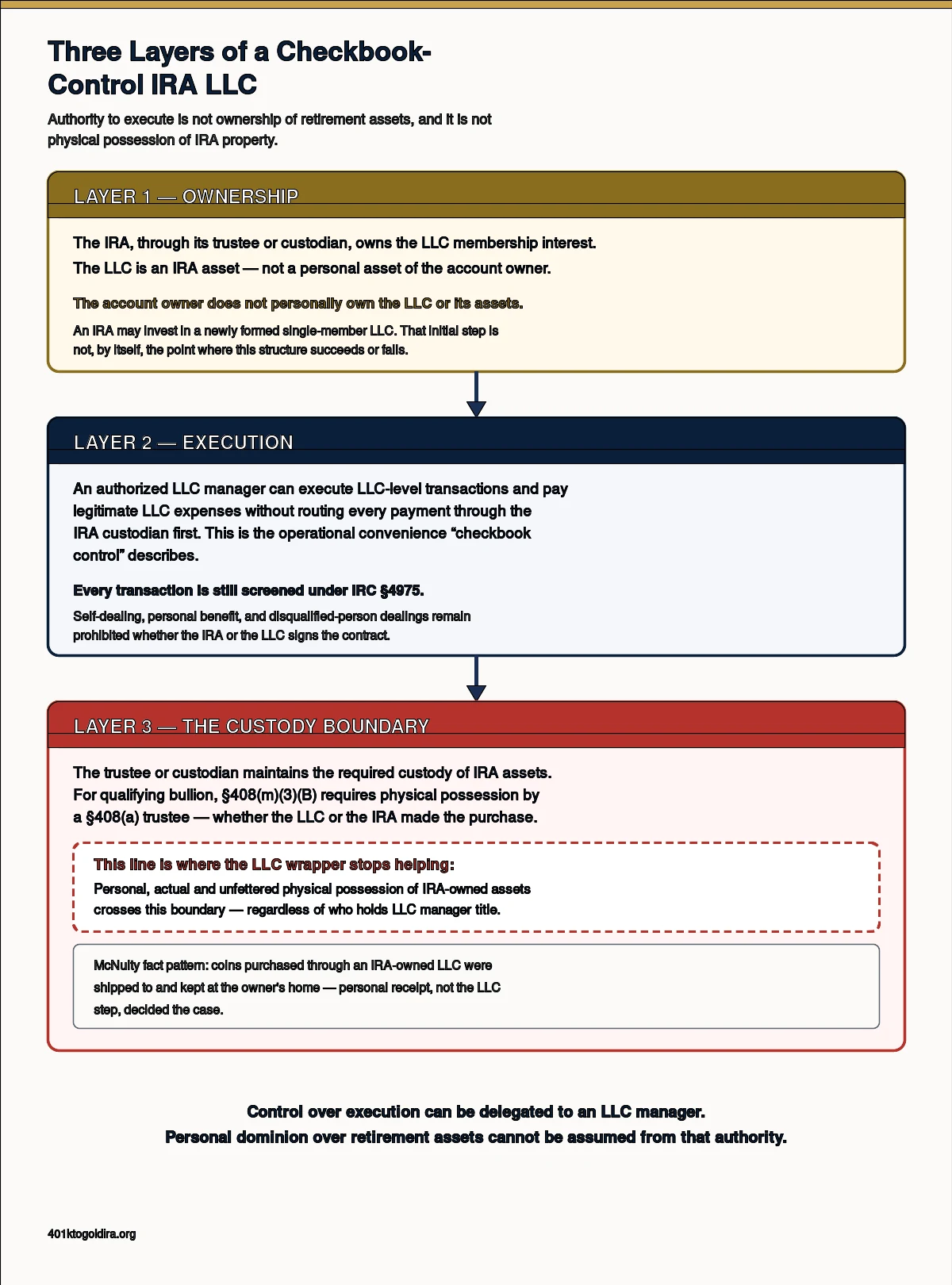
The structure adds an LLC between the IRA and the underlying investment. The IRA, through its trustee or custodian, acquires the LLC's membership interest. The LLC then holds its own bank or brokerage account and makes investments in its own name. An account owner may also serve as the LLC's manager, depending on the governing documents and facts. The phrase “checkbook control” describes the manager's ability to execute LLC-level transactions — for example, signing a check or authorizing a wire from the LLC account — without sending every underlying purchase instruction back through the IRA custodian. It is an operational description, not a term defined in the Internal Revenue Code.
That operational convenience is the beginning of the analysis, not the end. The account owner does not become the owner of the retirement assets. The IRA remains subject to §408's trust and custodial framework, and the IRA's interest in the LLC remains an IRA asset. In McNulty v. Commissioner, 157 T.C. No. 10 (2021), the Tax Court recognized that a self-directed IRA can invest in a single-member LLC while simultaneously holding that the account owner cannot have unfettered command over IRA assets (U.S. Tax Court — DAWSON, Docket No. 1377-19).
How the Structure Is Formed
Only the legally relevant steps are set out here — this is not a general LLC-formation guide, and no universal federal template exists for any of them.
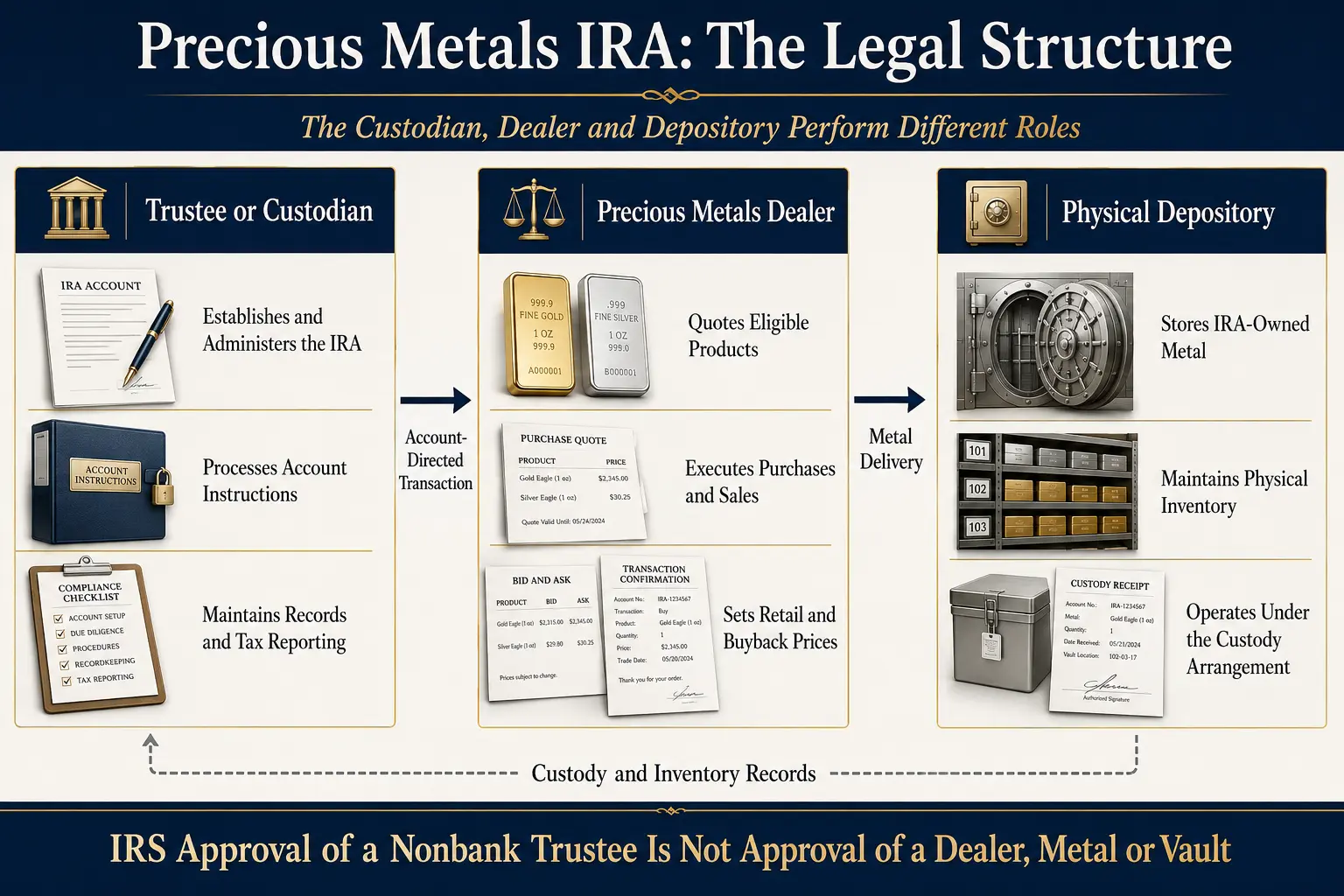
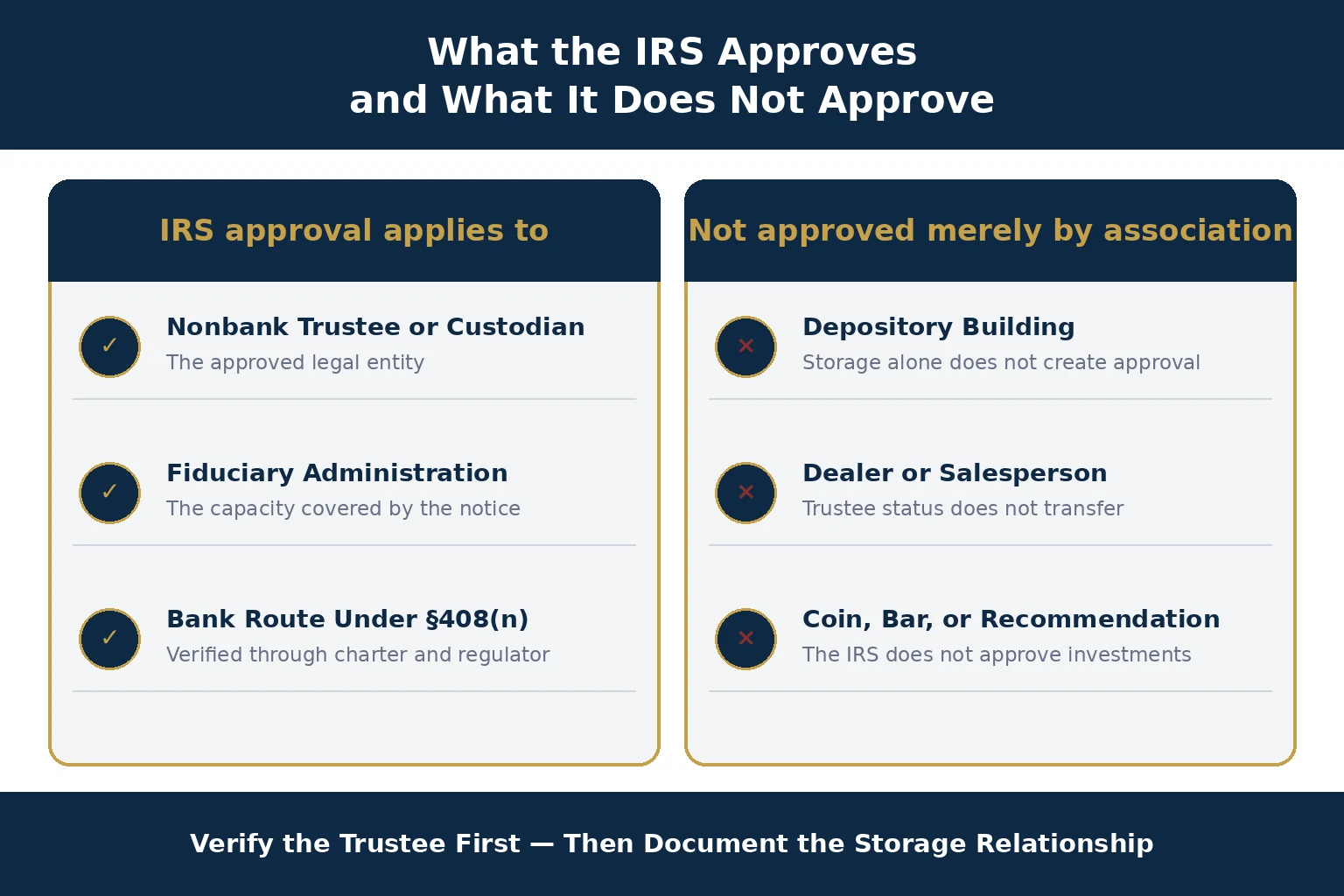
- A self-directed IRA is established with a qualifying trustee or custodian. Section 408(a)(2) requires a bank or another person satisfying the statutory standard; the IRS separately maintains a list of approved nonbank trustees and custodians under Treasury Regulation §1.408-2(e) (Cornell LII — 26 U.S.C. §408; IRS — approved nonbank trustees and custodians).
- An LLC is formed under applicable state law. Its operating documents identify the member or members and manager. In a single-member arrangement the IRA is commonly the member, while the account owner may be designated manager. McNulty records one such structure but does not create a universal state-law template.
- The IRA acquires the LLC membership interest. The narrow Swanson/Ellis lineage supports the proposition that an IRA's initial acquisition of an interest in a newly formed entity is not automatically a prohibited transaction merely because the IRA will own that entity.
- The LLC obtains its own tax identification and account arrangements where applicable. McNulty records an LLC EIN and LLC bank account as case facts. Federal IRA law does not prescribe one universal bank-account title or operating-agreement clause.
The custodian does not vanish after the LLC is funded. In McNulty, Kingdom Trust remained the IRA custodian even though it did not manage the LLC, purchase the coins, or administer the LLC's assets. The precise level of LLC-level transaction review varies with the actual custody agreement and cannot be stated as one federal rule.
Control over execution can be delegated. Personal dominion over retirement assets cannot.
What Checkbook Control Actually Permits, in Practice
At its narrowest, checkbook control changes who executes an otherwise permissible investment decision. Instead of asking the IRA custodian to send every payment for an underlying LLC purchase, the authorized LLC manager can cause the LLC to pay from its own account. That can shorten the operational chain, but it does not broaden the universe of lawful transactions.
The manager may direct LLC investments, pay legitimate LLC expenses, maintain books and records, and carry out administrative tasks contemplated by the operating documents. Whether a particular activity is permitted cannot be answered from the word “manager” alone. Section 4975 looks to function and transaction: a person exercising discretionary authority or control over plan management or plan assets can be a fiduciary, and fiduciaries are disqualified persons (Cornell LII — 26 U.S.C. §4975).
Authority to act for the LLC is not authority to benefit personally from the LLC. A checkbook-control arrangement can move transaction execution away from the custodian's desk, but it cannot convert a prohibited use of retirement assets into a permitted use.
IRC §4975: Prohibited Transactions Still Apply to the LLC Structure
Section 4975 expressly includes an IRA described in §408(a) within the definition of a “plan.” It also defines prohibited transactions to include both direct and indirect dealings. Interposing an LLC therefore does not end the analysis at the nominal counterparty. If an IRA-owned LLC is used as the vehicle for a transaction that transfers plan value to a disqualified person or enables fiduciary self-dealing, the LLC layer does not erase the underlying §4975 concern.
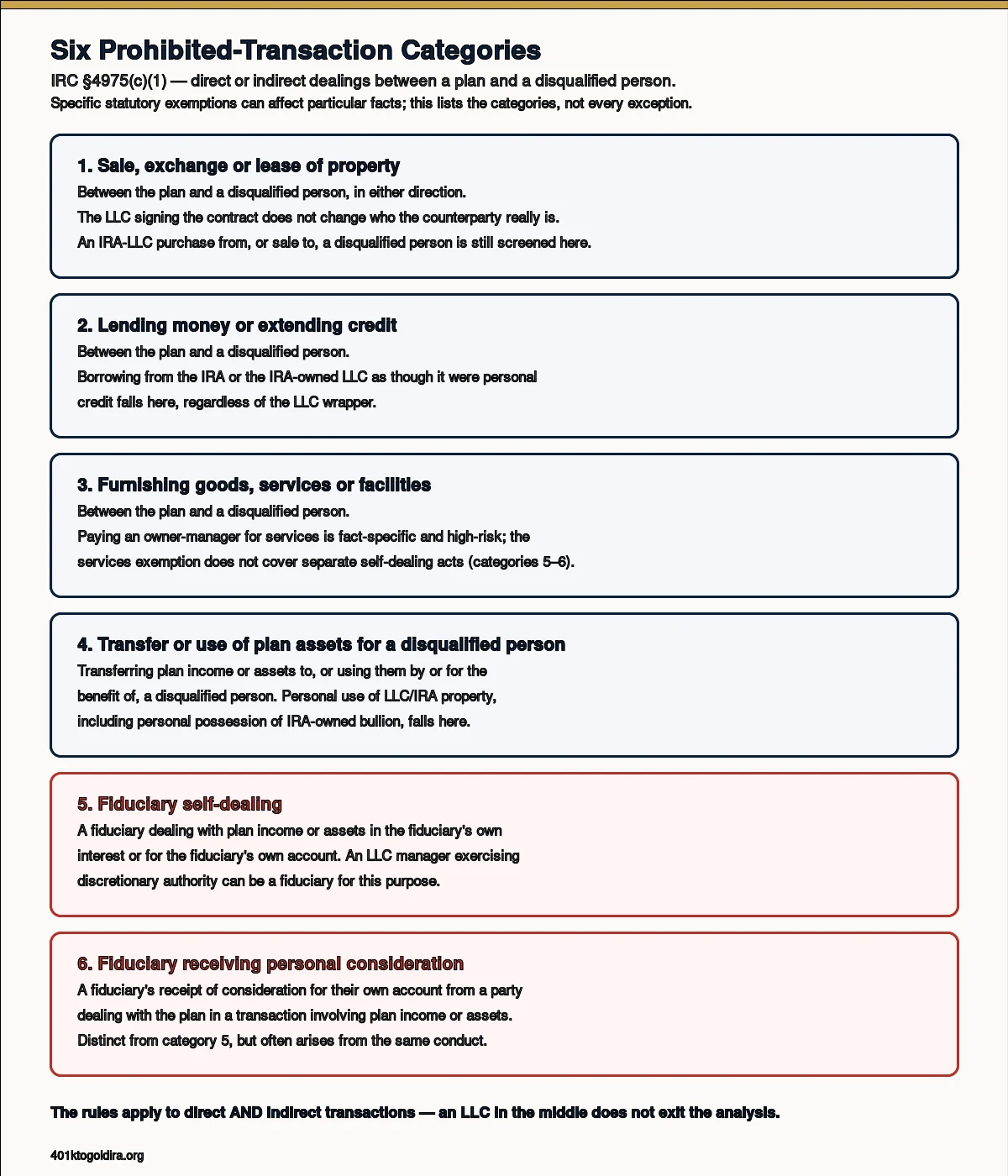
The rules apply to direct and indirect transactions — an LLC in the middle does not exit the analysis.
Who is a disqualified person?
The definition reaches fiduciaries, service providers, certain employers and organisations, a narrowly defined family class, and entities caught by ownership attribution. For a checkbook-control LLC the practical point is functional: §4975(e)(3) can make the account owner a fiduciary through discretionary authority or control over plan management or plan assets. The full disqualified-person map, the exact statutory family boundary and the attribution rules are set out in the self-directed IRA prohibited transactions reference.
Can the account owner be the LLC manager?
The case law does not establish that manager status, by itself, disqualifies the arrangement. McNulty analyzed the consequences of possession irrespective of the account owner's manager status and acknowledged the Swanson/Ellis line allowing an IRA investment in a single-member LLC. The legal risk turns on what the manager actually does with the retirement assets.
Compensation is particularly sensitive. In Ellis v. Commissioner, 787 F.3d 1213 (8th Cir. 2015), owner compensation from the IRA-owned LLC was part of the prohibited-transaction holding. Treasury Regulation §54.4975-6 also states that the services exemption does not exempt separate fiduciary self-dealing or third-party consideration acts described in §4975(c)(1)(E) or (F) (Cornell LII — Treas. Reg. §54.4975-6). The defensible rule is that owner-manager compensation requires transaction-specific legal analysis, and checkbook control supplies no independent permission.
Personal use, loans and commingling
The prohibited uses reach the underlying economic substance rather than whose name appears on the cheque: borrowing from the IRA, selling property to it, pledging it as security, and buying property for present or future personal use are all identified in IRS guidance. Those categories are worked through by asset class in the prohibited transactions reference.
Commingling personal and LLC or IRA funds is inconsistent with the separation the IRA structure requires and can create tracing and self-dealing problems. McNulty did not need to decide whether its coin storage constituted commingling, because personal possession independently resolved the distribution issue, so that case should not be cited as a separate commingling holding.
What happens if the owner engages in a prohibited transaction?
The account can cease to be an IRA as of the first day of that taxable year, with all assets treated as distributed at fair market value on that day. The mechanism, the separate excise-tax route that applies to other disqualified persons, and the statutory provision that keeps the owner from facing both are set out in the prohibited transactions reference. The downstream tax effects depend on basis, age and other facts — covered on the early withdrawal penalty and tax mistakes pages.
Precious Metals Inside a Checkbook-Control LLC
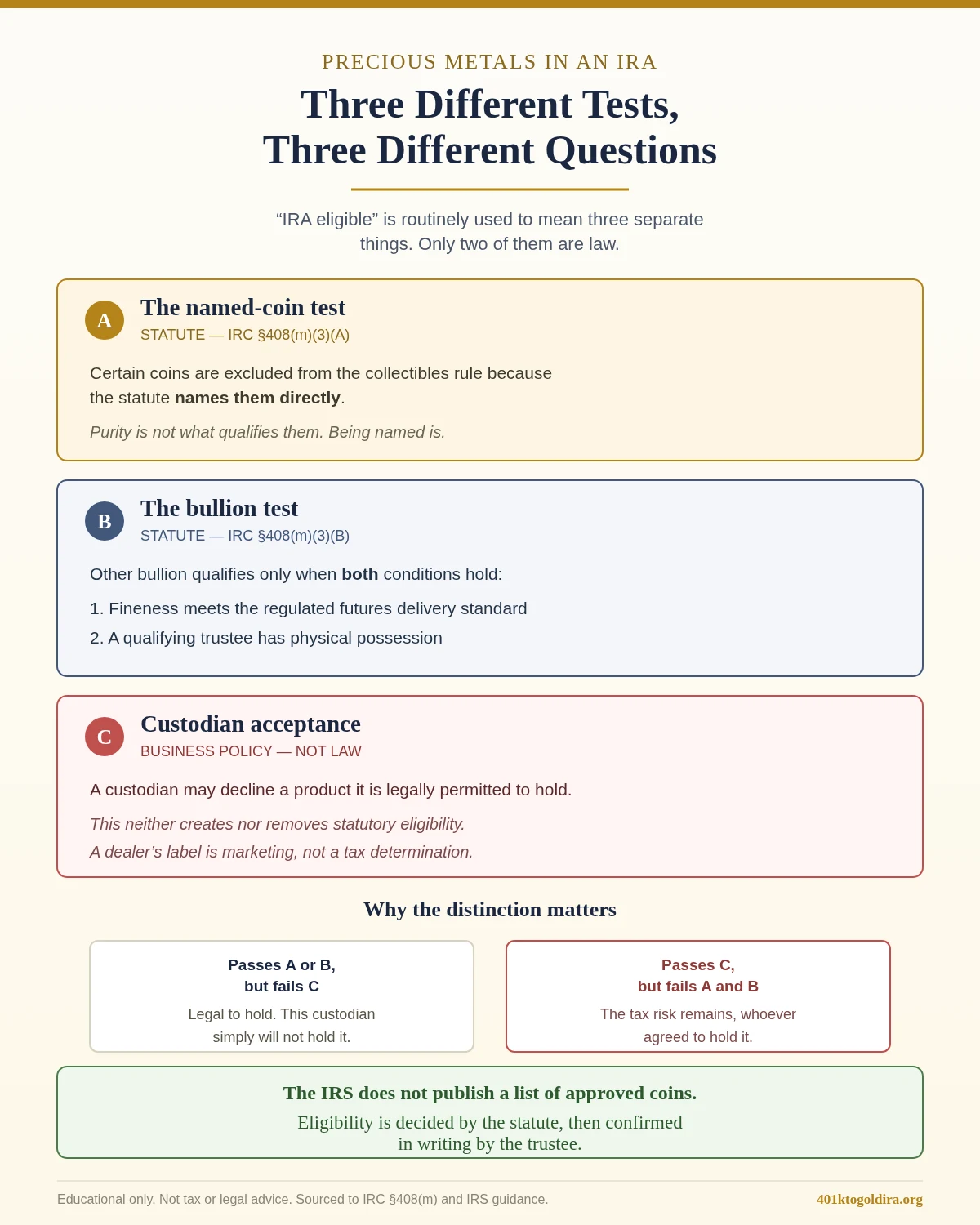
Precious metals add a second legal boundary beyond §4975. Section 408(m) generally treats an IRA's acquisition of a collectible as a distribution. It excludes specified coins and qualifying gold, silver, platinum or palladium bullion from that collectible definition, but the bullion exception contains an express condition: qualifying bullion must be in the physical possession of a trustee described in §408(a) (Cornell LII — 26 U.S.C. §408).
Product eligibility and custody are different questions. A metal can satisfy the product tests and still be held in a way that defeats the retirement-account treatment. The separate product-eligibility question is set out on the IRA-eligible precious metals reference.
McNulty: the LLC Did Not Cure Personal Possession
McNulty v. Commissioner, 157 T.C. No. 10 (2021), Docket No. 1377-19, is the clearest Tax Court illustration. The IRA owner's IRA invested $375,000 in Green Hill Holdings, LLC in 2015. Green Hill bought 320 one-ounce American Eagle gold coins for $374,000. The coins were shipped to the taxpayers' residence and stored in a safe. In 2016, Green Hill bought 2,000 one-ounce American Eagle silver coins for $37,380, likewise shipped to the residence; later 2016 gold-coin purchases were also delivered there.
The opinion identifies taxable distributions of $374,000 for 2015 and $37,380 for 2016 upon receipt of the coins. The Tax Court held that the owner had taxable distributions when she received physical custody of the coins, irrespective of her status as Green Hill's manager. It emphasized that an owner of a self-directed IRA may direct investments but may not take actual and unfettered possession of IRA assets.
A crucial accuracy point is what the court did not hold. The opinion records the Commissioner's concession that the IRA owner had not engaged in a §4975 prohibited transaction with respect to her IRA, the IRA's investment in Green Hill, or the purchase of the coins. The distribution result arose from the custody and possession analysis — not from a finding that the LLC investment itself was prohibited.
Did McNulty rely only on the bullion clause? No. The court interpreted §408(m) together with the broader §408(a) custodial framework, stating that the bullion text did not create an exception to the custodial requirements already imposed by §408(a) and the regulations. The court also did not need to resolve whether the American Eagle coins were bullion or whether they had been commingled with non-IRA assets, because physical possession was enough to decide the case. The statute's literal trustee-possession phrase appears in the bullion subparagraph, §408(m)(3)(B); for specified coins, McNulty supplies the broader custody principle that personal actual and unfettered possession is not made permissible merely because an IRA-owned LLC bought the coins.
Can an IRA-owned LLC hold precious metals at all? Current primary authority does not support the claim that every IRA-owned LLC holding metals is automatically prohibited. McNulty recognizes that a self-directed IRA may invest in a single-member LLC, and the Commissioner conceded no §4975 prohibited transaction with respect to the LLC investment or coin purchase. The failure was the custody result when the coins entered personal physical control. An IRA-owned LLC considering precious metals would need a written arrangement that keeps custody with the qualifying IRA trustee or custodian, maintains clear records and title, and prevents the account owner from obtaining actual, unfettered physical possession. A commercial depository's name alone should not be treated as proof; the legal relationship and custody documents matter — see the custodian due-diligence guide.
What Checkbook Control Does Not Permit
- Personal possession of IRA-owned precious metals.
- Personal use of IRA or LLC assets.
- Borrowing from the IRA or IRA-owned LLC as though it were personal credit.
- Pledging IRA assets as personal loan security.
- Buying from or selling to the owner or another disqualified person merely because the LLC is the named counterparty.
- Paying the owner-manager for services without a transaction-specific legal analysis.
- Commingling personal and retirement assets — McNulty did not separately decide the commingling issue.
- Ignoring §4975 because the LLC, not the IRA, signs the contract.
“Home Storage IRA” Claims and the LLC Wrapper
Marketing sometimes collapses two different ideas into one: an IRA can own an LLC, therefore the account owner can personally store whatever the LLC buys. McNulty rejects that leap. The Tax Court accepted the single-member-LLC premise for purposes of its analysis and still held that the owner's physical custody and complete control over the coins produced taxable distributions.
For bullion, the statutory text is explicit: the exception from collectible treatment applies only if qualifying bullion is in the physical possession of a trustee described in §408(a). An LLC is not a home-storage exception. For specified coins, the broader §408(a) custodial rules still matter under McNulty.
The Defensible Bottom-Line Rule
A checkbook-control IRA LLC is neither automatically prohibited nor automatically safe. The structure may be used as an IRA investment vehicle, but every material transaction still has to satisfy the IRA custody rules, §4975's direct-and-indirect prohibited-transaction rules, and any asset-specific provisions such as §408(m).
Control over execution can be delegated to an LLC manager; personal dominion over retirement assets cannot be assumed from that authority. When manager conduct creates personal use, self-dealing, a disqualified-person transaction, prohibited credit, or unfettered possession of IRA property, the LLC label does not erase the federal tax consequences.
Written-Document and Due-Diligence Checklist
- Verify the IRA trustee or custodian status and, for nonbank trustees or custodians, independently verify the applicable IRS listing.
- Confirm the LLC documents identify IRA ownership and do not suggest personal ownership of retirement assets.
- Document the manager's authority and the custodian's actual role under the custody agreement.
- Map disqualified persons before the LLC transacts.
- Screen every counterparty and direct or indirect purchase, sale, lease, loan, service, facility or transfer under §4975.
- Screen for personal use, borrowing, pledge, occupancy, receipt or other benefit.
- Obtain specific advice before any owner-manager compensation or reimbursement.
- For metals, separately test §408(m) product eligibility.
- For bullion, identify exactly where §408(m)(3)(B) trustee possession is satisfied in the written custody chain.
- For coins and other IRA assets, ensure the owner cannot obtain actual and unfettered physical possession before a lawful distribution.
- Have counsel review state-law formation, operating agreement, EIN and tax classification, and banking or titling details. No universal federal template was identified.
- Understand §408(e)(2) account-disqualification consequences before entering any transaction that could implicate §4975.
Once the structural and custody questions above are answered, a reader deciding whether to move retirement funds into a self-directed IRA holding precious metals may want to compare providers that administer this kind of account.
Considering a self-directed precious-metals IRA?
Goldco is a precious metals company. Customers can request a free Gold & Silver Kit at signup. Goldco markets a buyback program; customers should request current written terms directly.
Minimum investment: $25k · BBB rating: A+
Owners of this website may be paid to recommend Goldco. The content on this website, including any positive reviews of Goldco and other reviews, may not be neutral or independent.
Frequently Asked Questions
Is a checkbook-control IRA the same as a self-directed IRA?
Not exactly. “Self-directed IRA” describes an IRA in which the owner directs investments beyond a conventional platform. “Checkbook control” usually describes an additional LLC structure in which the IRA owns the LLC and an authorized manager can execute LLC-level transactions. The IRA remains subject to §408 and §4975.
Is a checkbook-control IRA LLC legal?
The structure is not automatically prohibited. In McNulty v. Commissioner, the Tax Court stated that a self-directed IRA may invest in a single-member LLC, citing Swanson and Ellis. The legality and tax treatment of later transactions depend on the conduct, the parties, the asset and any applicable exemption.
Can an IRA owner be the manager of the IRA-owned LLC?
Manager status alone is not the decisive issue in the cited cases. The critical question is what authority is exercised and whether a transaction creates prohibited self-dealing, personal benefit, disqualified-person dealings or impermissible possession of IRA assets.
Does checkbook control eliminate the IRA custodian?
No. Section 408 still requires the IRA trust or custody structure. In McNulty the IRA custodian remained in place even though it had no role in managing the LLC or executing the LLC's coin purchases. The precise operational oversight depends on the custody agreement.
Can a checkbook-control IRA LLC buy gold or other precious metals?
An IRA-owned LLC is not automatically barred from acquiring precious metals, but the metal must satisfy the applicable §408(m) product rules and the custody arrangement must satisfy the IRA rules. For qualifying bullion, §408(m)(3)(B) expressly requires physical possession by the §408(a) trustee.
Can an IRA-owned LLC keep gold at the owner's home?
The LLC wrapper does not create that permission. McNulty held that actual and unfettered physical possession of IRA-owned coins produced taxable distributions, and §408(m)(3)(B) separately requires trustee possession for qualifying bullion regardless of who purchased it.
What did McNulty v. Commissioner actually decide?
The Tax Court held that the IRA owner had taxable IRA distributions of $374,000 for 2015 and $37,380 for 2016 when she received physical custody and complete control of American Eagle coins purchased through her IRA-owned LLC. The Commissioner conceded that the IRA's LLC investment and coin purchases themselves were not §4975 prohibited transactions — the distribution resulted from personal possession, not from the LLC structure.
Does Swanson mean every checkbook IRA LLC is approved by the IRS?
No. Swanson should be cited narrowly: an IRA's initial investment in a newly formed entity was not a prohibited transaction because the entity was not yet a disqualified person. That does not immunize later owner-manager conduct, and the IRS states plainly that it maintains no list of approved retirement-plan investments.
What happens if an IRA owner commits a prohibited transaction?
Under IRC §408(e)(2) and Treasury Regulation §1.408-1(c)(2), the affected IRA can cease to be an IRA as of the first day of that tax year and be treated as distributing all its assets at that day's fair market value. The individual tax consequences depend on the specific facts.
Is using a depository enough to satisfy the trustee-possession rule for IRA-owned gold?
Not as a label alone. The legal question is whether the written custody arrangement actually preserves required trustee or custodian custody and records — and, for qualifying bullion, satisfies §408(m)(3)(B)'s specific trustee-possession condition — while denying the account owner unfettered physical control.
Terms used throughout this guide are defined in the gold IRA glossary. The account structure this LLC sits inside is explained in the precious metals IRA reference, and product-level eligibility is covered in IRA-eligible precious metals.
This page is educational and does not recommend any company, custodian, LLC-formation service, depository, or structure. Tax and legal outcomes depend on individual circumstances, and rules change. Account owners should consult a qualified attorney or tax professional before forming, funding, managing, or transacting through an IRA-owned LLC. Past performance does not guarantee future results.