Educational only: This page explains federal retirement-plan and IRA rules from published law, regulations and regulator guidance. It does not recommend a company, custodian, depository, dealer, product or allocation, and it is not financial, tax or legal advice. Some links elsewhere on this site may be sponsor links and the site owners may be compensated if customers request information from companies mentioned there. Customers should speak with a qualified financial or tax advisor before making retirement-account decisions. Past performance does not guarantee future results.
20% mandatory federal withholding generally applies when an eligible rollover distribution is paid to the participant. A direct rollover avoids that participant-level mandatory withholding.
Source: IRS — Rollovers of retirement plan and IRA distributions. The IRS illustrates the rule with a $10,000 eligible rollover distribution: $2,000 withheld, $8,000 received, and $2,000 from other funds needed to roll the full amount within the deadline. Checked 31 August 2026.
Key takeaways
- The plan decides first. Federal law sets when elective deferrals may be distributed; the written plan decides what is actually offered. Age alone is not permission.
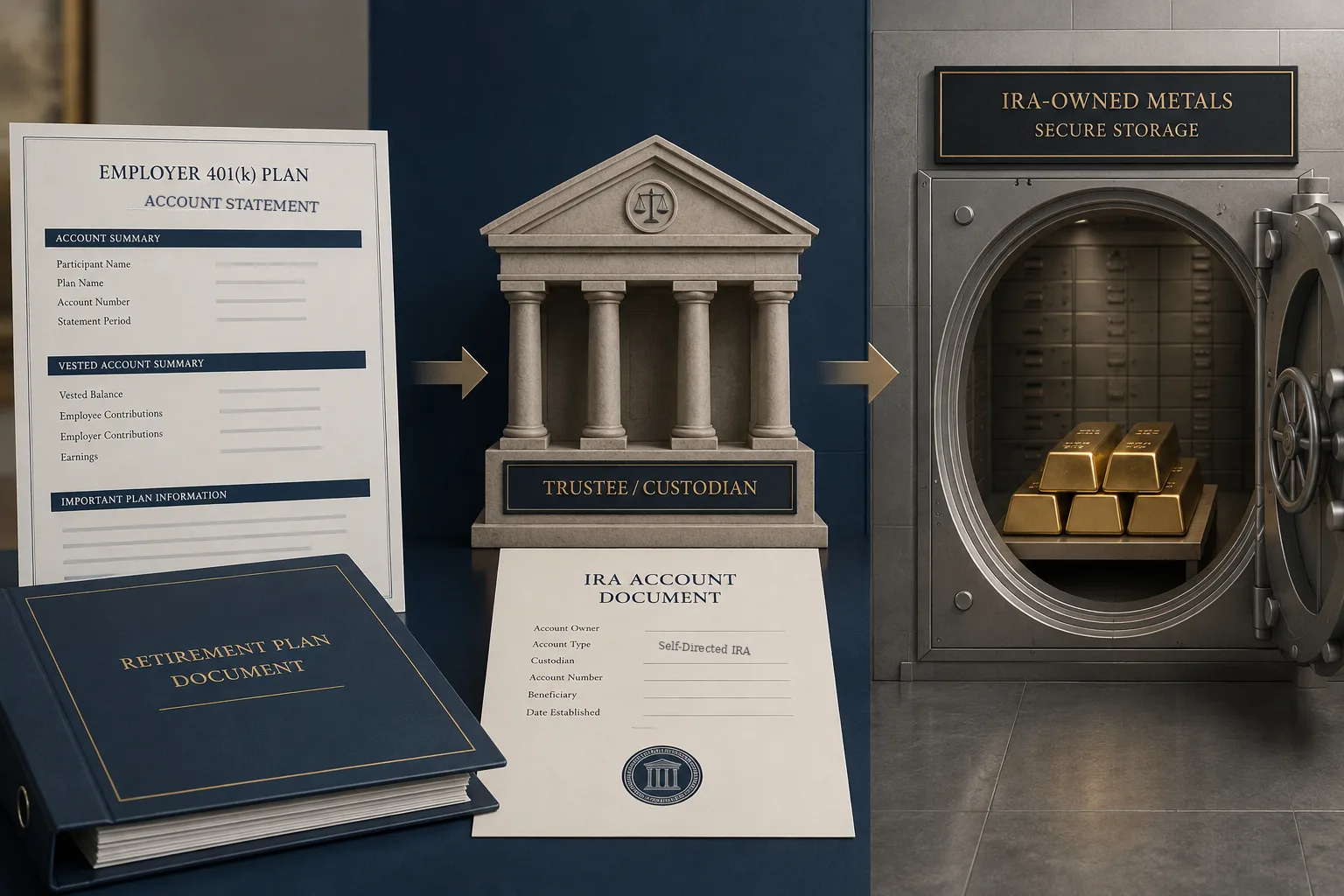
- “Gold IRA” is not a separate account type. The legal destination is a traditional or Roth IRA whose trustee or custodian permits qualifying physical metals.
- Payee status, not physical handling, decides the tax treatment. A direct-rollover check can pass through your hands if it is payable only to the receiving trustee or custodian.
- Tax character has to be mapped before anything moves. Pre-tax, designated Roth and after-tax non-Roth dollars may need different destinations.
- Some things can be lost by rolling. The age-55 separation exception, net unrealized appreciation on employer stock, plan loan terms and the ERISA plan framework are decided before the transfer, not after.
- The IRA one-per-12-month rule does not apply here. It governs certain IRA-to-IRA 60-day rollovers, not plan-to-IRA rollovers or trustee-to-trustee transfers.
- The metal comes last. A rollover can complete entirely in cash; the purchase inside the IRA is a separate transaction under the custody and eligibility rules.
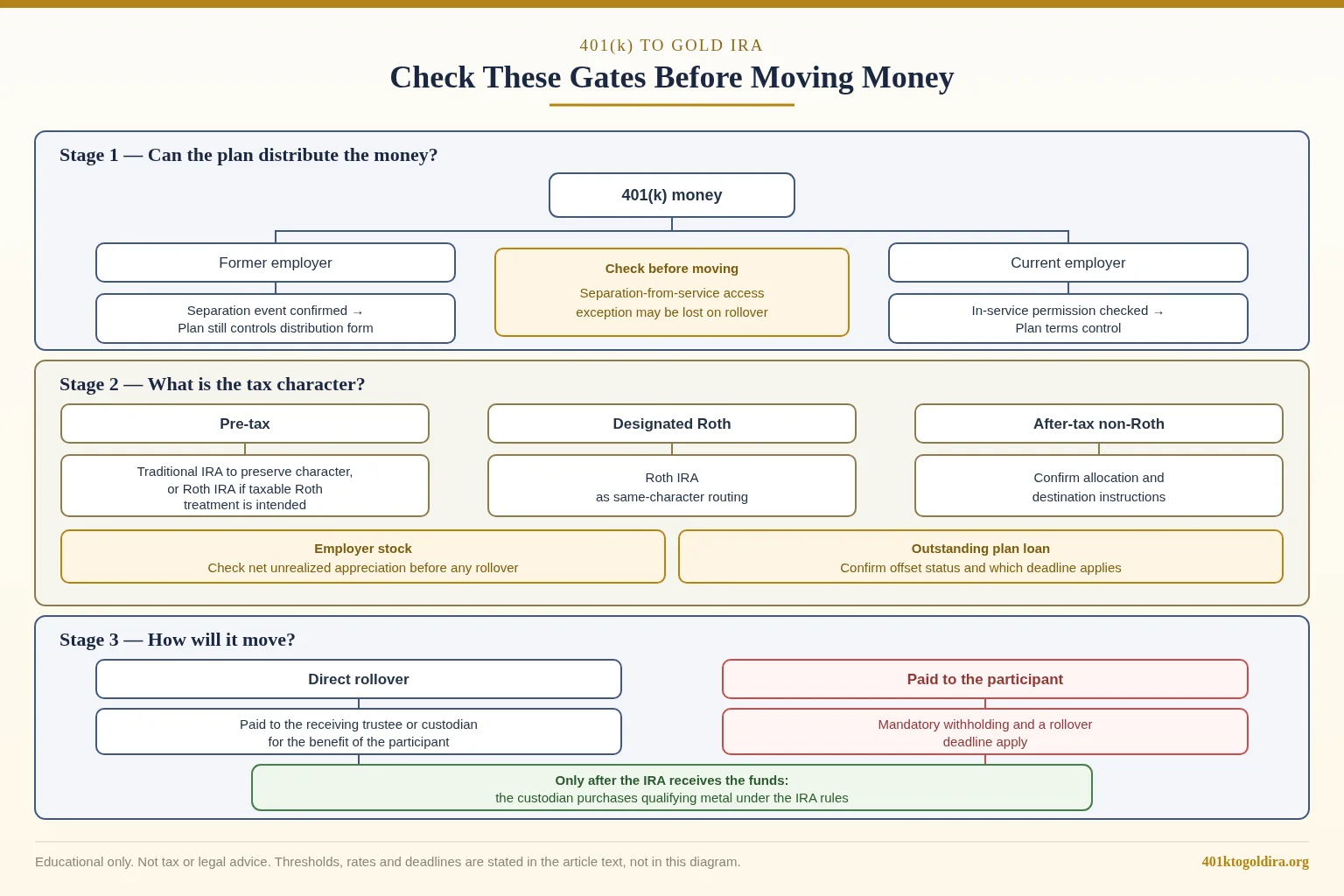
The Three Gates That Decide the Outcome
The clean way to analyse a 401(k)-to-Gold-IRA decision is to stop asking which custodian to open and start asking three questions in order. Each one can end the analysis on its own. Readers unsure of the difference between a rollover IRA and Roth IRA should settle that account question first.
| Gate | The question | What decides it |
|---|---|---|
| 1. Distribution | Is the money distributable now, and will the plan release it in the form requested? | Treasury regulations set the federal events for elective deferrals; the written plan decides which distributions are actually offered. Certain payments are never rollover-eligible. |
| 2. Tax character | Which dollars are pre-tax, designated Roth or after-tax non-Roth, and what destination preserves — or deliberately changes — that character? | IRC §402(c) and §408A, the current Form 1099-R and 5498 reporting rules, and Notice 2014-54 for split destinations. |
| 3. Movement | Will the plan pay the receiving IRA directly, or pay you? | 26 CFR §1.401(a)(31)-1 defines the direct rollover. Payment to the participant brings mandatory withholding and the 60-day deadline. |
Only after all three gates are answered does the “Gold” part begin. For an account-by-account overview across plan types, see the rollover eligibility matrix.
Gate 1: Can This 401(k) Move Now?
The first question is not which custodian to open. It is whether the 401(k) is allowed to distribute the amount you want to move.
Treasury regulations generally prevent elective deferrals from being distributed before specified events, including death, disability, severance from employment, plan termination in qualifying circumstances, and certain age- or hardship-based events (26 CFR §1.401(k)-1). IRS participant guidance then makes a second point that is easy to miss: the forms of distribution available depend on the plan’s terms (IRS — 401(k) resource guide, general distribution rules).
There is a useful precision point here that marketing copy routinely flattens. Section 1.401(k)-1(d)(1)(ii) makes attainment of age 59½ a distributable event for elective deferrals only in profit-sharing, stock bonus and rural cooperative plans. The federal gate is narrower than “you are 59½, so you can withdraw”, and it is still only a permission, never an obligation on the plan.
What distributions cannot be rolled over?
Not every payment from a 401(k) is an “eligible rollover distribution”. IRC §402(c)(4) excludes required minimum distributions, hardship distributions and specified substantially equal periodic payments, and IRS 401(k) guidance identifies corrective distributions among common non-rollover items (26 U.S.C. §402).
So the question for the administrator is not “what is my balance?” but “what is the rollover-eligible amount?”
Variant 1: The Former-Employer 401(k)
A genuine severance from employment is a recognised distributable event for elective deferrals. That is why a former-employer 401(k) is usually the straightforward version of this question: the federal distributable-event gate has generally been cleared.
But “former employer” does not mean “skip the plan documents”. Before authorising a rollover, obtain:
- the current vested account balance;
- the Summary Plan Description and distribution-election materials;
- the account’s pre-tax, designated Roth and after-tax breakdown;
- any outstanding loan or loan-offset information;
- any employer-stock position and cost-basis information; and
- the plan’s current fee and investment disclosure.
The vested-balance check matters because employee elective deferrals are always fully vested, while some employer contributions can remain subject to a plan vesting schedule until a vesting event occurs (IRS — retirement topics, vesting). Only amounts you legally own can become rollover property.
Variant 2: The Current Plan and the In-Service Gate
A current employee must not assume that “I am old enough” means “the plan must send my 401(k) to an IRA”. Federal rules can permit certain in-service distributions, but the plan’s written terms determine whether the plan actually offers that distribution.
The practical question for the administrator is therefore:
Does this plan permit an in-service distribution of the specific source of money I want to roll, and if so, does it permit the amount and form I am requesting?
The Summary Plan Description should explain if and under what conditions in-service distributions are allowed (IRS — plan disclosure documents). If the plan does not offer the requested distribution, no custodian or dealer can override that restriction.
Variant 3: Direct Versus Indirect Movement
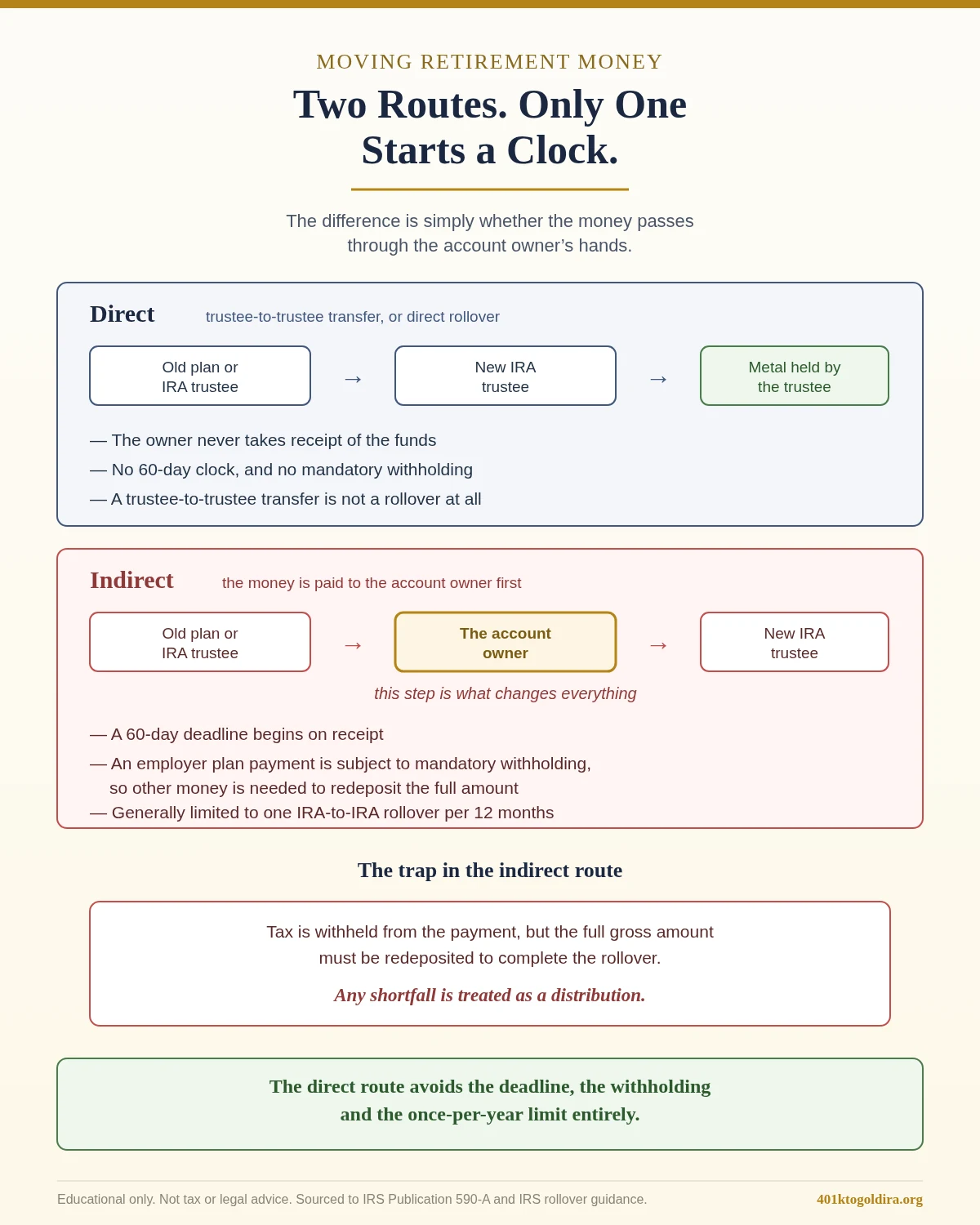
The movement method changes withholding, deadlines and the amount of outside cash required.
What a direct rollover actually is
A direct rollover is an eligible rollover distribution paid directly to the receiving eligible retirement plan for your benefit (26 CFR §1.401(a)(31)-1). It can be sent by wire or by check. If a check is used, the regulation requires it to be negotiable only by the receiving trustee or custodian — and a plan can hand that check to you for delivery without turning the transaction into a payment to you.
This is the point the popular explanation gets wrong. The test is not whether the money passes through your hands. It is who the payment is made to. “Check mailed to your house” and “check payable to you” are not the same fact. Being handed a check is also not unusual: federal survey evidence on how 401(k) rollovers are actually delivered shows a large minority of completed direct rollovers reach the participant this way.
For pre-tax 401(k) money moving to a traditional self-directed IRA, a compliant direct rollover generally avoids current federal income inclusion and avoids the participant-level mandatory withholding that applies when an eligible rollover distribution is paid to the participant.
What happens if the plan pays the distribution to you
If an eligible rollover distribution is paid to you, federal law generally requires 20% withholding, and you generally have 60 days to complete a rollover of the amount received.
The withholding creates a shortfall. The IRS illustrates the rule with a $10,000 eligible 401(k) distribution: $2,000 is withheld and the participant receives $8,000. To roll over the full $10,000 within the deadline, the participant must add $2,000 from other funds. If only $8,000 is rolled over, the $2,000 not rolled over is taxable and can also face the additional early-distribution tax unless an exception applies.
The rollover withholding shortfall calculator models that arithmetic on a specific amount before you request a participant-paid distribution.
The one-per-year rule does not apply here
The IRA one-rollover-per-12-month limit does not apply to a plan-to-IRA rollover. IRS guidance expressly lists plan-to-IRA rollovers among the transactions outside that IRA-to-IRA limitation, along with trustee-to-trustee transfers, IRA-to-plan and plan-to-plan rollovers and traditional-to-Roth conversions.
That rule should not be imported into a 401(k)-to-Gold-IRA guide. Where it genuinely applies is set out on the IRA transfer guide.
What tax forms to expect
A 401(k) distribution and rollover are generally reportable even when no current tax is due. Current IRS instructions require reporting of a direct rollover on Form 1099-R, and the receiving IRA reports qualifying rollover contributions on Form 5498 (IRS — Instructions for Forms 1099-R and 5498). Keep both forms, the distribution statement, the rollover confirmation and the custodian’s receipt records. “Nontaxable” does not mean “unreported”.
Gate 2: Pre-Tax, Roth and After-Tax Money
A plan balance can contain more than one tax character. Do not authorise the rollover until you know which source is going to which legal account.
| 401(k) money | Tax-preserving destination | Current federal tax effect of a compliant rollover | Main warning |
|---|---|---|---|
| Pre-tax elective deferrals and employer money | Traditional self-directed IRA | Generally no current income when directly rolled to a non-Roth eligible retirement plan. The 2026 Form 1099-R instructions direct the payer to enter -0- (zero) in box 2a for such a direct rollover. | Later IRA distributions are generally taxable under the IRA rules. |
| Pre-tax 401(k) money deliberately routed to a Roth IRA | Roth self-directed IRA | Taxable to the extent the amount would otherwise be includible in income. | This is a qualified rollover contribution from an employer plan. Do not call it tax-free. |
| Designated Roth 401(k) | Roth IRA | Same-tax-character routing. A direct rollover from a designated Roth account to a Roth IRA is reported using code H in box 7. | The plan’s five-year period and the Roth IRA’s own five-year period are determined independently, so the plan’s clock does not carry into the Roth IRA’s. [7] |
| After-tax non-Roth contributions | Often a Roth IRA for the after-tax portion, with the pre-tax portion directed separately | Notice 2014-54 permits multiple destinations for one distribution. | A mixed partial distribution is generally pro rata; the after-tax dollars cannot simply be extracted. Two conditions decide the outcome: the allocation must be given to the plan administrator before the direct rollovers are made, and the pretax amount is assigned first to the direct rollovers. See the order of operations below. [1] [2] |
Pre-tax 401(k) to a traditional self-directed IRA
This is the standard character-preserving path. The current reporting instruction is specific: for a direct rollover of an eligible rollover distribution to a traditional IRA or another non-Roth eligible retirement plan, the payer enters the gross amount in box 1 and “a -0- (zero) in box 2a”. That is the exact wording used by the 2026 Instructions for Forms 1099-R and 5498, and it is worth quoting precisely because a paraphrase cannot be located in the source by anyone trying to verify it.
The fact that the destination IRA later buys physical precious metals does not itself change the rollover tax treatment. The rollover and the later IRA investment are separate steps.
Pre-tax 401(k) to a Roth IRA: a taxable qualified rollover contribution
A pre-tax employer-plan rollover to a Roth IRA is not a tax-free preservation of pre-tax character. IRC §408A provides that when an eligible retirement-plan distribution is contributed to a Roth IRA as a qualified rollover contribution, the amount that would otherwise be includible in income is included in gross income (26 U.S.C. §408A).
Readers and advisers often say “Roth conversion” for any pre-tax-to-Roth movement, but current Form 5498 instructions distinguish an employer-plan rollover from a traditional-IRA-to-Roth-IRA conversion. On a page about what the words mean, the precise term is the honest one. The Roth-side rules themselves are covered in the Roth Gold IRA guide rather than duplicated here.
After-tax non-Roth contributions
If the 401(k) contains after-tax non-Roth contributions, ask for the source breakdown before requesting a distribution. Under Notice 2014-54, pre-tax and after-tax portions of a distribution sent to multiple destinations at the same time can be allocated so that, for example, pre-tax dollars go to a traditional IRA while after-tax dollars go to a Roth IRA (IRS — rollovers of after-tax contributions).
But that notice does not let you cherry-pick only the after-tax dollars from a mixed account while leaving the entire pre-tax share behind. A partial distribution from a mixed account generally carries a proportional share of pre-tax and after-tax amounts. This is a routing rule, not a backdoor-Roth strategy.
If You Split One Distribution Between Two IRAs, the Order of Operations Matters
Tell the Plan Administrator How to Split It, Before the Money Moves
A split rollover is not something that can be arranged after the money has moved.
Where one distribution goes to more than one destination, the participant may select how the pretax amount is allocated among those destinations [1] — but that selection binds only if the plan administrator is told first.
The Notice is explicit: “To make this selection, the recipient must inform the plan administrator of the allocation prior to the time of the direct rollovers.” [1] Request the distribution without that instruction and the allocation is settled by the ordering rule below rather than by what you intended.
On the timing of the rules themselves: “The allocation rules of section III of this notice generally apply to distributions made on or after January 1, 2015.” [1] So they govern any rollover being arranged today.
Concretely, that means putting the allocation in the distribution request itself, in writing: name each receiving account, and state the amount of the pretax portion assigned to each. Ask for written confirmation of the allocation before any check is issued or any transfer is made. That is a consequence of the timing requirement above, not a separate rule in the sources.
Why the Two Legs Must Be One Distribution
The allocation rule operates on a single distribution, so the first question is whether what the plan is doing counts as one.
The Notice sets its own test: “all disbursements of benefits from the plan to the recipient that are scheduled to be made at the same time (disregarding differences due to reasonable delays to facilitate plan administration) are treated as a single distribution without regard to whether the recipient has directed that the disbursements be made to a single destination or multiple destinations” [1].
Two things follow. Payments scheduled at the same time are one distribution even though they arrive in two different accounts, which is what makes a split possible at all.
And the phrase “reasonable delays to facilitate plan administration” is left undefined: no primary source captured for this page puts any figure on it [1], so none is given here. Schedule both legs together and keep the plan’s own confirmation of that schedule.
You Direct the Pretax Amount, Not the Dollars
This is the part most readers have backwards. A split does not let anyone reach into the account and pull out the after-tax contributions.
How much of the distribution is pretax is already fixed before any allocation happens, and it is the pro-rata rule that fixes it: “If a participant’s account balance in a plan qualified under § 401(a) or in a § 403(b) plan includes both after-tax and pretax amounts, then, under § 72(e)(8), each distribution from the account (other than a distribution that is paid as part of an annuity, which is subject to a different rule) will include a pro rata share of both after-tax and pretax amounts” [1]. The allocation rule then decides where that pretax amount goes, not how large it is.
The order of assignment is statutory, and it runs pretax first. The statute puts it beyond doubt: “In the case of a transfer described in subparagraph (A) or (B), the amount transferred shall be treated as consisting first of the portion of such distribution that is includible in gross income” [2]. Within a split, the tiers work outward from there:
- The pretax amount is assigned first to the direct rollovers. Where the pretax amount is smaller than the total being directly rolled over, the recipient can select how the pretax amount is allocated among those destinations [1].
- “Any remaining pretax amount is next assigned to any 60-day rollovers” [1].
- Anything a destination receives beyond the pretax amount assigned to it is after-tax: “If the amount rolled over to an eligible retirement plan exceeds the portion of the pretax amount assigned or allocated to the plan, the excess is an after-tax amount.” [1]
The Notice’s own worked case is the fact pattern this page describes. On a $100,000 distribution split between two IRAs: “Employee C is permitted to allocate the $80,000 that consists entirely of pretax amounts to the traditional IRA so that the $20,000 rolled over to the Roth IRA consists entirely of after-tax amounts.” [1]
Worked through one step at a time, on the Notice’s own figures [1]:
- The distribution is $100,000, and it is split $80,000 to a traditional IRA and $20,000 to a Roth IRA. Those are the two legs.
- How much of it is pre-tax was already settled before anyone chose anything. The pro-rata rule fixes that proportion [1]; nobody selects it.
- The pre-tax amount is assigned first to the direct rollovers [2]. All $80,000 of it is assigned to the traditional IRA leg, which is the allocation the participant is permitted to make [1].
- The Roth IRA leg therefore receives no pre-tax amount, so its $20,000 is after-tax money: anything a destination receives beyond the pre-tax amount assigned to it is an after-tax amount [1].
- What lands in the Roth IRA is the after-tax non-Roth contributions themselves. DERIVED [2]: the earnings attributable to those contributions are part of the pre-tax amount, so they are not in the $20,000 leg. This step is a derivation from the sources cited below, not a sentence any primary source states, and it is not attributed to the Notice.
- Designated Roth 401(k) money does not feature in this arithmetic at all. It is a separate source with its own routing.
Only the three figures the Notice’s own example carries are used above, and the worked example introduces no others. The account-balance figures behind the Notice’s pro-rata computation are deliberately not reproduced.
A consequence worth stating plainly, because it is where the money usually surprises people. DERIVED [2]: earnings attributable to after-tax non-Roth contributions are part of the pretax amount, not part of the after-tax amount, so the Roth IRA leg of a split carries the after-tax contributions and not their growth. This is a derivation from the sources below, not a sentence any primary source states, and it is not attributed to the Notice:
- Basis is the employee’s investment in the contract — “If an eligible rollover distribution includes some or all of an employee's basis (that is, the employee's investment in the contract), then the portion of the distribution that is allocable to the employee's basis may be rolled over to an IRA.” [3]
- Earnings are not basis, and the pretax amount is the portion includible in gross income [2], which the distribution carries pro rata [1].
- The arithmetic of the Notice’s own example is consistent with it: the after-tax leg equals the after-tax contributions [1].
Three different kinds of money are in play in that paragraph and they stay apart: the after-tax non-Roth contributions themselves, the earnings attributable to them, and designated Roth 401(k) money, which is a separate source with its own routing and is not part of this calculation at all.
One limit belongs here rather than in a block of its own, because this page’s destination is an IRA throughout: to an IRA the after-tax leg is permitted, but to a receiving employer plan it is permitted only where that plan separately accounts for the after-tax amounts and the earnings on them [2], and where it does not, the Notice’s own example makes the after-tax portion impermissible to roll into that plan [1] — so whether a receiving plan separately accounts is a question for that plan’s administrator, not a matter this page can answer.
Two Forms, and the One Line That Records Your Basis
A split leaves a paper trail in two places, and the editions behind them are different years, so they are cited separately here.
The payer’s side comes in more than one form. The Notice contemplates that for a split, “each disbursement may be required to be reported on a separate Form 1099-R” [1].
The current instructions put it directly: “If part of the distribution is a direct rollover and part is distributed to the recipient, prepare two Forms 1099-R.” [4] (2026 Instructions for Forms 1099-R and 5498). Those same 2026 instructions still send the reader to this Notice for the allocation rule itself — “For guidance on allocation of after-tax amounts to rollovers, see Notice 2014-54, 2014-41 I.R.B. 670” [4] — which is how you can tell the rule is current and not historical.
Your own side is Form 8606 [5], and it is a single line. Its instructions require that where a nontaxable portion of a qualified retirement plan was rolled over to a traditional IRA and was not previously reported: “You rolled over any nontaxable portion of your qualified retirement plan to a traditional IRA that wasn’t previously reported on Form 8606, line 2. Include the nontaxable portion on line 2.” [6] (2025 Instructions for Form 8606).
That line 2 entry is what carries the basis forward in the traditional IRA; without it the basis is undocumented. Basis tracking in the receiving account is covered in more depth on Rollover IRA vs Roth IRA, which is where that topic lives; the sentence above stays here because the reader needs the form named where they are standing.
The two editions are not one set. The 1099-R instructions cited here are the 2026 edition; Form 8606 and its instructions are the 2025 edition. Cite each with its own year.
What the Rules Do Not Say
This block is a set of stated limits. Every sentence in it is a limit.
- There is no documented route to correct a split once it has been allocated against what you intended. Every primary source describes the election prospectively [1]. No source captured for this page sets out a post-hoc re-election or correction procedure. That silence is the reason to get the instruction in writing beforehand; it is not a statement that a fix is impossible, and it is not a suggestion that one exists.
- “Reasonable delays to facilitate plan administration” is undefined [1]. No number of days is given anywhere in the sources, so none is given here.
- Three things are plan terms, not federal rules: whether after-tax non-Roth contributions exist in the account, whether the plan will make a split disbursement at all, and whether a receiving employer plan separately accounts for after-tax amounts [1] [2]. Ask the administrator.
- How often plans honour an allocation election is not something this page can tell you. No measurement with a disclosed method exists, so no figure, proportion or characterisation of plan or provider behaviour appears anywhere in this material.
Variant 4: The Roth 401(k)
A designated Roth 401(k) can be rolled to a Roth IRA, and a direct designated-Roth-to-Roth-IRA rollover is not a conversion of pre-tax money. The current 1099-R instructions report that direct rollover using code H in box 7 — the code for a direct rollover of a designated Roth account distribution to a Roth IRA — rather than through the zero-taxable-amount instruction that governs pre-tax direct rollovers to a non-Roth destination. The substantive conclusion is the same: it is same-character routing, not a taxable event.
The five-year rule needs separate attention. IRS designated Roth guidance states that the period of participation in the designated Roth account does not count toward the five-taxable-year period for the Roth IRA. If you already established a Roth IRA in an earlier year, that earlier Roth IRA contribution can establish the Roth IRA clock (IRS — FAQs on designated Roth accounts).
The regulation is flatter than the plain-language framing above: “The 5-taxable-year period described in this A-4 and the 5-taxable-year period of participation described in A-4 of § 1.402A-1 are determined independently.” [7] (26 CFR §1.408A-10 A-4, eCFR edition 2026-10-05). Neither period feeds the other.
That is exactly why the Roth 401(k) variant belongs inside this parent article, while the Roth IRA distribution rules themselves live in the Roth Gold IRA guide.
Variant 5: Partial Rollovers
Sometimes — but two separate permissions are involved.
Federal rollover law allows all or part of an eligible rollover distribution to be rolled to an eligible retirement plan. That authority sits in IRC §402(c), read together with the plan-document rule: what federal law does not do is force every plan to let a participant request any partial distribution at any time. A current plan may restrict in-service distributions, sources, frequencies or forms under its written terms.
So ask the administrator two questions separately:
- Does the plan permit a partial distribution of this source now?
- Of the amount the plan will distribute, how much do I want to roll over?
For accounts holding after-tax money, remember that a partial distribution from a mixed pre-tax/after-tax account generally carries a pro rata share of both.
The first of those two questions is the one most likely to end the conversation, and the odds are not even. In Vanguard's recordkeeping universe, fewer than half of plans permitted terminated participants to take ad hoc partial cash distributions in 2025, and availability rose steeply with plan size — the figures are set out in the research on how often plans actually allow partial withdrawals after separation.
Before You Roll: Decisions That May Be Lost or Changed
Check these before the paperwork, not after
- Age-55 separation access. Rolling the whole balance to an IRA can remove a penalty exception that exists only for plan distributions.
- Employer stock and net unrealized appreciation. Rolling employer securities into an IRA can eliminate NUA treatment for later IRA payments of that stock. The choice can be irreversible.
- Outstanding plan loan. A deemed distribution, a plan loan offset and a qualified plan loan offset carry different rollover rights and different deadlines.
Each of these is a tax-planning question to resolve before the rollover. None of them can be undone by the receiving custodian afterwards.
Age-55 separation-from-service access
IRC §72(t)(2)(A)(v) provides an exception to the 10% additional tax for distributions made to an employee from a qualified employer plan after separation from service in or after the calendar year in which the employee reaches age 55 (26 U.S.C. §72). The separation itself has to happen in or after that year; separating earlier and waiting until 55 does not satisfy it.
Two qualifications matter and are routinely dropped. First, qualified public safety employees have a separate and more generous condition under the same provision. IRS safe-harbor participant-notice language published in Notice 2026-13 puts it as an age-50-or-25-years-of-service alternative for those employees. Second, and decisively for this page, that plan-based exception does not apply to payments from an IRA.
So if you separated from the employer around that age and may need access before 59½, moving the entire balance to an IRA can remove that particular route. Other IRA exceptions may apply, but they are different rules with different conditions.
A note on what Notice 2026-13 is. It is a set of safe harbor explanations under IRC §402(f) that plan administrators may use to satisfy the participant-notice requirement, modifying the earlier Notice 2020-62 for SECURE 2.0 changes. The age-55 and NUA language sits inside model participant-notice text. It is a reliable statement of the rules for notice purposes, but the operative authority for the age-55 exception is §72(t)(2)(A)(v) itself, and this page cites it that way.
Employer stock and net unrealized appreciation
If the 401(k) holds employer stock, stop before liquidating or rolling it blindly. Certain qualifying lump-sum distributions of employer securities can receive special net-unrealized-appreciation treatment, where the NUA is not taxed at distribution and is instead taxed when the stock is sold.
The consequence for a rollover is stated plainly in the IRS safe-harbor notice text: “If you roll over the payment to an IRA, you will not have any cost basis in the employer securities and the special rule relating to NUA will not apply to later payments from the IRA.” The full consequence is the point — not only does the special rule stop applying, the basis position is lost as well.
That does not mean NUA is better. It means the choice can be irreversible and needs specialist tax analysis using the stock’s basis, current value, the distribution event, other plan assets and the participant’s own tax position.
Where the employer stock sits in an employee stock ownership plan rather than an ordinary 401(k), several further rules apply that are specific to that plan type, including the participant’s right to demand employer securities, the put option on shares that are not readily tradable, and the S-corporation shareholder bar. Those are set out on the ESOP rollover to an IRA guide.
Outstanding 401(k) loan
A loan can create a separate rollover problem. A deemed distribution caused by certain loan failures is not the same as a plan loan offset and may not be rollover-eligible. A plan loan offset reduces the participant’s account balance and can be an eligible rollover distribution (IRS — plan loan offsets).
If the offset is a qualified plan loan offset caused by plan termination or severance from employment and the statutory conditions are met, the participant can have until the federal income-tax return due date, including extensions, for the year of the offset to complete the rollover using other funds. Other plan loan offsets generally use the ordinary 60-day period.
Ask the plan administrator to state in writing whether the event is a deemed distribution, a plan loan offset or a qualified plan loan offset before assuming any deadline.
Two different protections, often wrongly merged
A rollover can change the legal framework around the money, and this is the point where careless writing does the most damage. There are two distinct regimes and they answer different questions.
ERISA Title I protections are about fiduciary duties and participant rights. DOL explains that employer-sponsored plans carry special protections under Title I of ERISA, meaning that plan fiduciaries must operate the plan prudently and in participants’ interests, and that participants have a right to enforce those duties in federal court. The DOL sentence carrying that meaning states that Title I protections include “the right to sue in federal court for benefits and breaches of fiduciary duty”. That is a statement about fiduciary standards and legal recourse. It is not a statement about creditor protection, and it should never be used to open one.
Bankruptcy protection is a separate federal statute. 11 U.S.C. §522 protects qualifying retirement funds in §401 and §408 accounts, and provides that qualifying direct transfers and eligible rollovers do not lose exemption status merely because of the transfer. There is also a point that matters most to exactly the reader of this page: §522(n) caps the bankruptcy exemption for IRAs at $1,000,000 (adjusted), but that cap expressly excludes amounts attributable to rollover contributions under §402(c) and earnings on them (11 U.S.C. §522). A large 401(k) rolled into an IRA is not squeezed under that cap.
Outside bankruptcy, state law varies. Nonbankruptcy creditor protection for IRAs is governed by state law and the facts of a particular claim, and it differs from state to state. This page does not certify a 50-state result. A reader with lawsuit, judgment, profession-specific, divorce or asset-protection concerns should obtain state-specific legal advice before moving ERISA plan assets. State-level differences are collected on the creditor protection by state page, and the separate rules for dividing an IRA itself in a divorce are set out in the IRA transfer incident to divorce guide.
Plan fees, institutional options and services
Leaving money in the plan is a real alternative, not a failure to complete a rollover. DOL’s fee guidance separates plan administration fees, investment fees and individual service fees, and notes that “in some cases, the employer pays some or all of the plan’s administrative expenses” — the sentence that carries the meaning, rather than the section heading above it (DOL — A Look at 401(k) Plan Fees).
Some 401(k)s also offer plan-specific investments, such as stable-value funds, that may not be available outside the plan. Availability is plan-specific and should be checked rather than assumed.
Before rolling, compare what you actually have against the self-directed IRA you would actually open: current plan administrative fees, investment expense ratios and share classes, any employer-paid costs, plan-only investment options, loan access, advice or managed-account services, distribution flexibility, and the IRA’s administration, transaction, storage and precious-metals trading costs.
The Seven-Step Direct-Rollover Process
Once the eligibility and pre-rollover decisions are resolved, the process itself is straightforward.
- Verify the distributable event and plan terms. Get the Summary Plan Description and distribution form. Confirm whether this is a former-employer account or a current plan with an allowed in-service distribution, and identify any rollover-ineligible amount.
- Compare the alternatives. A participant leaving an employer generally has several options: leave the money in the former plan if permitted, move it to a new employer plan if available and accepting rollovers, roll it to an IRA, or take a taxable distribution. Combinations can also be possible. Do the age-55, employer-stock, loan-offset, vesting, protection, fee, investment and service checks before selecting the IRA route.
- Choose the destination tax character. Map each source separately: pre-tax to a traditional IRA to preserve deferral; designated Roth to a Roth IRA; after-tax non-Roth under the Notice 2014-54 allocation if using multiple destinations; and pre-tax to a Roth IRA only if you intend to accept the current income inclusion. Where one distribution is being split between two IRAs, the order of operations sets out what the plan administrator has to be told, and when.
- Open the appropriate self-directed IRA. A “Gold IRA” is not a separate Code account type. Ask for the legal account registration, fee schedule, investment procedures, storage arrangement, distribution procedures and the exact rollover payee instructions before contacting the 401(k) administrator.
- Request the direct rollover. Give the plan administrator the receiving trustee or custodian’s exact payee and account instructions. A direct-rollover check should be payable to the receiving trustee or custodian for your benefit, not payable to you personally.
- Confirm receipt and reporting. Check that the IRA received the correct gross amount and source. Retain the plan’s Form 1099-R and the IRA’s Form 5498 records. If a Roth or after-tax source was involved, reconcile the basis and source reporting rather than relying on the cash balance alone. Expect the payer to prepare two Forms 1099-R where part of the distribution was a direct rollover and part was not, per the 2026 Instructions for Forms 1099-R and 5498 [4], and carry any nontaxable portion rolled to a traditional IRA to line 2 of Form 8606, per the 2025 Instructions for Form 8606 [6].
- Only then authorise a precious-metals purchase. The rollover can be completed entirely in cash. The later purchase of physical metal inside the IRA is a separate transaction governed by the IRA’s investment and custody rules.
The Gold IRA rollover calculator can model the amount to move; it is not a substitute for the plan eligibility or tax-character checks above.
How a Self-Directed IRA Holds Qualifying Physical Metals
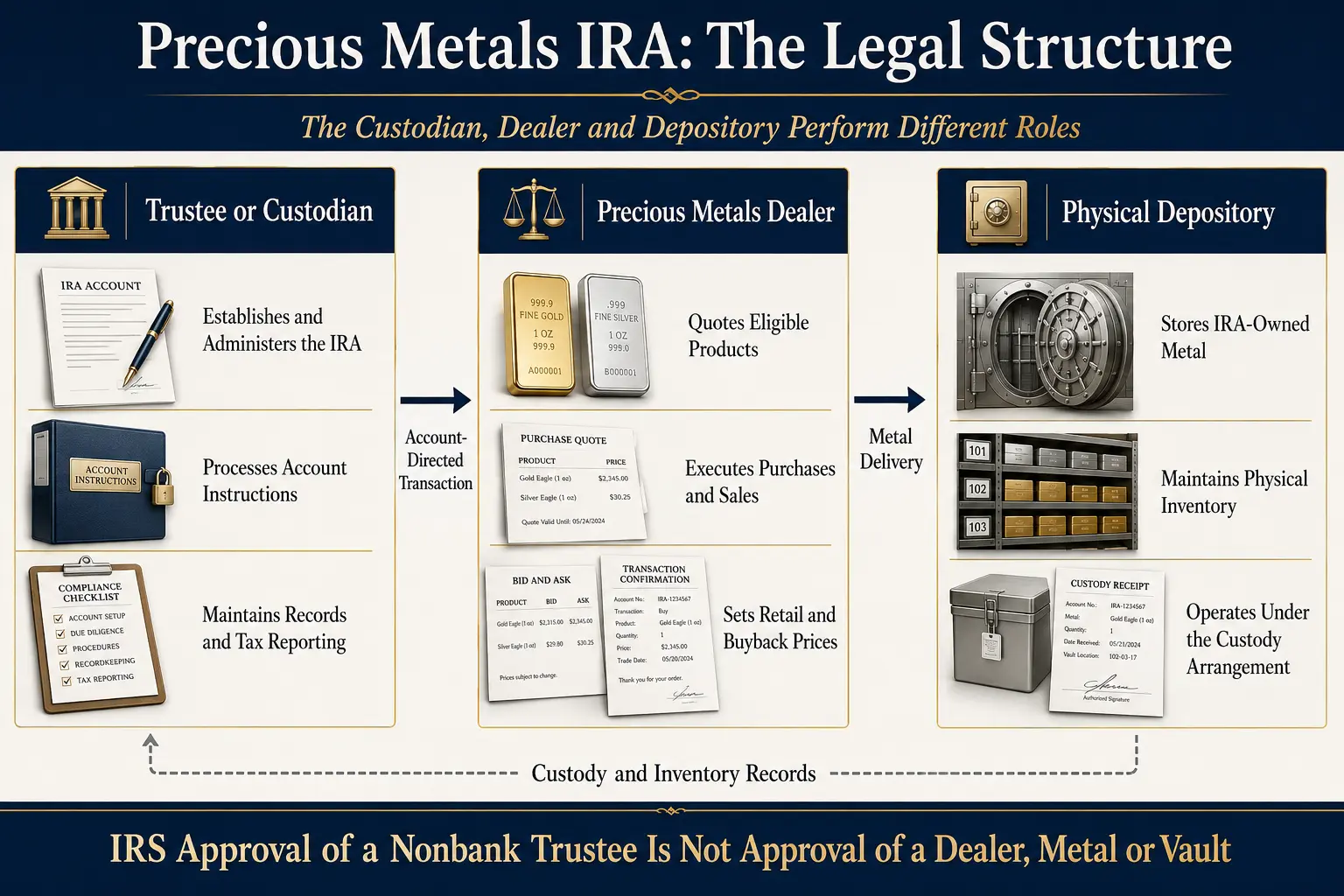
The Internal Revenue Code defines IRAs, including traditional and Roth structures. It does not establish a separate tax account named “Gold IRA”. In practice the phrase refers to a self-directed IRA whose trustee or custodian permits qualifying physical precious metals. The precious metals IRA guide explains the separate legal roles of trustee, dealer and depository.
The collectibles rule and its exceptions
IRC §408(m) generally treats an IRA acquisition of a collectible as a distribution, then creates exceptions for specified coins and qualifying gold, silver, platinum or palladium bullion. Qualifying bullion must meet the statutory fineness condition and be in the physical possession of the qualifying trustee (26 U.S.C. §408).
Product eligibility therefore has to be established for the exact coin or bar, not inferred from a dealer’s generic “IRA eligible” label. See the IRA-eligible precious metals guide for the product-level tests.
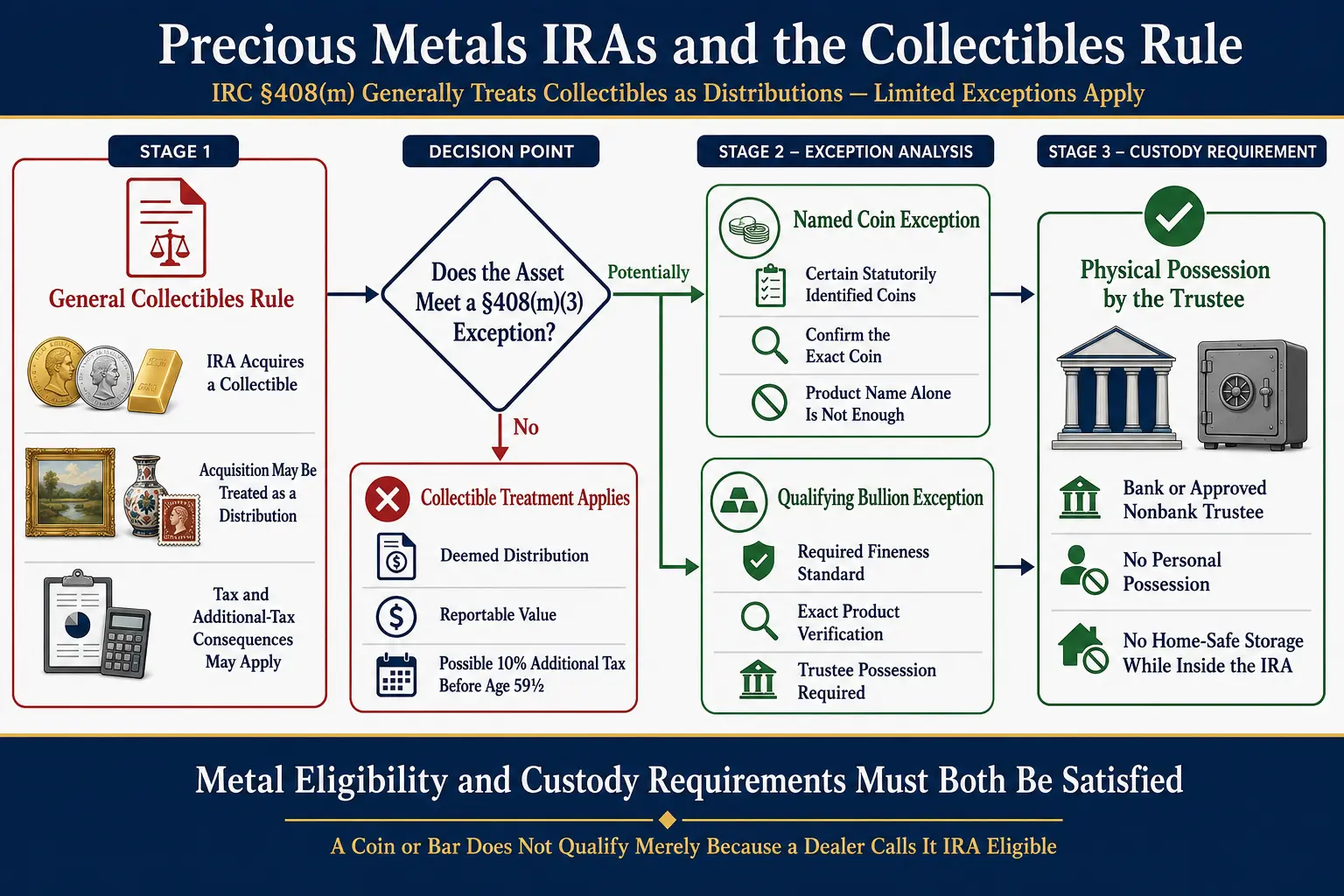
Custody stays inside the IRA structure
IRS guidance states that the highly refined bullion exception depends on the metal being in the physical possession of a bank or an IRS-approved nonbank trustee. The IRA FAQ then closes the loophole most often marketed around it: “This rule also applies to an indirect acquisition, such as having an IRA-owned Limited Liability Company (LLC) buy the bullion” (IRS — retirement plans FAQs regarding IRAs). A “checkbook IRA” or home-storage structure does not escape the possession requirement by inserting an entity the IRA owns.
Use “approved nonbank trustee or custodian” only where the IRS actually uses that status. Do not call metals, coins, dealers or depositories “IRS-approved”. The verification method is on the approved depository verification page and the storage comparison on depository versus home storage. Separately, IRC §4975 prohibits specified transactions and self-dealing involving disqualified persons, and it applies regardless of whether the product test is met.
Can the 401(k) itself hold physical gold without a rollover?
Federal law does not say that every 401(k) is categorically unable to hold qualifying physical precious metals. The IRS issue snapshot on collectibles in individually directed qualified plan accounts applies §408(m) to individually directed accounts under §401(a) plans, recognises the statutory precious-metals exceptions, and states that plan provisions may allow participant choice or limit investments to the plan’s offered options (IRS — investments in collectibles in individually directed qualified plan accounts).
So the accurate answer is that the plan menu is governed by its written provisions, the §408(m) framework can apply inside a qualified-plan account, the plan is not federally required to offer direct physical-metal ownership, and the administrator should be asked what the plan actually offers before assuming a rollover is the only route. If the plan menu includes a fund or security with gold exposure, that security is not the same legal asset as IRA-owned physical bullion.
Cost Reality: Compare the Plan You Have With the IRA You Would Open
A rollover does not create value by itself. It changes the account, the investment menu, the legal framework and the cost structure.
In the existing 401(k), get the plan’s current participant fee disclosure and investment comparison chart rather than estimating. In a self-directed precious-metals IRA, ask for the current written schedule covering account establishment, annual administration, transaction charges, storage and insurance-related charges, shipping or handling, the dealer’s retail price for the exact metal, the reference metal price used for that quote, and the dealer’s current repurchase price for the same item.
CFTC guidance tells precious-metals customers to get fees, commissions, the agreed retail price, storage costs and the dealer’s buyback price in writing before signing (CFTC — 10 things to ask before buying physical gold, silver or other metals).
For named, dated cost evidence, this site publishes current per-custodian schedules on the Gold IRA fees benchmark and observed dealer pricing on the dealer markup data page. Those pages read figures from named schedules; this article does not publish a universal annual-fee or dealer-markup benchmark, because current published schedules use different structures and no single range describes them.
One historical note is worth preserving because it is routinely misused. A CFTC customer advisory issued in the CARES Act period gave examples of bullion premiums of roughly 5–10% and numismatic premiums of 40–200% above spot. Those were regulator examples from that advisory, not a 2026 market average, and they should not be used to estimate a current dealer quote.
What to Obtain in Writing Before Authorising Movement
From the 401(k) administrator
- Summary Plan Description and current distribution rules.
- Confirmation of the distributable event, and whether the requested full or partial distribution is permitted.
- Vested balance.
- Pre-tax, designated Roth and after-tax source breakdown.
- The rollover-eligible amount and any excluded distribution.
- The direct-rollover payee procedure.
- Outstanding-loan status, and whether any event would be a deemed distribution, plan loan offset or qualified plan loan offset.
- Employer-stock position, cost basis and NUA information if applicable.
- Current plan fee and investment disclosure.
- Expected Form 1099-R coding for the proposed transaction.
From the receiving IRA trustee or custodian
- The exact legal account type: traditional IRA or Roth IRA.
- Written confirmation that the account accepts the intended rollover source.
- Exact rollover payee and account instructions.
- Complete fee schedule.
- Precious-metals investment procedures and any product restrictions the custodian imposes beyond federal law.
- The storage and custody arrangement, and the legal identity of the trustee or custodian.
- Distribution, in-kind distribution, valuation and account-termination procedures.
- Expected Form 5498 reporting.
From the metals dealer and the storage arrangement
- Exact product, weight and description, with the current reference price used in the quote and the actual retail price.
- Every commission, spread, markup, transaction, shipping or handling charge.
- A current repurchase quote for the same item — understood as a quote, not a guaranteed future buyback.
- Written confirmation of where the metal will be delivered under the IRA custodian’s instructions.
- Facility identity and address, its contracting relationship with the IRA trustee or custodian, the storage method and inventory-record process, and a written description of insurance coverage and its limitations.
The quote checklist and questions to ask before opening an account put the same discipline into a printable form. For tax-trap review after gathering the documents, use the Gold IRA tax mistakes guide.
Primary Sources
Primary sources were preferred throughout: the Internal Revenue Code and Treasury regulations first, then IRS publications, forms and guidance, then regulator consumer guidance. Company marketing and affiliate review pages were not used as legal authority. All links below were checked on 31 August 2026.
- 26 CFR §1.401(k)-1 — the distribution restrictions on elective deferrals, the recognised distributable events, and the narrow scope of the age-59½ event.
- 26 CFR §1.401(a)(31)-1 — the direct rollover definition and the rule that a check may be negotiable only by the receiving trustee.
- 26 U.S.C. §402 — §402(c) on rolling all or part of an eligible rollover distribution, the 60-day period, and the §402(c)(4) exclusions for RMDs, hardship distributions and certain periodic payments.
- 26 U.S.C. §72 — §72(t)(2)(A)(v), the separation-from-service exception for employer-plan distributions in or after the year age 55 is reached, and the public safety employee provisions.
- 26 U.S.C. §408 — the collectibles rule in §408(m), the precious-metals exceptions, and the physical-possession requirement.
- 26 U.S.C. §408A — qualified rollover contributions to a Roth IRA and income inclusion.
- 26 U.S.C. §4975 — prohibited transactions and self-dealing involving disqualified persons.
- 11 U.S.C. §522 — the bankruptcy exemption for retirement funds, the preservation of exemption on qualifying transfers and rollovers, and the §522(n) cap that excludes §402(c) rollover contributions and earnings.
- IRS — Instructions for Forms 1099-R and 5498 — direct rollover reporting, the “-0- (zero) in box 2a” instruction for a direct rollover to a non-Roth destination, code H for a direct rollover of a designated Roth account to a Roth IRA, and Form 5498 rollover reporting.
- IRS — Rollovers of retirement plan and IRA distributions — the 20% mandatory withholding rule, the $10,000/$2,000/$8,000 example, and the transactions excluded from the IRA one-rollover-per-12-month limit.
- IRS Notice 2026-13, 2026-6 I.R.B. — safe harbor explanations under §402(f) that plan administrators may use for participant notices, modifying Notice 2020-62 for SECURE 2.0. Source of the model NUA and public-safety-employee notice wording quoted above; the operative authority for the age-55 rule remains §72(t)(2)(A)(v).
- IRS — 401(k) resource guide, general distribution rules and plan disclosure documents — that available distribution forms depend on plan terms, and how to establish whether in-service distributions are offered.
- IRS — Rollovers of after-tax contributions — the Notice 2014-54 allocation framework and the pro rata rule for a mixed partial distribution.
- IRS — FAQs on designated Roth accounts — that participation in a designated Roth account does not count toward the Roth IRA five-taxable-year period.
- IRS — Plan loan offsets — the distinction between a deemed distribution, a plan loan offset and a qualified plan loan offset, and the extended deadline for a QPLO.
- IRS — Retirement topics, vesting — elective deferrals are always fully vested; employer contributions may follow a plan vesting schedule.
- IRS — Retirement plans FAQs regarding IRAs — the highly refined bullion possession requirement and its application to an indirect acquisition such as an IRA-owned LLC.
- IRS — Investments in collectibles in individually directed qualified plan accounts — §408(m) applied to individually directed qualified-plan accounts, and plan discretion over the investment menu.
- IRS — Approved nonbank trustees and custodians — the published list against which a nonbank trustee claim can be checked.
- DOL EBSA — A Look at 401(k) Plan Fees — plan administration, investment and individual service fees, and that an employer may pay some or all administrative expenses.
- DOL EBSA — Choosing the right person to give you investment advice — Title I ERISA protections, meaning fiduciary standards and the right to sue in federal court, which is a different question from creditor protection.
- CFTC — 10 things to ask before buying physical gold, silver or other metals — written pricing, dealer spread, storage, insurance and buyback price.
Tax rules and indexed figures change between years. Any figure or rule should be confirmed against current IRS guidance for the relevant tax year before it is relied on.
Sources for the split-allocation order of operations
Seven sources, numbered in order of first appearance in that subsection, each with the edition it follows and the date it was accessed. The 2026 Instructions for Forms 1099-R and 5498 and the 2025 Form 8606 and its instructions are cited separately, each with its own year; they are not one current forms set.
- IRS Notice 2014-54, 2014-41 I.R.B. 670 — released 2014-09-18; the allocation rules apply to distributions made on or after 1 January 2015. Accessed 7 October 2026.
- 26 U.S.C. §402(c)(2) — govinfo, USCODE-2024 edition. Accessed 7 October 2026.
- 26 CFR §1.402(c)-2 — eCFR edition 2026-10-05. Accessed 7 October 2026.
- 2026 Instructions for Forms 1099-R and 5498 — 2026 edition. Accessed 7 October 2026.
- Form 8606 — Rev. 2025. Accessed 7 October 2026.
- 2025 Instructions for Form 8606 — 2025 edition. Accessed 7 October 2026.
- 26 CFR §1.408A-10 A-4 — eCFR edition 2026-10-05. Accessed 7 October 2026.
Frequently Asked Questions
Can I roll my 401(k) into a Gold IRA while I still work for the company?
Only if the plan permits an in-service distribution of the money you want to move. Treasury regulations restrict when elective deferrals may be distributed, and the IRS states that the distribution forms actually available depend on the terms of the plan. Age alone is not permission: §1.401(k)-1(d)(1)(ii) makes age 59½ a distributable event only for profit-sharing, stock bonus and rural cooperative plans, and the written plan still decides whether that distribution is offered. Ask the administrator whether the plan permits an in-service distribution of the specific source, amount and form requested. A custodian or dealer cannot override a plan restriction.
Can I roll over an old 401(k) to a Gold IRA?
A genuine severance from employment is a recognised distributable event for elective deferrals, so a former-employer 401(k) has generally cleared the federal gate. The plan document still controls the distribution form. Before authorising anything, confirm the vested balance, the pre-tax, designated Roth and after-tax source breakdown, the rollover-eligible amount, any outstanding loan or loan offset, any employer-stock position and cost basis, and the plan’s current fee and investment disclosure. Employee elective deferrals are always fully vested, while employer contributions can still be subject to a plan vesting schedule.
Is a 401(k)-to-Gold-IRA rollover taxable?
It depends on tax character and destination. Pre-tax 401(k) money directly rolled to a traditional self-directed IRA generally preserves tax deferral, and the 2026 Form 1099-R instructions direct the payer to report such a direct rollover with a -0- (zero) in box 2a. Pre-tax money routed to a Roth IRA is a qualified rollover contribution under §408A and the otherwise includible amount is generally included in gross income. A designated Roth 401(k) rolled directly to a Roth IRA is same-character routing, reported with code H rather than as a taxable conversion. The later purchase of metal inside the IRA is a separate transaction and does not change the rollover’s tax treatment.
Is a direct rollover the same as having the 401(k) check mailed to me?
Not necessarily. What decides the treatment is who the payment is made to, not whose hands the check passes through. Under §1.401(a)(31)-1 a direct rollover is an eligible rollover distribution paid to the receiving eligible retirement plan, and a check may physically pass through the participant when it is negotiable only by the receiving trustee or custodian. A check payable to you personally is a participant-paid distribution: 20% mandatory federal withholding generally applies, a 60-day rollover deadline runs from receipt, and any amount not rolled over can be taxable and may face the additional early-distribution tax unless an exception applies.
What happens to the 20% withheld from a 401(k) rollover check?
If an eligible rollover distribution is paid to you, the plan generally withholds 20%, and you generally have 60 days to complete the rollover. The IRS illustrates it with a $10,000 eligible distribution: $2,000 withheld, $8,000 received, and $2,000 from other funds needed to roll the full $10,000 within the deadline. If only the $8,000 is rolled over, the $2,000 not rolled over is taxable and can also face the additional early-distribution tax unless an exception applies. The withheld amount is credited against that year’s tax liability, but it has to be replaced at the time of the rollover, not at filing.
Does the one-rollover-per-year rule apply to a 401(k)-to-IRA rollover?
No. IRS guidance expressly places plan-to-IRA rollovers outside the one-rollover-per-12-month limitation, which applies only to certain IRA-to-IRA 60-day rollovers. Trustee-to-trustee transfers between IRAs are not rollovers at all and are also outside the limit, as are IRA-to-plan and plan-to-plan rollovers and traditional-to-Roth conversions. The IRA one-per-year rule should not be imported into a 401(k)-to-Gold-IRA analysis.
Can I roll over only part of my 401(k) to a Gold IRA?
Two separate permissions are involved. IRC §402(c) allows all or part of an eligible rollover distribution to be rolled to an eligible retirement plan, but federal law does not require a plan to offer any partial distribution on demand, and the plan document controls whether the requested partial distribution, source, frequency and form are available. Current-employer in-service partial distributions are especially plan-specific. If the account mixes pre-tax and after-tax non-Roth money, a partial distribution generally carries a proportional share of both rather than letting the after-tax dollars be isolated.
What happens to the Rule of 55 if I roll my 401(k) into an IRA?
IRC §72(t)(2)(A)(v) provides an exception to the 10% additional tax for distributions from a qualified employer plan after separation from service in or after the calendar year the employee reaches age 55, and it applies only where the separation happened in or after that year. Qualified public safety employees have a separate, more generous condition. That exception applies to plan distributions and does not apply to IRA distributions, so moving the entire balance to an IRA can remove that particular route to penalty-free access before 59½. Other IRA exceptions may apply, but they are different rules with different conditions.
Can I roll a Roth 401(k) into a Roth Gold IRA?
A designated Roth 401(k) can generally be rolled directly to a Roth IRA, and the current 1099-R instructions report that direct rollover using code H rather than treating it as a taxable pre-tax-to-Roth conversion. The five-year period needs separate attention: IRS designated Roth guidance states that time inside the designated Roth account does not count toward the Roth IRA’s five-taxable-year period. If a Roth IRA was established in an earlier year, that earlier Roth IRA can establish the clock that applies after the rollover, which is why existing Roth IRA history matters more than the new account’s opening date.
Can my 401(k) hold physical gold without a rollover?
Federal tax law does not categorically forbid qualifying precious metals in every individually directed qualified-plan account. The IRS issue snapshot applies §408(m) to those accounts, recognises the statutory precious-metals exceptions, and states that plan provisions may allow participant choice or limit investments to the plan’s offered options — so the plan document and its menu decide. Qualifying bullion must also be in the physical possession of a bank or IRS-approved nonbank trustee, and the IRS IRA FAQ states that this rule also applies to an indirect acquisition, such as having an IRA-owned limited liability company buy the bullion.
When do I have to tell the plan administrator how to split the rollover?
Before the direct rollovers are made. The requirement is explicit: “To make this selection, the recipient must inform the plan administrator of the allocation prior to the time of the direct rollovers.” [1] In practice that means putting the allocation in the distribution request itself — naming each receiving account and the amount of the pre-tax portion assigned to each — and asking for written confirmation of the allocation before any check is issued or any transfer is made. The sources set no period for how far in advance that instruction must arrive, so none is stated here, and they describe the election prospectively only: no correction route after the fact appears in them, which is why the instruction goes in writing beforehand.
This page explains federal retirement-plan and IRA structure. It does not determine whether a rollover or physical precious metals are suitable for any particular saver, does not recommend a company, custodian, depository, dealer or product, and does not replace individualised tax or legal advice. Tax outcomes depend on individual circumstances and rules change. Customers should speak with a qualified financial or tax advisor before making retirement-account decisions. Past performance does not guarantee future results.
Researched and written by Daniel M. — independent precious-metals retirement researcher. Primary sources last checked 31 August 2026; split-rollover sources added 7 October 2026.
Readers who have finished the legal and cost work and now want to compare commercial options can use the site’s Gold IRA company comparison or the Gold IRA quiz. Neither is the evidence base for anything on this page, and neither replaces advice from a qualified tax adviser.