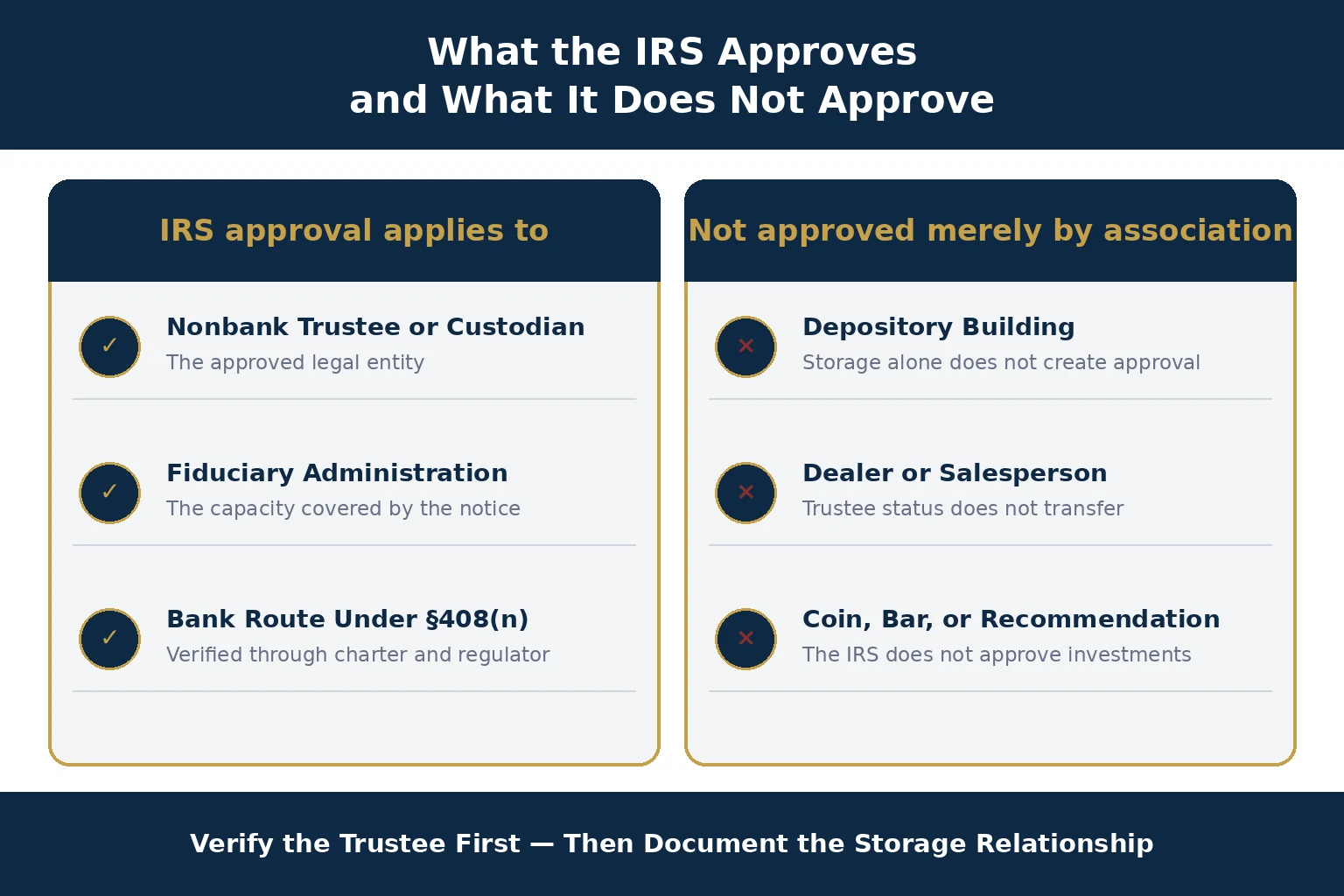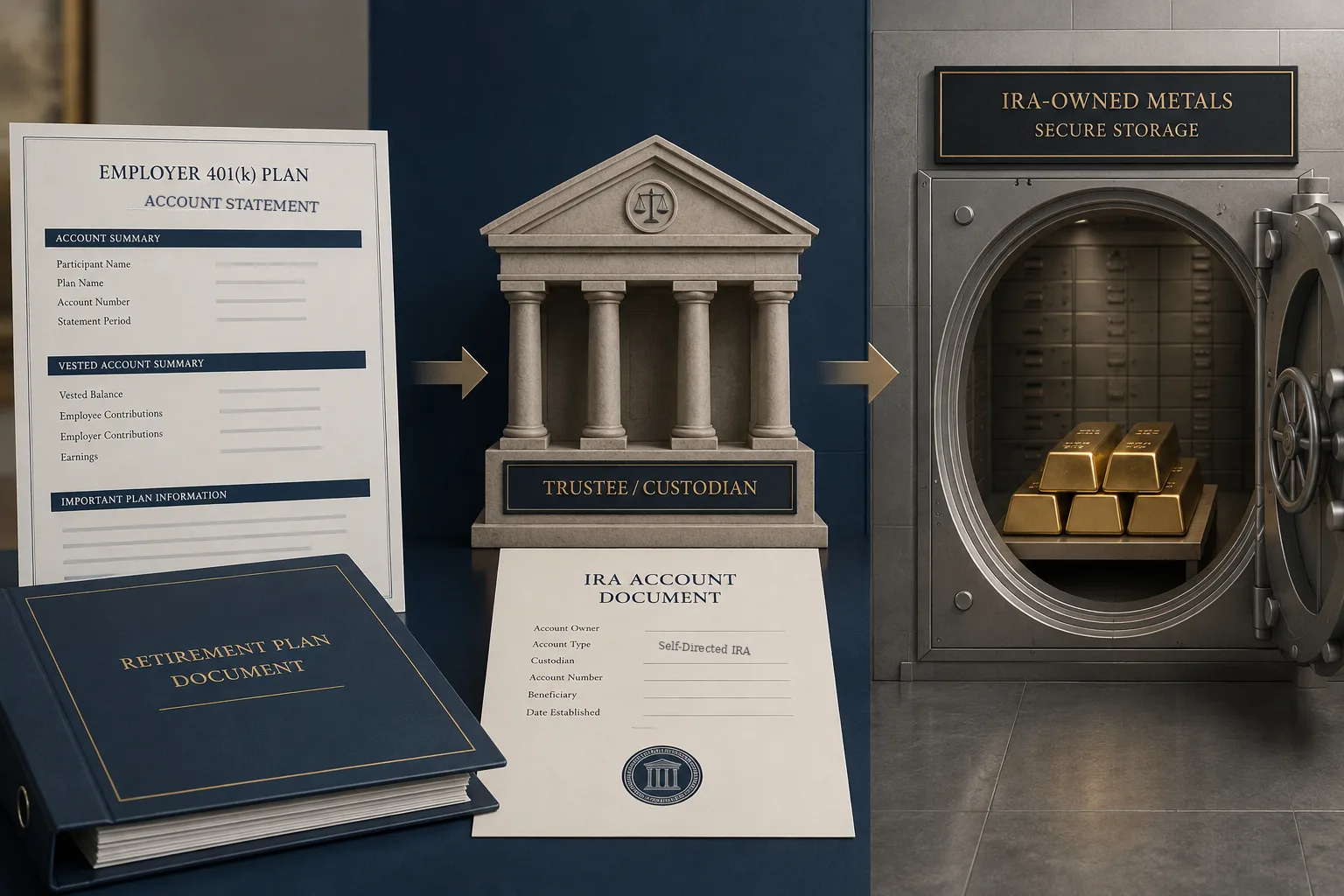
Educational only: This reference explains federal retirement-account tax rules from published statutes, Treasury regulations and IRS guidance. It does not determine what portion of any account is marital property, whether a settlement is fair, or how any reader should divide assets. It is not financial, tax or legal advice. Readers should consult a qualified family-law attorney and a tax professional before signing a settlement or instructing an IRA custodian.
Key takeaways
- A QDRO does not divide an IRA. An IRA described in §408 is excluded from the ERISA Part containing the anti-alienation rule and its QDRO exception.
- The cross-reference is to clause (i) only. A decree of divorce or separate maintenance, or a written instrument incident to such a decree. A standalone separation agreement is in a different clause.
- The transferred interest becomes the recipient's own IRA from the transfer, which is the foundation for everything that follows.
- Payee status decides the tax result. A transfer or redesignation keeps the movement outside the owner's income; a distribution paid to the owner does not.
- There is no divorce exception to the additional tax on an IRA distribution. The QDRO exception applies to employer-plan alternate payees, not to IRA withdrawals.
- Basis survives and must be reported. Where a transfer changes either spouse's traditional IRA basis, both file Form 8606 with an explanatory statement.
- Two points are genuinely unsettled in the primary sources: the Roth five-year clock after a divorce transfer, and how a mid-year required distribution is allocated between former spouses.
Two Different Mechanisms: QDRO for an ERISA-Covered Plan, §408(d)(6) for an IRA
The phrase “divide the retirement accounts” hides two separate federal mechanisms that travel through different institutions and rest on different authority.
A qualified domestic relations order exists because ERISA generally prohibits the assignment or alienation of pension-plan benefits and then creates an exception for a domestic relations order satisfying the statutory requirements (29 U.S.C. §1056(d)), with the parallel definition supplied by IRC §414(p). The plan administrator determines whether a submitted order qualifies.
An IRA sits outside that regime. An individual retirement account or annuity described in §408 is expressly excluded from the ERISA Part that contains the anti-alienation provision (29 U.S.C. §1051). That exclusion is the reason an IRA should not be described as being divided by a QDRO, and the reason its federal tax rule is §408(d)(6) instead.
A note on terminology matters here. The QDRO regime applies to ERISA-covered employer plans. Not every arrangement commonly called an employer retirement plan sits in that regime in the same way — governmental and church plans, for example, are treated differently. This page therefore says “ERISA-covered employer plan” rather than implying every employer plan is identical for this purpose.
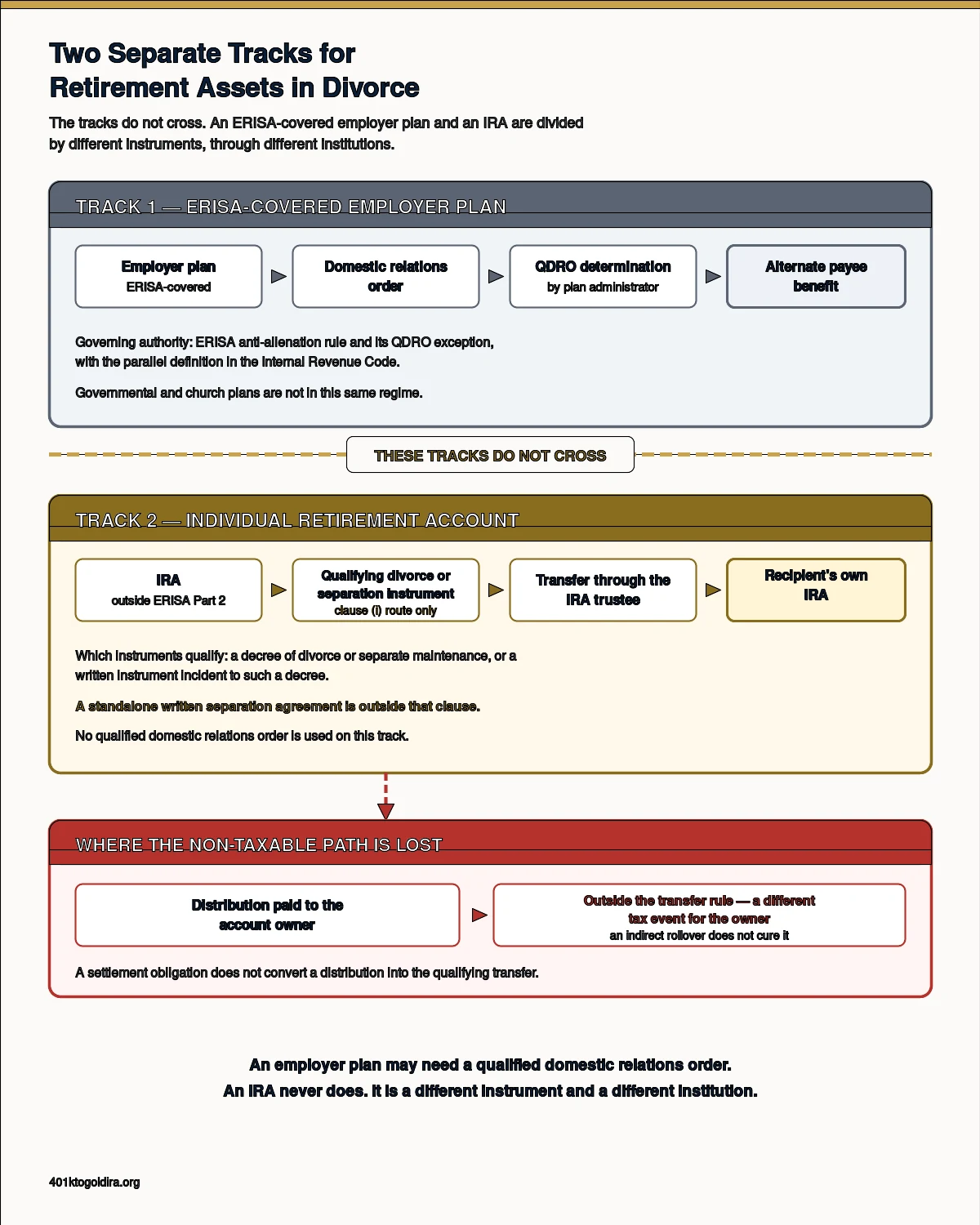
An employer plan may need a qualified domestic relations order. An IRA never does.
When a household holds both kinds of retirement asset
A single divorce can involve both, and the two workstreams run in parallel without merging. The employer-plan side asks whether a domestic relations order satisfies the QDRO requirements and is accepted by the plan administrator. The IRA side asks whether the transfer satisfies §408(d)(6) and whether the custodian has the documents and instructions it needs to execute it. Treating one instrument as covering both is the most common structural error on this topic. The employer-plan mechanics themselves are covered separately in the 401(k) rollover guide.
What §408(d)(6) Requires
The operative text is short, and every element in it carries weight:
The transfer of an individual's interest in an individual retirement account or an individual retirement annuity to his spouse or former spouse under a divorce or separation instrument described in clause (i) of section 121(d)(3)(C) is not to be considered a taxable transfer made by such individual… and such interest at the time of the transfer is to be treated as an individual retirement account of such spouse, and not of such individual.
First, the asset is an interest in an individual retirement account or individual retirement annuity (IRC §408(d)(6)).
Second, the transfer runs to the account owner's spouse or former spouse. The wording is not limited to the period after a final decree.
Third, the transfer is made under a qualifying instrument — and this is the element most often overstated elsewhere.
Fourth, where those conditions hold, the transfer is not treated as a taxable transfer by the transferor, and the interest becomes the recipient spouse's IRA for federal tax purposes.
Which instruments qualify: the cross-reference is to clause (i)
Section 408(d)(6) does not incorporate a general definition of “divorce or separation instrument.” It cross-references clause (i) of §121(d)(3)(C) specifically. That definition has three clauses, and only the first is incorporated:
- Clause (i) — incorporated: a decree of divorce or separate maintenance, or a written instrument incident to such a decree.
- Clause (ii) — not incorporated: a written separation agreement.
- Clause (iii) — not incorporated: a decree not described in clause (i) requiring a spouse to make payments for the support or maintenance of the other spouse.
The practical consequence is worth stating plainly, because a good deal of published material blurs it. A standalone written separation agreement, not incident to a decree, sits in clause (ii) and is therefore outside the cross-reference the IRA transfer rule uses. It should not be assumed sufficient for §408(d)(6) treatment merely because it is a written agreement between separating spouses. Whether a particular document amounts to a written instrument incident to a decree is a legal question for the reader's own attorney on the reader's own facts.
Can the transfer happen before the divorce is final?
Potentially, yes — but the route matters. The statute speaks of a transfer to a spouse as well as a former spouse, so it is not confined to the post-decree period. A decree of separate maintenance falls inside clause (i), as does a written instrument incident to such a decree. Those are the routes that support a pre-final-divorce transfer. A private written agreement that is not incident to a decree is not one of them.
Can only part of an IRA be transferred?
Yes. IRS guidance expressly discusses transferring all or part of an interest in an IRA, and describes moving the affected assets while the remainder stays with the original owner (IRS Publication 590-A; IRS Publication 504). A custodian may still impose its own forms, valuation cutoffs, signature requirements or processing steps. Those are operational requirements, not additional statutory elements.
Whose IRA Is It Afterwards?
Once a qualifying transfer completes, the transferred interest is treated as the recipient spouse's own IRA from the date of the transfer. That ownership change is the foundation for everything downstream: later distributions are analysed as distributions from the recipient's IRA, and the reporting attaching to that interest belongs to the recipient.
The rule should not be stretched past what it settles. It does not itself determine every beneficiary designation, every custodian contract term, or any state-law marital-property consequence.
How the Transfer Is Actually Executed
IRS Publication 590-A identifies two commonly used methods.
Changing the name on the IRA. Where the entire interest is transferred, the account can be redesignated from the transferor's name into the name of the spouse or former spouse.
A direct trustee-to-trustee transfer. The transferor directs the IRA trustee to move the affected assets directly to the trustee of a new or existing IRA for the recipient. Publication 590-A also describes the mirror arrangement, in which the recipient keeps the affected portion in the existing account while the transferor's retained share moves out and the original account is renamed.
Where both parties hold accounts at the same custodian, federal guidance creates no separate tax category. If the custodian moves or redesignates the affected interest under the qualifying instrument without making a distribution to the owner, the transaction is analysed as the direct transfer or redesignation the IRS describes. The internal forms and account numbering are that custodian's procedure.
The Expensive Mistake: Distribution Instead of Transfer
The single most consequential distinction on this topic is between a transfer of the IRA interest and a distribution paid to the account owner.
If the owner withdraws money from a traditional IRA and then pays it to the former spouse, the IRS treats the withdrawal as the owner's distribution, taxable to that owner to the extent it is otherwise includible in income. The divorce obligation does not convert it into a §408(d)(6) transfer (IRS — filing taxes after divorce or separation).
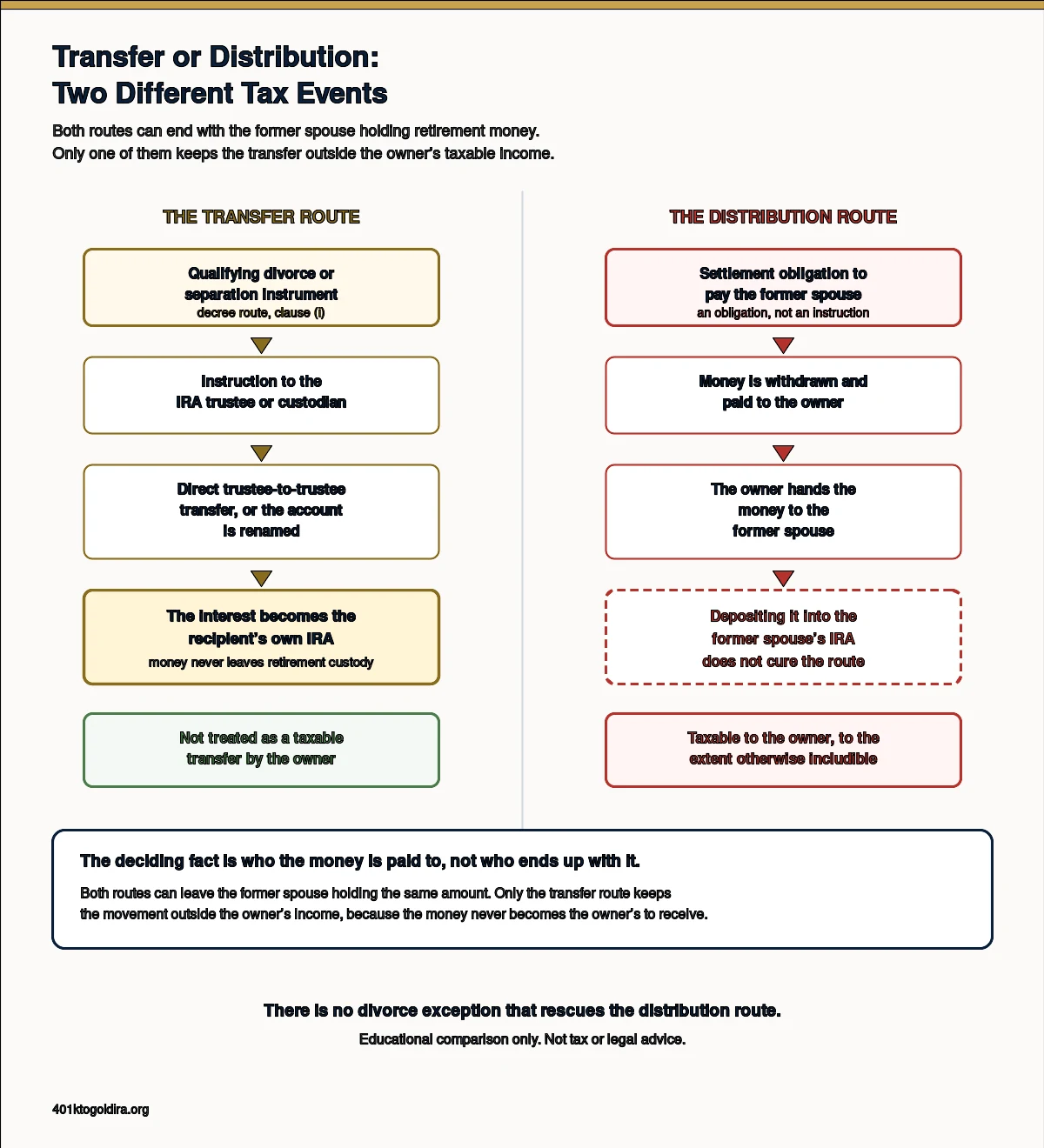
The deciding fact is who the money is paid to, not who ends up with it.
Can a 60-day rollover repair it?
Not as a substitute for the qualifying transfer. The IRS states that an indirect rollover to the former spouse does not qualify as the divorce transfer even where the distributed amount reaches the former spouse's IRA within 60 days (IRS — IRA distributions FAQ). The original owner may have separate rollover rights in respect of a distribution paid to that owner if the ordinary rules are met, but rolling money back into the owner's own IRA does not complete a transfer to the former spouse. That is a different transaction addressing a different problem. The general deadline-miss position is covered on the missed 60-day deadline page.
Is there a divorce exception to the additional tax?
Not for an IRA distribution. IRC §72(t)(2)(C) provides an exception to the additional tax for distributions to an alternate payee under a qualified domestic relations order, which is an employer-plan mechanism. The IRS addresses the IRA position directly and states that, unlike distributions made to a former spouse from a qualified retirement plan under such an order, there is no comparable exception — a withdrawal taken to satisfy a divorce court order can still carry the additional tax where the owner is under 59½ and no other exception applies. The only divorce-related relief for an IRA is the qualifying transfer itself. Related consequences are set out on the early withdrawal penalty page.
What about withholding?
The 20% mandatory withholding rule associated with eligible rollover distributions from employer plans should not be imported into an IRA divorce discussion. An IRA distribution paid to the owner generally carries a default federal withholding rate for nonperiodic payments, and the payee can usually elect a different rate. Withholding is prepayment of tax; it does not determine whether the distribution is taxable.
Basis, Roth Clocks and What the Sources Leave Unsettled
Traditional IRA basis
A traditional IRA can hold after-tax basis from nondeductible contributions. A divorce transfer does not make that basis disappear. The Form 8606 instructions address the point directly: where the transfer changes either spouse's traditional IRA basis, both spouses must file Form 8606, adjust the basis figure and attach a statement explaining the adjustment and the character of the amounts (IRS — Instructions for Form 8606).
That matters because it defeats a common oversimplification. Splitting an account by market value alone ignores tax character, and two halves of equal value can carry unequal after-tax basis. The instructions do not supply a universal allocation formula, so the settlement terms, the account records and the transferred interest need to support whatever allocation the forms report.
Roth IRAs: the transfer, and the open question
Current IRS instructions state that transferring part or all of a Roth IRA to a spouse under a divorce or separation agreement is not taxable to either spouse.
The harder question is what happens to the Roth IRA's five-taxable-year history for qualified-distribution purposes. The Roth regulations contain detailed five-year rules and expressly address how the clock behaves after the owner's death and in a surviving-spouse situation, but the primary sources reviewed for this page do not contain a matching divorce-specific rule stating that a transferor's five-year period carries to the former spouse, restarts, or merges with the recipient's existing Roth history (26 CFR §1.408A-6).
This page therefore does not publish a categorical answer on that point. The defensible statement is narrower: the divorce transfer itself can be non-taxable, while the qualification of a later Roth distribution can require separate analysis of the recipient's own Roth history and the underlying contributions and conversions. A reader in that position should obtain fact-specific advice rather than assume either outcome.
Beneficiary Designations, RMD Timing and Creditor Protection
Required minimum distributions
Treasury regulations state that a trustee-to-trustee transfer is not treated as a distribution for required-minimum-distribution purposes, and that the transferor IRA's minimum-distribution requirement still has to be satisfied (26 CFR §1.408-8). One clear rule follows: moving the assets in a divorce transfer does not itself satisfy the year's required distribution.
What the sources do not supply is a divorce-specific formula allocating a year's required distribution between former spouses when an account is divided mid-year. Anyone at or near required-distribution age should take advice before the assets move, particularly where a substantial share of the account is transferring.
Beneficiary designations
An IRA division changes ownership of the transferred interest, but the federal IRA tax provisions do not supply a universal rule rewriting a beneficiary designation on divorce. The practical position is procedural rather than automatic: both parties should review the designations on the accounts they own after the transfer, because the effect of an existing designation can depend on the account agreement, the terms of any order and applicable non-tax law. The separate rules governing beneficiaries are covered on the beneficiary rules page, and the distinct question of what happens on death is covered in the inherited IRA rules.
Creditor protection after the transfer
Once the transferred interest is the recipient's own IRA, federal bankruptcy law generally recognises retirement funds held in accounts described in §§408 and 408A, and the Bankruptcy Code provides that a qualifying direct transfer does not cease to qualify for that treatment merely because of the transfer (11 U.S.C. §522). That is the federal bankruptcy layer only. Protection outside bankruptcy turns on state exemption law, which varies considerably and which several statutes address specifically for a transferee's or alternate payee's interest. The state-by-state position is recorded in the 50-state creditor protection matrix rather than summarised here.
State Property Law and Federal Tax Treatment Are Separate Questions
A divorce court or settlement determines the parties' property rights under the applicable domestic-relations law of their state, including whether a community-property or equitable-distribution framework applies and what share of an account is marital property. Section 408(d)(6) answers a different question entirely: whether the federal tax treatment of a transfer qualifies for non-recognition.
Keeping those apart matters in practice. A settlement can specify an amount or percentage to be transferred while the tax law independently determines whether the movement of that amount qualifies. This page does not address state characterisation, and no general page should: that is a question for counsel on the reader's own facts and forum.
If the IRA Holds Physical Precious Metals
Section 408(d)(6) applies to the IRA interest. Nothing in the statute creates a different divorce-transfer standard because an account holds bullion rather than securities, and there is no separate “metals IRA divorce” category in federal tax law.
What changes is operational rather than legal:
- holdings may need a defensible valuation where a decree awards a percentage or a dollar-equivalent share;
- a custodian may or may not be able to divide specific bars or coins in kind;
- the order and the custodian's process together determine whether particular assets are transferred, sold or retained;
- any in-kind movement has to remain inside the IRA custody structure rather than becoming a personal distribution; and
- title and storage records need to remain consistent with the receiving account's custody arrangement.
Two points deserve stating plainly. The federal sources reviewed do not require liquidation of precious metals before a divorce transfer, and they do not guarantee that any particular custodian or depository can execute an in-kind split. Both are questions for the institutions involved. The underlying account structure is explained in the precious metals IRA reference.
Documents Checklist: Statutory Condition Versus Custodian Procedure
The useful distinction here is not important versus unimportant. It is statutory condition versus processing requirement. A custodian's form can be essential to getting a transfer completed without being a requirement written into §408(d)(6).
Federal tax conditions to establish
- The asset is an interest in an IRA or individual retirement annuity.
- The recipient is the spouse or former spouse.
- The transfer is made under a qualifying instrument within clause (i): a decree of divorce or separate maintenance, or a written instrument incident to such a decree.
- The movement is executed as a transfer or redesignation, not as a distribution paid to the owner.
Documents a custodian may request
- A certified copy of the decree or the relevant instrument.
- A transfer instruction on the custodian's own form.
- An account application for the recipient, where a new account is required.
- Signature verification, notarisation or a medallion guarantee.
- Valuation instructions and an asset schedule, particularly where assets are not cash.
Those are institution-specific requirements unless the custodian identifies a separate legal basis for them.
Frequently Asked Questions
Is an IRA split in divorce taxable?
It can be non-taxable when the IRA interest is transferred to a spouse or former spouse under a qualifying divorce or separation instrument and the transaction is executed as the §408(d)(6) transfer rather than as a withdrawal. A distribution paid to the account owner is a different transaction and is generally taxable to that owner to the extent otherwise includible in income.
Do IRAs need a QDRO in divorce?
No. A qualified domestic relations order is the federal mechanism used for ERISA-covered employer-plan benefits. An individual retirement account described in §408 is excluded from the ERISA Part that contains the anti-alienation rule and its QDRO exception, so an IRA is divided under IRC §408(d)(6) instead.
Which divorce documents actually qualify under section 408(d)(6)?
Section 408(d)(6) cross-references clause (i) of §121(d)(3)(C) specifically. That clause covers a decree of divorce, a decree of separate maintenance, or a written instrument incident to such a decree. The other clauses of that definition, which cover a standalone written separation agreement and certain support or maintenance decrees, are not part of the cross-reference the IRA transfer rule uses.
Can an IRA be transferred before the divorce is final?
Potentially. The statute speaks of a transfer to a spouse or former spouse, so it is not limited to the period after a final divorce decree, and a decree of separate maintenance falls inside the clause (i) definition. A written instrument incident to such a decree can also qualify. A private agreement that is not one of those instruments should not be assumed sufficient.
Can only part of an IRA be transferred to a former spouse?
Yes. IRS guidance expressly discusses transferring all or part of an interest in an IRA, and describes moving the affected assets directly to a new or existing IRA for the spouse or former spouse. A particular custodian can still impose its own forms, valuation cutoffs and processing procedures, which are operational requirements rather than additional statutory conditions.
Can the account owner withdraw the money and give it to the former spouse?
That is not the same as a §408(d)(6) transfer. The withdrawal is generally treated as the owner's own distribution with the ordinary tax consequences that follow, and a settlement obligation does not convert a distribution into the qualifying transfer.
Can the former spouse deposit the withdrawn money into an IRA within 60 days?
The IRS states that an indirect rollover to the former spouse does not qualify as the divorce transfer even when the amount is deposited within 60 days. That route does not repair a distribution that has already been paid to the account owner.
Does the QDRO early-distribution exception apply to an IRA divorce payment?
No. IRC §72(t)(2)(C) provides an exception for distributions to an alternate payee under a qualified domestic relations order, and the IRS states plainly that there is no comparable exception for an IRA distribution taken to satisfy a divorce court order. The IRA-specific relief is the qualifying transfer itself.
What happens to nondeductible traditional IRA basis?
Basis does not disappear on a divorce transfer. Current Form 8606 instructions state that if the transfer changes the traditional IRA basis of either spouse, both spouses must file Form 8606, adjust the basis figure and attach a statement explaining the adjustment and the character of the amounts.
Does transferring the IRA satisfy the year's required minimum distribution?
No. Treasury regulations state that a trustee-to-trustee transfer is not treated as a distribution for required-minimum-distribution purposes, and that the transferor IRA's minimum-distribution requirement still has to be satisfied. Anyone at or near required-distribution age should obtain fact-specific tax advice before the assets move.
Bottom Line
The federal framework is mechanical rather than discretionary. An ERISA-covered employer plan and an IRA can both be divided in the same divorce, but they travel on separate tracks: the plan may require a qualified domestic relations order, while the IRA relies on §408(d)(6), a qualifying instrument within clause (i), and a transfer or redesignation that keeps the transaction from becoming a distribution to the owner.
The transfer is only part of the file. Traditional IRA basis, Roth history, required-distribution timing, beneficiary designations, state property law and any alternative-asset logistics each warrant separate review, and two of those points are not settled by the primary sources at all. Where the answer is unsettled, the appropriate response is fact-specific advice rather than an assumption in either direction.
Terms used in this guide are defined in the gold IRA glossary. For the employer-plan side of a division, see the 401(k) rollover guide, and for which source accounts can move where, the rollover eligibility matrix.
This page is educational and does not determine marital property rights, the fairness of any settlement, or the right division for any reader. Tax and legal outcomes depend on individual circumstances and on the law of the reader's own state, and rules change. Readers should consult a qualified family-law attorney and a tax professional before signing a settlement or instructing a custodian. Past performance does not guarantee future results.