Gold IRA Quote Checklist: 15 Things to Verify Before You Commit
A practical checklist for comparing Gold IRA quotes before an account is funded: fees, storage, metals, buyback terms, provider records, rollover mechanics, and written documentation.
Open the Checklist →
Affiliate disclosure: Some links on this page may be sponsor links. The site owners may be paid if customers request information from companies mentioned here. This checklist is a research tool, not financial, tax, or legal advice. Customers should speak to a financial or tax advisor before making decisions. Past performance does not guarantee future results.
Key figure
Of the fifteen points below, only three appear on a published fee schedule. The rest exist only in a written quote a buyer has to request.
Derived by testing each checklist point against published custodian and depository schedules. CFTC and FINRA guidance directs investors to obtain pricing terms in writing.
Key takeaways
- Most of what determines the cost of a precious metals IRA is not on any published schedule. Custodian and storage charges are published; the dealer premium, the buyback terms and the shipping responsibilities generally are not.
- The premium is the figure to extract, and it is calculable without cooperation: the written price per unit against the metal’s value at the quoted spot reference gives it as a percentage.
- A quote is only comparable between providers when the storage charge is stated at the expected balance, because a percentage-based fee and a flat fee cannot be compared in the abstract.
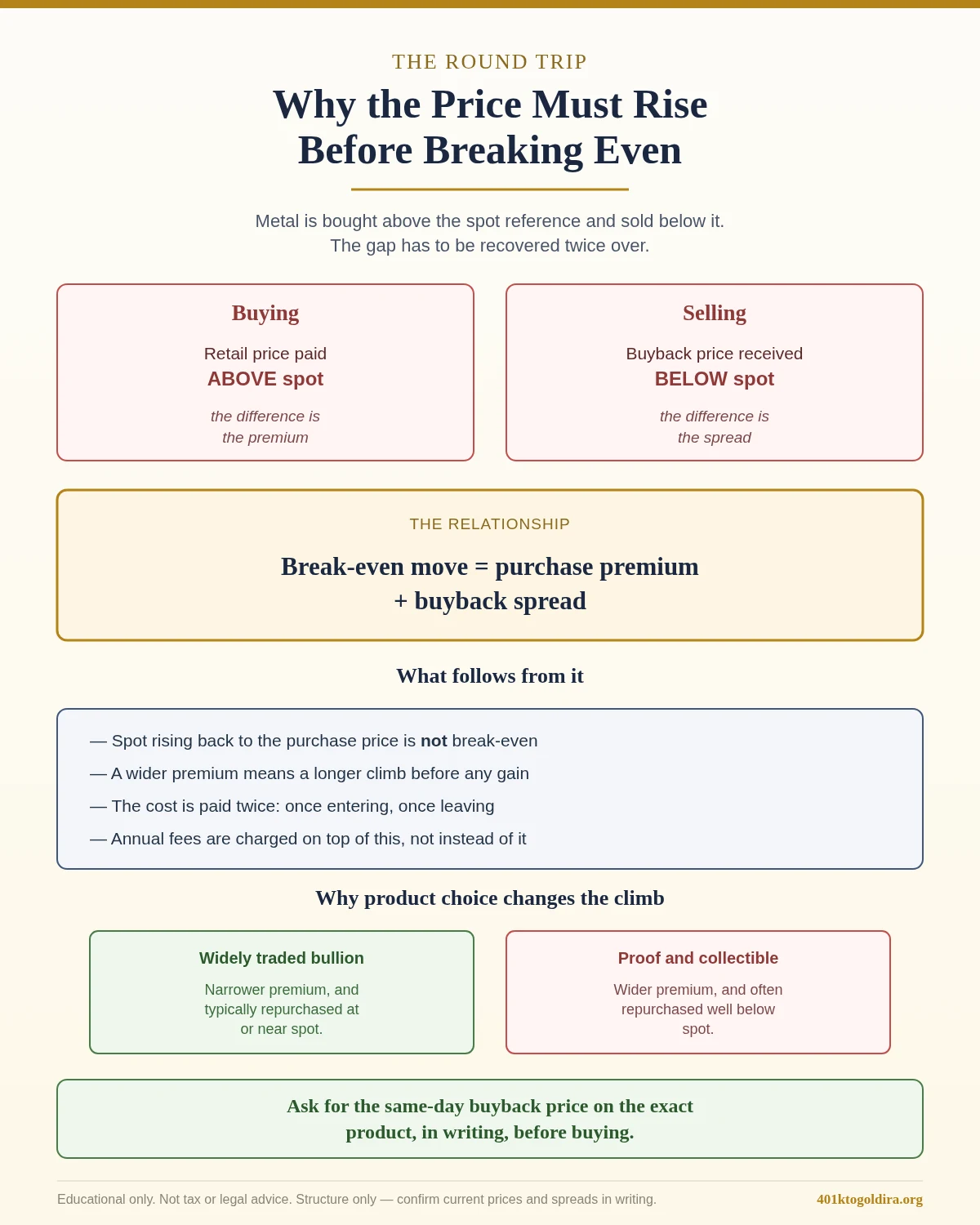
- Returning to the purchase price is not break-even. The entry premium and the exit spread must both be recovered, which is why buyback terms belong in the packet rather than in a later conversation.
- A promotion has a funding source. Asking how free metal is paid for usually moves the conversation to the spread on the accompanying purchase.
- Regulator guidance from the CFTC and FINRA directs investors to obtain pricing, spread, commission, storage and administrative terms in writing. A packet that cannot be assembled before funding is itself an answer.
Why a Quote Checklist Matters
A Gold IRA quote can look simple on the surface, but the actual cost depends on more than one number. Setup fees, annual custodian fees, storage, dealer spreads, eligible metals, promotions, and exit terms can all affect the account. This checklist helps customers compare written quotes before committing funds.
Compare providers side by side first
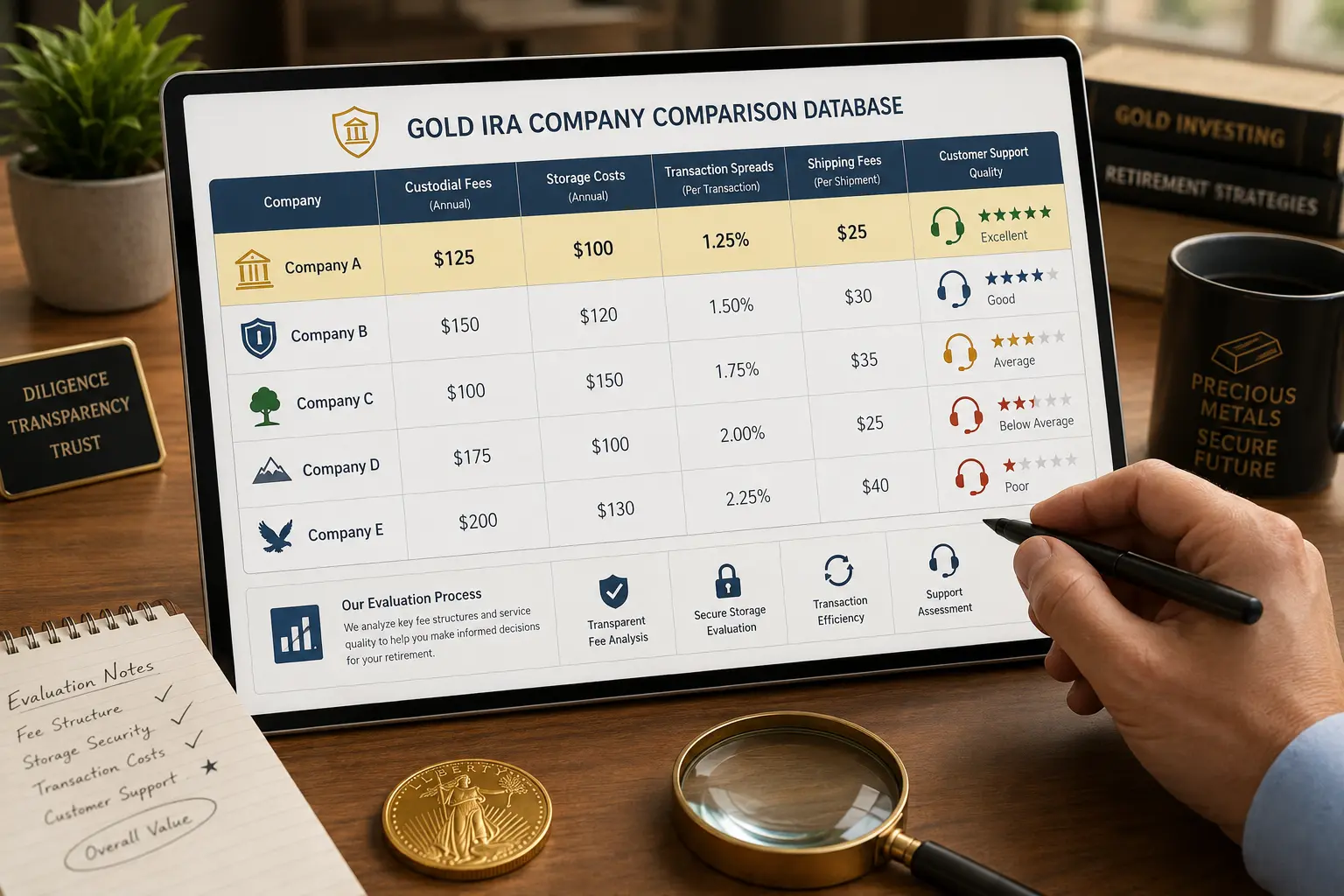
Before requesting quotes, review the public company database for minimums, BBB records, fee notes, storage notes, and buyback-policy prompts.
Open the Company Comparison Database →The 15-Point Gold IRA Quote Checklist
Print this page or keep it open during provider calls. Each item should be answered in writing before funds move.
- 1. Account eligibility
Confirm whether the existing IRA, 401(k), TSP, 403(b), SEP IRA, or other retirement account can be moved without creating a taxable event.
A satisfactory answer: A named plan type with a stated reason, not a general assurance that everything is eligible.
- 2. Direct rollover path
Ask whether the process uses a direct trustee-to-trustee transfer or rollover whenever possible, instead of an indirect rollover with a 60-day clock.
A satisfactory answer: Confirmation that funds move trustee to trustee, with the indirect route and its 60-day exposure explained rather than skipped.
- 3. Provider minimum
Confirm the minimum IRA amount in writing before starting paperwork.
A satisfactory answer: A figure in writing. A minimum quoted verbally and then revised upward after paperwork begins is the pattern to watch for.
- 4. Setup fee
Ask whether there is a one-time setup, application, wire, or account-opening fee.
A satisfactory answer: An amount and the trigger for it, including whether a wire fee applies on the way in and on the way out.
- 5. Annual custodian fee
Identify the IRA custodian and the annual administration cost.
A satisfactory answer: The custodian named as a separate legal entity, with its own published schedule, not folded into a single all-in number.
- 6. Storage fee
Confirm the depository, annual storage cost, and whether the quote is flat-fee or percentage-based.
A satisfactory answer: The depository named, and the charge stated at the expected balance, because a percentage-based fee cannot be compared without the balance.
- 7. Segregated vs commingled storage
Ask which storage type is used, what it costs, and whether it changes liquidation or delivery options.
A satisfactory answer: Which model applies, the price difference, and whether it changes what is returned on an in-kind distribution.
- 8. Dealer spread or markup
Request pricing against spot price and ask how the buy/sell spread is calculated.
A satisfactory answer: The spot reference used, the price per unit, and the resulting premium as a percentage. This is the figure that is embedded rather than billed.
- 9. IRS-eligible metals
Confirm that every coin or bar meets IRA eligibility rules and avoid collectible or numismatic coins inside the IRA.
A satisfactory answer: The specific product tested against the statutory standard, rather than an assurance that the product is approved.
- 10. Promotion terms
If free silver or another promotion is offered, ask how the value is funded and whether spreads or fees are affected.
A satisfactory answer: How the promotion is funded. Free metal has a source, and it is normally the spread on the accompanying purchase.
- 11. Buyback policy
Request written terms covering process, price determination, fees, settlement timing, and whether buyback is guaranteed or discretionary.
A satisfactory answer: Written terms covering how price is determined, what it costs and when it settles, plus whether the buyback is a commitment or a stated intention.
- 12. Shipping and insurance
Confirm who pays for shipping, insurance, delivery, and liquidation-related logistics.
A satisfactory answer: Who pays on entry, on exit, and on an in-kind distribution, with insurance during transit stated explicitly.
- 13. Complaint record
Review BBB profile, complaint themes, response patterns, and public records before funding.
A satisfactory answer: Complaint themes and responses read directly at the source, rather than a rating quoted by the company selling the account.
- 14. Tax-advisor review
Have a qualified advisor review rollover, distribution, RMD, and beneficiary implications before funds move.
A satisfactory answer: An advisor who is not compensated by the transaction reviewing rollover, distribution, RMD and beneficiary consequences.
- 15. Written quote packet
Keep the quote, fee schedule, account forms, depository details, and buyback policy together before signing.
A satisfactory answer: Every document above, together, before funds move. A packet that cannot be assembled is itself an answer.
Questions to Ask Before Funding
- Which fees are one-time, and which fees repeat every year?
- Which custodian and depository will be used?
- How is metal pricing calculated against spot price?
- What happens if the customer needs to liquidate part of the account later?
- Is every promise included in the written quote packet?
What to Keep in the Quote Packet
The customer should keep a copy of the provider quote, custodian paperwork, depository disclosure, fee schedule, eligible-metals list, promotion terms, and buyback-policy language. If any piece is missing, the quote is not ready for comparison.
Two free tools to compare what you collect
Once quotes are in hand, score each company against 18 research signals with the Due Diligence Scorecard, then line up the numbers in the Dealer Comparison Worksheet. Both are educational, free, and run in the browser.
Open the Comparison Worksheet →When to Pause
Customers should slow down when a quote relies on urgency, does not show fees in writing, emphasizes promotional metals without explaining spreads, recommends collectible coins inside an IRA, or treats tax guidance as if it came from a qualified tax advisor.
How "Best Company" Rankings Can Mislead
Many Gold IRA "best company" pages and evaluation-standard articles read like independent research but are advertorials — paid or affiliate-driven placements presented in an editorial style. A written quote packet is more reliable than any ranking, because it comes from the company itself and can be checked against public records. When reading any ranking page, a few tests separate genuine analysis from marketing:
- Advertorial vs. independent. A ranking that earns a commission on sign-ups has an incentive the reader should know about. The Federal Trade Commission's endorsement guidance explains that material connections between a reviewer and the companies reviewed should be clearly disclosed (Federal Trade Commission — Endorsement Guides). A page with no visible disclosure, or one that ranks only companies it links to for commission, should be read as marketing rather than neutral research.
- Dealer claims vs. custodian and depository documents. A ranking often repeats a company's own "low fee" or "free storage" claim. Those are dealer statements, not custodian or depository schedules — and the actual charges live in the custodian's dated fee schedule and the depository's storage terms, not in the ranking.
- Published methodology vs. unexplained scoring. A trustworthy comparison states how it scored each company and against what criteria. A numbered list with no published method — no explanation of why one company sits above another — is an opinion, not a measurement.
- Current public records vs. promotional statements. Ratings, complaint counts, and enforcement records change and should be checked directly and dated. A promotional statement is not a substitute for the current BBB profile, the state regulator record, or the company's own dated disclosure.
Regulators warn that precious-metals sales can involve high-pressure tactics and inflated markups, and recommend obtaining all costs and terms in writing before committing (CFTC — Precious Metals Fraud). The strongest response to any ranking is the written quote packet this checklist assembles: it lets a reader verify the specific numbers for the specific account, rather than relying on a page whose scoring method and incentives may be unstated.
Methodology
Each checklist point was tested against two questions: whether the figure appears on a schedule a buyer can read without contacting the company, and what form of answer would let a buyer compare one provider against another. Points were drawn from published custodian and depository fee schedules, dealer disclosure documents, and CFTC and FINRA investor guidance on obtaining pricing terms in writing. The “satisfactory answer” column describes the form of a usable answer rather than any particular provider’s terms, because the same charge appears under different names across providers and a figure quoted without its basis cannot be compared. Schedules and terms change without notice and should be confirmed in writing directly with the provider and the named custodian before funds move.
How to cite this checklist
A fifteen-point verification checklist for a precious metals IRA quote, recording for each point the item to verify, the question to ask, and what a satisfactory written answer looks like, compiled from published custodian and depository fee schedules and CFTC and FINRA investor guidance. Compiled by 401ktogoldira.org. https://401ktogoldira.org/gold-ira-quote-checklist/
Article reviewed and edited by Daniel — independent precious-metals retirement researcher. Updated July 2026 with guidance on reading "best company" ranking methodologies.