How 401(k) Rollovers Are Actually Delivered: Sent Directly to Your New Plan, or a Check You Have to Forward
Choosing a direct rollover settles the tax treatment. It does not settle how the money travels. In a nationally representative federal survey, a large minority of participants who completed a direct rollover were handed a check and had to deliver it themselves, and no federal rule sets a deadline for the old plan to finish the job. This page assembles what the primary sources actually say, keeps routing and rails apart, and separates what the IRS has issued from what it has only proposed. Customers should speak to a financial or tax advisor before making decisions.

Educational only: This page reports published federal statistics and quotes federal guidance from named primary sources. It does not state what any individual plan will do, and it is not financial, tax or legal advice. Only the plan administrator can confirm how a particular plan delivers a rollover. Readers should speak to a financial or tax advisor before making decisions about their own account.
nearly 30 percent of 401(k) participants who completed a direct rollover received a check payable to the new plan that they had to forward to the new plan themselves, in GAO's survey.
Source: U.S. Government Accountability Office, GAO-24-103577 (January 2024), p. 66. Margin of error plus or minus 10 percentage points. GAO's own wording is “nearly 30 percent”, and it is not rounded to a precise figure here. Observed 30 September 2026. S1
Key takeaways
- nearly 60 percent — the share of 401(k) participants whose old plan sent their savings directly to the new plan, per GAO's survey. “Sent directly” is a routing category that includes a check mailed straight to the receiving plan; it is not a measure of electronic transfer. S1
- none specified — plans are not required to process distribution requests within a specified time frame, per GAO. The 60-day rollover clock binds the participant, not the plan. S1
- permitted — current Treasury regulations (§1.401(a)(31)-1, Q&A-4) permit a plan to complete a direct rollover by giving the participant a check made payable to the new plan's trustee or custodian, as restated in IRS Notice 2026-49. S2
- optional — IRS Notice 2026-49 (August 2026) issued sample rollover forms and a standardized procedure under SECURE 2.0 section 324. Their use is optional and carries no safe harbor. S2
- under consideration — Treasury and the IRS are considering, but have not issued, guidance to remove Q&A-4 (which allows paper checks to be sent to participants) and to require rollovers by electronic transfer or by check sent directly to the receiving plan. S2
- October 23, 2026 — deadline for public comments on Notice 2026-49, including on whether to end checks to participants. S2
- 3 days — in Australia, a retirement account transfer is completed generally within 3 days as legally required, per GAO's international comparison. A comparator only; not evidence of what U.S. plans must do. S1
When you move an old 401(k) to a new plan or an IRA and choose a direct rollover, you might assume the money travels from one institution to the other without you touching it. Often it does. But in a nationally representative survey by the U.S. Government Accountability Office, nearly 30 percent of participants who completed a direct rollover instead received a check payable to the new plan and had to forward it themselves S1. GAO's estimate for the other route, the old plan sending the savings directly to the new plan, was nearly 60 percent.
That check is not a mistake and not an indirect rollover. It is a lawful way to complete a direct rollover: current Treasury regulations state that “a trustee of a plan may accomplish a direct rollover by providing a distributee with a check made payable to the trustee” of the receiving plan S2. What federal rules do not do is set a time limit for the old plan to act. In GAO's words, “Plans are not required to process distribution requests within a specified time frame.” S1
This page compiles what the primary sources actually say: GAO's measured delivery split and its limits, the regulation that permits the check route, the absence of a federal completion deadline, and the IRS notice issued in August 2026 that proposes, but does not yet require, ending checks to participants. Comments on that notice close on October 23, 2026. If you are planning a move to an IRA, the practical question to ask your old plan is in the checklist near the end.
What Did GAO Measure About How Rollovers Are Delivered?
| GAO survey estimate (direct rollovers) | Value | Source |
|---|---|---|
| Old plan sent savings directly to the new plan | nearly 60 percent | S1 |
| Participant received a check payable to the new plan and had to forward it | nearly 30 percent | S1 |
| Survey responses analyzed | 1,043 | S1 |
| Respondents who had completed a rollover | 551 | S1 |
| Margin of error, 95 percent confidence | plus or minus 10 percentage points | S1 |
| Weighted response rate | 3.8 percent | S1 |
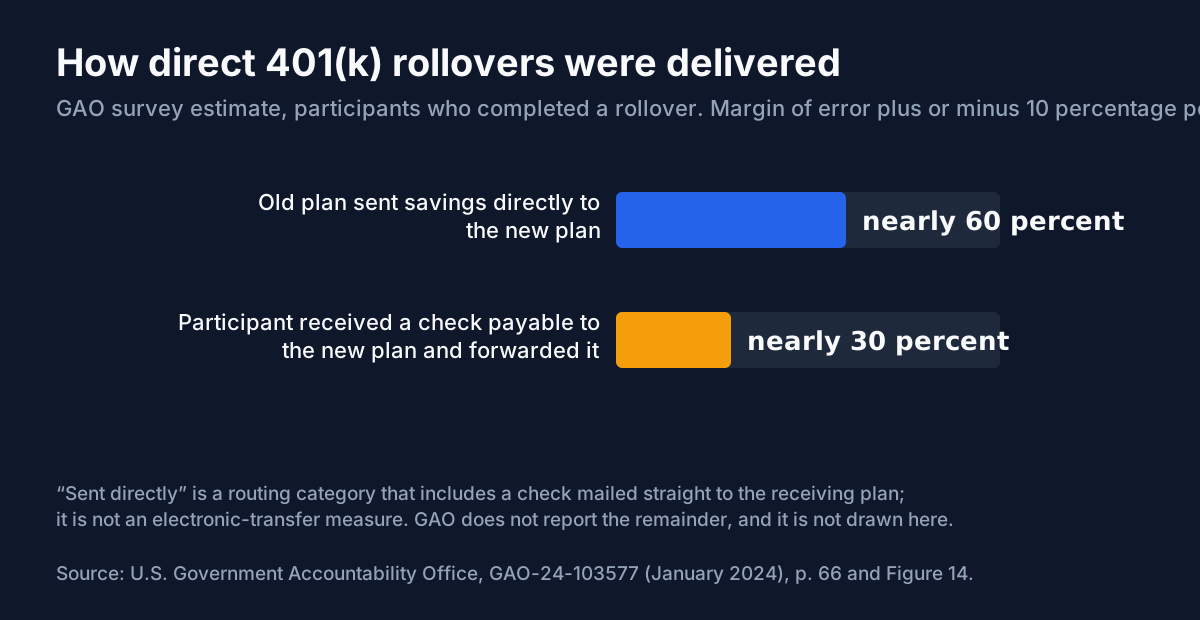
nearly 30 percent of participants who completed a direct rollover received a check payable to the new plan and had to forward it themselves, in GAO's survey. The margin of error is plus or minus 10 points. S1
Two things about this estimate matter as much as the numbers. First, GAO defines the routes by who handles the money, not by how it moves. Its definition of a direct rollover is completed by either “(1) sending the funds directly to the new employer’s retirement plan or to an IRA, or (2) mailing the separated participant a check made payable to the new plan or IRA, and that the participant then has to deliver to the new plan or IRA.” S1 A check mailed straight from the old plan to the new one counts as “sent directly.” So the nearly 60 percent is not a measure of electronic transfer, and this page does not treat it as one.
Second, GAO's survey instrument does include a question asking whether the money went by paper check or by electronic transfer, but the report publishes no result for it. The specific question wording behind the split is not reproduced in the report's appendix either. This page therefore relies on GAO's published result, its definition, and its stated methodology, and makes no claim that depends on wording that could not be verified. The same survey found that “about a quarter of 401(k) participants who recently completed a plan-to-plan rollover would have wanted their plans’ rollover process to be standardized” S1.
Is a Check Payable to Your New Plan a Real Direct Rollover?
| Rule or definition | Value | Source |
|---|---|---|
| Direct rollover by check payable to the new plan's trustee, under Treas. Reg. §1.401(a)(31)-1 Q&A-4 | permitted | S2 |
| Indirect rollover: participant's deadline to redeposit | 60 days | S1 |
| Indirect rollover: mandatory withholding on the amount paid to the participant | 20 percent | S1 |
60 days is the participant's window to complete an indirect rollover. It is the participant's clock, not the plan's; no comparable federal clock applies to the old plan's processing. S1
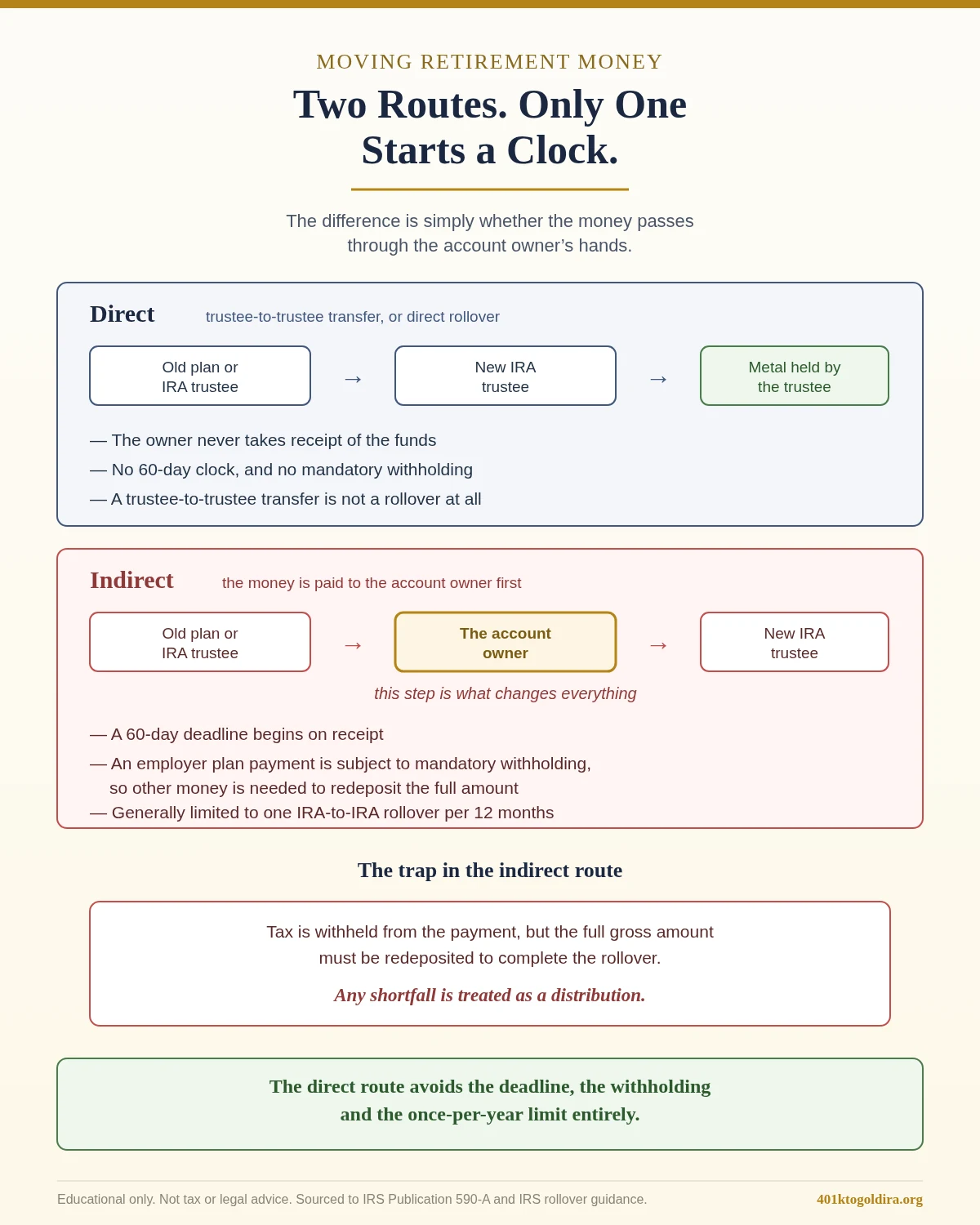
The distinction between the two kinds of check decides the tax outcome. A check payable to the new plan for your benefit is a direct rollover: no withholding, no 60-day deadline on you, and nothing to report as income, provided it reaches the new plan. A check payable to you is an indirect rollover: the plan must withhold 20 percent, and you have 60 days from receipt to deposit the full amount, including the withheld portion from your own funds, or the shortfall becomes a taxable distribution S1. Readers who have already missed that window can find the relief routes for a late rollover on this site.
The practical difference between the two direct-rollover routes is time and handling. GAO describes it plainly: “A participant’s savings may linger in the process for weeks given the time it takes a service provider to prepare and send a paper check by mail to the participant, who then needs to deliver it to the receiving plan.” S1 No public source measures that delay with a defensible method, and this page does not state a typical duration.
Is There a Federal Deadline for a Plan to Complete Your Rollover?
| What GAO reports | Value | Source |
|---|---|---|
| Federal requirement to process distribution requests within a specified time frame | None stated | S1 |
| Federal requirement to complete the rollover within a specified period or send savings electronically | None stated | S1 |
| Providers allowed to send rollover checks to participants | Yes, per GAO | S1 |
| Australia: transfer completed, as legally required (comparator only) | 3 days | S1 |
3 days is how long an Australian retirement account transfer generally takes, as legally required there, in GAO's international comparison. This is a comparator, not a statement of what U.S. plans must do. S1
This is the supporting fact that explains the first one. Because no federal rule sets a completion timeframe or requires direct delivery, the choice of route sits with the old plan's service provider. GAO reports what officials told it about why: “Treasury and IRS officials previously told us that plan service providers often choose to send direct rollover distribution checks to participants, rather than to the receiving plan, because it is easier for the service provider.” S1 It also reports a blunter account from providers themselves: “several service providers told us that because it is not in the interests of most service providers to release funds to another service provider, they may not process plan-to-plan rollover requests in a timely manner.” S1 Both are GAO's account of what it was told, and this page attributes them that way.
The precise claim here is narrow. Federal law regulates a great deal about rollovers: which distributions are eligible, what must be withheld, what a plan may reasonably require before it processes a direct rollover election, and how long the participant has on an indirect rollover. What is absent is a specified deadline for the plan to complete the transaction and a requirement to deliver electronically. GAO's international table lists Australia at 3 days as legally required, alongside longer statutory limits in Belgium and Denmark; it is useful context for what a deadline can look like, not evidence that U.S. plans are failing a standard that does not exist. Anyone comparing an employer plan with a self-directed IRA's distribution rules should keep that separation in mind.
What Does IRS Notice 2026-49 Change, and What Is Only Proposed?
| Category | What it says | Source |
|---|---|---|
| Current law: direct rollover by check to the participant, payable to the new plan's trustee (Q&A-4) | permitted | S2 |
| Issued August 2026: sample forms and procedure under SECURE 2.0 section 324 | optional | S2 |
| Issued: safe harbors attached to the sample forms | None currently | S2 |
| Issued: fallback when electronic transfer is unavailable | Check payable to the receiving plan, sent directly there | S2 |
| Under consideration: remove Q&A-4, ending paper checks sent to participants | under consideration | S2 |
| Under consideration: require electronic transfer or check sent directly to the receiving plan | under consideration | S2 |
| Effective date of any such future guidance | Not until systems can be changed | S2 |
| Comment deadline | October 23, 2026 | S2 |
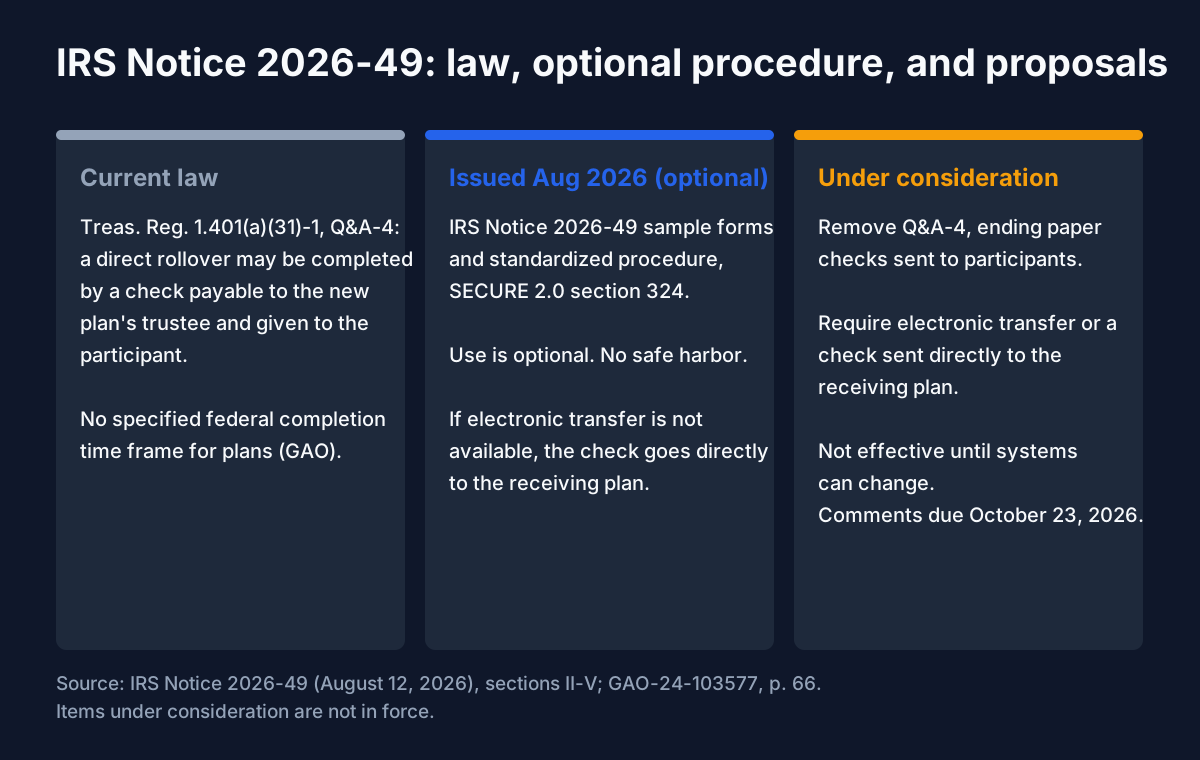
October 23, 2026 is the deadline for public comments on Notice 2026-49, including on whether to end direct-rollover checks sent to participants. Docket IRS-2026-0100 on regulations.gov. S2
The notice's own procedure shows the direction of travel. Where a plan uses the sample forms, electronic transfer is the preferred route, and if that is not available, “the distributing plan is directed to make the check payable to the participant’s receiving plan ‘for the benefit’ of the participant and to mail or send the check directly to the receiving plan.” S2 In other words, even the optional procedure keeps the check out of the participant's hands. But the notice is explicit that plans may keep their existing procedures, and that no safe harbor rewards adoption: “The Treasury Department and the IRS are not currently providing safe harbors based on the use of the sample forms and proposed rollover procedures.” S2 It is equally explicit that “any such guidance would not be effective until administrators and trustees have been given sufficient time to implement changes to their systems to comply with such guidance.” S2
Trade coverage has tended to compress this into a claim that the IRS proposes rules for quicker electronic rollovers. The accurate reading is that the IRS has issued optional forms now and asked whether to require electronic or direct-to-plan delivery later. One more figure from the notice deserves its label: Treasury's statement that “checks are over 16 times more likely to be lost, stolen, altered, or delayed than electronic payments.” S2 That is a general statistic about payments, cited from Treasury's payments-modernization work. It is not a 401(k) rollover statistic, and it is context for why the question is being asked, not evidence about rollovers. Readers deciding between an IRA and a new employer plan, or working through the mechanics of a direct 401(k) rollover, should know that the destination does not change which of these rules applies to the sending plan.
What to Ask Your Old Plan Before You Start
What this means if you are about to roll over. The route your old plan uses is its choice, and no federal rule requires it to send the money directly or to finish by a set date. Get the answers below in writing before you submit the request; they come from your plan, not from this page.
Ask the old plan's administrator or recordkeeper:
- Will you send the funds directly to my new plan or IRA, or mail a check?
- If a check: is it payable to my new plan's trustee for my benefit, or payable to me?
- If a check: is it mailed to me or to the receiving plan?
- Is an electronic transfer available, and what does the receiving plan need to accept one?
- What is your own stated processing time, and what does it cover?
Confirm with the new plan or IRA custodian:
- How they accept a rollover check (mail, branch, mobile deposit) and any coding they require
- Whether they will accept a check payable to them but mailed to you
This checklist does not state what your plan will do. Only the plan can answer that.
Methodology and Limitations
This page's central estimate comes from GAO-24-103577 (January 2024), a U.S. Government Accountability Office report whose web survey of 1,043 participants (551 who completed a rollover and 492 who did not) is generalizable to U.S. 401(k) participants eligible to complete a rollover within the prior three years, with a margin of error of plus or minus 10 percentage points at 95 percent confidence and a 3.8 percent weighted response rate. GAO's estimate measures how a direct rollover was delivered (sent directly to the new plan, or a check payable to the new plan that the participant forwarded); it does not measure electronic versus paper transfer, and this page does not convert it into one. The specific survey question behind the estimate is not reproduced in the report's appendix, so the page relies on GAO's published result, its Figure 14 definition, and its stated methodology, and makes no claim that depends on unverified wording.
Regulatory statements are taken from IRS Notice 2026-49 (August 12, 2026), read from the IRS PDF, with current law, issued-and-optional guidance, and guidance under consideration kept separate throughout. A vendor survey reporting a paper-check share was reviewed and excluded: it uses a different population and event definition and cannot be combined with GAO's estimate. Fifteen recordkeepers' public pages were checked for statements about outbound delivery method; none of the nine reachable disclosed one and six were blocked from the research host, so no claim about provider disclosure is made. A 2025 newspaper article on the topic could not be obtained and is not cited. No public source measures rollover duration with a defensible method, so no typical duration is stated. Every figure and quotation was checked against the live source document by an automated verifier that matches quoted wording verbatim. Nothing here is tax or legal advice.
- Sources consulted: 24; sources cited: 2.
- Data range: GAO fieldwork within a November 2019 to January 2024 audit; IRS notice August 2026.
- Research date: 30 September 2026. 41 of 41 figures verified against live primary documents; 25 quotations matched verbatim.
- Update schedule: re-check after the Notice 2026-49 comment period closes (23 October 2026) and when Treasury issues any final guidance on Q&A-4.
- Limitations: the delivery estimate is a single GAO survey with a plus or minus 10 point margin, a 3.8 percent weighted response rate, and recall over three years; the specific survey question behind it is not reproduced in the report's appendix. “Sent directly” is routing, not rails, and GAO does not report a third category. No public source measures rollover duration with a defensible method, so this page states none. A vendor survey on paper checks is not combined with GAO's estimate. Notice 2026-49's proposals are under consideration, not in force, and Australia's 3-day figure is a comparator only.
Sources last reviewed: 30 September 2026. How figures on this site are produced and checked is set out in the research methodology, and errors are handled under the corrections policy.
Frequently Asked Questions
Is it normal for my old 401(k) to mail me a check instead of sending the money to my new plan?
Common enough to be measured. In GAO's nationally representative survey, nearly 30 percent of participants who completed a direct rollover received a check payable to the new plan that they had to forward themselves, while nearly 60 percent had the savings sent directly. The margin of error is plus or minus 10 points.
If the check is payable to my new plan, is it still a direct rollover?
Yes. Current Treasury regulations state that a plan trustee may accomplish a direct rollover by providing the participant with a check made payable to the receiving plan's trustee. No withholding applies and the 60-day clock does not run against you, provided the check reaches the new plan. A check payable to you personally is an indirect rollover instead.
Is there a deadline for my old plan to process the rollover?
No specified federal deadline. GAO reports that plans are not required to process distribution requests within a specified time frame, and are not required to complete the rollover within a specified period or send savings electronically. The 60-day rule is the participant's deadline on an indirect rollover, not the plan's.
Does GAO's 60 percent mean the money was sent electronically?
No. GAO's category is 'sent directly to the new plan,' which by its definition includes a check mailed straight from the old plan to the new one. The survey asked a separate paper-versus-electronic question, but the report publishes no result for it, so no electronic share can be stated.
Is the IRS about to ban rollover checks sent to participants?
Not yet. IRS Notice 2026-49 (August 2026) issued optional sample forms whose procedure routes any check directly to the receiving plan, and it lists removing the check-to-participant option as guidance under consideration. Any such rule would take effect only after plans have time to change their systems. Comments are due October 23, 2026.
What should I ask my old plan before I start a rollover?
Ask whether the plan will send the funds directly to your new plan or mail a check, to whom any check will be made payable, where it will be mailed, and whether an electronic transfer is available. Because federal rules set no completion deadline for the plan, the answers determine how much of the process you will have to manage yourself.
Sources
Two primary sources, both federal government documents, both reachable when checked on 30 September 2026. Government authorities are linked under this site's standing nofollow treatment; no commercial source is cited or linked on this page.
- S1 — U.S. Government Accountability Office, “401(k) Plans: Additional Federal Actions Would Help Participants Track and Consolidate Their Retirement Savings (GAO-24-103577)” (18 January 2024) The anchor source for the delivery split, the survey's scope and margin, the absence of a specified federal completion timeframe, and the international comparator. Its estimate describes how a direct rollover was delivered, not whether it moved electronically or on paper. Observed 30 September 2026.
- S2 — Internal Revenue Service, “Notice 2026-49, Guidance on Section 324 of the SECURE 2.0 Act with Respect to Rollovers” (12 August 2026) The source for current law on direct-rollover checks, for the optional sample forms and procedure issued in August 2026, and for the separate list of guidance under consideration. Items under consideration are not in force. Observed 30 September 2026.
How to Cite This Page
Source: 401ktogoldira.org — How 401(k) Rollovers Are Actually Delivered:
Sent Directly to Your New Plan, or a Check You Have to Forward.
https://401ktogoldira.org/401k-rollover-delivery-check-vs-direct/
(sources last reviewed 30 September 2026)
Figures compiled on this page are attributed to the organisation that produced them. Where GAO's delivery split is quoted, quote its scope with it: the categories describe who handled the money, not whether it moved electronically, and the margin of error is plus or minus 10 percentage points.
This page is educational and does not evaluate any reader's plan, account or circumstances. It reports published federal statistics and quotes federal guidance, and it cannot establish how any individual plan will deliver a rollover; that is answered only by the plan administrator. Readers should consult the plan administrator and a qualified tax professional about their own account. Past performance does not guarantee future results.
Reviewed and edited by Daniel M. — Editor, 401kToGoldIRA.org. Last verified: 30 September 2026.
Update History
- September 2026: Initial publication. Forty-one figures verified against live primary documents and twenty-five quotations matched verbatim on 30 September 2026. Routing and rails are kept apart throughout, and Notice 2026-49's current law, optional guidance and proposals are reported as three separate categories.
Explore More Retirement Research
This page is part of the Research & Data Center, where every dataset is compiled from named primary sources with its methodology and limitations stated. The research closest to this one: