Gold IRA Creditor Protection by State: 50-State Statute Matrix (2026)
Whether a creditor can reach an IRA depends on two separate bodies of law: the federal Bankruptcy Code in a bankruptcy case, and the exemption statute of a single state everywhere else. This matrix records what each state's statute actually says about an owner's traditional and Roth IRA, about an inherited account, and about the limits and named exceptions attached to each, read from primary sources on 26 September 2026. Customers should speak to a qualified attorney before relying on any exemption.

Educational research, not legal advice: this page records statutory text observed on the dates shown and asserts no outcome for any account or dispute. Exemption results depend on the proceeding, the creditor, the timing of contributions and facts a court finds. Anyone facing an actual or potential creditor claim should consult a qualified bankruptcy, creditor-rights or asset-protection attorney and a tax advisor. Some links on this site are from sponsors and the site owners may be compensated if customers request information from companies mentioned; that compensation does not change what a statute says. Read the full disclosure.
In a bankruptcy case, 11 U.S.C. §522(n) caps the aggregate exemption for IRAs described in §408 or §408A at $1,711,975, effective 1 April 2025. Outside bankruptcy that cap does not apply at all, and a single state's exemption statute decides the question.
The figure is the adjusted amount of the statutory $1,000,000 cap, set by the Judicial Conference notice at 90 F.R. 8941, and §522(n) excludes simplified employee pensions under §408(k) and simple retirement accounts under §408(p) from it by its own terms. The statute adds that the amount may be increased if the interests of justice so require.
Key takeaways
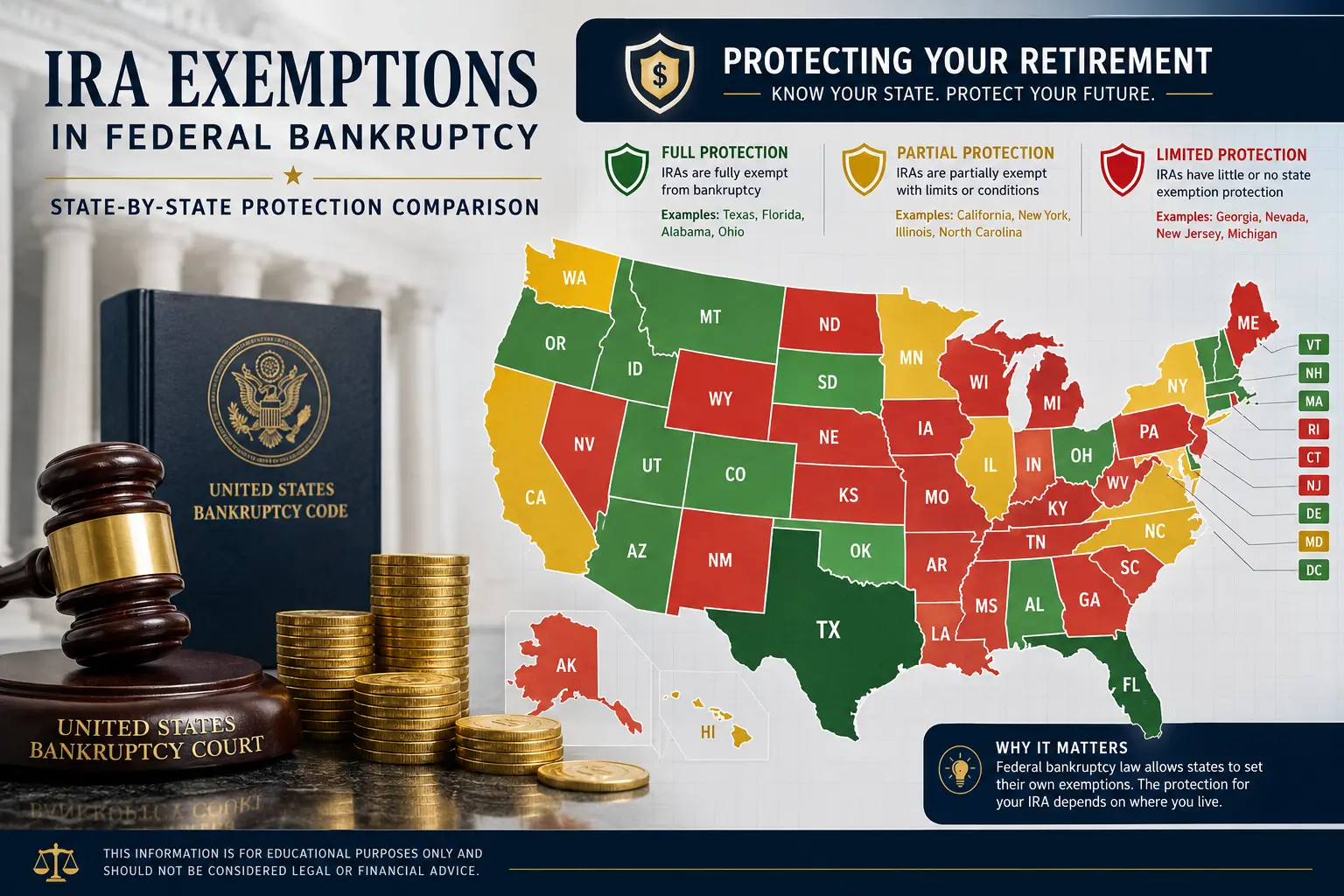
- The familiar four-tier map does not survive the statutes. At least twenty states fit none of its categories, because the operative limit is a contribution-timing lookback or a tax-character tracing rule rather than a dollar figure. Every row here states the statutory condition instead of a tier.
- Dollar caps are the exception, not the rule. Five states set an explicit account-value or aggregate exemption amount in their own law: Maine, Minnesota, Nevada, North Dakota and South Dakota. Virginia imports the federal ceiling by reference, and California imports the federal §522(n) figure as a floor for defined personal debts. Other dollar figures in the matrix are contribution or support exceptions rather than exemption ceilings, as in Pennsylvania and Vermont.
- Timing is the most common real limit. Contributions made shortly before a filing or judgment fall outside the exemption in many states, and the window ranges from 90 days in Wyoming to three years in Hawaii and five years in Massachusetts, which measures deposits above 7% of income over that period.
- Segregating rollover money is an evidentiary convenience, not a statutory requirement. The federal cap disregards an enumerated list of rollover contributions and their earnings; no provision of §522 imposes a whole-account commingling taint, and no controlling authority for one was located.
- ERISA does not reach IRAs. 29 U.S.C. §1051(6) excludes §408 accounts from the Part containing the anti-alienation rule, which is precisely why state law carries the weight outside bankruptcy.
- Inherited accounts split the country. The federal exemption does not cover them after Clark v. Rameker, twelve states in this matrix protect them expressly or in functionally equivalent terms, and others either end protection at death or have had a court hold the exemption does not reach them.
Two Bodies of Law, Applied in Different Proceedings
The federal Bankruptcy Code governs what a debtor may exempt in a bankruptcy case. It does not govern an ordinary civil judgment: a creditor enforcing a state-court judgment encounters the forum state's exemption statute, and the federal cap is irrelevant to that proceeding. Conversely, a debtor in bankruptcy who must use a particular state's exemptions takes that state's statute with its own limits attached.
The two layers are therefore not a spectrum from weaker to stronger protection. They are different questions decided by different texts, and a claim about one says nothing reliable about the other. A third category sits outside both: federal tax collection, criminal restitution and domestic support obligations reach assets through mechanisms of their own, described in the federal section below.
The Federal Rules in Bankruptcy
The cap, and what sits outside it
In bankruptcy, 11 U.S.C. §522(n) caps the aggregate value exempted from individual retirement accounts described in Internal Revenue Code §408 or §408A at $1,000,000 as written in the statute, adjusted to $1,711,975 effective 1 April 2025 by the Judicial Conference notice dated 30 January 2025, 90 F.R. 8941. The statute adds that the amount may be increased if the interests of justice so require. A simplified employee pension under §408(k) and a simple retirement account under §408(p) are outside the cap because §522(n) excludes them by its own terms, not because of any ERISA status.
The rollover exclusion is an enumerated list
The cap applies without regard to amounts attributable to rollover contributions under §§402(c), 402(e)(6), 403(a)(4), 403(a)(5) and 403(b)(8) of the Internal Revenue Code, and earnings on them. Those amounts are not counted toward the cap when attributable and otherwise qualified. That is a closed list, and it does not include a governmental 457(b) rollover under §457(e)(16). Describing the exclusion as covering any employer-plan rollover overstates the statute.
Segregation, commingling and what the statute does not say
The statute contains no separate-account or segregation requirement. Section 522(b)(4)(C) provides that a direct transfer of retirement funds between funds or accounts exempt from taxation under §§401, 403, 408, 408A, 414, 457 or 501(a) does not cease to qualify for exemption by reason of the transfer, and §522(b)(4)(D) protects a distribution qualifying as an eligible rollover distribution within the meaning of §402(c), including an amount redeposited within 60 days.
Keeping rollover money in its own account can make tracing easier as a matter of proof, and that is an evidentiary convenience rather than a statutory rule: separate-account segregation is not statutory text. No provision of §522 imposes a whole-account commingling taint, and no controlling authority establishing an automatic whole-account taint rule was located in this review. The uncapped treatment attaches to the enumerated rollover amounts and their earnings, not to the account they happen to sit in.
The exemption, the presumption and the estate
Sections 522(b)(3)(C) and 522(d)(12) exempt retirement funds to the extent those funds are in a fund or account exempt from taxation under §§401, 403, 408, 408A, 414, 457 or 501(a). Section 522(b)(4)(A) presumes those funds exempt where the fund has received a favourable determination under Internal Revenue Code §7805 in effect at filing, and (B) lets a debtor establish the exemption without one by showing no contrary determination together with substantial compliance with the Code, or a failure for which the debtor is not materially responsible. Section 522(m) applies the section separately to each debtor in a joint case, subject to the subsection (b) limitation.
A separate provision operates earlier in the analysis. Section 541(c)(2) provides that a restriction on the transfer of a beneficial interest of the debtor in a trust that is enforceable under applicable nonbankruptcy law is enforceable in a bankruptcy case, which keeps ERISA-plan benefits out of the bankruptcy estate rather than merely exempting them from it. In Patterson v. Shumate, 504 U.S. 753 (1992), the Supreme Court held that an anti-alienation provision in a qualified pension plan is such a restriction, and that the phrase encompasses any relevant nonbankruptcy law, including federal law such as ERISA.
ERISA does not protect IRAs
ERISA's anti-alienation rule at 29 U.S.C. §1056(d)(1) requires that each pension plan provide that benefits under the plan may not be assigned or alienated. It does not apply to IRAs: 29 U.S.C. §1051(6) excludes an individual retirement account or annuity described in §408 from the Part in which that rule sits. An IRA carries no ERISA anti-alienation protection, and that is the reason IRA protection outside bankruptcy depends on state exemption law while an employer 401(k) does not. Governmental §457(b) plans are governmental plans, which ERISA also does not cover, and describing one as an ERISA plan is inaccurate.
Divorce transfers and QDROs are different mechanisms
Section 1056(d)(3)(A) makes the anti-alienation rule inapplicable to a domestic relations order determined to be a qualified domestic relations order, so a QDRO can divide an ERISA plan; (B) defines the term and (H) governs the 18-month segregation of disputed amounts. QDROs as such do not apply to IRAs. An IRA is divided instead under Internal Revenue Code §408(d)(6), under which the transfer of an individual's interest to a spouse or former spouse under a divorce or separation instrument is not a taxable transfer, and the interest is thereafter treated as the transferee's IRA.
A domestic order can therefore reach and divide an IRA, and several state statutes then protect the recipient's awarded interest. Florida provides that an interest awarded or received in a §408(d)(6) divorce transfer is exempt upon being awarded and continues to be exempt thereafter, and Arizona, Kansas, Maryland, Missouri, Utah and Wyoming each exempt an alternate payee's own interest from that payee's creditors.
The transfer mechanics themselves — which instruments qualify under the clause (i) cross-reference, how a compliant transfer is executed, and why a distribution paid to the account owner falls outside the rule — are set out in the IRA transfer incident to divorce guide.
Tax, restitution and support are three distinct bases
Section 522(c) makes exempt property liable, notwithstanding the exemption, for a debt of a kind specified in §523(a)(1) or §523(a)(5), certain taxes and domestic support obligations, and for a debt secured by a properly filed tax lien; §522(c)(4) adds debts arising from fraud in obtaining student financial assistance. Criminal restitution is not listed in §522(c). Federal criminal restitution reaches otherwise-exempt retirement assets through the Mandatory Victims Restitution Act and the enforcement provisions of 18 U.S.C. §3613, a different mechanism with different limits. Treating tax liens, restitution and support as a single exemption rule conceals those differences.
Inherited accounts under Clark v. Rameker
In Clark v. Rameker, 573 U.S. 122 (2014), the Supreme Court held that funds held in inherited IRAs are not retirement funds within the meaning of §522(b)(3)(C). The Court rested on three legal characteristics of an inherited account: the holder may never invest additional money in it under §219(d)(4); the holder is required to withdraw money no matter how far from retirement, under §§408(a)(6) and 401(a)(9)(B); and the holder may withdraw the entire balance at any time, for any purpose, without penalty. State law can and frequently does provide otherwise, and the state rows below record where it does.
Which state's exemptions apply
Section 522(b)(3)(A) looks to the state where the debtor was domiciled for the 730 days before filing, and where the debtor did not live in a single state for that whole period, to the state where the debtor was domiciled for the longer portion of the 180 days preceding those 730 days. A recent move does not by itself make a new state's exemptions available in a bankruptcy case, and outside bankruptcy an existing judgment is enforced under the law governing that enforcement rather than the law of a later residence.
Federal primary sources
The federal provisions above were read from the official texts listed here. Each opens the authority itself rather than a summary of it.
- 11 U.S.C. §522 (Exemptions, including the §522(n) cap)
- 11 U.S.C. §541 (Property of the estate, including §541(c)(2))
- 29 U.S.C. §1051 (Coverage; (6) excludes §408 individual retirement accounts)
- 29 U.S.C. §1056 (Anti-alienation rule and qualified domestic relations orders)
- 26 U.S.C. §408 (Individual retirement accounts)
- 11 U.S.C. §522 adjustment notes, including 90 F.R. 8941 (30 January 2025, effective 1 April 2025)
- Clark v. Rameker, 573 U.S. 122 (2014)
- Patterson v. Shumate, 504 U.S. 753 (1992)

The 50-State Statute Matrix
One row per state, recorded in the statute's own terms. Where a statute does not address inherited accounts, the row says so rather than inferring a result. Where the operative limit is a contribution-timing lookback or a tax-character tracing rule, the row states that limit rather than converting it into a dollar figure or a tier. Sources were read on 26 September 2026.
| State | Owner traditional and Roth IRA | Inherited account | Limits and named exceptions | Primary authority |
|---|---|---|---|---|
| Alabama | Exempt. §19-3B-508 expressly names the individual retirement annuity and account, the rollover IRA, the Roth IRA under §408A, and SEP and SIMPLE IRAs. | Not protected. Subsection (g) ends the exemption after the account owner's death, except for assets owned or controlled by a surviving spouse. | Contributions above the amounts the Code allows, and earnings on them, are not exempt. Subsection (c) names taxes owed to any local, state or federal taxing authority, a §414(p) QDRO, excess contributions, and criminal restitution orders enforced as civil judgments. A distribution constituting a qualified rollover contribution stays protected for at least 60 days. | Ala. Code §19-3B-508 |
| Alaska | Exempt. AS 09.38.017 covers the interest of an individual or beneficiary in a retirement plan and the money or assets payable from it, and conclusively presumes the plan a spendthrift trust. | Protected. Where a beneficiary acquired the interest as the result of an individual's death, the beneficiary's interest is exempt to the same extent the individual's was immediately before death. | Contributions made within 120 days before a bankruptcy filing are excluded, and the section does not prevent payment of benefits to an alternate payee under a QDRO. | AS 09.38.017 |
| Arizona | Exempt. A.R.S. §33-1126(B) covers money or assets payable to a participant or beneficiary of, and any interest in, a §401(a), 403(a), 403(b), 408, 408A or 409 plan, or a §457 deferred compensation plan. | Protected, expressly: the exemption applies whether the beneficiary's interest arises by inheritance, designation, appointment or otherwise. | Excludes an alternate payee under a §414(p) QDRO, whose own interest is then exempt from that payee's creditors; amounts contributed within 120 days before a bankruptcy filing; and assets of bankruptcy proceedings filed before 1 July 1987. | A.R.S. §33-1126(B) |
| Arkansas | Exempt. A.C.A. §16-66-220 covers assets held in or payments from a pension, profit-sharing or similar plan or contract, and an IRA or individual retirement annuity including a SEP, unless the plan or account does not qualify under the Internal Revenue Code. | Protected since 2025. Acts 2025, No. 681 added subsection (c), whose “qualified savings plan” list expressly includes an inherited individual retirement account or annuity. | Contributions exceeding the amounts deductible under the Code, and accrued earnings on them, are not exempt; that limitation does not apply to a Roth IRA established under §408A. | A.C.A. §16-66-220, as amended by Acts 2025, No. 681, §1 |
| California | Needs-based. Under CCP §704.115(a)(3) and (e)(1) an IRA is exempt only to the extent necessary to provide for the support of the judgment debtor when the debtor retires, and of a spouse and dependents, taking into account all resources likely to be available at retirement. | Not addressed by the statute. | Since 1 January 2025, for a “personal debt” as defined in §683.110(d), the amount necessary for support cannot be less than the federal §522(n) figure as adjusted. The exempt amount may be aggregated across all retirement plans in the debtor's name and reduced so far as it is attributable to property disposed of to hinder, delay or defraud a creditor, and the court allows an additional amount for income taxes owed on applying plan funds to the judgment. Judgments for child, family or spousal support are an exception, and periodic payments are limited to what the Wage Garnishment Law permits. | CCP §704.115, as amended by Stats. 2024, Ch. 514, Sec. 7 (AB 2837) |
| Colorado | Exempt with no dollar cap. C.R.S. §13-54-102(1)(s) names any individual retirement account as defined in 26 U.S.C. §408, any Roth individual retirement account as defined in §408A, and any plan as defined in §401. | Not expressly addressed. | No dollar cap appears in the subsection. Subsection (1)(t) excepts property subject to a judgment for failure to pay another state's income tax on retirement-plan benefits received for periods of non-residency. | C.R.S. §13-54-102(1)(s) |
| Connecticut | Conditional. C.G.S. §52-321a(a)(1)(B) exempts a §408 IRA only so far as it is funded by a rollover from a qualified plan under §402(a)(5), 403(a) or 408(d)(3), or by annual contributions within the IRC §219(b) limit determined without the active-participant reduction. Subsection (a)(1)(C) separately exempts SIMPLE accounts, a §408A Roth IRA, education IRAs, §529 accounts and a SEP within the §408(j) limits or funded by qualified-plan rollovers. | Not addressed. | Subsection (c) withdraws protection where a self-employed debtor, Keogh partner, 1%-or-more shareholder, or a person exercising dominion and control over the sponsoring entity contributed less than 90 days before the claim on which judgment is entered, and where contributions are a fraudulent conveyance. Alternate-payee rights under a QDRO are preserved. | C.G.S. §52-321a, reached through §52-352b(13) |
| Delaware | Exempt with no dollar cap. 10 Del. C. §4915(a) covers assets held or amounts payable under any retirement plan, and (f) defines that term to reach §401, 403, 408, 408A, 409, 414 and 457 arrangements. | Protected. The definition expressly reaches a plan or account a decedent left to or for the benefit of an owner or beneficiary by will, trust, exercise of a power of appointment, beneficiary designation, transfer-on-death designation or any other method. | An eligible rollover distribution stays exempt for 60 days and remains exempt if contributed to a retirement plan within 60 days. Granting an enforceable security interest for a plan loan makes the assets subject to execution for that interest. Exceptions: claims under Title 13 chapters 5 and 15 (support and divorce), a QDRO alternate payee whose own interest is then exempt from that payee's creditors, and a judgment obtained under 30 Del. C. §554. | 10 Del. C. §4915 |
| Florida | Exempt. Fla. Stat. §222.21 exempts IRA money and assets from legal process. | Protected. Money or assets remain exempt after death when held by one or more subsequent beneficiaries by direct transfer or eligible rollover excluded from gross income, expressly including an inherited IRA as defined in §408(d)(3); the paragraph is remedial and applies retroactively to all inherited IRAs. | Not exempt from the claims of a QDRO alternate payee, or from a surviving spouse's elective-share order under ch. 732 part II. An interest awarded or received in a §408(d)(6) divorce transfer is itself exempt once awarded and continues to be exempt thereafter. An alternate payee's own interest is exempt from all creditors other than the Department of Revenue. | Fla. Stat. §222.21 |
| Georgia | Needs-based and narrow. O.C.G.A. §44-13-100(a)(2)(F) exempts a payment from a §408 IRA only to the extent reasonably necessary for the support of the debtor and any dependent; (a)(2.1)(D) separately lists an IRA among undistributed funds held under a retirement or pension plan. | Not addressed, and no §408A Roth reference appears in the IRA provisions. | The needs test is the limit, and the section operates in lieu of §44-13-1 for bankruptcy purposes because Georgia has opted out of the federal exemptions. Source note: Georgia's code is published through a commercial host that refused automated retrieval, so this wording was corroborated from official federal bankruptcy opinions applying the statute, including In re Mooney, 503 B.R. 916 (Bankr. M.D. Ga. 2014), rather than read from the state's own host. | O.C.G.A. §44-13-100(a)(2)(F), (a)(2.1)(D) |
| Hawaii | Exempt with no dollar cap. HRS §651-124 exempts the right to a pension, annuity, retirement or disability allowance, death benefit or other right accrued under a §401(a), 401(k), 403(a), 403(b), 408, 408A, pre-1984 409, 414(d) or 414(e) plan, and any fund created by it. | Not addressed. | Contributions made within three years before a bankruptcy filing, or within three years before a civil action is initiated against the debtor, are excluded, except contributions to a plan established by state statute where the effect would eliminate a state employee's retirement service credit. A QDRO under ERISA §206(d) or IRC §414(p) is an exception, which Hawaii case law treats as preempted so far as it actually conflicts with ERISA. | HRS §651-124 |
| Idaho | Exempt. Idaho Code §11-604A(3) exempts the right to a pension, annuity, retirement or disability allowance, death benefit or other right accrued under an employee benefit plan and any fund created by it; the defined term reaches §408 accounts, §408A Roth accounts and pre-1984 §409 bonds. | Not established. Subsections (5) and (6) address a deceased spouse's community-property interest in an IRA held in the other spouse's name, which is a community-property rule rather than a general inherited-IRA exemption. | Child-support collection actions; QDRO payments to a spouse, former spouse, child or dependent; and for §403(b), 408, 408A and 457 plans, any court order providing for maintenance or support. | Idaho Code §11-604A |
| Illinois | Exempt with no dollar cap. 735 ILCS 5/12-1006 exempts a debtor's interest in or right to assets held in or payments under a retirement plan intended in good faith to qualify under the Internal Revenue Code, or created under the Illinois Pension Code; (b)(3) expressly includes an individual retirement annuity or account. | Not addressed. | Such a plan is conclusively presumed a spendthrift trust under Illinois law. No exceptions are stated in the IRA text. | 735 ILCS 5/12-1006 |
| Indiana | Conditional. Ind. Code §34-55-10-2(c)(6) exempts a retirement plan interest only to the extent of contributions that were not subject to federal income taxation when made, or that are made to an IRA in the manner prescribed by §408A, together with earnings on them not subject to tax at the time of the levy and rollovers of them. | Not addressed. | The tax character of the contributions is the operative test. No IRA-specific exceptions are named in the subsection. | Ind. Code §34-55-10-2(c)(6) |
| Iowa | Exempt, on a formula. Iowa Code §627.6(8)(f) exempts contributions and assets, including accumulated earnings and market increases in value, in the listed plans. Transfers in any amount from an ERISA trust to an IRA, and transfers between §408(d)(3), §408(a), §408(b) and §408A accounts and annuities, are exempt. | Not addressed. | Rollovers are uncapped, but for SEPs, Keogh plans, §408(a) IRAs, §408(b) annuities, SIMPLEs and SARSEPs the exemption for each tax year's contributions is the lesser of the amount actually deducted on the debtor's return or the maximum deductible §408(a) contribution, with earnings prorated by the exempt fraction. QDROs, child support and alimony are exceptions, and §627.6(8)(e) denies exemption to the portion of a pension payment attributable to above-customary contributions made within a year before the petition. | Iowa Code §627.6(8)(f) |
| Kansas | Exempt with no dollar cap. K.S.A. §60-2308(b) exempts money or assets payable to a participant or beneficiary from a §401(a), 403(a), 403(b), 408, 408A or 409 plan from all claims of creditors, and conclusively presumes the plan a spendthrift trust. | Not covered. The statute's own annotations record In re Mosby, 532 B.R. 167 (Bankr. D. Kan. 2015), holding that an inherited IRA is not a retirement plan under the Kansas exemption statute. | Subsection (c) excepts a QDRO alternate payee and child-support orders under ch. 23 art. 30; the alternate payee's own interest is then exempt from that payee's creditors other than the Kansas Department for Children and Families. | K.S.A. §60-2308(b)-(c) |
| Kentucky | Exempt with no dollar cap. KRS §427.150(2)(f) exempts the right or interest of a person in an IRA or annuity, deferred compensation account, tax-sheltered annuity, SEP, pension, profit-sharing, stock bonus or other retirement plan described in the Code or in §408 or §408A that defers income tax until distribution, and applies for §522(b)(3) purposes in bankruptcy. | Not addressed. | Does not apply to amounts contributed within 120 days before a bankruptcy filing or, outside bankruptcy, before the earlier of entry of judgment or issuance of the levy, attachment, garnishment or other execution. Court orders for maintenance and for child support are exceptions. | KRS §427.150(2)(f) |
| Louisiana | Exempt with no dollar cap. R.S. §20:33(1) exempts tax-deferred arrangements to the extent prescribed in R.S. §13:3881, whose definition covers individual retirement accounts and annuities of any variety, balances rolled over from any other tax-deferred arrangement, Keogh plans, SEPs, SIMPLEs and Roth IRAs. | Not addressed. | No contribution made less than one calendar year from the date of filing for bankruptcy, or from the date writs of seizure are filed, is exempt; a transfer from one tax-deferred arrangement or annuity contract to another is not a contribution for that rule. Alimony and child support are excepted, as is R.S. 11:292. | La. R.S. §20:33(1) and R.S. §13:3881(D) |
| Maine | Exempt up to an aggregate value of $1,054,550. 14 M.R.S. §4422(13) covers retirement funds in a fund or account exempt from taxation under §401, 403, 408, 408A, 414, 457 or 501(a). | Not addressed. | The aggregate cap above, plus amounts contributed within 120 days before a bankruptcy filing or, outside bankruptcy, before the earlier of entry of judgment or issuance of execution. Amounts necessary to satisfy child-support or spousal-support obligations are excepted. | 14 M.R.S. §4422(13) |
| Maryland | Exempt. Cts. & Jud. Proc. §11-504(h) exempts money or assets payable to a participant or beneficiary from, or any interest in, a §401(a), 403(a), 403(b), 408, 408A, 414(d), 414(e) or pre-1984 §409 plan from all creditor claims other than claims by the Maryland Department of Health. | Not addressed. | A contribution exceeding the deductible amount, or for a §408A contribution the maximum contribution allowed, and accrued earnings on that portion, are not exempt. Exceptions: a QDRO alternate payee, a §401(a) plan acting as creditor of a §408 IRA, bankruptcy cases filed before 1 January 1988, and Maryland Department of Health claims throughout. | Md. Code, Cts. & Jud. Proc. §11-504(h) |
| Massachusetts | Exempt. M.G.L. c.235 §34A exempts the interest of a person in an annuity, pension, profit-sharing or other retirement plan subject to ERISA, a Keogh plan, a non-ERISA §401(a) plan, a simplified employee plan, a §403(b) annuity plan, or an individual retirement account or annuity maintained by an individual, and annuities purchased with assets distributed from any of them. | Not addressed. | For an individually maintained plan the exemption does not reach sums deposited during the five-year period before the individual's declaration of bankruptcy or entry of judgment that exceed 7% of total income for that period, computed without regard to rollovers or transfers. Exceptions: a court order concerning divorce, separate maintenance or child support, and on conviction of a crime a court order to satisfy a monetary penalty or make restitution to the victim. | M.G.L. c.235 §34A |
| Michigan | Exempt, with no limit on the number of accounts. MCL §600.6023(1)(j) exempts an individual retirement account or annuity as defined in §408 or §408A and the payments or distributions from it, and applies to the federal bankruptcy code as permitted by §522(b)(2). | Not addressed. | Does not apply to amounts contributed within 120 days before a bankruptcy filing, or to contributions and premiums, with earnings or benefits from them, exceeding the deductible §408 amount in the tax year made; that contribution limit does not apply to a rollover of a §401 qualified plan or a §403(b) annuity contract. Orders under a judgment of divorce or separate maintenance, and orders concerning child support, are exceptions. | MCL §600.6023(1)(j) |
| Minnesota | Exempt up to a present value of $81,000, plus additional amounts so far as reasonably necessary for support. Minn. Stat. §550.37 subd. 24 names the individual retirement account, Roth IRA, individual retirement annuity and simplified employee pension among the covered plans. | Not addressed. | The $81,000 aggregate present-value figure across all plans and contracts, with more only to the extent reasonably necessary for the support of the debtor and any spouse or dependent. The exemptions do not apply where the debt is owed under a support order as defined in §518A.26, subd. 21. | Minn. Stat. §550.37, subd. 24 |
| Mississippi | Exempt. Miss. Code §85-3-1(e) covers assets held in and monies payable from a §401(a), 403(a) or 403(b) plan, a §457(b) deferred compensation plan, an individual retirement account or annuity within §408 including a simplified employee pension plan, and a Roth individual retirement account within §408A. | Not addressed. | No limits are stated in the IRA subsection, and no exceptions are named there. | Miss. Code §85-3-1(e) |
| Missouri | Exempt. Mo. Rev. Stat. §513.430.1(10)(f) exempts money or assets payable from, or any interest in, a §223, 401(a), 403(a), 403(b), 408, 408A or 409 plan, whether the participant's or beneficiary's interest arises by inheritance, designation, appointment or otherwise. | Protected, expressly: the text includes an inherited account or plan. | Bankruptcy-specific limits and fraud and three-year provisions follow in the section. A QDRO alternate payee is an exception, with the payee's own interest then exempt from all creditors other than the State of Missouri through its Department of Social Services, as are judicial or administrative orders for child support or maintenance. The most recent amendments carry an effective date of 1 January 2027; the inherited-account language is in the current text. | Mo. Rev. Stat. §513.430.1(10)(f) |
| Montana | Conditional. Mont. Code §25-13-608(1)(e) exempts a §408(a) IRA to the extent of deductible contributions made before the suit resulting in judgment was filed and the earnings on them, a §408A Roth IRA to the extent of qualified contributions made before that suit and the earnings on them, and rollover contributions as defined in §408(d)(3). | Not addressed. | The pre-suit contribution timing rule above, together with the exceptions in subsection (2). | Mont. Code §25-13-608(1)(e) |
| Nebraska | Needs-based. Neb. Rev. Stat. §25-1563.01 exempts an interest held under a stock bonus, pension, profit-sharing or similar plan or contract payable on account of illness, disability, death, age or length of service only to the extent reasonably necessary for the support of the debtor and any dependent, in bankruptcy and in collection of a money judgment alike. | Not addressed. | No exemption where, within two years before bankruptcy or entry of a money judgment that becomes final, the plan was established or amended to increase contributions by or under the auspices of the individual or an insider that employed the individual, or where the plan does not qualify under §401(a), 403(a), 403(b), 408 or 408A. | Neb. Rev. Stat. §25-1563.01 |
| Nevada | Exempt up to $1,000,000 in present value. NRS §21.090(1)(r) covers money held in an individual retirement arrangement conforming to §408 or §408A, a written simplified employee pension plan, a cash or deferred arrangement plan, a trust forming part of a stock bonus, pension or profit-sharing plan, and a trust forming part of a qualified tuition program. | Protected, expressly: the subsection names an inherited individual retirement arrangement, an inherited simplified employee pension plan and an inherited cash or deferred arrangement plan. | The $1,000,000 present-value cap. | NRS §21.090(1)(r) |
| New Hampshire | Exempt with no dollar cap. RSA §511:2, XIX exempts any interest in a retirement plan or arrangement qualified for tax exemption under present or future acts of Congress, listing individual retirement accounts including Roth IRAs and education IRAs, individual retirement annuities, simplified employee pension plans, Keogh plans, §403(a) annuity plans, §403(b) annuities and eligible §457 deferred compensation plans. | Not addressed. | Subject to the Uniform Voidable Transactions Act, RSA 545-B, although a transfer or rollover contribution between retirement plans is not deemed a transfer fraudulent as to a creditor. Applies only to extensions of credit made, and debts arising, after 1 January 1999. | N.H. RSA §511:2, XIX |
| New Jersey | Exempt with no dollar cap. N.J.S.A. §25:2-1(b) exempts property held in a qualifying trust and distributions from it from all claims of creditors and excludes it from a bankruptcy estate; a qualifying trust is one created or qualified and maintained under federal law including §401, 403, 408, 408A, 409, 529 or 530. | Not addressed. | Three exceptions and no others: preferences and fraudulent conveyances violating the Uniform Voidable Transactions Act or other state or federal law; child-support or spousal-support orders and QDRO alternate payees, whose own interest is then exempt from that payee's creditors; and punitive damages awarded in a civil action arising from manslaughter or murder. | N.J.S.A. §25:2-1(b) |
| New Mexico | Exempt with no dollar cap. N.M.S.A. §42-10-1 exempts an interest in or proceeds from a pension, individual retirement account, annuity, profit-sharing plan and any other retirement account, and an individual retirement account that would qualify for tax exemption under 26 U.S.C. §408 or any similar account. | Not addressed. | A separate, narrower needs test at subsection (6)(f) applies to a payment under a stock bonus, pension, profit-sharing, individual retirement account, annuity or similar plan on account of illness, disability, death or length of service; the (10) and (11) provisions are the broader, later-listed exemptions. | N.M.S.A. §42-10-1, §42-10-2 |
| New York | Exempt with no dollar cap. C.P.L.R. §5205(c) treats trusts, custodial accounts, annuities, insurance contracts, monies, assets and interests qualified as an IRA under §408 or §408A, a Keogh, a §401 corporate plan, rollovers from such plans, or a §457 plan as trusts created by a person other than the judgment debtor, conclusively presumed spendthrift trusts for all purposes including bankruptcy. | Not addressed. | No dollar cap applies to IRAs under §5205(c), and additions remain subject to the section's fraudulent-conveyance provisions. The subdivision does not impair rights under a QDRO or under any order of support, alimony or maintenance, including arrears whether or not reduced to a money judgment. | N.Y. C.P.L.R. §5205(c) |
| North Carolina | Exempt. N.C.G.S. §1C-1601(a)(9) covers individual retirement plans as defined in the Internal Revenue Code, including individual retirement accounts and Roth retirement accounts under §408(a) and §408A, individual retirement annuities under §408(b), and accounts established as part of a §408(c) trust. | Protected, expressly: money, assets or an interest remain exempt after an individual's death if held by one or more subsequent beneficiaries by direct transfer or eligible rollover excluded from gross income, including to an inherited IRA as defined in §408(d)(3). | None stated in (a)(9). Subsection (a)(10) was repealed by S.L. 2025-46, s. 6(b), effective 1 September 2025 and applicable to actions filed on or after that date. | N.C.G.S. §1C-1601(a)(9) |
| North Dakota | Exempt up to $200,000 per account and $400,000 in aggregate, for retirement funds that have been in effect at least one year in a fund or account exempt from taxation under §401, 403, 408, 408A, 414, 457 or 501(a). The dollar limit does not apply so far as the property is reasonably necessary for the support of the resident and dependents. | Not addressed. | The one-year seasoning requirement and the per-account and aggregate figures above, subject to the needs-based override. Retirement funds are not exempt from enforcement of an order to pay spousal or child support, or a QDRO under §§15-39.1-12.2, 39-03.1-14.2 and 54-52-17.6. | N.D.C.C. §28-22-03.1(7) |
| Ohio | Exempt by contribution tracing. O.R.C. §2329.66(A)(10)(c) exempts an IRA, individual retirement annuity, Roth IRA, §529 or §529A account or education IRA so far as it is attributable to contributions within the applicable deductible or Roth limits, rollover contributions within the limits in §§219, 402(c), 403(a)(4), 403(b)(8), 408(b), 408(d)(3), 408A(c)(3)(B), 408A(d)(3) and 530(d)(5), and §529 or §529A contributions, plus earnings, dividends, interest, appreciation or gains on any of those. The reasonably-necessary standard in (A)(10)(d) applies to Keogh and H.R. 10 plans, not to IRAs. | Protected, expressly, by (A)(10)(e), which reaches an account a decedent left to or for the benefit of the person by will, trust, exercise of a power of appointment, beneficiary designation, transfer or payment-on-death designation or any other method. | The contribution and rollover tracing conditions. For (d), assets deposited to evade payment of a debt are excluded, while (g) preserves the exemption after a good-faith administrative error. The (A)(10)(a) preamble excepts §2921.41 theft-in-office restitution withholding, §2907.15 withholding orders, §§2929.192, .193 and .194 forfeiture orders and the listed support and divorce provisions; (f) extends the exemptions to a QDRO alternate payee. | O.R.C. §2329.66(A)(10)(c), (d), (e), (f) |
| Oklahoma | Exempt with no dollar cap. 31 O.S. §1(A)(20) exempts any interest in a retirement plan or arrangement qualified for tax exemption or deferment under present or future acts of Congress, including distributions from it, listing individual retirement accounts and annuities, simplified employee pension plans, Keogh plans, §403(a) annuity plans, §403(b) annuities, Roth IRAs under §408A, education IRAs under §530 and eligible §457 deferred compensation plans. | Not addressed. | Subject to the Uniform Fraudulent Transfer Act, although a transfer or rollover contribution between retirement plans that avoids current federal income taxation is not deemed fraudulent. Applies to plans in existence on or created after 16 April 1987, and no Oklahoma resident may use the federal §522(d) exemptions. | 31 O.S. §1(A)(20) |
| Oregon | Exempt by allowable-contribution tracing. O.R.S. §18.358 defines a retirement plan to include an individual retirement account or annuity under §408 or §408A, including one under a simplified employee pension, and runs the exemption to allowable contributions: deductible contributions permitted under the Code, deductible or nondeductible contributions not subject to the federal excise tax as an excess contribution, rollovers or transfers between plans preserving tax-deferred status, rollovers from a §408 account to a §408A account, and earnings attributable to any of those. | Not addressed. | Excess contributions subject to the federal excise tax fall outside the definition of allowable contributions. | O.R.S. §18.358 |
| Pennsylvania | Exempt. 42 Pa.C.S. §8124(b)(1)(ix) exempts a retirement or annuity fund under §401(a), 403(a), 403(b), 408, 408A, 409 or 530, its appreciation and income, the benefits or annuity payable under it, and transfers and rollovers between such funds. | Not addressed. | Excludes amounts the debtor contributed within one year before filing for bankruptcy, amounts the debtor contributed above $15,000 within a one-year period, and amounts deemed fraudulent conveyances; in the first two cases amounts directly rolled over from other exempt funds are not counted. | 42 Pa.C.S. §8124(b)(1)(ix) |
| Rhode Island | Exempt with no dollar cap. R.I. Gen. Laws §9-26-4(11) exempts an individual retirement account or individual retirement annuity as defined in 26 U.S.C. §§408 and 408A, and the payments or distributions from such an account or annuity. | Not addressed. | Contributions or premiums, including earnings or benefits from them, that constitute an excess contribution within §4973 are excluded. An order of a court pursuant to a judgment of divorce or separate maintenance, and an order concerning child support, are exceptions. | R.I. Gen. Laws §9-26-4(11) |
| South Carolina | Exempt. S.C. Code §15-41-30(A)(13) exempts the debtor's right to receive individual retirement accounts under §408(a) and §408A, individual retirement annuities under §408(b) and accounts established as part of a §408(c) trust, and states the exemption is available whether the individual's interest is as participant, beneficiary, contingent annuitant, alternate payee or otherwise. | Weaker than an express inherited-IRA statute. The section reaches an interest held as a beneficiary, which is not the same as the express inherited-IRA language used in Florida, Texas or Utah. | A claimed exemption may be reduced or eliminated by the amount of a fraudulent conveyance into the individual retirement account or other plan. | S.C. Code §15-41-30(A)(13) |
| South Dakota | Exempt up to $1,000,000. S.D.C.L. §43-45-16 gives a person the right to select and designate a total of one million dollars, and the income and distributions from it, in certain retirement benefits. | Not addressed. | The $1,000,000 designation, and the state's collection rights stated in the section heading. | S.D.C.L. §43-45-16 |
| Tennessee | Exempt with no dollar cap. Tenn. Code §26-2-105(b) exempts funds or assets payable to a participant or beneficiary from, or any interest of a participant or beneficiary in, a plan qualified under §§401(a), 403(a), 403(b), 408 and 408A, or an Archer MSA under §220 or a health savings account under §223, from all claims of creditors except the state, and exempts the participation records from the subpoena process. | Not addressed, although the exemption does reach an interest held as a beneficiary. | Claims by the State of Tennessee, and under (c) an alternate payee under a QDRO, whose own interest is then exempt from all creditors other than the state. For pensions from the state or a political subdivision under (a), an order of assignment of support under §36-5-501. | Tenn. Code §26-2-105 |
| Texas | Exempt. Tex. Prop. Code §42.0021(b) exempts a person's interest in and right to receive payments from a qualified savings plan, whether vested or not, from attachment, execution and seizure; (a) defines that term to include an individual retirement account or annuity and a Roth IRA, health savings accounts, Coverdell accounts, §529 and §529A programs, and annuities purchased with assets distributed from such a plan. | Protected, expressly: the definition names an inherited individual retirement account or annuity and an inherited Roth IRA, and (c) exempts an interest acquired by reason of another person's death to the same extent the decedent's interest was exempt at the date of death. | Subsection (d) excludes §4973 excess contributions and accrued earnings on them; (e) keeps distributions exempt for 60 days and thereafter if they qualify as a rollover contribution; (f) excludes an unfunded, unsecured employer promise to pay deferred compensation; and (g) makes assets subject to attachment for a granted plan-loan security interest. | Tex. Prop. Code §42.0021 |
| Utah | Exempt with no dollar cap. Utah Code §78B-5-505(1)(n) exempts money or assets held for or payable to an individual as owner, participant or beneficiary from a fund or account in a §401(a), 401(h), 401(k), 403(a), 403(b), 408, 408A, 409, 414(d), 414(e) or 457 plan, including an interest that arises by inheritance, designation, appointment or otherwise. | Protected, expressly, including an inherited fund or account. Subsection (2)(a) keeps the exemption after death for a direct transfer or eligible rollover to an inherited IRA as defined in §408(d)(3), and (2)(b) applies that rule to all inherited IRAs without regard to when the account was created. | Subsection (2)(c)(ii) excludes amounts contributed or benefits accrued within one year before the debtor files for bankruptcy, except amounts directly rolled over from other exempt funds. A QDRO alternate payee is excepted, though (1)(o) separately exempts the payee's own interest, and (5)(a) disapplies the exemption to a civil accounts receivable or civil judgment of restitution for contempt under §78B-6-317. | Utah Code §78B-5-505(1)(n), (2) |
| Vermont | Conditional. 12 V.S.A. §2740(16) exempts a debtor's interest in self-directed retirement accounts including individual retirement accounts, Keogh plans, simplified employee pension plans and other plans qualified under §401, 403, 408, 408A or 457, but an IRA, Keogh, SEP or other qualified plan other than a Roth IRA is exempt only so far as contributions were deductible or excludable from federal income taxation at the time of contribution, plus the earnings and growth acquired with them. A Roth IRA is exempt so far as contributions did not exceed the §408A limits, plus earnings and growth. | Not addressed. | No contribution made less than one calendar year from the date of filing for bankruptcy is exempt. Exemptions under the subdivision do not exceed $5,000 for attachment of assets by the office of child support under 15 V.S.A. §799. | 12 V.S.A. §2740(16) |
| Virginia | Exempt to the same extent permitted under federal bankruptcy law. Va. Code §34-34(B) applies that measure to an individual's interest in a retirement plan intended to satisfy IRC §§401, 403(a), 403(b), 408, 408A, pre-repeal 409 or 457, whether the interest is held as participant, beneficiary, contingent annuitant, alternate payee or otherwise. | Not addressed. | Because the exemption is pegged to the federal bankruptcy limit, the federal §522(n) cap effectively governs the IRA figure. The section also defines an annual-benefit mechanism keyed to an annuity commencing at age 65, and (D) addresses married individuals claiming under the same plan jointly. Subsection (C) excepts claims made against an individual by that individual's own alternate payee, claims by the Commonwealth in administrative actions under Title 63.2 ch. 19, and court process enforcing a child or child-and-spousal support obligation. | Va. Code §34-34 |
| Washington | Exempt. RCW §6.15.020(3) exempts the right to a pension, annuity, retirement or disability allowance, death benefit or other right accrued under an employee benefit plan and any fund created by it; (4) defines that term to include an individual retirement account or annuity under §408, a Roth IRA under §408A, §401(a) and §403(a) plans, §403(b) arrangements, and medical or health savings accounts; and (5) deems such a plan a spendthrift trust regardless of the source of funds or the debtor's ability to withdraw or borrow. | Not addressed. | Child-support collection actions under ch. 26.18, 26.23 or 74.20A RCW where federal law permits; collection actions for taxes imposed under Title 82A RCW; QDRO payments to a spouse, former spouse, child or dependent; and for §403(b) and §408 plans and pre-1984 §409 bonds, any court order for maintenance or support. | RCW §6.15.020 |
| West Virginia | Exempt regardless of amount. W. Va. Code §38-10-4(j)(5) exempts funds on deposit in an individual retirement account, including a simplified employee pension, regardless of the amount of funds, alongside the needs-based exemption for plan payments on account of illness, disability, death, age or length of service. | Not addressed. | The IRA exemption fails only where all four listed conditions hold together, because they are conjunctive: the plan was established by or under the auspices of an insider that employed the debtor; the payment is on account of age or length of service; the plan does not qualify under §401(a), 403(a), 403(b), 408 or 409; and the amount is subject to the §4973 or §4979 excess-contribution excise tax, whether or not the tax is paid. | W. Va. Code §38-10-4(j)(5) |
| Wisconsin | Exempt. Wis. Stat. §815.18(3)(j)1 exempts assets held or amounts payable under any retirement, pension, disability, death benefit, stock bonus or profit sharing plan, annuity, individual retirement account, individual retirement annuity, Keogh, 401-K or similar plan or contract providing benefits by reason of age, illness, disability, death or length of service, and payments made to the debtor from them. | Not addressed. | The plan or contract must either comply with the Internal Revenue Code or meet the employer-created exclusive-benefit structure in (j)2; the qualification condition is the limit and there is no dollar cap. Section 815.18(1) directs that the section be construed to secure its full benefit to debtors. | Wis. Stat. §815.18(3)(j) |
| Wyoming | Exempt. Wyo. Stat. §1-20-110(a)(i) and (a)(ii) exempt the interest of an individual or beneficiary in a retirement plan and money or other assets payable to an individual from one, where the plan is qualified under 26 U.S.C. §401, 403, 408, 408A, 409, 414 or 457. | Protected. Subsections (a)(iii) and (a)(v) exempt a beneficiary's interest acquired as the result of an individual's death to the same extent the individual's interest was exempt immediately before death, and (d)(iii) reaches an interest acquired as designated beneficiary, survivor, co-annuitant, heir or legatee. | Contributions made within 90 days before a bankruptcy filing are excluded. A QDRO alternate payee's claim is an exception, with the payee's own interest then exempt from that payee's creditors. Subsection (a)(iv) excludes Wyoming property where the judgment favours another state for unpaid income tax on retirement-plan benefits, applying only to judgments obtained after Wyoming residency was established and the debtor was domiciled there at least 180 days. | Wyo. Stat. §1-20-110 |
Eight rows cite an authority without a link, because no official free-standing URL was recorded for the provision used. A citation without a link is published as such rather than pointed at a commercial mirror.
Download the 50-state matrix (CSV)
Sources last reviewed: 26 September 2026. The CSV carries the same 50 rows as the table above, with the source URL and review date on each row, and both are generated from one data file so they cannot disagree. State legislatures amend these provisions regularly; confirm anything material against the current official text.
What Holding Physical Metal Changes, and What It Does Not
Exemption statutes apply to the account, not its contents. An IRA holding bullion is an individual retirement account under Internal Revenue Code §408, and none of the provisions in this matrix distinguishes between metal and securities. What physical metal changes is practical: valuation and liquidation in a collection or bankruptcy proceeding involve a custodian and a depository rather than a brokerage sale, which affects timing and cost rather than the exemption analysis.
One tax provision is worth separating from exemption law because it is frequently merged into it. Internal Revenue Code §408(e)(2) provides that if the individual for whose benefit an IRA is established engages in a prohibited transaction, the account ceases to be an IRA as of the first day of that taxable year and its assets are treated as distributed. That is a disqualification rule with tax consequences. An account that has ceased to be an IRA is no longer the thing an IRA exemption statute describes, which is the accurate way to state the connection.
Limitations of This Matrix
- State law changes. Several rows reflect amendments from 2024 and 2025, including California's 2025 personal-debt floor, Arkansas's 2025 inherited-account category and North Carolina's September 2025 repeal of a neighbouring subsection. Missouri's most recent amendments carry an effective date of 1 January 2027. A row is accurate as of the review date and no longer.
- An ordinary civil judgment, a bankruptcy case and federal collection are separate questions. A state exemption governs the first, the Bankruptcy Code the second, and federal tax collection, criminal restitution under 18 U.S.C. §3613 and domestic support obligations operate under their own mechanisms. A row describing a state exemption says nothing about those federal mechanisms.
- Divorce is division, not creditor collection. An IRA divided under §408(d)(6) is not a creditor reaching an exempt asset, and the two should not be read together.
- Statutory text is not outcome. These rows record what the provisions say. Case law applying them, the facts a court finds, the timing of contributions and the character of the debt all bear on a result, and this matrix compiles none of those.
- One row rests on court opinions rather than the state's own host. Georgia's code is published through a commercial host that refused automated retrieval. Its wording was corroborated from official federal bankruptcy opinions applying the statute, and confirming the exact current subsection text against an authoritative copy is a reasonable further step.
- Inherited-account silence is silence. Where a statute does not address accounts acquired on death, the row records that. It is not evidence either way, and Clark v. Rameker governs the federal exemption regardless.
Methodology
- Sources: the current official legislature, statute or court text for each state, plus uscode.house.gov for the federal provisions and the official reports of Clark v. Rameker and Patterson v. Shumate, all linked under federal primary sources. No review site, affiliate listicle, commercial summary or nationwide survey was used as authority for any row.
- Coverage: 50 states, one governing IRA exemption provision each. Forty-nine were read from official state sources. Georgia was corroborated from official federal bankruptcy opinions applying the statute because its publisher refused automated retrieval, and that limitation is stated in the row.
- Recording rule: each row states the statutory condition in the statute's own terms. No protection tier is assigned, because a tier cannot express a 120-day contribution lookback, a deductibility tracing test or a needs standard without discarding the condition that decides the case.
- Links: every source link points to an official or non-commercial authority. Where no official free-standing URL was recorded, the citation is published without a link rather than substituting a commercial host.
- Dating: all rows were read on 26 September 2026, and that date is published on the page, in the CSV and in the Dataset metadata.
- Data integrity: the rendered table and the published CSV are generated from a single data file, so a corrected row moves in both at once.
How figures on this site are produced and checked is set out in the research methodology, and errors are handled under the corrections policy.

How to Cite This Page
A 50-state matrix of IRA creditor-exemption statutes read from primary sources, recording each state's rule for an owner's traditional and Roth IRA, its treatment of accounts acquired on death, and the statutory limits and named exceptions attached to each, alongside the federal bankruptcy provisions stated separately.
Source: 401ktogoldira.org — Gold IRA Creditor Protection by State: 50-State Statute Matrix (2026).
Publisher: 401ktogoldira.org
URL: https://401ktogoldira.org/gold-ira-creditor-protection-by-state/
Data: https://401ktogoldira.org/data/gold-ira-creditor-protection-by-state.csv
Sources last reviewed: 26 September 2026
Accessed: state the retrieval date, as state legislatures amend these provisions.
To cite one state rather than the page, append its row anchor to the URL, for example
#row-state-nevada. Row anchors are derived from the state name and stay stable
when rows are edited.
Reviewed and edited by Daniel M. — Editor, 401kToGoldIRA.org.
Update History
- 26 September 2026 — full primary-source rebuild. Every state row was re-read from the current official statute or, for Georgia, from official federal bankruptcy opinions applying it, and the page was rebuilt as a data asset with a published CSV, stable per-state anchors and Dataset metadata. The previous version derived its rows from secondary nationwide surveys and sorted states into protection tiers; that legend was retired because at least twenty states do not fit it.
- 26 September 2026 — categories corrected. The rebuild corrected the treatment of state dollar figures, several of which were wrong or attributed to states whose statutes contain no dollar cap at all; the classification of states whose real limit is a contribution-timing lookback or a tax-character tracing rule; the list of states addressing accounts acquired on death, in both directions; the description of Roth treatment, where no state was found to exclude Roth accounts outright; and the federal section, which now separates the §522(n) cap from the §541(c)(2) estate exclusion, states the rollover exclusion as the enumerated list it is, records that ERISA excludes §408 accounts, distinguishes a §408(d)(6) divorce transfer from a QDRO, and separates tax, restitution and support as distinct bases. Withdrawn claims are not restated here as present fact; the current text above governs.
- 19 June 2026: Original publication.
FAQ
Does a Gold IRA get different creditor protection from any other IRA?
No. Exemption statutes apply to the IRA wrapper, not to what the account holds, so an IRA holding physical metal is treated as the individual retirement account it is under Internal Revenue Code §408. Physical metal changes valuation and liquidation mechanics in a collection or bankruptcy proceeding, not which exemption applies.
How much does federal bankruptcy law protect?
11 U.S.C. §522(n) caps the aggregate value exempted from IRAs described in §408 or §408A at $1,000,000 as written, adjusted to $1,711,975 effective 1 April 2025 by the Judicial Conference notice at 90 F.R. 8941. The statute adds that the amount may be increased if the interests of justice so require. Simplified employee pensions under §408(k) and simple retirement accounts under §408(p) sit outside the cap by the statute's own terms.
Do rollover balances have to be kept in a separate account?
The statute contains no separate-account or segregation requirement. The cap applies without regard to amounts attributable to rollover contributions under §§402(c), 402(e)(6), 403(a)(4), 403(a)(5) and 403(b)(8) and earnings on them, which is a closed list. Keeping rollover money in its own account can make tracing easier as a matter of proof, and that is an evidentiary point rather than a statutory rule. No provision of §522 imposes a whole-account commingling taint, and no controlling authority for one was located.
Does the rollover exclusion cover a governmental 457(b) rollover?
Not under the enumerated list. The amounts §522(n) disregards are rollover contributions under §§402(c), 402(e)(6), 403(a)(4), 403(a)(5) and 403(b)(8), and a governmental 457(b) rollover under §457(e)(16) is not among them. Describing the exclusion as covering any employer-plan rollover overstates the statute.
Are inherited IRAs protected?
Not by the federal exemption. Clark v. Rameker, 573 U.S. 122 (2014), held that funds held in inherited IRAs are not retirement funds within the meaning of §522(b)(3)(C). State law frequently provides otherwise: this matrix records express or functionally equivalent inherited-account protection in Alaska, Arizona, Arkansas, Delaware, Florida, Missouri, Nevada, North Carolina, Ohio, Texas, Utah and Wyoming, while Alabama ends protection at death except for a surviving spouse and a Kansas bankruptcy court has held inherited IRAs fall outside that state's exemption.
Does ERISA protect an IRA?
No. ERISA's anti-alienation rule at 29 U.S.C. §1056(d)(1) applies to pension plans, and 29 U.S.C. §1051(6) excludes an individual retirement account or annuity described in §408 from the Part containing that rule. That exclusion is the reason IRA protection outside bankruptcy depends on state exemption law while a 401(k) does not.
How is an IRA divided in divorce?
A qualified domestic relations order divides an ERISA plan; QDROs as such do not apply to IRAs. An IRA is divided under Internal Revenue Code §408(d)(6), under which a transfer of an individual's interest to a spouse or former spouse under a divorce or separation instrument is not a taxable transfer and the interest is then treated as the transferee's IRA. Several statutes then protect what the recipient receives: Florida provides that an interest awarded in a §408(d)(6) transfer is exempt upon being awarded and continues to be exempt, and Arizona, Kansas, Maryland, Missouri, Utah and Wyoming each exempt an alternate payee's own interest from that payee's creditors.
Which creditors can reach an exempt IRA anyway?
Three distinct mechanisms, which are often collapsed into one. Under 11 U.S.C. §522(c) exempt property remains liable for debts of a kind specified in §523(a)(1) or §523(a)(5), certain taxes and domestic support obligations, for a debt secured by a properly filed tax lien, and under §522(c)(4) for debts arising from fraud in obtaining student financial assistance. Criminal restitution is not listed in §522(c): federal criminal restitution reaches otherwise-exempt retirement assets through the Mandatory Victims Restitution Act and the enforcement provisions of 18 U.S.C. §3613. State exemption statutes carry their own named exceptions, which the matrix records per state.
Does moving to another state change which exemptions apply?
In bankruptcy the domicile rule in 11 U.S.C. §522(b)(3)(A) looks to where the debtor was domiciled for the 730 days before filing, and to the 180-day period before that where the debtor did not live in a single state for the whole 730 days. Outside bankruptcy, a state-court judgment turns on the forum's own exemption law and the location of the assets. A move does not retroactively change how an existing judgment is enforced.
Are Roth IRAs protected less than traditional IRAs?
No state located in this review excludes Roth IRAs from protection outright. Two states apply a different test rather than a lesser one: Vermont exempts a traditional IRA to the extent contributions were deductible or excludable when made while exempting a Roth to the extent contributions stayed within the §408A limits, and Connecticut conditions the §408 exemption on rollover source or §219(b) contribution limits while listing the Roth separately.
What does this matrix not answer?
It records statutory text and named exceptions, not outcomes. Whether a particular account is reachable turns on the type of proceeding, the creditor, the timing of contributions, the facts a court finds and case law this matrix does not compile. State legislatures amend these provisions regularly, several rows reflect amendments from 2024 and 2025 and one Missouri amendment carries an effective date in 2027, and nothing here is legal advice.