Gold IRA Rollover Eligibility Matrix: Which Accounts Can Move, and When
Most articles answer gold IRA rollover eligibility one account at a time. This page puts every account type in one verified decision table: whether it can roll into a traditional gold IRA, what event unlocks it, and which withholding and timing rules apply on the way. Every cell is sourced to IRS or TSP primary pages, and the places where official sources conflict are flagged rather than papered over. Customers should speak to a financial or tax advisor before making decisions.
Educational only: This matrix summarises federal rules from IRS and TSP sources. Employer plans can impose their own distribution restrictions, so the plan document and administrator govern individual cases. This is not tax, legal or investment advice. Customers should speak to a financial or tax advisor before making decisions. This site does not offer tax or legal advice. Past performance does not guarantee future results.
Of the ten account types people ask about, six can roll into a traditional gold IRA, one qualifies only after a 2-year clock, two cannot roll in at all, and one is not listed by the IRS as an eligible source.
Source: IRS Rollover Chart (undated PDF), summarised on the IRS rollovers page last updated 31 May 2026. Eligibility also depends on a distributable event and the plan's own terms.
Key takeaways
- Pre-tax 401(k), 403(b), governmental 457(b), TSP, traditional IRA and SEP IRA can all roll into a traditional gold IRA. C-001
- SIMPLE IRAs wait 2 years from the first employer deposit — moving earlier is a distribution taxed at an increased 25% early-distribution rate. C-008
- Roth IRAs cannot roll to a traditional IRA, and non-governmental 457(b) plans are not an eligible rollover source. C-007 C-009
- Employer-plan eligibility needs both a permitted event (separation, age 59½, plan termination) and the plan document allowing it. The permitted events are set out in the 401(k) resource guide — general distribution rules. C-005
- Indirect rollovers: 20% mandatory withholding from employer plans; 10% default (waivable) from IRAs; a 60-day deadline; and the once-per-12-months rule applies to IRA-to-IRA only. C-015 C-019
Check One Account
Pick a source account to see its verdict, what unlocks it, how withholding works and which sources carry it. Every row is also in the full table below, which renders whether or not this control is used.
Select an account to see its verdict.
- To a traditional gold IRA
- —
- Roth IRA destination
- —
- What unlocks it
- —
- Indirect-rollover withholding
- —
- Timing rules
- —
- Sources and claims
- —
Educational output from the published table only. It does not read a plan document, and the plan administrator's answer governs any individual case.
The Eligibility Matrix: Every Account Type in One Table
Destination is a traditional (pre-tax) gold IRA. "Roth destination" notes where a Roth IRA differs, and the account labels themselves are compared in Rollover IRA vs Roth IRA vs Traditional IRA. Direct trustee-to-trustee movement is assumed; indirect rollovers add the withholding and timing rules covered below.
Showing all 10 account types.
| Source account | To traditional IRA? | Unlocking event (employer plans) | Roth IRA destination |
|---|---|---|---|
| 401(k) / qualified plan (pre-tax) | Yes | Separation, age 59½ in-service (if the plan allows), disability, plan termination. Hardship distributions cannot be rolled over. | Yes — taxable as a conversion |
| 403(b) (pre-tax) | Yes | Age 59½, severance, disability, death. The plan may, but need not, allow each. | Yes — taxable as a conversion |
| Governmental 457(b) | Yes | Severance from employment. This page asserts NO in-service age: the IRS topic pages and the statute disagree, and that conflict is preserved rather than resolved. | Yes — taxable as a conversion |
| Non-governmental 457(b) | Not listed | Not an eligible rollover source. The IRS Rollover Chart lists only governmental 457(b). Assets remain employer property and move only to another tax-exempt 457(b). | Not listed |
| TSP | Yes | Separation, or an age-59½ in-service withdrawal while still employed. | Yes — taxable portion included in income |
| Traditional IRA | Yes | None needed. No distributable-event gate applies to IRAs, so the two-key lock is not in play. | Yes — a Roth conversion, taxable |
| SEP IRA | Yes | None needed. A SEP IRA is a traditional IRA for rollover purposes. | Yes — taxable as a conversion |
| SIMPLE IRA | Yes, after 2 years | A 2-year clock runs from the employer's FIRST deposit, not the hire date. Inside that window money may move only to another SIMPLE IRA. | Yes, after 2 years — taxable |
| Roth IRA | No | A Roth IRA rolls only to another Roth IRA. The TSP will not accept Roth IRA money either. | Yes (Roth to Roth) |
| Designated Roth account (Roth 401(k), 403(b) or governmental 457(b)) | No | Rolls only to a Roth IRA or another designated Roth account. Frequently confused with the pre-tax account of the same name. | Yes |
A conflict worth knowing about — governmental 457(b) in-service age: two IRS topic pages list the in-service distribution age for governmental 457(b) plans as 70½, but 26 U.S. Code § 457(d)(1)(A)(i) as amended sets it at 59½ for governmental plans, with 70½ applying to tax-exempt plans. The IRS web pages appear not to have been updated since that change. This matrix therefore does not assert an in-service age for governmental 457(b); a participant should confirm with the plan administrator, and the statute is the controlling text. C-006
Download the Eligibility Matrix (CSV)
What Actually Unlocks an Employer-Plan Rollover?
The single most common misunderstanding in this area is treating eligibility as automatic. For employer plans it is a two-key lock: federal rules must permit a distribution, and the plan document must offer it.
The 401(k) resource guide — general distribution rules lists the permitted events for elective deferrals — death, disability, severance from employment, plan termination without a successor, age 59½, and hardship — and consistently uses the phrase "a plan may, but is not required to, allow". A plan that offers no in-service distributions at 59½ is following the rules, and no custodian or dealer can override that. Hardship distributions, where offered, cannot be rolled over at all.
The two-key lock
Tick both keys to see the result.
IRAs are different: a traditional or SEP IRA has no distributable-event gate, so neither key applies. A SIMPLE IRA has its own 2-year window instead, covered below. C-005 C-011
The practical consequence: the plan administrator's answer is the eligibility answer. This page tells a reader what to ask; the plan document decides.
An employee stock ownership plan is a qualified plan whose distributions run on this same machinery, but it adds a distribution-form question the other plan types do not have, because the account may hold employer securities rather than cash. The availability gate, the form of the distribution and the employer-stock checkpoint are set out on the ESOP rollover to an IRA guide, and when a payout must become available after leaving is covered on the ESOP payout timing guide.
Destination Path: Traditional, Roth, or Nowhere
Eligibility and destination are two separate questions. An account can be eligible to move and still be barred from the destination someone has in mind.
Six of the ten account types reach it directly.
Pre-tax 401(k) and qualified plans, pre-tax 403(b), governmental 457(b), TSP, traditional IRA and SEP IRA all reach a traditional (pre-tax) gold IRA. For the employer plans in that list the two-key lock still has to turn first. For the IRAs there is no distributable-event gate at all.
Worth noting. A SIMPLE IRA joins this list only after its 2-year clock. Nothing on this path converts tax character, so no income is created by the movement itself.
Reachable from almost every source, but the tax consequence changes.
A pre-tax source reaching a Roth IRA is a conversion: the previously untaxed amount is generally included in income for the year. A Roth IRA reaches a Roth IRA with no conversion. A designated Roth account reaches a Roth IRA and is frequently confused with the pre-tax plan of the same name.
Worth noting. This page does not work through Roth mechanics or the five-year periods. Those belong to the Roth guide, which is linked from the destination section.
Two rows cannot reach a traditional IRA, and one is not a listed source at all.
A Roth IRA cannot roll to a traditional IRA of any kind, and a designated Roth account rolls only to Roth destinations. Separately, a non-governmental 457(b) is not listed by the IRS as an eligible rollover source: those assets remain employer property and move only to another tax-exempt 457(b).
Worth noting. Holding metals in a self-directed Roth IRA is a separate arrangement funded from Roth sources. It is not a rollover from a Roth IRA into a traditional one.
The Roth side of that decision — conversion mechanics and the Roth five-year periods — is set out in the Roth Gold IRA guide.
Why Does the SIMPLE IRA 2-Year Rule Catch People?
Because the clock starts somewhere unexpected: the first day the employer deposits into the SIMPLE IRA — not the hire date, and not the plan's effective date.
During those 2 years, money may only move to another SIMPLE IRA. The statutory basis is 26 U.S. Code § 408(d)(3)(G), and the Internal Revenue Service states that a payment to a non-SIMPLE IRA in that window "is neither a tax-free trustee-to-trustee transfer nor a rollover contribution" — it is a distribution, included in gross income, with the early-distribution tax applying at an increased 25% rate rather than the usual 10%, unless an exception such as age 59½ applies.
SIMPLE IRA two-year clock
Enter the first-deposit date to see when the window closes.
- Window closes
- —
- Proposed move
- —
Counts two calendar years from the first-deposit date. It does not know the plan's records, whether an exception such as age 59½ applies, or what the custodian requires as evidence. Educational only; nothing is saved or sent anywhere. C-008
After the 2 years, a SIMPLE IRA behaves like a traditional IRA for rollover purposes, including Roth conversion with income inclusion.
What Happens on an Indirect Rollover?
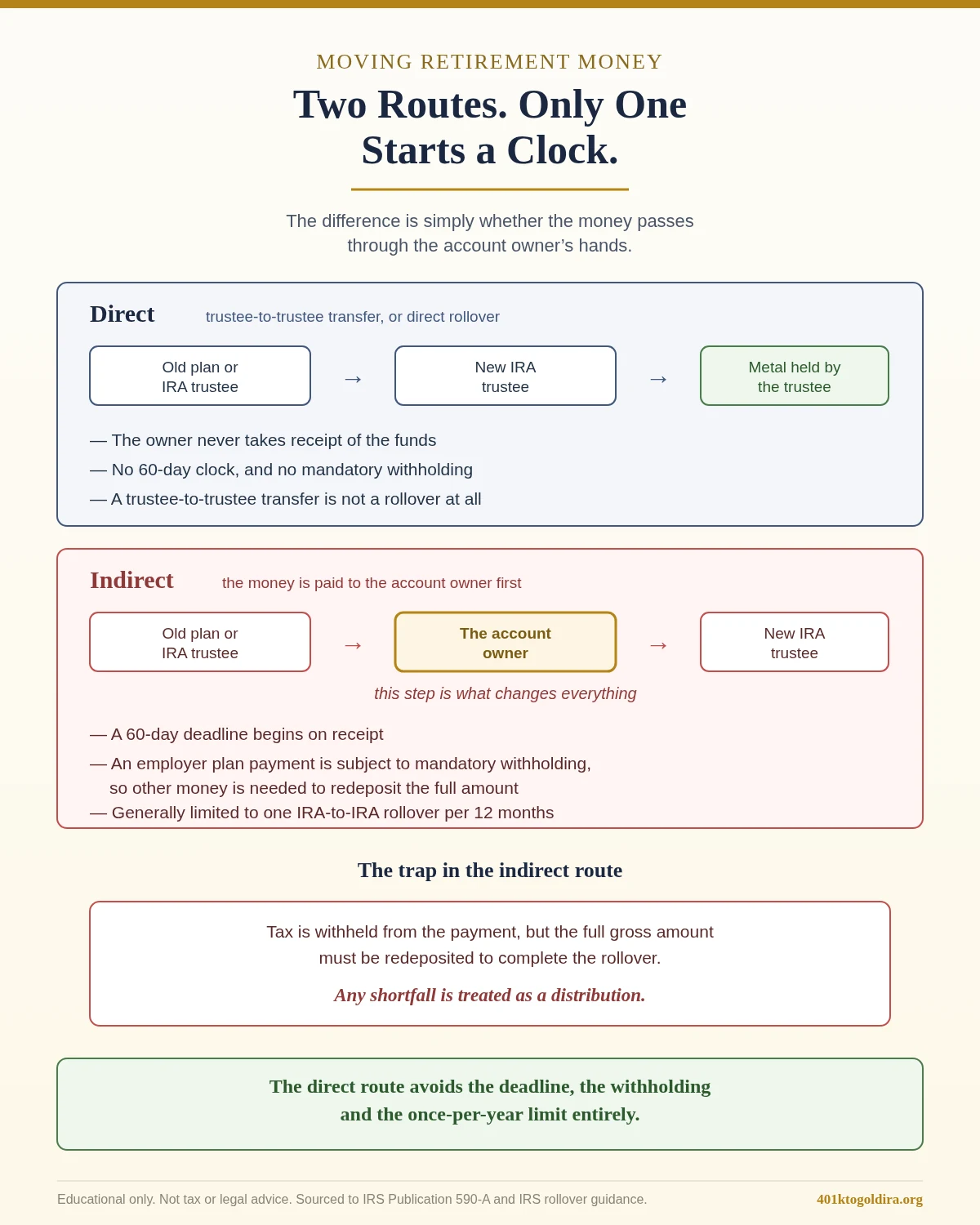
When a distribution is paid to the account holder rather than moved directly, three rules attach, and they differ by source:
- Employer plans withhold 20%, mandatorily. The IRS states a plan distribution paid to the participant carries 20% federal withholding "even if you intend to roll it over later". To complete a full rollover, the withheld amount must be made up from other funds within the deadline, or it becomes a taxable distribution itself. C-015
- IRAs default to 10% — but it can be waived. An IRA distribution paid to the owner carries 10% withholding unless the owner elects out. This page states it precisely because the IRS page does: it is a waivable default, not "no withholding". C-016
- The 60-day deadline applies to both, with a defined waiver process for circumstances such as institutional error. C-018
Withholding and deadline illustrator
- Withheld
- —
- Cash actually received
- —
- To roll the full gross, add from other funds
- —
- 60-day deadline
- —
Enter an amount to see the illustration.
Illustrative federal withholding only. It ignores state tax, after-tax basis, any exception, and the participant's actual tax liability, and it is not a tax conclusion. A direct trustee-to-trustee transfer avoids both the withholding and the deadline entirely. C-017
Direct trustee-to-trustee movement avoids all three, which is why it is the standard route for a gold IRA rollover. The 401(k)-specific version of this analysis — the distributable-event gate, tax character by source and the direct-versus-participant-paid choice — is worked through on the 401(k) to Gold IRA rollover guide. The mechanics and common failure modes are covered in Gold IRA tax mistakes. And eligibility is only the way in — what happens when money or metal eventually comes back out, with its own timelines and fee layers, is benchmarked in the distribution benchmark.
Which Amounts Cannot Be Rolled Over at All?
Eligibility is not only about the account type. Some distributions cannot be rolled over whatever the destination, and the IRS keeps two separate lists. Confusing them is a common error, because the plan list is much longer than the IRA list. C-014
From an IRA, the IRS states you can roll over all or part of any distribution except:
- a required minimum distribution; or
- a distribution of excess contributions and related earnings.
From an employer retirement plan, the excluded list is longer:
- required minimum distributions;
- loans treated as a distribution;
- hardship distributions;
- distributions of excess contributions and related earnings;
- a distribution that is one of a series of substantially equal payments;
- withdrawals electing out of automatic contribution arrangements;
- distributions to pay for accident, health or life insurance;
- dividends on employer securities; and
- S corporation allocations treated as deemed distributions.
The IRS calls what remains an eligible rollover distribution. The practical consequence for anyone funding a gold IRA: an RMD already due for the year cannot be moved into the new account. Attempting it does not make it disappear — it remains a taxable distribution, and an amount paid into an IRA that was never eligible can be treated as an excess contribution and taxed at 6% per year for as long as it stays there. C-013 (IRS: Rollovers of retirement plan and IRA distributions, checked 1 September 2026)
Where Does the Once-Per-Year Rule Actually Apply?
IRA-to-IRA indirect rollovers only. The IRS page is explicit that the limit excludes: rollovers from plans to IRAs, from IRAs to plans, plan-to-plan movements, trustee-to-trustee transfers, and traditional-to-Roth conversions. C-019
Where it does apply, it aggregates across all of a person's IRAs — traditional, SEP and SIMPLE together — following Bobrow v. Commissioner and IRS Announcement 2014-32. One indirect IRA-to-IRA rollover per 12 months, total, not per account.
A footnote on the IRS Rollover Chart can mislead here: it attaches the once-per-year note to plan-to-IRA cells, but the prose page confirms plan-to-IRA rollovers are outside the limit. The footnote is best read as flagging the rule that attaches to the money once it is in an IRA. C-021
Checklist and Questions to Take to the Administrator
Because the plan document decides, the practical value of this table is the question list it hands over. Tick what is already held; the rest copies as plain text for an email.
Documents to gather 0 / 13
Questions for the plan administrator
- Which distributable events does this plan actually offer, as opposed to those federal law permits?
- Has a distributable event occurred for this participant, and on what date?
- Does the plan permit an in-service distribution, and at what age?
- Is any part of the balance a designated Roth account with separate accounting?
- Will the plan pay by direct trustee-to-trustee transfer to an IRA?
- What exact payee wording and account title should appear on the election form?
- Does a default election apply if no form is returned, and what is that default?
- Is any part of the distribution a required minimum distribution for this year?
- Is any part of it a hardship distribution, a loan offset, or another amount that cannot be rolled over?
- What withholding will be applied, and can it be avoided by moving directly?
- How long does the plan take to process a direct transfer once the form is complete?
- What is the plan's formal claims procedure if the participant disagrees with the answer?
Questions for the receiving custodian
- Which account type is being opened: a traditional IRA, a SEP IRA, or a Roth IRA?
- Will the custodian accept an incoming direct rollover from this specific plan type?
- What exact account title and delivery instructions should the sending plan use?
- Is the account open and correctly titled before the plan releases anything?
- How will the incoming amount be reported, and when will confirmation arrive?
- For a SIMPLE IRA source, does the custodian require evidence that the 2-year window has closed?
- Which of these answers are the custodian's own policy rather than a federal requirement?
Source and Claim Register
This register is plain HTML on the page, not assembled by script, so it is readable, linkable and indexable on its own. Every substantive claim in the matrix resolves to one of the numbered sources below. C-020
Sources
- S1 — IRS Rollover Chart (undated PDF) The anchor citation for the grid itself. It carries no printed revision date and its metadata suggests a 2016 vintage, but it remains linked from the IRS rollovers page and nothing has superseded it.
- S2 — IRS — Rollovers of retirement plan and IRA distributions Last reviewed 31 May 2026. Source for withholding, the 60-day deadline, the eligible-rollover-distribution exclusion lists and the scope of the once-per-year rule.
- S3 — IRS — 401(k) resource guide: general distribution rules The permitted distributable events for elective deferrals, and the recurring “a plan may, but is not required to, allow” language that makes plan permission the second key.
- S4 — 26 U.S.C. §457(d)(1)(A)(i) The in-service distribution age for governmental plans. This is the controlling text in the conflict flagged in section 1, and the reason this page asserts no in-service age for governmental 457(b).
- S5 — 26 U.S.C. §408(d)(3)(G) The statutory basis for the SIMPLE IRA 2-year rule.
- S6 — IRS — retirement topics: SIMPLE IRA contribution limits States that a payment to a non-SIMPLE IRA inside the 2-year window is neither a tax-free trustee-to-trustee transfer nor a rollover contribution.
- S7 — IRS — 403(b) plan distribution rules (named in the dataset; no direct URL asserted) Named as a primary source for the 403(b) row in the published matrix dataset. No direct page URL is asserted here, because none was captured when this register was built; the row's eligibility itself rests on the Rollover Chart (S1).
- S8 — TSP — taking money from your account, and booklet TSPBK12 (May 2024) (named in the dataset; no direct URL asserted) Source for the TSP row's unlocking events, cited in the published dataset. No direct page URL is asserted here for the same reason as S7.
Claims and publication decisions
| ID | Claim | Authority | Kind | Decision |
|---|---|---|---|---|
| C-001 | Six of the ten compared account types can reach a traditional gold IRA. | IRS Rollover Chart (S1) | rule | Published |
| C-002 | Pre-tax 403(b) balances roll to a traditional IRA, and the plan may but need not allow each unlocking event. | S1; S7 | condition | Published |
| C-003 | TSP unlocking events are separation, or an age-59½ in-service withdrawal. | S8 | rule | Published |
| C-004 | Governmental 457(b) rolls to a traditional IRA, and severance is an unlocking event. | S1; S4 | rule | Published |
| C-005 | Employer-plan eligibility requires both a federal distributable event and plan permission. | S3 | rule | Published |
| C-006 | Governmental 457(b) in-service age: IRS topic pages indicate 70½; IRC §457(d)(1)(A)(i) sets 59½ for governmental plans. | IRS topic pages vs. S4 | conflict | PRESERVED — no in-service age asserted |
| C-007 | Non-governmental 457(b) is not an eligible rollover source; the Chart lists only governmental 457(b). | S1 (by absence) | exception | Published |
| C-008 | The SIMPLE IRA 2-year clock runs from the first employer deposit; earlier movement to another kind of IRA is a distribution with an increased 25% early-distribution rate. | S5; S6 | condition | Published |
| C-009 | A Roth IRA cannot roll to a traditional IRA; Roth-to-Roth only. | S1 | rule | Published |
| C-010 | Designated Roth accounts roll only to a Roth IRA or another designated Roth account. | S1 | rule | Published |
| C-011 | A traditional IRA and a SEP IRA require no distributable event. | S1 | rule | Published |
| C-012 | Hardship distributions cannot be rolled over. | S3 | exception | Published |
| C-013 | An RMD already due cannot be rolled over, and an ineligible amount paid into an IRA can be treated as an excess contribution taxed at 6% per year while it remains. | S2 | rule | Published |
| C-014 | The employer-plan exclusion list is materially longer than the IRA exclusion list. | S2 | rule | Published |
| C-015 | An employer-plan distribution paid to the participant carries mandatory 20% federal withholding. | S2 | rule | Published |
| C-016 | An IRA distribution paid to the owner carries a 10% default withholding, waivable by electing out. | S2 | rule | Published |
| C-017 | Direct trustee-to-trustee movement triggers no mandatory withholding and no redeposit deadline. | S2 | rule | Published |
| C-018 | The 60-day deadline applies to indirect rollovers, with a defined waiver process. | S2 | rule | Published |
| C-019 | The once-per-12-months limit applies to IRA-to-IRA indirect rollovers only, aggregated across all of a person's IRAs. | S2; Bobrow v. Commissioner; Announcement 2014-32 | rule | Published |
| C-020 | The IRS Rollover Chart carries no printed revision date and is of approximately 2016 metadata vintage, but is unsuperseded. | Chart metadata; S2 | source vintage | Published with the vintage stated |
| C-021 | Plan-to-IRA rollovers sit outside the once-per-year limit despite the placement of the Chart's footnote. | S2 | rule | Published as a clarification |
A Note on the Sources
The anchor citation is the IRS Rollover Chart. It carries no printed revision date — its metadata suggests a 2016 vintage — but it remains linked from the IRS rollovers page, which was last reviewed 31 May 2026, and nothing has superseded it. This page therefore cites the chart for the grid and the dated prose pages for mechanics, and states the vintage rather than overclaiming currency. C-020
Where an IRS topic page and the Internal Revenue Code conflict — as with the 457(b) in-service age — this page flags the conflict rather than silently picking a side. TSP-side rules are cited to tsp.gov and its dated booklet TSPBK12 (May 2024). Two sources in the register are named without a direct URL, because no link for them was captured when the register was built and a guessed URL would be a fabricated citation.
What the tools on this page cannot do. Each one is an illustration built from the published table. None of them reads a plan document, calculates a tax liability, produces a personal due date, or makes a recommendation. Nothing is saved, and nothing is transmitted anywhere.
FAQ
Which retirement accounts can roll into a gold IRA?
Pre-tax 401(k), 403(b), governmental 457(b), TSP, traditional IRA and SEP IRA balances can generally roll in. SIMPLE IRAs qualify after 2 years. Roth IRAs and non-governmental 457(b) plans cannot.
Can a rollover happen while still employed?
Sometimes — IRS rules permit in-service distributions at 59½ for 401(k) and 403(b) elective deferrals, but only if the plan offers them. Both keys must turn.
What is the SIMPLE IRA 2-year rule?
For 2 years from the employer's first deposit, a SIMPLE IRA may only move to another SIMPLE IRA. Breaking the window is a distribution with a 25% early tax unless an exception applies.
Can a Roth IRA fund a gold IRA?
Not a traditional one — Roth IRAs roll only to Roth IRAs. Holding metals in a self-directed Roth IRA is a separate arrangement funded from Roth sources, set out in the Roth Gold IRA guide.
How much withholding applies to an indirect rollover?
20% mandatory from employer plans; 10% default from IRAs, which the owner can elect out of; none for direct trustee-to-trustee movement.
Does the once-per-year rule block a 401(k) rollover?
No. It applies only to IRA-to-IRA indirect rollovers, aggregated across all of a person's IRAs.
Do income limits affect rollover eligibility?
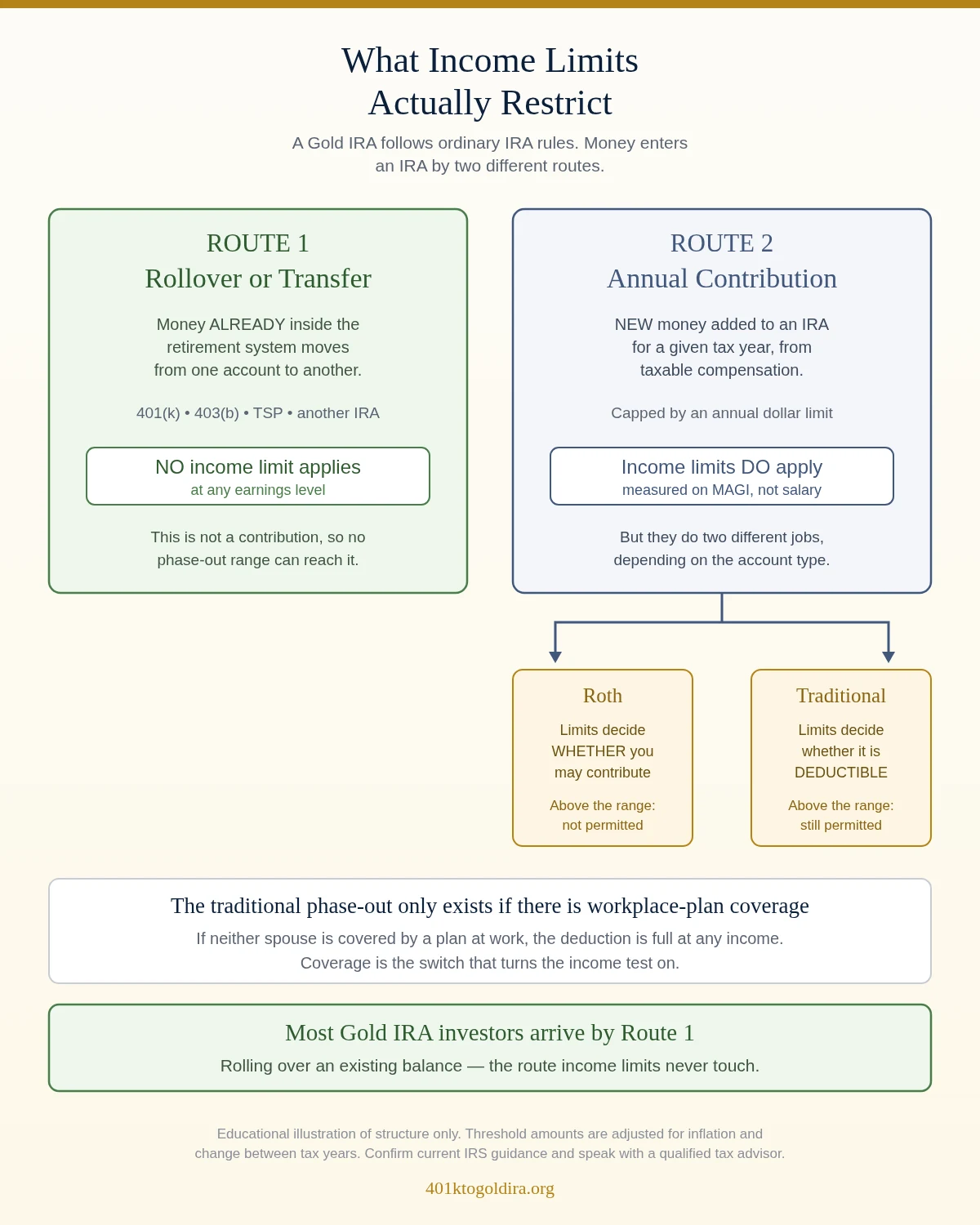
No. Income limits govern annual contributions and traditional-IRA deductibility, not rollovers. The income limits guide covers that separate question.
Reviewed and edited by Daniel M. — Editor, 401kToGoldIRA.org. Last verified: September 29, 2026.
Update History
- September 2026: Interactive upgrade. Added the account console, the rollable-only table filter, the two-key lock checker, destination-path tabs, the SIMPLE two-year clock, the withholding and deadline illustrator, the document checklist and copyable question lists, and a server-rendered source and claim register (C-001 to C-021). No legal claim was added or changed: every cell still traces to the sources verified in August, and the governmental 457(b) conflict remains preserved rather than resolved.
- August 2026: Initial publication. All rules verified against live IRS and TSP pages; the governmental 457(b) in-service age conflict between IRS topic pages and IRC §457(d)(1)(A)(i) documented rather than resolved.