The Rule of 55 Has a Second Gate: Whether Your 401(k) Plan Lets You Take Partial Withdrawals After You Leave
Most explanations of the Rule of 55 stop at the tax code, which is only half the answer. The tax rule can remove the penalty; the plan document decides whether you can take money in pieces at all. This page assembles the best public evidence on that second gate, states the scope of every figure in the sentence that carries it, and keeps the measures that are routinely blurred together firmly apart. Customers should speak to a financial or tax advisor before making decisions.

Educational only: This page reports published plan-design statistics from named primary sources. It does not state what any individual plan permits, and it is not financial, tax or legal advice. Only the plan document and the plan administrator can confirm the distribution options on a particular account. Readers should speak to a financial or tax advisor before making decisions about their own account.
43% of Vanguard-recordkept plans permitted terminated participants to take ad hoc partial cash distributions in 2025 — a percentage of plans in Vanguard's recordkeeping universe, not of all U.S. 401(k) plans.
Source: Vanguard, How America Saves 2026, Figure 114 “Distribution options, 2025” (percentage of plans; more than 1,300 qualified plans and nearly 5 million participants as of 31 December 2025). Observed 30 September 2026. S1
Key takeaways
- 68% of Vanguard-recordkept plans allowed installment payments other than RMDs in 2025 (percentage of plans). A separate feature from ad hoc partial distributions. S1
- 26% of Vanguard-recordkept plans with fewer than 500 participants permitted ad hoc partial distributions in 2025 (percentage of plans). S1
- 78% of Vanguard-recordkept plans with 5,000 or more participants permitted them (percentage of plans). An association with plan size, not a causal claim. S1
- 79% of participants in Vanguard-recordkept plans were offered ad hoc partial distributions in 2025 (percentage of participants offered). Participant-weighted, and not to be mixed with the 43% plan-weighted figure. S1
- 16% of Vanguard-recordkept plans permitted partial distributions in 2015, the start of the ten-year series that reaches 43% in 2024 (percentage of plans). S2
- 73% of Callan's 80 mega DC plan sponsors offered partial distributions as a retirement income solution in 2025 — a large-plan comparator that sits close to Vanguard's 78% for plans with 5,000 or more participants. S3
- 36% of private-industry workers participating in savings and thrift plans had installments available as a method of retirement benefit distribution in 2019. Worker-weighted government context, on a different unit from the Vanguard series. S4
Most explanations of the Rule of 55 stop at the tax code. They tell you that if you leave your employer in or after the year you turn 55, distributions from that employer's plan escape the 10% additional tax on early withdrawals S5. The IRS states the exception in one line: “Distributions made to you after you separated from service with your employer after attainment of age 55.” That is correct, and it is also only half the answer. The tax rule says nothing about whether the plan will let you take a few thousand dollars in March and a few thousand more in September. That decision belongs to the plan document, and many plans do not allow it.
The best public evidence on this second gate comes from Vanguard's recordkeeping data. In 43% of the plans Vanguard recordkeeps, a terminated participant could take an ad hoc partial cash distribution in 2025 S1. In the rest, the recordkeeper's own words apply: “If a plan does not offer ad hoc distributions, it requires any terminated participant seeking to use any part of their retirement savings to withdraw or roll over the entire account balance.” That universe covers more than 1,300 qualified plans and nearly 5 million participants as of December 31, 2025 S1. It is not a census of all U.S. 401(k) plans, and this page does not treat it as one.
What the data does show clearly is that plan size changes the picture. Among Vanguard-recordkept plans with fewer than 500 participants, 26% permitted ad hoc partials; among plans with 5,000 or more participants, 78% did S1. That gap, not any single national percentage, is the finding a saver considering the Rule of 55 needs to understand before deciding whether to leave money in a former employer's plan or move it to an IRA through a rollover.
What Does Vanguard's 2026 Data Actually Show About Partial Withdrawals?
| Measure (percentage of plans, 2025) | Value | Source |
|---|---|---|
| Plans permitting ad hoc partial distributions for terminated participants | 43% | S1 |
| Plans allowing installments other than RMDs | 68% | S1 |
| Qualified plans in Vanguard's recordkeeping universe (more than) | 1,300 | S1 |
| Participants in that universe (nearly) | 5 million | S1 |
43% of Vanguard-recordkept plans permitted terminated participants to take ad hoc partial cash distributions in 2025. In the others, using any part of the balance means withdrawing or rolling over all of it. S1
The definition matters as much as the number. Vanguard's table separates “Installments other than RMDs” from “Ad hoc partial distributions,” and the prose describes the second feature as what permitted terminated participants to take partial ad hoc cash distributions. The population is terminated participants of any age, which is the right population for a Rule-of-55 reader, since the exception only applies after separation from service.
The universe is Vanguard's own client book: the plans for which it directly provides recordkeeping services, with data as of December 31, 2025 S1. Vanguard also notes in its methodology that plan-design results are restated the following year once final compliance testing is complete, so the figures cited here are dated to the 2026 edition. A reader who wants the national picture should know that no public source provides one; the reasons are covered in the government-data section below. The same second gate applies to 403(b) plans after separation, where the age-55 exception works the same way and the plan document still governs the mechanics.
How Much Does Plan Size Change the Odds, From 26% to 78%?
| Plan size (participants) | Ad hoc partials | Source |
|---|---|---|
| Fewer than 500 | 26% | S1 |
| 500 to 999 | 43% | S1 |
| 1,000 to 4,999 | 57% | S1 |
| 5,000 or more | 78% | S1 |
| Installments, fewer than 500 | 61% | S1 |
| Installments, 500 to 999 | 68% | S1 |
| Installments, 1,000 to 4,999 | 72% | S1 |
| Installments, 5,000 or more | 88% | S1 |
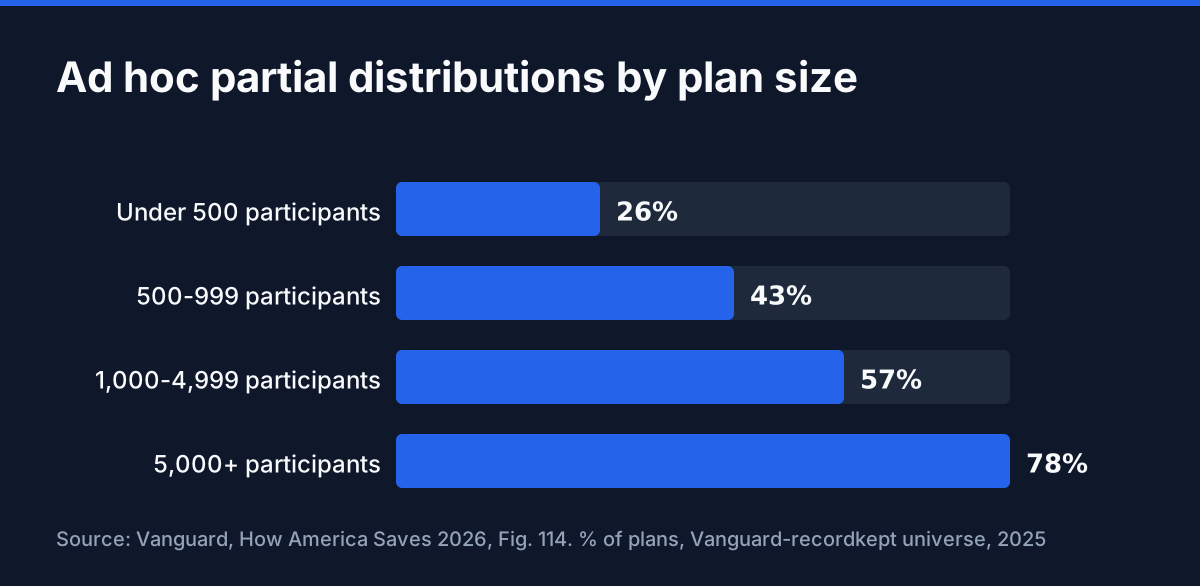
This is the most useful table in the public record on the question, because it tells a reader which way the odds lean before they call the plan administrator. A participant leaving a small employer is, in Vanguard's data, far less likely to find an ad hoc partial option than one leaving a large one. The same gradient appears for installments, though installments are more common at every size.
Two cautions apply. First, this is an association with plan size, not proof that size causes the difference; larger plans may differ in industry, governance, or recordkeeping arrangements in ways the table does not capture. Second, the bands describe groups of plans, not any individual plan. A small plan can permit partials and a large one can refuse them. The table narrows the question; it does not answer it for your plan, which is why the checklist further down this page exists. Readers weighing a move to an IRA can also compare the early withdrawal rules that apply after a rollover, which differ from the employer-plan exception.
Why Must Partial Withdrawals, Installments, and the Two Weightings Stay Separate?
| Measure, 2025 | Value | Source |
|---|---|---|
| Installments other than RMDs, percentage of plans | 68% | S1 |
| Ad hoc partial distributions, percentage of plans | 43% | S1 |
| Installments, percentage of participants offered | 89% | S1 |
| Ad hoc partials, percentage of participants offered | 79% | S1 |
| Ad hoc partials offered, participants in plans under 500 | 32% | S1 |
| Ad hoc partials offered, participants in plans of 5,000 or more | 87% | S1 |
| 2021 retirees in flexible plans who set up installments in year one (usage) | 7% | S2 |
| Remaining 2021 retirees using installments or partials after three years (usage) | 3 in 10 | S2 |
79% of participants in Vanguard-recordkept plans were offered ad hoc partial distributions in 2025. The plan-weighted figure for the same feature is lower because most plans are small and most participants are in large plans. S1
For a Rule-of-55 saver the feature distinction is practical. Someone bridging a few years to Social Security or a pension may want a fixed monthly amount, which an installment feature handles well. Someone covering an irregular expense, a roof, a tax bill, or a gap between jobs, needs ad hoc access. An article or advisor that says a plan “allows partial withdrawals” without saying which feature has left out the important part, and this is why the figures on this page are never added or averaged: the installment rate and the ad hoc rate come from the same plans but measure different provisions. A saver who decides the plan's options are too narrow and moves the balance through a direct 401(k) rollover trades the age-55 exception for the IRA rules, which is a separate decision from anything in this table.
The weighting distinction decides which number a reader should use. If the question is “what will I probably find when I look at my own plan,” the plan-weighted figure and the size bands are the guide. If the question is “what share of workers have this option,” the participant-weighted figure is closer. Neither is a national rate. A third measure, actual usage, is different again: among 2021 retirees who stayed in a plan with flexible options, 7% set up installments in the first year and another 7% took partial withdrawals, rising to about 3 in 10 of remaining participants after three years S2. Usage records what people did, not what plans permit. Anyone planning early-retirement withdrawals should treat availability as the first question and usage as background.
How Did Access Change From 2015 to 2025?
| Year (percentage of plans) | Ad hoc partials | Source |
|---|---|---|
| 2015 | 16% | S2 |
| 2020 | 35% | S2 |
| 2021 | 37% | S1 |
| 2022 | 39% | S1 |
| 2023 | 40% | S1 |
| 2024 | 43% | S1 |
| 2025 | 43% | S1 |
| Installments, 2015 | 59% | S2 |
| Installments, 2020 | 63% | S2 |
| Installments, 2025 | 68% | S1 |
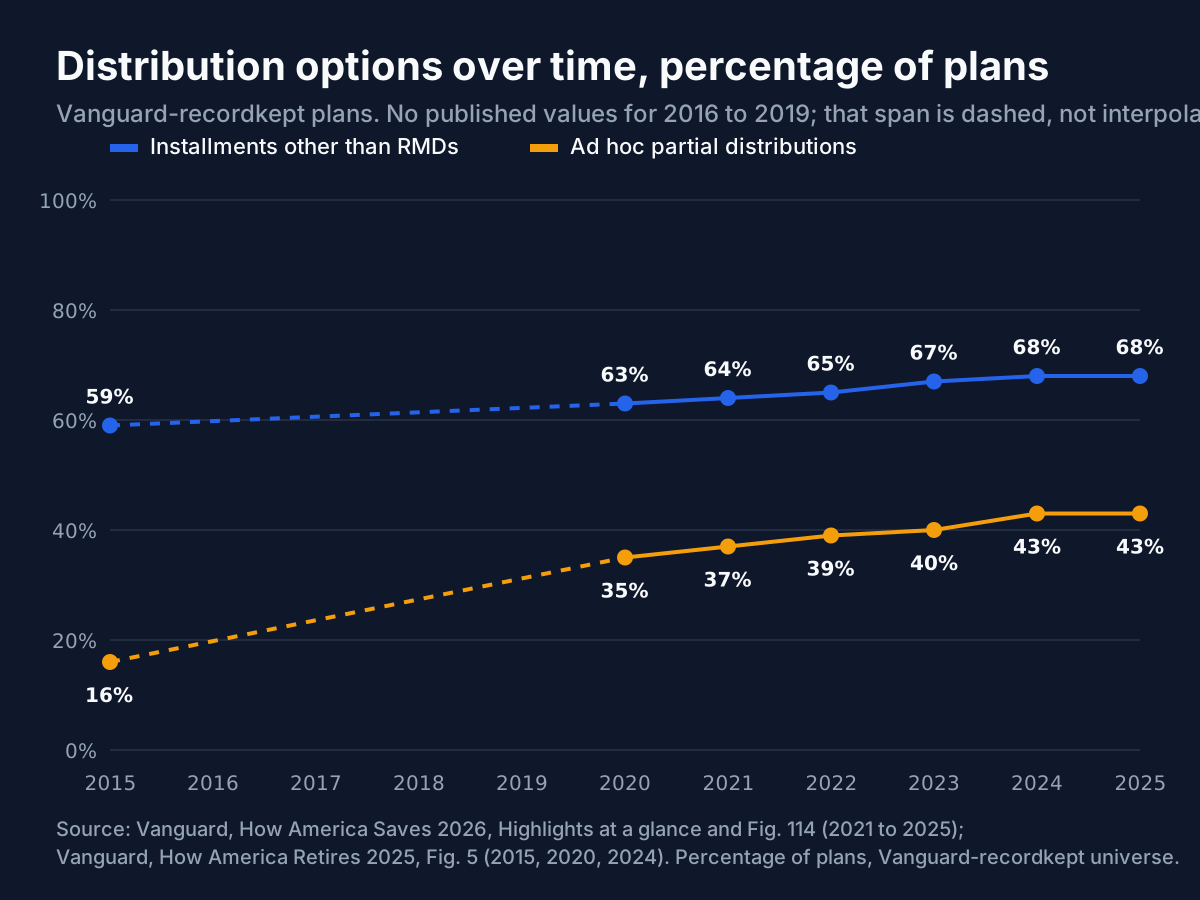
Seven points from one publisher under one definition is enough to call a trend, and the direction is clear: ad hoc access has more than doubled across a decade of Vanguard-recordkept plans, while installments have moved up more modestly from a higher base. The 2024 value appears in both Vanguard reports at the same level, a useful check that the two series line up. There are no published values for 2016 through 2019, and the chart leaves that span open rather than filling it in.
The figures here are taken from the reports' figure tables, not their prose. Vanguard's own summaries give different historical baselines in different places, so a reader comparing this page to a Vanguard executive summary may see a different “up from” number. The tables are the authoritative version, and they are what this page cites. The improvement also does not close the small-plan gap; it has lifted every size band without changing the order. For anyone who does move money out, the 60-day rollover deadline is the other clock that starts once a distribution is paid.
Why Doesn't Callan's 73% Contradict Vanguard's 43%?
| Measure | Value | Source |
|---|---|---|
| Callan respondents offering partial distributions (retirement income solution), 2025 | 73% | S3 |
| Callan respondents offering installment payments, 2025 | 79% | S3 |
| Callan respondents (mega DC plan sponsors) | 80 | S3 |
| Callan respondents with more than 10,000 participants | 62% | S3 |
| Vanguard plans with 5,000 or more participants permitting ad hoc partials, 2025 | 78% | S1 |
| Vanguard participants offered ad hoc partials, all plans, 2025 | 79% | S1 |
73% of Callan's mega-plan respondents offered partial distributions in 2025. Once plan size is held constant, this sits close to Vanguard's large-plan figure rather than contradicting its all-plan figure. S3
Callan is a useful comparator and a poor national benchmark. More than 90% of the plans in its survey held over $200 million in assets S3, its question is framed around retirement income solutions rather than terminated-participant rights, and its sample and wording change from year to year. Its role here is to show that a large-plan survey lands where Vanguard's large-plan band lands, which supports the size story rather than undermining the headline.
The lesson for readers is to check the sample before trusting any percentage on this topic. A number drawn from mega sponsors will look generous; a number drawn from all plans will look tight; both can be accurate descriptions of different populations. The force-out rules for small balances add a further wrinkle for former employees, since a plan may push out an account below its threshold regardless of what distribution options it offers above it.
What Can Government Data Tell Us, and What Can't It?
| BLS measure (percentage of participating workers) | Value | Source |
|---|---|---|
| Installments available, all workers, 2019 | 36% | S4 |
| Lump sum available, all workers, 2019 | 92% | S4 |
| Installments available, establishments with 500 or more workers, 2019 | 42% | S4 |
| Installments available, union workers, 2019 | 57% | S4 |
| Installments available, all workers, 2017 | 38% | S6 |
36% of workers participating in savings and thrift plans had installments available as a distribution method in 2019, per BLS. This is worker-weighted and measured at retirement, so it is context for Vanguard's plan-weighted figures, not a comparison. S4
Three things keep the BLS table from answering the Rule-of-55 question directly. Its base is workers covered, not plans and not participants offered. Its unit is “savings and thrift plans,” a BLS classification broader than 401(k) plans. And it measures methods of distribution at retirement rather than what a separated participant of any age may do. Its footnote also states that multiple methods are available to some employees, which is why the lump-sum and installment columns add to more than the total and why subtracting one from the other would produce a fiction. BLS has not published this table since its 2022 edition, and its own glossary does not define installments for defined contribution plans.
Two other government routes lead nowhere. Department of Labor Form 5500 filings, the annual report every plan submits, do not collect whether a plan permits partial or installment distributions, so the largest plan database in the country cannot answer this question. The Plan Sponsor Council of America's annual survey covers hundreds of plans across all sizes, but its distribution-option tables are paid and its free release carries none, so no figure from it appears here. That absence is the reason a recordkeeper's client book is the best public evidence available, and the reason this page states its scope in every sentence that carries a number. Readers comparing an employer plan with an IRA can also review the distribution benchmarks for self-directed accounts, which are governed by different rules entirely.
What to Ask Your Former Employer or Plan Administrator
What this means if you are considering the Rule of 55. The tax exception clears one gate. The plan document is the second, and the data above says the odds of a flexible option are meaningfully lower at a small former employer than at a large one. Before deciding whether to leave the balance in the plan, roll it to an IRA, or take a full distribution, get the plan's distribution rules in writing. The questions below are the ones to ask; the answers come from your plan, not from this page.
Ask the plan administrator, or check the summary plan description, whether the plan permits after separation:
- Ad hoc partial distributions — a withdrawal of an amount you choose, on request
- Installment payments — a scheduled series of payments you set up
- Both features
- Only a full distribution or a rollover of the entire balance
Also confirm:
- Whether you separated from service in or after the year you reached the exception age — the tax rule, separately from the plan's distribution terms
- Any minimum amount, frequency limit, fee, or form required for a partial or installment request
- Whether a small balance is subject to the plan's force-out rules regardless of the options above
- Whether rolling the balance to an IRA would change which early-withdrawal rules apply to it
This checklist does not state what your plan permits. Only the plan document and administrator can answer that.
Methodology and Limitations
This page draws its central figures from Vanguard's How America Saves 2026 (Figure 114 and the Highlights at a glance table) and How America Retires 2025 (Figure 5), which describe the qualified plans for which Vanguard directly provides recordkeeping services: more than 1,300 plans and nearly 5 million participants as of December 31, 2025. These are the only public sources found that publish plan-weighted availability of ad hoc partial distributions and installments under a stated definition, with plan-size bands and a multi-year series. They are not a random or complete sample of U.S. 401(k) plans, and Vanguard notes that plan-design results may be restated in the following edition.
Callan's 2026 Defined Contribution Trends Survey is used only as a large-plan comparator. Bureau of Labor Statistics National Compensation Survey tables (2017 and 2019) are cited only as context: they are worker-weighted, cover savings and thrift plans rather than 401(k) plans specifically, measure distribution methods at retirement, and use overlapping categories, so no lump-sum-only share can be derived from them. The Plan Sponsor Council of America's survey tables on this topic are paid and were not obtained; Department of Labor Form 5500 filings do not collect distribution-option provisions. The IRS page is cited only for the wording of the age-55 separation-from-service exception. Every figure was checked against the live source document by an automated verifier that also confirms quoted wording verbatim; every source was reachable at research time. Nothing on this page states what any individual plan permits.
- Sources consulted: 14; sources cited: 6.
- Data range: 2015 data through 2025 data; reports published April 2018 to June 2026.
- Research date: 30 September 2026. 60 of 60 figures verified against live primary documents; 3 quotations matched verbatim.
- Update schedule: annually, after each How America Saves edition (June) and How America Retires edition (November). Restated figures are re-checked at each update.
- Limitations: the primary series is one recordkeeper's client universe, not a census or random sample of U.S. 401(k) plans, and it likely skews toward larger plans. No independent public plan-weighted source with the same definition was found. How America Retires defines its retiree population as terminated participants aged 60 and over, which is not the age 55 to 59 Rule-of-55 group. Callan is a small mega-plan sample with changing question wording.
Sources last reviewed: 30 September 2026. How figures on this site are produced and checked is set out in the research methodology, and errors are handled under the corrections policy.
Frequently Asked Questions
Does the Rule of 55 guarantee I can take partial withdrawals from my old 401(k)?
No. The IRS exception only removes the additional tax on distributions made after you separate from service with your employer after reaching age 55. Whether the plan pays you in pieces is set by the plan document. Vanguard states that a plan without ad hoc distributions requires a terminated participant who wants any part of the balance to withdraw or roll over the entire account.
What share of 401(k) plans let a separated participant take a partial withdrawal?
There is no national figure. The best public measure is Vanguard's: 43% of plans in its recordkeeping universe (more than 1,300 qualified plans, nearly 5 million participants, as of December 31, 2025) permitted terminated participants to take ad hoc partial cash distributions in 2025. That is a percentage of Vanguard-recordkept plans, not of all U.S. 401(k) plans.
Are installment payments the same as partial withdrawals?
No. Installments are scheduled payments the participant sets up; ad hoc partial distributions are withdrawals on request. Vanguard reports them separately: 68% of its recordkept plans allowed installments other than RMDs in 2025, while 43% permitted ad hoc partial distributions. A plan can offer one without the other, so the two figures should never be combined.
Does the size of my former employer's plan matter?
In Vanguard's data, yes. Ad hoc partial distributions were permitted by 26% of recordkept plans with fewer than 500 participants and 78% of plans with 5,000 or more participants in 2025. That is an association with plan size, not proof that size causes it, and it does not tell you what any particular plan permits.
Has access to partial withdrawals improved over time?
Within Vanguard's plan-weighted series, yes. Plans permitting partial distributions rose from 16% in 2015 to 35% in 2020 and 43% in 2024, with 2025 also at 43%. Installments other than RMDs moved from 59% to 68% over the same decade. The figures are read from the reports' figure tables, not their prose summaries.
Why do some surveys report much higher availability than 43%?
Sample composition. Callan's 2026 survey found 73% of respondents offering partial distributions, but it covered 80 mega plan sponsors, 62% of them with more than 10,000 participants. Vanguard's figure for plans with 5,000 or more participants is 78%, so the sources agree once plan size is held constant. Callan is a large-plan comparator, not a national cross-check.
Where the Decision Goes From Here
Two questions sit behind this page, and they are worth keeping apart. The first is what your former employer's plan permits, which is settled entirely by the plan document and the administrator, and which nothing on this page can answer for an individual account. The data above only tells you which way the odds lean before you ask.
The second question, which only arises once the first is answered, is what you may choose to do with the account afterward. Leaving the balance in the plan, taking a full distribution, and moving it to an IRA are all lawful options with different consequences, and none of them is required in order to use the Rule of 55. Moving a balance to an IRA in particular trades the employer-plan age-55 exception for the IRA rules, which is a genuine trade rather than an improvement in itself. That second question turns on individual circumstances this page cannot see, so it stops where the plan-design evidence stops. For the tax arithmetic on a distribution once the plan does permit one, the 401(k) withdrawal tax and penalty calculator estimates the income tax, the additional tax and the 20% withheld at payout, and asks for your age in the year you separated rather than your age now.
Sources
Six primary sources, all reachable when checked on 30 September 2026. Government authorities are linked; commercial publishers are cited in plain text with title, publisher and date, which is this site's standing practice on pages carrying an affiliate relationship.
- S1 — The Vanguard Group, “How America Saves 2026 (25th edition), Figure 114 “Distribution options, 2025”; Highlights at a glance; Methodology” (June 2026). Observed 30 September 2026; cited in plain text, not linked. The anchor source for every plan-weighted and participant-weighted figure on this page. Describes the qualified plans for which Vanguard directly provides recordkeeping services, as of 31 December 2025. Not a census or random sample of U.S. 401(k) plans.
- S2 — The Vanguard Group, “How America Retires 2025, Figure 5 “Distribution option trends”; Figure 14; footnote 8” (10 November 2025). Observed 30 September 2026; cited in plain text, not linked. Carries the 2015, 2020 and 2024 points of the ten-year series, and the usage figures. Its “retiree” population is terminated participants aged 60 and over, which is not the age 55 to 59 group this page is about.
- S3 — Callan LLC, “Callan 2026 DC Survey: What Sponsors Should Know (summary of the 2026 Defined Contribution Trends Survey, 19th edition)” (15 April 2026). Observed 30 September 2026; cited in plain text, not linked. A mega-plan comparator only. Eighty respondents, 62% of them with more than 10,000 participants, and its question is framed around retirement income solutions rather than terminated-participant rights. Not a national cross-check.
- S4 — U.S. Bureau of Labor Statistics, National Compensation Survey, “Retirement Plan Provisions for Private Industry Workers in the United States, 2019 (Bulletin 2792), Table 29” (April 2020) Worker-weighted context on a different unit. Its categories overlap by the table's own footnote, so no lump-sum-only share can be derived from it by subtraction.
- S5 — Internal Revenue Service, “Topic no. 558, Additional tax on early distributions from retirement plans other than IRAs” (Observed 30 September 2026) Cited only for the wording of the age-55 separation-from-service exception to the 10% additional tax. It says nothing about whether a plan permits partial distributions.
- S6 — U.S. Bureau of Labor Statistics, National Compensation Survey, “Health and Retirement Plan Provisions in Private Industry in the United States, 2017 (Bulletin 2788), Table 20” (May 2018) The earlier edition of the same BLS table, cited only for the 2017 comparison point. BLS has not published this table since its 2022 edition.
How to Cite This Page
Source: 401ktogoldira.org — The Rule of 55 Has a Second Gate: Whether Your
401(k) Plan Lets You Take Partial Withdrawals After You Leave.
https://401ktogoldira.org/rule-of-55-partial-withdrawals/ (sources last reviewed 30 September 2026)
Figures compiled on this page are attributed to the organisation that produced them. Where a figure is quoted, quote the scope with it: every Vanguard rate is a percentage of plans, or of participants offered, within Vanguard's recordkeeping universe, and none is a measure of all U.S. 401(k) plans.
This page is educational and does not evaluate any reader's plan, account or circumstances. It reports published statistics about groups of plans and cannot establish what any individual plan permits; that is answered only by the plan document and the plan administrator. Readers should consult the plan administrator and a qualified tax professional about their own account. Past performance does not guarantee future results.
Reviewed and edited by Daniel M. — Editor, 401kToGoldIRA.org. Last verified: 30 September 2026.
Update History
- September 2026: Initial publication. Sixty figures verified against live primary documents and three quotations matched verbatim on 30 September 2026. The plan-weighted and participant-weighted bases, the ad hoc and installment features, and availability and usage are reported separately throughout and are never combined.
Explore More Retirement Research
This page is part of the Research & Data Center, where every dataset is compiled from named primary sources with its methodology and limitations stated. The research closest to this one: