Educational only: This page explains federal retirement-account tax structure from published law and current IRS materials. It is not financial, tax or legal advice, and it does not recommend one account type over another. Federal treatment depends on the character of the money, prior IRA basis, filing status and transaction structure. This page contains sponsor/affiliate links, and the site owners may be compensated if customers request information from companies shown in those commercial modules. Compensation does not change the tax rules or the source standards used here, and the commercial modules are kept separate from the account comparison. Goldco does not offer tax or legal advice. Past performance does not guarantee future results.
Key takeaways
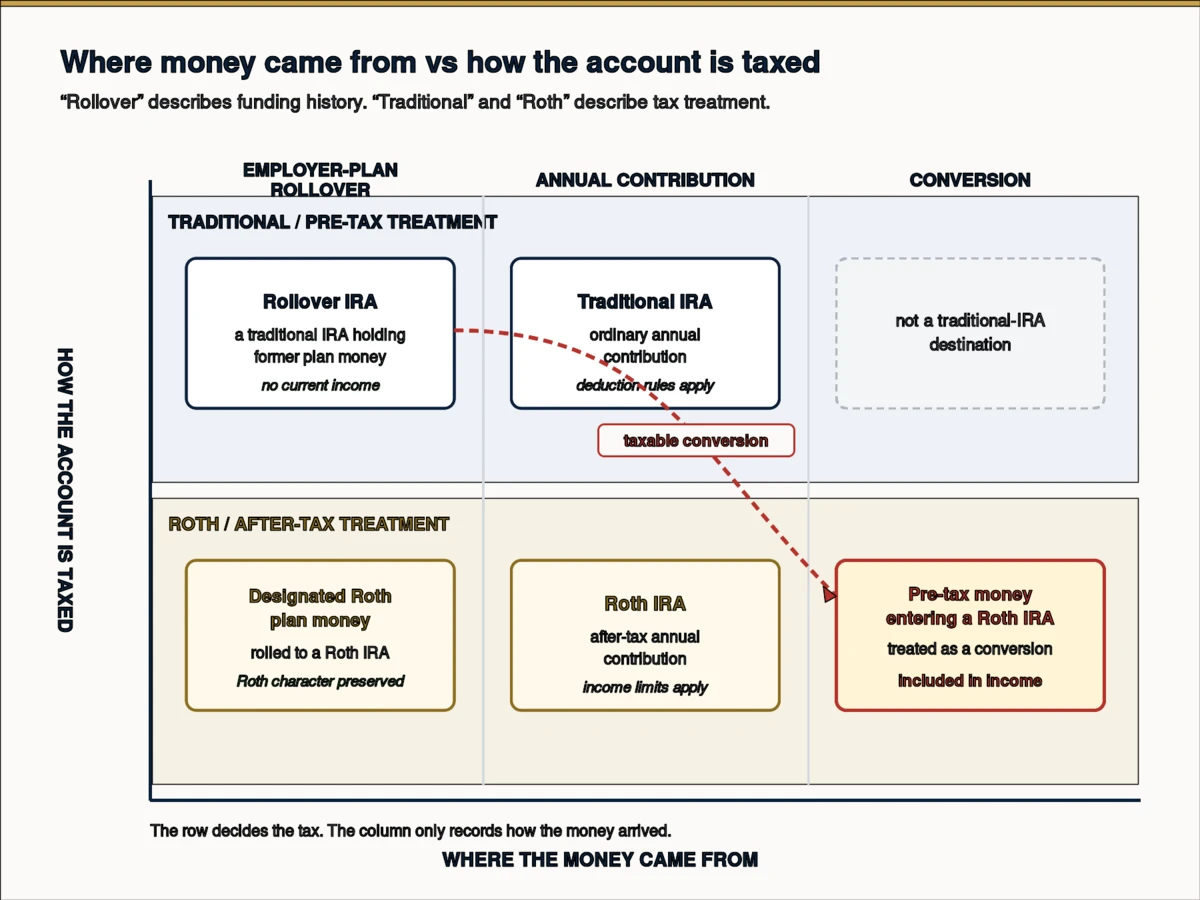
- A rollover IRA is ordinarily a traditional IRA whose balance came from an employer plan. “Rollover” describes funding history; “traditional” and “Roth” describe tax treatment.
- Moving pre-tax employer-plan money to a traditional or rollover IRA is generally not currently taxable, while moving that same pre-tax amount to a Roth IRA generally creates current taxable income.
- Rollover contributions do not consume the annual IRA contribution limit. For tax year 2026 the combined traditional-and-Roth limit is $7,500, or $8,600 at age 50 or older, and those limits apply to regular contributions rather than qualifying rollovers.
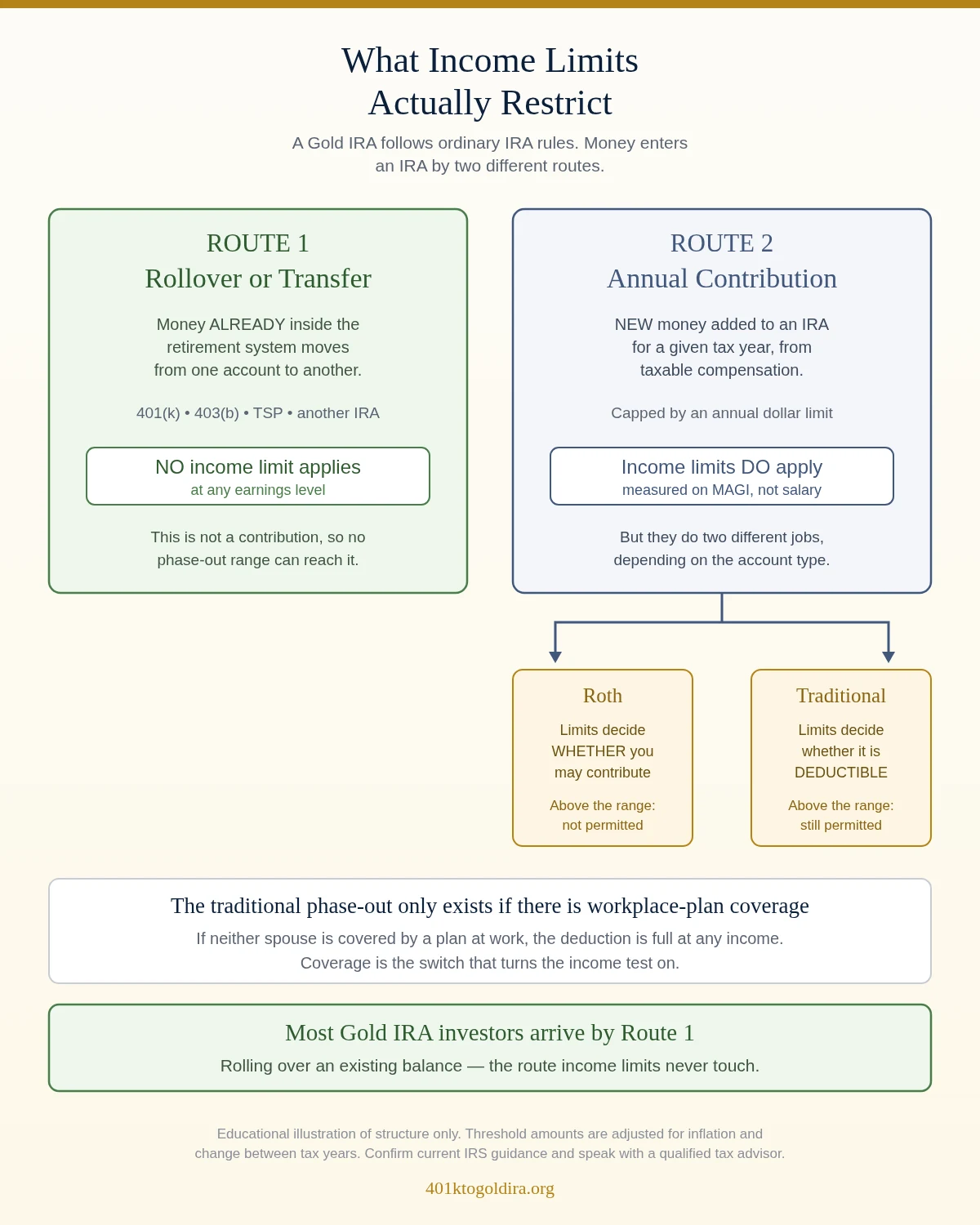
- Roth income limits apply to regular Roth contributions, not to an otherwise permitted conversion. IRS guidance states a conversion may be available regardless of adjusted gross income.
- Mixing annual contributions with rollover money does not by itself create a new federal tax type or automatically bar a later employer-plan rollover, but the receiving plan controls whether it accepts roll-ins.
- Traditional and rollover IRAs are subject to the owner RMD regime; Roth IRAs are not subject to RMDs while the owner is alive.
- Federal bankruptcy protection and state-law creditor protection are separate questions, and protection outside bankruptcy can vary by state.
Are rollover, traditional and Roth IRAs really three different account types?
No. IRC §408 supplies the traditional IRA framework and IRC §408A supplies the Roth framework. IRS Publication 590-A permits eligible employer-plan money to enter a traditional IRA, while Publication 590-B describes IRAs as traditional or Roth. None creates a third federal tax class called a “rollover IRA”.
“Rollover IRA” is therefore a funding-history label, usually for a traditional IRA holding former employer-plan money. That history can still matter for later plan roll-ins, tracing and bankruptcy analysis.
The labels in one table
| Decision factor | Rollover IRA | Ordinary traditional IRA | Roth IRA |
|---|---|---|---|
| What the label mainly describes | Funding history, usually employer-plan money placed in a traditional IRA | Traditional federal IRA tax treatment, whatever the money’s source | Roth federal IRA tax treatment |
| Incoming employer-plan money | Pre-tax eligible rollover generally enters without current income inclusion | Same, because the receiving account is a traditional IRA | Pre-tax amount is generally included in current income |
| Regular annual contributions | Permitted if ordinary IRA contribution rules are met | Permitted if ordinary IRA contribution rules are met | Permitted if compensation and Roth income rules are met |
| Annual contribution limit | Regular contributions count; rollover contributions do not | Regular contributions count; rollover contributions do not | Regular contributions count; qualified rollover contributions do not |
| RMDs for the owner | Traditional-IRA RMD rules apply | Traditional-IRA RMD rules apply | No owner RMDs while alive |
| Qualified withdrawals | Taxable except to the extent of basis | Taxable except to the extent of basis | Qualified distributions are excluded from gross income |
| Future move to an employer plan | Possible only if the plan accepts the rollover type and documentation | Same rule; plan terms control | A Roth IRA generally moves only to another Roth IRA |
How does a rollover IRA versus Traditional IRA comparison work?
The shortest accurate answer is same tax wrapper, different history. When a rollover IRA is a traditional IRA, both accounts generally follow the same rules for tax-deferred growth, taxable distributions, basis recovery, annual contributions and RMDs. Publication 590-B defines a traditional IRA broadly as an IRA that is not a Roth IRA or a SIMPLE IRA.
The meaningful differences are mostly operational. A rollover IRA may carry a cleaner documentary trail showing the balance originated in an employer plan, which can matter if a later employer plan accepts incoming rollovers. IRS guidance makes two points that prevent common overstatements: a qualified plan may accept eligible IRA money but is not required to, and Publication 590-A says a conduit IRA can still be rolled to a qualified plan even after regular contributions or other funds have been added.
The old blanket warning that a single annual contribution “contaminates” a rollover IRA and permanently destroys future plan-roll-in eligibility is therefore too broad. Commingling makes records more important, and a receiving plan may impose its own documentation requirements, but current IRS material does not support a universal federal rule that one regular contribution makes the account permanently ineligible for every future employer plan.
How does a rollover IRA versus Roth IRA comparison work?
This comparison is materially different, because Roth is a distinct federal tax treatment. A traditional rollover IRA generally defers tax on pre-tax money until distributions occur. A Roth IRA accepts after-tax Roth contributions and qualified rollover or conversion amounts under §408A; qualified distributions are excluded from gross income, and owner RMD rules do not apply during life.
The immediate question for old employer-plan money is whether the source is pre-tax. When pre-tax money goes directly to a traditional or rollover IRA, the eligible rollover generally does not create current taxable income. When the same pre-tax amount goes to a Roth IRA, §408A requires inclusion in gross income of the amount that would have been taxable absent the Roth rollover. After-tax basis is not taxed again.
Roth contribution income limits are not Roth conversion income limits
For tax year 2026, regular Roth IRA contributions phase out across modified adjusted gross income ranges published by the IRS, and the married-filing-separately range for tax year 2026 remains $0–$10,000 under the stated conditions. Those limits govern regular Roth contributions. IRS Topic 309 separately states that, regardless of adjusted gross income, an individual may be able to convert traditional IRA amounts to a Roth IRA and may be able to roll qualified plan amounts to a Roth IRA.
That difference matters because a high-income saver can be ineligible to make a direct annual Roth contribution yet still have an otherwise permitted Roth conversion available. Eligibility to convert and the desirability of the resulting tax bill are separate questions.
What happens to pre-tax, after-tax and Roth plan money?
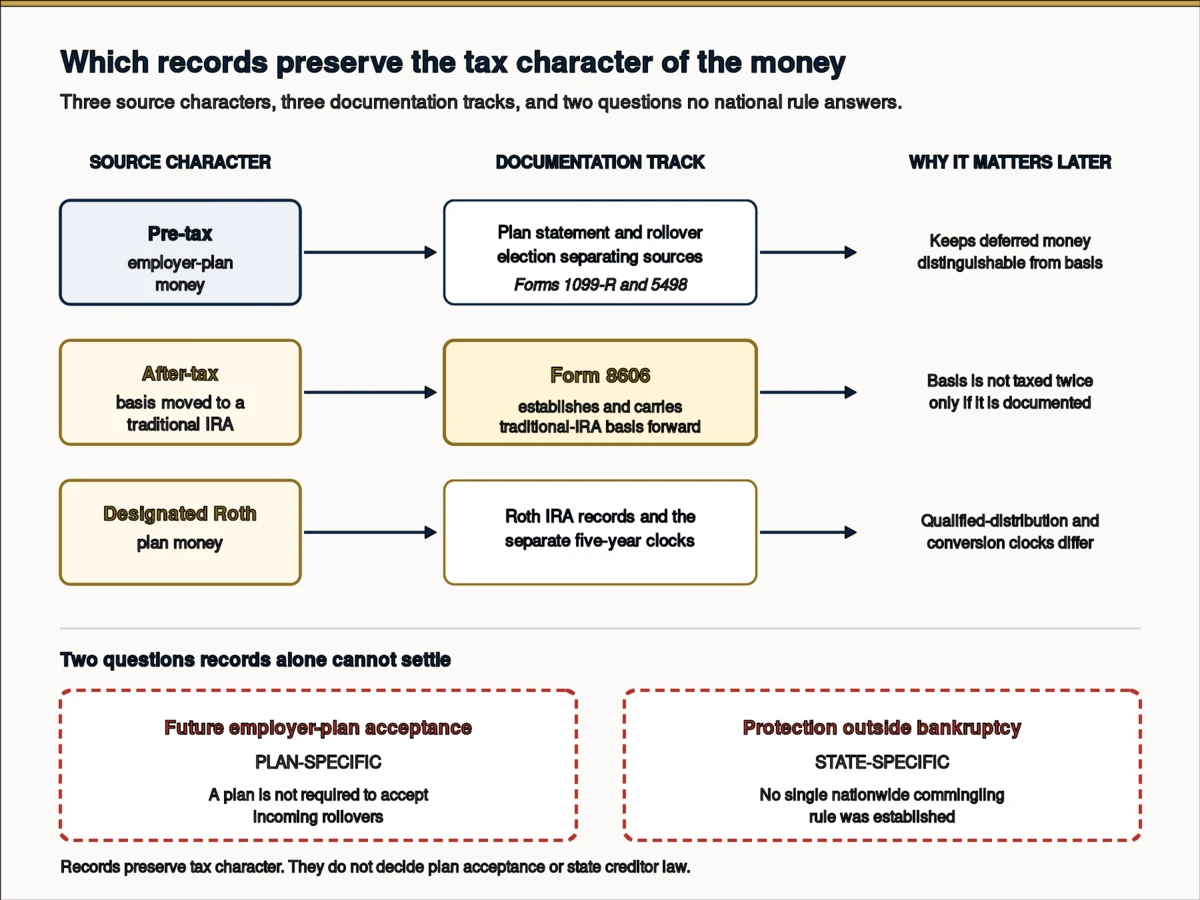
The source character should be identified before the destination is selected. Employer plans can hold pre-tax deferrals, after-tax employee contributions and designated Roth amounts. IRS guidance on after-tax rollovers permits after-tax and pre-tax pieces of the same plan distribution to be directed to different eligible destinations in a coordinated rollover.
| Money source | Destination | Immediate federal income-tax effect, generally |
|---|---|---|
| Pre-tax employer-plan amount | Traditional or rollover IRA | No current inclusion if the amount is an eligible rollover completed correctly |
| Pre-tax employer-plan amount | Roth IRA | Previously untaxed amount is generally included in gross income for the rollover or conversion year |
| After-tax employer-plan basis | Traditional IRA | Basis is not taxed again; the amount becomes IRA basis and must be tracked |
| After-tax employer-plan basis | Roth IRA | Basis itself is not included again in income; related pre-tax earnings remain a separate tax character |
| Designated Roth plan amount | Roth IRA | Eligible rollover generally preserves Roth treatment; Roth IRA distribution rules govern the receiving IRA |
Form 8606 becomes central when traditional IRA basis exists
A rollover of after-tax plan contributions into a traditional IRA can create or increase basis in traditional IRAs. Publication 590-A states that nontaxable amounts rolled into a traditional IRA become basis, and Publication 590-B explains that basis affects the taxable share of later distributions. Form 8606 is used for nondeductible traditional IRA contributions, distributions when basis exists, and conversions to Roth IRAs.
For IRA-to-Roth conversions, basis is not isolated account by account in the way many savers assume. IRC §408(d)(2) aggregates an individual’s traditional IRA arrangements for the relevant tax calculation. A conversion strategy involving nondeductible basis therefore needs a current Form 8606 review rather than a label-based assumption about which particular traditional IRA contains the after-tax dollars.
Do rollover amounts use the annual IRA contribution limit?
No. The IRS states that the annual IRA contribution limit does not apply to rollover contributions. For tax year 2026, the combined annual limit for regular contributions to all traditional and Roth IRAs is $7,500, or $8,600 for an individual age 50 or older, subject to compensation and Roth income rules. A qualifying employer-plan rollover can be much larger without consuming that regular-contribution allowance. See the IRS IRA contribution limits page. IRC §408A makes the same structural distinction for Roth IRAs.
Myths and corrections
| Myth | Correction |
|---|---|
| A rollover IRA is a separate tax type. | Federal tax law distinguishes traditional and Roth treatment. “Rollover” usually describes how money entered the IRA. |
| A large rollover uses the annual IRA contribution limit. | Qualifying rollover contributions sit outside the regular annual IRA contribution limit. |
| High income blocks a Roth conversion. | Roth contribution income limits and Roth conversion eligibility are different rules. |
| One annual contribution permanently ruins a conduit IRA. | IRS Publication 590-A states a conduit IRA can later roll to a qualified plan even after regular contributions or other funds are added. The receiving plan still controls acceptance. |
| A rollover IRA has special RMD rules. | A traditional rollover IRA follows traditional-IRA RMD rules. A Roth IRA has different owner RMD treatment. |
When does a Roth destination create a current tax bill?
A direct rollover from a pre-tax employer plan to a Roth IRA is a rollover mechanically, but it is also a Roth conversion for tax purposes. §408A requires the otherwise-taxable amount to be included in gross income. Publication 590-A says the same: amounts from a qualified plan that would have been taxable if not rolled over are included in income when rolled into a Roth IRA, while a return of after-tax basis is not taxed again.
That makes the tax character of the source more important than the account label on a custodian application. A plan statement separating pre-tax, after-tax and designated Roth sources is more decision-useful than a generic account balance.
Direct rollover versus payment to the participant
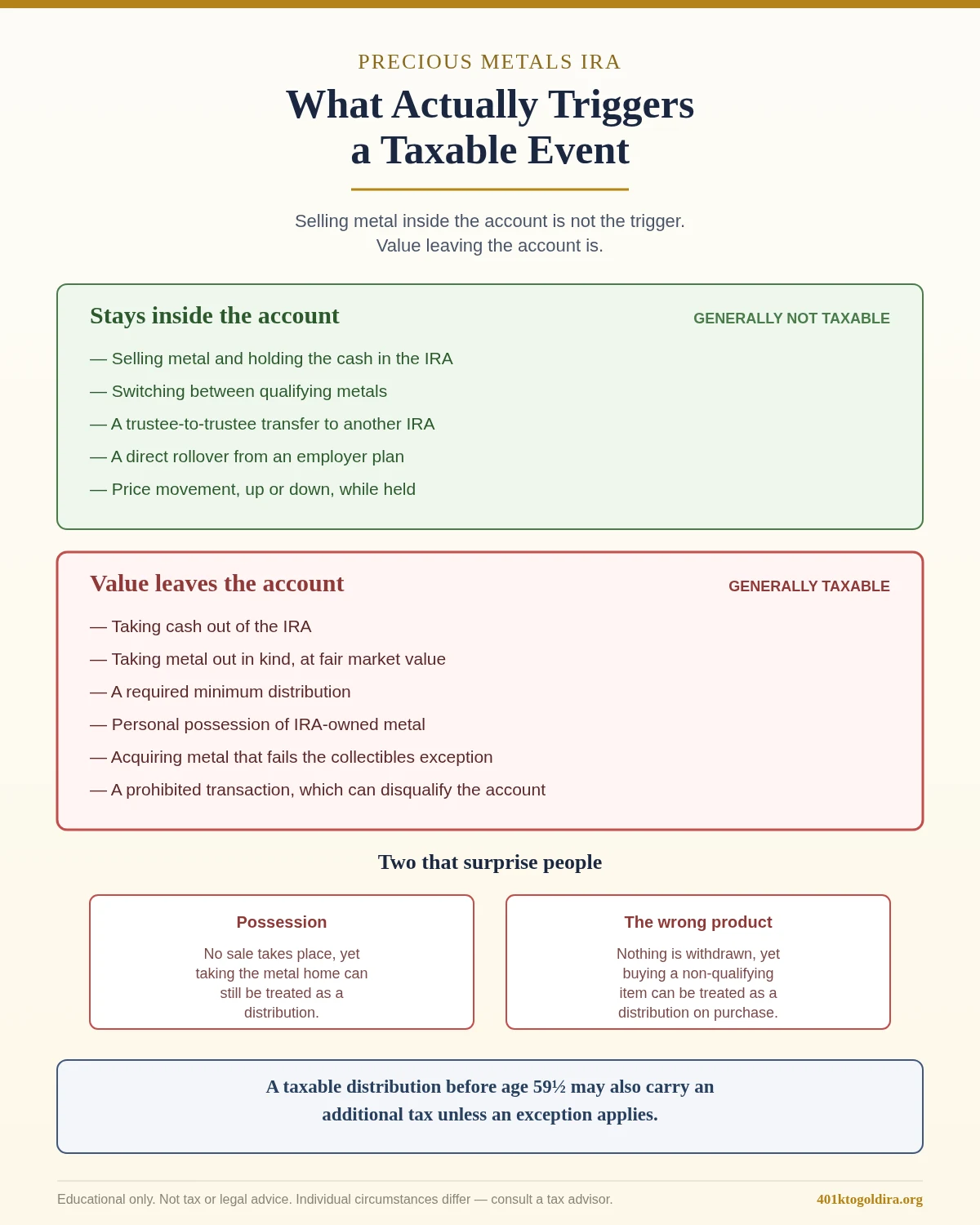
The mechanics matter only to the extent they change the comparison. A direct employer-plan rollover generally avoids mandatory withholding. If an eligible rollover distribution is instead paid to the participant, the taxable portion is generally subject to 20% mandatory federal withholding, and rolling the full gross amount then requires replacing the withheld portion from other funds. Any taxable amount not rolled over remains a distribution and may also face the additional early-distribution tax if no exception applies; the IRS list of exceptions to the tax on early distributions sets out the recognised exceptions, and IRS Topic 413 covers the withholding rule. The full mechanics belong with the 401(k)-to-Gold-IRA rollover process and the IRA transfer guide rather than here.
A conversion also cannot simply be undone through recharacterization under current rules. Publication 590-A states that conversions from traditional IRAs to Roth IRAs and rollovers from other eligible retirement plans to Roth IRAs made after the statutory cutoff cannot be recharacterized back to traditional treatment.
How do RMDs and the Roth five-year rules differ?
Traditional and rollover IRAs are subject to the traditional IRA required-minimum-distribution regime. Roth IRAs are different: IRS RMD guidance states the RMD rules do not apply to Roth IRA owners while alive, although beneficiary rules apply after death.
The five-year discussion needs two separate clocks rather than one compressed rule. Under §408A, a Roth IRA distribution is not a qualified distribution if it occurs within the five-taxable-year period beginning with the first taxable year for which a contribution was made to a Roth IRA for that individual, and a qualified distribution must also satisfy a statutory qualifying event such as attaining age 59½, disability or death.
Publication 590-B separately explains that each taxable conversion or qualified-plan rollover to a Roth IRA has its own five-year period for purposes of the additional tax on an early distribution of the taxable conversion amount, and the publication expressly warns that this conversion-related period is not necessarily the same as the period used to determine whether a distribution is qualified. The recognised exceptions to the early-distribution tax apply here as well. “Roth after five years” is not a sufficient summary, because the two clocks answer different questions.
Does keeping rollover money separate preserve creditor protection or plan options?
The cleanest federal conclusion is narrower than many articles claim. 11 U.S.C. §522 protects qualifying retirement funds held in tax-exempt accounts that include §408 and §408A IRAs. Under §522(b)(4)(C), a direct transfer of retirement funds among specified tax-exempt retirement accounts does not, by reason of the transfer alone, cause the funds to lose that bankruptcy exemption.
For ordinary traditional and Roth IRA assets, §522(n) contains a separate federal bankruptcy cap subject to statutory adjustment. In applying that cap, the statute excludes amounts attributable to certain enumerated rollover contributions and their earnings rather than every employer-plan rollover. That language gives rollover history potential significance in bankruptcy and makes documentation and tracing valuable. It does not establish a universal rule that an IRA must never contain annual contributions.
State protection outside bankruptcy is a different question. The federal Bankruptcy Code does not create one nationwide answer for creditor protection outside bankruptcy, because state exemption statutes, judgment-enforcement rules and case law can differ. A saver with material creditor exposure needs state-specific analysis; the state-by-state creditor protection guide covers that question separately.
When may an employer plan accept IRA money back?
A qualified employer plan is not required to accept rollover contributions, and IRS rollover guidance directs participants to check the receiving plan’s terms. If the plan does accept roll-ins, Publication 590-A states the taxable part of a traditional IRA distribution may be eligible to move into a qualified plan, and it specifically discusses conduit IRAs used as holding accounts for former employer-plan money. Publication 590-A also says part or all of a conduit IRA may later roll to a qualified plan even if regular contributions or funds from other sources were added, although adding other money can affect certain optional tax treatment. Which accounts may move at all is set out in the rollover eligibility matrix.
Where does a Gold IRA fit?
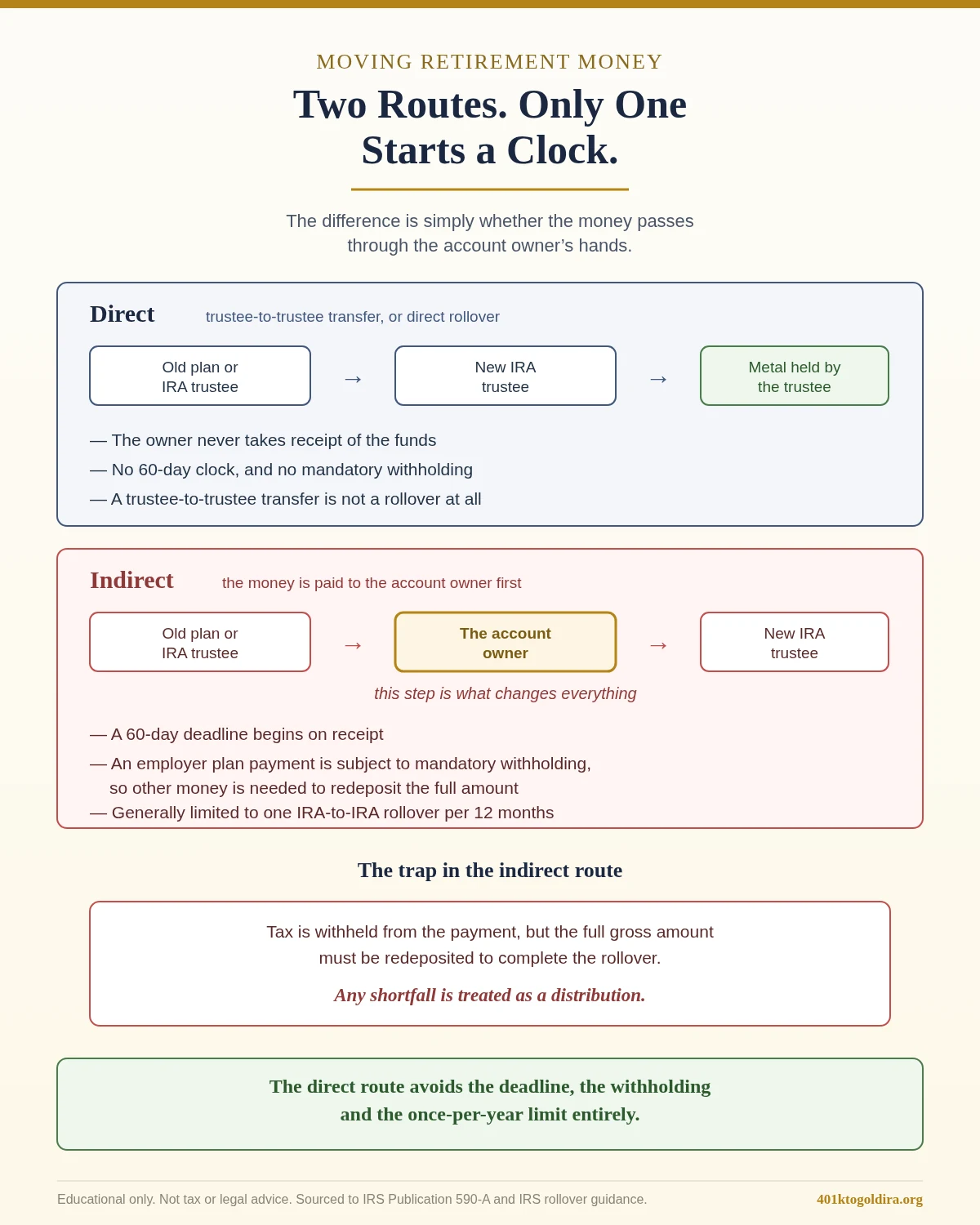
A self-directed Gold IRA is not a separate tax wrapper. Investor.gov describes a self-directed IRA as an IRA held by a custodian that permits a broader range of assets than many mainstream IRA custodians. The tax character remains traditional or Roth depending on the account, so the account-choice sequence stays tax-first: traditional versus Roth treatment, then custodian and permitted-asset decisions.
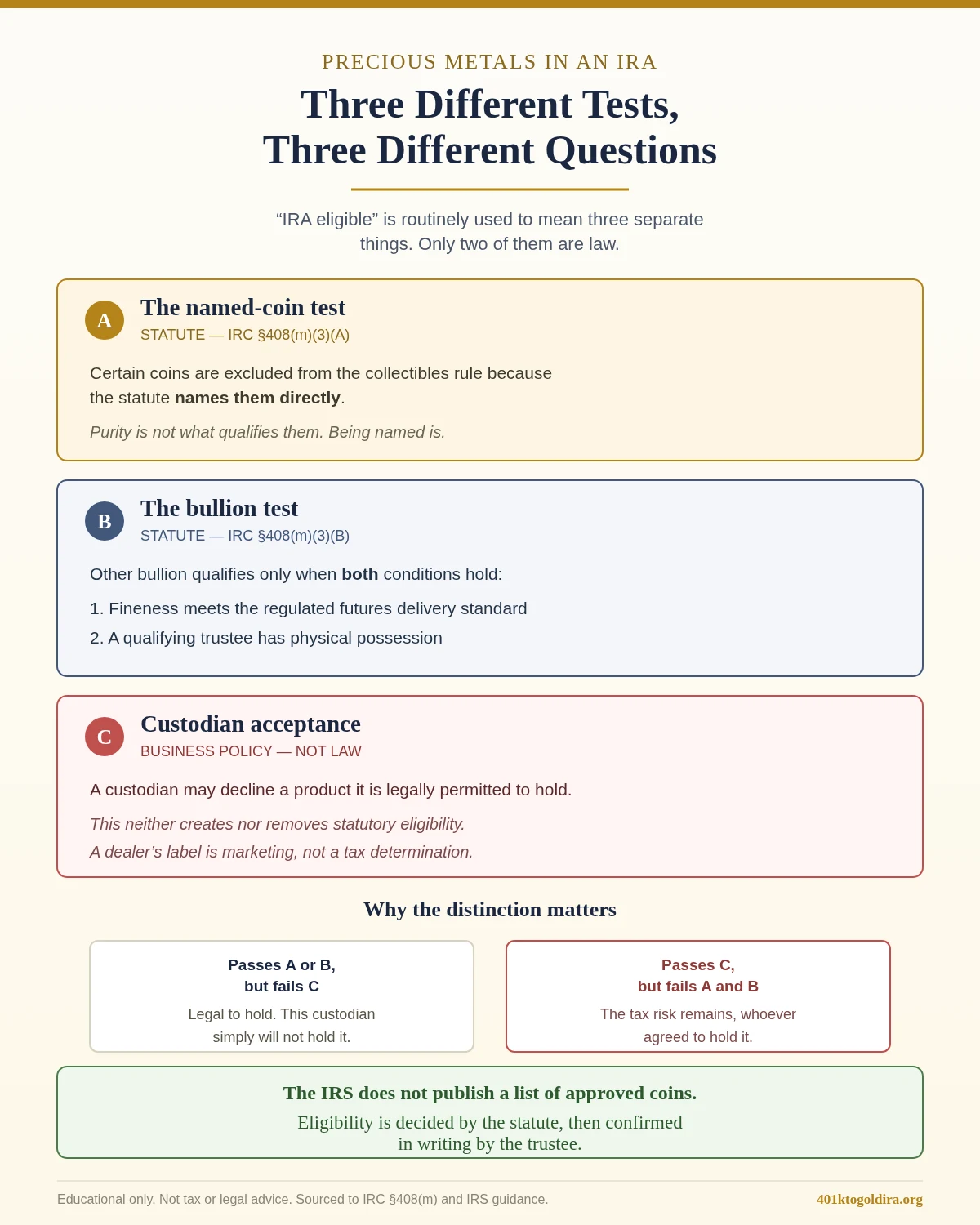
Metals eligibility and storage mechanics belong on separate pages. The Roth Gold IRA rules cover what a Roth may hold, and the precious-metals IRA account guide covers the wrapper itself.
Researching a self-directed IRA custodian?
Birch Gold Group offers a wide selection of metals that may qualify under IRC §408(m), publishes its own fee schedule, and states a $5,000 minimum subject to market conditions. Educational resources available for first-time customers.
Minimum investment: $5k · BBB rating: A+
Owners of this website may be paid to recommend Birch Gold Group. The content on this website, including any positive reviews of Birch Gold Group and other reviews, may not be neutral or independent.
What records and questions belong on the decision checklist?
The decision record should identify the tax character and source of the money before any custodian product name is considered. Records worth gathering include employer-plan statements separating pre-tax, after-tax and designated Roth sources; distribution or rollover election materials and the relevant Forms 1099-R and 5498; any prior Form 8606 establishing traditional-IRA basis; records tracing employer-plan rollover money where future plan acceptance or bankruptcy tracing may matter; and written roll-in rules from any employer plan that may receive the money later.
Questions for the receiving IRA custodian: will the account be reported as traditional or Roth, will rollover history be preserved in the custodian’s records, and how will after-tax basis and Roth conversion reporting be handled? Questions for a current or future employer plan: does the plan accept rollovers from traditional IRAs, what source documentation is required, and does the plan restrict accounts containing both rollover and annual-contribution history?
A tax professional is appropriate whenever the old plan contains after-tax basis, a conversion would create significant current taxable income, Form 8606 basis exists across multiple IRAs, or a rollover has already been reported in a way that may need correction. An ERISA attorney is the more appropriate next step when the dispute concerns plan terms, a refusal to process a distribution or rollover, or creditor-protection consequences that depend on plan status or state law.
What could not be verified as a universal rule?
- No universal “commingling destroys the rollover IRA” rule was verified. Publication 590-A expressly says a conduit IRA may later roll to a qualified plan even after regular contributions or other funds are added.
- No nationwide non-bankruptcy creditor-protection rule was verified. Federal bankruptcy law supplies federal exemptions, but protection outside bankruptcy can depend on state law and the type of proceeding.
- No universal rule was verified requiring every employer plan to accept a traditional or rollover IRA. IRS guidance states that plans are not required to accept rollover contributions.
- No universal custodian labelling standard was verified for the words “rollover IRA”. A custodian may use the label administratively while the federal tax treatment remains traditional or Roth.
- No individual tax-cost conclusion can be drawn from account type alone. The taxable effect of a conversion depends on the pre-tax and after-tax character of the money and the saver’s overall tax facts.
- No general state-law conclusion was drawn from the federal bankruptcy rollover provisions.
Frequently asked questions
Is a rollover IRA legally different from a traditional IRA?
Usually not as a federal tax category. A rollover IRA is ordinarily a traditional IRA that received rollover money. The rollover label preserves information about funding history, while the traditional label describes the federal IRA tax treatment.
Can pre-tax 401(k) money go directly into a Roth IRA?
Yes, if the amount is an eligible rollover distribution and the rollover requirements are met, but the previously untaxed amount is generally included in gross income for the conversion year. After-tax basis is not taxed again.
Does high income prevent a Roth conversion?
Not by itself. IRS Topic 309 distinguishes annual Roth contribution eligibility from conversion eligibility and states that a traditional IRA conversion may be available regardless of adjusted gross income. The conversion can still create taxable income.
Is the Roth five-year rule one single rule?
No. One five-tax-year rule helps determine whether a Roth IRA distribution is qualified, while a separate five-year period can apply to each taxable conversion or rollover for purposes of the additional early-distribution tax.
Can a Roth IRA be rolled back into a new employer plan?
IRS guidance states that Roth IRAs can be rolled only to another Roth IRA. A designated Roth account inside an employer plan is not the same thing as a Roth IRA.
Methodology
This page was checked against federal primary authorities and current IRS materials available on 25 September 2026. Substantive IRA rules were checked against IRS Publication 590-A and Publication 590-B, the latest editions posted by the IRS at the time of writing. Tax-year 2026 contribution and income-limit figures were checked against the IRS IRA contribution-limits page. Statutory claims were checked against the current text of IRC §§408 and 408A and Bankruptcy Code §522 via the Cornell Legal Information Institute. Rollover mechanics were checked against current IRS rollover, Topic 413, early-distribution-exceptions, after-tax rollover and Roth topic pages. Commercial marketing pages were not used as authority for tax treatment.
How to Cite This Page
Source: 401ktogoldira.org — Rollover IRA vs Roth IRA vs Traditional IRA: 2026 Tax Rules and Key Differences.
Publisher: 401ktogoldira.org
URL: https://401ktogoldira.org/rollover-ira-vs-roth-ira/
Sources last reviewed: 25 September 2026
Accessed: state the date the page was retrieved, as IRS figures and guidance change by tax year.
Primary sources
- 26 U.S.C. §408 — Individual retirement accounts, Cornell Legal Information Institute.
- 26 U.S.C. §408A — Roth IRAs, Cornell Legal Information Institute.
- 11 U.S.C. §522 — Exemptions, Cornell Legal Information Institute.
- IRS Publication 590-A and Publication 590-B.
- IRS — Rollovers of retirement plan and IRA distributions.
- IRS Topic 413 and IRS Topic 309.
- IRS — Exceptions to tax on early distributions.
- IRS — IRA contribution limits.
- IRS — Rollovers of after-tax contributions.
- IRS — Required minimum distributions FAQs.
- IRS — About Form 8606.
- IRS — Retirement plans FAQs regarding IRAs.
- Investor.gov — Self-Directed IRAs and the Risk of Fraud.
How figures on this site are produced and checked is set out in the research methodology, and errors are handled under the corrections policy. Article reviewed and edited by Daniel — independent precious-metals retirement researcher.