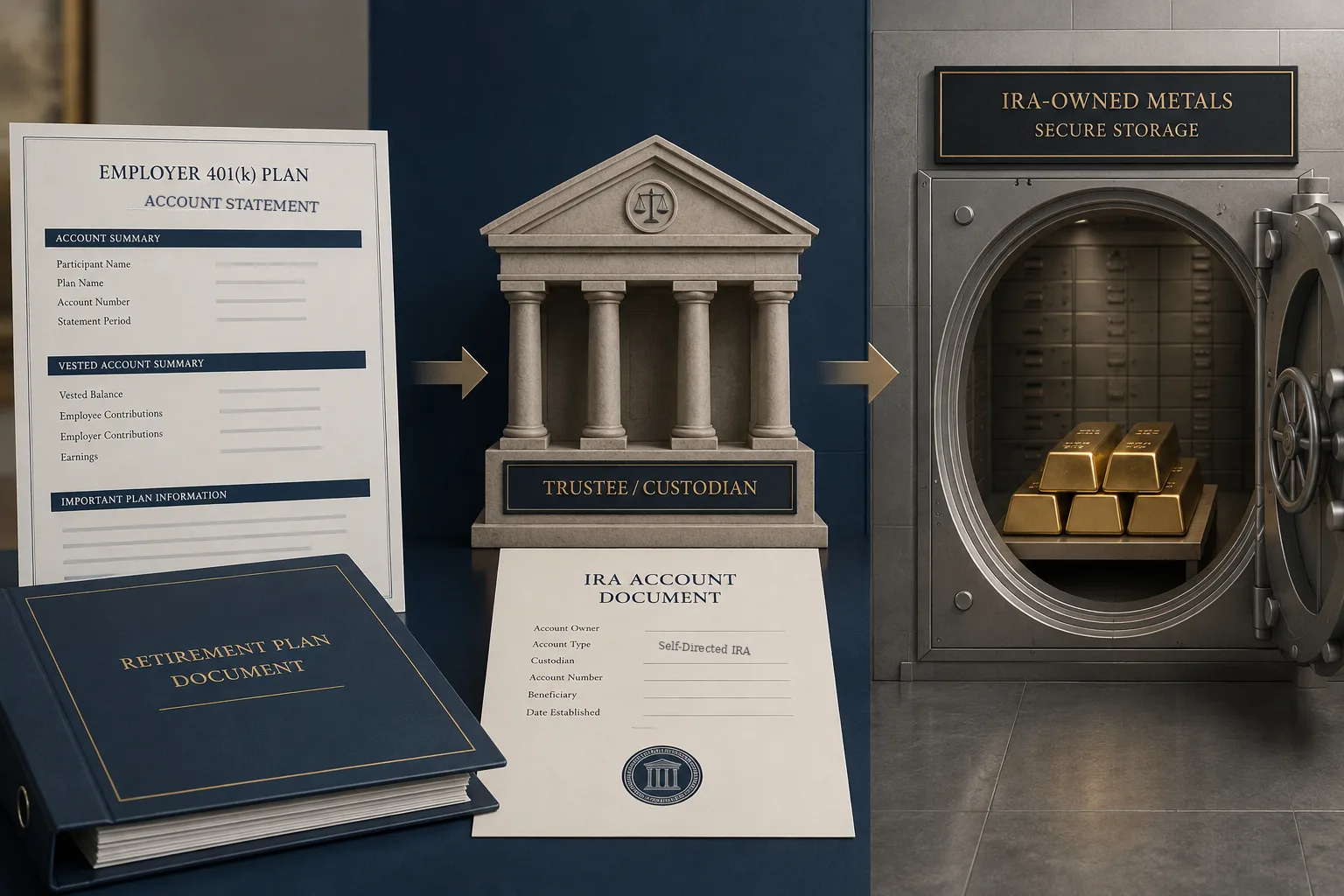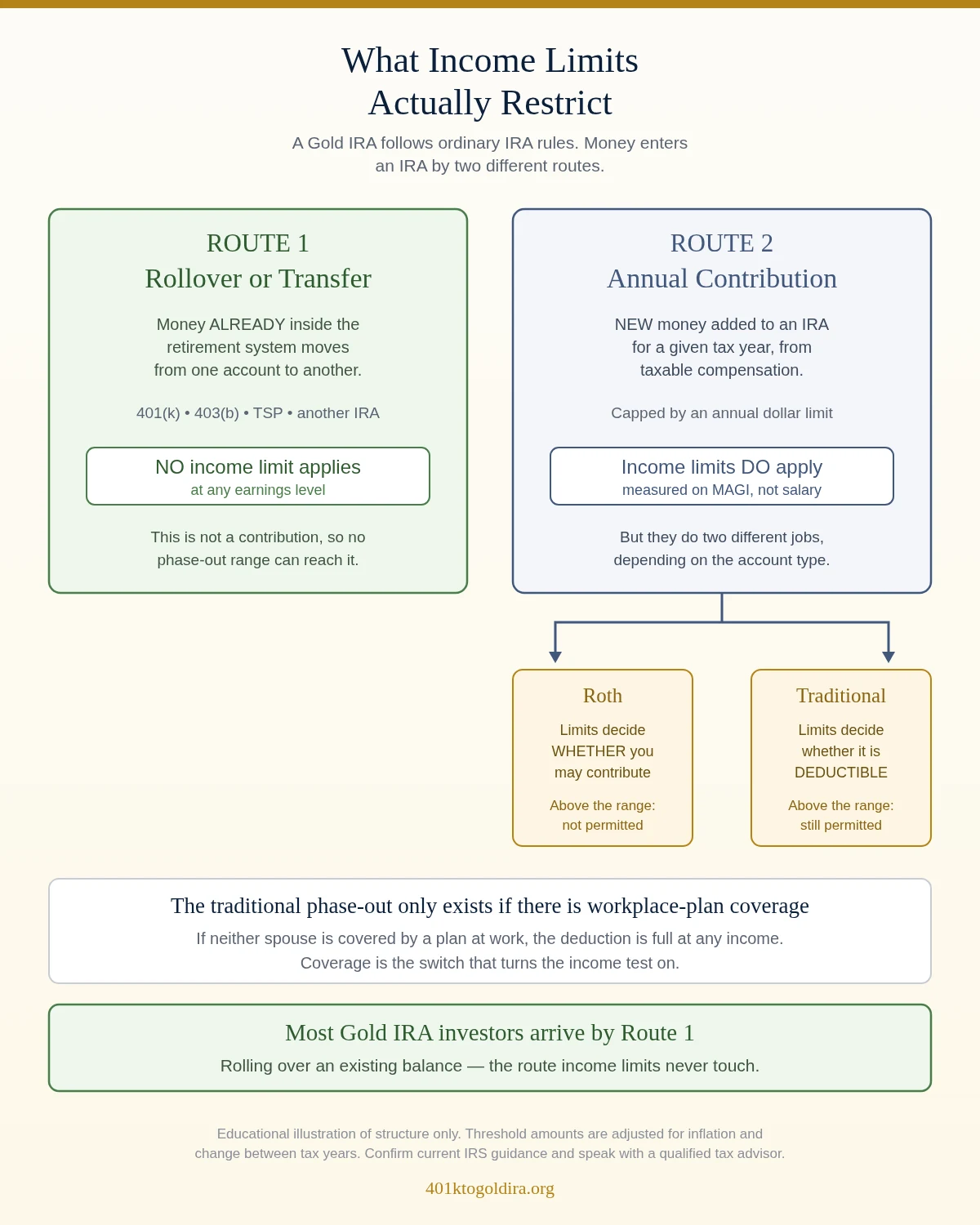
Educational only: This page explains federal retirement-plan and tax rules from published statutes, regulations and agency guidance. It does not evaluate any particular plan, account or participant, and it is not financial, tax or legal advice. Where federal law leaves an answer to the plan document, this page says so rather than supplying a general answer. Anyone holding employer securities should speak to a qualified tax professional before making an election. Past performance does not guarantee future results.
Key takeaways
- Nothing “rolls over an ESOP.” Federal law works on a distribution, not an account. An ESOP is a qualified plan, and its distributions are tested under the ordinary rollover rules rather than a separate ESOP regime.
- A vested balance is not a distributable amount. Vesting decides how much can ever be paid; the plan's terms and federal commencement rules decide how much can be paid now.
- A rollover defers current income inclusion. It does not erase tax. The amount is taxed when it later leaves the IRA.
- The choice between a direct rollover and a payment to the participant is mechanical, not cosmetic. The direct route carries no mandatory withholding and no redeposit clock; the participant-paid route carries both.
- Rolling employer shares, or the proceeds of selling them, into an IRA may make later net unrealized appreciation treatment unavailable for those amounts, and the rollover designation is irrevocable. This is the one decision on the page that cannot be unwound.
- Whether the participant receives cash or stock is largely the plan's answer. Federal law gives a default right to demand employer securities, with exceptions that are common in practice, and the plan document resolves it.
- Federal law decides whether a destination is permitted; the custodian's own agreement decides whether the asset is accepted. A participant can satisfy every federal requirement and still be unable to complete an in-kind stock rollover.
The Four Gates
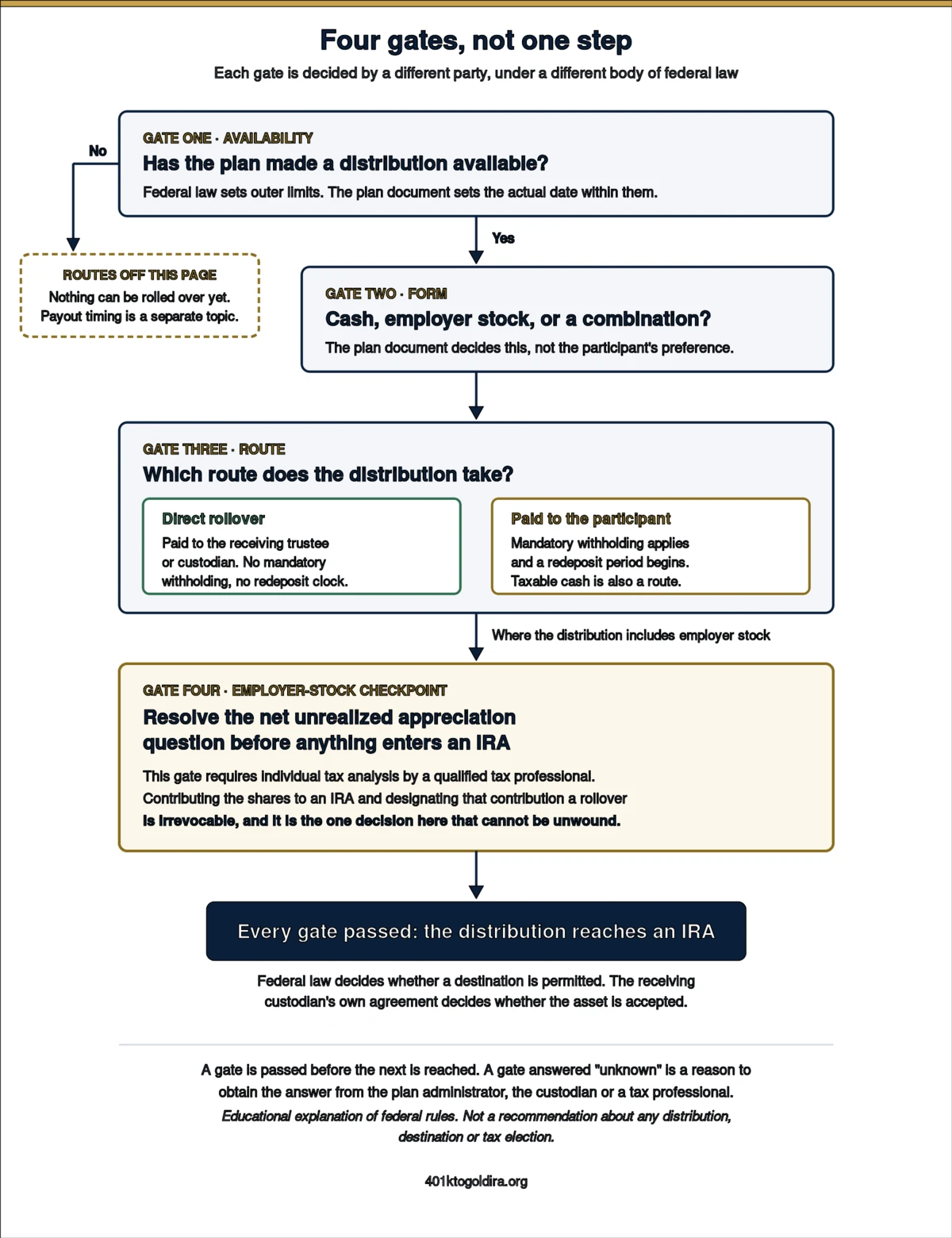
Four gates, decided in sequence by different parties, with different consequences.
“Rolling an ESOP into an IRA” is four decisions rather than one administrative step. Each gate is governed by a different body of federal law, and each must be passed before the next is reached.
- Availability. Has the plan made a distribution available? This is a yes or no question, and a “no” answer routes off this page entirely, because rollover mechanics have nothing to act on until a distribution exists.
- Form. Will the distribution be paid in cash, in employer securities, or in a combination? Federal law supplies defaults and exceptions; the plan document supplies the answer.
- Tax path. A direct rollover, a rollover the participant completes after being paid, taxable cash, or another permitted destination.
- Employer-stock checkpoint. Where the distribution includes employer securities, the net unrealized appreciation question has to be resolved with a qualified tax professional before anything enters an IRA, because the rollover designation is irrevocable.
The pre-rollover checklist is organised by the same four gates, so the model is a working structure rather than an illustration.
What “Rolling Over an ESOP” Actually Means
The precise unit of analysis is an eligible rollover distribution paid from a qualified trust to an eligible retirement plan. An ESOP is a defined contribution plan that is a stock bonus plan, or a stock bonus and money purchase plan, qualified under §401(a) and designed to invest primarily in qualifying employer securities. Its trust is a qualified trust for rollover purposes, so its distributions run on the ordinary machinery of 26 U.S.C. §402(c) rather than on an ESOP-specific rollover statute.
Three terms carry the whole structure.
- Eligible rollover distribution. §402(c)(4) reaches “any distribution to an employee of all or any portion of the balance to the credit of the employee in a qualified trust,” subject to stated exclusions. The current regulation confirms the breadth: any amount distributed from a qualified plan is an eligible rollover distribution unless specifically excepted.
- Eligible retirement plan. §402(c)(8)(B) lists an individual retirement account under §408(a) and an individual retirement annuity under §408(b) first among six permitted destinations.
- Direct rollover. §401(a)(31)(A) requires the plan, on the distributee's election, to pay the distribution “in the form of a direct trustee-to-trustee transfer to the eligible retirement plan so specified.”
This is a distribution that is rolled over, not a transfer
The terminology is load-bearing. The regulation states that for plan-qualification purposes “a direct rollover is a distribution and rollover of the eligible rollover distribution and not a transfer of assets and liabilities.” The statutory phrase “direct trustee-to-trustee transfer” describes the form a direct rollover takes. It does not make the transaction an IRA-to-IRA transfer under §408, and the two are governed by different rules. Movement between IRAs is a separate transaction, covered in the IRA-to-IRA transfer guide.
What can be rolled over, in sequence
Four tests must hold, in order, and in an ESOP the gap between the first two is often years.
- Nonforfeitable. The amount must be vested under the plan's schedule. A defined contribution plan satisfies the minimum vesting standard with three-year cliff vesting, or with the two-to-six-year graded schedule, and ERISA imposes the same minimums. A plan may vest faster than the minimum.
- Distributable. A distributable event must have occurred and the plan's provisions must permit payment.
- Actually distributed. §402(a) taxes “any amount actually distributed,” and §402(c)(4) speaks of a distribution rather than an entitlement.
- Not excluded. See the exclusions below.
A vested balance answers how much is ultimately the participant's. It does not answer how much can move today. A participant who is sixty percent vested in a balance shown on an account statement has at most that proportion which can ever be distributed, and that is still not the amount currently distributable. Federal law supplies a concrete reason why: for ESOP distribution purposes the account balance excludes employer securities acquired with the proceeds of a plan-level acquisition loan until the close of the plan year in which that loan is repaid in full (26 U.S.C. §409(o)). A fully vested participant in a leveraged ESOP can hold a large vested balance of which none is currently distributable.
Partial vesting does not block a rollover. No rule requires full vesting before a distribution qualifies. The unvested portion is forfeited under the plan's terms and never becomes a rollover amount. Where the participant has been re-employed, whether pre-break service counts toward the nonforfeitable percentage is a separate calculation under §411(a)(6) and is a question for the plan administrator rather than a rollover question.
Which payments are excluded
Three exclusions sit in the statute. §402(c)(4) removes a distribution that is one of a series of substantially equal periodic payments made for life or life expectancy, or for a specified period of ten years or more; any amount required as a minimum distribution under §401(a)(9); and any distribution made upon hardship. The current regulation adds a closed list of eleven further items that are not treated as eligible rollover distributions, including corrective distributions, a loan treated as a deemed distribution under §72(p), and the cost of life insurance coverage.
Where minimum distributions are required for a calendar year, amounts distributed that year are treated as required minimum distributions, and therefore not as eligible rollover distributions, until the year's requirement has been satisfied. Amounts paid before January 1 of the first distribution calendar year are not required minimum distributions and remain rollable if they otherwise qualify.
The periodic-payment exclusion interacts with ESOP practice in a way that is easy to get backwards. The exclusion requires a specified period of ten years or more. The ESOP statutory default is a stream of substantially equal periodic payments over a period not longer than the greater of five years or a longer period for large balances. A five-year installment stream therefore does not meet the ten-year exclusion, and its payments generally remain eligible rollover distributions, payment by payment. A stream genuinely set for ten years or more does meet the exclusion, and those payments are not rollable. Two further rules sit alongside it: a payment substantially larger or smaller than the others in a series is an independent payment and is an eligible rollover distribution unless otherwise excepted, while a final payment that merely empties a defined contribution account within a qualifying series is not independent and is not an eligible rollover distribution.
Two exclusions that exist only because this is an ESOP
- Dividends on employer securities described in §404(k) are excluded from eligible rollover treatment, and are not designated distributions for withholding purposes. The carve-back is the detail that matters: dividends paid to an ESOP and reinvested in employer securities under a participant election “are included in the participant's account balance and lose their character as dividends when subsequently distributed from the account,” and so are eligible rollover distributions if they otherwise qualify.
- Prohibited allocations in an S corporation ESOP, treated as deemed distributions under §409(p), are excluded. This is rare for a departing participant but it is genuinely ESOP-specific.
No further ESOP-specific rollover exclusion was located in the provisions examined. That silence is recorded as a scoped absence rather than converted into a positive statement that every other ESOP distribution is rollable.
Plan loans, where the plan has them
Participant loans are not an ESOP feature under federal law, and the leverage that gives a leveraged ESOP its name is a plan-level loan rather than a participant loan. Where a plan does permit participant loans, two different things must be kept apart. A deemed distribution under §72(p) is not an eligible rollover distribution. A plan loan offset amount, which reduces the accrued benefit to repay the loan, is an actual distribution and is an eligible rollover distribution if it otherwise qualifies. An ordinary offset may be rolled within the general redeposit period; a qualified plan loan offset, arising from plan termination or from a repayment failure caused by severance from employment on a loan that met the §72(p)(2) requirements immediately beforehand, may be rolled until the individual's tax filing due date including extensions, and must occur within one year of severance to be qualified. A plan is not required to offer a direct rollover of an offset amount.
When the Rollover Process Can Begin
This section is a boundary, not a timing guide.
Rollover mechanics begin only once the plan has made an eligible distribution available. Federal law sets outer limits on how long an ESOP may wait, and those limits differ depending on whether the participant separated by reason of normal retirement age, disability or death, or for another reason. A separate general rule sets an outer limit for qualified plans by reference to normal retirement age, the tenth anniversary of participation, or termination of service, whichever is latest. Within those limits the plan document and the plan's distribution policy decide the actual date.
Two consequences follow for a reader who has recently left an employer.
- No former employee is entitled as a matter of federal law to immediate distribution. For a participant who resigned or was dismissed rather than retiring, federal law permits an ESOP to defer the start of distribution by reference to a later plan year. Until the plan makes a distribution available, there is nothing to roll over.
- The commonly listed distributable events are separation from service, attainment of normal retirement age, disability, death and plan termination. Federal law names them; the plan defines them. Whether the plan's normal retirement age is sixty-five or earlier is a plan question bounded by §411(a)(8), how the plan defines disability is a plan question, and this research located no provision requiring an ESOP to distribute on plan termination, so that event is named here rather than asserted as a federal rule.
Whether a particular former employee's payment is due, late or delayed, how long an ESOP may delay, how installment and lump-sum timing compare, and what to do when a former employer has not paid or has not produced records are payout-timing questions. They are a separate subject from rollover mechanics and are answered on the ESOP payout after leaving a company guide, which owns the availability question this page begins from.
An involuntary small-balance distribution moved by a former employer without the participant's election is a different transaction from the elective distribution this article describes, and it follows its own rules and thresholds. A reader in that position should start with the force-out rules for small balances.
Direct Rollover Mechanics
A qualified plan must, as a condition of its qualification, honor a distributee's election to have an eligible rollover distribution paid directly to a specified eligible retirement plan. The payment “may be accomplished by any reasonable means of direct payment,” with a wire transfer or a mailed check given as the regulation's examples. Three consequences follow automatically: the amount is not currently includible in gross income, the twenty percent mandatory withholding does not apply, and the transaction is treated as a distribution and rollover rather than a transfer of assets and liabilities.
The general qualified-plan rollover process is set out in full in the 401(k) to Gold IRA rollover guide. What follows here is confined to the points an ESOP participant needs.
Who the payment must be made out to
This is the point most often got wrong in practice, and federal authority is exact.
If payment is made by check, “the check must be negotiable only by the trustee of the eligible retirement plan.” If by wire, the transfer must be directed only to the trustee. Where the receiving plan has no trustee, as with a custodial IRA or an individual retirement annuity, the custodian or issuer “should be substituted for the trustee.” The regulation supplies the literal construction, [Name of the trustee] as trustee of [name of the eligible retirement plan], with the worked example “ABC Bank as trustee of Individual Retirement Account of John Q. Smith.” Unless the distributee's name appears in the name of the receiving plan, the check must also indicate that it is for the benefit of the distributee.
The practical distinction: a check the participant physically carries can still be a direct rollover, provided the payee line is drawn correctly. A check payable to the participant personally is not a direct rollover. It is a payment to the participant, which triggers mandatory withholding and starts the redeposit clock.
The notice and the election
The plan administrator must, “within a reasonable period of time before making an eligible rollover distribution,” provide a written explanation to the recipient. The statute fixes its contents: the direct rollover option, the withholding consequence of not transferring the distribution directly, the redeposit rule, where applicable the special rules on lump-sum treatment and net unrealized appreciation, and the fact that distributions from the receiving plan “may be subject to restrictions and tax consequences which are different from those applicable to distributions from the plan making such distribution.”
On timing, a plan generally must provide the section 402(f) notice no less than 30 days and no more than 180 days before the distribution. The published regulation still states 90 days. The Pension Protection Act of 2006 directed that 90 be replaced by 180, and plans may rely on guidance permitting the longer period. The current IRS safe harbor explanations, published in Notice 2026-13, state that the notice “may be provided as many as 180 days before the date on which the distribution is made (or the annuity starting date).” The thirty-day floor may be waived where the participant affirmatively elects an earlier distribution, provided the administrator clearly indicates a right to consider the direct rollover decision for at least thirty days after the notice is provided. Posting the notice is not provision of it, and it must be provided individually; electronic delivery is permitted.
Two features of the notice rules matter specifically to an ESOP participant.
First, the regulation requires the notice to explain the special rules on the taxation of the distribution under §402(d) and (e), including the treatment of net unrealized appreciation. The participant is supposed to have been told about the employer-stock question in writing before making the election.
Second, current IRS guidance expressly permits a plan to omit inapplicable sections of the model explanation, and states that where the plan does not provide for distributions of employer stock or other employer securities “it would be appropriate to eliminate the section ‘If your payment includes employer stock that you do not roll over’.” A participant whose notice lacks that section has been told something about the plan, and its absence is a legitimate question for the administrator.
The election procedure itself is largely the administrator's. No federal content standard for a distribution election form was located in the provisions examined; what federal law regulates is the procedure. The administrator “may prescribe any procedure for a distributee to elect a direct rollover ... provided that the procedure is reasonable” and may require reasonable supporting information, such as a statement from the receiving plan that it will accept the rollover, but a plan fails the direct-rollover requirement if it prescribes an unreasonable procedure or requires information “that effectively eliminates or substantially impairs the distributee's ability to elect a direct rollover.” Some plans operate a default election procedure where no election is returned. The election form should therefore be read as a plan-produced document under a reasonableness standard rather than as a federally specified form.
Splitting the distribution, and its two limits
Federal law gives the participant a right against the distributing plan. The administrator “must permit a distributee to elect to have a portion of an eligible rollover distribution paid to an eligible retirement plan in a direct rollover and to have the remainder paid to the distributee.” Two limits may be imposed by the plan. It may require that the directly rolled portion meet a specified minimum, provided that minimum is no more than $500. It may require a single receiving plan rather than splitting across several, since allowing the split “is not required (but is permitted).” Where the year's eligible rollover distributions are reasonably expected to total less than $200, a direct rollover option need not be offered at all.
One narrowing rule is worth stating precisely because it is easy to overstate. The plan's mandatory direct-rollover obligation reaches only the portion of the distribution that would be includible in gross income, unless the destination is a separately accounting defined contribution plan or an IRA. Because an IRA is the destination under discussion here, that narrowing does not apply. It would be wrong to write that a plan must always offer a direct rollover of after-tax amounts to any destination.
Destinations other than an IRA
An IRA is one of six statutory destinations. A direct rollover may also go to another employer plan, a §403(a) annuity plan, a governmental §457(b) plan or a §403(b) annuity contract. Two acceptance limits apply in every case and are covered under the destination section: no receiving plan is required to accept a rollover, and a receiving plan may limit the types of assets it will accept. A reader holding several retirement accounts and wanting the cross-plan picture will find it in the rollover eligibility matrix.
Direct Rollover Versus Payment to the Participant
The difference between the two routes is mechanical, and this section states the mechanics rather than recommending a route.
Mandatory withholding on a payment to the participant
Mandatory federal withholding attaches when an eligible rollover distribution is paid to the participant rather than directly to an eligible retirement plan. The statute requires the payor to “withhold from such distribution an amount equal to 20 percent of such distribution” (26 U.S.C. §3405(c)), and the regulation states the trigger and the only escape together: the twenty percent “applies to an eligible rollover distribution unless the distributee elects under section 401(a)(31) to have the eligible rollover distribution paid directly to an eligible retirement plan in a direct rollover.” A participant cannot elect out of it, though more may be withheld by agreement with the payor.
Three refinements apply.
- On a split distribution, withholding applies “only to the portion of the eligible rollover distribution that the distributee receives and not to the portion that is paid in a direct rollover.”
- Below a $200 floor no withholding is required, aggregating all eligible rollover distributions received within one taxable year under the same plan.
- Where the distribution includes employer securities the computation changes, and that modification is set out under employer stock below. It must be read together with this general rule: the securities sit inside the amount multiplied by twenty percent but outside the cap on what may actually be withheld, so a distribution paid only in employer securities can carry no withholding at all.
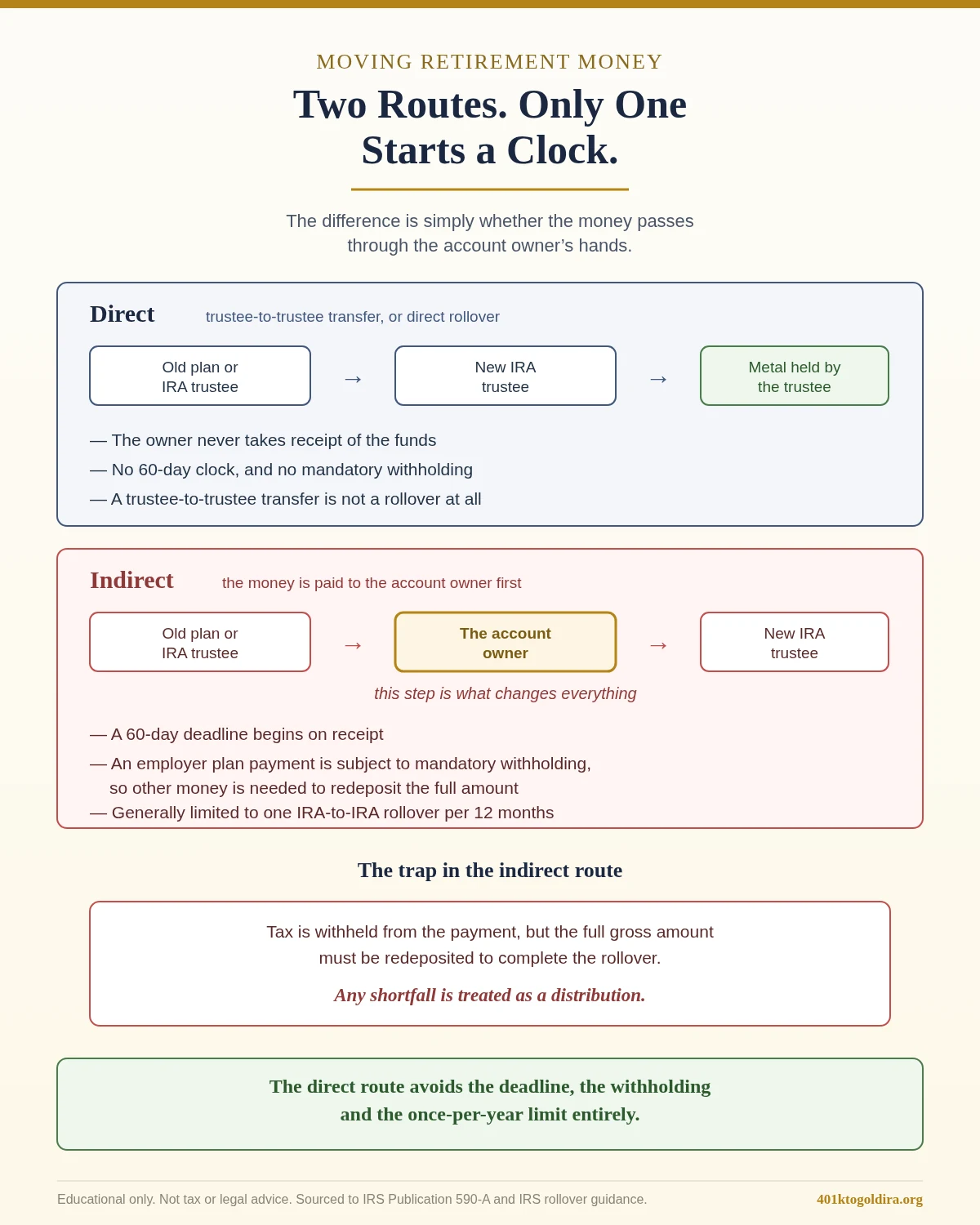
The payee decides the treatment. This diagram does not show the employer-stock dimension, which modifies the withholding computation as described above and below.
Withholding is not the tax owed
An amount withheld under these rules is treated “as if it were wages paid by an employer to an employee with respect to which there has been withholding under section 3402.” It is therefore a credit against the year's income tax liability, settled on the return. The actual tax depends on the participant's total income, filing status and marginal rates, and may be more or less than twenty percent. The twenty percent is a prepayment toward the eventual tax, not a settlement of it, and it is not a penalty.
The redeposit period, and the gross-versus-net problem
Where the distribution is paid to the participant, the exclusion from income does not apply “to any transfer of a distribution made after the 60th day following the day on which the distributee received the property distributed.”
The practical difficulty is that withholding has already reduced what the participant holds. The full gross amount is treated as distributed even though the participant receives eighty percent, and any part not rolled over within the period, including the part withheld, is generally included in income. To defer the whole distribution, the participant has to replace the withheld portion from other money: “your contribution to the new plan or IRA must include other money (for example, from savings or amounts borrowed) to replace the amount withheld.” The IRS supplies its own worked example, reproduced here rather than replaced with different figures: on a $10,000 eligible rollover distribution with $2,000 withheld and $8,000 received, the participant “will have to get $2,000 from some other source to add to the $8,000 you actually received,” and rolling only the $8,000 means “you must include the $2,000 not rolled over in your income for the distribution year” (IRS Publication 575). The arithmetic can be modelled on the withholding shortfall calculator.
The withheld amount is not lost, since it is credited on the return. It is simply not available to be rolled over within the period unless it is replaced from elsewhere. That timing mismatch, together with the deadline and the absence of either feature on the direct route, is the whole of the difference in administrative risk between the two routes.
What becomes taxable when only part is rolled over
The exclusion applies only “to the extent so transferred.” Whatever is not rolled over within the period is includible in gross income for the year of distribution and subject to ordinary income tax. Whether any particular retained amount produces tax at a given rate depends on the participant's whole return, and this article does not compute it.
The additional tax on early distributions
Where an amount is includible in gross income, the tax for the year may be “increased by an amount equal to 10 percent of the portion of such amount which is includible in gross income” (26 U.S.C. §72(t)). The charge therefore bites only on what is retained, including a withheld amount left unreplaced. A properly completed rollover leaves nothing includible and so nothing exposed.
Several exceptions exist. The general one applies to distributions made on or after the date the employee attains age 59½. Of more relevance to a departing ESOP participant, an exception applies to a distribution “made to an employee after separation from service after attainment of age 55.” IRS guidance fixes the condition: the participant “must have separated from service in or after the year in which you reach age 55,” and its example is directly on point, describing a participant who separated at forty-nine and took a distribution in the year he reached fifty-five: “Because he separated from service before he reached age 55, he didn't meet the requirements for the exception.” There is also an ESOP-specific exception for dividends paid with respect to corporate stock described in §404(k). The informal label “Rule of 55” appears in no cited authority and is used here once only, as the common name for the statutory separation exception.
This exception does not survive the move into an IRA. The statute provides that the separation-after-55 exception and the exception for an alternate payee under a qualified domestic relations order “shall not apply to distributions from an individual retirement plan.” The exception set changes in both directions, since some exceptions exist only for IRAs, so this is stated as a change to be understood rather than as a reason to avoid rolling over. The full exception list is on the early withdrawal penalty page.
If the period has already been missed
The deadline is a rule, and federal law contemplates relief only in limited circumstances, where failure to waive the requirement “would be against equity or good conscience, including casualty, disaster, or other events beyond the reasonable control of the individual.” A reader who has already missed it should go to the dedicated page on what to do after a missed 60-day rollover deadline, which owns the correction routes. The existence of relief is not a reason to treat the deadline casually.
One limit that does not apply here
The once-per-twelve-month limit on IRA rollovers does not restrict a plan-to-IRA rollover, and there is regulatory authority on the point. A distribution from a qualified plan that is rolled over to an individual retirement account or annuity “is not treated for purposes of section 408(d)(3)(B) as an amount received by an individual from an individual retirement account or individual retirement annuity.” The limit is by its own terms an IRA-to-IRA rule, and IRS guidance agrees that it “doesn't apply to eligible rollover distributions from an employer plan.” The limit does apply to any later movement between IRAs, which is a separate transaction.
Choosing the IRA Destination
A traditional IRA: deferral, not forgiveness
The exclusion from current income is conditional on four things: an eligible rollover distribution, a transfer to an eligible retirement plan, completion within the statutory time limit, and, where property is distributed, the transfer of that same property. The amount is then taxed when it later leaves the IRA. IRS guidance states that on a later withdrawal the amount “will be subject to the normal rules for IRA distributions and will be taxed as ordinary income,” and the statute includes amounts paid out of an individual retirement plan in gross income. A compliant rollover defers current income inclusion. It does not avoid tax.
The same-property rule is what makes the employer-stock decision constraining in one direction. Where an eligible rollover distribution consists of property other than money, “only that property may be rolled over to an eligible retirement plan.” The alternative is to sell the property and roll the proceeds, although “to the extent those proceeds exceed the property's fair market value at the time of the sale, that excess may not be rolled over.” IRS guidance puts the consequence plainly: the participant “can't keep the property and contribute cash to a traditional IRA in place of the property. You must either roll over the property or sell it and roll over the proceeds.”
A Roth IRA: where tax character changes
A Roth IRA is a statutorily permitted destination. A rollover from an eligible retirement plan qualifies as a qualified rollover contribution where it meets the ordinary rollover requirements, and no other rollover contribution to a Roth IRA is permitted.
The change in tax character is the answer to the question. The statute provides that in the case of such a distribution “there shall be included in gross income any amount which would be includible were it not part of a qualified rollover contribution,” and that the additional tax on early distributions does not apply to it (26 U.S.C. §408A). IRS guidance states the same rule and adds that previously taxed plan contributions are not included again. The IRS rollover chart marks the route from a pre-tax qualified plan to a Roth IRA as permitted with a “must include in income” footnote.
This move cannot be undone. A rollover from an eligible retirement plan to a Roth IRA made in tax years beginning after 31 December 2017 “cannot be recharacterized as having been made to a traditional IRA.”
Roth status, conversion mechanics and the Roth five-year rules are covered on the Roth IRA and physical gold page. This article identifies the change in tax character and routes the deeper question there.
“Rollover IRA” is an account label, not a federal tax type
The Code creates three relevant vehicles and no fourth: the individual retirement account, the individual retirement annuity, and the Roth IRA, which is an individual retirement plan designated as a Roth IRA at the time the plan is established, and which is otherwise treated as an individual retirement plan.
The clearest demonstration is the IRS's own account-type taxonomy on Form 5498. Its account-type checkboxes are IRA, SEP, SIMPLE and Roth IRA, with no “rollover IRA” box; a rollover received is reported as an amount on a form whose type box is ticked “IRA.” Account type and funding source are separate fields on the same form.
There is a real idea behind the label, and IRS guidance names it. A traditional IRA may be used as a conduit for a later rollover into an employer plan, but “if you make regular contributions to the conduit IRA or add funds from other sources, the qualified plan into which you move funds won't be eligible for any optional tax treatment for which it might have otherwise qualified.” That is a consequence of not commingling funds, stated conditionally, rather than a distinct type of account. A reader who wants the receiving-account labels compared in full will find that comparison on the rollover IRA, Roth IRA and traditional IRA page.
After-tax basis, and why the IRA is the least restricted destination
After-tax employee basis can exist in the distributing plan. The amount that may be rolled over is capped at the portion includible in gross income, and that cap is lifted for a direct trustee-to-trustee transfer to a separately accounting qualified trust or §403(b) contract, and for a transfer to an IRA. Where a transfer is made, “the amount transferred shall be treated as consisting first of the portion of such distribution that is includible in gross income.”
The current regulation establishes a destination asymmetry worth knowing. Basis “may be rolled over to an IRA”; it may reach a qualified plan “only through a direct trustee-to-trustee transfer” with separate accounting; and it “may not be rolled over to an eligible deferred compensation plan described in section 457(b).” For after-tax basis, an IRA is the least restricted of the permitted destinations.
Where simultaneous disbursements go to more than one destination, they are treated as a single distribution regardless of the number of destinations; where the pre-tax amount is less than the amount directly rolled over, the entire pre-tax amount is assigned to the direct rollover; and where the direct rollover goes to two or more plans the recipient may select the allocation, provided the plan administrator is informed before the rollovers are made. The receiving plan's own accounting capability can be decisive: where a receiving qualified plan does not separately account for after-tax contributions, rolling the after-tax portion there is impermissible and it goes to the IRA instead. That is a federal rule about the receiving plan's accounting, and it is a different thing from the custodian-acceptance question below.
Non-taxable amounts rolled into a traditional IRA “become part of your basis (cost) in your IRAs,” recovered by completing Form 8606 for the year of the distribution, with the non-taxable portion of a qualified plan rollover entered on line 2 of that form.
Custodian acceptance is a separate gate
Federal law does not oblige any receiving plan to take a rollover, and Treasury says so directly. Section 401(a)(31) “imposes no requirement that any eligible retirement plan accept rollovers. Thus, a plan can refuse to accept rollovers. Alternatively, a plan can limit the circumstances under which it will accept rollovers. For example, a plan can limit the types of plans from which it will accept a rollover or limit the types of assets it will accept in a rollover (such as accepting only cash or its equivalent).”
Two things follow. The participant's right runs against the distributing plan, not against the receiving one. And a restriction on the asset types a receiving plan will take is Treasury's own description of the obstruction, not a commercial invention.
Where a custodian's restrictions live is contractual, and the IRS model custodial agreement anticipates it: the model form reserves an article for additional provisions agreed between the depositor and the custodian, which “may include, for example, definitions, investment powers, voting rights, ... accepting only cash, ...” A custodian may lawfully contract to accept only cash.
Categories of restriction that may apply, each of which can stop an in-kind stock rollover that federal law permits, and each of which is provider practice rather than a rule:
- No non-publicly-traded assets. The IRS reporting architecture recognises the category, with a dedicated fair-market-value reporting code for “stock or other ownership interest in a corporation that is not readily tradable on an established securities market” and a distribution code for IRA assets without a readily available fair market value. A reporting regime existing does not oblige any custodian to offer the service.
- Valuation capability. “Trustees and custodians are responsible for ensuring that all IRA assets (including those not traded on established markets or not having a readily determinable market value) are valued annually at their FMV.” A custodian unwilling to carry that duty will decline the asset.
- Asset-type and issuer restrictions in the account agreement, including transfer restrictions, rights of first refusal and issuer-imposed investor conditions.
- Pre-acceptance review and titling requirements.
- Account-opening timing. The account must exist, be correctly titled and be able to accept the asset before the plan releases it.
The line to hold is that federal law decides whether a destination is permitted, while the custodian's agreement decides whether the asset is accepted. A participant can satisfy every federal requirement and still be unable to complete an in-kind stock rollover. How common any of these restrictions is has not been established by any source in this research, and no proportion is asserted.
Employer Stock Before the Rollover
Before anything in this section is acted on, one consequence has to be stated, because it is the one decision in this article that cannot be reversed.
The irreversibility warning. Once any portion of an eligible rollover distribution has been contributed to an IRA and designated as a rollover, taxation of the later withdrawal is determined under the IRA rules, and “therefore, the eligible rollover distribution is not eligible for capital gains treatment, five-year or ten-year averaging, or the exclusion from gross income for net unrealized appreciation on employer stock.” That designation “is irrevocable,” and in a direct rollover the distributee is deemed to have irrevocably made it. The IRS states the consequence in its own participant-facing words: doing a rollover for a payment that includes employer stock, including by selling the stock and rolling over the proceeds, means the special rule relating to the distributed employer stock will not apply to later payments from the IRA or generally from the plan. So rolling employer shares, or the proceeds of selling them, into an IRA may make later net unrealized appreciation treatment unavailable for those amounts. The checkpoint below exists because of this, and it belongs before the election, not after it.
Whether the participant receives stock at all
Four provisions govern this, and they are four separate issues rather than one.
- The default right. A participant entitled to a distribution “has a right to demand that his benefits be distributed in the form of employer securities.”
- The repurchase right. Where the securities are not readily tradable on an established market, the participant has a right “to require that the employer repurchase employer securities under a fair valuation formula.” The put option must run for at least sixty days after distribution and, if not then exercised, for a further period of at least sixty days in the following plan year.
- Cash is permitted. A plan is not treated as failing the qualification requirements merely because benefits may be distributed in cash or in employer securities.
- The demand right can be removed. It does not apply to a plan maintained by an employer whose charter or bylaws restrict ownership of substantially all outstanding employer securities to employees or to a §401(a) trust, or by an S corporation, where the plan gives a right to receive the distribution in cash. It also does not apply to any portion of the account the employee elected to have reinvested under the plan's diversification election.
So an ESOP is not required to distribute stock, and it is not required to distribute cash. Federal law gives a default right to demand employer securities, subject to exceptions that are common in practice, and the plan document resolves it. For a substantial part of the ESOP universe there is no federal right to receive shares in kind at all, and the federal rules push toward cash.
The employer's repurchase obligation, the mechanics of how the repurchase price is paid, share valuation and valuation timing are distinct subjects that this article does not develop. What matters here is only that a “fair valuation formula” is the statutory standard for the repurchase right, and that the existence of that right can affect whether the participant ends up holding shares or cash.
S corporation ESOPs: a federal bar, not a custodian preference
Where the ESOP sponsor is an S corporation, the shares generally cannot be held in an IRA at all, and the reason is federal law rather than provider policy.
An S corporation must not “have as a shareholder a person (other than an estate, a trust described in subsection (c)(2), or an organization described in subsection (c)(6)) who is not an individual” (26 U.S.C. §1361). The permission for an exempt organisation covers an entity described in §401(a) or §501(c)(3) and exempt under §501(a), which is why the ESOP trust itself may hold the stock. An IRA is a §408(a) trust and does not come within that permission. The only exception is a narrow grandfathered clause limited to bank and depository-institution-holding-company stock held as of that clause's enactment. The IRS states the conclusion in one line: “An IRA trustee or custodian, however, is not a permissible S corporation shareholder.”
Federal law then supplies an accommodation rather than a flat prohibition. The IRS will accept that an S corporation's election is not affected by an ESOP's distribution of S corporation stock where the participant directs that the stock be distributed to an IRA in a direct rollover, on three conditions: the ESOP's terms require the corporation to repurchase the stock immediately upon distribution to an IRA; the repurchase actually occurs contemporaneously with and effective on the same day as the distribution, whether by the corporation or by the ESOP assuming those rights and obligations; and no income, loss, deduction or credit attributable to the distributed stock is allocated to the IRA. Whether a particular plan's terms contain that language is a question for the plan administrator and cannot be established from any public source.
The practical consequence, stated conditionally, is that the arrangement the IRS contemplates leaves the IRA holding cash rather than retained shares. Consistent with that, the IRS has concluded that mandatory-repurchase provisions in such plans are consistent with the distribution-rights rules “without regard to whether the distribution is made to a participant or as a direct rollover to an IRA.” For a reader whose employer is an S corporation, a “rollover of the stock” is in practice likely to involve a sale, which is the act that forecloses the net unrealized appreciation exclusion.
What counts as employer securities, and for which purpose
For net unrealized appreciation purposes, “securities” means “only shares of stock and bonds or debentures issued by a corporation with interest coupons or in registered form,” and “securities of the employer corporation” extends to securities of a parent or subsidiary corporation as defined by cross-reference. The withholding regulation adopts the same definition, which is why the withholding answer tracks this definition rather than a broader notion of company stock.
A different definition of employer securities exists for plan-qualification purposes and governs the distribution rights described above rather than the tax exclusion. The two must not be substituted for one another.
Withholding where the distribution includes stock
This is the modification to the general twenty percent rule stated under the two routes above, and the two must be read together. Neither is complete alone.
Employer securities are included in the amount multiplied by twenty percent but sit outside the cap on what may actually be withheld. “The maximum amount to be withheld on any designated distribution (including any eligible rollover distribution) under section 3405(c) must not exceed the sum of the cash and the fair market value of property (excluding employer securities) received in the distribution.” Four consequences follow.
- If the only portion of an eligible rollover distribution not paid in a direct rollover consists of employer securities or a plan loan offset amount, withholding is not required.
- If a distribution consists solely of employer securities and cash not in excess of $200 in lieu of fractional shares, no amount is required to be withheld.
- Net unrealized appreciation excludable under the statute is not in the withholding base at all. The regulation's own example confirms the mechanism on a distribution consisting of a plan loan offset and employer securities.
- Where a distribution mixes stock and cash, the cash bears the withholding, because the cash is the only thing available to withhold from. A participant expecting to receive all of the cash alongside the shares may receive substantially less. This is a mechanical consequence of the cap rather than a planning recommendation.
The IRS states both halves in a single participant-facing sentence: the plan is required to withhold twenty percent of the payment for federal income taxes “(up to the amount of cash and property received other than employer stock).”
It would be wrong to say that employer stock is exempt from withholding. It is included in the computation and excluded only from the cap on the amount actually withheld.
Rolling cash while taking the stock outside the IRA
Some participants do split a distribution so that cash and other assets are rolled over while employer shares are distributed outside the IRA. This is sometimes possible. It is not a right, and every one of the following must hold.
Federal conditions. The distribution must still satisfy the statutory lump-sum test after the split, including the aggregation of like plans and completion within a single taxable year of the recipient, following a qualifying event. The shares intended for the exclusion must not be contributed to an IRA and designated as a rollover. Amounts that are rolled must themselves be eligible rollover distributions, and where property is rolled, only that property or its sale proceeds. The securities must meet the statutory definition.
Conditions that are not federal law at all. The plan document must permit a partial distribution in that form and permit distribution in kind. The closely held and S corporation exception may substitute a cash right. The receiving custodian must accept what is sent. The administrator must be operationally able to execute the split and report it correctly, which requires two Forms 1099-R.
Records specific to stock
The plan, not the participant, is the source of the cost basis figure, and net unrealized appreciation is measured as “the excess of the market value of such securities at the time of distribution over the cost or other basis of such securities to the trust.” The plan administrator can state the amount of any net unrealized appreciation.
There is a records trap in the sequence. Box 6 of Form 1099-R carries net unrealized appreciation, all of it for a lump-sum distribution or only the employee-contribution portion otherwise, but for a direct rollover the payer need not complete it. A direct rollover of stock can therefore leave the figure unreported on the form. A participant who rolls first and asks afterwards may find the number is not there, which is why it should be obtained from the administrator before the election.
One further mechanic affects the figure quietly: net unrealized appreciation is determined without regard to a transaction in which the plan trustee disposes of employer securities and uses the proceeds to acquire employer securities within ninety days, subject to an exception for an employee who received a money distribution in the intervening period.
The Net Unrealized Appreciation Checkpoint
This section is a checkpoint, not a recommendation. It contains no calculation, no rate comparison and no view on whether the exclusion is advantageous. Whether it produces a better or worse outcome than a rollover depends on facts this article does not have.
What the exclusion is
Net unrealized appreciation is a conditional statutory exclusion. In the case of any lump sum distribution which includes securities of the employer corporation, the net unrealized appreciation attributable to that part of the distribution consisting of those securities is excluded from gross income. The exclusion applies unless the taxpayer affirmatively elects out on the return for the year in which the distribution is required to be included.
A second and much narrower rule applies to a distribution that is not a lump sum distribution: it reaches only the appreciation attributable to amounts contributed by the employee, and it carries its own shut-off, since it “shall not apply to a distribution to which subsection (c) applies,” that is, to a distribution that is rolled over.
Every element must hold
The elements are cumulative. A failure in any row defeats the exclusion for that distribution.
| # | Element |
|---|---|
| 1 | The distribution comes from a qualifying plan and trust |
| 2 | The distribution includes securities of the employer corporation |
| 3 | Those securities meet the statutory definition of “securities” |
| 4 | The issuer is the employer corporation, or a parent or subsidiary as defined |
| 5 | The entire balance to the credit of the employee is distributed |
| 6 | That distribution occurs within one taxable year of the recipient |
| 7 | Like plans of the employer are aggregated for the balance test, and an ESOP is a stock bonus plan |
| 8 | A qualifying event has occurred: death |
| 9 | or attainment of age 59½ |
| 10 | or separation from service, which applies only to an individual who is an employee without regard to the self-employment provision |
| 11 | or disability, which applies only to an employee within the meaning of that provision |
| 12 | The securities are distributed rather than rolled over |
| 13 | The rollover designation, which is irrevocable, has not been made for them |
| 14 | The taxpayer has not elected out of the exclusion |
Two of these are routinely dropped by other explanations. The separation-from-service event does not reach a self-employed individual, and the disability event reaches only one. And the aggregation rule is the mechanism by which a participant can fail the lump-sum test without realising it, because all stock bonus plans maintained by the employer are treated as a single plan for the balance-to-the-credit test.
Three conditions sit outside the statutory test and can defeat it in practice: the plan must permit distribution in kind, the closely held and S corporation exception may substitute a cash right, and the receiving custodian must accept whatever is sent if any part is to be rolled.
What is taxed, and what this article does not state
At distribution, the plan's cost basis in the shares is includible in income and the net unrealized appreciation is excluded. The excluded appreciation is not added to the recipient's basis in the securities for the purpose of determining gain or loss on a later disposition. On a later sale, IRS guidance states that any gain is long-term capital gain up to the amount of the appreciation not included in basis, and appreciation beyond that figure takes its character from the recipient's own holding period.
No tax rate and no holding period is stated here. The figures that appear in older regulatory and guidance material are artefacts of superseded capital-gains regimes, and publishing them would misstate current law.
Facts to resolve before anything is signed
Each of these is a yes, no or unknown question, and an unknown is a reason to obtain an answer rather than to proceed.
- Does the account hold securities meeting the statutory definition?
- Has a qualifying event occurred for this participant, and does the employment-status limit on the separation and disability events affect them?
- Can the entire balance to the credit, across all aggregated like plans of this employer, be distributed within one taxable year of the recipient?
- Does the plan permit distribution of shares in kind, or does the closely held and S corporation exception mean a cash right applies instead?
- Has the plan supplied its cost basis figure and the amount of any net unrealized appreciation?
- If part of the distribution is to be rolled over, will the receiving custodian accept what is actually being sent?
- Has any amount already been contributed to an IRA and designated as a rollover?
Questions for a qualified tax professional
These require someone applying the participant's own facts. The plan administrator cannot answer them and the custodian cannot answer them.
- On these facts, does the intended distribution satisfy every element of the statutory lump-sum definition, including aggregation and completion within a single taxable year?
- What amount would be included in ordinary income in the year of distribution, and how was the plan's cost basis figure determined?
- Does the additional tax on early distributions apply to the amount included in income, given this participant's age and circumstances?
- Should the election out of the exclusion for the year of distribution be considered, and by when must it be made on the return?
- Does any prior or intervening distribution affect the lump-sum test? This research could not resolve that question from statute, regulation or current IRS guidance, and it is posed here as a question for exactly that reason rather than stated as a rule.
- How much cash will remain after withholding has been satisfied, given that employer securities sit inside the amount multiplied by twenty percent but outside the cap on what may actually be withheld?
- How does the decision interact with the participant's estate plan and intended beneficiaries?
- What should appear in box 6 of the Form 1099-R, and what should be checked when the form arrives, given that a direct rollover can leave the figure unreported?
Whether to keep or sell employer shares is an investment question, and this article does not weigh it.
Tax Reporting and Records
What the forms are
Form 1099-R reports the distribution. Every eligible rollover distribution must be reported on it, including one paid in a direct rollover. For a direct rollover the payer reports the amount “in box 1 and a -0- (zero) in box 2a” and enters “code G in box 7a unless the rollover is a direct rollover from a designated Roth account to a Roth IRA” (Instructions for Forms 1099-R and 5498). Where part of the distribution is directly rolled and part is paid to the recipient, the payer prepares two Forms 1099-R. Box 5 carries after-tax employee contributions recoverable tax free, and box 6 carries net unrealized appreciation, subject to the direct-rollover exception noted above.
Form 5498 reports the receiving side. A direct rollover to an individual retirement plan “is reported on Form 5498 as a rollover contribution to the individual retirement plan,” with rollover contributions captured in box 2. For a rollover of property the custodian enters the fair market value of the property on the date it is received, and that “value may be different from the value of the property on the date it was distributed to the participant.” That divergence is the reason both documents are worth keeping. Where a direct rollover goes to a qualified plan or §403(b) arrangement instead of an IRA, the recipient plan is not required to report receipt.
What the forms establish, and what they do not
The forms establish that a distribution occurred, its gross amount, the payer's characterisation of the taxable amount, the code the payer assigned, and, for an IRA destination, that the custodian recorded a rollover contribution.
They do not establish that the transaction was done correctly. A code-G Form 1099-R is commonly treated as proof that a rollover was completed properly. It is evidence of how the payer reported it, and no more.
- A distribution code is the payer's assessment and can be wrong. IRS guidance contemplates exactly this, instructing a taxpayer to file Form 5329 where an exception applies but the early-distribution code was shown, and noting that a corrected Form 1099-R replaces an erroneous original.
- A Form 5498 rollover entry does not validate the rollover. The regulations contemplate a plan accepting an invalid rollover contribution and provide relief where the administrator “reasonably concludes that the contribution is a valid rollover contribution.” Reporting and validity are separate questions.
- Neither form resolves whether the net unrealized appreciation exclusion was preserved or forfeited. That is determined by the substantive rules, not by the reporting.
- The forms do not establish basis. For a traditional IRA the payer is generally not required to compute the taxable amount and will check the box indicating that the taxable amount was not determined. Basis carried in from the plan is entered on line 2 of Form 8606 and recovered only through cumulative filings.
Where a Self-Directed IRA Fits
Once an eligible ESOP distribution has reached an IRA, the account is an ordinary individual retirement account under the Code. Federal tax law does not create a separate category called a self-directed IRA. The phrase describes custodians whose account agreements permit assets beyond publicly traded securities, and the IRS model custodial agreement expressly contemplates that a custodian may limit investment powers or accept only cash. So the question is not whether a different kind of account is needed, but whether a given custodian's agreement permits the asset.
Any later purchase of an alternative asset is a separate transaction made by the IRA after the rollover is complete. The ESOP shares are not exchanged for another asset, and no part of the rollover buys anything. Three different provisions govern three different events: the rollover provision governs the movement of the distribution, the contribution rule permits property to enter an IRA on a rollover, and the collectibles provision governs an acquisition made by the account. The sequence is distribution, then rollover, then, only if the account owner chooses, a purchase by the account.
Two federal limits then apply to what the account may hold. The acquisition by an IRA of a collectible is treated as a distribution of the amount invested, subject to exceptions for specified coins and for bullion, and the bullion exception applies only “if such bullion is in the physical possession of a trustee described under subsection (a) of this section” (26 U.S.C. §408(m)). Separately, the prohibited-transaction rules reach transactions between the account and a disqualified person, and where the individual or beneficiary engages in one the account “ceases to be an individual retirement account as of the first day of such taxable year” and is treated as distributing all of its assets. IRS guidance adds that where an IRA holds non-publicly-traded assets or assets the owner directly controls, “the risk of engaging in a prohibited transaction in connection with your account may be increased.”
A reader considering that route will find the account structure, which assets qualify, and how custody and storage are arranged on the precious metals IRA page, and the prohibited-transaction limits and their consequences on the self-directed IRA prohibited transactions page. Moving an existing IRA to a different custodian is its own transaction under different rules.
Nothing above suggests that an ESOP balance belongs in any particular asset class. A custodian's willingness to hold a given asset is a contractual question, and the comparison above is a starting point for a reader who has already decided to look at self-directed providers.
Comparing self-directed IRA providers?
Goldco is a precious metals company. Customers can request a free Gold & Silver Kit at signup. Goldco markets a buyback program; customers should request current written terms directly.
Minimum investment: $25k · BBB rating: A+
Owners of this website may be paid to recommend Goldco. The content on this website, including any positive reviews of Goldco and other reviews, may not be neutral or independent.
The Pre-Rollover Checklist
The documents and questions below are organised by the four gates. Each item names what it establishes; the explanations sit in the sections above rather than being repeated here.
Documents to hold before an election is signed
Some of these are obtainable as of right. On written request the plan administrator “shall ... furnish a copy of the latest updated summary, plan description, and the latest annual report, any terminal report, the bargaining agreement, trust agreement, contract, or other instruments under which the plan is established or operated,” subject to a reasonable copying charge (29 U.S.C. §1024). The request should be in writing, because that is the condition the statute attaches.
Establishing what the participant has (gate 1)
- The most recent individual benefit statement. An individual account plan must furnish one at least annually to a participant who does not direct the investment of the account, showing total accrued benefits and the nonforfeitable benefits accrued or the earliest date they become nonforfeitable, and, for an individual account plan, “the value of each investment to which assets in the individual account have been allocated, determined as of the most recent valuation date under the plan, including the value of any assets held in the form of employer securities.” The statement value is a vested balance at a valuation date, not the amount currently distributable.
- Vesting information: the schedule, and the participant's own percentage. The schedule must satisfy the statutory minimums; the benefit statement states the nonforfeitable amount; the summary plan description states the schedule and the accrual and vesting provisions.
- The summary plan description. For a pension plan it must describe the plan's normal retirement age and any other conditions that must be met before a participant is eligible to receive benefits, and must identify circumstances that may result in loss, forfeiture, suspension, offset or reduction of benefits.
- The plan document and trust agreement, where the summary plan description does not resolve the question.
Governing the decision itself (gates 2 and 3)
- The section 402(f) notice, in the version actually received. For an ESOP participant this is the document that is supposed to raise the employer-stock question in writing before the election. Whether the version received contains the employer-stock section is a fact the reader can check, and its absence is a legitimate question for the administrator.
- The distribution election form, read before it is signed. This single election determines whether mandatory withholding applies and whether the amount is currently includible in income.
- The consent notice and the deferral option it discloses. Where the present value of the nonforfeitable accrued benefit exceeds $7,000 the benefit may not be immediately distributed without the participant's consent, and the regulation requires that “so long as a benefit is immediately distributable, a participant must be informed of the right, if any, to defer receipt of the distribution.”
About the employer stock (gate 4)
- The plan's cost basis figure for any employer securities, and how it was determined. Obtained before the election, because a direct rollover need not report the figure afterwards.
- Company-stock records: share count, and whether the securities are readily tradable, which determines whether the repurchase right and its put-option terms are engaged.
- Any statement of after-tax employee contributions, which box 5 of the Form 1099-R will carry when it arrives.
About the receiving account (gate 3)
- Written receiving-IRA instructions: the exact payee wording and account title.
- Written confirmation of what the receiving custodian will accept.
- Confirmation that the receiving account exists and is correctly titled before the plan distributes.
Received afterwards, and retained
- Form 1099-R for the distribution.
- Form 5498 from the receiving custodian.
- Form 8606, where any non-taxable amount was rolled into a traditional IRA.
Questions for the ESOP plan administrator
These are the questions only the plan can answer, because federal law leaves the answer to the plan document.
- Is a distribution currently available to this participant under the plan's terms, and if not, what determines when it becomes available?
- What amount is currently distributable, as distinct from the vested balance shown on the statement?
- Are any employer securities in the account still excluded from the account balance as shares acquired with acquisition-loan proceeds?
- What is the participant's nonforfeitable percentage, which vesting schedule does the plan use, and how has any prior period of employment been counted?
- Will the distribution be paid in cash, in employer securities, or in a combination, and what does the plan permit?
- Does the participant have the right to demand distribution in the form of employer securities, or has that right been removed because the employer is an S corporation or because the charter or bylaws restrict ownership?
- If the securities are not readily tradable, what put-option terms apply?
- Where the employer is an S corporation, what does the plan require if a direct rollover to an IRA is elected, given that an IRA is not a permissible S corporation shareholder?
- Has the section 402(f) notice been issued, on what date, and does the version issued include the section on employer stock that is not rolled over?
- Does the plan permit part of the distribution to be paid in a direct rollover and the remainder to the participant, and does it impose a minimum on the directly rolled portion?
- Will the plan split a direct rollover across more than one receiving plan, or does it require a single receiving account?
- Does a default election procedure operate if no election is returned, and what is the default?
- What information does the plan require before it will execute the direct rollover, such as a statement from the receiving plan that it will accept the rollover?
- What exact payee wording and account title should appear on the election form?
- What is the plan's cost basis for the employer securities, and how was it determined?
- Does the plan hold any after-tax employee contributions in this account, and how will they be reported?
- How will the distribution be reported on Form 1099-R, and will the net unrealized appreciation figure appear in box 6?
- May the participant leave the balance in the plan, and if so, until when?
- May the participant obtain the plan document and trust agreement?
Questions for the receiving IRA custodian
The custodian answers a different question from the administrator: not what will be paid, but what can be received, and when.
- Which account type will be opened, in the IRS's own terms: an individual retirement account, an individual retirement annuity, or a Roth IRA?
- Where a Roth IRA is intended, does the custodian's paperwork designate it as a Roth IRA at establishment?
- How will the incoming amount be reported on Form 5498, in box 2 as a rollover contribution or in box 3 as a conversion?
- Which of the three statutory vehicles is actually being opened, given that “rollover IRA” is an account label rather than a separate federal tax type?
- Does the custodian accept securities in kind at all, or only cash?
- Does it accept securities that are not readily tradable on an established securities market, and on what conditions?
- Will it accept this specific security, given any transfer restrictions, rights of first refusal, put-option terms or issuer conditions attached to it?
- Where the employer is an S corporation, what does the custodian require, given that an IRA trustee or custodian is not a permissible S corporation shareholder?
- Will the custodian take on the annual fair-market-value determination the asset will require, and what will it need each year to do so?
- Is the account open, correctly titled and ready to receive now, and what exact account title and delivery instructions should appear on the plan's election form?
- How long does the custodian need to complete its acceptance review after the plan releases the assets, and what happens if that review is still open when the assets arrive?
- Which documents does the custodian require before the plan distributes, as opposed to afterwards?
- How will the custodian record any after-tax amount included in the rollover, and does it accept that tracking that basis on Form 8606 is the participant's own responsibility?
- What statements and confirmations will the participant receive, and when?
- What fees apply to holding a hard-to-value or non-traded asset, and how are they charged?
- Which of the custodian's answers are its own policy rather than a legal requirement?
Questions for a qualified tax professional
The eight questions in the net unrealized appreciation checkpoint above are the tax-professional list. Three more belong with them.
- Where the destination is intended to be a Roth IRA, what is the current-year income inclusion, given that the move cannot be recharacterised?
- Where the participant separated from service in or after the year of reaching age 55, what is the effect on the set of available exceptions of moving the assets into an IRA?
- Where the plan holds after-tax employee contributions, how should the pre-tax and after-tax portions be routed?
Decisions that are difficult or impossible to reverse
- Designating a contribution to an IRA as a rollover. The designation is irrevocable, and it is deemed made in a direct rollover.
- The net unrealized appreciation exclusion for the amount rolled, including the employee-contribution branch, which does not apply to a distribution that is rolled over.
- Selling the shares and rolling the proceeds, which is expressly identified as forfeiting the special rule for the distributed employer stock. The sale itself cannot be undone.
- The choice between rolling the property and rolling cash, since where property is distributed only that property or its sale proceeds may be rolled.
- Allowing the taxable year to close without completing the balance-to-the-credit distribution, where the lump-sum test depended on it.
- Electing out of the exclusion on the return for the year of distribution.
- A rollover to a Roth IRA, which triggers current income inclusion and cannot be recharacterised.
- The loss of the qualified-plan-only exceptions to the additional tax, in particular the separation-after-55 exception, which does not apply to distributions from an individual retirement plan.
- The character of after-tax basis, which becomes IRA basis tracked by the participant on Form 8606.
- The taxable consequence of a portion not rolled over, with the withheld amount counting as retained unless replaced within the period.
What is not irreversible
The rollover election can generally be made later. It cannot be unmade. Where the plan permits the balance to remain, leaving it there preserves the choice, and a participant who has not yet decided has not lost anything by waiting. Any plan-side deadline for returning an election form is plan-specific and is a question for the administrator. A later movement between IRAs is a separate transaction under different rules, including the once-per-twelve-month limit that does not apply to the plan-to-IRA step.
When to pause rather than submit the election
Each item below names an unresolved fact and the person who can resolve it. An unresolved item is a reason to obtain an answer.
- The amount currently distributable has not been distinguished from the vested balance on the statement. Plan administrator.
- The nonforfeitable percentage, or how prior service has been counted, is unclear. Plan administrator.
- It is not established whether the distribution will be paid in cash, in employer securities, or in a combination. Plan administrator.
- The account holds employer securities and the plan's cost basis figure has not been supplied. Plan administrator, before the election.
- The employer is an S corporation and what will happen to the shares on a direct rollover has not been established. Plan administrator and a qualified tax professional.
- Employer securities are involved and the conditions for the exclusion have not been tested against this participant's facts. Qualified tax professional.
- The section 402(f) notice received does not contain the section on employer stock that is not rolled over, and the account holds securities. Plan administrator.
- It is uncertain whether a prior or intervening distribution has already affected the lump-sum test. Qualified tax professional.
- The receiving custodian has not confirmed in writing what it will accept. Custodian.
- The receiving account is not yet open and correctly titled, or the exact payee wording has not been obtained. Custodian and administrator.
- The destination is intended to be a Roth IRA and the current-year income inclusion has not been considered. Qualified tax professional.
- The participant separated from service in or after the year of reaching age 55 and the effect on the exception set has not been considered. Qualified tax professional.
- The plan holds after-tax employee contributions and the routing of the pre-tax and after-tax portions is unsettled. Plan administrator and a qualified tax professional.
- The distribution is to be split between a direct rollover and a payment to the participant, and the withholding and taxability of the retained portion are not understood. Plan administrator and a qualified tax professional.
Frequently Asked Questions
Can an ESOP be rolled into an IRA after leaving a company?
Generally yes, once the plan has made an eligible distribution available. An ESOP is a qualified plan, its trust is a qualified trust, and its distributions are tested under the ordinary rollover rules, with an IRA among the six permitted destinations. Availability comes first: until the plan makes a distribution available there is nothing to roll over.
Can ESOP stock be transferred directly into an IRA?
Not in all cases, and two separate obstacles can apply. Where the employer is an S corporation, an IRA is not a permissible shareholder, so the shares generally cannot be held in an IRA at all. Independently, no receiving plan is obliged to accept a rollover and a custodian may limit the asset types it will accept, including by accepting only cash or its equivalent. Where property is distributed, only that property or the proceeds of its sale may be rolled over.
Is an ESOP rollover taxable?
A compliant rollover defers current income inclusion rather than eliminating tax. The distribution is excluded from gross income for the year paid to the extent transferred, and the amount is taxed when it later leaves the IRA. A rollover to a Roth IRA is different, because it requires current income inclusion of what would otherwise have been includible.
Does an ESOP rollover have mandatory withholding?
A direct rollover does not, because the twenty percent withholding does not apply where the distributee elects to have the distribution paid directly to an eligible retirement plan. A payment to the participant does, at twenty percent, and the participant cannot elect out of it. Where the distribution includes employer securities the amount actually withheld is capped at the cash and the fair market value of property other than those securities, so a stock-only portion can carry no withholding.
What happens if the ESOP check is made payable to the participant?
It is a payment to the participant rather than a direct rollover. Withholding applies, and the redeposit period begins on receipt. To defer the whole distribution the participant must roll the gross amount, replacing the withheld portion from other money. A check the participant carries can still be a direct rollover if it is negotiable only by the receiving trustee or custodian.
Can part of an ESOP distribution be rolled over?
Yes. The administrator must permit an election to have part paid to an eligible retirement plan in a direct rollover and the remainder paid to the participant. The plan may require that the rolled portion meet a minimum of no more than $500 and may require a single receiving plan. The retained part is subject to ordinary income tax.
Can an ESOP be rolled into a Roth IRA?
Yes, as a qualified rollover contribution, but the amount that would otherwise have been includible must be included in gross income in the year of the rollover, and the additional tax on early distributions does not apply to it. The move cannot be recharacterised as having been made to a traditional IRA.
What happens to employer-stock cost basis in an IRA rollover?
Net unrealized appreciation is measured against the plan's cost basis in the securities, and the plan administrator is the source of that figure. Once the amount is contributed to an IRA and designated a rollover, the exclusion is no longer available to it, and for a direct rollover the payer need not report the figure on the Form 1099-R at all. Any after-tax basis rolled into a traditional IRA becomes IRA basis, tracked by the participant on Form 8606.
What is NUA, and why must it be checked before rolling over company stock?
Net unrealized appreciation is a statutory exclusion: in the case of a lump sum distribution that includes securities of the employer corporation, the appreciation attributable to those securities is excluded from gross income. Its elements are cumulative and all of them must hold. It has to be checked first because rolling the shares, or the proceeds of selling them, into an IRA may make the exclusion unavailable for those amounts, and the rollover designation is irrevocable.
Can an ESOP rollover go into a self-directed IRA?
The rollover goes into an individual retirement account, and federal tax law does not create a separate category called a self-directed IRA. What varies is the custodian's account agreement rather than the tax law. Any later purchase of an alternative asset by the account is a separate transaction after the rollover is complete, and no part of the rollover buys anything.
How long does an ESOP payout take after leaving a company?
Federal law sets outer limits that differ depending on whether the participant separated by reason of normal retirement age, disability or death, or for another reason, and the plan sets the actual date within those limits. Payout timing is a separate subject from rollover mechanics, and the ESOP payout guide on this site covers when a distribution must become available, what can lawfully delay it, and what to do when records are missing.
Bottom Line
This is a decision sequence, not a recommendation.
- Establish whether a distribution is available at all, and what amount is currently distributable as distinct from the vested balance. If nothing is available yet, nothing else on this page applies.
- Establish what the plan will pay: cash, employer securities, or a combination, and whether any right to demand stock exists or has been removed.
- If employer securities are involved, resolve the net unrealized appreciation question before anything else, with a qualified tax professional, because contributing them to an IRA and designating the contribution a rollover is irrevocable and may make the exclusion unavailable.
- Confirm what the receiving custodian will actually accept, in writing, before the plan releases anything, and confirm the account is open and correctly titled.
- Choose the route. A direct rollover carries no mandatory withholding and no redeposit clock. A payment to the participant carries twenty percent withholding, a redeposit period, and the need to replace the withheld amount from other funds to defer the whole distribution.
- Choose the destination, understanding that a traditional IRA defers current income inclusion while a Roth IRA requires current inclusion and cannot be recharacterised.
- Get the payee line exactly right.
- Keep the records, because the forms record how the transaction was reported and do not establish that it was done correctly, and basis is tracked by the participant rather than by the custodian.
- Where a fact is unknown, obtain it before signing. The election can usually be made later; the designation cannot be unmade.
Methodology
Sources were used in a strict hierarchy: the Internal Revenue Code first, then Treasury and Department of Labor regulations, then IRS and Department of Labor guidance including publications, forms and their instructions, notices and revenue procedures. Specialist and commercial material was not used to carry any legal, tax, eligibility, withholding or net unrealized appreciation claim. Every quotation was verified verbatim against the fetched source, and every cited URL was re-fetched, with an observation date of 28 September 2026 recorded against each underlying claim.
Where federal law leaves an answer to the plan document, this page says so and identifies the document or the question that resolves it, rather than supplying a general answer. Where a question could not be resolved from primary authority, it is posed as a question rather than stated as a rule. Where a source was silent, the silence is recorded as silence and is not converted into permission or prohibition. One consequence is visible in the net unrealized appreciation checkpoint: the frequently repeated claim that an intervening distribution defeats the lump-sum test could not be sourced to statute, regulation or current IRS guidance, so it is posed as a question for a tax professional rather than published as a rule.
This page is educational and does not evaluate any reader's plan, account, shares or circumstances. ESOP outcomes depend on plan terms, employer structure, vesting, timing and custodian policy that a general reference cannot establish, and several questions addressed here are not settled by the primary sources. Anyone holding employer securities should consult a qualified tax professional before making an election, because the rollover designation is irrevocable. Past performance does not guarantee future results.
Primary Sources
- 26 U.S.C. §402 — taxability of beneficiary of employees' trust, including the rollover rules at §402(c) and net unrealized appreciation at §402(e)(4).
- 26 U.S.C. §401 — qualified plans, including the direct rollover requirement at §401(a)(31).
- 26 U.S.C. §409 — qualifications for tax credit employee stock ownership plans, including the distribution rights and the account-balance rule for leveraged shares.
- 26 U.S.C. §408 and §408A — individual retirement accounts and Roth IRAs.
- 26 U.S.C. §72 — annuities, including the additional tax on early distributions and its exceptions.
- 26 U.S.C. §3405 — withholding on designated distributions, including the twenty percent rule for eligible rollover distributions.
- 26 U.S.C. §1361 — S corporation definitions, the provision that bars an IRA from holding S corporation shares.
- 26 U.S.C. §411 — minimum vesting standards and the consent rule for immediately distributable benefits.
- 26 C.F.R. §1.402(c)-2 and §1.401(a)(31)-1 — eligible rollover distributions and direct rollover mechanics, including the payee construction.
- 26 C.F.R. §31.3405(c)-1 — withholding on eligible rollover distributions, including the employer-securities cap.
- IRS Notice 2026-13 — the current safe harbor explanations for eligible rollover distributions under §402(f).
- IRS Publication 575 — pension and annuity income, including the withholding worked example and the net unrealized appreciation discussion.
- IRS Publication 590-A — contributions to individual retirement arrangements, including rollovers of property and conduit IRAs.
- Instructions for Forms 1099-R and 5498 — reporting codes, box 6 net unrealized appreciation and the direct-rollover exception.
- Instructions for Form 8606 — how after-tax basis rolled into a traditional IRA is tracked.
- IRS — Employee Stock Ownership Plans (ESOPs).
- 29 U.S.C. §1024 and §1025 — ERISA disclosure rights and individual benefit statements.
For the participant-elected side of the general employer-plan decision, see the 401(k) rollover guide, and for which source accounts can move where, the rollover eligibility matrix.
How figures on this site are produced and checked is set out in the research methodology, and errors are handled under the corrections policy. Article reviewed and edited by Daniel M. — Editor, 401kToGoldIRA.org.