Affiliate disclosure: Some links on this page may be sponsor links. The site owners may be compensated if customers request information from companies mentioned here. This page is educational only and does not provide financial, tax, or legal advice. Customers should speak with a financial or tax advisor before making retirement-account decisions. Past performance does not guarantee future results.
For tax year 2026, a single filer can make a full Roth IRA contribution until modified adjusted gross income reaches $153,000, and eligibility ends entirely at $168,000. For married couples filing jointly, the range runs $242,000 to $252,000.
Source: IRS — IR-2025-111, announcing the 2026 retirement plan limitations (Notice 2025-67). These thresholds are adjusted for inflation each year, so the correct range depends on the tax year a contribution is made for.
Key takeaways
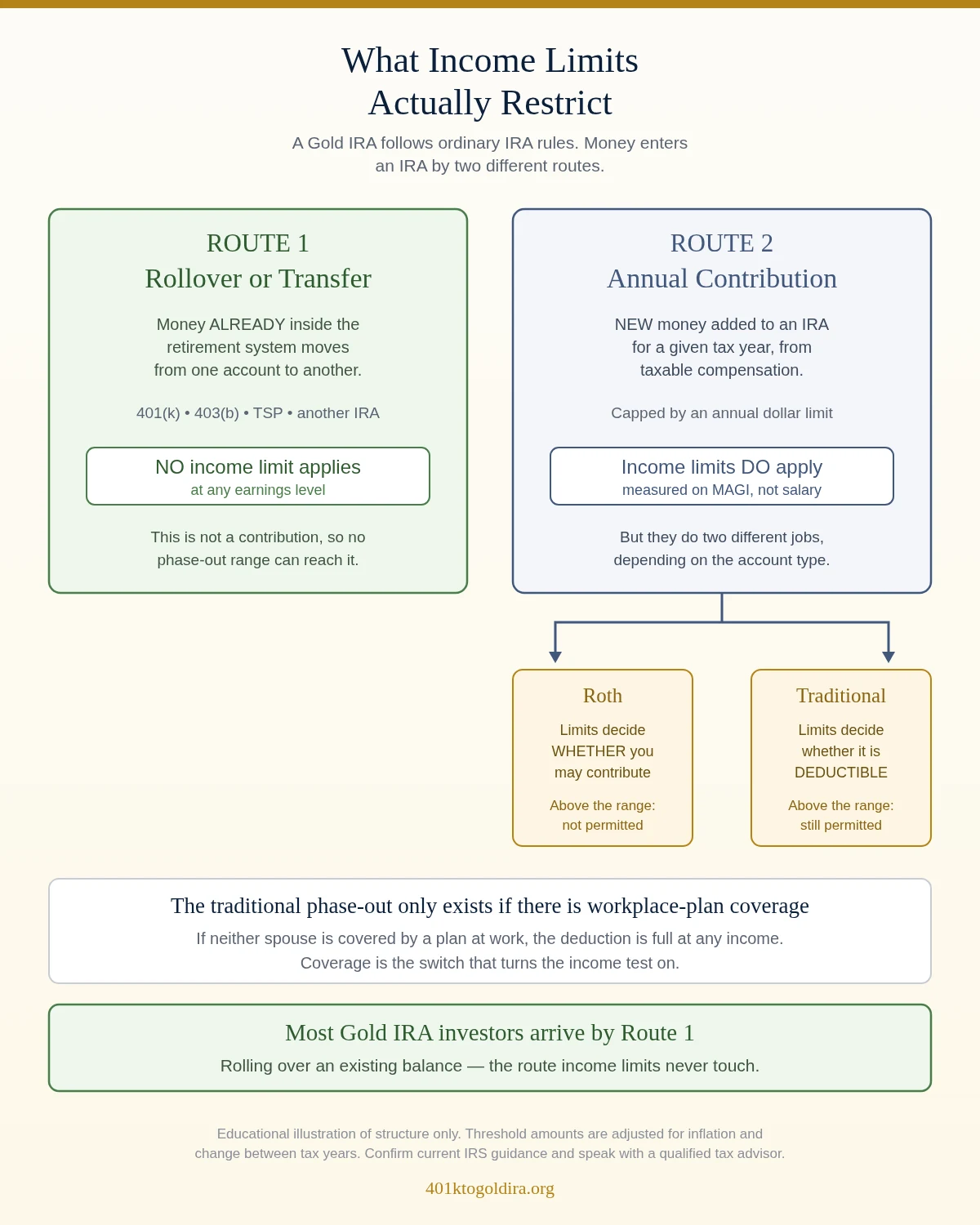
- A Gold IRA has no separate income limits. It inherits the ordinary IRA rules, because it is an IRA that holds metals rather than a distinct account type.
- Rollovers and transfers are not income-restricted at all. Moving an existing 401(k) or IRA balance into a Gold IRA is unaffected by earnings, at any income level.
- Income limits do two different jobs: they cap direct Roth contributions, and they phase out the deduction for traditional contributions. A traditional contribution itself is still permitted above the range, just not deductible.
- If neither spouse is covered by a workplace plan, the traditional deduction has no income phase-out whatsoever.
- Married filing separately has two cases. A taxpayer who lived apart from their spouse for the entire year uses the single range. Only one who lived with their spouse at any point during the year faces the statutory $0 to $10,000 band.
- The annual dollar limit is shared across every IRA a person holds, so opening more accounts does not raise it.
Is There an Income Limit for a Gold IRA?
No, not as such. A Gold IRA is a self-directed IRA holding physical precious metals, not a separate category of retirement account with its own rulebook. Every income rule that applies to it is the ordinary IRA rule.
That matters because the question usually arrives in one of two very different situations, and they have opposite answers:
- Moving money that is already in a retirement account — a 401(k), 403(b), TSP, or another IRA. Income limits are irrelevant here. There is no earnings level that disqualifies a rollover.
- Adding new money as an annual contribution. Here income limits apply, in the same way they would for an IRA holding index funds.
Most people arriving at a Gold IRA are doing the first. The rollover route is the one that is unrestricted, which is worth establishing before working through phase-out tables that may not apply.
What Is Modified Adjusted Gross Income?
Every threshold on this page is measured against modified adjusted gross income, not gross salary and not taxable income. Modified adjusted gross income starts from adjusted gross income and adds back certain deductions and exclusions.
Two points are commonly missed. First, MAGI is usually higher than the figure a taxpayer thinks of as their income after deductions, so estimating from a payslip tends to understate it. Salary is only one input: interest, dividends, capital gains, taxable IRA distributions and business income can all push modified adjusted gross income above a threshold that a wage figure alone would clear comfortably.
Second, the specific adjustments are not identical across rules. IRS Publication 590-A supplies one worksheet for the traditional deduction and a separate one for Roth contribution eligibility. Both add back items such as the student loan interest deduction, the foreign earned income and housing exclusions, excluded savings-bond interest and excluded adoption benefits. The Roth worksheet then does something the traditional one does not: it subtracts income arising from a conversion or a qualified-plan-to-Roth rollover, purely for the purpose of testing direct-contribution eligibility. That conversion income still counts towards taxable income generally; it is removed only from this one calculation.
Both differ again from the definition Medicare uses for IRMAA premium surcharges. A single MAGI figure should not be assumed to serve all three.
Because the calculation depends on individual circumstances, the figure that matters should be confirmed with a qualified tax advisor rather than estimated.
What Are the Roth IRA Income Limits for a Gold IRA?
Roth IRA eligibility phases out across a range rather than stopping at a cliff. Below the lower figure, the full contribution is available. Within the range, the permitted contribution reduces progressively. Above the upper figure, direct Roth contributions are not permitted.
For tax year 2026, the ranges announced by the IRS are:
| Filing status | Full contribution below | Phase-out range | No direct contribution above |
|---|---|---|---|
| Single or head of household | $153,000 | $153,000 – $168,000 | $168,000 |
| Married filing jointly or qualifying surviving spouse | $242,000 | $242,000 – $252,000 | $252,000 |
| Married filing separately, lived apart all year | $153,000 | $153,000 – $168,000 | $168,000 |
| Married filing separately, lived together at any point | — | $0 – $10,000 | $10,000 |
The married-filing-separately position is the one most often stated incorrectly, because it has two cases rather than one. A taxpayer who lived apart from their spouse for the whole tax year is treated as single for this purpose and uses the single range. Only a taxpayer who lived with their spouse at any point during the year falls into the $0 to $10,000 band.
That narrow band is set by statute and is not indexed for inflation, so it does not move when the other figures are updated each year.
These tables also assume sufficient taxable compensation. A taxpayer with modified adjusted gross income below the threshold but little or no taxable compensation can still face a lower contribution limit for that reason alone.
How Do Income Limits Affect a Traditional Gold IRA?
Traditional IRAs work differently, and the distinction is the single most misunderstood point in this area. Income limits do not stop anyone from contributing to a traditional IRA. They only determine whether that contribution is deductible.
They also only bite when there is workplace retirement plan coverage. If neither the taxpayer nor their spouse is covered by a plan at work, the deduction is available in full regardless of income, with no phase-out at any level.
Where coverage does exist, the tax year 2026 ranges are:
| Situation | Phase-out range |
|---|---|
| Single or head of household, covered by a workplace plan | $81,000 – $91,000 |
| Married filing jointly, the contributing spouse is covered | $129,000 – $149,000 |
| Married filing jointly, the contributor is not covered but their spouse is | $242,000 – $252,000 |
| Married filing separately, covered by a workplace plan | $0 – $10,000 |
The third row deserves care. A taxpayer with no workplace plan of their own, married to someone who has one, gets a far more generous range than a covered taxpayer does. That range currently shares its numbers with the Roth married-filing-jointly range shown earlier, but the two are separate rules that happen to coincide. They are indexed independently and may diverge in future years, so they should not be treated as one threshold.
Why Is “Deductible” Not the Same as “Allowed”?
This distinction is the single most consequential point on the page, and it is routinely reported wrongly. A taxpayer above the deduction range may still make a permitted traditional IRA contribution. The contribution simply becomes partly or wholly non-deductible.
A non-deductible contribution creates after-tax basis in the IRA, and that basis is generally reported on Form 8606. The form is what establishes the basis on record. Without accurate basis records, a later distribution or conversion can be treated as more taxable than it should be, because the taxpayer cannot demonstrate that part of the money was already taxed.
That record-keeping is a long-term obligation rather than a one-off filing, and it is a common source of error. It warrants professional advice before being relied on as a strategy.
How Is the Reduced Amount Calculated Inside a Phase-Out Range?
Eligibility does not stop abruptly at the lower figure. Inside the range the permitted amount falls proportionally, according to how far modified adjusted gross income has travelled through the band.
For a Roth contribution, the IRS worksheet works through this sequence: take modified adjusted gross income, subtract the lower boundary for the filing status, divide by the width of the range, and multiply that fraction by the contribution limit. Subtracting the result from the limit gives the reduced contribution. The figure is rounded up to the nearest $10, and where a positive result falls below $200 the taxpayer may contribute $200.
Applied to a single filer under 50 with modified adjusted gross income of $160,500 in tax year 2026: that is $7,500 into a $15,000 band, so half the range has been used. Half of the $7,500 limit is $3,750, leaving a permitted Roth contribution of $3,750. Holding gold inside the account does not alter the arithmetic.
The traditional deduction uses a separate worksheet running the other way: the fraction of the band still remaining, multiplied by the contribution. A single filer covered at work with modified adjusted gross income of $86,000 sits halfway through the $81,000 to $91,000 range, so roughly $3,750 of a $7,500 contribution would be deductible and the remaining $3,750 non-deductible.
Both illustrations are simplified. The official worksheets in IRS Publication 590-A control the result, because compensation, contributions already made to other IRAs, filing status, age and rounding can all change the final figure. Customers should speak with a qualified tax advisor before relying on an illustrative calculation.
Do Income Limits Apply to a 401(k) Rollover?
No. This is the most important practical point on the page, and it is why income limits are often a non-issue for Gold IRA investors.
Income limits govern annual contributions: new money added to an IRA for a given tax year. A rollover or trustee-to-trustee transfer moves money that is already inside the retirement system from one account to another. It is not a contribution, it does not count against the annual limit, and no modified adjusted gross income threshold restricts it.
A high earner who cannot make a direct Roth contribution can still roll an entire 401(k) balance into a Gold IRA. The annual dollar limit does not cap it either, because the limit expressly excludes rollover contributions.
Other rules do still apply. The distributing plan must permit a distribution, the payment must be an eligible rollover distribution, and the tax character carries across: pre-tax plan money moved to a traditional IRA generally stays tax-deferred, while pre-tax money moved to a Roth IRA is generally included in income as a conversion.
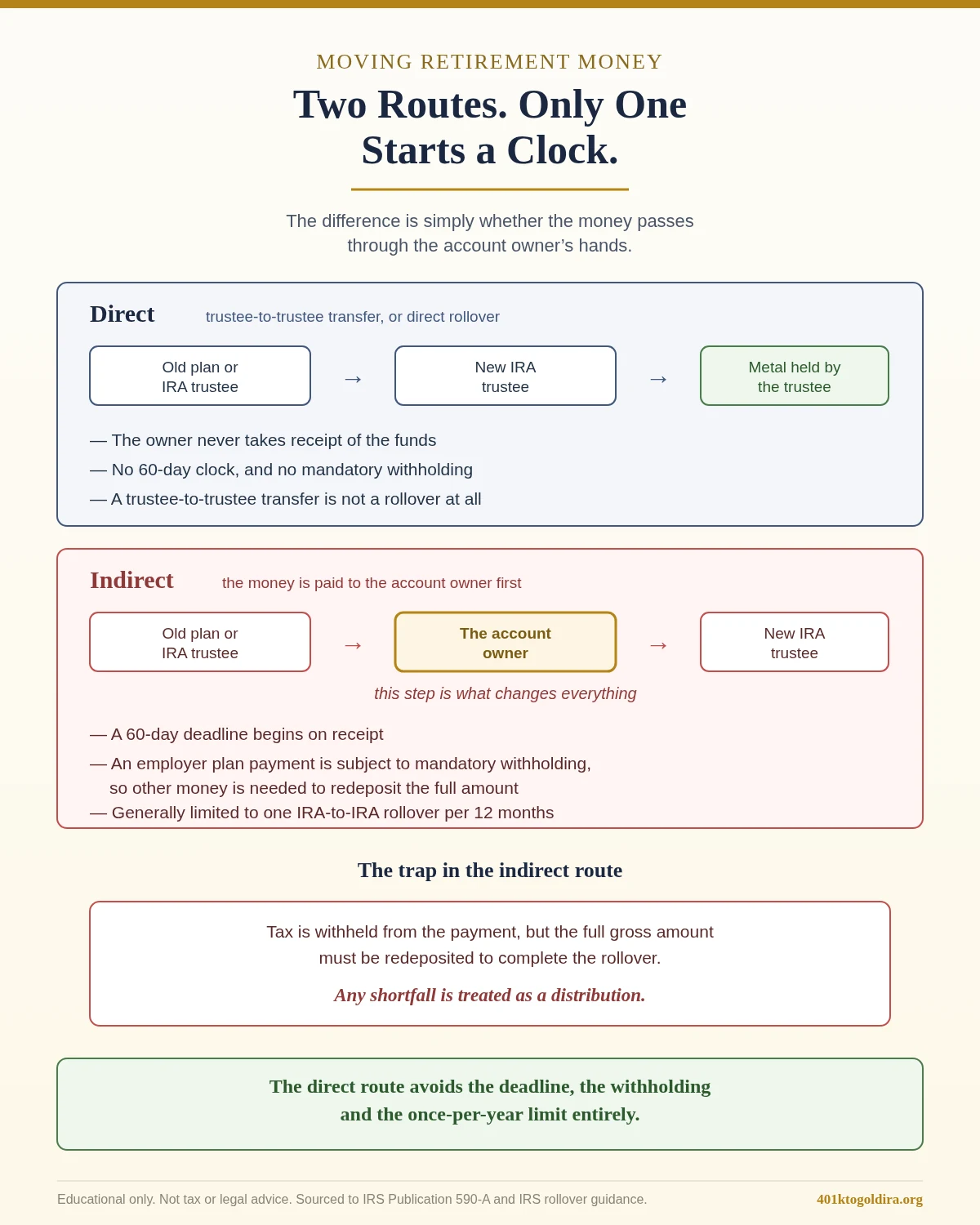
A trustee-to-trustee transfer is different again. Because the account holder never receives the money, Publication 590-A does not treat it as a rollover at all, and it is not subject to the one-rollover-per-12-months waiting period. A 60-day rollover, where funds are paid out and redeposited, brings withholding and timing risks that a direct transfer avoids. Those mechanics matter far more here than eligibility, and are covered in Gold IRA tax mistakes, 403(b) to Gold IRA rollover, and TSP to Gold IRA rollover.
Gold IRA Rollover Mechanics Video
Rollovers are the route most Gold IRA investors actually use, and the one income limits do not touch.
Gold IRA educational video
Video published by Goldco on YouTube — a company this site has an affiliate relationship with. Embedded as a third-party explanation; not produced, endorsed or independently verified by this site.
How Much Can Be Contributed to a Gold IRA?
Separate from the income tests, an annual dollar limit applies. For tax year 2026 it is $7,500, with an additional catch-up contribution of $1,100 for those aged 50 and over, giving a total of $8,600.
Two constraints sit alongside that figure. The limit is shared across all IRAs a person holds, so it is not $7,500 per account, and opening additional self-directed accounts does not raise it. A contribution also cannot exceed taxable compensation for the year where that is lower than the limit.
One related point often causes confusion in a metals context: IRS Publication 590-A distinguishes trustee administrative fees from contributions, and those administrative fees are not subject to the contribution limit. How such fees are paid and documented can still affect the tax and economic outcome.
The catch-up amount is worth a note: it was fixed at $1,000 for many years and has only recently begun to move, because it is now adjusted for inflation. Older guidance still in circulation may show the fixed figure.
What If Income Is Above the Roth Limit?
Being above the Roth range does not close off a Gold IRA. The realistic options are:
- A rollover or transfer of existing retirement money, which is not income-restricted, as set out above.
- A traditional IRA contribution, which remains permitted at any income, and is fully deductible if there is no workplace plan coverage.
- A non-deductible traditional contribution, permitted at any income where there is sufficient compensation, creating after-tax basis reported on Form 8606.
- A Roth conversion, which has no income limit of its own but is generally a taxable event in the year it happens, and can affect Medicare premium surcharges two years later. Where the destination holds physical metals, the Roth Gold IRA guide separates a taxable conversion from a Roth-to-Roth transfer that is not one.
- Leaving the money where it is. A rollover is not required. An existing 401(k), 403(b), TSP or IRA may be retained where the plan permits, and the comparison properly covers costs, available investments, creditor protection, withdrawal rules and plan-specific features. No income rule determines whether moving is preferable.
Each carries tax consequences that depend on the individual’s full position, particularly the interaction between existing pre-tax IRA balances and any conversion, covered below. These are decisions to take with a qualified tax advisor, not from a comparison table.
Why Existing IRA Balances Matter Before a Conversion
A non-deductible contribution followed by a conversion is a widely discussed route for taxpayers above the Roth range. It carries a complication that is easy to miss, and it can be expensive.
When a traditional IRA holding after-tax basis is converted, the taxable proportion is not calculated on the single account chosen for conversion. It is calculated across the taxpayer’s traditional, SEP and SIMPLE IRA balances taken together, using total basis and aggregate year-end values. This is commonly called the pro-rata rule, and Form 8606 performs the calculation.
The practical consequence: opening a new gold IRA, funding it with a non-deductible contribution and converting it does not isolate that money from existing pre-tax balances elsewhere. Where substantial pre-tax IRA balances already exist, the conversion can generate considerably more taxable income than the isolated account would suggest.
Physical metals add further steps, because valuation, liquidation and custody all bear on how a conversion is carried out. Customers should speak with a qualified tax advisor before completing a conversion.
What Mistakes Commonly Cause Problems?
- Treating a rollover as a regular contribution. A rollover should be documented and coded as one. Misclassifying it can make an account appear to exceed the annual limit when it does not.
- Assuming income blocks a traditional contribution. Income can remove the deduction while leaving the contribution permitted.
- Using salary in place of modified adjusted gross income. Salary omits investment income and other items, and ignores the rule-specific adjustments.
- Applying the Roth range to a rollover or conversion. It governs direct annual contributions only.
- Forgetting the shared limit. Opening several self-directed accounts does not multiply the annual contribution limit.
- Overlooking existing pre-tax IRAs before converting. The pro-rata calculation considers them all together.
- Treating dealer or custodian terminology as a tax determination. Phrases such as “Roth eligible” or “rollover approved” do not replace IRS rules, plan documents or tax reporting.
Sources
- IRS — IR-2025-111: 401(k) limit increases for 2026, IRA limit increases to $7,500, announcing the figures set out in Notice 2025-67.
- IRS — Notice 2025-67 (PDF), the underlying authority for the cost-of-living adjustments.
- IRS — COLA increases for dollar limitations on benefits and contributions.
- IRS — Retirement topics: IRA contribution limits.
- IRS — Publication 590-A, Contributions to Individual Retirement Arrangements, including the modified adjusted gross income worksheets and the reduced-contribution calculations. Note that the publication is revised per filing year and may lag the annual notice.
- IRS — Instructions for Form 8606, covering non-deductible contributions, basis, and the pro-rata calculation on conversion.
- IRS — Rollovers of retirement plan and IRA distributions.
Phase-out ranges and contribution limits are adjusted for inflation and change between tax years, so any figure should be confirmed against current IRS guidance for the tax year in question before it is relied on.
FAQ
Is there an income limit for a Gold IRA?
A Gold IRA is a self-directed IRA holding physical metals, so it follows standard IRA income rules rather than having limits of its own. Income limits restrict direct Roth contributions and the deductibility of traditional contributions. They do not restrict rollovers or transfers.
Do income limits apply to a 401(k) rollover into a Gold IRA?
No. Income limits apply to annual contributions, not to rollovers or trustee-to-trustee transfers. An existing retirement balance can be rolled into a Gold IRA at any income level.
Can a high earner still deduct a traditional IRA contribution?
Yes, if neither the taxpayer nor their spouse is covered by a workplace retirement plan there is no income-based phase-out, and the contribution is fully deductible regardless of income. The phase-out ranges apply only where workplace-plan coverage exists.
What happens inside the phase-out range?
The permitted Roth contribution reduces progressively across the range rather than stopping abruptly. The precise reduced amount is calculated using the method set out in IRS Publication 590-A.
Why is the married filing separately limit so low?
The $0 to $10,000 range is set by statute rather than by annual inflation adjustment, so it has remained unchanged while other thresholds have risen. It applies where a married taxpayer files separately and lived with their spouse at any point during the year.
Does the annual IRA limit apply separately to each gold IRA?
No. The annual limit is shared across all of a taxpayer’s traditional and Roth IRAs. Opening several self-directed accounts does not create several contribution limits.
Does the income limit apply to an IRA-to-IRA transfer?
A direct trustee-to-trustee transfer is not a regular annual contribution and is not restricted by the Roth phase-out. Publication 590-A also confirms it is not subject to the one-rollover-per-year waiting period. Moving existing Roth money into a self-directed Roth IRA that holds metals is covered in the Roth Gold IRA guide.
Do gold holdings change the phase-out calculation?
No. The calculation depends on the IRA type, filing status, modified adjusted gross income, compensation, age, and contributions to other IRAs. The asset held inside the account does not affect it.
Are custodian and storage fees counted against the contribution limit?
IRS Publication 590-A distinguishes trustee administrative fees from contributions, and those administrative fees are not subject to the contribution limit. The way fees are paid and documented can still affect the tax and economic result.
Is modified adjusted gross income the same as salary?
No. Modified adjusted gross income begins with adjusted gross income and adds back certain deductions and exclusions. It is usually higher than the income figure most people work from, and the exact calculation varies between the Roth and traditional deduction rules.
Does a Roth conversion have an income limit?
Conversions are not subject to an income limit. However, a conversion is generally taxable in the year it occurs and can affect Medicare premium surcharges two years later, so timing matters. Customers should speak with a qualified tax advisor before converting.