Educational only: This guide explains a conditional tax strategy; it is not tax, legal, or investment advice, and it is not market-timing advice or a promise of tax savings. A recession does not create an automatic conversion signal. It summarizes IRS, SSA, and CMS guidance in general terms, and figures should be confirmed against current guidance for the applicable year. Customers should speak to a financial or tax advisor before making decisions. Goldco does not offer tax or legal advice. Past performance does not guarantee future results.
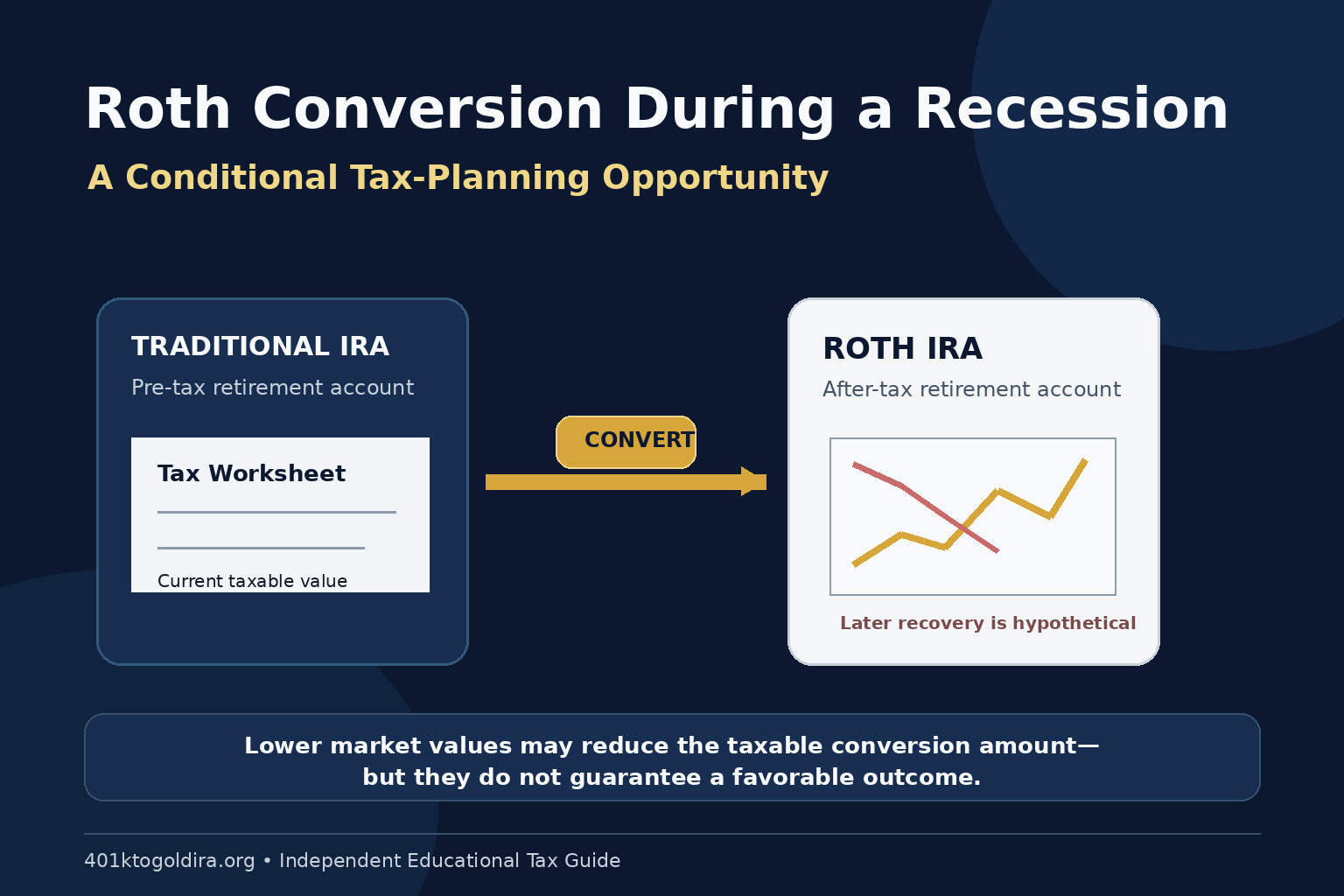
Converting a traditional IRA to Roth when account values are temporarily depressed means the same holdings convert at a lower taxable value — so more of the balance can move to tax-free Roth status per dollar of tax paid, if any later recovery then grows tax-free.
Source: IRS — Publication 590-A (Contributions to IRAs). A conversion is a taxable event; the strategy shifts when the tax is paid, not whether.
Key takeaways
- A recession is not an automatic signal — a conversion only helps if the tax cost fits the household's bracket and cash to pay the tax comes from outside the IRA.
- A Roth conversion is a taxable event: the converted pretax amount is added to ordinary income for the year.
- The pro-rata rule (Form 8606) applies basis across all traditional IRA balances — a conversion is rarely tax-free even with after-tax contributions.
- A five-year rule applies before converted amounts can be withdrawn without penalty; a different five-year test governs whether earnings are qualified.
- Conversion income raises MAGI and can lift Medicare IRMAA — SSA generally uses tax data from two years earlier, so a conversion today can raise premiums later.
A recession does not create an automatic conversion signal. The useful question is whether a lower account value, current tax bracket, future required distributions, Medicare costs, available cash, and estate goals combine to make a partial or full conversion reasonable (IRS: Retirement Plans FAQs Regarding IRAs).
Roth Conversion Opportunity Recession: Why Lower Values Matter
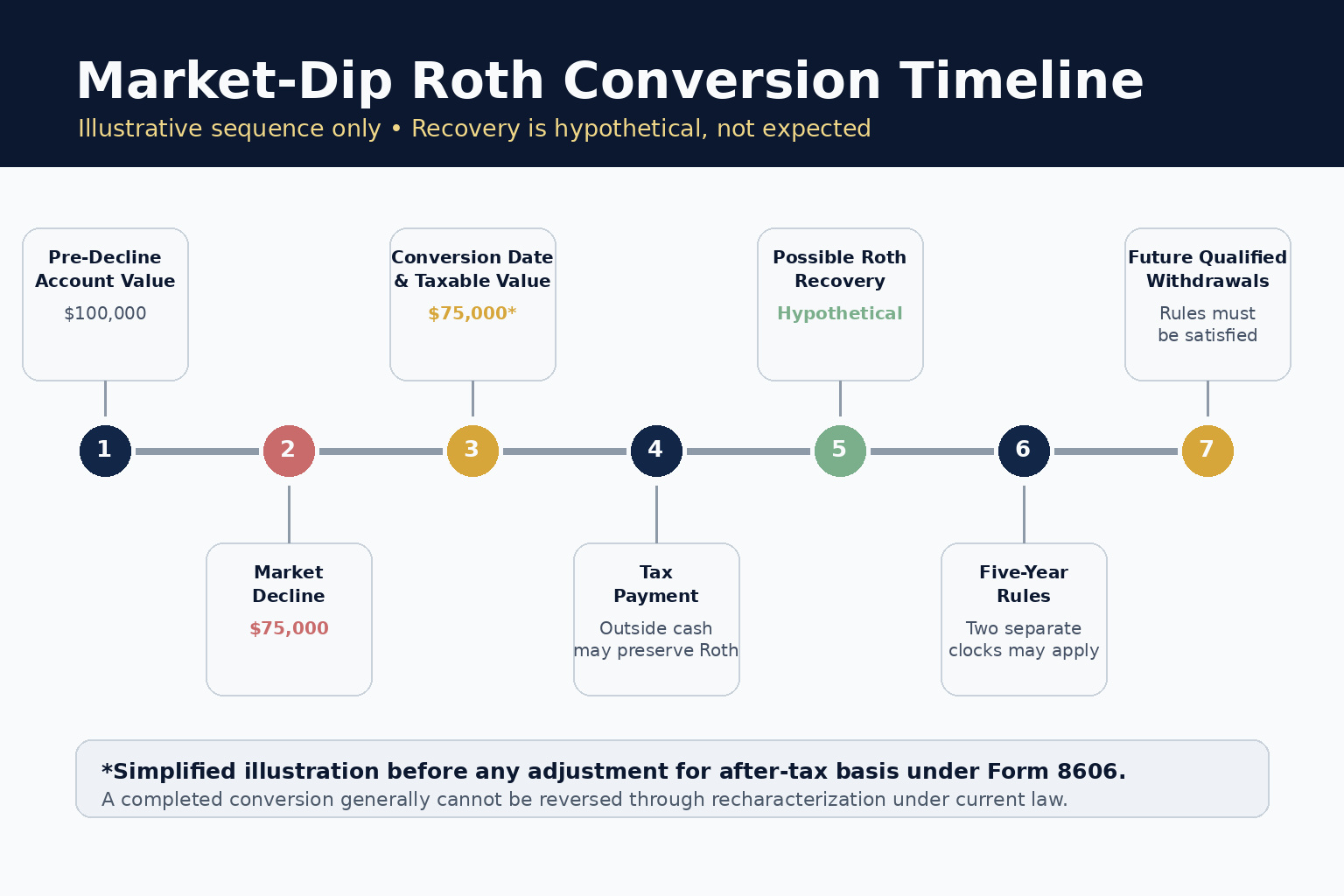
A Roth conversion moves money or property from a pre-tax retirement account into a Roth account. The IRS states that untaxed traditional IRA amounts converted to a Roth IRA are included in gross income for the conversion year (IRS: Publication 590-A). When the same number of shares is worth less, the amount moved is also worth less at conversion — that can reduce the current taxable amount without changing the number of shares entering the Roth. Consider a simple illustration:
- A traditional IRA holding is worth $100,000 before a market decline.
- The holding later falls to $75,000.
- Converting the entire holding at the lower value generally creates a $75,000 gross conversion rather than a $100,000 gross conversion, before any adjustment for after-tax IRA basis.
- If the holding later returns to $100,000 inside the Roth, the $25,000 recovery occurs in the Roth account.
This is arithmetic, not a forecast. If the holding falls to $55,000 after conversion, the tax was still triggered from the value converted earlier. Current law generally does not allow a Roth conversion completed after 2017 to be reversed through recharacterization. Fidelity describes the same conditional market-dip logic: converting a fixed number of shares at a lower value can produce a smaller taxable amount, while converting a fixed dollar amount can move more shares, and it states that no perfect conversion time exists (Fidelity: Roth Conversions and Tax Diversification). A roth conversion before market recovery can therefore be helpful only when several uncertain events line up: the converted assets must recover, qualified Roth rules must eventually be met, and the current tax cost must compare favorably with taxes avoided later. Customers should speak to a financial or tax advisor before making decisions involving conversion timing, taxable income, estimated payments, or future withdrawals. Goldco does not offer tax or legal advice.
How a Roth Conversion Is Taxed
Pre-Tax Amounts Become Current Income
The IRS states that a conversion includes in gross income the traditional IRA amounts that would have been taxable if distributed instead of converted, generally reported for the calendar year in which the conversion occurs. A conversion can be completed by trustee-to-trustee transfer, a transfer between accounts at the same trustee, or a qualifying rollover method; a direct transfer can reduce operational errors but does not remove the conversion tax. The taxable conversion amount is added to other ordinary income, and that added income can push part of the conversion into a higher marginal bracket. A partial conversion can be sized around a chosen tax ceiling, but the correct ceiling depends on filing status, deductions, state tax, credits, other income, and future expectations. The IRS warns that a person who includes conversion income may need additional withholding or estimated tax payments. Customers should speak to a financial or tax advisor before choosing a conversion amount, withholding method, estimated payment, or tax bracket target. Goldco does not offer tax or legal advice.
Paying the Tax Changes the Economics
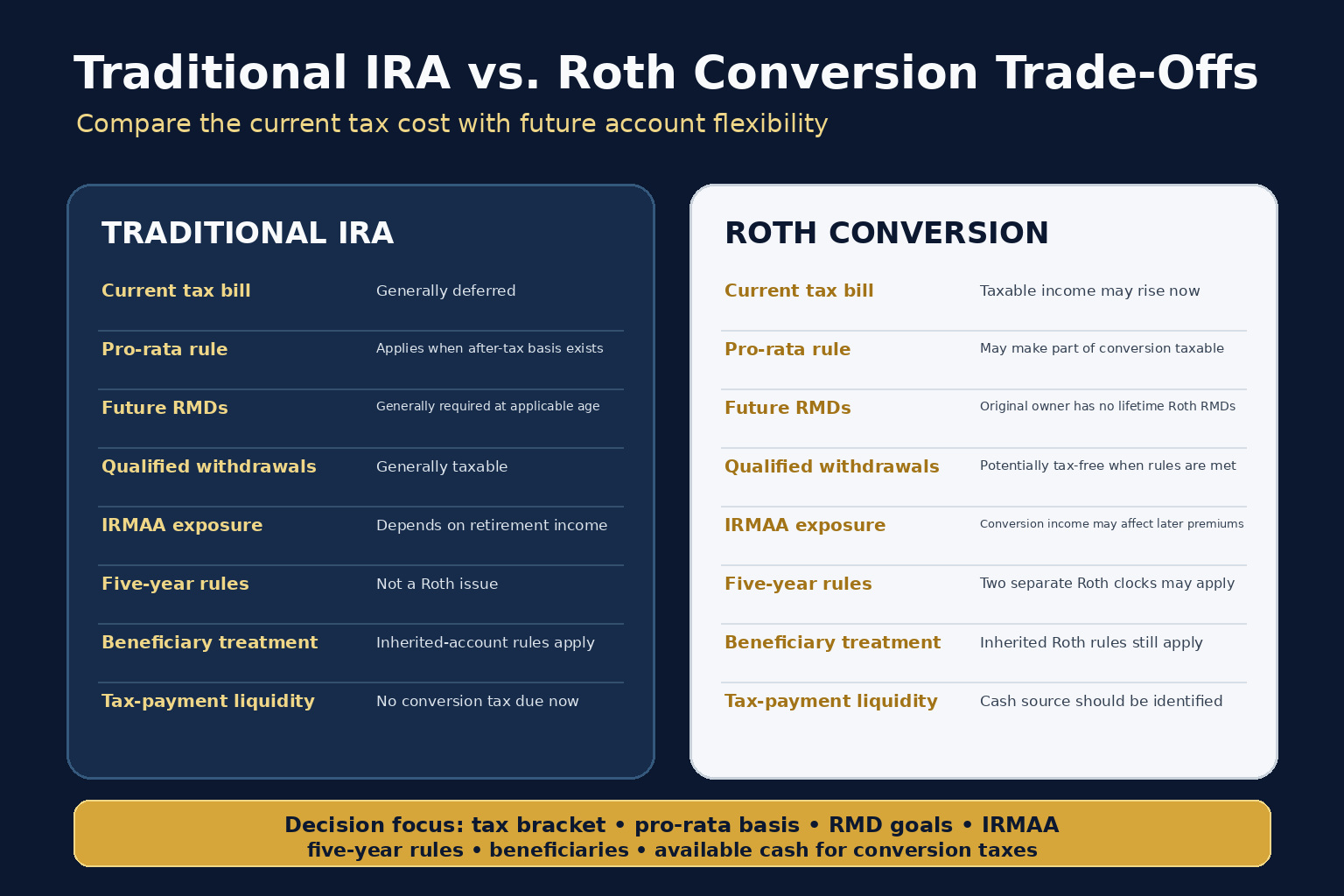
A Roth conversion does not create cash to pay the tax bill. The tax must be covered from taxable savings, withholding, or money removed from a retirement account. Using outside cash preserves the full converted amount inside the Roth; using IRA money to cover withholding reduces the amount that reaches the Roth. For a person under age 59½, an amount withheld rather than converted may also be treated as an early distribution unless an exception applies — the IRS generally applies an additional 10% tax to taxable early IRA distributions when no exception is available (IRS: Topic No. 557, Additional Tax on Early Distributions). The need for outside cash can make a roth conversion market dip less attractive even when the account value has fallen. Customers should speak to a financial or tax advisor before using IRA assets, withholding, or taxable savings to pay conversion taxes. Goldco does not offer tax or legal advice.
The Roth Conversion Pro-Rata Rule
A traditional IRA can contain both pre-tax money and after-tax basis. After-tax basis usually comes from nondeductible contributions that were properly reported. The IRS uses Form 8606 to determine the taxable and nontaxable shares of a traditional IRA distribution or conversion, aggregating the value and basis of all traditional IRAs (generally including traditional SEP and SIMPLE IRAs unless the instructions state otherwise) (IRS: Instructions for Form 8606). This aggregation creates the roth conversion pro rata rule: a taxpayer generally cannot isolate only the after-tax dollars in one traditional IRA and convert that amount tax-free while leaving all pre-tax IRA money untouched.
Pro-Rata Illustration
Assume at year-end: total traditional, SEP, and SIMPLE IRA value of $100,000; total documented after-tax basis of $20,000; and a conversion amount of $25,000. The after-tax share is 20% of the combined IRA value, so in a simplified example about $5,000 of the conversion would be nontaxable basis and about $20,000 would be taxable. Form 8606 performs the actual calculation and also considers distributions, conversions, outstanding rollovers, and year-end IRA values. An account holder with several small IRAs can face the same pro-rata result as a person with one large IRA, and missing basis records can also cause tax reporting problems. Customers should speak to a financial or tax advisor before applying the pro-rata rule, moving IRA balances, filing Form 8606, or estimating the taxable conversion amount. Goldco does not offer tax or legal advice.
The Two Roth Five-Year Rules
The phrase roth conversion five year rule can refer to two separate clocks.
Five Years for a Qualified Roth IRA Distribution
The IRS states that a qualified Roth IRA distribution generally must occur after the five-year period beginning with the first tax year for which a contribution was made to any Roth IRA for the owner, and also after age 59½, after death, because of disability, or for qualifying first-home expenses within the statutory limit. This qualified-distribution clock is tied to the first Roth IRA contribution or conversion for the owner, not separately to each Roth IRA account.
Separate Five-Year Period for Each Conversion
A different five-year period applies to each conversion or qualified-plan rollover when determining whether an early distribution of taxable converted amounts may face the additional 10% tax. IRS Publication 590-B states that each conversion has a separate five-year period and that this clock is not necessarily the same as the qualified-distribution clock (IRS: Publication 590-B). This second rule matters mainly before age 59½: a person who converts at age 45 and withdraws converted taxable principal too soon may face a different result from a person who converts after age 59½. A roth ladder conversion strategy often uses a series of annual conversions, but each conversion requires separate tax records and can have its own early-withdrawal clock. Customers should speak to a financial or tax advisor before planning Roth withdrawals, conversion ladders, early distributions, or five-year periods. Goldco does not offer tax or legal advice.
Reducing Future RMDs and Changing the Estate Picture
Roth Conversion RMD Reduction
Traditional IRAs are generally subject to required minimum distributions after the applicable starting age. The original owner of a Roth IRA is not required to take lifetime RMDs (IRS: Required Minimum Distributions). A conversion reduces the traditional IRA balance used for future RMD calculations and increases the Roth balance that is not subject to lifetime RMDs for the original owner, which can improve tax flexibility later but does not erase the current conversion tax. The value of roth conversion rmd reduction depends on future traditional IRA growth, future tax rates and brackets, the account owner's age and life expectancy, other retirement income, charitable plans, and whether the converted money is likely to be spent or inherited. A large conversion can create more tax now than later RMDs would have produced; a smaller series of conversions may reduce bracket pressure but leaves more time for traditional balances to grow. Customers should speak to a financial or tax advisor before using a conversion to reduce RMDs or change retirement-income sequencing. Goldco does not offer tax or legal advice.
Estate and Beneficiary Effects
A Roth IRA can remain invested during the original owner's lifetime without owner RMDs, which can leave a larger Roth balance for beneficiaries when the owner does not need the funds, and qualified Roth distributions are not included in income (IRS: Roth IRAs). The estate-planning benefit has limits: beneficiaries are subject to inherited-account distribution rules, and many non-spouse designated beneficiaries must empty an inherited IRA by the end of the tenth year after death, while spouses and certain eligible beneficiaries have different options (IRS: Retirement Topics — Beneficiary). A Roth conversion does not remove federal or state estate-law questions, beneficiary-designation issues, trust rules, or the inherited-account timetable — it changes the income-tax character of the account, not every estate-planning rule. The estate planning with a Gold IRA guide covers beneficiary and custody questions for precious-metals accounts.
Medicare IRMAA and Tax-Bracket Trade-Offs
A Roth conversion increases adjusted gross income to the extent the conversion is taxable. Social Security defines Medicare IRMAA modified adjusted gross income as adjusted gross income plus tax-exempt interest, and Medicare uses this amount to determine whether higher Part B and Part D charges apply (SSA: Medicare Premiums). Social Security generally uses tax information from two years before the premium year, so conversion income reported for one tax year can affect Medicare premiums two years later.
For 2026, the standard Part B monthly premium is $202.90. The first IRMAA tier begins above $109,000 of 2024 MAGI for an individual return and above $218,000 for a joint return; at that first tier, the 2026 Part B premium is $284.10 and the Part D adjustment is $14.50 plus the plan premium. Higher tiers apply at higher income levels, and these thresholds and charges change over time (CMS: 2026 Medicare Parts A and B Premiums and Deductibles). A conversion at age 63 can therefore affect Medicare charges at age 65 when the normal two-year lookback applies, and a conversion after Medicare enrollment can also affect later premium years. Social Security permits IRMAA reconsideration for certain life-changing events, including work stoppage or work reduction; a voluntary Roth conversion by itself is not listed as a life-changing event. The tax-bracket issue works in the same direction: conversion income fills lower brackets first and can push the remaining amount into higher brackets. A partial conversion may help control this effect, but IRMAA, state tax, deductions, credits, and other income must be modeled together. Customers should speak to a financial or tax advisor before setting a conversion amount near a tax-bracket or Medicare IRMAA threshold. Goldco does not offer tax or legal advice.
Where a Self-Directed or Gold Roth Fits
A self-directed Roth IRA can allow a broader set of assets than a conventional brokerage IRA, including certain precious metals. Investor.gov warns that self-directed IRAs can involve higher fees, complex assets, fraud exposure, and custodians that may not evaluate the quality or legitimacy of an asset (Investor.gov: Self-Directed IRAs and the Risk of Fraud). The IRS generally treats metals and coins as collectibles, with exceptions for certain coins and qualifying gold, silver, platinum, or palladium bullion held in the physical possession of a bank or approved nonbank trustee (IRS: Investments in Collectibles). A converting ira to roth recession strategy can include a self-directed IRA holding metals, but the conversion mechanics remain the main tax issue — the converted fair market value, account basis, custody, valuation, fees, and later distributions all require documentation. Gold is not required for a Roth conversion and does not create special conversion tax treatment; it remains one possible asset inside a qualifying self-directed Roth structure. Customers should speak to a financial or tax advisor before converting a self-directed IRA, valuing physical metals, changing custody, or paying conversion taxes. Goldco does not offer tax or legal advice. The Roth Gold IRA guide sets out the §408(m) eligibility and custody rules that apply once metals are inside a Roth IRA, and separates a taxable conversion from a Roth-to-Roth transfer that is not one. The Gold IRA tax mistakes guide and Gold IRA guide for first-time investors provide additional account-rule context, and a broader provider review is available through the Gold IRA companies comparison and Gold IRA quiz.
When a Conversion May Not Make Sense
A roth conversion after downturn may still be unfavorable when the current tax cost is too high or the future benefit is weak.
A lower future tax rate is expected. Paying tax at a high rate now can be inefficient when traditional IRA withdrawals are expected to face a lower rate later. Future tax law cannot be known with certainty, so the comparison should use several scenarios.
The conversion crosses important thresholds. A conversion can trigger a higher marginal bracket or Medicare IRMAA tier, and it can interact with other income-based tax provisions. The full return, not only the IRA, must be modeled.
Cash is not available for the tax. Using retirement assets to cover the tax reduces the amount reaching the Roth, and before age 59½ the amount withheld can also create an early-distribution issue.
The money may be needed soon. The qualified-distribution rules and separate conversion clocks can make a Roth less flexible for near-term withdrawals, especially for a younger account owner.
The market decline continues. A lower conversion value can reduce the initial taxable amount, but a further decline can leave the Roth worth less after tax has already been paid. A recession conversion is therefore not market-timing advice.
The traditional IRA supports other plans. Traditional IRA assets may support future qualified charitable distributions, staged withdrawals, or other tax planning, and a conversion removes the converted amount from those traditional IRA strategies. The Gold IRA RMD strategy provides more context on distribution-phase planning.
A Calm Roth Conversion Review Process
A written review can reduce the pressure to convert based on headlines.
- Record every traditional, SEP, and SIMPLE IRA balance and after-tax basis.
- Estimate current-year income before conversion.
- Model several conversion amounts rather than one all-or-nothing move.
- Calculate federal and state tax under each scenario.
- Check the applicable Medicare IRMAA lookback year and thresholds.
- Review both Roth five-year rules.
- Compare future RMD and beneficiary outcomes.
- Identify the cash source for the tax bill.
- Stress-test a continued market decline and a delayed recovery.
- Preserve Forms 8606, account statements, conversion confirmations, and beneficiary records.
The right choice depends on individual tax circumstances, retirement income, age, liquidity, beneficiaries, and expectations about future rates. A roth conversion tax strategy should be evaluated as a multi-year plan rather than a one-day market call.
Frequently Asked Questions
Why can a recession make a Roth conversion relatively cheaper?
A lower account value can reduce the taxable amount when the same shares or property are converted. Any later recovery occurs inside the Roth, but recovery is uncertain and the conversion tax cannot generally be reversed through recharacterization.
Is a Roth conversion tax-free?
No. Untaxed traditional IRA amounts converted to a Roth IRA are generally included in gross income for the conversion year. After-tax basis can make part of a conversion nontaxable under the Form 8606 calculation.
Can only after-tax IRA money be converted tax-free?
Generally, no separate IRA can be isolated for this purpose when other traditional, SEP, or SIMPLE IRA balances exist. Form 8606 applies basis across the combined traditional IRA balances under the pro-rata calculation.
Does every Roth conversion have a five-year rule?
A separate five-year period applies to each conversion for the early-distribution recapture rule. A different five-year period applies when determining whether Roth IRA earnings are part of a qualified distribution.
Can a Roth conversion reduce future RMDs?
Yes. Converting reduces the traditional IRA balance that may later be subject to RMDs, while the original Roth IRA owner has no lifetime RMD requirement. The current conversion tax must still be weighed against the possible future benefit.
Can a Roth conversion increase Medicare premiums?
Yes. Taxable conversion income can raise MAGI, and SSA generally uses tax information from two years earlier to calculate IRMAA for Part B and Part D.
Conclusion
A recession can create a relatively lower-value window for a Roth conversion, but the opportunity is conditional. The conversion produces current taxable income. The pro-rata rule can make more of the conversion taxable than expected. Two separate five-year rules can affect later withdrawals. Higher income can cross tax brackets or Medicare IRMAA thresholds. The conversion can reduce future RMDs and change beneficiary planning, but inherited-account rules still apply. A market decline improves the arithmetic only when the assets later recover, the Roth rules are met, and the current tax cost is lower than the future tax value avoided — none of those outcomes is certain. The strongest approach models several conversion sizes, identifies the tax-payment source, checks Medicare and five-year rules, and compares current and future tax scenarios without trying to predict the market bottom. Customers should speak to a financial or tax advisor before making decisions involving Roth conversions, taxes, RMDs, Medicare premiums, beneficiaries, self-directed IRAs, or precious metals. Goldco does not offer tax or legal advice.
Sources
- Internal Revenue Service. Retirement Plans FAQs Regarding IRAs.
- Internal Revenue Service. Publication 590-A (Contributions to IRAs).
- Internal Revenue Service. Publication 590-B (Distributions from IRAs).
- Internal Revenue Service. Instructions for Form 8606.
- Internal Revenue Service. About Form 8606, Nondeductible IRAs.
- Internal Revenue Service. Roth IRAs.
- Internal Revenue Service. Required Minimum Distributions.
- Internal Revenue Service. RMD Comparison Chart: IRAs vs. Defined Contribution Plans.
- Internal Revenue Service. Retirement Topics — Beneficiary.
- Internal Revenue Service. Retirement Plan and IRA RMD FAQs.
- Internal Revenue Service. Topic No. 557, Additional Tax on Early Distributions.
- Internal Revenue Service. Investments in Collectibles in Individually Directed Qualified Plan Accounts.
- Social Security Administration. Medicare Premiums.
- Social Security Administration. Modified Adjusted Gross Income (POMS).
- Social Security Administration. IRMAA Sliding Scale Tables (POMS).
- Social Security Administration. Request to Lower an IRMAA.
- Centers for Medicare & Medicaid Services. 2026 Medicare Parts A and B Premiums and Deductibles.
- Investor.gov. Self-Directed IRAs and the Risk of Fraud.
- Fidelity. Roth Conversions and Tax Diversification.
- Fidelity. Why Convert to a Roth IRA Now?
Article reviewed and edited by Daniel M. — editor, 401kToGoldIRA.org. Sourced to the IRS, the Social Security Administration, CMS, Investor.gov, and Fidelity; educational only, not tax or legal advice, and not market-timing advice. Tax figures and thresholds change and should be confirmed for the applicable year.