
Affiliate disclosure: Some links on this page may be sponsor links. The site owners may be compensated if customers request information from companies mentioned here. This page is educational only and does not provide financial, tax, or legal advice. Customers should speak with a qualified tax professional before making retirement-account decisions. Past performance does not guarantee future results.
A taxable early IRA distribution can add a federal tax equal to 10% of the amount included in gross income, unless an exception applies.
Source: 26 U.S.C. § 72(t). The additional tax is separate from ordinary income tax and does not apply to a tax-free return of basis.
Key takeaways
- Two federal taxes may apply: ordinary income tax and the separate 10% additional tax on taxable early distributions.
- Taking metal is still a distribution: the custodian reports the metal's fair market value on Form 1099-R.
- Exceptions are not universal: the age-55 separation rule applies to qualifying employer plans, not IRAs.
- Moving money is not spending money: a direct rollover or trustee-to-trustee transfer normally avoids the 60-day deadline.
- An exception usually removes only the additional tax: ordinary income tax can still apply.
What Is the Gold IRA Early Withdrawal Penalty?
A Gold IRA is an IRA that holds permitted precious metals through a self-directed account. Gold does not create a special early-withdrawal regime. Under Internal Revenue Code section 72(t), a distribution received before age 59½ generally increases federal income tax by 10% of the portion included in gross income, unless an exception applies.
The 10% amount is not withholding and is not the entire tax bill. A fully taxable $50,000 traditional IRA distribution can add $5,000 under section 72(t), while the same $50,000 also increases ordinary taxable income. Filing status, other income, deductions, state law, and tax credits can change the final result.
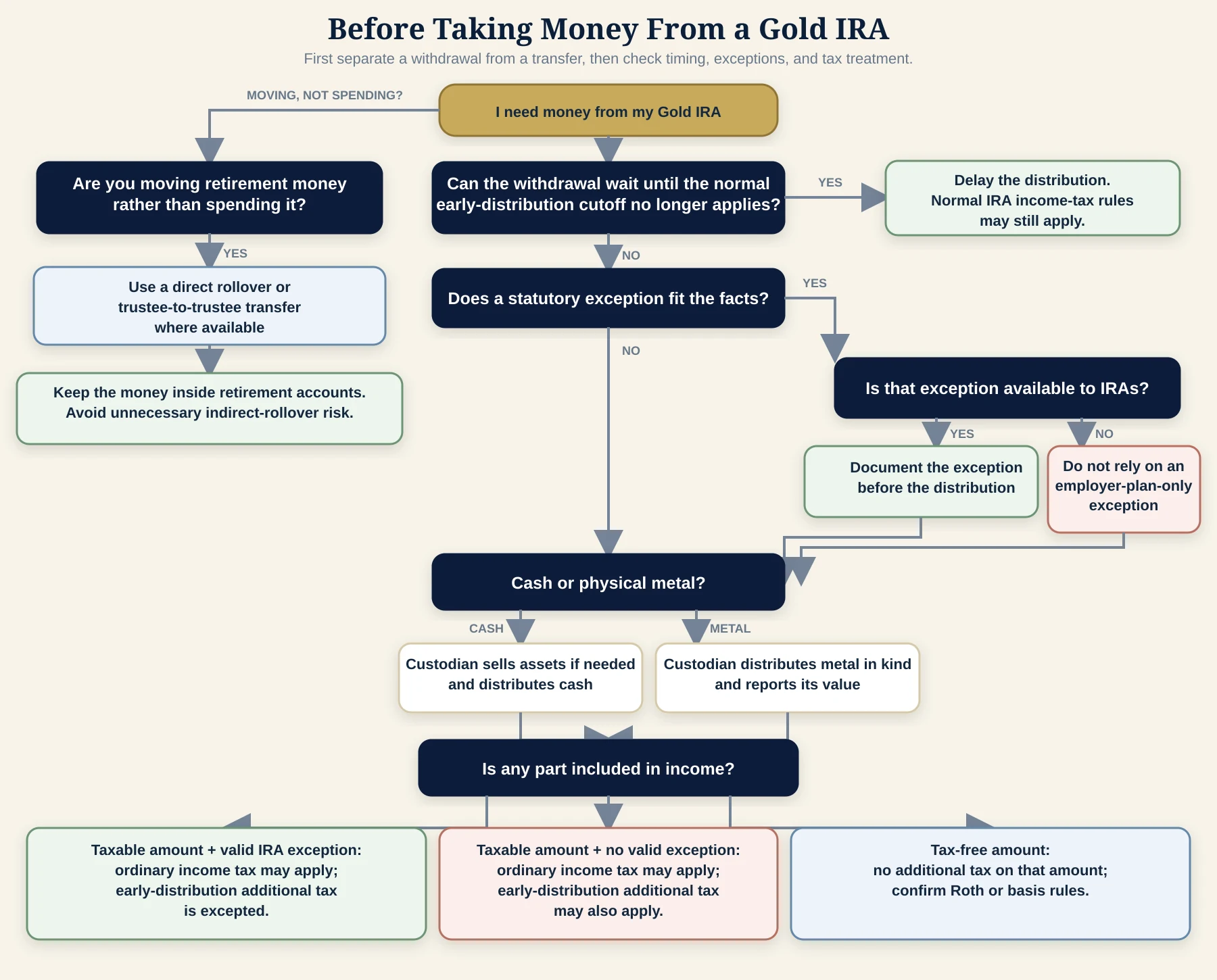
Does Taking Physical Gold Avoid the Tax?
No. A custodian may distribute property rather than cash when the account permits it, but an in-kind metal distribution still removes value from the IRA. The IRS instructions for Forms 1099-R and 5498 direct the custodian to include the property's fair market value on the distribution date in the gross-distribution amount.
For a traditional IRA with no after-tax basis, receiving metal worth $50,000 generally creates a $50,000 gross distribution. If the owner is under 59½ and no exception applies, the taxable amount can face ordinary income tax and the additional 10% tax. Changing the form from cash to coins or bars does not keep the assets inside the IRA.
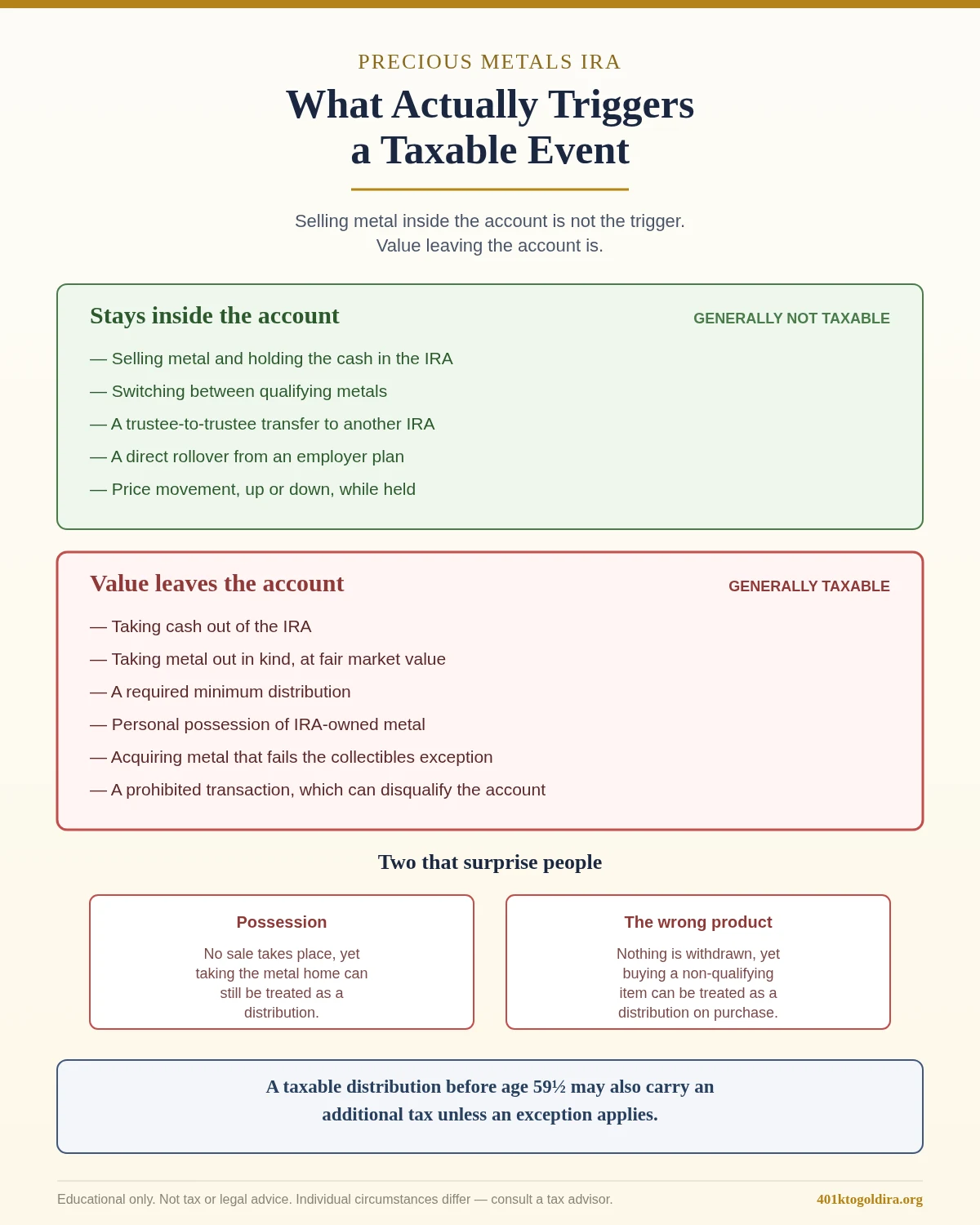
How Do Traditional and Roth Gold IRA Withdrawals Differ?
Traditional Gold IRA
A fully taxable early distribution from a traditional Gold IRA is included in ordinary income and may also face the 10% additional tax. If the owner made nondeductible IRA contributions, the pro-rata basis rules can make part of the distribution tax free. The additional tax applies only to the part included in gross income.
Roth Gold IRA
Roth IRA distributions follow ordering rules: regular contributions first, then conversions and rollovers on a first-in, first-out basis, and earnings last. Two five-year rules are commonly confused.
- Qualified-distribution five-year rule: helps determine when Roth earnings can be distributed tax free, together with age 59½, death, disability, or a qualifying first-home distribution.
- Conversion five-year rule: can recapture the additional tax when someone under 59½ withdraws taxable conversion amounts too soon. Each conversion has its own five-year period.
The metal's fair market value still determines the amount distributed. The Roth ordering and five-year rules determine whether that amount is taxable or exposed to the additional tax.
How Is an Early Gold IRA Distribution Reported?
The trustee or custodian reports the gross distribution on Form 1099-R. A custodian may use code 1, “Early distribution, no known exception,” because it does not know whether a personal exception applies. Roth IRA distributions commonly use codes J, Q, or T, depending on the facts and what the payor knows.
Form 5329 is generally used to calculate the additional tax or claim an exception that the Form 1099-R code does not establish. Form 8606 may also be needed when Roth distributions or traditional IRA basis are involved.
Which Early-Distribution Exceptions Work for IRAs?
The IRS exception matrix distinguishes IRA exceptions from employer-plan exceptions. Each rule has eligibility, documentation, timing, and dollar-limit requirements. A valid exception usually removes the 10% additional tax, not ordinary income tax.
Age 59½, death, or disability
Distributions after reaching age 59½ fall outside the early-distribution tax. Death and qualifying disability can also provide exceptions. The disability standard requires inability to engage in substantial gainful activity because of an impairment expected to result in death or continue indefinitely.
72(t) substantially equal payments
A valid SEPP schedule can avoid the additional tax using an IRS-recognized calculation method. It is a continuing payment series, not permission for one hardship withdrawal. An improper modification can trigger recapture tax and interest.
Medical expenses
The exception can cover the qualifying portion of unreimbursed medical expenses above the statutory adjusted-gross-income threshold. Only that qualifying amount is protected.
Health insurance while unemployed
This IRA-specific exception can cover qualifying health-insurance premiums when unemployment-compensation and timing requirements are met.
Higher education
An IRA distribution can qualify to the extent it does not exceed eligible higher-education expenses for the owner, spouse, child, or grandchild after required reductions for tax-free assistance.
First home
The lifetime limit is $10,000 per individual, subject to the first-time-buyer definition, the two-year ownership lookback, timing rules, and qualifying family-member provisions.
IRS levy
The exception applies when the distribution results from an IRS levy on the retirement plan. A voluntary withdrawal to pay a tax bill is not the same event.
Qualified reservist
Qualifying reservists called to active duty for more than 179 days or for an indefinite period may qualify when the distribution occurs within the statutory active-duty period.
Birth or adoption
Up to $5,000 per parent can qualify for a birth or adoption distribution, subject to aggregation, timing, and current recontribution rules.
Terminal illness
A physician must certify an illness or condition that can reasonably be expected to result in death within 84 months or less. Current law also permits eligible repayment.
Domestic abuse
A qualifying domestic-abuse victim distribution is limited to the lesser of the indexed ceiling or 50% of the eligible account balance. For 2026, the IRS-adjusted ceiling is $10,500.
Federally declared disaster
A qualified individual may designate up to $22,000 per disaster across eligible plans and IRAs, with current rules for income spreading and repayment.
Emergency personal expense
One qualifying distribution per calendar year can be excepted, limited to the lesser of $1,000 or the account balance above $1,000, with repayment and later-distribution restrictions.
Which Employer-Plan Exceptions Do Not Carry Over?
A rollover from an old 401(k) into a Gold IRA can remove access to an employer-plan-only exception. This should be checked before the transfer, especially if the owner may need money before age 59½.
- Separation from service at age 55: this exception generally applies to qualifying employer-plan distributions after separation in or after the year the employee reaches age 55. It does not apply to IRAs. Clearing the tax exception is only half the question, because the plan document decides whether money can be taken in pieces rather than as one full withdrawal.
- Qualified domestic relations order: the QDRO exception applies to employer plans, not IRAs. IRA transfers incident to divorce use a different framework.
- Other plan-only structures: ESOP dividends, pension-linked emergency savings, phased retirement, and qualified long-term-care distributions are not generic IRA exceptions.
How Does the 60-Day Rollover Trap Create a Penalty?
Three different movements are often lumped together. A direct employer-plan-to-IRA rollover sends money to the receiving retirement account. A trustee-to-trustee IRA transfer sends money between financial institutions. A 60-day rollover pays the distribution to the individual, who must redeposit the eligible amount within the deadline.
When an employer plan pays an eligible rollover distribution to the participant, it generally withholds 20% of the taxable eligible amount. The participant must replace that withheld amount from other funds to roll over 100%. The IRS instructions state that this mandatory 20% rule does not apply to IRA distributions, which have different withholding rules. For a withdrawal from a 401(k) specifically, the 401(k) withdrawal tax and penalty calculator estimates the income tax, the additional tax and that 20% side by side, and shows the balance left to settle at filing.
If the 60-day deadline is missed and no waiver or special relief applies, the amount does not qualify for tax-free rollover treatment. Revenue Procedure 2020-46 allows self-certification for listed reasons, but it is not a blanket extension and does not prevent later examination.
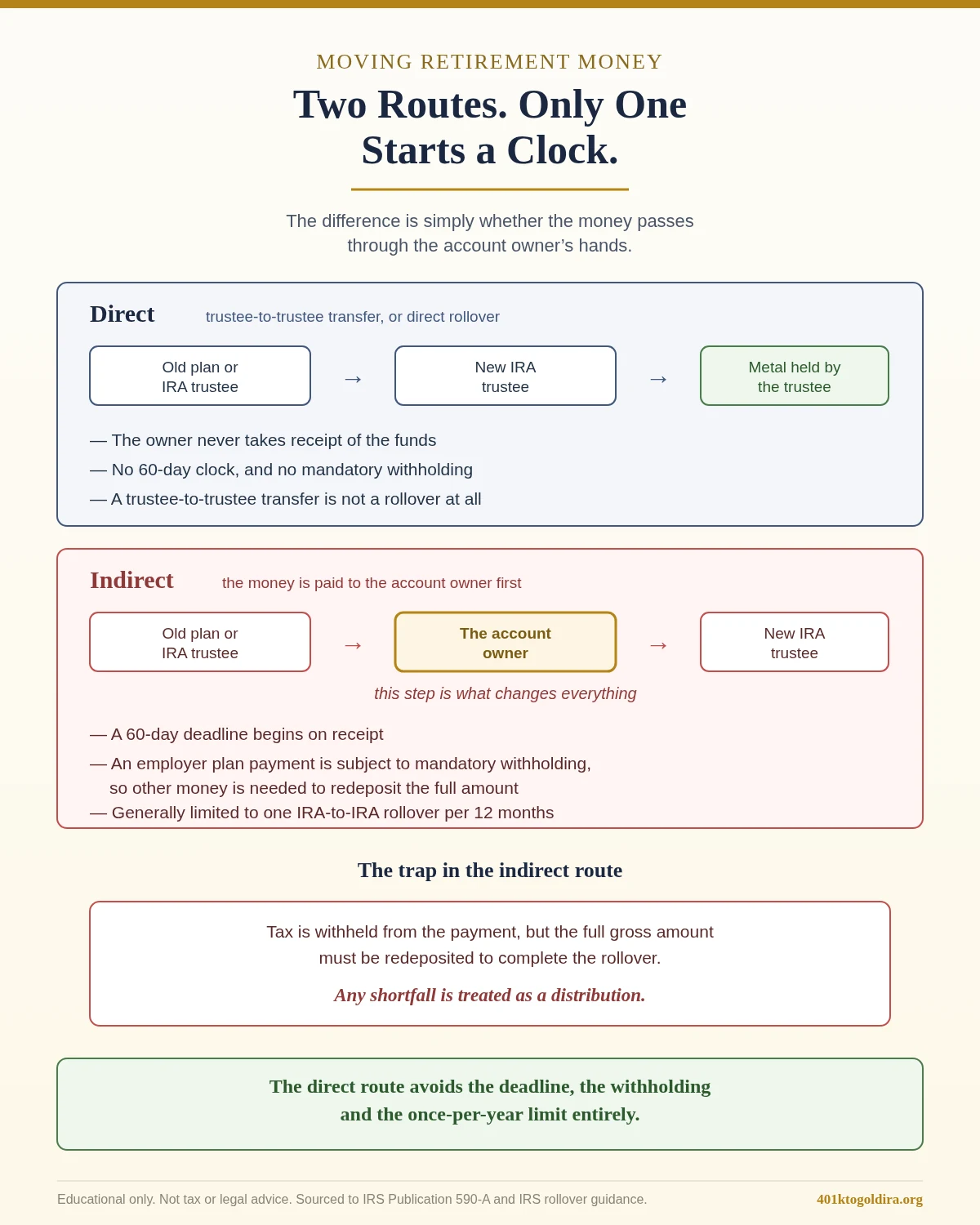
The once-per-12-month rule also applies to indirect IRA-to-IRA rollovers across all of an owner's IRAs. It does not apply to trustee-to-trustee transfers, plan-to-IRA rollovers, plan-to-plan rollovers, IRA-to-plan rollovers, or Roth conversions. For step-by-step context, see the 401(k) to Gold IRA rollover guide.
Can Home Storage Trigger More Than a Normal Withdrawal?
Home-storage marketing often mixes two legal consequences. In McNulty v. Commissioner, 157 T.C. No. 10 (2021), the Tax Court held that coins placed in the IRA owner's actual, unfettered possession were taxable distributions. The decision did not say every home-storage arrangement automatically distributes every asset in the IRA.
A separate prohibited-transaction rule can be broader. If an owner or beneficiary engages in a prohibited transaction under section 4975, the account can cease to be an IRA as of the first day of that tax year, creating a deemed distribution of the entire account. Read the custody comparison in depository versus home storage.
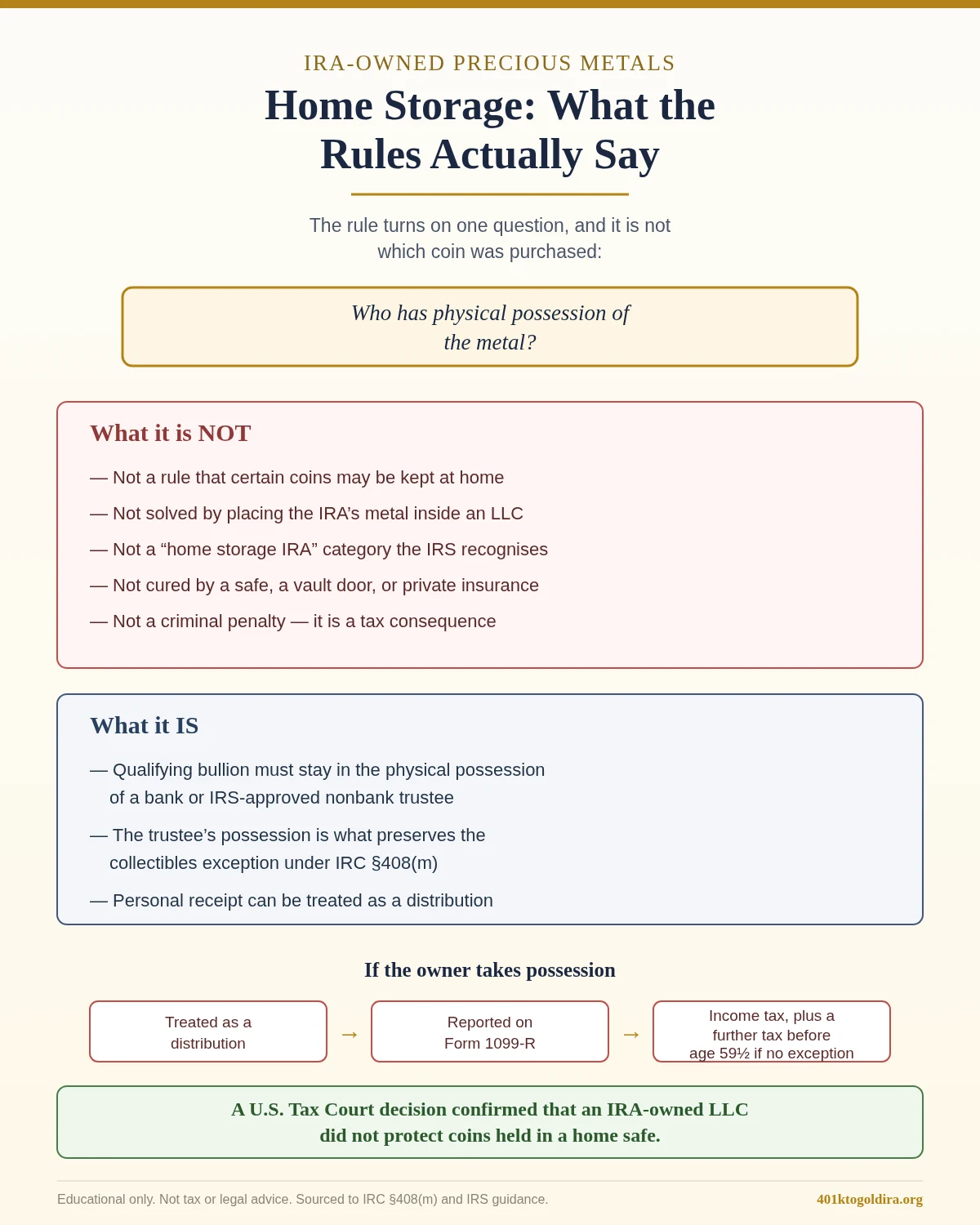
What Happens If the IRA Acquires a Nonqualifying Coin?
Section 408(m) generally treats an IRA's acquisition of a collectible as a distribution equal to the account's cost. The statute excludes specified U.S. coins and qualifying gold, silver, platinum, and palladium bullion that meets the required fineness standard. Qualifying bullion must also remain in the physical possession of an eligible trustee.
A dealer's “IRA eligible” label is not the law. The account must pass both the metal-eligibility test and the custody test. A deemed distribution from acquiring a nonqualifying collectible can create ordinary income and the additional early-distribution tax for an owner under 59½.
What Can a $50,000 Early Gold IRA Withdrawal Cost?
This simplified example demonstrates the mechanism rather than predicting anyone's tax bill. Assume a 55-year-old single filer has $80,000 of taxable income before taking a fully taxable $50,000 distribution from a traditional Gold IRA in 2026. Assume no exception, after-tax basis, state income tax, credits, or other income-sensitive effects.
Ordinary federal tax before distribution: $12,312
Ordinary federal tax after distribution: $23,798
Incremental ordinary federal income tax: $11,486
Additional early-distribution tax: $5,000
Total simplified incremental federal cost: $16,486
Cash remaining: about $33,514 before state tax and metal-liquidation costs.
The distribution fills the remaining part of the 22% bracket and pushes part of the added income into the 24% bracket under the IRS 2026 rate schedules. Use the Gold IRA withdrawal tax estimator to model a different amount, then confirm the result with a tax professional.
How a 72(t) SEPP changes the result
A SEPP is not a one-time label placed on a desired withdrawal. It must be calculated from account value, age, a permitted life-expectancy table, and a permitted method. In the research illustration, an $800,000 IRA at age 55 using fixed amortization and a 5% assumed rate produced an annual payment of about $50,891.
The scheduled payment remained ordinary taxable income, but a valid SEPP removed the additional tax. The tradeoff is loss of flexibility: the series generally cannot be modified before the later of its fifth anniversary or age 59½. A prohibited modification can trigger recapture tax and interest. A real SEPP requires current professional calculation and documentation.
Dealer spreads are a separate cost
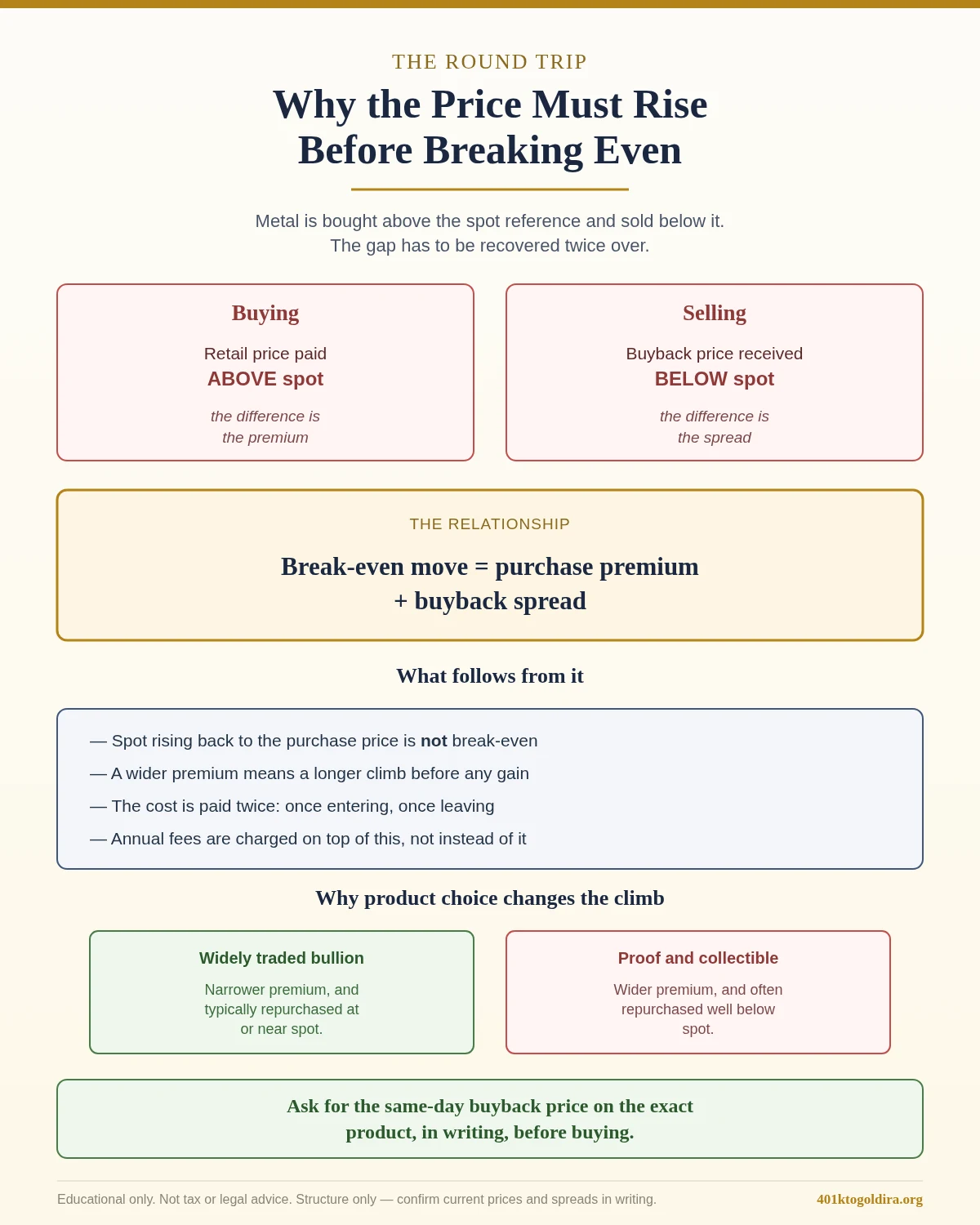
When metal must be sold, the difference between the dealer's retail and buyback prices reduces available cash before taxes. One Money Metals Exchange 1 oz Gold Bar page observed September 13, 2026 showed a retail quote of $4,487.95 and a “Sell to Us” quote of $4,190.15. That single-page quote gap was about 6.64%; it is an illustration, not a market average or tax rule.
What Can an Owner Do Instead of Taking an Early Withdrawal?
- Use a direct rollover or trustee-to-trustee transfer when the goal is moving retirement money rather than spending it.
- Wait until age 59½ when the need can wait. Traditional IRA income tax may still apply.
- Take only the amount needed to limit taxable income and avoid selling more metal than necessary.
- Confirm an IRA-specific exception before distribution, including its eligibility, documentation, timing, and dollar-limit rules.
- Use SEPP only for a genuine multi-year income need, not as a one-time escape from the additional tax.
- Plan Roth conversions well ahead. A conversion creates current taxable income, and its separate five-year clock can affect later access.
- Compare other cash sources without pledging IRA assets as collateral or borrowing from the IRA, both of which can create serious tax problems.
The Gold IRA liquidity guide compares cash and in-kind distributions. The Gold IRA exit-strategy guide explains staged liquidation and planning before a cash need becomes urgent.
What Should Be Checked Before Authorizing a Distribution?
- Is the money being spent, or only moved to another retirement account?
- Can a direct rollover or trustee-to-trustee transfer be used?
- Will the owner be under age 59½ on the distribution date?
- Is the account traditional, Roth, or partly supported by after-tax basis?
- If Roth, which qualified-distribution and conversion five-year periods apply?
- Does an exception fit the facts before the distribution?
- Is that exception available to IRAs?
- What fair market value will the custodian report for an in-kind distribution?
- What dealer, depository, shipping, or transaction costs apply if metal is sold or shipped?
- Could the added income change the federal bracket, state tax, health-insurance subsidy, or Medicare costs?
- What Form 1099-R code is expected, and will Form 5329 or Form 8606 be needed?
- Has the owner kept documentation for the exception and the custodian's valuation?
Frequently Asked Questions
What is the penalty for withdrawing from a Gold IRA before age 59½?
A taxable Gold IRA distribution received before age 59½ generally faces an additional federal tax equal to 10% of the amount included in gross income, unless a statutory exception applies. Ordinary income tax may also apply to a traditional IRA distribution.
Can physical gold be withdrawn from a Gold IRA without tax?
Taking physical metal from a Gold IRA is an in-kind distribution. The custodian reports the metal's fair market value on the distribution date. Whether that value is taxable or subject to the additional early-distribution tax depends on the IRA type, basis, age, and exceptions.
Does the age-55 rule apply to a Gold IRA?
No. The separation-from-service exception at age 55 applies to qualifying employer-plan distributions, not IRA distributions. Rolling an old employer plan into an IRA can remove access to that employer-plan exception.
Does an exception remove all tax from an early Gold IRA distribution?
Usually not. A valid exception generally removes the 10% additional tax. A taxable traditional IRA distribution can still be included in ordinary income.
How is a Gold IRA early-distribution exception reported?
The custodian reports the distribution on Form 1099-R. When a personal exception applies but is not shown by the custodian's distribution code, the taxpayer generally uses Form 5329 to claim the exception.
Can a 72(t) SEPP avoid the Gold IRA early withdrawal penalty?
A properly calculated series of substantially equal periodic payments can avoid the 10% additional tax on scheduled payments. It is a rigid multi-year arrangement, not a one-time hardship withdrawal, and an impermissible modification can trigger recapture tax and interest.
Primary Sources
- 26 U.S.C. § 72: early-distribution tax and statutory exceptions.
- IRS exceptions to tax on early distributions: IRA-versus-plan matrix.
- IRS Publication 590-B: traditional and Roth IRA distributions.
- IRS Instructions for Forms 1099-R and 5498: property valuation, distribution codes, and withholding.
- IRS Instructions for Form 5329: reporting the additional tax and exceptions.
- IRS rollover guidance: direct rollovers, transfers, and the 60-day rule.
- IRS Notice 2022-6: substantially equal periodic payments.
- 26 U.S.C. § 408(m): collectibles and qualifying bullion.
- 26 U.S.C. § 4975: prohibited transactions.
- IRS SECURE 2.0 disaster guidance.
- IRS Notice 2025-67: 2026 inflation adjustments.
- IRS Notice 2026-33: qualified long-term-care distributions and IRA exclusion.
Sources retrieved September 13, 2026. Tax rules change. Confirm current forms, instructions, and personal eligibility before acting.
Article reviewed and edited by Daniel, independent precious-metals retirement researcher.