Affiliate disclosure: Some links on this page may be sponsor links. The site owners may be compensated if customers request information from companies mentioned here. This page is educational only and does not provide financial, tax, or legal advice. A missed rollover deadline can create income-tax, additional-tax, withholding, reporting and excess-contribution issues at the same time, and a qualified tax professional should review the facts promptly. Past performance does not guarantee future results.
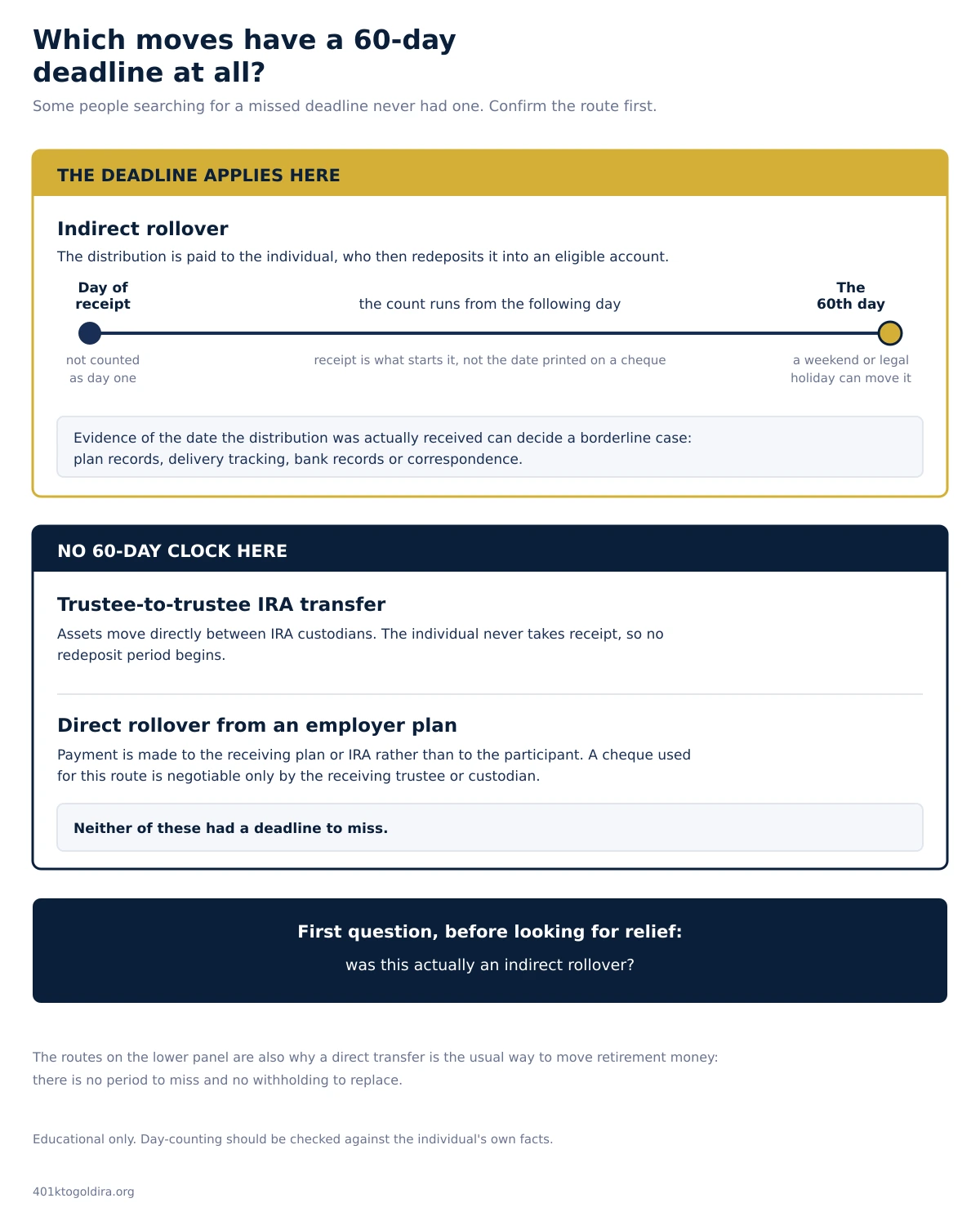
For an indirect rollover, the contribution must generally be made no later than the 60th day following the day the distribution is received.
Source: IRC §402(c)(3) and IRC §408(d)(3). The same statutory timing rule appears in both the qualified-plan and IRA rollover rules.
Key takeaways
- Test the automatic waiver first — it requires no application and no IRS user fee.
- Revenue Procedure 2020-46 is the operative self-certification procedure, superseding 2016-47 and adding a twelfth permitted reason.
- Self-certification is not an IRS determination and can be rejected on examination if the facts do not support it.
- The self-certified rollover must be made as soon as practicable after the blocking reason ends; completion within 30 days is a safe harbor.
- A private letter ruling remains available when the first two routes do not fit, but it carries a substantial user fee.
- The one-rollover-per-year rule is separate and is not waived by 60-day relief.
- If no relief applies, the unrolled taxable amount is generally income and may face the additional early-distribution tax.
Is the 60-day deadline actually missed?
What starts the clock?
For a 60-day rollover, the statutory clock runs from receipt of the distribution. Publication 590-A states the practical rule the same way: the rollover contribution generally must be made by the 60th day after the day the distribution is received. The day of receipt is therefore not counted as day one; the following day begins the count. (IRS Publication 590-A; IRC §402(c)(3)(A); IRC §408(d)(3)(A))
This matters when a check was issued on one day but actually received later. The governing language focuses on receipt, not merely the check date. Documentation showing when the distribution was received can therefore matter: plan records, delivery tracking, bank records, or correspondence may establish the relevant starting point.
Do weekends and holidays change the last day?
The general tax-law timing rule in IRC §7503 provides that when the last day prescribed under the internal revenue laws falls on a Saturday, Sunday, or legal holiday, performance on the next succeeding day that is not a Saturday, Sunday, or legal holiday is treated as timely. (IRC §7503) The rollover-specific IRS pages state the 60-day rule but do not separately restate the weekend-and-holiday provision. A borderline case should therefore be documented carefully before treating the deadline as missed.
Did the transaction even use the 60-day route?
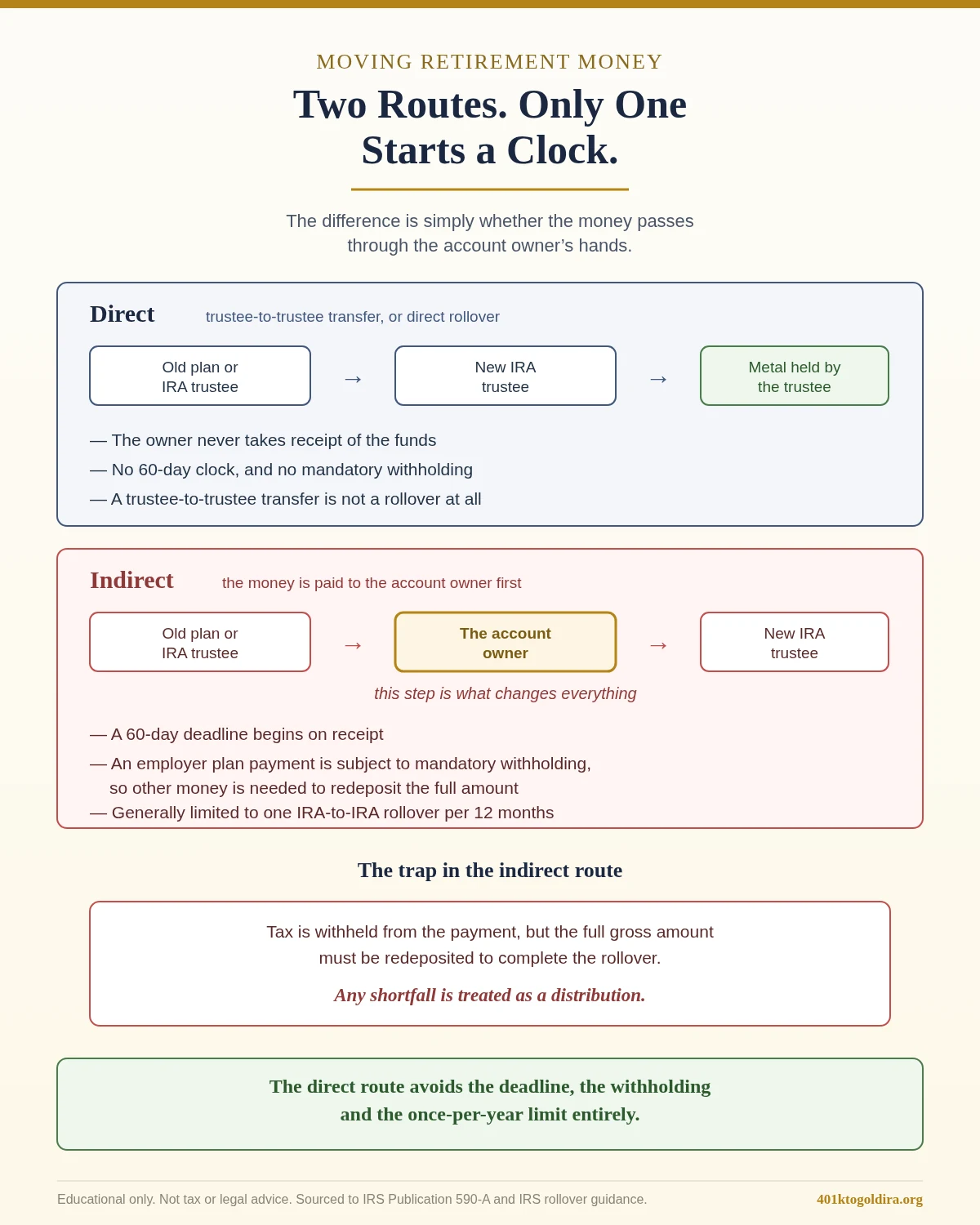
The 60-day deadline is a feature of an indirect rollover — a distribution received by the participant or IRA owner and then redeposited. It does not govern a trustee-to-trustee IRA transfer, and a direct rollover from an employer plan is paid directly to the receiving plan or IRA rather than to the participant. (IRS rollover guidance) A person worried about a missed deadline should first confirm that the transaction was actually an indirect rollover.
Which relief route should be tested first?
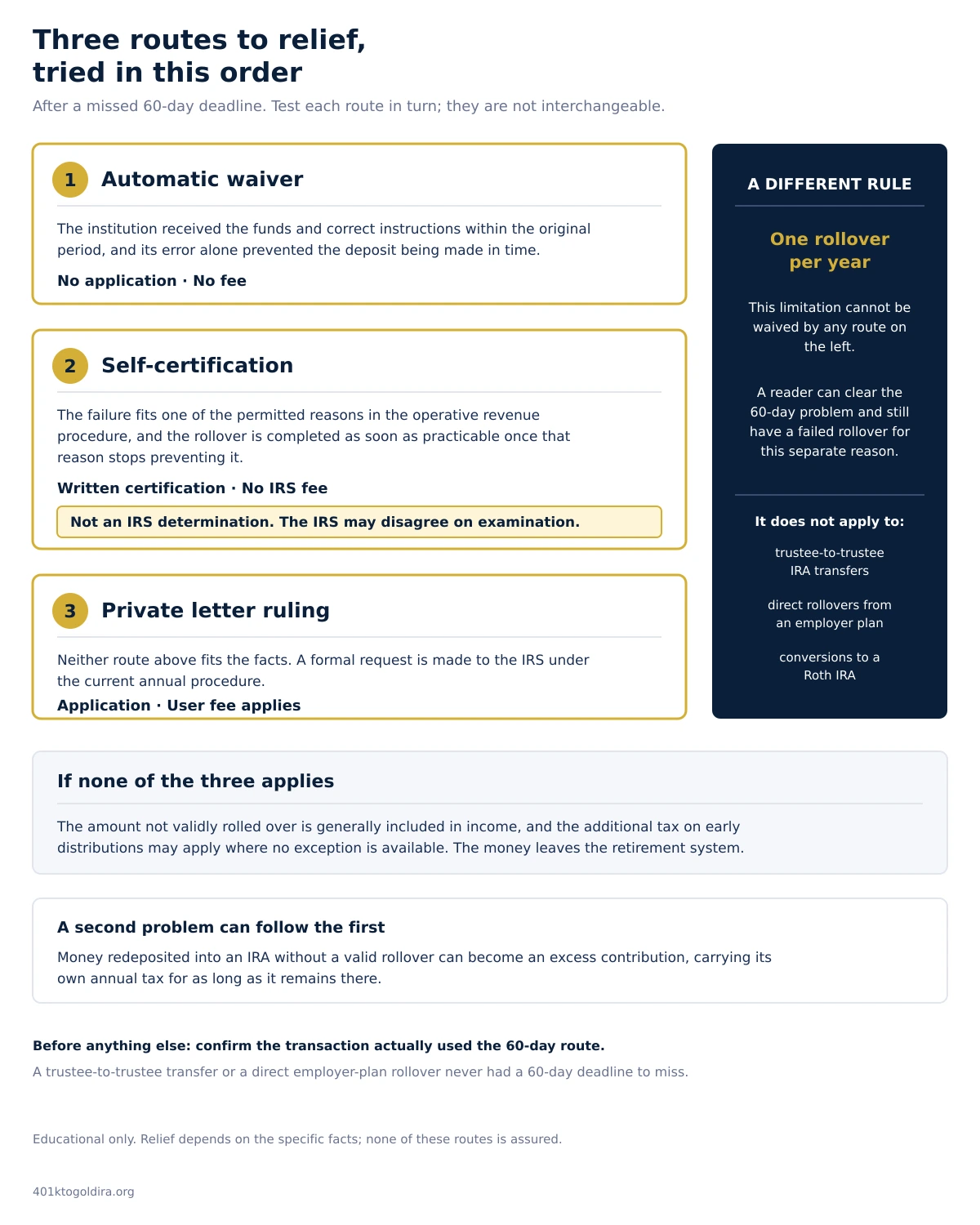
The three remedies are not interchangeable. Publication 590-A identifies three ways a late rollover can obtain relief: an automatic waiver, self-certification, or a private letter ruling. (IRS Publication 590-A)
| Order | Route | Core test | IRS application? | IRS fee? | Main limitation |
|---|---|---|---|---|---|
| 1 | Automatic waiver | Financial institution received the funds in time and its error alone prevented timely deposit | No | No | Exact conditions must all be met |
| 2 | Self-certification | One or more permitted reasons actually prevented timely rollover | No | No | Not an IRS determination; subject to examination |
| 3 | Private letter ruling | Facts do not fit the first two routes, but an equity or good-conscience waiver may still be justified | Yes | Yes | Costly; outcome not guaranteed |
The ordering matters. An automatic waiver is the cleanest route because it is built into the IRS waiver framework and requires neither an application nor a user fee. Self-certification can allow a receiving plan or IRA trustee to accept a late contribution without first obtaining an IRS ruling, but it is only a taxpayer certification of eligibility. A private letter ruling is the formal ruling route when the simpler procedures do not fit. (IRS waiver FAQs)
When does the automatic waiver apply?
All conditions must be satisfied
Publication 590-A states five conditions for the automatic waiver. The financial institution must receive the funds on the individual's behalf before the end of the 60-day period; the individual must have followed the institution's procedures for depositing the funds into the IRA or eligible plan within that period; the failure to complete the deposit within 60 days must be solely due to the financial institution's error; the funds must be deposited into the plan or IRA within one year from the beginning of the 60-day period; and the rollover must otherwise have been valid if the institution had deposited the funds as instructed. (IRS Publication 590-A)
The route therefore does not cover every bank or custodian problem. It is strongest when the record shows that the institution had the funds and proper instructions within the original 60-day period, yet its own processing error prevented the timely posting.
What must be done?
There is no separate IRS application and no user fee. The practical task is to assemble proof that all automatic-waiver conditions are met and obtain written confirmation from the receiving institution showing when it received the funds, what instructions were provided, what error occurred, and when the deposit was finally completed. The one-year outside condition should be checked immediately.
The IRS does not publish a universal processing timetable for the institution's correction. The legal timing condition is the one-year limit described above, not a promised service standard.
When can self-certification fix a late rollover?
Revenue Procedure 2020-46 is the operative procedure
Revenue Procedure 2020-46 modified and superseded Revenue Procedure 2016-47. Current IRS pages continue to direct taxpayers and receiving institutions to Revenue Procedure 2020-46 for late-rollover self-certification. (Rev. Proc. 2020-46; IRS, Accepting Late Rollover Contributions)
What reasons qualify?
The missed deadline must have resulted from the individual's inability to complete the rollover because of one or more of these permitted reasons:
- An error by the financial institution receiving the contribution or making the distribution.
- A distribution check was misplaced and never cashed.
- The distribution was deposited into and remained in an account the individual mistakenly believed was an eligible retirement plan.
- The individual's principal residence was severely damaged.
- A member of the individual's family died.
- The individual or a family member was seriously ill.
- The individual was incarcerated.
- Restrictions were imposed by a foreign country.
- A postal error occurred.
- The distribution resulted from a levy under IRC §6331 and the levy proceeds were returned to the individual.
- The distributing party delayed providing information the receiving plan or IRA required, despite the individual's reasonable efforts to obtain it.
- The distribution was made to a state unclaimed-property fund.
That complete list appears in Revenue Procedure 2020-46. (Rev. Proc. 2020-46)
What are the other conditions?
The IRS must not previously have denied a waiver request for the same distribution. The rollover must satisfy every other legal requirement for a valid rollover. The contribution must be made as soon as practicable after the permitted reason no longer prevents the rollover. Revenue Procedure 2020-46 provides a safe harbor: that timing requirement is deemed satisfied when the contribution is completed within 30 days after the blocking reason ends. (Rev. Proc. 2020-46)
What document is used, and who receives it?
The individual gives the receiving plan administrator or IRA trustee the model certification in the appendix to Revenue Procedure 2020-46, or language substantially similar in all material respects. A copy should be retained. The receiving institution may rely on the certification for purposes of accepting and reporting the late rollover unless it has actual knowledge contradicting the certification.
What self-certification does not do
The IRS also states that a particular financial institution is not required to accept a late rollover. Self-certification gives the institution a basis on which it may rely; it does not force acceptance. There is no IRS fee for self-certification and no pre-approval waiting period, because no ruling is issued at that stage.
When is a private letter ruling the remaining route?
IRC §§402(c)(3)(B) and 408(d)(3)(I) authorize the IRS to waive the 60-day requirement when failure to waive it would be against equity or good conscience, including casualty, disaster, or other events beyond the individual's reasonable control. The private-letter-ruling procedure remains the formal application route where the automatic waiver does not apply and self-certification is unavailable or does not adequately fit the facts. (IRC §402(c)(3)(B); IRC §408(d)(3)(I))
Publication 590-A says the IRS considers all relevant facts and circumstances, including financial-institution errors; death, disability, hospitalization, incarceration, serious illness, foreign-country restrictions, or postal error; whether the distributed amount was used; and how much time has passed since the distribution. That fact-intensive standard is one reason a tax professional is appropriate early. A ruling request is a formal submission, not a short customer-service appeal.
The current IRS publication states that a request for a waiver of the 60-day rollover requirement must be accompanied by a $18,500 user fee, referring to the user-fee chart in the operative annual employee-plans ruling procedure. Because fee schedules are updated through annual revenue procedures, the figure should be reverified immediately before filing. (IRS Publication 590-A)
The annual ruling procedures describe submission and processing mechanics, but no universal completion deadline for a 60-day-waiver ruling was identified in the primary sources. A ruling therefore should not be described as a fixed-number-of-days remedy.
Considering Goldco?
Goldco is a precious metals company. Customers can request a free Gold & Silver Kit at signup. Goldco markets a buyback program; customers should request current written terms directly.
Minimum investment: $25k · BBB rating: A+
Owners of this website may be paid to recommend Goldco. The content on this website, including any positive reviews of Goldco and other reviews, may not be neutral or independent.
Why is the one-rollover-per-year rule a separate problem?
Revenue Procedure 2020-46 expressly states that self-certification addresses only the 60-day requirement, not every other requirement for a valid rollover. One of the examples it gives is the IRA one-rollover-per-year limitation. (Rev. Proc. 2020-46)
Under IRC §408(d)(3)(B), an individual generally may make only one tax-free IRA-to-IRA rollover in a one-year period. IRS guidance applies the limitation across the individual's IRAs in the aggregate rather than separately to each account. (IRC §408(d)(3)(B); IRS Topic No. 451)
IRS guidance states that the one-per-year limit does not apply to trustee-to-trustee transfers between IRAs. It also does not apply to direct rollovers from employer plans, because those are not IRA-to-IRA 60-day rollovers governed by the limitation. Traditional-IRA-to-Roth-IRA conversions are also outside it. (IRS rollover guidance)
A person can therefore solve the 60-day issue and still have an invalid transaction because a prior IRA rollover triggered the one-year restriction. The 60-day waiver authority does not waive that separate statutory condition.
How do employer-plan distributions differ from IRA-to-IRA rollovers?
Mandatory withholding can create a rollover shortfall
When an eligible rollover distribution from an employer plan is paid to the participant rather than sent by direct rollover, the taxable portion is generally subject to mandatory 20% federal withholding. The withheld amount is still treated as part of the distribution. To roll over the full distribution, the participant must supply other funds equal to the amount withheld. If only the net check is rolled over, the unrolled withholding portion is generally taxable and may also be subject to the additional early-distribution tax if no exception applies. (IRS rollover guidance)
Late-rollover relief does not erase this arithmetic. A waiver of the timing rule permits a late rollover that otherwise qualifies; it does not transform an amount that was never contributed into a rollover contribution.
IRA distributions use different withholding rules
IRA distributions paid to the owner do not use the employer-plan mandatory rule. IRS rollover guidance states that IRA distributions paid to the individual are generally subject to 10% withholding unless the individual elects out or chooses a different amount.
Reporting still occurs
A rollover distribution remains reportable. Employer-plan and IRA distributions are generally reported on Form 1099-R. Revenue Procedure 2020-46 states that an IRA trustee accepting a rollover contribution after the 60-day deadline reports on Form 5498 that the contribution was accepted after the deadline. (IRS Instructions for Forms 1099-R and 5498; Rev. Proc. 2020-46)
What happens if no relief is available?
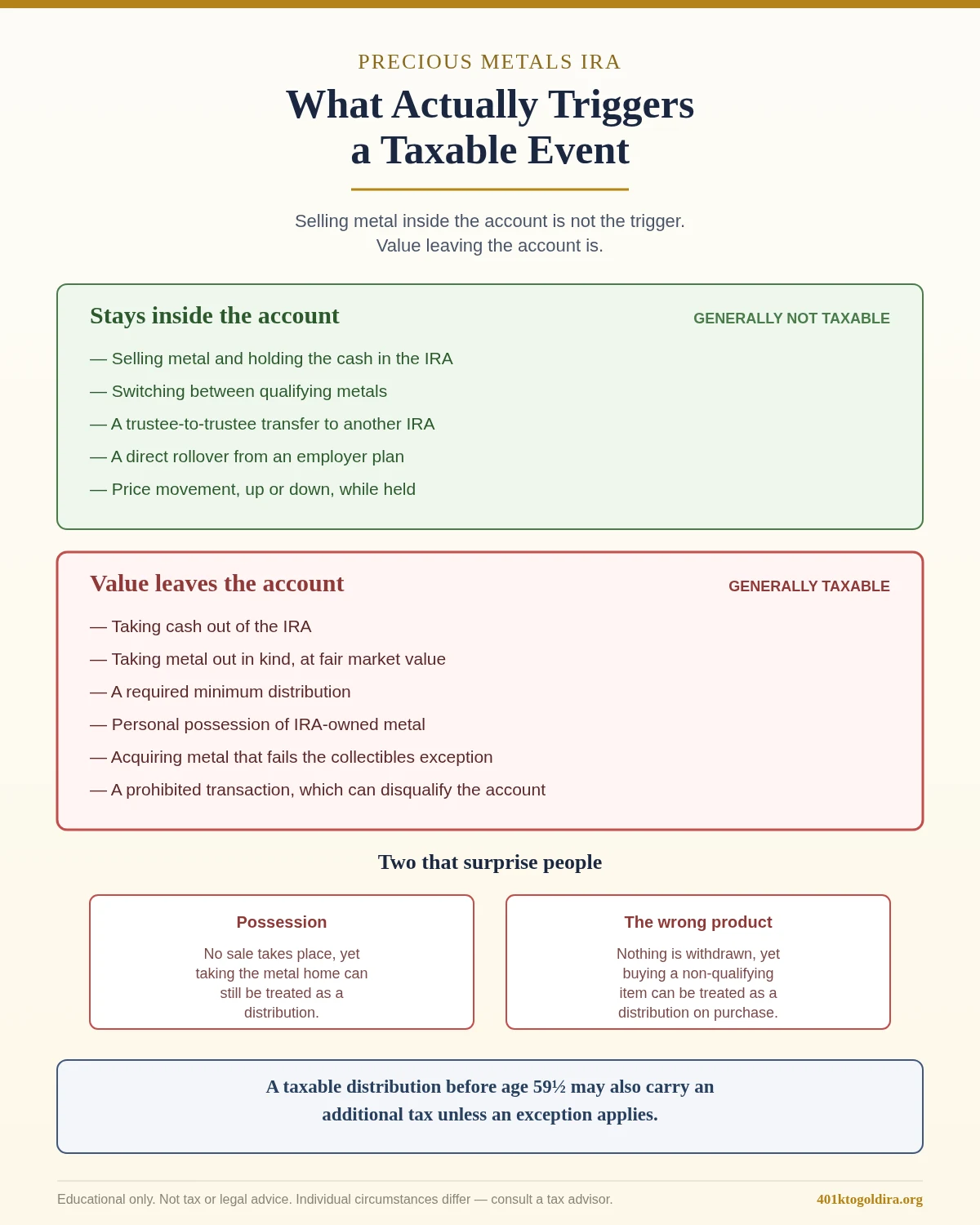
If the 60-day period was missed and no waiver applies, the amount that was not validly rolled over generally loses tax-free rollover treatment. A taxable amount is included in income, and if the individual is under age 59½, the taxable amount may also be subject to the 10% additional tax on early distributions unless a statutory exception applies. (IRS Topic No. 413; IRS Publication 590-A)
The money is no longer sheltered merely because it was intended for retirement. A later deposit does not become a valid rollover simply because the individual labels it as one.
How can an invalid redeposit become an excess contribution?
An improper rollover contribution to an IRA can be an excess contribution. The IRS states that excess IRA contributions are generally subject to a 6% excise tax for each year the excess remains in the IRA, subject to the statutory limits on that tax. (IRS IRA contribution limits)
IRS guidance also explains the standard correction concept: to avoid the recurring excess-contribution tax, the excess contribution and attributable income generally must be removed by the applicable return due date, including extensions, subject to the detailed rules in Publication 590-A. A failed late rollover therefore can create two separate problems — taxation of the original distribution and an excess contribution in the receiving IRA — if the deposit is left in place without valid rollover treatment.
What should happen with a lost, delayed, or wrongly issued check?
A lost and uncashed check is a listed self-certification reason
Revenue Procedure 2020-46 expressly lists a distribution made by check that was misplaced and never cashed as a permitted self-certification reason. Postal error is separately listed. A delayed distribution document may also fit the reason covering a distributing party that failed to provide information the receiving plan or IRA needed despite reasonable efforts to obtain it.
A wrong payee or processing error may point to the automatic waiver
If a financial institution actually received the funds and timely instructions but its own error prevented timely deposit, the automatic waiver should be tested first. If the funds were not in the receiving institution's hands within the original period, the automatic waiver may fail even though the facts might fit one of the self-certification reasons.
The paperwork matters: check copies, cancellation records, mailing records, account statements, call logs, written instructions, and institution correspondence can determine which route is supportable.
What does the court record show?
The court record reinforces a basic point: a 60-day waiver can address the timing defect, but it does not cure unrelated rollover defects.
In Trimmer v. Commissioner, 148 T.C. No. 14, the Tax Court held that it had jurisdiction to review the IRS's denial of a hardship waiver connected with a deficiency and that the appropriate standard was abuse of discretion. The case involved retirement-plan distributions that were rolled over long after the 60-day period, where the taxpayer had requested hardship relief during the IRS examination. The court rejected the IRS position that Examination lacked authority to consider the waiver request.
In Estate of Caan v. Commissioner, the Tax Court again recognized review of the IRS's refusal to grant a 60-day waiver, but upheld that refusal because the rollover had a separate defect: noncash IRA property had been liquidated and cash was contributed instead, violating the same-property requirement. The court emphasized that waiving the 60-day period would not cure a different statutory failure. (Estate of Caan v. Commissioner, 161 T.C. 77)
Earlier Tax Court cases cited in Trimmer had declined to supply equitable rollover relief where the taxpayers had not first requested a hardship waiver administratively. The pattern is therefore procedural as much as sympathetic: documented circumstances matter, an administrative relief route matters, and the transaction must satisfy the non-timing rollover rules. No case should be read as predicting how the IRS will treat a new set of facts.
What should not be done while the problem is unresolved?
- Do not assume a self-certification is an IRS approval. That can lead to a return being filed as though the issue were finally settled when the IRS can still disagree on examination.
- Do not redeposit money and ignore the one-rollover-per-year rule. A timing waiver cannot cure that separate IRA limitation.
- Do not leave a questionable redeposit in an IRA indefinitely. If the rollover is invalid, the deposit may be an excess contribution with a recurring excise tax.
- Do not spend the distributed funds while expecting a ruling to solve everything. Publication 590-A identifies use of the distributed amount as a factor the IRS considers in ruling requests.
- Do not ignore withholding. For employer-plan distributions, the withheld portion remains part of the distribution and must be replaced from other funds if the full amount is to be rolled over.
- Do not wait to document the reason for delay. The operative procedure requires the late contribution to be made as soon as practicable after the qualifying reason stops preventing it.
- Do not treat a late rollover as purely an account-service issue. Once the deadline has passed, tax reporting, excise-tax exposure and waiver standards can intersect.
What should be gathered and verified, in order?
- Distribution evidence. Obtain Form 1099-R if issued, the distribution statement, check copy or wire record, and proof of the date the distribution was actually received.
- Destination evidence. Gather statements from the account or plan that was supposed to receive the rollover and any deposit instructions that were given.
- Timeline. Build a day-by-day chronology from receipt through the attempted or completed redeposit, including the 60th day and any weekend or legal-holiday issue.
- Automatic-waiver test. Ask whether the receiving institution had the funds and correct instructions within the original period and whether its error alone caused the failure. Request written confirmation if so.
- Self-certification test. Compare the facts against all twelve reasons. Identify when the blocking reason ended and whether the late contribution was made within the 30-day safe harbor.
- Other-rollover validity. Confirm that the distribution was otherwise eligible, that no required minimum distribution or other non-rollover amount is being redeposited, and that the one-rollover-per-year rule does not bar the transaction.
- Withholding reconciliation. For employer-plan money paid to the participant, determine the gross distribution, the net amount received, the amount withheld, and the amount actually contributed.
- Receiving-institution documentation. If self-certifying, provide the model certification or materially similar language and keep a copy.
- Ruling decision. If the first two routes do not fit, have a tax professional evaluate whether the facts support a formal waiver request and whether the current user fee is economically sensible relative to the tax exposure.
- Return reporting. Reconcile Form 1099-R, any Form 5498, withholding credits, rollover reporting, and any Form 5329 or excess-contribution correction that may be required.
Frequently asked questions
Is there still a fix after the 60 days have passed?
Sometimes. The IRS recognizes three relief paths: an automatic waiver, self-certification, and a private letter ruling. The facts determine which, if any, applies. None of them is assured.
Is self-certification the same as getting an IRS waiver?
No. The operative revenue procedure expressly states that self-certification is not an IRS waiver determination. The IRS may later determine on examination that the requirements were not met, for example because the stated reason did not actually prevent a timely rollover or the contribution was not made as soon as practicable after the impediment ended.
How many reasons allow self-certification?
The operative procedure lists twelve permitted reasons. Revenue Procedure 2020-46 added the state unclaimed-property-fund reason and superseded Revenue Procedure 2016-47.
What does as soon as practicable mean?
The contribution must be made as soon as practicable after the qualifying reason stops preventing the rollover. The procedure provides a safe harbor where the contribution is made within 30 days after that point.
Can a receiving IRA custodian refuse a self-certified late rollover?
Yes. IRS guidance says a financial institution is not required to accept a late rollover. The certification gives the institution a basis on which it may rely if it does not have actual knowledge contradicting it, but it does not compel acceptance.
Does a 60-day waiver also waive the IRA one-rollover-per-year rule?
No. The one-per-year limitation is a separate requirement and is not waived by 60-day relief. A person can resolve the timing problem and still have an invalid transaction because a prior IRA rollover triggered the one-year restriction.
Does the one-rollover-per-year rule apply to direct rollovers from a 401(k) to an IRA?
No. The limitation concerns IRA-to-IRA rollovers. Direct employer-plan rollovers and IRA trustee-to-trustee transfers fall outside it, as do conversions to a Roth IRA.
What if 20% was withheld from an employer-plan distribution?
The withholding is still part of the gross distribution. A full rollover requires replacing the withheld amount from other funds; otherwise the unrolled portion is generally taxable and may trigger the additional early-distribution tax if no exception applies.
What if a late deposit has already been made into an IRA but no waiver applies?
An improper rollover contribution can be an excess IRA contribution. IRS guidance states that excess contributions generally face a 6% annual excise tax while they remain in the IRA, subject to the detailed correction rules.
What could not be verified
The primary sources do not establish a universal IRS processing time for a private letter ruling on a missed 60-day rollover. No fixed completion estimate is stated here.
The primary sources do not establish a universal processing time for a financial institution to accept and post a self-certified late rollover. The institution is not required by the IRS to accept the late contribution.
No primary source located provides a reliable success rate for 60-day waiver requests, self-certifications, or private letter rulings. No percentage likelihood of relief is stated or implied.
The rollover-specific IRS pages do not separately restate the weekend-and-holiday extension rule. The general statutory rule in IRC §7503 was therefore used for that point, and borderline day-counting should be checked against the individual's actual receipt date and facts.
No court decision can establish that a new taxpayer with similar facts will receive relief. The cited cases show legal and procedural principles, not predictive outcomes. A live public URL for the full text of the Trimmer opinion could not be verified at the time of writing, so that case is cited by name and reporter citation only.
Primary Sources
- IRS Publication 590-A — Contributions to Individual Retirement Arrangements
- IRS Topic No. 413 — Rollovers From Retirement Plans
- IRS Topic No. 451 — Individual Retirement Arrangements
- IRS — Rollovers of Retirement Plan and IRA Distributions
- IRS — Accepting Late Rollover Contributions
- IRS — FAQs Relating to Waivers of the 60-Day Rollover Requirement
- Revenue Procedure 2020-46, Internal Revenue Bulletin
- IRS — Instructions for Forms 1099-R and 5498
- IRS — IRA Contribution Limits and Excess Contribution Guidance
- Cornell LII — IRC §402
- Cornell LII — IRC §408
- Cornell LII — IRC §7503
- Estate of Caan v. Commissioner, 161 T.C. 77
- Trimmer v. Commissioner, 148 T.C. No. 14. Full-text URL could not be verified; cited by reporter citation.
This material is educational only and is not financial, tax, or legal advice. A missed rollover deadline can create income-tax, additional-tax, withholding, reporting, and excess-contribution issues at the same time. A qualified tax professional should review the facts promptly, particularly before a late contribution is made, a self-certification is signed, a private letter ruling is requested, or a tax return is filed or amended.