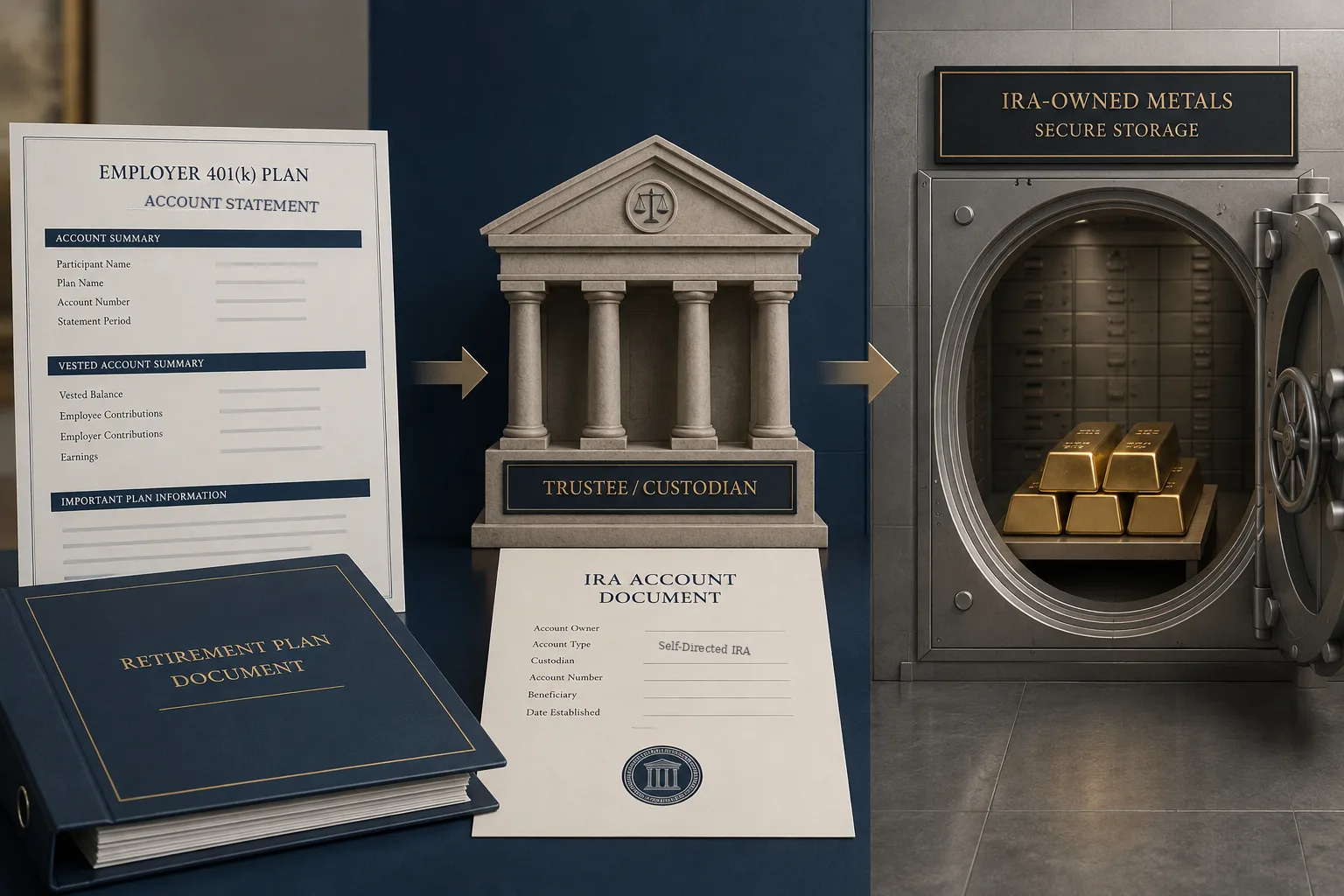
Educational only: This page explains federal retirement-plan rules from published statutes, regulations and agency guidance. It does not evaluate any particular plan's conduct, and it is not financial, tax or legal advice. Anyone who believes a plan applied the wrong rule should obtain the governing documents and speak to the plan administrator and a qualified professional. Past performance does not guarantee future results.
Key takeaways
- $7,000 is the current ceiling for distributions made after 31 December 2023. Anything still citing $5,000 is stale.
- A small balance is not itself a distributable event. The Code and the plan must independently permit the distribution.
- The plan had to adopt the rule. Federal law permits a force-out; it does not require one.
- The statement balance can mislead. Prior rollover contributions and their earnings may be disregarded when applying the threshold.
- A compliant automatic rollover is not taxable and carries no mandatory withholding.
- The 60-day clock runs from receipt of the distribution, not from whether a cheque was cashed.
- Nothing here means the money was forfeited. It is retirement money with a location, and the first task is to find out which one.
The Three Questions That Actually Matter
The question is rarely “what is a force-out.” It is what happened to my money, was that allowed, and what can I still do? Those resolve in sequence:
- Was the plan permitted to do this? The threshold, the plan document, the distributable event and the notice obligation.
- Where did the money go? Cash distribution, default IRA, or retention in the plan — and what decided which.
- What can be done now? The rollover window, the tax position if a cheque was cashed, the route out of a default IRA, and what is genuinely irreversible.
Was the Plan Allowed to Force It Out?
Two conditions have to hold together, and a small balance alone satisfies neither.
The plan document must have adopted the rule. Federal law permits a small-balance force-out; it does not impose one. A plan that never adopted the provision cannot rely on it, which is why the governing documents are the first thing to obtain.
The amount must be otherwise distributable. A small account cannot be distributed merely because it is small. A distributable event must exist independently under the Code and the plan — for a former employee that is usually severance from employment, though other permitted events can exist. This also means a current employee's balance is not automatically exposed simply because it is modest.
The three balance bands
Where those conditions are met and the participant does not respond to the required notice, the amount decides the destination:
- More than $1,000 and not more than $7,000 — absent an affirmative election, the amount must go by direct rollover to a default IRA. IRC §401(a)(31)(B) requires the plan administrator to make that transfer and to notify the participant in writing (Cornell LII — 26 U.S.C. §401).
- $1,000 or less — the federal automatic-rollover command does not apply. A plan that adopted a force-out may pay the amount directly, although the Department of Labor safe harbour also permits a fiduciary to roll such an amount to an IRA (29 C.F.R. §2550.404a-2).
- Above $7,000 — the small-balance consent exception is unavailable. IRC §411(a)(11)(A) provides that where the present value of the nonforfeitable accrued benefit exceeds $7,000, the benefit may not be immediately distributed without the participant's consent (Cornell LII — 26 U.S.C. §411). Other rules, such as required minimum distributions, can still apply later.
The $7,000 figure reflects SECURE 2.0 and applies to distributions made after 31 December 2023. A great deal of published material still quotes $5,000, which describes the pre-amendment position and is stale for current distributions. Any source quoting a threshold without an effective date is worth treating with caution.
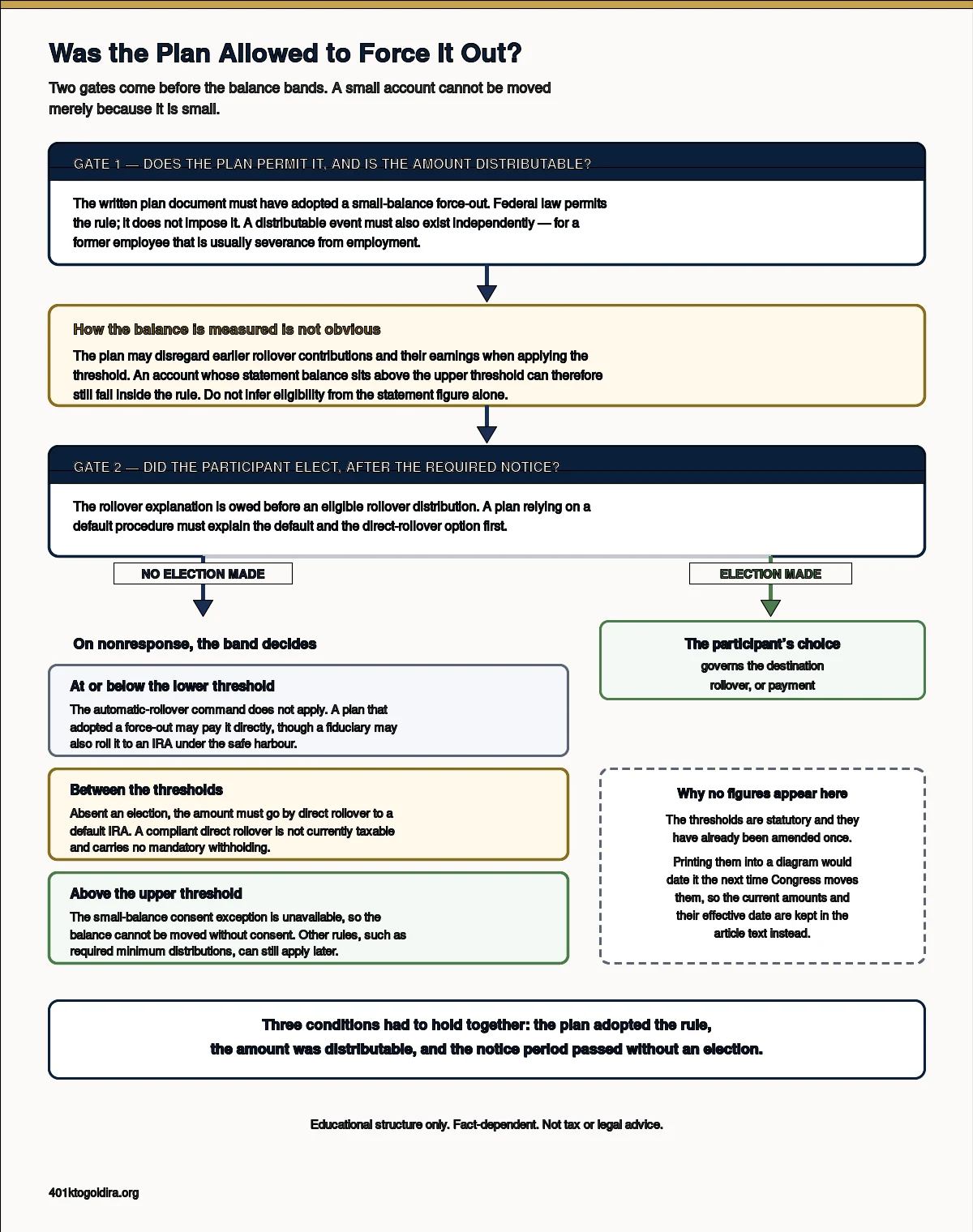
Three conditions had to hold together, not just the balance.
How the Balance Is Measured — the Part That Surprises People
This is the most practically important technicality on the topic, and it works against the assumption most readers make.
A plan may provide that the present value of the nonforfeitable accrued benefit is determined without regard to the portion attributable to prior rollover contributions and their earnings. IRC §411(a)(11)(D) states that a plan does not fail the consent requirement by doing so.
The consequence is counter-intuitive: an account whose statement balance sits comfortably above $7,000 can still fall within the force-out rule, if a large share of it arrived as a rollover from an earlier employer's plan and the current plan contains that provision. Someone who checked a statement, saw a five-figure balance and concluded they were protected may have been reading the wrong number.
Eligibility should therefore never be inferred from the statement figure alone. The plan document decides how the threshold is applied.
The Notice That Should Have Come First
For an eligible rollover distribution, the plan administrator must provide the rollover explanation required by IRC §402(f). Current IRS operating guidance uses a window of no fewer than 30 days and no more than 180 days before the distribution, subject to a permitted waiver of the 30-day minimum after notice.
A plan relying on a default procedure must explain the default and the direct-rollover option before treating nonresponse as authority to act. For an automatic rollover, the plan's written notification may be incorporated into the §402(f) notice. The Department of Labor safe harbour separately requires disclosure of the automatic-rollover arrangement, the principal-preservation investment approach, how fees are allocated, and a contact for the provider.
If no notice was received, that is worth establishing rather than assuming — notices are frequently sent to a stale address after someone has moved.
Where the Money Went
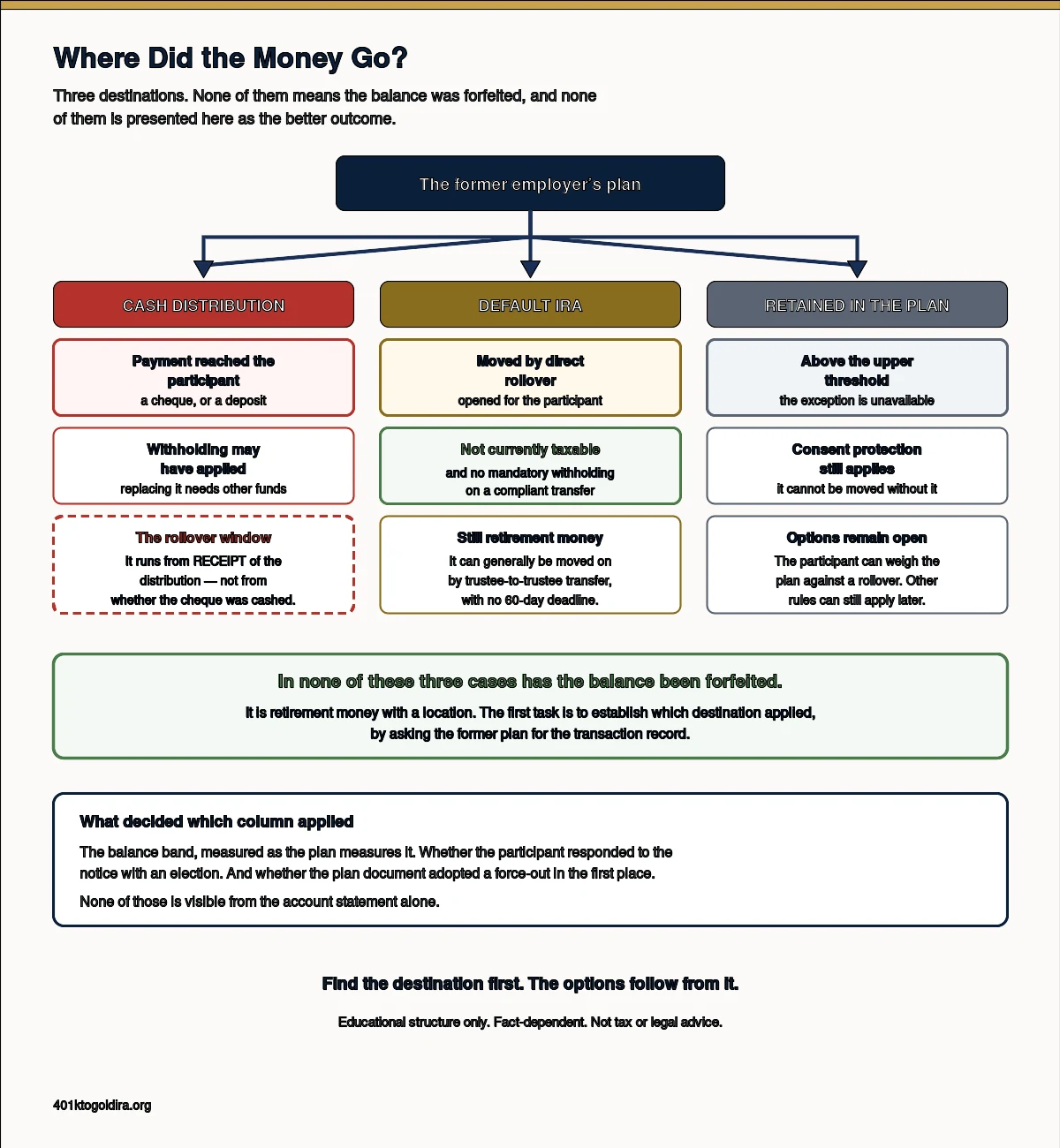
In none of these cases has the balance been forfeited.
Default IRA. For more than $1,000 through $7,000 where no election was made, the compliant transfer is a direct rollover. It is therefore not currently taxable and not subject to mandatory withholding. The IRA is established for the participant's benefit — the money has moved, not vanished.
Cash distribution. An amount of $1,000 or less may be paid directly where the plan provides for it, and a participant may also affirmatively choose payment instead of a rollover within the automatic-rollover band. A participant-payable eligible rollover distribution is generally subject to 20% withholding, with a special rule for payments below $200.
Retained in the plan. Above $7,000 the consent exception cannot be used, so the balance stays put unless the participant elects otherwise. Other independent rules can still apply in time. A balance that stays put is then governed by the plan's own distribution menu, and that menu is narrower than most people expect: whether a former employer's plan permits partial withdrawals at all varies from roughly a quarter of small plans to most large ones.
Roth, After-Tax and Plan Loans
Designated Roth money
A designated Roth account is not simply merged into a traditional default IRA. Current IRS guidance provides that a mandatory cashout of more than $1,000 from a designated Roth account, absent an election, is directly rolled to a Roth IRA chosen by the plan administrator or payor, preserving the Roth character of the transfer. Someone holding both Roth and non-Roth plan accounts may therefore see separate rollover treatment and separate reporting.
After-tax non-Roth contributions — where the sources stop
IRS guidance establishes that a distribution from an account holding both pretax and after-tax money generally carries a pro-rata share of each, and that pretax and after-tax components may be directed to different eligible destinations in an elected rollover.
What the primary sources reviewed do not establish is a single universal operational rule for how every automatic default-IRA arrangement splits after-tax non-Roth money. This page therefore does not invent one. The practical response is to obtain the distribution breakdown, confirm what basis was carried to the IRA, and preserve the records — because where after-tax basis enters a traditional IRA, later distributions can be partly taxable and partly not, and Form 8606 can become relevant.
An outstanding plan loan
A force-out and a loan offset are related only in some cases. A plan may provide that an unpaid loan is offset against the account, but whether and when an offset occurs depends on the loan terms, repayment status, the severance circumstances and the plan's provisions. A force-out does not itself prove an offset happened.
The plan-document question comes first: whether 401(k) loan repayment can continue after leaving the job. The answer determines whether an offset question arises at all.
Where an offset qualifies as a qualified plan loan offset — caused by plan termination or qualifying severance circumstances — the participant can have until the federal income-tax return due date, including extensions, for the tax year of the offset to roll over the offset amount. That extended period applies to the offset amount and should not be applied casually to the rest of a distribution.
If the Money Is in a Default IRA
The most important correction first: the retirement money still exists. A default IRA is an IRA for the participant's benefit, not a forfeiture.
Someone who wants a different provider can generally request a trustee-to-trustee transfer from the default traditional IRA to another traditional IRA. IRS guidance treats that as a transfer rather than a rollover, so it is tax-free, not subject to the 60-day clock, and does not consume the once-per-year IRA rollover allowance.
That makes this decision materially different from the original employer-plan one. The balance is already IRA money, so another traditional IRA, an eligible employer plan that accepts incoming rollovers, or other permitted IRA arrangements are all on the table. Acceptance is never automatic, though — the receiving provider or plan sets its own operational rules.
One warning: moving from a traditional default IRA to a Roth IRA is not equivalent to a traditional-to-traditional transfer. That is a Roth conversion, and previously untaxed amounts are generally included in income.
If a Cheque Was Received
The clock runs from receipt
This is the single most useful correction on the page, because the intuitive assumption is wrong. The rollover period is generally measured as 60 days from receipt of the eligible rollover distribution — not from the day a cheque is cashed, and not from the day it is deposited.
Leaving a cheque uncashed therefore does not pause the deadline. What it may do in practice is create a window to contact the plan administrator and ask whether the cheque can be voided and replaced with a direct rollover. No federal rule was located requiring a plan to agree to that, so it is an administrator question rather than an entitlement.
If the cheque was cashed
Cashing it does not by itself destroy rollover eligibility. Where the period is still open, the eligible amount can generally be contributed to an eligible retirement plan. If 20% was withheld, rolling over the full gross amount normally means replacing the withheld portion from other funds — the arithmetic is modelled on the withholding shortfall calculator.
Any part not rolled over is generally included in income to the extent taxable, and the additional tax on early distributions may apply where the participant is within its scope and no exception is available. The exceptions are set out on the early withdrawal penalty page.
If the 60 days have already passed
The deadline is not always the end of it. IRS procedures recognise three possible routes: an automatic waiver in qualifying circumstances, self-certification, or a private-letter-ruling request. Self-certification should not be overstated — it is not itself an IRS waiver, and the conditions can be reviewed on examination. The detailed relief analysis is on the missed 60-day deadline page.
Can a Force-Out Be Reversed or Challenged?
A compliant force-out should not be described as reversible on demand, and no primary federal source creating a general right to put the transaction back was located. Where the money sits in a default IRA it can usually be moved forward by transfer, but that is not the same as undoing the original plan distribution.
Where someone believes the plan used the wrong threshold, ignored its own document, mishandled the rollover-contribution carve-out or failed to provide the required explanation, the supportable process is to gather records first. ERISA gives participants disclosure rights to key governing plan documents, and ERISA-covered plans must maintain a claims and review procedure for benefit disputes. The Department of Labor's Employee Benefits Security Administration can also help with understanding ERISA rights.
That does not guarantee any particular remedy, and this page does not characterise any plan's conduct as unlawful on the strength of a reader's description. The remedy remains fact-specific.
Documents to Request
It helps to separate what ERISA makes available from what is simply sensible to ask for.
With an ERISA disclosure basis: for an ERISA-covered plan, a written request can be made for the latest summary plan description, the plan description, the latest annual report, and the instruments under which the plan is established or operated. For a force-out question the most useful are the SPD, the plan-document distribution provisions, and any amendments that changed the cash-out limit or the rollover procedure.
Sensible to request, without a specific disclosure right: the transaction record showing the date and amount, the tax reporting issued, the notice that was sent and the address it went to, the default IRA provider's name and account details, and the breakdown of pretax, Roth and after-tax components.
If the plan could not locate the participant
Department of Labor guidance on missing participants is fact-specific and emphasises diligent search and recordkeeping, so no single destination follows automatically and this page does not imply one.
Separately, SECURE 2.0 §303 added ERISA §523, codified at 29 U.S.C. §1153, creating the Retirement Savings Lost and Found. The Department of Labor now operates it as a plan-locator database at lostandfound.dol.gov. That is a short recovery note here rather than the subject of this page — tracing genuinely lost accounts, former-employer research and unclaimed-property paths are a broader topic.
Where a Self-Directed or Precious-Metals IRA Becomes an Option
One consequence of a force-out is worth stating plainly, because it changes what is available. A balance sitting in a default IRA is already IRA money. A trustee-to-trustee transfer to a self-directed IRA is therefore possible in a way it was not while the money sat inside the employer plan.
That is a factual change in the available options, not a recommendation. Several conditions apply: the receiving custodian must accept the asset class, and where precious metals are involved the eligibility and custody rules under IRC §408(m) then govern what may be held and who must hold it. The safe harbour's own investment conditions also applied to how the default IRA was initially invested.
Nothing here suggests that moving a forced-out balance into metals is safer, protective or advisable. It is one lawful destination among several, and it carries the costs and constraints set out in the evidence-graded pros and cons. The account structure is explained in the precious metals IRA reference, and custodian due diligence in the custodian guide.
For a reader whose balance is now in a default IRA and who is weighing where it should go next, the provider comparison may be a useful starting point.
Comparing self-directed IRA providers?
Goldco is a precious metals company. Customers can request a free Gold & Silver Kit at signup. Goldco markets a buyback program; customers should request current written terms directly.
Minimum investment: $25k · BBB rating: A+
Owners of this website may be paid to recommend Goldco. The content on this website, including any positive reviews of Goldco and other reviews, may not be neutral or independent.
Frequently Asked Questions
What is the current 401(k) force-out limit?
The small-balance consent exception applies where the present value of the nonforfeitable accrued benefit does not exceed $7,000, for distributions made after 31 December 2023. Above that figure a plan cannot immediately distribute the benefit without the participant's consent. Material still quoting a $5,000 limit is describing the pre-amendment position and is stale for current distributions.
Can an employer cash out my 401(k) without asking me?
Only where several conditions hold together. The written plan document must have adopted a small-balance force-out, the amount must be otherwise distributable under the Code and the plan — for a former employee that is usually severance from employment — and the balance must fall within the small-balance range. Federal law permits the rule; it does not require a plan to adopt it.
Where does the money go in a force-out?
One of three places. Above $1,000 through $7,000, absent an election after the required notice, it must go by direct rollover to a default IRA opened for the participant. At $1,000 or less the automatic-rollover command does not apply, so a plan that adopted a force-out may pay it directly, though a fiduciary may also roll it to an IRA under the Department of Labor safe harbour. Above $7,000 it stays in the plan unless the participant consents.
My balance is over $7,000 — am I safe from a force-out?
Not necessarily, and this is the point most easily missed. A plan may determine the present value without regard to the portion attributable to prior rollover contributions and their earnings. An account whose statement balance sits above the threshold can therefore still fall inside the force-out rule if the plan contains that provision. Eligibility should not be inferred from the statement figure alone.
Is a forced rollover to a default IRA a taxable event?
No. A compliant direct rollover to a default IRA is not currently taxable and is not subject to mandatory withholding. The money has not been forfeited or distributed to the participant — it is retirement money that has moved to an IRA established for that person's benefit.
I received a cheque but never cashed it. Has the 60-day clock started?
Yes. The rollover period runs from receipt of the eligible rollover distribution, not from the day a cheque is cashed. Leaving a cheque uncashed does not pause or stop the deadline. It may, in practice, give a window to ask the plan administrator whether the cheque can be voided and replaced with a direct rollover, but no federal rule was located requiring a plan to agree to that.
What happens to the 20% that was withheld?
Where a participant-payable eligible rollover distribution is subject to 20% withholding, the participant receives less cash than the gross distribution. Rolling over the full gross amount normally requires replacing the withheld portion from other funds. Any part not rolled over is generally included in income to the extent taxable, and the additional tax on early distributions may apply where the participant is within its scope and no exception is available.
Can a force-out be reversed?
A compliant force-out should not be described as reversible on demand, and no primary federal source creating a general right to undo the transaction was located. Where the money is in a default IRA it can usually be moved forward by transfer, but that is different from undoing the original distribution. Where a participant believes the plan applied the wrong threshold or failed its notice obligation, the supportable route is to request the governing documents and transaction record, use the plan's claims and appeal procedure, and seek assistance from the Employee Benefits Security Administration on ERISA questions.
What if the plan could not find me?
Department of Labor guidance on missing participants is fact-specific and emphasises diligent search and recordkeeping, so no single destination follows automatically. Separately, SECURE 2.0 created the Retirement Savings Lost and Found, which the Department of Labor now operates as a plan-locator tool. Detailed account-searching is a broader topic than this page covers.
What happens to designated Roth money in a force-out?
It is not simply merged into a traditional default IRA. Current IRS guidance provides that a mandatory cashout of more than $1,000 from a designated Roth account, absent an election, is directly rolled to a Roth IRA chosen by the plan administrator or payor, which preserves the Roth character of the transfer. A participant holding both Roth and non-Roth plan accounts may therefore see separate rollover treatment and separate reporting.
Bottom Line
A force-out is not evidence that anything went wrong, and it is not a forfeiture. It means a plan applied a rule it had adopted, to a balance that fell within a range, after a notice period passed without an election.
The useful sequence is to establish which destination applied, then work out what options that destination leaves open. A default IRA can generally be transferred onward with no deadline pressure. A cheque may still be inside a rollover window measured from receipt. And a balance above the threshold should not have been moved without consent at all — though whether the threshold was correctly applied depends on how the plan measures it, which is a question the plan document answers rather than the statement.
For the participant-elected side of the same decision, see the 401(k) rollover guide, and for which source accounts can move where, the rollover eligibility matrix. Where the balance sits in an employee stock ownership plan, the elective distribution follows its own sequence, including the employer-stock question: that is covered on the ESOP rollover to an IRA guide.
This page is educational and does not evaluate any reader's plan, account or circumstances. Thresholds and procedures are current-year specific and require periodic review; several questions addressed here are fact-dependent and are not settled by the primary sources. Readers should consult the plan administrator and a qualified tax professional about their own account. Past performance does not guarantee future results.