Educational only: This page explains federal retirement-plan timing rules from published statutes, regulations and agency guidance, observed on 29 September 2026. It does not evaluate any particular plan's conduct, and it is not financial, tax or legal advice. An individual due date cannot be determined without the plan document, summary plan description, account records, election materials and the participant's own separation facts. Past performance does not guarantee future results.
Jump to a section
- The ESOP payout timing map
- The two separation branches
- Why the second federal test can change the answer
- Plan-year date finder
- Lump sum versus installments
- What can lawfully delay or spread payment
- Employer stock, put options and repurchase timing
- No statement and no packet
- Is the payment not due, delayed, or potentially late?
- Checklists and questions
- Frequently asked questions
- Sources and methodology
Key takeaways
- A vested balance is not automatically payable on the last day of employment. Vesting, distribution availability, valuation and actual payment are four separate questions.
- Why employment ended decides which clock starts. Retirement age, disability or death runs on a different plan-year clock from resignation, discharge or layoff.
- The clock is tied to the close of a plan year, not to the termination date, and a plan year need not be the calendar year.
- The special ESOP rule is not the only outside limit. A second, general commencement rule must be tested separately, and the IRS says an ESOP distribution cannot begin later than that rule would require.
- The plan document can promise an earlier date than either federal limit, which is why the plan provision usually matters more than the general rule.
- Missing records do not by themselves prove a payment is late. The first task is to identify the plan's timing rule, valuation date, election requirements and claims procedure.
The ESOP Payout Timing Map
A former employee can resolve the timing question in a fixed order. Working through it in this sequence avoids the two most common errors: counting months directly from the last day worked, and treating the special ESOP rule as though it were the only federal deadline.
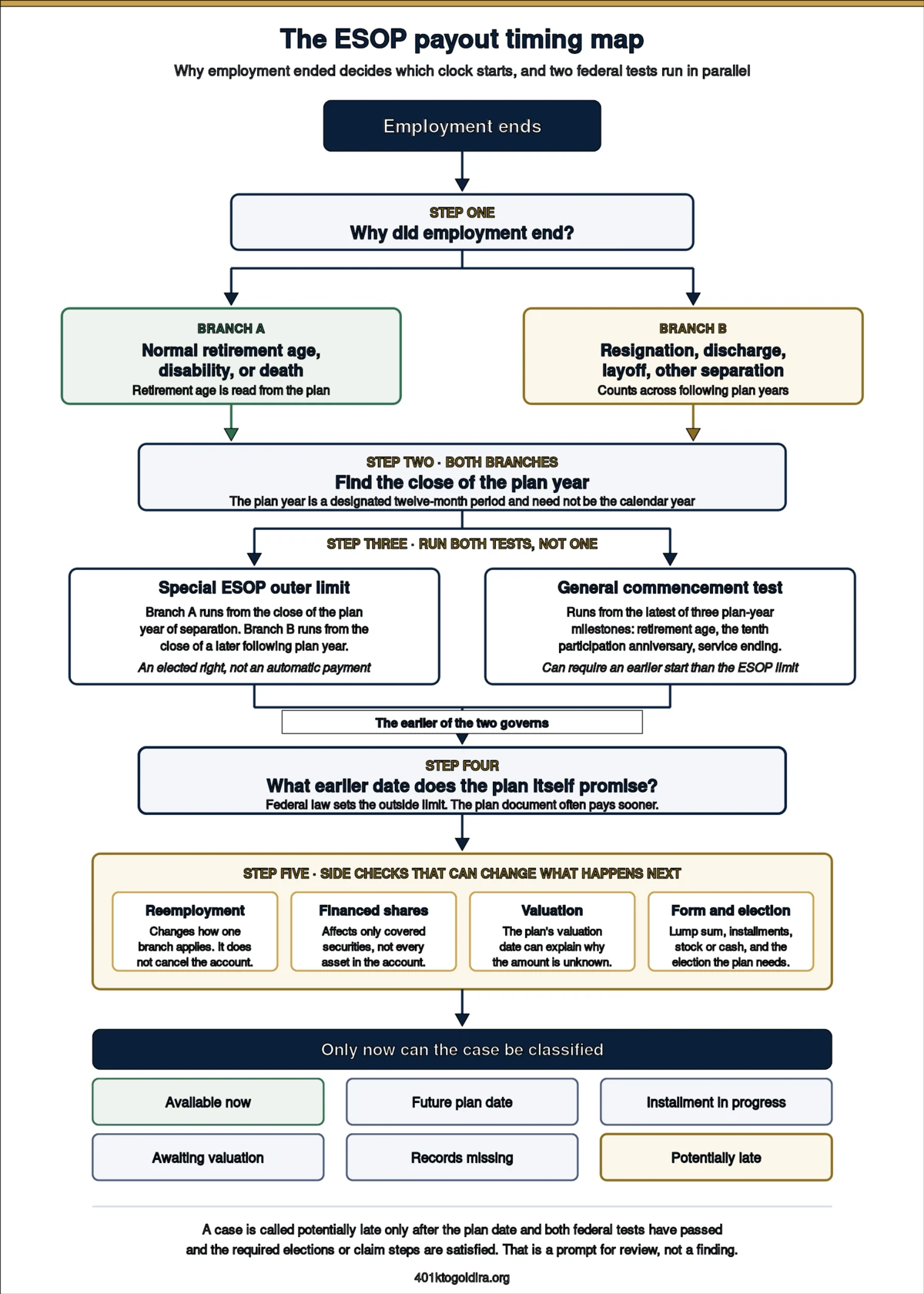
- Why did employment end? Normal retirement age under the plan, disability or death takes the first branch. Any other separation, including resignation, discharge or layoff, takes the second.
- What is the plan year? Find the 12-month plan year in the summary plan description or plan document. It may not match the calendar year.
- What is the special ESOP elected outer limit? Apply the correct branch, including the reemployment exception and any financed-security limitation.
- Does the general commencement rule require an earlier start? Run that separate test on its own facts.
- What earlier date does the plan actually promise? A plan commonly operationalises distributions earlier than the federal outside limit.
- What still has to happen? Check valuation, payment form, election and consent, stock-versus-cash treatment, and any installment schedule.
Vested Does Not Mean Payable Now
“Vested” means the participant has a nonforfeitable right to that portion of the benefit. It does not mean the participant can demand cash on any chosen date. Distribution timing is a separate qualification rule, and the plan document specifies when a distributable benefit becomes payable.
The same distinction applies to value. The Department of Labor's ESOP participant guide explains that the individual account statement reports fair market value, account balance, vested amount and annual changes, while the summary plan description explains how distributions are made and what happens when an employee leaves. A statement showing a vested balance is a starting record, not a due-date notice.
A useful document set separates four different questions:
- Vesting: what percentage of the account is nonforfeitable?
- Distribution availability: has the plan's rule, and the federal timing rule, reached a commencement point?
- Valuation: which plan valuation date determines the employer-stock value used for the distribution?
- Payment: is the benefit paid as a lump sum, installments, employer stock, cash or another permitted form?
The Two Separation Branches
The special ESOP rule in 26 U.S.C. §409(o) gives an electing participant a commencement right keyed to the reason for separation and to the close of a plan year.
Branch one: normal retirement age, disability, or death
Where separation occurs because the participant reached normal retirement age under the plan, became disabled, or died, the statute provides an election right under which distribution must commence no later than one year after the close of the plan year in which that separation occurs. Spousal consent is included only where the referenced survivor-annuity rules make it applicable, so it is a conditional requirement rather than a universal one.
That is an outer limit under the special rule, not necessarily the plan's actual payout date. The plan can pay earlier, and this branch does not displace the general commencement rule described below.
Normal retirement age is not one universal age. The starting point is the plan's own definition. The Code contains a statutory framework constraining that definition for qualified-plan purposes, but it does not support telling every ESOP participant that their normal retirement age is simply 65. The plan's definition has to be read.
On the death branch, this page stops at commencement. It is used here only to identify when an ESOP distribution must become available. Beneficiary account rules, required minimum distributions for beneficiaries, taxation and destination choices are separate subjects and are not covered here.
Branch two: resignation, discharge, layoff, or another separation
Where separation occurs for any other reason, the statute uses the fifth plan year following the plan year of separation. If the participant elects the statutory right, distribution must commence no later than one year after the close of that fifth following plan year. The clause does not apply if the participant is reemployed by the employer before distribution is required to begin under it.
That language creates a plan-year calculation rather than a flat number of months from the termination date, which is why “six years after termination” is an unsafe shorthand.
Calendar-year illustration
Assume a calendar-year ESOP and a participant who separates for another reason during 2026. The plan year of separation is 2026. The five following plan years are 2027, 2028, 2029, 2030 and 2031. The elected outside commencement point is one year after the close of the fifth following plan year, which is the end of 2032.
That is not a conclusion that the plan may always wait until the end of 2032. The plan may promise an earlier date, and the general commencement rule may produce an earlier outside limit based on the participant's age, participation history and termination year.
Non-calendar-year illustration
Assume instead a plan year running 1 July to 30 June, and a participant who leaves in January 2026. That separation falls in the plan year ending 30 June 2026. The fifth following plan year closes 30 June 2031, so the elected outside date is one year later, 30 June 2032, again subject to the separate general test and to any earlier plan provision.
These are illustrations of counting only. They are not individualised due-date calculations.
Why the Second Federal Test Can Change the Answer
26 U.S.C. §401(a)(14) and the parallel ERISA provision at 29 U.S.C. §1056(a) require a qualified plan, unless the participant elects otherwise, to begin payment by the 60th day after the close of the latest of three plan years: the one in which the participant reaches the earlier of age 65 or the plan's normal retirement age, the one containing the tenth anniversary of participation, and the one in which service terminates.
The IRS's ESOP determination-letter guidance states that ESOPs are subject to those distribution provisions as well as the special ESOP rule. The IRS ESOP Listing of Required Modifications makes the interaction explicit: distribution cannot begin later than the general rule would require.
That produces three possible patterns:
- The plan's own date is earlier than both federal limits. The plan's earlier date governs in practice.
- The special ESOP elected limit is earlier. That right accelerates commencement.
- The general rule produces the earlier limit. The plan cannot treat the longer special-rule window as permission to delay past it.
This is precisely why a participant needs more than a termination date before concluding that a payment is late.
Plan-Year Date Finder
This tool counts plan years for the special ESOP branch. It is an arithmetic aid for understanding the counting method, not an individualised due-date calculation, and it deliberately refuses to name a single controlling date until enough facts are present to run both federal tests.
Enter a separation date to count the plan years.
What this tool does not do. It does not model reemployment, financed shares, the plan's own earlier date, valuation, elections or payment form, and it does not produce an individualised due date. The plan may be required to pay earlier than anything shown here. Nothing is saved, sent or transmitted; the calculation runs entirely in the browser.
What the Plan Document Can Decide
The IRS says the plan document must clearly state when a distribution will be made, and that a participant should consult the summary plan description or other disclosure materials to determine when a distribution can be requested.
Within federal constraints, an ESOP can specify operational rules including an earlier commencement date for particular distributable events, lump-sum versus installment treatment, different treatment by account size where lawfully structured, whether distributions are made in cash or stock or a permitted combination, the valuation date used, the election procedure and deadlines, and the claims procedure for a disputed benefit.
For a timing dispute, the most important document is usually not a general ESOP article but the actual plan provision implementing these federal limits.
Lump Sum Versus Installments
The statute sets a federal default unless the participant elects otherwise: the account balance is distributed in substantially equal periodic payments, at least annually, over a period generally no longer than five years, subject to an extension for larger accounts.
For 2026, the adjusted larger-account amount is $1,455,000 and the extension increment is $290,000. One additional year is added for each $290,000, or fraction of it, by which the balance exceeds $1,455,000, subject to the statutory limit of five additional years.
Freshness check. These two amounts are annual inflation adjustments taken from IRS Notice 2025-67 and are specific to 2026. They must be re-checked against the IRS cost-of-living notice for the following year before this page is carried forward, and figures published in older IRS ESOP drafting material are superseded. Observed 29 September 2026.
2026 statutory-default illustration
Drag to see how the statutory default period changes. This illustrates the extension formula only.
This is not a payment calculator. It does not compute an actual payment amount or schedule, and it does not override the plan. A plan may offer another permitted form, and the participant may elect otherwise. The base period is 5 years with a statutory maximum of 5 additional years.
Installment timing is not the same as rollover eligibility
An installment schedule answers how the plan pays the account. Whether each payment is an eligible rollover distribution is a separate tax question with its own rules, covered on the ESOP rollover to an IRA guide rather than here.
What Can Lawfully Delay or Spread Payment
Reemployment
For the other-separation branch, the statutory clause does not apply if the participant is reemployed by the employer before distribution is required to begin under that clause. The accurate statement is not that a rehire cancels the payout, but that it changes how that particular acceleration rule applies. The participant should ask the administrator how the rehire affected the plan's distribution provision and which federal commencement rule now controls.
Financed employer securities
The statute excludes, for this purpose, employer securities acquired with the proceeds of a covered ESOP loan until the close of the plan year in which that loan is repaid in full.
That rule speaks to the affected financed securities. It does not mean every asset in every leveraged ESOP account can be delayed for the same period. A participant told only that “the ESOP loan is not paid off” should ask which portion of the account is covered and which plan provision is being applied.
Valuation
Under the ESOP valuation regulation, value for the relevant purposes is determined as of the most recent valuation date under the plan. That helps explain why a final distributable amount may not exist on the separation date.
A valuation process is a real timing step. It is not an unlimited right to postpone an otherwise due benefit, and a valuation lag should not be described as misconduct.
Election or consent
The special ESOP right is election-based, and spousal consent is conditional where the referenced rules apply. A plan can therefore require a distribution election packet before implementing the participant's choice. If the packet was never received, the question is factual: what election is required, what default applies, what notice was sent, and has a formal claim been made? It does not follow that an unreturned form lets a plan delay indefinitely.
Pre-1987 shares
The 1986 amendments to the special ESOP rule apply to distributions attributable to stock acquired after 31 December 1986. Legacy-share treatment can depend on acquisition history and plan terms, so an account that may hold older shares is a case for plan-specific review rather than a general calculation.
Administrative processing
Record reconciliation or correspondence may explain a short gap in a particular case. This page does not publish a “normal processing time,” because no such federal standard exists; the due-date analysis stays anchored in the plan document and the federal rules.
Employer Stock, Put Options and Repurchase Timing
Payout timing and cash-receipt timing can diverge when an ESOP distributes employer securities. Under the Code, a participant entitled to a distribution generally has a right to demand employer securities, and where those securities are not readily tradable on an established market, a right to require the employer to repurchase them under a fair valuation formula. Specified plans, including certain S-corporation plans and plans whose ownership is restricted, may provide cash treatment instead.
Three different clocks can run here, and confusing them is the most common error. An employer-stock repurchase schedule is not the ESOP distribution schedule.
When must the ESOP distribution commence? This is the question the rest of this page answers: the special ESOP branch, the general commencement rule, and the plan's own earlier date, all counted from the close of a plan year.
When can the participant exercise a put option on distributed stock? The current Code provides a period of at least 60 days after the stock is distributed. If the option is not exercised in that period, there must be a further period of at least 60 days in the following plan year.
When must the employer pay after the put option is exercised? That depends on how the securities came out. For securities distributed as part of a total distribution, payment may be made in substantially equal annual installments over a period no longer than five years, beginning no later than 30 days after exercise, with adequate security and reasonable interest on the unpaid amount. For securities distributed as part of an installment distribution, the repurchase amount is due no later than 30 days after exercise.
No Statement and No Packet: Start With Records, Not Accusations
A former employee who cannot find any paperwork should begin with record recovery. Nothing about a missing document establishes that a plan has done anything wrong.
Identify the plan and administrator
Where old records are missing, the public Form 5500 filing search can be queried by plan name, sponsor name, employer identification number, plan number or filing acknowledgment ID, which can identify the plan and sponsor and retrieve public filings.
That database is not a participant-document repository. Some filings are not publicly disclosed, and participant-level records, election packets and current plan documents generally still have to be requested from the administrator directly.
Ask for the controlling documents in writing
The Department of Labor identifies the full plan document, the trust agreement, the summary plan description and the individual account statement as core ESOP records. ERISA separately gives participants and beneficiaries a written-request route for the latest summary plan description, the latest annual report and the instruments under which the plan is established or operated. A nonparticipant-directed individual account plan generally furnishes a benefit statement at least annually.
A focused request asks for what answers the timing question rather than for an indiscriminate archive. The checklist below sets out the specific items.
Standing matters. The written-request route runs to participants and beneficiaries, and an authorised representative may act where the plan's procedure allows it. A family member without authorisation should not be described as independently entitled to participant records or payment.
Separate an information request from a benefit claim
A request for documents asks for information. A claim for benefits invokes the plan's formal procedure for deciding entitlement, and the Department of Labor advises participants to read the summary plan description or claims booklet for where and how to file. Where a participant believes the benefit is due and the plan has not paid it, a formal claim is usually the step that produces a written decision capable of being appealed.
The Formal Claim, the Appeal, and What EBSA Can Do
Department of Labor guidance on retirement-benefit claims states that a plan generally has up to 90 days to decide a claim, and that special circumstances can extend that period, with notice, to as much as 180 days. A denial should give the specific reasons, identify the plan provisions relied on, explain any missing information and describe the appeal procedure. The claimant must receive at least 60 days to appeal. The plan generally has up to 60 days to decide the appeal, with a possible additional 60 days after written notice, and a committee or board meeting on a scheduled basis can follow a different review timetable.
These claim-processing periods are not a new payout grace period. They are the procedure for deciding a disputed claim, and they sit on top of the underlying due-date analysis rather than replacing it.
Benefits Advisors at the Employee Benefits Security Administration can explain ERISA rights, make inquiries in appropriate cases and seek informal resolution, and a valid complaint may be referred for enforcement review. The Department also states plainly that it cannot ensure every complaint results in an investigation and may not always be able to provide a solution. EBSA is an assistance and enforcement channel, not a guaranteed collection mechanism.
Is the Payment Not Due, Delayed, or Potentially Late?
Only after the plan year, the applicable branch, the general test, the plan's own date and the side checks are known can a case be classified. Select a situation to see what it means and what the next action is.
Not distributable yet. The participant is vested, but the applicable plan or federal commencement event has not occurred, or a lawful condition has not been satisfied.
Next action Identify the exact future trigger in the plan document and record the provision that states it.
Future plan date. The distribution becomes available on a plan-specific date that is still in the future and sits inside the federal outer limits.
Next action Record that provision and the plan year it uses, then diarise the date and confirm it in writing with the administrator.
Awaiting valuation. The distributable amount depends on a valuation date or annual appraisal that is not yet reflected in the account.
Next action Confirm the plan's actual valuation provision. Do not assume the termination-date balance is the final figure.
Installment in progress. Payments have begun and the plan is using a permitted installment schedule.
Next action Confirm the election made, the installment period, the payment frequency and whether any larger-account extension applies.
Records missing. The due date cannot be determined yet because the summary plan description, plan document, account statement, election packet or the administrator's identity is missing.
Next action Use the record-recovery route first: identify the plan, then request the governing documents in writing.
Formal claim needed. There are enough records to assert that the benefit should be available, but no formal benefit determination has been made.
Next action Follow the plan's written claims procedure and preserve dated evidence of the filing.
Potentially late. The plan's own date and the applicable federal outer limits appear to have passed, required elections or claim steps are satisfied, and no supported exception explains the nonpayment.
Next action Take the case to individualised benefits or legal review. On an incomplete record this is a prompt for review, not a finding that any rule was broken.
The last of those is deliberately called potentially late. On an incomplete record, that is a prompt for individualised benefits or legal review. This page does not characterise any plan's conduct as a violation.
Once Payout Is Available, the Rollover Question Begins
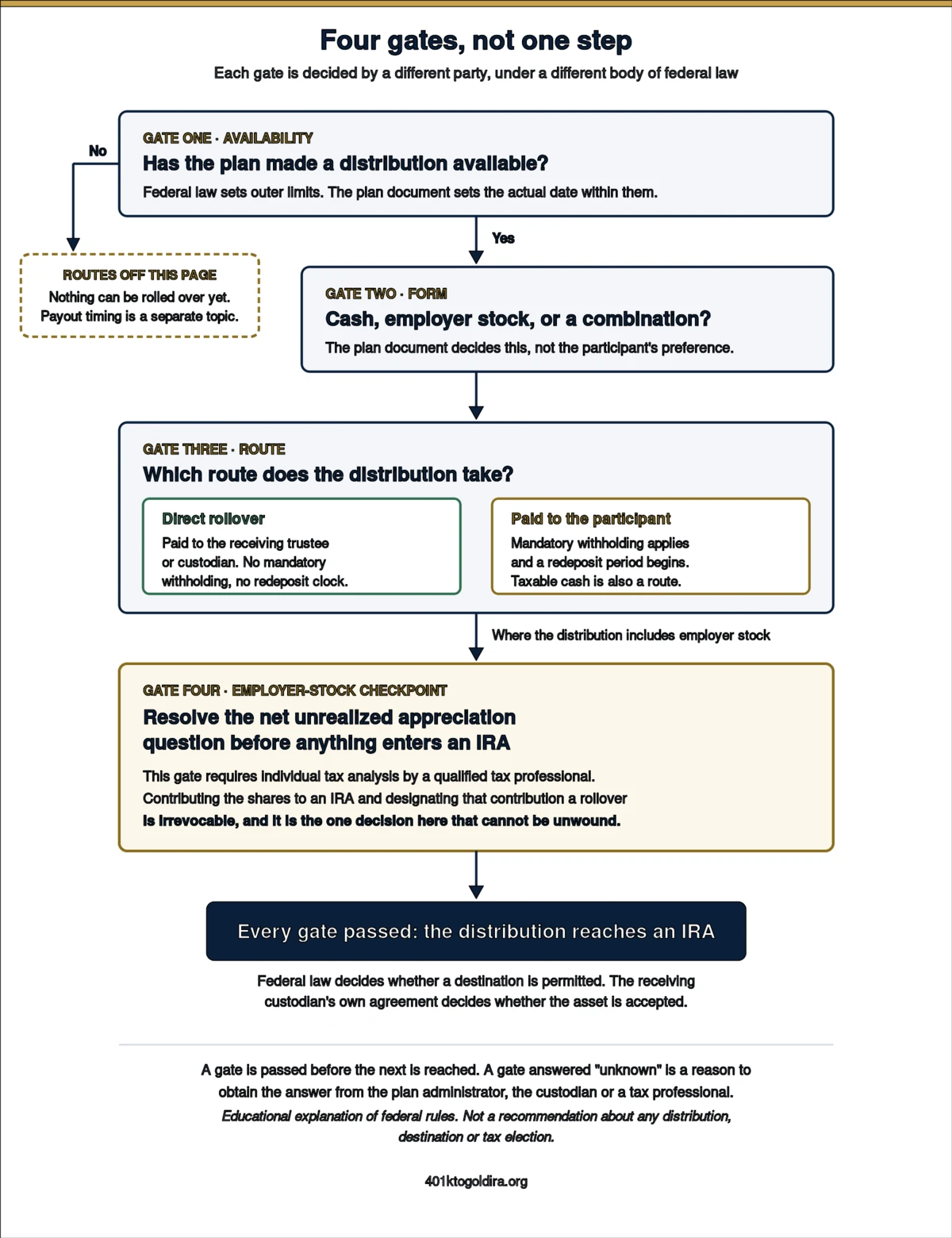
Payout timing asks when the ESOP must make a distribution available. Rollover mechanics ask what happens after that distribution is available and the participant chooses a destination. They are different questions with different rules, and this page deliberately stops at the first.
The next-step guide is the ESOP rollover to an IRA guide, which owns eligible rollover distributions, the direct versus participant-paid routes, withholding, the redeposit deadline, the net unrealized appreciation checkpoint for employer stock, the S-corporation shareholder question and the receiving-account decision. None of that is repeated here.
Before making a later rollover or tax decision, retain the distribution notice, the election, the valuation statement, the stock or cash breakdown, any installment schedule, put-option documentation where applicable, and the tax reporting forms when they arrive.
An involuntary small-balance distribution moved by a former employer without the participant's election is a different transaction with its own thresholds and rules, covered on the force-out rules page. For the wider picture of which account types can move where once a distribution is available, see the rollover eligibility matrix.
Checklists and Questions to Ask the Plan Administrator
Records to keep or request
Tick the items still needed, then copy the list into an email to the administrator. Nothing is saved or transmitted; the selection exists only in this browser tab.
Twelve questions to put to the administrator
- What plan year applies to this ESOP?
- Which separation category is being used for this participant's payout timing?
- What plan provision states the distribution commencement date?
- Is the plan using a date earlier than the federal outside limit?
- Has the participant made the election required for the requested form or timing?
- Is spousal consent applicable under this plan's design?
- Is any portion of the account being treated as financed securities?
- What valuation date will be used for this distribution?
- What payment form applies: lump sum, installments, stock, cash, or another permitted form?
- If stock is distributed, what put-option and repurchase procedure applies?
- If payment has not started, what specific plan provision or unresolved step explains why?
- What is the formal benefit-claim procedure if the participant disagrees?
What to preserve if the payment may be late
Keep the employment end date and the stated reason for separation, the plan-year definition, the normal retirement age provision where relevant, the participation start date, the vesting record, any distribution election and any required consent, the administrator's stated due date, the valuation and account statements, delivery evidence for requests and claims, the claim filing and receipt evidence, denial and appeal notices, and a dated chronology of communications with the administrator.
Still working out whether the account can move at all once it is available? The rollover eligibility matrix sets out which account types can move where, and the missed 60-day deadline page covers the position where a distribution has already been paid to the participant and the redeposit window was missed.
Frequently Asked Questions
When do I get my ESOP money after leaving a company?
There is no single date that applies to every ESOP. The answer depends on why employment ended, the plan year, the plan's own distribution provision, the special ESOP election rule, and the separate general commencement rule that applies to qualified plans. Those have to be worked through in order before any due date can be identified.
Can an ESOP make a former employee wait years for payment?
Sometimes the statutory and plan structure does produce a future payment date, particularly after a separation other than retirement, disability or death. But a plan cannot treat the longest special-rule date as permission to ignore an earlier deadline set by the general commencement rule or by the plan document itself.
Does an ESOP have to pay immediately after retirement?
Not necessarily. For separation because of normal retirement age, disability or death, the special elected limit runs from the close of the plan year in which the separation occurred, and the plan or the general commencement rule can require an earlier start. Immediate payment on the last day worked is not the federal standard.
Is the payout rule different after resignation or termination?
Yes. A separation for a reason other than normal retirement age, disability or death uses the later branch of the special ESOP rule, which counts across following plan years. That branch is subject to a reemployment exception and to the separate general commencement rule.
How is the fifth-plan-year rule counted?
Start with the plan year in which the separation occurred, then count the five plan years that follow it. The elected limit is one year after the close of that fifth following plan year. Because the plan year need not be the calendar year, counting months from the termination date is unreliable.
What happens if a former employee is rehired?
The other-separation clause does not apply if the participant is reemployed by the employer before distribution is required to begin under that clause. That changes how the special acceleration rule applies. It does not mean a rehire cancels the account, and the plan's own terms and the other federal timing rules still have to be checked.
Can an ESOP pay in installments instead of a lump sum?
Yes. The statute contains a default installment structure of substantially equal payments, at least annually, generally over no more than five years unless the participant elects otherwise, and the plan may specify the payment forms it permits. For 2026, the larger-account threshold is $1,455,000 and the extension increment is $290,000, with a statutory limit of five additional years.
Why is the ESOP payout amount still unknown?
The final amount can depend on the plan's valuation date and its employer-stock valuation process. The relevant federal rule looks to the most recent valuation date under the plan, so there is no universal rule fixing every departing employee's value on the termination date.
What happens when the company is still repaying an ESOP loan?
For the special ESOP timing rule, employer securities acquired with the proceeds of a covered loan are excluded from the account balance until the close of the plan year in which that loan is repaid in full. That rule reaches the covered securities. It is not authority to delay every asset in the account, so the participant should ask which portion is affected.
Can an ESOP distribute company shares instead of cash?
Often a participant entitled to a distribution has a statutory right to demand employer securities, and where those securities are not readily tradable there is a right to require the employer to repurchase them under a fair valuation formula. The Code also permits cash treatment for specified plans, including certain S-corporation and ownership-restricted plans, so the plan terms decide it.
What documents show when the payout is due?
The plan document, the summary plan description and its amendments, the benefit statement, the plan-year definition, the distribution and election materials, the valuation information, and the claims procedure. The Department of Labor identifies the plan document, trust agreement, summary plan description and account statement as the core ESOP records.
What can a former employee do if records or payment are missing?
Identify the plan and administrator first, then request the relevant records in writing, keeping an information request separate from a formal benefit claim. If a formal claim is denied, use the plan's appeal process. The Employee Benefits Security Administration can assist, but it does not guarantee payment or an investigation.
Can the ESOP payout be rolled into an IRA?
Some ESOP distributions are eligible rollover distributions, but eligibility and tax treatment depend on what is being paid and how. That is a separate question from when the payout becomes available, and the ESOP rollover guide on this site covers the rollover mechanics, withholding, net unrealized appreciation and destination choices.
Bottom Line
Do not decide whether an ESOP payout is late from the termination date alone. Identify the separation category, the plan year, the special ESOP elected limit, the general commencement limit, and the plan's own earlier date. Then check valuation, election, financed shares and payment form.
Only once those facts are documented can the case be classified as not yet due, awaiting valuation, an installment in progress, missing records, needing a formal claim, or potentially late. That sequence is also what turns a frustrating wait into a specific, answerable question for the plan administrator.
Once a distribution is actually available, the separate question is where it can go. Some savers at that point research self-directed custodians, including those holding physical metals; the account structure is explained on the precious metals IRA page, and the limits that apply to such accounts on the prohibited transactions page.
Researching where a distribution could go?
Goldco is a precious metals company. Customers can request a free Gold & Silver Kit at signup. Goldco markets a buyback program; customers should request current written terms directly.
Minimum investment: $25k · BBB rating: A+
Owners of this website may be paid to recommend Goldco. The content on this website, including any positive reviews of Goldco and other reviews, may not be neutral or independent.
Sources and Methodology
Primary authorities were checked on 29 September 2026. Statutory timing and payment rules were anchored to the current United States Code, then cross-checked against IRS ESOP determination guidance and current Department of Labor participant guidance. The current 2026 inflation-adjusted amounts were taken from the IRS cost-of-living notice for that year. Commercial pages were not used to establish any legal deadline, participant right or remedy.
Where federal law leaves an answer to the plan document, this page says so and identifies the document or question that resolves it rather than supplying a general answer. Where a question could not be resolved from primary authority, it is posed as a question rather than stated as a rule.
Source register (17 authorities)
- S1 — 26 U.S.C. §409 Distribution commencement, the two separation branches, the reemployment exception, financed securities, the installment default, and put-option and repurchase timing.
- S2 — 26 U.S.C. §401(a)(14) The general qualified-plan commencement rule: payment begins no later than the 60th day after the latest of three plan-year milestones.
- S3 — 26 U.S.C. §411 Vesting and the normal-retirement-age framework. It constrains the plan's definition; it does not set one universal age for every participant.
- S4 — 29 U.S.C. §1056(a) — ERISA §206(a) The ERISA rule parallel to §401(a)(14).
- S5 — 29 U.S.C. §1024 — ERISA §104 On written request, the administrator must furnish the latest updated summary plan description, the latest annual report, and the instruments under which the plan is established or operated.
- S6 — 29 U.S.C. §1025 — pension benefit statements A nonparticipant-directed individual account plan generally furnishes a benefit statement at least once each calendar year.
- S7 — IRS Notice 2025-67 — 2026 amounts Cost-of-living adjusted §409(o)(1)(C)(ii) amounts for 2026. Requires an annual freshness check against the following year's notice.
- S8 — IRS — ESOP determination letter application review process States that ESOPs are subject to the distribution provisions of §401(a)(14) as well as §409(o).
- S9 — IRS — ESOP Listing of Required Modifications Drafting guidance: distribution cannot begin later than §401(a)(14) would require, and a plan may vary commencement and payment form within federal limits. A 2017 document: its dollar figures are superseded and are not used here.
- S10 — IRS — When can a retirement plan distribute benefits? The plan document must clearly state when a distribution will be made.
- S11 — IRS — Retirement plans definitions A plan year is a 12-month period designated by the plan, which may be a calendar year or another period.
- S12 — 26 C.F.R. §54.4975-11(d)(5) Good-faith fair-market-value determination. For the relevant purposes, value is determined as of the most recent valuation date under the plan.
- S14 — DOL/EBSA — Your ESOP Documents: A Quick Guide for Participants Participants may view the full plan document and trust agreement; the account statement shows fair market value, account balance and vested amount.
- S15 — DOL/EBSA — Filing a Claim for Your Retirement Benefits The benefit-claim procedure and its decision and appeal periods.
- S16 — DOL/EBSA — What We Do Benefits Advisors assist and seek informal resolution, but the Department states it cannot ensure that every complaint results in an investigation.
- S17 — EFAST2 — Form 5500 Search Help Public filings are searchable by plan sponsor name, employer identification number, plan number or acknowledgment ID.
- S21 — IRS — Internal Revenue Bulletin 2007-34 Published summary reflecting the current statutory put-option and repurchase-payment structure.
Claim and publication-decision register (26 claims)
Each row records a claim, the authority behind it, and the publication decision taken. One row was deliberately not published: a 1977 regulation still carries a put-option formulation inconsistent with the later statute, so it is recorded here and kept out of the reader-facing rules rather than blended with them.
| ID | Claim | Authority | Type | Decision |
|---|---|---|---|---|
| C-001 | ESOP payout timing after separation requires both the special ESOP analysis and the general qualified-plan analysis. | §409(o); §401(a)(14) | rule | Published |
| C-002 | The special rule keys to the reason for separation and the close of a plan year, not the last day worked. | §409(o)(1)(A) | rule | Published |
| C-005 | Retirement-age, disability or death branch: elected commencement no later than one year after the close of the plan year of separation. | §409(o)(1)(A)(i) | rule | Published |
| C-006 | Other-separation branch uses the fifth following plan year plus one year, and carries a reemployment exception. | §409(o)(1)(A)(ii) | rule | Published |
| C-007 | A plan year is a designated 12-month period and need not be the calendar year. | IRS definitions | definition | Published |
| C-008 | The general rule uses the 60th day after the latest of three plan-year milestones. | §401(a)(14)(A)-(C) | rule | Published |
| C-010 | The IRS states an ESOP must satisfy both, and distribution cannot begin later than the general rule requires. | IRS review process; ESOP LRM | rule | Published |
| C-011 | A plan may specify an earlier commencement date and particular payment forms within federal limits. | ESOP LRM | plan-specific | Published |
| C-012 | A vested balance is not the same thing as immediately distributable cash. | §411; IRS guidance | rule | Published |
| C-014 | The default installment structure is substantially equal payments, at least annually, generally over no more than five years unless the participant elects otherwise. | §409(o)(1)(C) | rule | Published |
| C-015 | The 2026 adjusted amounts are $1,455,000 and $290,000. | Notice 2025-67 | current figure | Published, labelled 2026, annual freshness check |
| C-016 | Reemployment before distribution is required to begin disables that particular statutory clause. | §409(o)(1)(A)(ii) | exception | Published |
| C-017 | Employer securities acquired with covered loan proceeds are excluded for this purpose until the close of the plan year the loan is repaid. | §409(o)(1)(B) | exception | Published, scope qualified |
| C-018 | The 1986 amendments apply to distributions attributable to stock acquired after 31 December 1986. | §409 effective-date note | exception | Published as a brief legacy note only |
| C-019 | ESOP valuation uses a good-faith fair-market-value determination, and for the relevant purposes the most recent plan valuation date applies. | 26 C.F.R. §54.4975-11(d)(5) | rule | Published |
| C-020 | The Code generally provides a right to demand employer securities and a repurchase right, with specified cash-distribution exceptions. | §409(h)(1)-(3) | rule | Published |
| C-021 | The put-option window is at least 60 days after distribution, plus at least 60 days in the following plan year. | §409(h)(4) | rule | Published |
| C-022 | Total-distribution repurchase may be spread over no more than five years beginning within 30 days of exercise; installment-distribution repurchase is due within 30 days of exercise. | §409(h)(5)-(6) | rule | Published |
| C-023 | A 1977 regulation retains an older put-option formulation inconsistent with the later statutory structure. | 26 C.F.R. §54.4975-7 | disputed / legacy | NOT PUBLISHED — conflict kept in the research uncertainty log |
| C-024 | The right is election-based, and spousal consent applies only where the referenced survivor-annuity rules apply. | §409(o)(1)(A) | condition | Published, qualified |
| C-026 | A written-request route exists for the latest summary plan description, annual report and governing instruments. | 29 U.S.C. §1024(b)(4) | rule | Published |
| C-027 | Nonparticipant-directed individual account plans generally furnish a benefit statement annually. | 29 U.S.C. §1025 | rule | Published |
| C-028 | Public Form 5500 filings can identify a plan but are not a complete participant-document repository. | EFAST2 | limit | Published |
| C-030 | Claim and appeal timing generally follows a 90/180-day initial and 60/120-day appeal framework. | DOL/EBSA claims guidance | procedure | Published |
| C-031 | EBSA can assist and seek informal resolution but cannot guarantee an investigation or a solution. | DOL/EBSA | limit | Published |
| C-032 | Normal retirement age must be read from the plan; no universal age applies to every participant. | §411(a)(8) | condition | Published |
This page is educational and does not evaluate any reader's plan, account or circumstances. Timing outcomes depend on plan provisions, separation facts, elections and records that a general reference cannot establish, and several questions addressed here are resolved only by the plan document. Readers should consult the plan administrator and, where a benefit appears overdue or a claim has been denied, a qualified benefits or legal professional. Past performance does not guarantee future results.
Article reviewed and edited by Daniel M. — editor, 401kToGoldIRA.org. How figures on this site are produced and checked is set out in the research methodology, and errors are handled under the corrections policy.