Affiliate disclosure: Some links on this page may be sponsor links. The site owners may be compensated if customers request information from companies mentioned here. This page is educational only and does not provide financial, tax, or legal advice. Customers should speak with a financial or tax advisor before making retirement-account decisions. Past performance does not guarantee future results.
Quick Answer: The Main Options When Cash Is Needed
When cash is needed from a Gold IRA, an account holder typically has two broad categories of options: taking a distribution from the IRA, or repositioning assets inside the IRA while leaving funds in the tax-advantaged account. In practice, that resolves into three choices: sell metals and distribute cash, sell metals but keep the proceeds in the IRA, or take an in-kind distribution of the metals themselves.
Each path involves trade-offs in taxes, penalties, timing, and future flexibility, and each must follow the IRS distribution rules that apply to traditional and Roth accounts. Because gold does not settle instantly like a stock, the process usually runs through the custodian, the dealer, and the depository together.
Why Gold IRA Liquidity Differs From Cash or Brokerage Assets
Gold IRA liquidity is more complex than selling stocks or holding cash in a regular brokerage IRA, because the account holds physical bullion and approved coins in a depository under the trustee's control rather than purely electronic positions that can be sold instantly.
- Physical metals must be sold or shipped. Liquidation requires coordination among the custodian, the dealer, and the depository to move and sell coins or bars.
- Dealer bid prices and spreads matter. The price received depends on dealer bid prices, market conditions, and product-specific spreads, not a single spot price.
- Timing can be slower. The process involves forms, invoices, and settlement steps that can take days rather than seconds, especially for larger positions.
Because cash needs may arise suddenly — medical costs, home repairs, or market stress — many retirement savers study Gold IRA exit strategies before funding an account so they understand how liquidation and distributions work in practice.
Option 1: Sell Metals Inside the IRA and Distribute Cash
The most direct option when cash is needed is to sell metals inside the IRA and take a cash distribution. Custodian and dealer materials describe a fairly standard liquidation process.

- Initiate the request. The account holder submits distribution and liquidation instructions to the custodian, often online or via a form.
- Coordinate with the dealer. The custodian or account holder works with the dealer to agree which metals to sell, at what bid price, and on what date.
- Sell metals and settle to cash. The depository releases specified metals to the dealer, which buys them at agreed pricing, and the custodian records the sale and credits cash to the IRA.
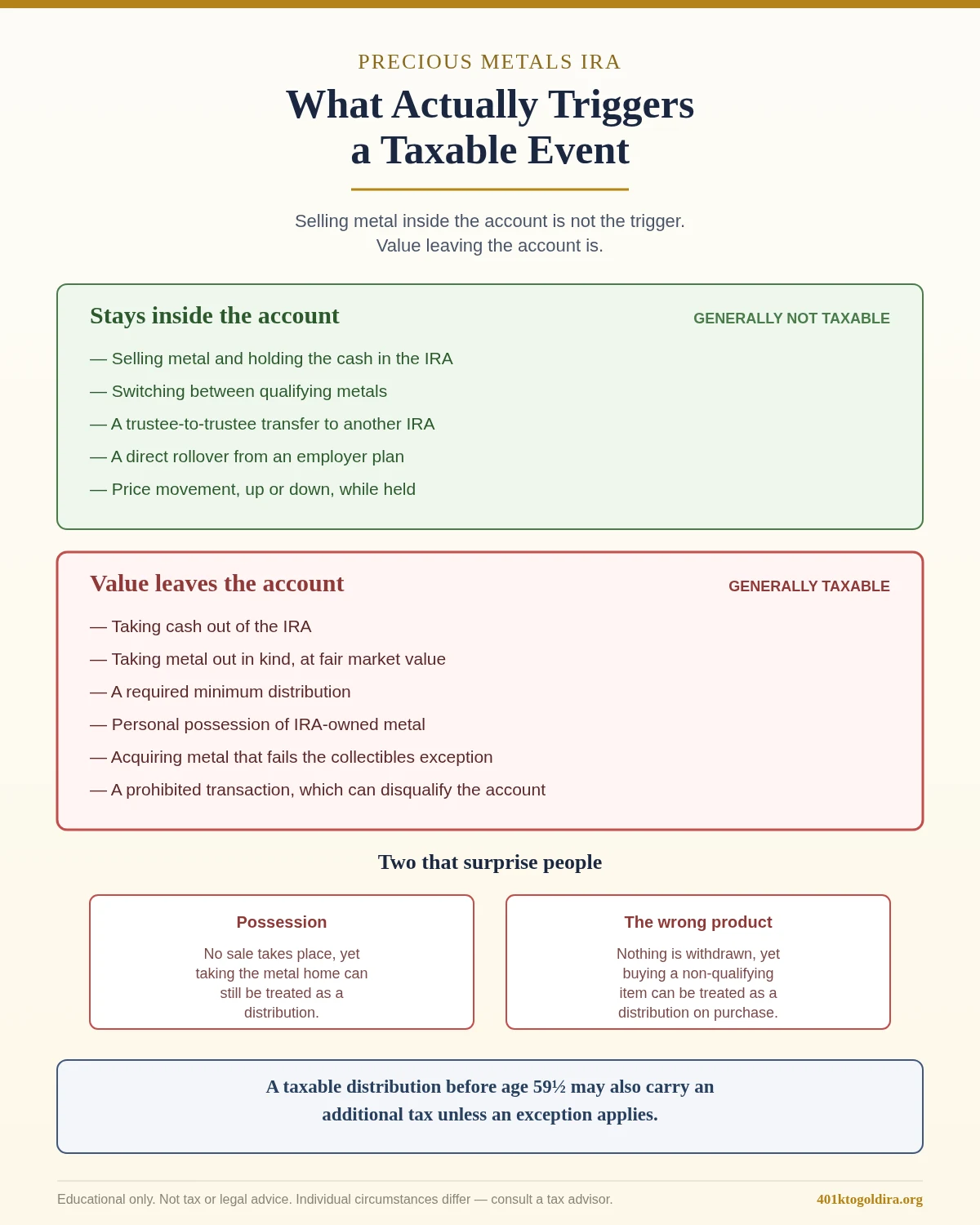
- Issue the cash distribution. The custodian sends funds by check or transfer; the amount becomes a taxable distribution if taken from a traditional IRA.
Cash distribution rules mirror standard IRA withdrawal rules: for traditional accounts, distributions are generally taxed as ordinary income, and early distributions before age 59½ can face an additional 10 percent tax except in certain IRS-defined situations. The Gold IRA early withdrawal penalty guide explains the IRA-specific exceptions, employer-plan exceptions that do not transfer, and how in-kind metal distributions are reported. This option provides direct cash but may reduce future diversification. The withdrawal & tax estimator illustrates the possible ordinary tax and early-distribution additional tax on an assumed distribution. Customers should speak to a financial or tax advisor before making decisions. Goldco does not offer tax or legal advice.
Option 2: Keep Proceeds in the IRA After Sale
Sometimes the need is to change assets inside the IRA rather than withdraw funds. In that case, metals can be sold and the proceeds kept inside the IRA as cash or redeployed into other permitted investments. The liquidation steps look similar, but there is no distribution and therefore no immediate tax event.
Investors use this approach to reduce exposure to metals when prices or risk preferences change, to build cash for upcoming required minimum distributions from a traditional Gold IRA, or to shift funds into other asset classes a self-directed IRA allows. It can create a cash buffer inside the IRA without triggering current taxes. For how this fits an overall withdrawal plan, see Gold IRA RMD strategy.
Option 3: Take an In-Kind Distribution of Metals
Instead of selling, an account holder may take an in-kind distribution, in which coins or bars move out of the IRA and become personally owned assets. The physical metals leave the IRA and are retitled into the owner's name, the fair market value at the time of distribution is the taxable amount for traditional IRAs, and shipping, insurance, and handling may apply. The in-kind distribution calculator can estimate roughly how many ounces a target distribution represents at an entered metal price.
This method is often used when an investor wants long-term personal possession of specific coins or bars but is ready to accept the tax consequences of removing them from the IRA. An in-kind distribution is generally taxed the same way as a cash distribution from the same account type: from a traditional Gold IRA, the fair market value is usually taxed as ordinary income, with a possible 10 percent early-distribution penalty before age 59½; from a Roth Gold IRA, qualified distributions may be tax-free if age and holding-period requirements are met, while non-qualified distributions can trigger taxes on earnings. Customers should speak to a financial or tax advisor before making decisions.
Educational video: how Gold IRA distributions work
Because these choices can be confusing, a simple walkthrough of Gold IRA mechanics — custodians, depositories, dealers, and how assets are sold or distributed — can help clarify what happens when cash is needed. The approved Gold IRA education video is below.
Video published by Goldco on YouTube — a company this site has an affiliate relationship with. Embedded as a third-party explanation; not produced, endorsed or independently verified by this site.
Tax and Penalty Considerations for Traditional and Roth Accounts
Gold IRA withdrawal rules follow standard IRS distribution rules, with important differences between traditional and Roth accounts.

Traditional Gold IRAs: distributions are usually taxed as ordinary income in the year taken; early withdrawals before age 59½ are typically subject to a 10 percent additional penalty unless an IRS exception applies; and required minimum distributions must begin at the applicable age: 73 for owners born 1951 to 1959 and 75 for owners born in 1960 or later under SECURE 2.0. Missed or insufficient RMDs may result in an excise tax.
Roth Gold IRAs: contributions are made after tax, and qualified distributions can be tax-free; early withdrawals of contributions are generally tax-free, but early withdrawals of earnings may face taxes and a 10 percent penalty unless exceptions apply; and Roth IRAs do not require RMDs for the original owner, allowing more timing flexibility. Because collectibles tax rates and IRA rules can intersect, Gold IRA tax mistakes covers planning in more depth. Customers should speak to a financial or tax advisor before making decisions. Goldco does not offer tax or legal advice.
Required Minimum Distributions and Cash Needs
Required minimum distributions are a key part of liquidity planning for traditional accounts. Traditional IRA owners must begin taking RMDs in the year they reach the applicable age: 73 for owners born 1951 to 1959 and 75 for owners born in 1960 or later under SECURE 2.0. The amount is calculated by dividing the prior year-end balance by a life-expectancy factor from IRS tables. Failing to take an RMD can result in an excise tax on the amount that should have been withdrawn.
Whether a sale is best made now or deferred to a later year is treated separately in the timing and triggers guide. For a Gold IRA holding physical metals, RMDs can be satisfied by selling enough metals within the IRA to generate the required cash, or by taking an in-kind distribution of metals whose fair market value equals or exceeds the RMD amount. Because RMDs must be taken regardless of market conditions, planning around RMD timing helps avoid rushed sales — many guides recommend building some cash inside the IRA ahead of RMD dates or scheduling partial sales over time. See Gold IRA RMD strategy for practical methods. Past performance does not guarantee future results.
Buyback Policies, Dealer Bid Pricing, Spreads, and Timing
Liquidation outcomes depend heavily on buyback policies, dealer bid prices, and spreads. Many providers offer to buy back metals originally sold through the firm, but buyback policies are subject to change and cannot be guaranteed. A typical arrangement has the dealer quoting a bid price based on product, condition, and market, the custodian and depository releasing metals for sale, and the account holder then requesting a cash distribution or keeping proceeds in the IRA.
Published stage timelines, custodian fee inputs and observed buyback spreads are collected in the liquidation and distribution benchmark, sourced per provider rather than averaged. On pricing: the bid price is what the dealer will pay, usually below the retail price at which metals were purchased; the spread between bid and ask is a cost to the investor and can be larger for collectible or numismatic products than for standard bullion; and volatile markets can widen spreads or cause temporary illiquidity for specific products. The markups and spreads guide, the dealer markup data, and the fee calculator help estimate the impact on eventual proceeds. Buyback terms vary, so many savers compare them across firms using the best Gold IRA companies page and the gated comparison workbook.
Planning Cash Reserves Before Opening a Gold IRA
Liquidity planning is easier when done in advance. Some retirement savers keep emergency funds or separate savings outside retirement plans so that short-term cash needs do not force early IRA withdrawals and penalties. Others use non-IRA accounts for intermediate-term goals, leaving the Gold IRA primarily for long-term diversification.
Planning ahead may involve allocating only a portion of retirement assets to metals with the rest in more liquid assets, keeping some cash inside the IRA to manage RMDs or planned distributions without selling metals at unfavorable prices, and clarifying exit strategies — partial sales, gradual distributions, or in-kind transfers — using Gold IRA exit strategies.
Questions to Ask Providers Before Funding
A practical exit strategy starts before the account is funded. Structured questions help investors understand liquidity options ahead of time — the questions to ask before opening a Gold IRA checklist covers these areas:
- Withdrawal rules and processes. How are cash distributions processed, and what is the typical timeline from liquidation request to cash receipt?
- In-kind distribution procedures. How are metals retitled and shipped, and what costs apply for shipping, insurance, and handling?
- Buyback and secondary-market options. Is there a structured buyback program, are the terms written, and can they change without notice?
- Fee schedules and spreads. What are the setup, annual, storage, and transaction fees, and what typical spreads apply to common bullion at purchase and sale?
- RMD and distribution support. How does the custodian help calculate and satisfy RMDs for a Gold IRA?
Comparing answers across providers using the best Gold IRA companies page and the comparison workbook can help savers find firms whose liquidity and exit policies match long-term goals.
Plan liquidity before you fund
Model an allocation and its costs, then take the quiz to think through timing and options — both are educational and make no recommendation.
Open the Gold IRA Calculator →FAQ
What happens if an investor needs cash from a Gold IRA?
The account holder usually sells metals inside the IRA and takes a cash distribution, sells metals but keeps proceeds in the IRA, or takes an in-kind distribution of physical metals. Each option follows IRS distribution rules and has different tax, penalty, and timing implications.
What is the Gold IRA liquidation process?
Liquidation generally starts with contacting the custodian, who coordinates with the dealer and depository to sell specified metals. After metals are sold and settled to cash in the IRA, the account holder can request a cash distribution or leave proceeds in the account.
What is an in-kind distribution of Gold IRA metals?
An in-kind distribution occurs when coins or bars are transferred out of the IRA and retitled into the owner's name instead of being sold for cash. The fair market value at the time of distribution determines the taxable amount for traditional IRAs and penalty status for early withdrawals.
Are Gold IRA withdrawals subject to penalties?
Withdrawals from traditional accounts taken before age 59½ are generally subject to a 10 percent early-withdrawal penalty plus income tax unless an IRS exception applies. Roth Gold IRAs can provide tax-free qualified distributions but may still impose taxes and penalties on early withdrawals of earnings.
How do RMDs work with Gold IRAs?
Required minimum distributions for traditional Gold IRAs normally begin at the applicable age: 73 for owners born 1951 to 1959 and 75 for owners born in 1960 or later under SECURE 2.0. They can be satisfied by selling metals within the IRA and distributing cash, or by taking in-kind distributions of metals whose fair market value meets the required amount.
Do all Gold IRA providers have the same buyback policy?
No. Buyback policies vary by provider and can change over time, and some firms state that they cannot guarantee future repurchases. Investors should review written buyback terms and understand how liquidation will be handled before funding a Gold IRA.
Article reviewed and edited by Daniel — independent precious-metals retirement researcher.