
Affiliate disclosure: Some links on this page may be sponsor links. The site owners may be compensated if customers request information from companies mentioned here. This page is educational only and does not provide financial, tax, or legal advice. Customers should speak with a financial or tax advisor before making retirement-account decisions. Past performance does not guarantee future results.
Quick Answer: What a Gold IRA Fee Calculator Estimates
A Gold IRA fee calculator estimates the full economic impact of holding physical gold or other precious metals that qualify under IRC §408(m) in a retirement account. Typical inputs include account size, expected holding period, one-time setup costs, annual custodian charges, storage fees, transaction charges, dealer markup assumptions, and possible exit costs.
The calculator output usually separates first-year costs from recurring costs. That distinction matters because the first year may include account setup and purchase costs, while later years are more heavily affected by storage, custodial administration, and any trading or liquidation activity.
For a broader allocation view, the site’s Gold IRA Calculator can be used alongside this fee guide. This page focuses specifically on cost inputs, fee schedules, and provider comparison questions.

What Costs Belong in a Gold IRA Fee Calculator?
A practical gold IRA cost calculator should include every fee category that can affect the long-term cost of ownership. Investors often see the account setup fee first, but the bigger picture includes recurring account charges, vault storage, purchase premiums, future sell spreads, and optional processing charges.
- Account setup fees: one-time establishment or application fees charged when the self-directed IRA is opened.
- Annual custodian fees: recurring administration, reporting, and account maintenance fees.
- Storage fees: annual depository charges for holding metals in approved storage, which may be flat or percentage-based.
- Transaction fees: charges for buying, selling, transferring, wiring funds, or processing account changes.
- Dealer spreads and markups: the premium over spot paid when metals are bought and the possible discount to spot when metals are sold.
- Shipping and insurance: possible costs when metals are moved, distributed in kind, or transferred during account closure.
- Termination or transfer fees: exit charges that may apply if an account is closed or moved to another custodian.
The most useful calculators treat these as adjustable assumptions. Provider fees differ, so any ranges or scenarios should be labeled as examples rather than promises.
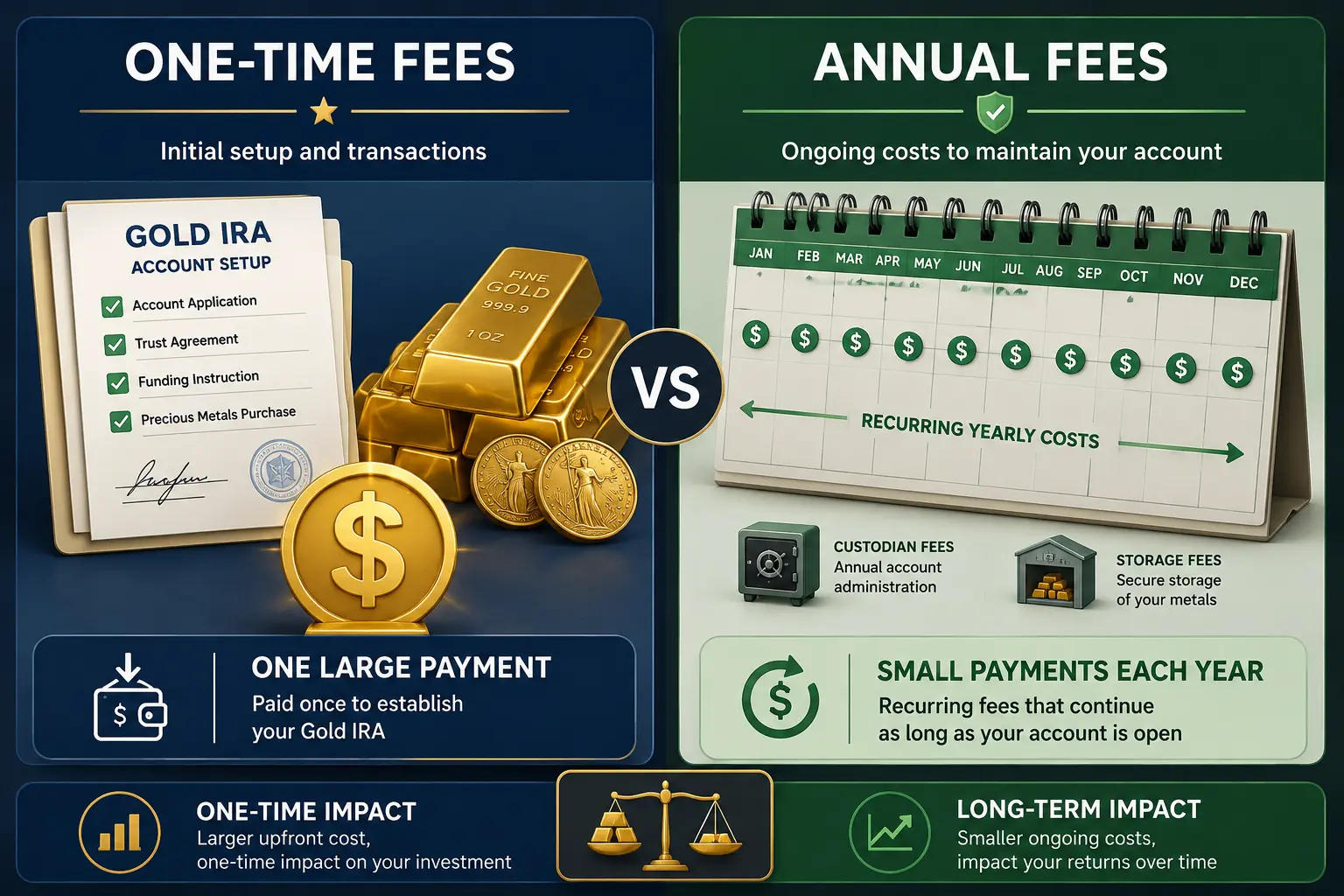
One-Time Fees vs Annual Fees
Gold IRA costs fall into two broad groups: upfront charges and ongoing charges. Separating the two helps investors understand why a first-year estimate can look very different from a year-five or year-ten estimate.
One-time fees may include account setup, initial wire or transfer processing, and the first metals purchase. Some providers waive one-time fees for qualifying accounts, but waived fees should not distract from dealer spreads or later annual costs.
Annual fees may include custodian administration, recordkeeping, statement processing, and depository storage. These costs continue for as long as the IRA remains open, so small annual differences can matter over long holding periods.
Custodian Fees, Storage Fees, and Transaction Fees
Custodian fees
Gold IRA custodian fees cover administration of the self-directed IRA, including account records, tax reporting, transaction processing, and coordination with depositories or dealers. Some custodians charge a flat annual maintenance fee. Others may add asset-based charges or tiered pricing for larger balances or complex holdings.
A calculator should let investors compare flat-fee and percentage-based models. Flat fees can be easier to understand, while percentage-based fees may rise as account value rises.
Storage fees
Gold IRA metals generally must be held at an approved depository, not at home. Storage charges may differ depending on whether the account uses commingled storage or segregated storage. Segregated storage may cost more because specific bars or coins are held separately for the account.
Investors should ask whether the quoted storage charge includes insurance, audit procedures, reporting, and any special handling fees. The calculator should also show whether storage is flat or asset-based.
Transaction fees
Transaction costs can apply when metals are bought, sold, transferred, or distributed. A low annual fee may look attractive until investors add the cost of wires, outgoing transfers, account closure, or future liquidations. Because many Gold IRA accounts are opened as long-term holdings, a calculator can model a simple case: one initial purchase and one later sale.
Dealer Spreads and Markups
Dealer spreads are often the most misunderstood Gold IRA cost. A spread is the price gap between what customers pay when buying metals and what a dealer may pay when buying those same metals back. Markups are not always shown on custodian fee schedules because they are part of the metals transaction, not the IRA administration fee.
For example, if a coin or bar is sold above spot and later bought back below spot, the investor must overcome that price gap before the position breaks even. This is why the Gold IRA markups and spreads guide is an important companion to any fee calculator.
Calculator assumptions should be conservative and transparent. Investors can ask providers for written examples on common bullion products, including the retail purchase price, spot price at the time of quote, and estimated buyback method.

Why “Free” Promotions May Still Have Costs
Some Gold IRA promotions waive setup fees, first-year administration, or storage costs for qualifying balances. These offers can reduce visible charges, but they do not always reduce total cost. The calculator should show both the promotional year and the normal fee schedule after the promotion ends.
Promotions can also shift costs into metals pricing. A company may advertise free silver or waived fees while charging wider spreads or higher premiums on selected products. That does not automatically mean the offer is unsuitable, but it means the entire quote should be compared against written alternatives.
The Gold IRA Fees & Hidden Costs Guide can help investors track these charges before speaking with a provider.
Sample Cost Scenario for $25k, $50k, $100k, and $250k Accounts
The table below is an educational example only. It is not a provider quote. It uses simple assumptions so investors can see how fixed account fees and percentage-based dealer markups behave at different account sizes.
- Setup fee example: $100.
- Annual custodian fee example: $150.
- Annual storage fee example: $150.
- Miscellaneous transaction and wire fees example: $50.
- Dealer markup example: 3% at purchase.
- Holding period example: 5 years.
| Account size | Approx. first-year fixed fees | Approx. 5-year custodian + storage total | Example 3% dealer markup |
|---|---|---|---|
| $25,000 | ~$450 | ~$1,500 | ~$750 |
| $50,000 | ~$450 | ~$1,500 | ~$1,500 |
| $100,000 | ~$450 | ~$1,500 | ~$3,000 |
| $250,000 | ~$450, or higher if asset-based fees apply | ~$1,500 under this flat-fee example | ~$7,500 |
This example shows why both fixed fees and spreads matter. Under a flat-fee model, account administration may not rise much with balance. Dealer markup, however, scales with the amount of metals purchased. Under percentage-based storage or administration, larger accounts may also face higher recurring fees.
Compare fee quotes side by side
Use the comparison workbook to log setup fees, annual fees, storage terms, spreads, and buyback policies before choosing a provider.
Get the Comparison Workbook →How Costs Change by Holding Period
Holding period changes the way Gold IRA fees feel. Short holding periods emphasize upfront setup costs and dealer spreads because there are fewer years for any price movement to offset the initial cost. Longer holding periods reduce the relative impact of setup fees but increase total custodian and storage charges.
For a one- or two-year holding period, spreads and setup charges may dominate the estimate. For a ten- or twenty-year holding period, recurring fees and storage assumptions become more important. Investors comparing providers should model both the expected holding period and a longer backup scenario.
Gold and other metals can rise or fall in price. Fees are not the only factor, and fee estimates should not be treated as performance projections. Past performance does not guarantee future results.
How to Compare Fee Quotes From Providers
Comparing quotes is where a calculator becomes most useful. Rather than accepting a single headline fee, investors can enter each provider’s full schedule and compare five-year or ten-year estimated totals.
- Request the written fee schedule. Ask for setup, annual custodian, storage, transaction, wire, transfer, and termination fees in writing.
- Ask how metals are priced. Request examples showing spot price, retail price, premium or markup, and likely buyback method for common coins or bars.
- Separate custodian fees from dealer spreads. A custodian fee schedule may look low while metals pricing carries a wider spread.
- Model promotions twice. Run the estimate with the promotion, then again under the normal fee schedule after waivers expire.
- Compare provider-specific pages. Start with the American Hartford Gold fees breakdown and Augusta Precious Metals fees review, then compare against the Best Gold IRA Companies page.
Customers should speak to a financial or tax advisor before making decisions about retirement accounts, rollovers, taxes, withdrawals, or portfolio allocation. Goldco does not offer tax or legal advice.
Methodology and Limitations
Methodology. The sample scenarios add the fixed account fees (setup plus annual custodian, storage, and miscellaneous charges across the holding period) to a percentage-based dealer markup applied to the amount of metal purchased. Fixed fees stay roughly constant as account size rises, while the dealer markup scales with the purchase amount — which is why a large account can carry low visible fees yet a much larger markup cost. All figures are labeled examples, not provider quotes.
Assumptions. The worked example uses a $100 setup fee, $150 annual custodian fee, $150 annual storage fee, $50 miscellaneous transaction/wire fees, a 3% dealer markup at purchase, and a 5-year holding period. These are adjustable illustrative inputs, not averages to rely on.
Limitations. This guide is educational and does not provide financial, tax, or legal advice, and is not a provider quote or a suitability assessment. It does not model taxes, metal price movement, promotional waivers expiring mid-period, percentage-based custodian or storage tiers, or the buyback spread at sale — all of which can materially change total cost. Custodian and storage fees are charged by independent third parties. Customers should request written fee schedules and speak with a financial or tax advisor before deciding. Past performance does not guarantee future results.
FAQ
What does a “Gold IRA fee calculator” actually do?
A Gold IRA fee calculator models estimated costs associated with opening and maintaining a precious metals IRA, including setup, annual custodian, storage, transaction, dealer markup, and possible liquidation costs. It helps compare scenarios but does not guarantee exact provider fees.
Are Gold IRA fees always a percentage of assets?
No. Some self-directed IRA providers use flat annual fees, while others charge asset-based percentages or tiered charges. Flat-fee structures can make costs easier to estimate, while percentage-based structures may increase as the account grows.
How much do Gold IRA annual fees typically cost?
Annual costs vary by provider, custodian, storage type, account size, and transaction activity. Many educational fee guides discuss examples of several hundred dollars per year once account maintenance and storage are combined, but investors should rely on written provider schedules rather than averages.
How do dealer markups affect Gold IRA costs?
Dealer markups represent the premium above spot price paid when metals are purchased. Buyback spreads may also apply when metals are sold. Together, these costs can outweigh small differences in setup or storage fees.
Can promotional offers make Gold IRAs “free”?
Promotions may waive certain setup or first-year fees, but investors may still face dealer markups, storage costs, transaction charges, and later annual fees. A calculator should show the account with and without promotional waivers.
Do Gold IRA calculators include tax effects?
Most fee calculators focus on account costs rather than tax outcomes. Tax treatment depends on account type and personal circumstances, so investors should review tax effects separately with qualified advisors.
Are liquidation fees part of Gold IRA cost estimates?
Yes. Liquidation can involve transaction fees, wire charges, and buyback spreads. Including exit assumptions helps investors compare the full life cycle of the account, not just the opening process.
Where can investors find more detailed fee breakdowns?
Investors can review the Gold IRA Fees & Hidden Costs Guide, the Gold IRA Company Comparison Workbook, provider-specific fee pages, the site’s Gold IRA Calculator, and the full Retirement Research Center.