
Affiliate disclosure: Some links on this page may be sponsor links. The site owners may be compensated if customers request information from companies mentioned here. This page is educational only and does not provide financial, tax, or legal advice. Customers should speak with a financial or tax advisor before making retirement-account decisions. Past performance does not guarantee future results.
Quick Answer: What a Gold IRA Exit Strategy Includes
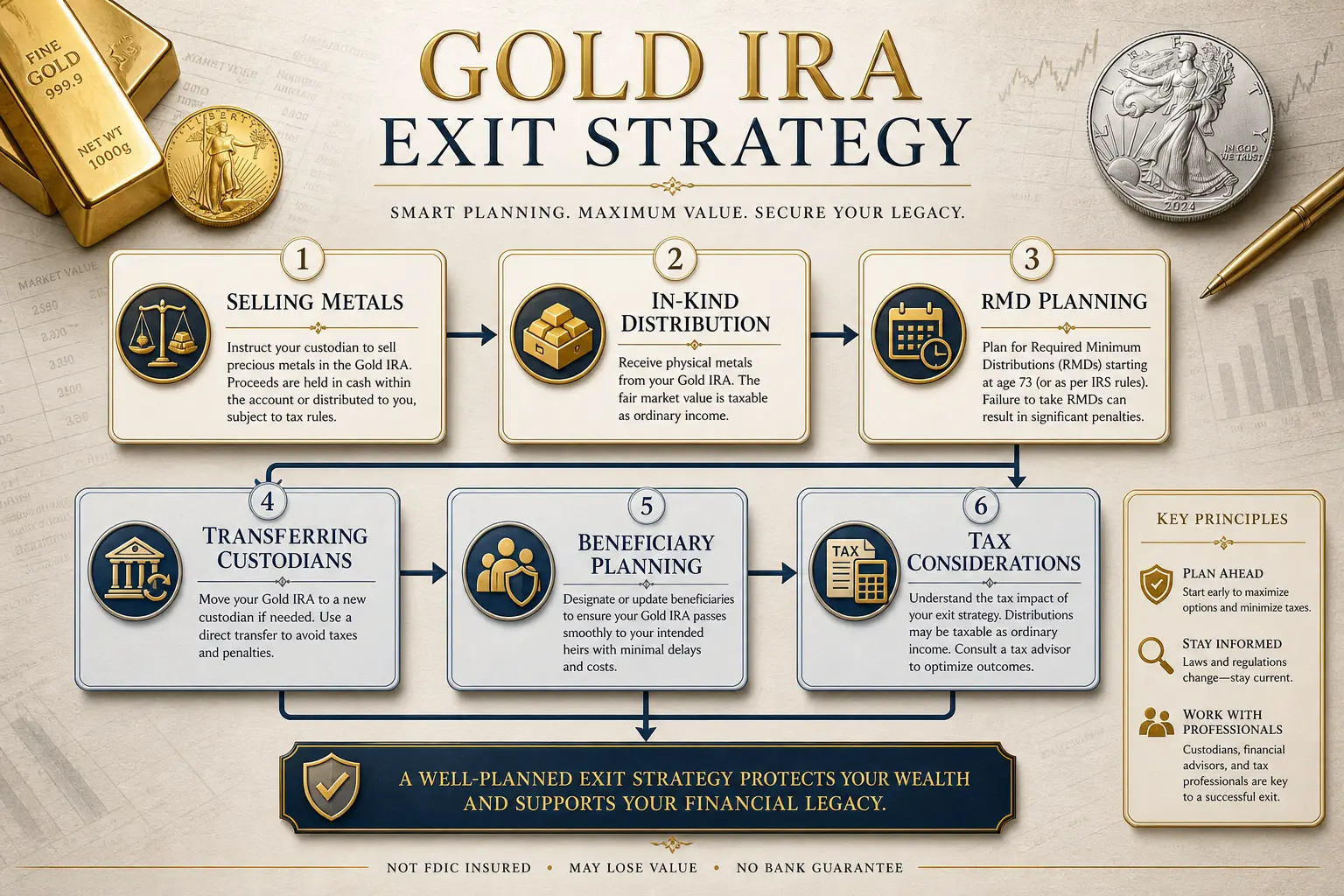
A gold ira exit strategy usually covers five decisions: selling metals inside the IRA, taking an in-kind distribution, using partial liquidation for RMDs, transferring or rolling assets to another custodian, and planning how beneficiaries may inherit the account.
The best time to review those decisions is before account opening, not during a market move, tax deadline, retirement income need, or family transition. A planned exit does not remove risk, but it gives investors clearer questions to ask about liquidity, fees, spreads, tax reporting, and account administration.
Why Exit Planning Belongs Before Account Opening
Gold IRAs are often discussed as a way to hold physical precious metals inside a retirement account, but the eventual exit is just as important as the purchase. Metals may need to be sold for cash, distributed in physical form, transferred to another custodian, or handled by heirs after death.
Exit planning also clarifies whether the account fits the investor's retirement income needs. Physical metals do not produce dividends or interest, and liquidation may depend on dealer bid prices, custodian procedures, storage logistics, and market conditions. Those details should be reviewed before a rollover or contribution is completed.
Investors can use the Gold IRA Calculator to model allocation assumptions and the Gold IRA Company Comparison Workbook to record provider answers.

Option 1: Sell Metals Inside the IRA
The most common Gold IRA liquidation path is selling metals inside the IRA and holding the proceeds as cash before taking a distribution or reinvesting. This approach can be simpler than receiving metals directly because the IRA remains the account structure during the sale.
The process usually involves contacting the custodian, requesting a sale through the approved channel, confirming bid pricing and any transaction fees, and deciding whether cash remains in the IRA or is distributed under IRA withdrawal rules. The stage-by-stage procedure, with provider-cited timelines, fees and buyback spreads, is documented separately. Where the sale is not a planned exit but an immediate need for cash from the account, the penalty and spread consequences deserve separate attention.
Investors should ask how the provider determines bid prices, whether the original dealer is involved, whether alternative sale channels are allowed, and how long settlement typically takes. Liquidity can vary by product type, market conditions, and buyback policy terms.
Option 2: Take an In-Kind Distribution
An in-kind distribution sends physical metals from the IRA to the account holder rather than selling metals for cash first. This can appeal to investors who want to keep metals personally after a distribution, but it can also create tax valuation and logistics questions.
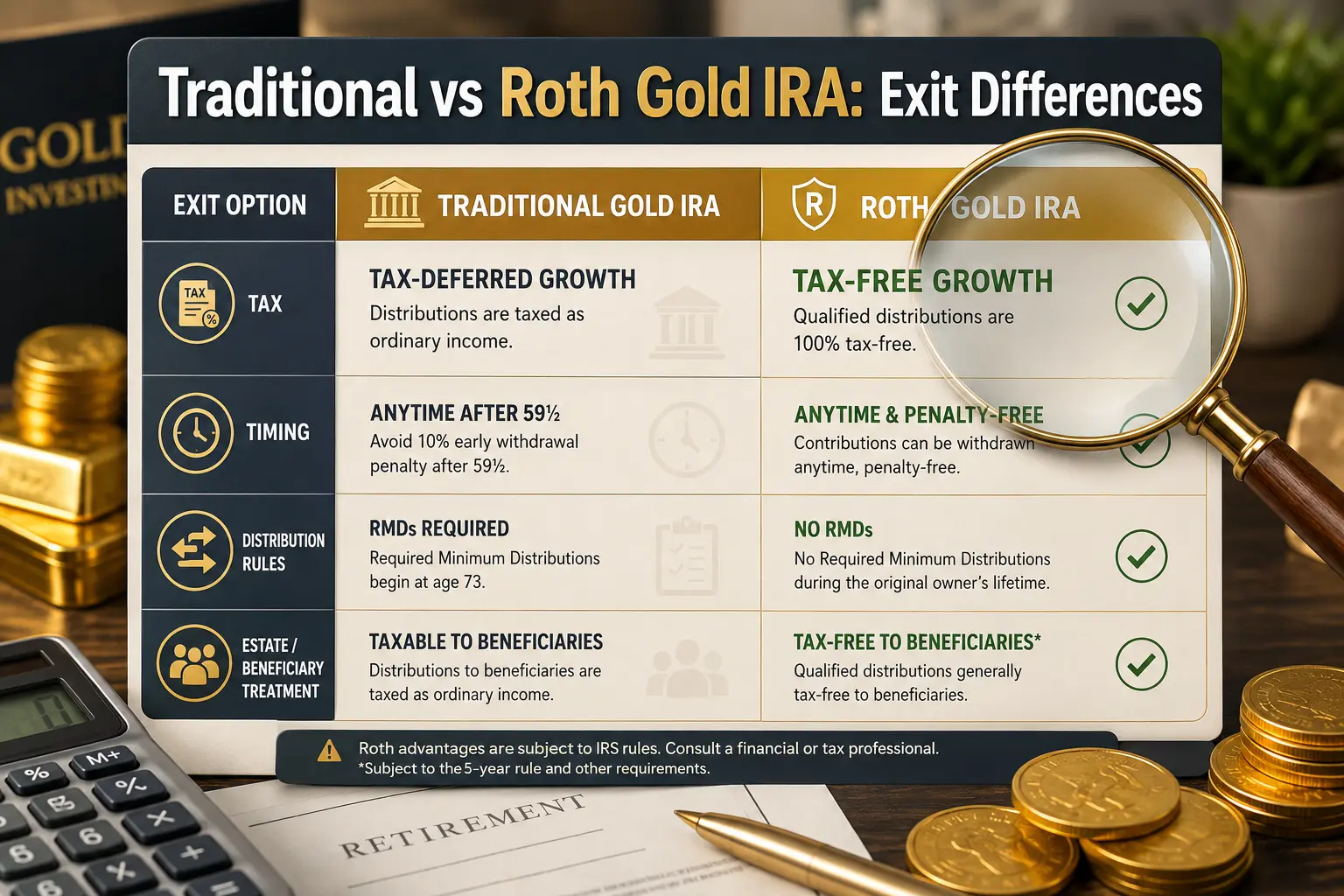
For a traditional IRA, the fair market value of distributed metals is generally treated as taxable income. If a distribution occurs before age 59½, early-distribution penalties may also apply unless an exception is available. Roth IRA treatment can differ when qualified distribution rules are met.
Because in-kind distributions involve valuation, shipping, insurance, storage changes, and tax reporting, customers should speak with a financial or tax advisor before making withdrawal decisions.
Option 3: Partial Liquidation for RMDs
Traditional Gold IRAs are subject to required minimum distribution rules once the account holder reaches the applicable age. Since physical metals do not naturally produce cash, RMD planning is a major part of any gold ira exit planning process.
Deciding which year and which trigger should prompt a sale is a planning question in its own right, distinct from the mechanics below. Common approaches include selling enough metals to generate the required cash distribution, taking an in-kind distribution valued at the required amount, or using other IRA assets to satisfy the RMD when aggregation rules allow. The available path depends on account type, custodian procedures, and tax circumstances.
RMD mistakes can create penalties and tax complications, so investors should not rely on dealer marketing for personalized tax guidance. Customers should speak with a financial or tax advisor before making RMD decisions.
Option 4: Transfer or Rollover to Another Custodian
A Gold IRA exit strategy does not always mean leaving precious metals entirely. Sometimes the planned exit is a transfer to another custodian, a rollover to a different IRA structure, or a liquidation followed by movement into a broader retirement account.
Reasons for transferring may include lower fees, better account service, different storage choices, clearer reporting, or improved buyback procedures. Direct custodian-to-custodian transfers can reduce tax risk compared with receiving funds personally, but paperwork and timing still matter.
Before opening an account, investors should ask whether future transfers are allowed, what fees apply, how metals are moved or sold, and whether the provider restricts transfers by product, storage type, or account status.
Option 5: Beneficiary and Estate Planning
Beneficiary planning determines what happens to a Gold IRA when the account holder dies. A spouse beneficiary, non-spouse beneficiary, trust, or estate may face different options, timelines, and tax consequences.
Some beneficiaries may liquidate metals for cash. Others may receive in-kind distributions or move inherited IRA assets under applicable rules. Non-spouse beneficiaries often face tighter distribution timelines than spouses, so beneficiary designations and written instructions matter.
The site's Inherited Gold IRA Rules guide explains the inheritance side in more detail. Customers should speak with estate, financial, and tax professionals before relying on a Gold IRA as a legacy asset.
What Buyback Policies Do and Do Not Guarantee
A gold ira buyback policy can make liquidation easier by giving account holders a defined channel for selling metals. It does not guarantee profits, future prices, or protection from market losses.
Buyback terms may depend on whether the metals were purchased from the same provider, whether the products are eligible bullion, what market bid prices are at the time of sale, and what administrative or transaction fees apply. Some policies are written clearly. Others leave important details to the sales process.
Investors should ask for the written buyback policy, example buy/sell pricing on common metals, timeline for settlement, and any exclusions. Provider-specific public-record pages such as Goldco Lawsuit 2026 can also help investors understand how complaints and disputes have been discussed historically.
Exit-Planning Questions to Ask Providers
Exit-focused questions help investors compare providers before funding a Gold IRA. Useful questions include:
- How can metals be sold inside the IRA, and what bid pricing or spreads typically apply?
- Does the custodian support in-kind distributions of metals, and how are metals valued for tax reporting?
- How are RMDs handled when the account holds physical metals?
- What options exist for transferring or rolling the account to another custodian later?
- How does the provider explain spouse and non-spouse beneficiary options?
- What does the buyback policy cover, and what does it not promise?
The Best Gold IRA Companies page and comparison workbook can help organize those answers across multiple firms.
Gold IRA Exit Options Video and Tools
After reviewing exit options, many retirement savers compare scenarios with educational tools before speaking with providers.
Gold IRA educational video
Video published by Goldco on YouTube — a company this site has an affiliate relationship with. Embedded as a third-party explanation; not produced, endorsed or independently verified by this site.
FAQ
What is a Gold IRA exit strategy?
A Gold IRA exit strategy is a plan for how and when metals in a Gold IRA may be sold, distributed, transferred, or passed to beneficiaries under IRA rules.
Can investors sell Gold IRA metals at any time?
Gold IRA owners can usually request sales through the custodian or approved dealer channel, but liquidity, bid pricing, processing time, taxes, and penalties may vary.
What is a Gold IRA in-kind distribution?
An in-kind distribution occurs when physical metals are delivered from the IRA instead of being sold for cash. The market value may be taxable for traditional IRAs and early-distribution penalties may apply.
How do RMDs work with Gold IRAs?
Traditional Gold IRAs must satisfy required minimum distribution rules at the applicable age. RMDs may be handled by selling metals, distributing metals in kind, or coordinating with other IRA assets when rules allow.
Can Gold IRA assets be rolled into another IRA or custodian?
Yes. Investors may transfer or roll eligible assets to another custodian or IRA structure, often using direct custodian-to-custodian processes to reduce tax risk.
How are Gold IRAs handled when the owner dies?
Beneficiary treatment depends on account type, beneficiary relationship, and current IRA inheritance rules. Spouses and non-spouse beneficiaries may have different options and timelines.
Do buyback policies guarantee a profit?
No. Buyback policies may provide a selling channel, but they do not guarantee profits, specific future prices, or protection from market declines.
Are Gold IRA exit strategies the same for Roth and traditional accounts?
The mechanical options can look similar, but tax treatment can differ. Traditional IRA distributions are generally taxable as ordinary income, while Roth IRA qualified distributions may receive different tax treatment.
Customers should speak with a financial or tax advisor before making withdrawal, rollover, RMD, or beneficiary decisions.