Educational only: This article is general educational information about Gold IRA decumulation timing. It is not financial, tax, legal, investment, estate-planning, or retirement advice. IRA sales, distributions, RMDs, rebalancing, and tax results depend on individual facts and current law. Customers should speak to a financial or tax advisor before making decisions. Goldco does not offer tax or legal advice. Past performance does not guarantee future results.
The clearest forced "when" is required minimum distributions: traditional IRA owners generally must begin annual RMDs at age 73 — rising to 75 for people born on or after January 1, 1960.
Source: IRS — RMD FAQs and final Treasury regulations (age 75). An RMD forces a distribution — not always a sale.
Key takeaways
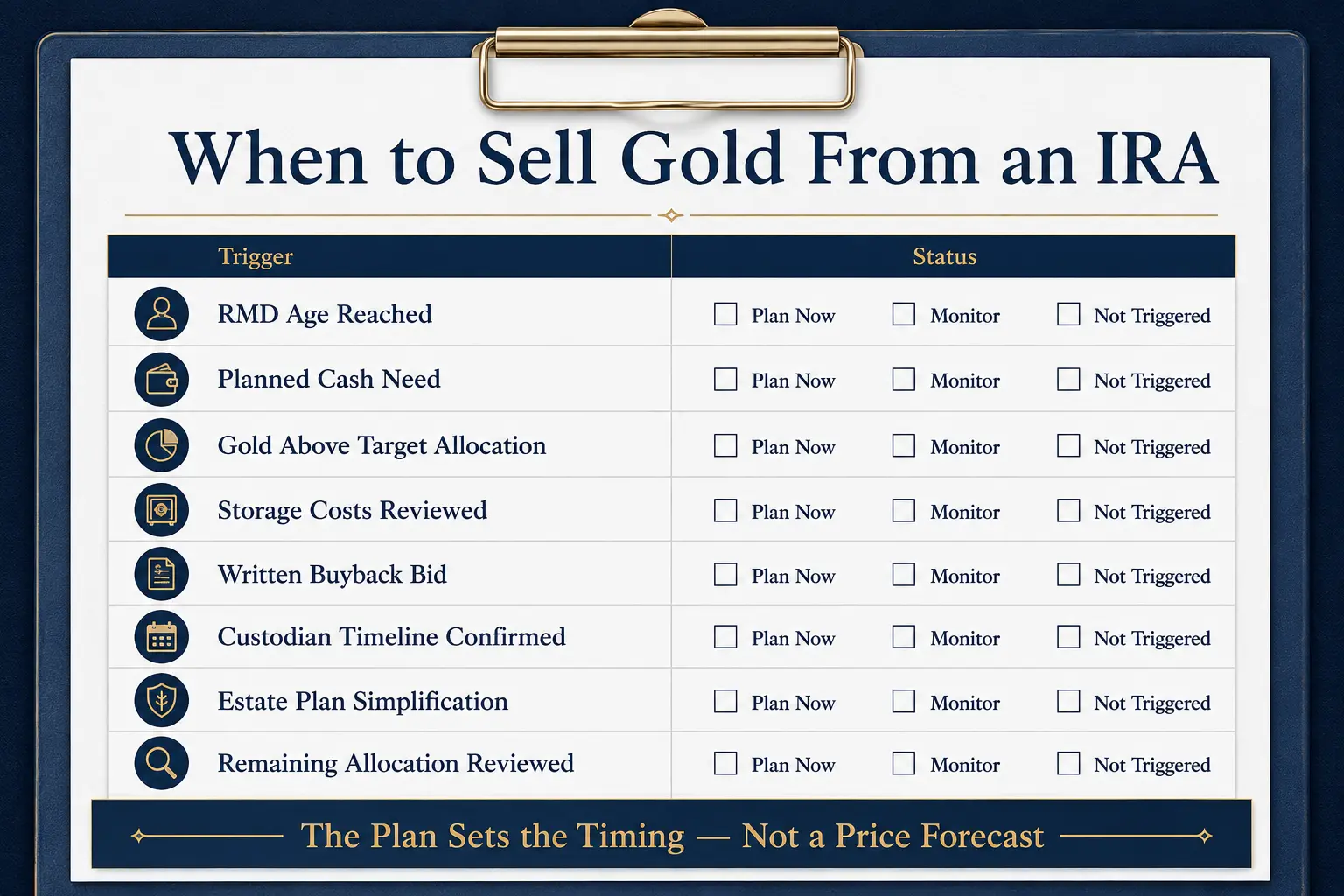
- The plan sets the timing, not a price forecast. Five triggers: a cash need, RMDs, rebalancing, carrying costs, and estate simplicity.
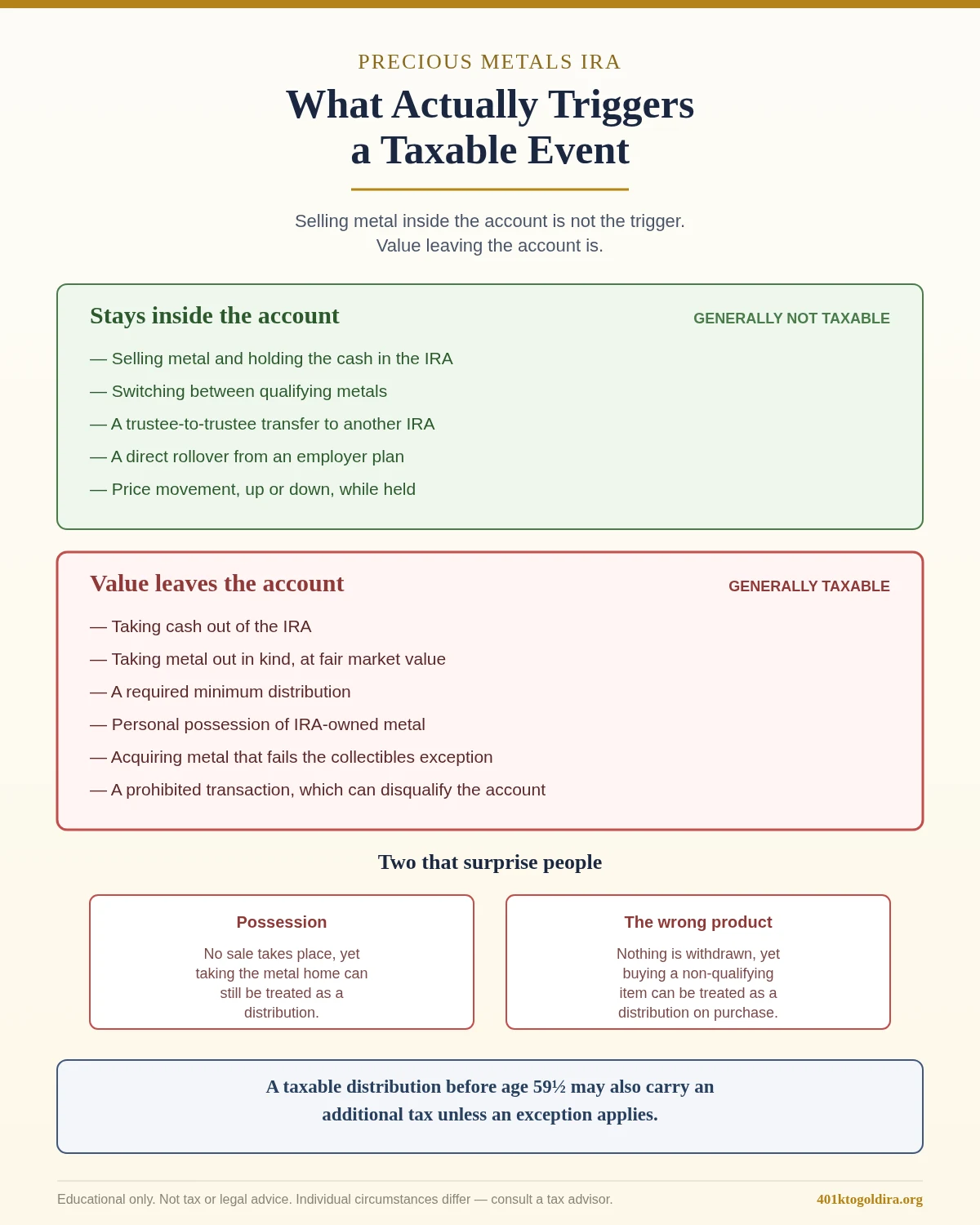
- An internal sale is not a distribution. Selling bullion can create cash that stays inside the IRA; tax generally attaches to the distribution, not the trade.
- RMDs force a distribution, not always a sale — cash already in the IRA or an in-kind metal distribution can satisfy them.
- Gold is not automatically first or last in the withdrawal order — it depends on allocation, costs, liquidity, and estate goals.
- Physical frictions matter: the dealer bid sits below spot, and paperwork takes time, so leave lead time before any deadline.
Quick answer: The timing decision should answer four questions — Is cash needed from the account? Is the gold allocation still inside its target range? Will required minimum distributions create a deadline? Do the dealer bid, spread, custodian process, and estate plan support an orderly sale? A sale inside an IRA is not the same as a distribution from the IRA: selling bullion can create cash that remains inside the account, and federal income tax is generally connected to a taxable distribution from a traditional IRA, not merely to an internal trade. Traditional IRA distributions may be fully or partly taxable depending on after-tax basis (Internal Revenue Service).
When Does It Make Sense to Start Selling Gold From an IRA?
A plan-based sale usually begins when at least one of five triggers appears.
1. A known cash need is approaching
Retirement expenses may require distributions for housing, health care, taxes, travel, family support, or another planned purpose. Physical gold does not produce cash flow inside the IRA, so the custodian must generally arrange a sale or an in-kind distribution before the asset can support personal spending. A retiree who expects a large distribution next year may begin the sale process earlier rather than waiting until the final week — that allows time to obtain a written bid, review the spread, complete custodian paperwork, and decide whether a partial sale is enough. The mechanics of moving money out are covered in the site's guide to accessing cash from a Gold IRA.
2. Required minimum distributions are approaching
A traditional Gold IRA is subject to the same RMD rules as other traditional IRAs. The current IRS FAQ states that traditional, SEP, and SIMPLE IRA owners generally must begin annual RMDs for the year they reach age 73, and final Treasury regulations set age 75 for people born on or after January 1, 1960 (Internal Revenue Service; Internal Revenue Service). An account that holds mostly physical metal may need planned sales to create cash for those distributions.
3. Gold has moved outside the target allocation
Gold can become a larger or smaller share of the total portfolio as asset prices change. Investor.gov defines rebalancing as bringing a portfolio back to its intended asset allocation, and its example shows that an asset category that has grown above its target can be partly sold to restore the planned mix — while also noting that fees and tax consequences should be checked before rebalancing (Investor.gov). A partial gold sale may therefore be a risk-control decision rather than a view that gold is about to fall.
4. The carrying costs no longer fit the position
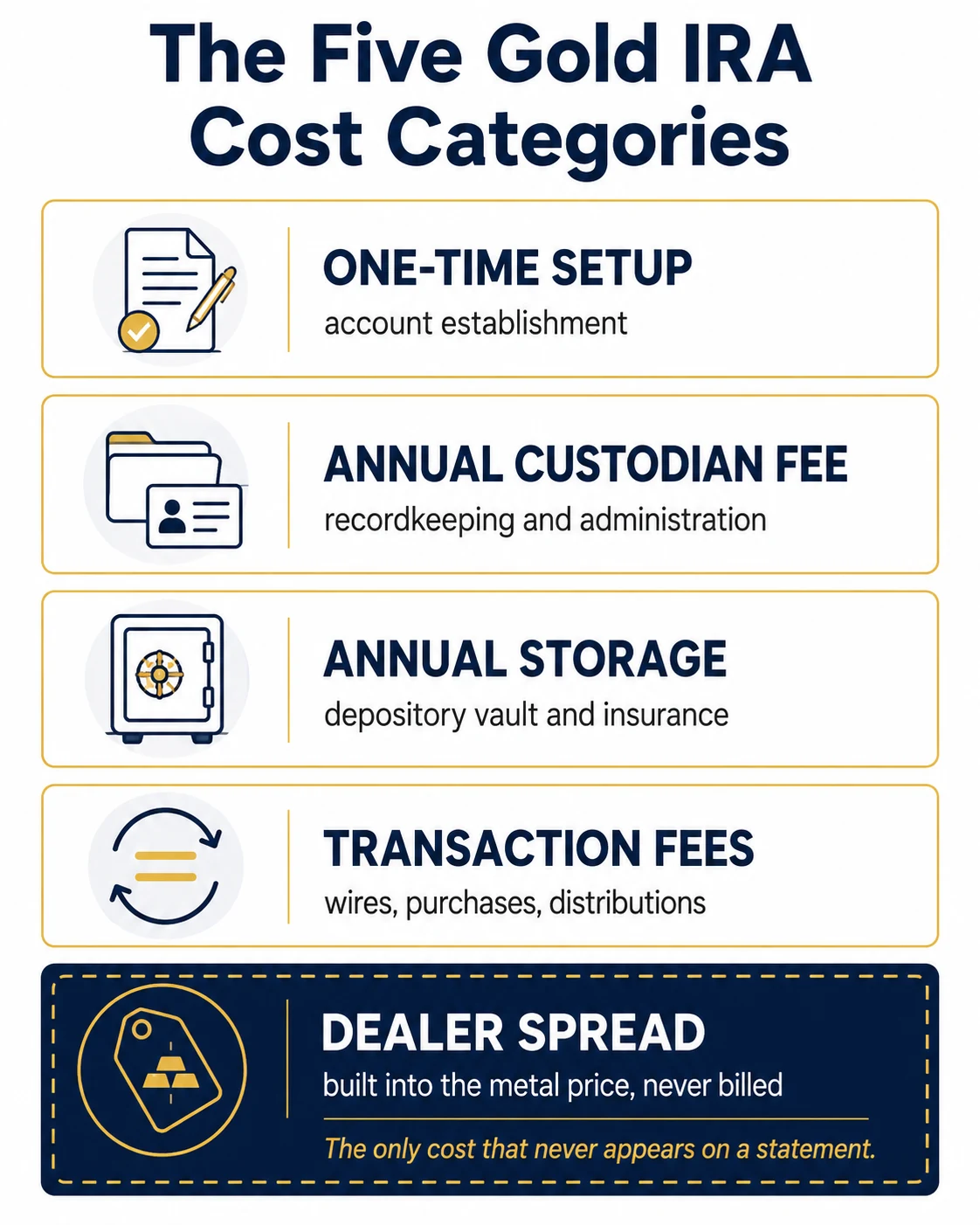
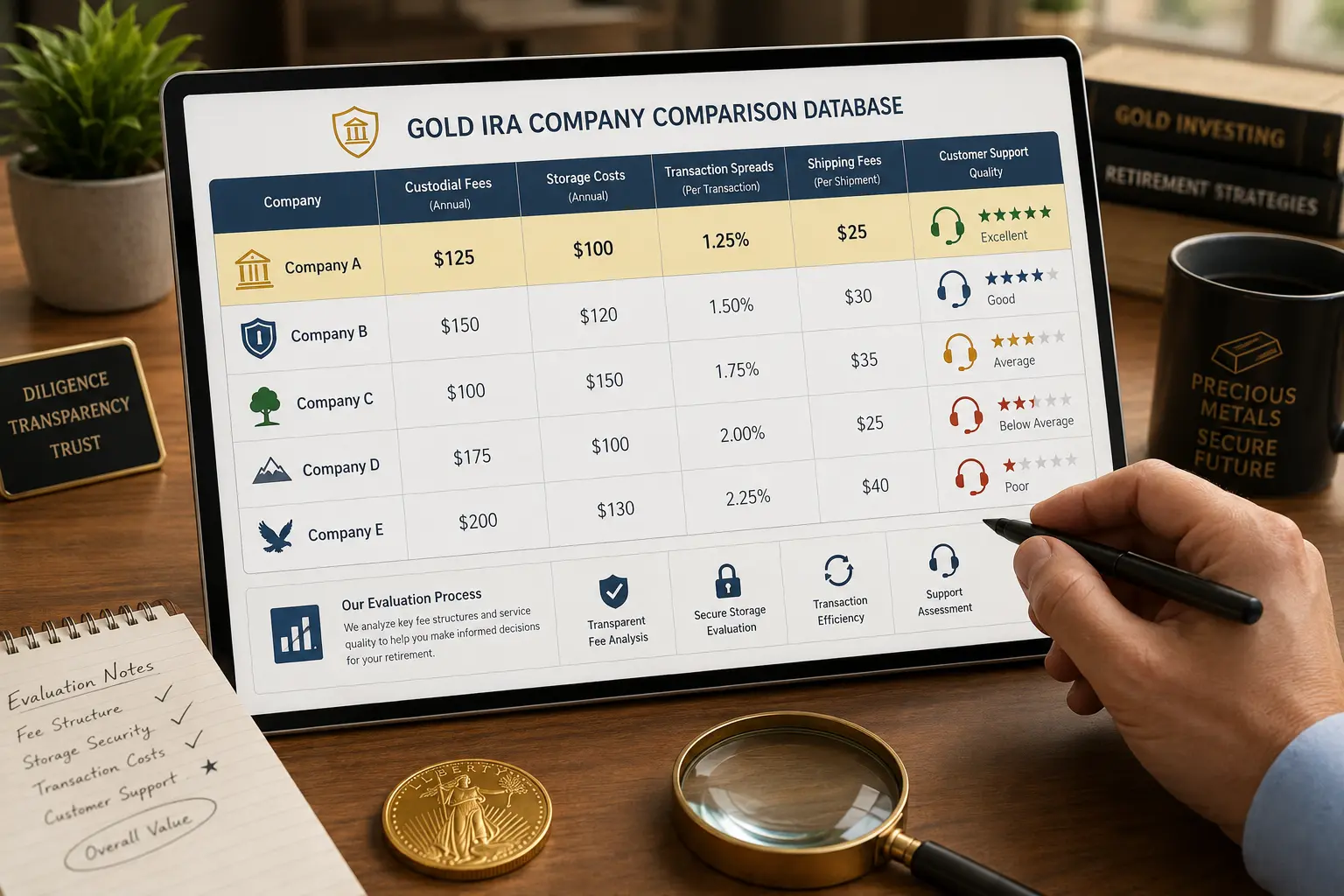
Physical precious-metals IRAs may involve custodian administration, storage, insurance, transaction, shipping, and distribution charges. FINRA and the CFTC advise customers to request all fees and dealer pricing in writing, and note that self-directed IRA fees are typically higher than directed-IRA fees (FINRA and Commodity Futures Trading Commission). A small gold position can become inefficient when fixed annual charges consume too much of its value; a larger position may remain cost-effective but create allocation or liquidity concerns.
5. The estate plan favors simpler holdings
An IRA beneficiary is subject to distribution rules after the account owner's death. The IRS states that beneficiary options depend on the beneficiary's relationship to the owner, whether death occurred before or after the required beginning date, and whether the beneficiary qualifies as an eligible designated beneficiary (Internal Revenue Service). Physical metal may add steps for valuation, custody, sale, or in-kind distribution. Some account owners may prefer to reduce a complex physical position during life; others may prefer to leave the metal in the account and provide clear instructions. Estate simplicity can be a valid timing trigger, but it does not create a universal reason to sell.
Do Required Minimum Distributions Force a Gold Sale?
RMDs force a distribution, not always a sale. The IRS states that traditional IRA owners generally must withdraw minimum amounts annually beginning at the applicable age, and that the first distribution can generally be delayed until April 1 of the following year — though that delay can cause two RMDs to fall in the same calendar year (Internal Revenue Service). The account can satisfy the distribution in several ways, subject to the custodian's procedures.
When can an RMD be paid from cash?
If the Gold IRA already holds enough cash, the custodian may distribute that cash without selling bullion. Cash may have entered the account through a prior sale or another permitted transaction. A cash reserve inside the IRA can reduce the chance that a year-end RMD deadline forces a rushed metal sale.
Can the metal itself be distributed?
IRA distributions can include money or other property. IRS Publication 590-B refers to distributions of IRA assets as money or other property, and IRS reporting instructions recognize distributions of traditional IRA assets that do not have a readily available fair market value (Internal Revenue Service; Internal Revenue Service). A custodian may allow an in-kind distribution of specific coins or bars; the fair market value is treated as the distribution amount for reporting, and personal possession begins only after the distribution is completed. An in-kind distribution does not avoid tax merely because no cash changed hands — the taxable portion of a traditional IRA distribution is generally included in income.
When does an RMD lead to a sale?
A sale becomes the practical choice when the IRA has too little cash, the account owner does not want personal possession, the custodian does not support the desired in-kind process, the metal is being reduced for rebalancing, or the distribution must cover taxes or expenses that require cash. The site's Gold IRA strategy after age 73 and Gold IRA RMD strategy guide cover RMD calculations and satisfaction methods in greater detail. Customers should speak to a financial or tax advisor before making decisions about RMDs, distributions, or IRA asset sales. Goldco does not offer tax or legal advice.
Where Should Gold Sit in the Retirement Withdrawal Order?
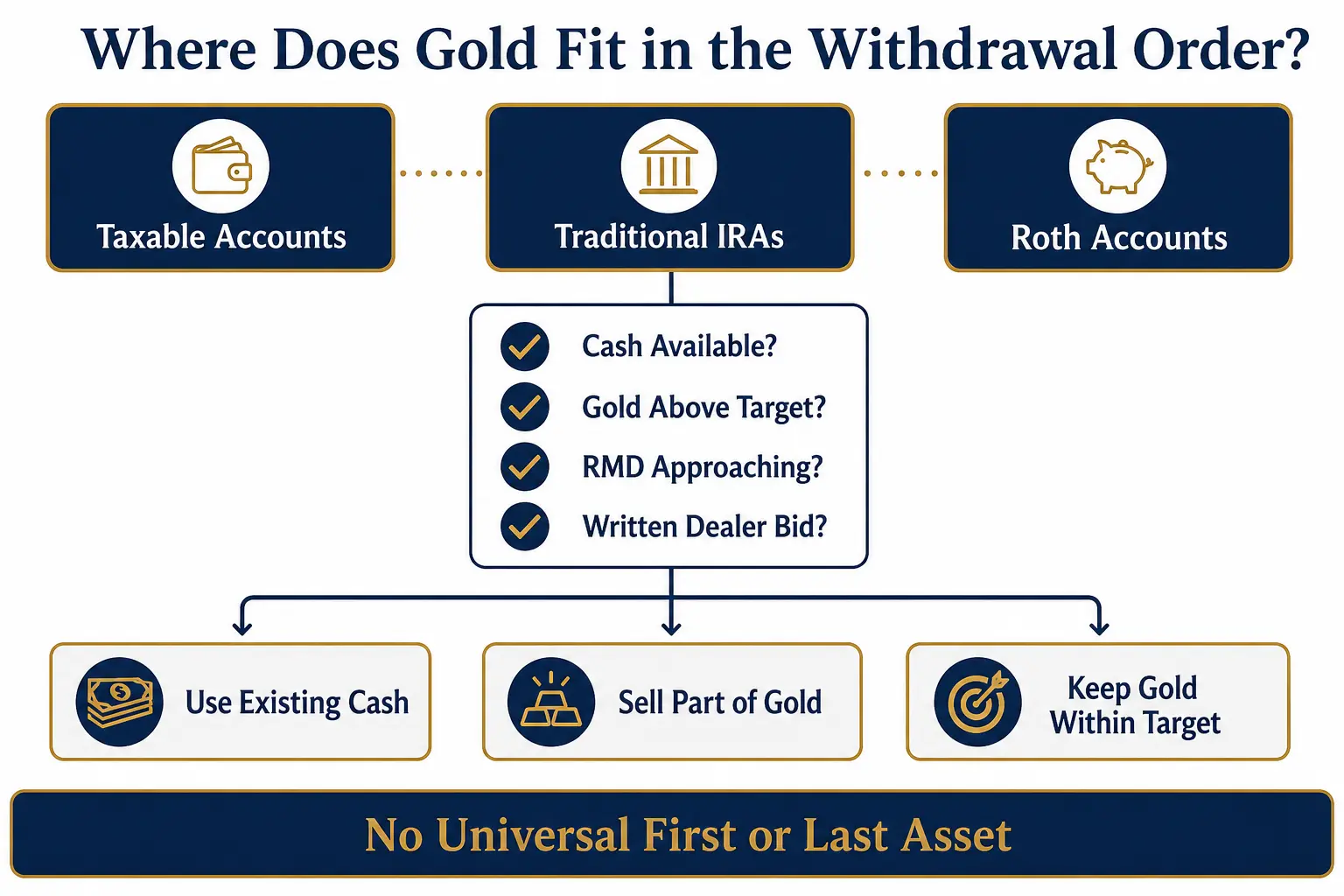
Withdrawal order has two levels. The first level decides which account type provides the money; the second decides which asset inside that account should be sold. Those decisions should not be confused.
What is the traditional account-order approach?
A common starting approach is taxable accounts first, then tax-deferred accounts (including traditional IRAs), then Roth accounts. Vanguard explains that this order can allow tax-advantaged accounts to keep growing longer, and Fidelity describes the same traditional sequence but notes that proportional withdrawals or other tax-managed methods can work better for some households (Vanguard; Fidelity). That order is not a universal rule: a retiree may use traditional IRA withdrawals earlier to fill a lower tax bracket, reduce future RMDs, or coordinate Social Security and Medicare taxes, while another may preserve Roth assets for later years or estate goals.
Where does gold fit inside a traditional IRA?
Gold should not automatically be the first asset sold or the last asset sold; the position should be compared with the rest of the portfolio. Gold may move earlier in the order when it is above its target allocation, storage and administration costs are high relative to the position, a cash need is approaching, the IRA lacks liquid assets for RMDs, the estate plan favors simpler holdings, or the dealer bid is acceptable and the sale can be completed without a deadline. Gold may move later when it remains inside the target allocation, other liquid assets already cover near-term distributions, selling would create unnecessary spread and transaction costs, the plan still assigns a diversification role to the metal, or a weak dealer bid makes an immediate sale unattractive and no deadline exists. The correct question is not "Should gold always be sold first?" but "Which sale keeps the full portfolio closest to its risk, tax, liquidity, and estate goals?"
Is It Better to Sell Gold Earlier or Later in Retirement?
Both approaches can be reasonable. Selling earlier may reduce future pressure: a retiree can create cash before RMD deadlines, reduce storage costs, simplify records, and rebalance an overweight position. An earlier partial sale may also allow the account to spread liquidation across several years rather than relying on one large transaction — useful when the account is concentrated in a few large bars or when the custodian's processing time is slow. Selling earlier may also support tax planning when distributions from the traditional IRA are intentionally taken before RMD age; the internal gold sale itself does not set the tax bill, but the later distribution of sale proceeds can affect taxable income.
Keeping gold longer may make sense when the position remains modest, costs are acceptable, and cash needs are covered elsewhere — preserving the planned diversification role for more of retirement and avoiding an unnecessary transaction when the dealer spread is wide. The risk is that waiting too long can turn a planned sale into a forced sale. The strongest case for selling later exists when the account has enough liquidity, the allocation remains appropriate, and a written trigger identifies when action will begin. A staged sale divides one large liquidation into several smaller transactions — for example, selling enough to fund one or two years of planned distributions, then reviewing annually. Staging does not ensure a better average price; it reduces dependence on one sale date and may fit rebalancing or RMD planning, though several small sales may cost more than one larger sale because of fixed transaction charges.
How Does Rebalancing Trigger a Partial Gold Sale?
Rebalancing is one of the most objective reasons to sell. Suppose a retirement plan sets a 10% target for precious metals; if gold appreciation raises the position to 16%, the account is carrying more gold risk than the plan intended. Investor.gov explains that rebalancing can involve selling part of an asset category that has grown above its target and moving the proceeds to an underweight category (Investor.gov). The sale amount does not have to eliminate gold — a partial sale can restore the target, fund an RMD cash reserve, or reduce concentration. Rebalancing can also work in the opposite direction: if gold falls below its target, the plan may call for no sale or for purchases from other assets. That is an allocation decision, not a price prediction.
No single review schedule fits every portfolio. Common methods include a fixed annual review, a review when an asset moves beyond a preset percentage band, a review before major distributions, or a review after a large life, tax, or estate change. The trigger should be written before the market move occurs. The site's Gold IRA buyback calculator can help compare a dealer bid with the metal's reference value and estimated selling costs.
What Physical-Gold Frictions Affect the Timing?
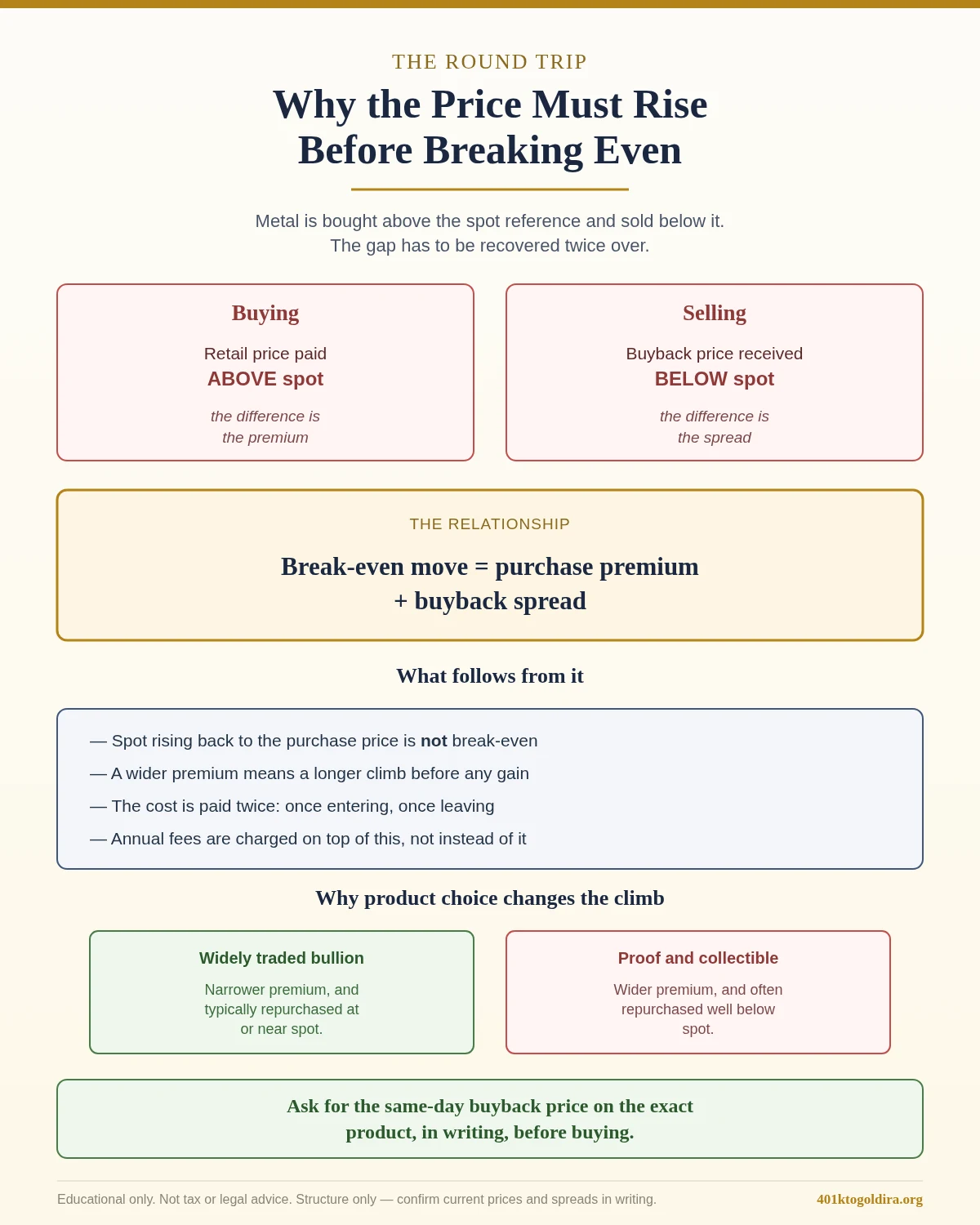
Physical gold is not sold with the same process as a highly traded stock fund. The account holder usually instructs the custodian; the custodian or dealer confirms the product, quantity, and bid; the depository releases or transfers the metal under the account procedures; and settlement then creates cash inside the IRA or completes an in-kind distribution. Several frictions matter. The dealer bid may be below spot: FINRA and the CFTC explain that dealers normally sell above spot and buy below spot, and each dealer sets its own spread, so the current spot price is not necessarily the amount the IRA will receive (FINRA and Commodity Futures Trading Commission). The exact product affects liquidity: the same bulletin states that numismatic and so-called semi-numismatic products may be less liquid than bullion, so a position that is harder to sell needs more lead time. Written bids matter: the bulletin advises customers to ask what the dealer would pay if the metal had to be sold back the next day and to obtain fees and agreed prices in writing.
A retirement sale should record the spot-price timestamp, product and weight, dealer bid, spread from the current reference value, custodian transaction charge, shipping or handling charges, expected settlement date, and cash available after the sale. Custodian processing creates a timeline — a Gold IRA sale may require forms, signatures, identity verification, depository instructions, and settlement — so a deadline-based distribution should begin early enough to allow corrections. The detailed transaction steps remain in the cash-from-Gold-IRA guide.
Why Is Gold-Price Timing the Wrong Anchor?
Waiting for a perfect price creates a decision that may never become clear. FINRA defines market timing as moving money in or out of investments to exploit expected short-term price changes, an approach that depends on correctly predicting both the exit and the next action (FINRA). Gold prices can respond to interest rates, currency movements, central-bank demand, investor flows, inflation expectations, geopolitical events, and other forces, and the direction and timing cannot be known reliably in advance. The SEC's Investor.gov warns that past performance does not necessarily predict future results (Investor.gov).
A plan-based trigger is more useful than a forecast because it can be measured — for example: RMD age is within two years; the IRA cash reserve has fallen below a chosen amount; gold exceeds the target allocation band; a known expense is due next year; storage costs exceed a preset percentage of the position; or the estate plan calls for simpler assets. The site's gold price timing guide covers the separate question of purchase timing and should not be used as a retirement liquidation forecast.
What Checklist Can Guide the First Sale?
An IRA owner can use the following sequence.
- Define the reason in one sentence: cash need, RMD preparation, rebalancing, costs, or estate simplification.
- Calculate the amount needed so the sale covers the purpose without liquidating more metal than necessary.
- Review the full portfolio — compare gold with stocks, bonds, cash, and other retirement accounts.
- Check taxes and distribution plans. An internal sale and a taxable distribution are different events; the annual plan should estimate traditional IRA income, Social Security taxation, Medicare premiums, state taxes, and other withdrawals.
- Request written bids documenting the dealer bid, spread, fees, and settlement schedule.
- Confirm custodian instructions — whether proceeds stay in the IRA, are distributed as cash, or support an in-kind distribution.
- Leave time before a deadline. RMD and expense deadlines should not depend on a last-minute sale.
- Review the remaining allocation against the target range after the sale.
The Gold IRA decision quiz can organize broader account-structure questions. It does not provide personalized withdrawal advice.
What Are Common Questions About Selling Gold From an IRA?
Does an RMD require every Gold IRA owner to sell metal?
No. An RMD requires a distribution. Cash already inside the IRA or an in-kind metal distribution may satisfy the requirement, subject to the custodian's procedures and tax reporting. A sale is often needed when the account lacks cash.
At what age should gold sales begin?
There is no universal age. Traditional IRA RMDs are the clearest age-based trigger — the current general age is 73, while final regulations set age 75 for people born in 1960 or later. Earlier sales may be reasonable for spending, rebalancing, costs, or estate planning (Internal Revenue Service; Internal Revenue Service).
Should gold be sold before stocks or bonds?
Not as a universal rule. The order depends on allocation targets, liquidity, taxes, dealer spreads, future income, and the role assigned to each asset.
Is selling gold inside an IRA immediately taxable?
An internal sale generally creates cash inside the IRA. The taxable event is generally the traditional IRA distribution, not the sale itself. Traditional IRA distributions may be fully or partly taxable depending on basis (Internal Revenue Service).
Can Gold IRA metal be distributed instead of sold?
A custodian may permit an in-kind distribution. The fair market value becomes the reportable distribution amount, and personal custody begins after the distribution is completed.
Should an IRA owner wait for gold to reach a target price?
A retirement plan should not depend on a short-term price forecast. RMDs, cash needs, rebalancing, costs, and estate goals provide clearer triggers.
Bottom Line
The best time to begin selling gold from an IRA is not tied to a headline or a predicted gold price. The plan should begin a sale when the account needs cash, an RMD deadline is approaching, gold has moved outside its target allocation, physical holding costs no longer fit, or the estate plan favors simpler assets. Gold should not automatically be sold first or held forever. A measured approach uses written triggers, partial sales when appropriate, current dealer bids, enough lead time, and a review of the full retirement portfolio.
Sources
- Internal Revenue Service. RMD FAQs · Internal Revenue Bulletin 2024-33 (RMD final regulations).
- Internal Revenue Service. Publication 590-B · Instructions for Forms 1099-R and 5498 · Retirement topics — beneficiary.
- Investor.gov (U.S. SEC). Is it time to rebalance? · Investor bulletin.
- Vanguard. How to set up retirement withdrawals.
- Fidelity. Tax-savvy withdrawals.
- FINRA and Commodity Futures Trading Commission. Buying physical gold or other metals.
- FINRA. Market timing.
Reviewed and edited by Daniel M. — editor, 401kToGoldIRA.org. Educational only; sourced to the IRS, Investor.gov (SEC), Vanguard, Fidelity, and the FINRA/CFTC precious-metals bulletin. Not financial, tax, or investment advice.