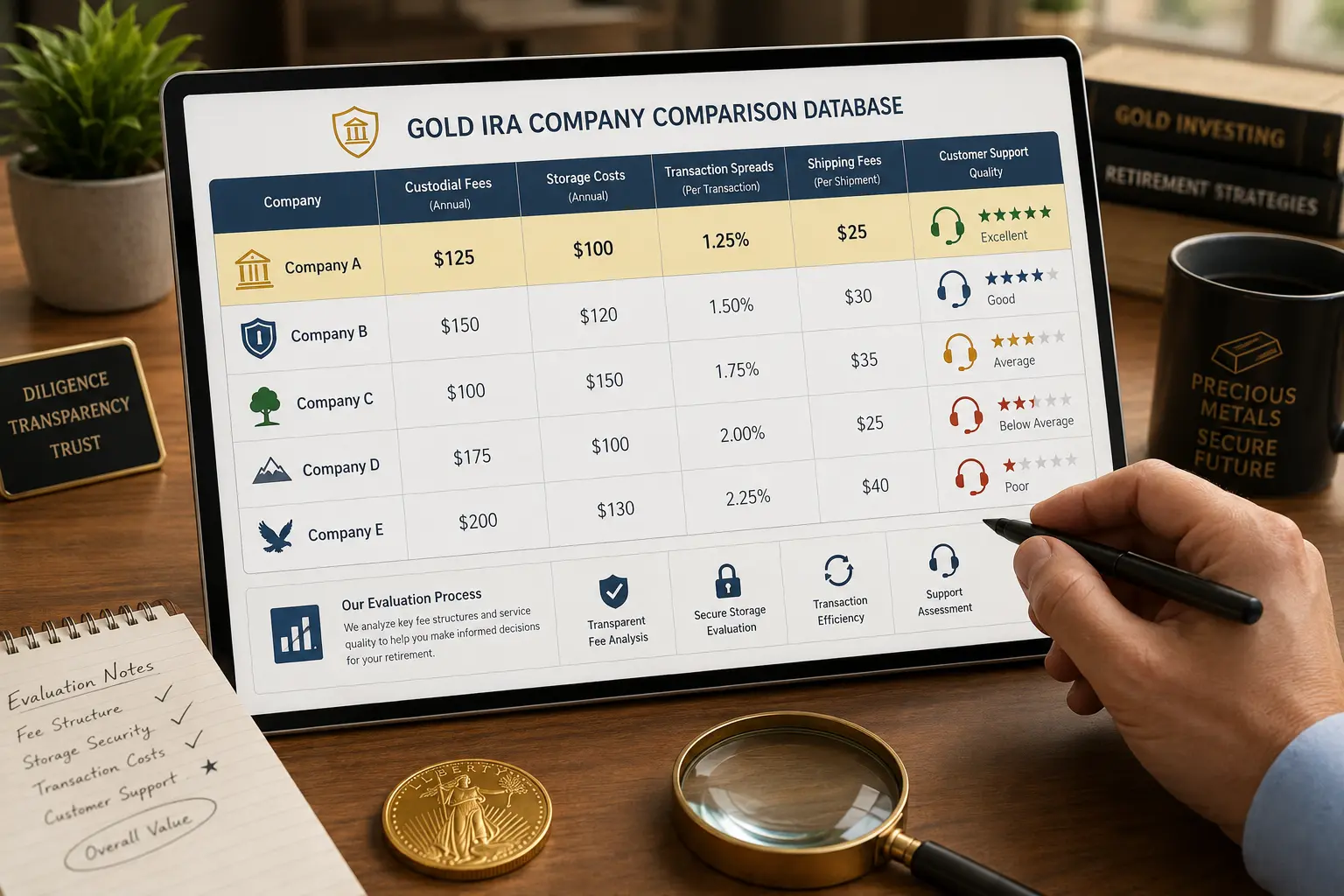
Educational only: This page contains sponsor/affiliate links, and the site owners may be compensated if customers request information from companies shown in those commercial modules. Those modules are dealer-related and are kept separate from the custodian framework below; they are not custodian rankings, and no compensation influenced this framework. This page explains eligibility rules and documentary evidence from published law and official records. It is not financial, tax or legal advice, and it does not rank, score or recommend any custodian. Goldco does not offer tax or legal advice. Past performance does not guarantee future results.
Key takeaways
- An entity on the IRS nonbank-trustee list has been approved to serve in that capacity under Treasury Regulation §1.408-2(e). That status does not establish investment quality, service quality or suitability.
- The nonbank list is not a complete directory of every IRA custodian, because banks and other entities meeting the statutory definition in IRC §408(n) qualify by a different legal route.
- Regulators warn that self-directed IRA custodians generally do not evaluate the quality or legitimacy of an investment or its promoter.
- Fee comparisons are strongest when built from the custodian’s own schedule and agreement, with each category separated by trigger and calculation method rather than collapsed into one annual number.
- A dealer relationship, a depository relationship or a custodian’s willingness to process a transaction is not independent evidence that an asset is suitable or free of prohibited-transaction risk.
- Trustees and custodians report year-end fair market value on Form 5498, and report certain assets without a readily available value in Boxes 15a and 15b.
- Physical possession is a legal boundary, not a marketing preference. IRC §408(m)(3) contains the precious-metals exception, and the Tax Court’s McNulty decision should be read narrowly for its actual facts.
Who is the custodian in a Gold IRA transaction?
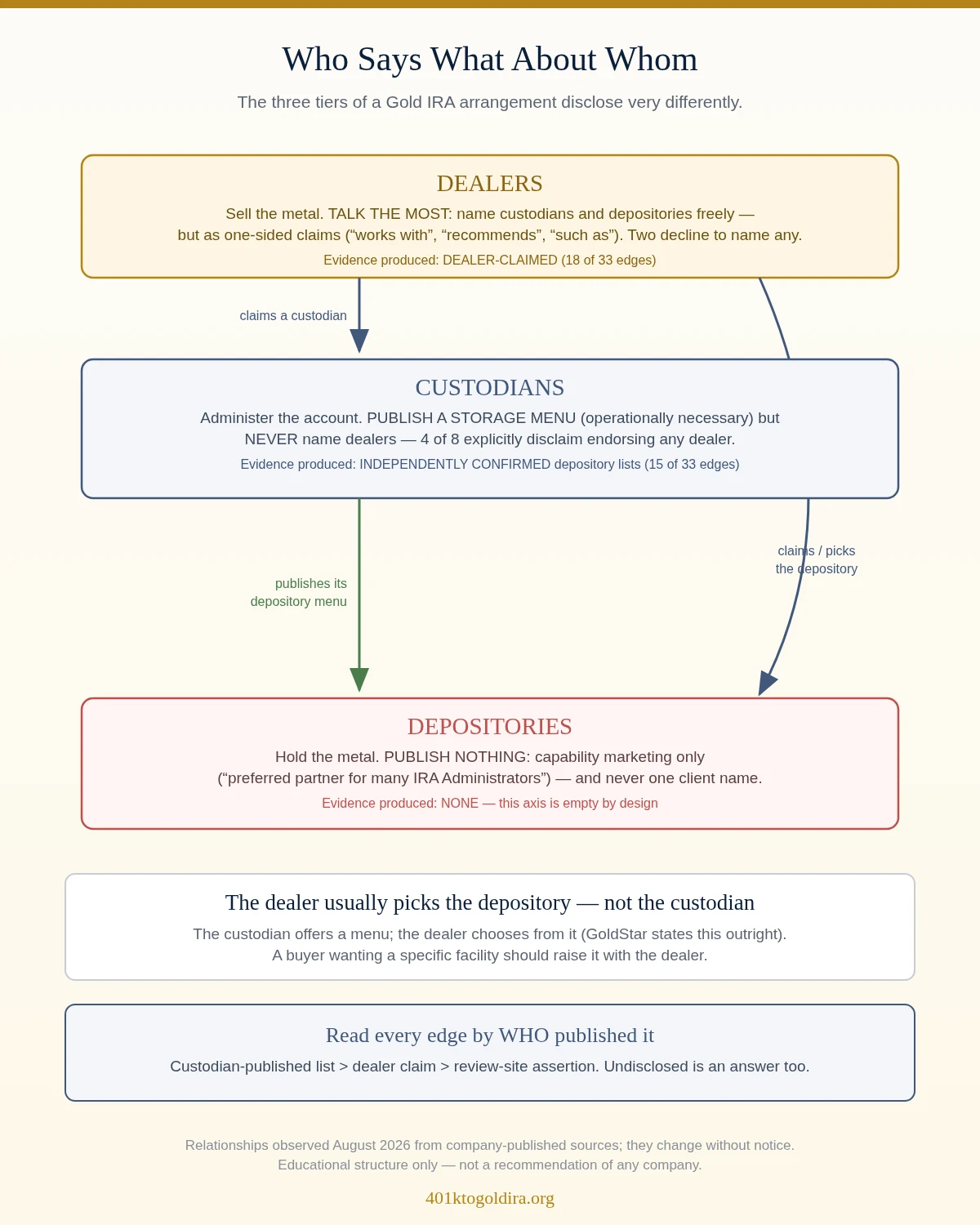
A self-directed precious-metals IRA can involve several entities, but the legal roles are not interchangeable. IRC §408 requires an IRA to be maintained by a qualifying trustee or custodian. A dealer sells the metal. A depository stores it under an arrangement that must fit the IRA’s legal structure. An administrator may process paperwork or provide an interface, but an administrator is not automatically the legal IRA custodian.
The distinction matters because a website, sales representative or dealer referral can use the word “custodian” loosely. The documentary test is the account agreement: the legal entity named as trustee or custodian should match the entity whose legal status can be verified.
| Party | Core function | Best document to verify the role | What the role does not prove |
|---|---|---|---|
| IRA trustee/custodian | Holds and administers the IRA under its governing agreement and tax-reporting obligations | Custodial agreement, IRS nonbank approval or bank/trust charter record, Form 5498 issuer identity | That a proposed investment is suitable, fairly priced or legitimate |
| Administrator/service provider | May process forms, instructions, valuations or account servicing for the legal custodian | Service disclosure, account forms, agreement identifying the legal custodian | That the administrator itself is legally authorised to serve as trustee or custodian |
| Precious-metals dealer | Sells or buys metal and sets the transaction price and spread | Trade confirmation, invoice, dealer disclosures | That the IRA structure is compliant or the custodian is independently suitable |
| Depository/storage facility | Provides physical storage and inventory services under the relevant custodial arrangement | Custodian storage policy, depository agreement or permitted-facility disclosure | That the custodian has reviewed the merits or pricing of the metal purchase |
The joint CFTC and FINRA precious-metals advisory warns that dealer markups, spreads and fees are separate from IRA custodial costs and should be obtained in writing before a transaction. Which dealers actually name their custodian and depository is recorded separately in the custodian and depository relationship database.
How is legal eligibility verified?
The first comparison is not a fee comparison. It is an eligibility gate.
Banks and supervised institutions. IRC §408(a)(2) states that an IRA trustee may be a bank as defined in §408(n), or another person who demonstrates to the Secretary that the account will be administered consistently with §408. Section 408(n) includes a bank within the tax-code definition, an insured credit union, and a corporation subject under state law to supervision and examination by the state banking authority. The OCC Financial Institution Search and FDIC BankFind confirm institutional records, though insurance status is not a substitute for identifying the legal custodian or its trust powers. State-chartered trust companies require the corresponding state regulator record; no single federal page replaces that check.
Approved nonbank trustees and custodians. An entity that is not a qualifying bank generally must demonstrate to the IRS that it can administer fiduciary accounts consistently with §408. The IRS maintains the official list of approved nonbank trustees and custodians.
Treasury Regulation §1.408-2(e) requires an applicant to demonstrate fiduciary ability, continuity, an established place of business in the United States, fiduciary experience, financial responsibility, accounting capacity, fitness to handle retirement funds and written rules of fiduciary conduct. It also sets explicit net-worth tests. Under §1.408-2(e)(5)(ii)(B), no fiduciary account may be accepted unless net worth exceeds the greater of $100,000 or four percent of the value of all assets held in fiduciary accounts — two percent for a passive trustee described in §1.408-2(e)(6)(i)(A). Under §1.408-2(e)(5)(ii)(C), the applicant must take whatever lawful steps are necessary, including relinquishing fiduciary accounts, to ensure net worth at the close of each taxable year exceeds the greater of $50,000 or two percent of those assets, or one percent for a passive trustee. A trustee is passive only where, under the written trust instrument, it has no discretion to direct the investment of trust funds and is merely authorised to acquire and hold particular investments specified by the instrument.
What does IRS approval prove, and what does it not prove?
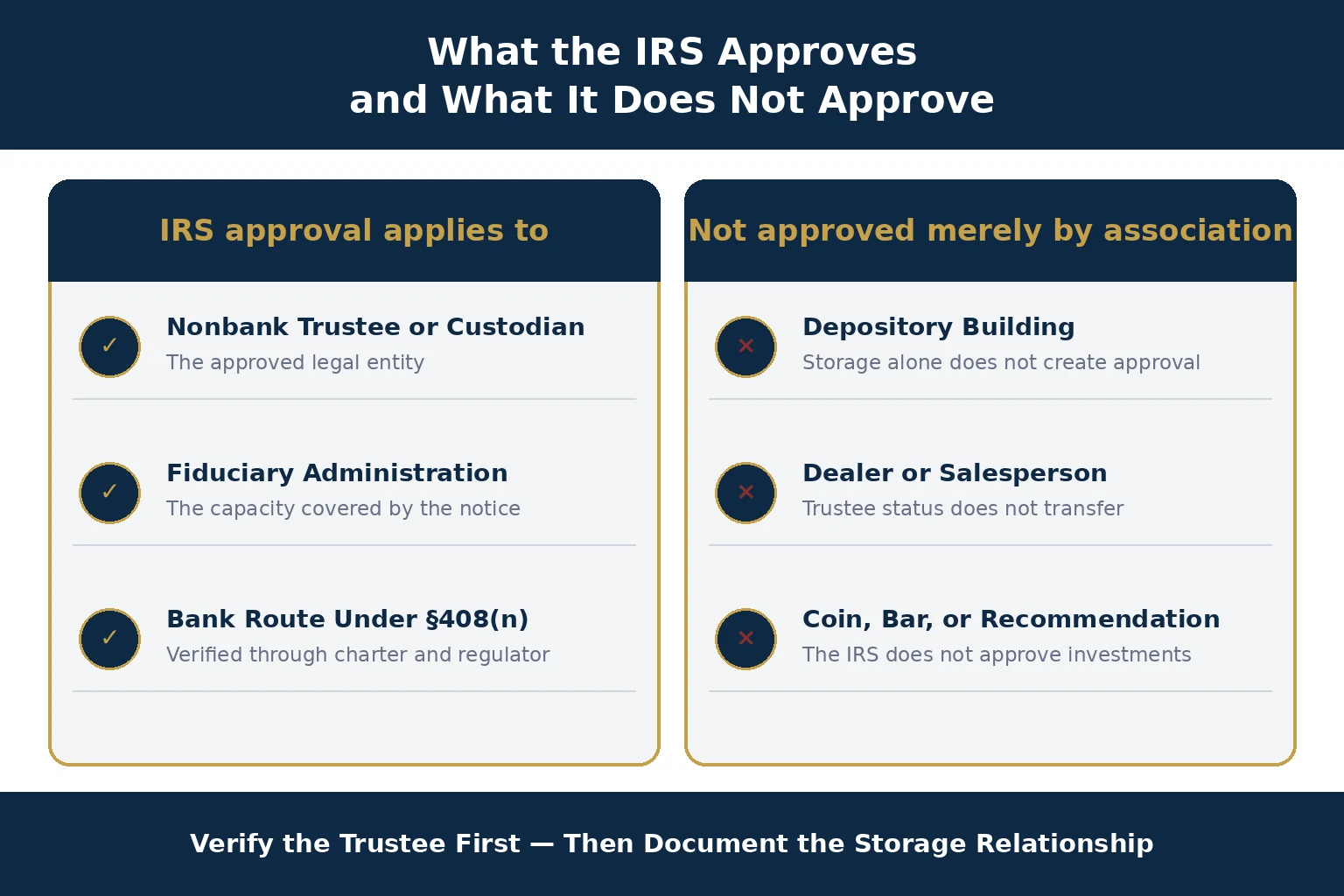
IRS nonbank approval proves a narrow but important point: the entity has been approved to serve as a nonbank trustee or custodian under the applicable regulatory framework. It is a legal-status threshold.
It does not establish that the IRS endorses the entity, recommends it, rates its customer service, verifies the fairness of its fees, certifies a dealer relationship, or approves any particular investment offered through the account. The official page describes the list as entities approved to serve in that capacity; it does not present a quality ranking. The NASAA Investor Alert on self-directed IRAs, issued with the SEC’s Office of Investor Education and Advocacy and FINRA, states that self-directed IRA custodians generally do not sell investment products, provide investment advice, evaluate the quality or legitimacy of an investment, or verify financial information supplied for it. NASAA is an association of state and provincial securities regulators, not a federal agency.
For selection purposes, “approved” is the start of the diligence process, not the finish. The separate question of what the phrase means for storage is covered in the guide to verifying a custodian against official records.
Which documents should be obtained before comparing custodians?
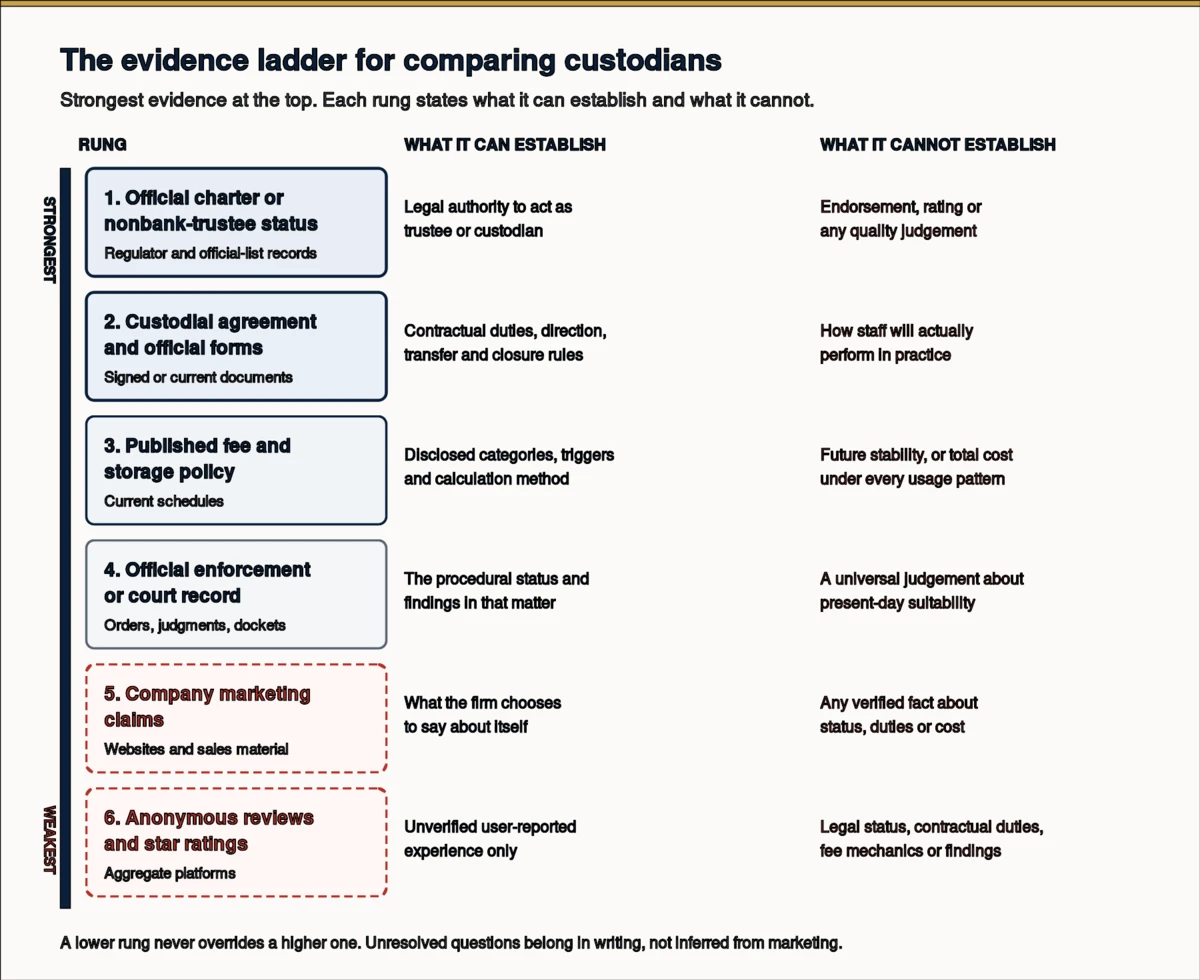
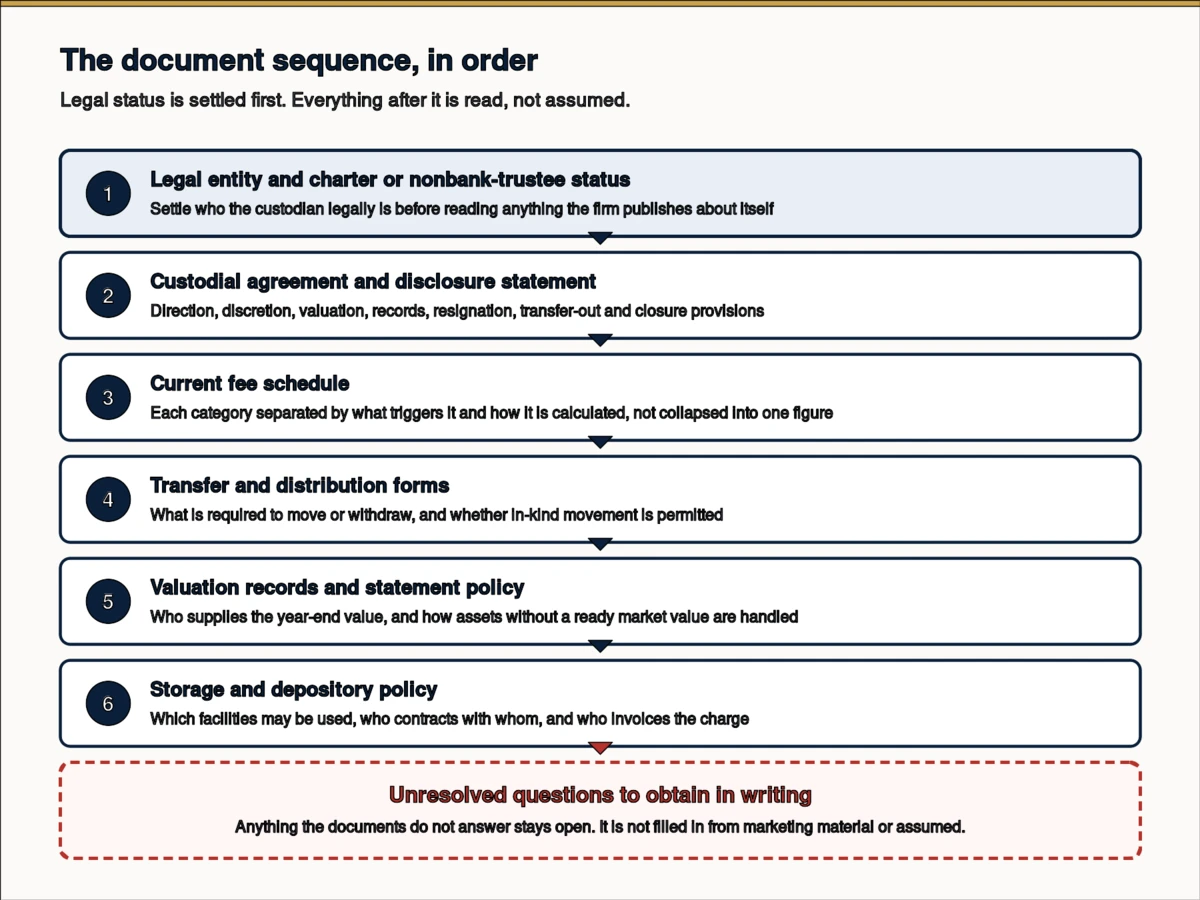
A document-first comparison reduces reliance on sales scripts and rankings. The evidence table below places documents closest to legal status and contractual obligation at the top.
| Question | Best source | What it proves | What it does not prove |
|---|---|---|---|
| Is the entity legally eligible to serve? | IRS nonbank list, OCC or FDIC record, state banking or trust regulator | Legal or regulatory status relevant to serving as custodian | Service quality, suitability or endorsement |
| What duties and limits apply? | Current custodial agreement and disclosure statement | Contractual allocation of authority, direction, valuation, resignation and closure rules | How well staff will perform in practice |
| What does the account cost? | Current published fee schedule and storage schedule | Disclosed categories, triggers and calculation method | Future fee stability or total cost under every transaction pattern |
| Which assets and transactions are accepted? | Permitted-asset policy, transaction forms, purchase and sale procedures | What the custodian says it will administer | That an asset is suitable or tax-compliant in every fact pattern |
| Where may metal be stored? | The custodian's storage or depository policy and contractual documents | Named or permitted storage arrangements and options | An independent safety ranking of a facility |
| How does an account move out? | Transfer-out, distribution, resignation and termination provisions | Required forms, steps, fees and possible liquidation conditions | Actual future processing speed |
| What is officially reported? | IRS Form 5498 instructions and account statements | Year-end fair-market-value and specified-asset reporting obligations | Independent verification of every hard-to-value asset |
| Has a regulator or court made a finding? | Official enforcement release, order, judgment or docket | The actual procedural status and findings in that matter | A universal judgement about present-day suitability |
At minimum the file should hold the custodial agreement, disclosure statement, current fee schedule, account-opening form, transfer form, distribution form, transfer-out or termination procedure, asset-acceptance policy and storage policy. Among the IRS model forms, Form 5305-A is the traditional custodial account model, Form 5305 is the traditional trust account model, and Form 5305-RA is the Roth custodial-account model. Commercial agreements add extensive operational provisions and should be read on their own terms.
How should published fees be compared?
No reliable primary-source dataset was identified that establishes a universal market average for precious-metals IRA custodial fees. A stronger comparison uses each custodian’s own current documents and normalises the categories.
| Fee category | Where to look | Common structure to identify | Question that resolves ambiguity |
|---|---|---|---|
| Account setup or opening | Fee schedule, application | Flat one-time charge, or waived under stated conditions | Is the fee charged by the custodian, an administrator or another party? |
| Annual administration | Fee schedule | Flat, tiered by asset count, or tiered by account value | What exactly changes the tier? |
| Transaction processing | Buy/sell or asset-acquisition form | Per transaction, per asset, or bundled | Does a metals purchase and a later sale create separate charges? |
| Wire, check or ACH | Fee schedule, distribution form | Per outgoing payment or per method | Are inbound and outbound movements treated differently? |
| Storage and depository | Storage schedule, depository policy | Flat, percentage-based, segregated or commingled, or facility-specific | Who invoices the charge, and what services are included? |
| Valuation and asset servicing | Fee schedule, hard-to-value asset policy | Annual, per asset or event-based | Who provides the valuation, and is a third-party appraisal required? |
| Transfer-out or termination | Transfer or closure form, agreement | Per account, per asset or flat closing charge | Does an in-kind transfer create additional handling charges? |
| Distribution or in-kind shipment | Distribution form | Flat plus carrier and insurance, or asset-specific | Who bears shipping, insurance and depository release costs? |
A missing fee schedule is a disclosure fact. It is not proof that a fee is excessive or concealed. The evidence-based response is to request the schedule in writing and leave the category unresolved until documentary support arrives. Which providers publish what, as a dated observation rather than a quality judgement, is recorded in the provider transparency scorecard.
Two companion assets carry the detail this checklist deliberately omits: how flat and percentage-based storage charges behave at different account sizes is modelled in the storage fee calculator, and named current custodian schedules are compared in the Gold IRA fees benchmark.
What should a custodial agreement be checked for?
Investment direction and discretion. The agreement should reveal whether the custodian acts only on the account holder’s instructions, whether it disclaims investment review, and which instructions it may refuse. Treasury Regulation §1.408-2(e)(6)(i)(A) recognises passive trustees whose written instrument gives them no discretion to direct investments.
Valuation and statements. The 2026 Instructions for Forms 1099-R and 5498 require trustees and custodians to report year-end fair market value, and to report the value of certain specified assets in Box 15a with a category code in Box 15b. The listed codes cover categories such as non-traded stock, non-traded debt, LLC or partnership interests, real estate, options and, at code G, any other asset without a readily available fair market value. There is no separately enumerated code for precious metals, so a metals position is reported under the general architecture rather than a metals-specific code. The agreement should be read alongside any valuation policy to establish who supplies values and what happens if documentation is late.
Records, transfers and succession. Nonbank-trustee rules require fiduciary records to be kept separately, with full information relative to each account. The agreement should specify the authority needed to move cash or assets, the treatment of in-kind distributions, and what happens on resignation, merger, closure or when a successor custodian cannot be found. No uniform national commercial clause was identified; the agreement controls, subject to applicable law. Where a custodian stops responding mid-process, the custodian-not-responding incident guide sets out the escalation sequence.
How should storage and depository relationships be evaluated?
The phrase “works with” a depository is not enough. A documentary comparison should establish the legal custodian, the permitted facility or facilities, whether segregated or commingled options are offered, who contracts with whom, who invoices storage, and how withdrawals or transfers are authorised. The storage-options comparison guide organizes those questions by legal standing, cost, insurance and audit trail.
IRC §408(m) generally treats collectibles as distributions but creates exceptions for specified coins and qualifying gold, silver, platinum and palladium bullion. For qualifying bullion the statute requires physical possession by a trustee described in §408(a). That statutory rule does not create an IRS endorsement category for storage facilities. A dealer’s preferred relationship with a custodian or depository is evidence of a business relationship only. Which facilities can actually be traced to primary sources is recorded in the verified depository directory.
What prohibited-transaction and possession boundaries matter?
The disqualified-person classes, the statutory family boundary and the separate consequence routes are set out in full in the self-directed IRA prohibited transactions reference.
IRC §4975 prohibits specified transactions between a plan and a disqualified person, including sales, exchanges, lending, furnishing goods or services, transfer or use of plan assets for a disqualified person, and certain self-dealing by fiduciaries. The IRS prohibited-transactions guidance explains that improper use of an IRA by the owner, a beneficiary or another disqualified person can carry serious tax consequences.
For physical metals, personal possession deserves separate treatment. In McNulty v. Commissioner, 157 T.C. No. 10, docket 1377-19, the Tax Court held that an IRA owner received taxable distributions when she took physical possession of American Eagle coins purchased through an IRA-owned LLC. It is a warning against assuming an LLC label cures a possession problem. It should not be stretched into a claim that every arrangement promoted as home storage presents identical facts or fails for the same reason. The full case facts, the LLC-ownership structure, and the §4975 boundary that survives it are set out in the checkbook-control IRA LLC guide.
How should an enforcement-history check be performed?
An enforcement review should proceed from official sources and use precise labels. Identify the legal entity name and any prior names from charter or corporate records. Search the entity through the regulator that actually supervises it: the IRS nonbank status page, the OCC for OCC-regulated institutions, FDIC BankFind for insured-bank history, the appropriate state banking or trust regulator, and state securities regulators where relevant. NASAA publishes a state-regulator directory for that routing.
Then search federal and state enforcement releases and official court dockets using the exact legal name and known former names, and classify each result correctly: complaint, allegation, examination matter, consent order, administrative finding, settlement, judgment or dismissal. An allegation is not a finding, and a settlement does not automatically establish every allegation in a complaint. A clean search result is not proof that a company has never had a dispute; it means no responsive official record was found in the sources and names checked, as of the observation date.

Which questions should be asked in writing?
A satisfactory answer identifies the legal entity, points to a governing document, and resolves who is responsible for the action or the fee.
- What is the full legal name of the IRA trustee or custodian, and what regulatory or IRS status supports its authority to serve?
- Is the named entity a bank, a state-chartered trust company, or an IRS-approved nonbank trustee or custodian?
- Which current custodial agreement governs the account, and where are the resignation, transfer-out and closure provisions?
- Which fees apply to setup, annual administration, transactions, wires, checks, storage, valuation, distributions, transfer-out and closure?
- Which precious-metals transactions will the custodian administer, and which documents must precede a purchase instruction?
- Which storage facilities may be used, who contracts with the facility, and how are segregated or commingled options documented?
- Who supplies the year-end value used on statements and Form 5498, and what happens when an asset has no readily available market value?
- Can assets be transferred in kind to another custodian, and under what conditions might liquidation be required?
- What written procedure applies if the custodian resigns, merges, closes an account type or stops administering a category of assets?
- What regulator or complaint channel applies, and what escalation path is published for unresolved operational problems?
The broader account-opening question list is in questions to ask before opening a Gold IRA, and an example of a single custodian documented from public records is the STRATA Trust Company review, used there only for what that entity publishes.
What are evidence-based red flags?
Evidence-based red flags are gaps or contradictions in documents, not character verdicts about a company. The legal custodian is unresolved when sales material names one entity and the agreement names another without explaining the relationship. A claim that IRS approval means the IRS recommends or endorses the firm conflicts with the limited status the list reflects. A fee comparison is incomplete when major categories are omitted and no written schedule is supplied. A depository arrangement is unresolved when the facility cannot be identified in the custodian’s own documents. A transfer promise is unverified when no form or written procedure supports it.
Equally, an official complaint or enforcement matter must not be inflated beyond what the record supports. The correct response is to capture the status, date, regulator, allegation or finding, and disposition. Factors such as “most trusted”, “best service”, aggregate star ratings and a dealer’s preferred relationship do not support a universal custodian ranking from primary public evidence alone.
How can custodians be compared without ranking them?
The worksheet below is intentionally non-scored. A retirement saver assigns personal importance to each factor without this page imposing a house winner, because different account holders weigh transaction frequency, storage options, account size, transfer flexibility and paperwork differently. The underlying evidence stays objective even when the weighting is personal.
| Criterion | Evidence to collect | Custodian A | Custodian B | Custodian C | Reader-assigned importance |
|---|---|---|---|---|---|
| Legal status verified | IRS list, or bank or trust charter record | ||||
| Governing agreement obtained | Current custodial agreement | ||||
| Full fee schedule obtained | Current fee and storage schedules | ||||
| Fee calculation method understood | Written fee calculation | ||||
| Permitted metals and transactions documented | Asset policy and transaction forms | ||||
| Depository arrangement documented | Storage or depository policy | ||||
| Valuation method documented | Statement and valuation policy | ||||
| Transfer-out process documented | Transfer and termination forms | ||||
| Resignation and successor language reviewed | Agreement provisions | ||||
| Official enforcement search completed | Regulator and court records | ||||
| Complaint and escalation route identified | Regulator plus internal procedure | ||||
| Unresolved questions answered in writing | Dated written responses |
What could not be verified as a universal rule?
- No single federal directory lists every legally eligible IRA custodian, because the IRS list covers approved nonbank trustees and custodians while banks and state-supervised entities qualify by other routes.
- No primary-source national dataset establishes a current market-average fee for self-directed precious-metals IRA custodians across setup, administration, transaction, storage and transfer-out costs.
- No primary-source dataset permits a reliable nationwide ranking of service quality, responsiveness, customer satisfaction or trustworthiness across custodians.
- No universal public standard was identified for transfer-processing time. Published service standards remain institution-specific statements rather than guaranteed completion times.
- No single federal database covers every state-chartered trust company and every state enforcement record; state searches remain jurisdiction-specific.
- No universal commercial rule was identified for whether every custodian permits every qualifying metal, every depository, in-kind transfers or the same storage structure. Those are account-agreement questions.
- No broad conclusion was drawn from McNulty beyond the court’s actual facts and holding on physical possession.
Frequently asked questions
Is an IRS-approved nonbank custodian “approved” in the sense of being recommended?
No. The IRS list records entities approved to serve as nonbank trustees or custodians under Treasury Regulation §1.408-2(e). The source does not rank them and does not state that the IRS recommends them.
If an entity is absent from the IRS nonbank list, is it automatically ineligible?
No. The statutory trustee rule also permits banks, and §408(n) defines bank to include specified supervised institutions. The nonbank list is not a complete list of every IRA custodian.
Does a self-directed IRA custodian perform due diligence on the metal or the dealer?
Regulator guidance says self-directed IRA custodians generally do not evaluate the quality or legitimacy of an investment or its promoter, and do not verify financial information provided for the investment. A legitimate custodian therefore does not validate the investment itself.
Does the IRS approve a depository?
The sources reviewed support IRS approval of qualifying nonbank trustees and custodians, not a general IRS endorsement category for storage facilities. Metals are tested against §408(m)(3), and the storage facility should be evaluated through the custodian’s documented storage arrangement rather than an endorsement claim.
Can star ratings or review sites determine the best custodian?
Not under this methodology. Aggregate ratings are subjective, can mix different products and periods, and do not establish legal status, contractual duties, fee mechanics or enforcement findings. They can be treated as unverified user-reported experience, not as suitability evidence.
What did McNulty establish?
The Tax Court held that, on the facts before it, an IRA owner received taxable distributions when she took physical possession of American Eagle coins purchased through an IRA-owned LLC. The decision warns against assuming an LLC label cures a possession problem, and it should not be presented as a ruling on every possible custody arrangement.
Methodology
Research was observed on 25 September 2026. The official IRS nonbank-trustee page was checked for the list it currently links. The analysis used IRC §§408 and 4975, Treasury Regulation §1.408-2(e), the IRS nonbank-trustee and prohibited-transaction pages, IRS Forms 5305, 5305-A and 5305-RA, the 2026 Instructions for Forms 1099-R and 5498, the joint CFTC and FINRA precious-metals advisory, the NASAA Investor Alert on self-directed IRAs, OCC and FDIC institutional-search tools, the NASAA regulator directory and the U.S. Tax Court docket in McNulty. Regulation text was read from the Cornell Legal Information Institute’s current edition rather than an archived 2008 printing, so that the net-worth thresholds and passive-trustee definition quoted above reflect the provision as it currently stands.
Commercial custodians, dealers, administrators and depositories were not used as authority for legal or tax rules. No commercial company was ranked, scored or named as a recommended provider. Where a commercial document is cited in future work it should be identified by legal entity, document title and observation date, as plain text and without a hyperlink.
How to Cite This Page
Source: 401ktogoldira.org — How to Choose a Gold IRA Custodian: 2026 Fees, IRS Status, Storage and Due Diligence.
Publisher: 401ktogoldira.org
URL: https://401ktogoldira.org/how-to-choose-gold-ira-custodian/
Sources last reviewed: 25 September 2026
Accessed: state the date the page was retrieved, as official lists and published schedules change.
The page should be cited for its comparison framework. Legal propositions should be checked against the primary sources linked above.
Primary sources
- IRS — Approved nonbank trustees and custodians and application procedures.
- 26 CFR §1.408-2, Cornell Legal Information Institute.
- 26 U.S.C. §408 and §4975, Cornell Legal Information Institute.
- IRS — Retirement topics: prohibited transactions.
- IRS model agreements: Form 5305 (traditional trust account), Form 5305-A (traditional custodial account), Form 5305-RA (Roth custodial account).
- 2026 Instructions for Forms 1099-R and 5498.
- CFTC and FINRA — 10 things to ask before buying physical gold, silver or other metals.
- NASAA Investor Alert — Self-directed IRAs and the risk of fraud and the NASAA regulator directory.
- OCC Financial Institution Search and FDIC BankFind Suite.
- U.S. Tax Court — McNulty v. Commissioner, 157 T.C. No. 10, docket 1377-19.
How figures on this site are produced and checked is set out in the research methodology, and errors are handled under the corrections policy. Article reviewed and edited by Daniel — independent precious-metals retirement researcher.
The companies above are precious-metals dealers, not IRA custodians, and their inclusion is a commercial placement rather than an outcome of the custodian framework on this page.