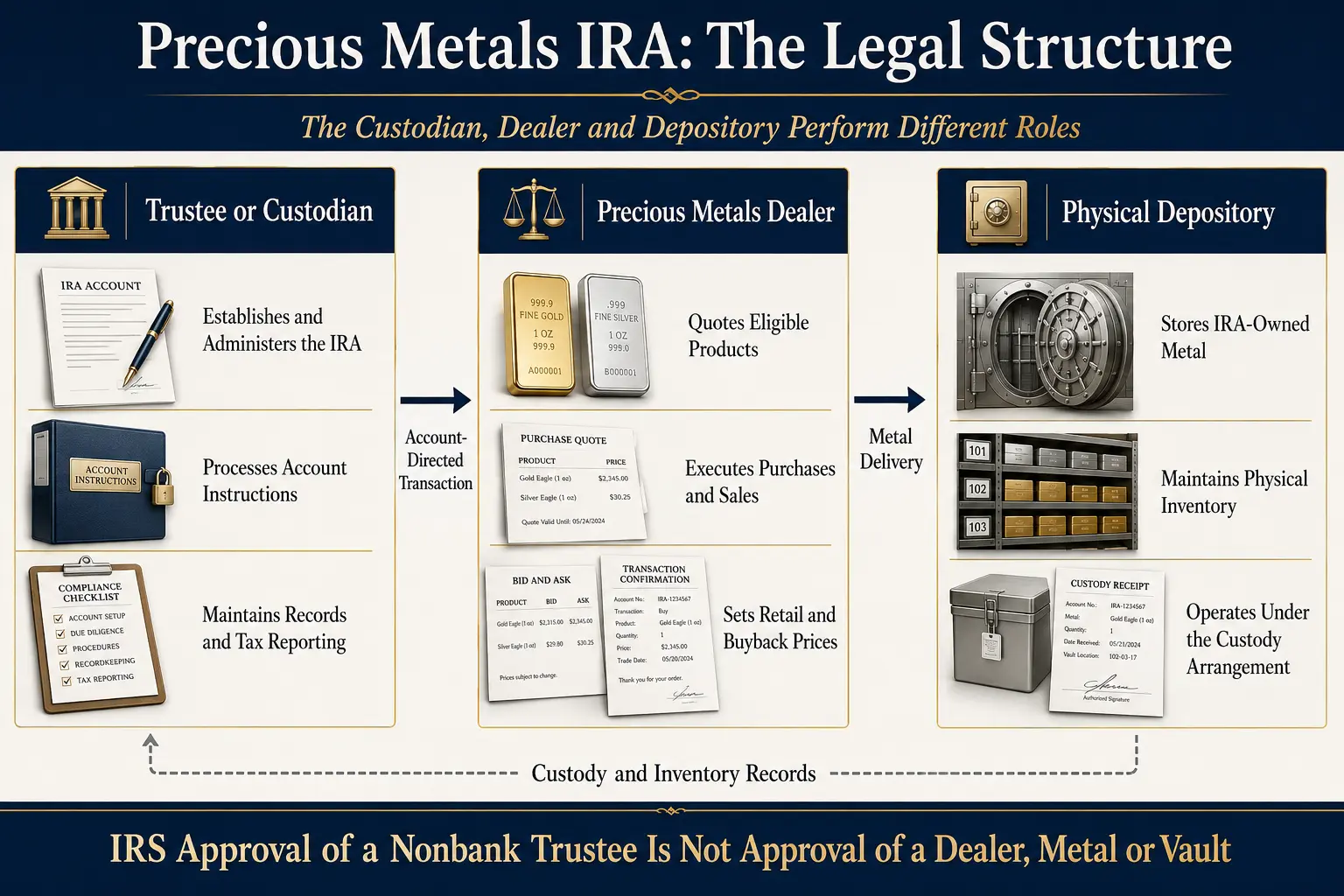
Educational only: This page appraises published evidence about gold held inside a retirement account. It does not recommend a company, custodian, depository, dealer, product or allocation, and it is not financial, tax or investment advice. Readers should consult qualified professionals before making retirement-account transactions. Past performance does not guarantee future results.
Key takeaways
- Balance is not equal word count. Some claims are supported, some conditional, one is contradicted. Grading them is more useful than listing them.
- The inflation-hedge claim is the most overstated in this market. Independent research finds gold unreliable over practical investment horizons.
- A gold-specific tax advantage does not exist. The treatment comes from the IRA wrapper and is identical for other assets in the same account type.
- Safe-haven behaviour is conditional, not dependable, and varies by market and by crisis.
- The drawbacks are structural. No income, spread recovery, layered costs and custody rules apply regardless of price direction.
- No universal allocation percentage exists in any primary source reviewed, and this page does not invent one.
- A self-directed custodian does not vet the deal. Verification stays with the account owner.
How This Guide Grades the Evidence
A pros-and-cons page that gives every talking point equal weight is not balanced; it is merely symmetrical. Each claim below is graded by what primary, regulator or independent research actually establishes:
- Supported — the evidence establishes the claim within its stated scope.
- Partly supported / conditional — real evidence exists, but the marketing version is broader than what the evidence shows.
- Commonly claimed, not established — widely repeated, with no adequate independent support located.
- Contradicted — the better evidence points against the claim as commonly stated.
That grading matters because the two sides are not symmetrical in kind. Several drawbacks are arithmetic and legal facts. Several claimed benefits depend on time horizon, market regime or portfolio construction — conditions nobody can promise in advance.
The Claimed Advantages, Appraised
1. Diversification — partly supported, conditional
Diversification is a valid portfolio principle. Investor.gov explains that spreading money among investments can reduce the damage when one holding or asset class performs poorly, while warning explicitly that diversification cannot guarantee against loss.
Gold may contribute something distinct because its price responds to drivers that are not identical to corporate profits or bond income. Federal Reserve Bank of Chicago research examines relationships between real gold prices, inflation expectations, real interest rates and pessimism about future economic conditions (Chicago Fed Letter 464). The authors stress that their regressions establish correlation rather than causation — a caveat the marketing versions of this claim routinely drop.
The defensible claim is therefore modest: gold may diversify a portfolio under some conditions. The evidence does not establish that every retirement saver needs it, that more improves diversification, or that diversification prevents losses.
2. Inflation protection — partly supported, conditional
This is where Gold IRA marketing most often outruns the evidence, and it is worth stating the finding plainly even though it is unhelpful to the industry this site covers.
The National Bureau of Economic Research paper known as The Golden Dilemma found that gold may preserve purchasing power over extremely long historical horizons — periods measured in centuries — while being unreliable as an inflation hedge over practical investment horizons (NBER Working Paper 18706).
The Chicago Fed research reaches a more nuanced result in the same direction. Some specifications find a positive association between expected inflation and real gold prices; others do not. The paper also shows that after 2000 the role of inflation expectations was overshadowed by real interest rates and economic pessimism.
So the conclusion is narrower than the pitch: gold can respond to inflation expectations, but it is not established as a dependable short- or medium-term inflation offset. A saver buying gold specifically to offset inflation over a retirement planning horizon is relying on something the research does not support.
3. A tangible asset with no corporate issuer — supported, but narrower than it sounds
Physical bullion is not a share in a company and not a promise by an issuer to repay. The Federal Reserve's financial-accounts framework describes reserve gold bullion as a financial asset with no corresponding liability (Federal Reserve — Financial Accounts instrument descriptions), and International Monetary Fund research characterises gold as carrying no credit risk.
That is a genuine structural distinction, and it should not be inflated into “no risk.” Privately held IRA gold still carries market-price risk, dealer and pricing risk, custody and administration dependencies, and exposure to fraud or operational failure. The Federal Reserve statement also concerns monetary reserve gold rather than private retirement holdings, so the analogy has limits.
4. Tax-advantaged treatment — contradicted as a gold-specific advantage
This one is graded against the common claim rather than merely qualified.
IRS guidance describes traditional and Roth IRA tax treatment by account type, independently of the underlying asset. A traditional IRA's treatment is generally tax-deferred and a qualifying Roth distribution can be tax-free — and that is true whether the account holds metals, funds or anything else it may lawfully hold.
Gold-specific rules do exist, but they govern which coins and bullion may remain inside the account, not how gains are taxed. Presenting the IRA's tax treatment as a benefit of gold is therefore misleading. The advantage belongs to the wrapper, and an identical wrapper is available holding entirely conventional assets.
5. Crisis or safe-haven behaviour — partly supported, conditional
The strongest accessible statement here comes from institutional research rather than the marketing literature. The International Monetary Fund's analysis describes gold as highly volatile, with hedging and diversification benefits that are conditional rather than dependable. The Commodity Futures Trading Commission separately warns that metals prices can be volatile on a day-to-day basis (CFTC customer advisory).
Peer-reviewed academic work points the same way in more detail. Studies published in the Journal of Banking & Finance, Economic Modelling and the International Review of Financial Analysis have found safe-haven behaviour present in some developed markets and crisis periods but not universally, and in at least one case changing between the early and later phases of the same crisis. Those journals sit behind paywalls, so they are named here as supporting academic context rather than as the evidence a reader must check.
The conclusion either way is the same: “gold reliably rises when stocks fall” is not defensible. Safe-haven behaviour has been observed, it is conditional, and it is not a promise about the next equity drawdown.
The Drawbacks, Appraised
No income — supported
Physical bullion pays no interest, no coupon and no corporate dividend. Its investment result depends on price change net of transaction and account costs. IMF analysis makes the related point that real interest rates represent an opportunity cost of holding a non-yielding asset. This is structural rather than probabilistic: it is true in every market condition.
Layered costs — supported
A physical-metal IRA stacks metal-dealing costs on top of self-directed account administration. Joint CFTC and FINRA guidance identifies dealer spreads alongside storage, insurance and administrative charges, and notes that self-directed IRA fees are typically higher than those of directed IRAs (CFTC and FINRA — ten things to ask).
This page deliberately publishes no fee figures, averages or ranges. Cost data belongs on the pages that maintain it, where it is kept current: see the fees benchmark and how to spot hidden fees.
The spread is a break-even hurdle — supported
Dealers sell above the spot price and buy back below it. The practical consequence is arithmetic: the wider the spread and the higher the other costs, the further the metal price must rise before a position is merely even. Regulators advise obtaining the retail price, the fees and commissions, and the dealer's buy-back price in writing before purchasing. The mechanics are covered on the dealer markup data page.
Liquidity and valuation friction — supported, with qualification
Joint guidance from NASAA, the SEC's investor-education office and FINRA warns that self-directed IRA alternative assets can be difficult to value or sell, and that this matters particularly when required distributions fall due (NASAA investor alert).
The qualification matters and cuts the other way: bullion itself trades in a large market and should not be described as categorically illiquid. The friction is in the process — the specific product, a dealer bid, the custodian's workflow and settlement — rather than in the metal.
Custody constraints — supported
Qualifying bullion must remain in the physical possession of an eligible trustee. That is a statutory condition rather than a provider policy, and it is why home-storage marketing warrants scepticism. The rule itself is set out in the precious metals IRA reference.
Volatility and concentration — supported
Gold prices move, sometimes sharply. Concentrating a retirement account in any single asset undermines the diversification that is often the stated reason for buying it in the first place — a tension worth noticing, because the same page of marketing frequently makes both arguments.
Sales-channel conduct risk — supported
The CFTC, FINRA and NASAA have jointly warned retirees and older savers about overpriced metals, high markups, commissions and fees in retirement-account promotions (CFTC press release). That documents a channel risk; it does not establish that every dealer or Gold IRA is fraudulent. The distinction matters, and the enforcement record is maintained on the enforcement tracker.
A related point that surprises people: a self-directed IRA custodian generally administers the asset without evaluating the investment or the promoter. Verification remains the account owner's job — see the custodian due-diligence guide.
The Grading, Side by Side
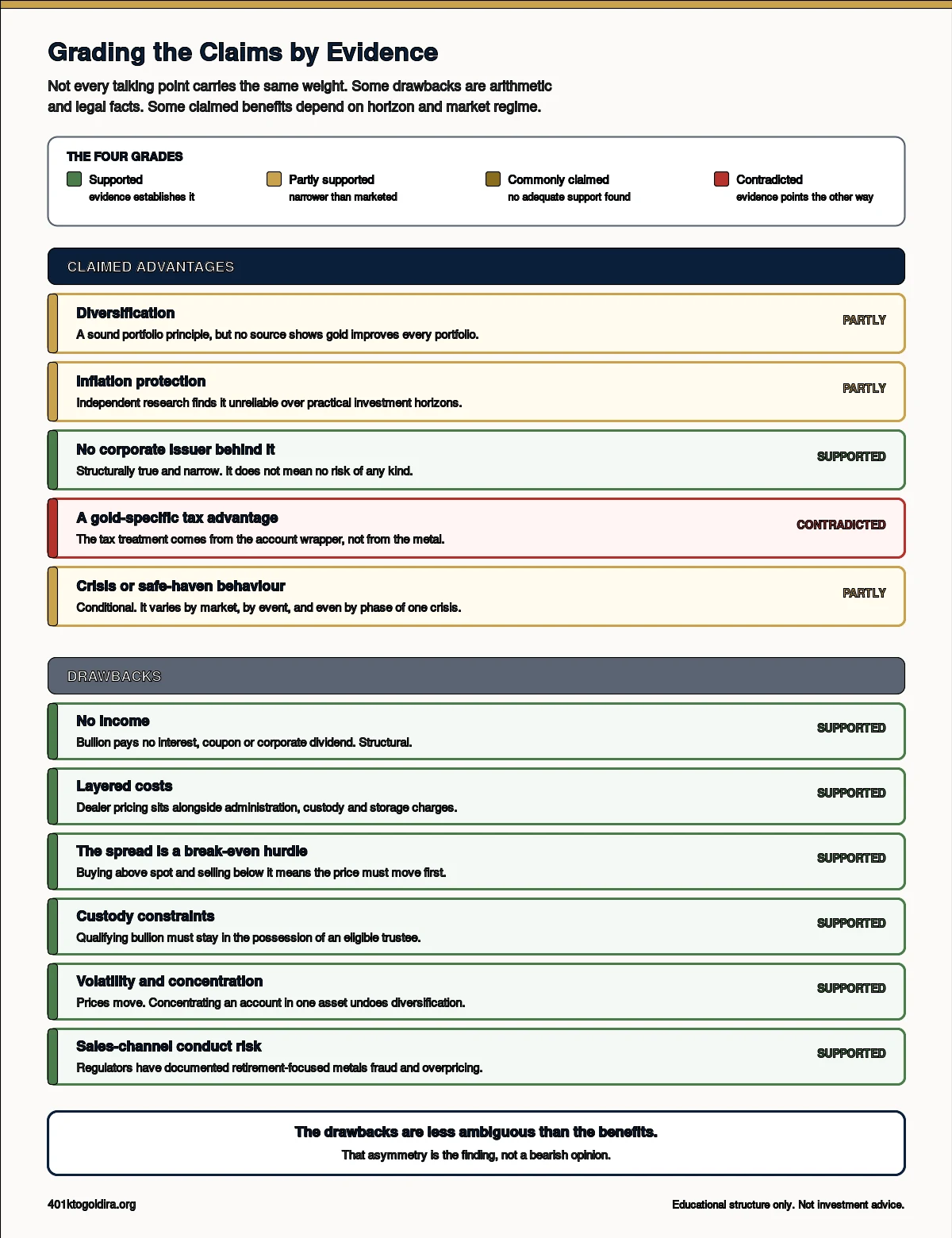
The drawbacks are less ambiguous than the benefits. That asymmetry is the finding.
Certain Factors and Conditional Ones
There is a second asymmetry underneath the grading, and it is arguably more useful than the grades themselves.
The costs and constraints are accepted with certainty at the moment of purchase. The spread is paid. The custody rule applies. The absence of income is immediate and permanent. Meanwhile the benefits — diversification, inflation response, crisis behaviour — may or may not arrive, depending on conditions nobody controls or can forecast.
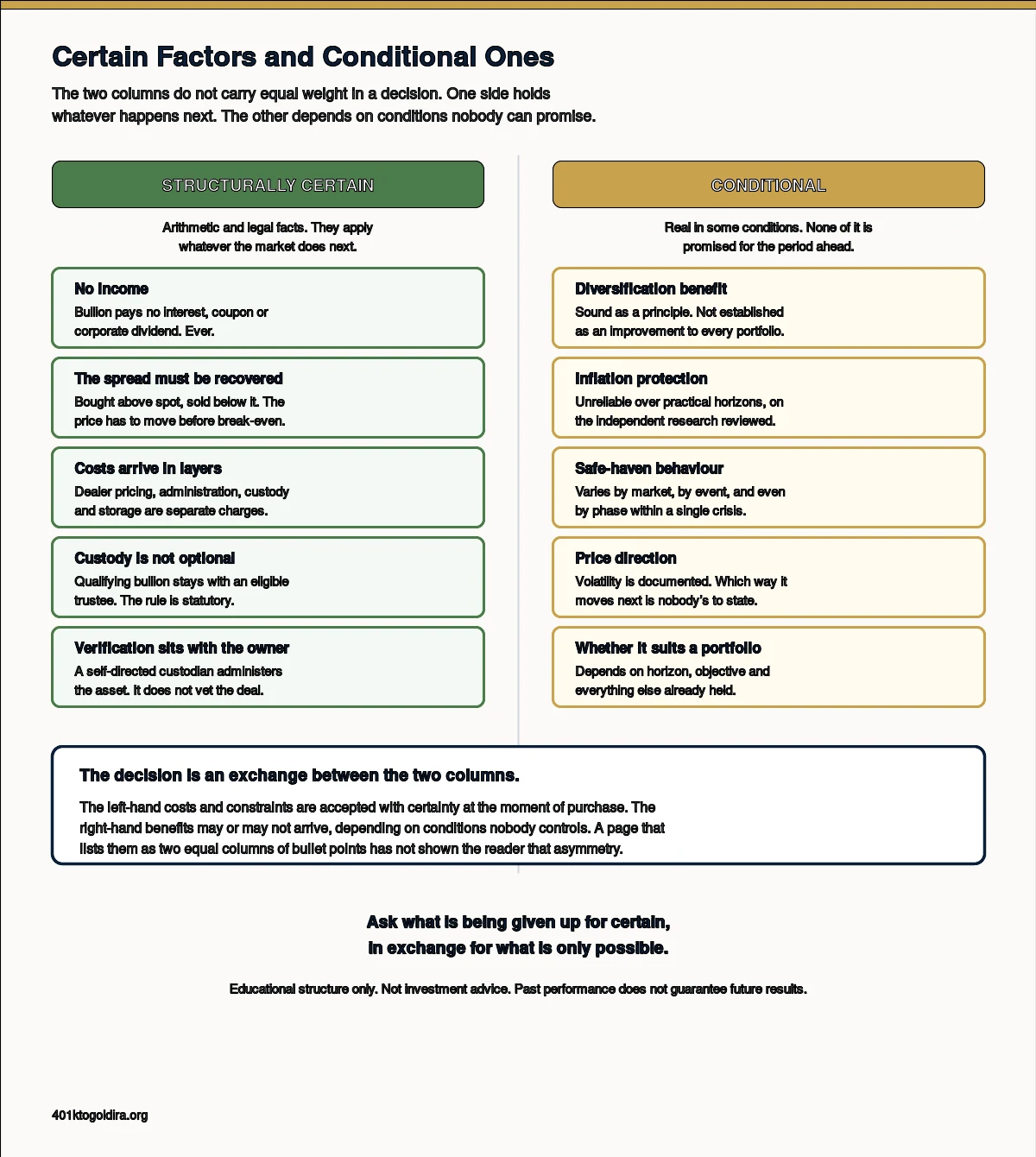
Ask what is given up for certain, in exchange for what is only possible.
When the Balance Plausibly Tips
These are conditions rather than recommendations, and no reader should treat them as a verdict on their own situation.
Conditions that make the case stronger: a saver who specifically wants direct physical-metal exposure inside a retirement account rather than exposure through a security; a long horizon that can absorb the spread and the absence of income; an allocation small enough that volatility in one asset does not dominate the account; and a willingness to do the provider verification the structure requires.
Conditions that make it weaker: buying primarily for inflation protection over an ordinary planning horizon, which the research does not support; expecting reliable gains when equities fall; a balance small enough that fixed account and custody costs consume a meaningful share; a need for straightforward liquidity; or an expectation that the custodian is vetting the transaction.
Alternatives Worth Having Considered
A balanced appraisal should name what else was available. Joint CFTC and FINRA guidance identifies regulated exchange-traded products and pools among the ways to obtain precious-metals exposure without the physical-metal custody workflow. Those carry their own fees and risks and are not equivalent — the wrapper comparison, including after-fee modelling, is on the Gold IRA versus gold ETF page.
Holding bullion personally outside a retirement account is a different proposition again, with no IRA wrapper and no custody requirement but no tax treatment either. And not holding gold at all remains a legitimate answer that a page like this should be willing to state.
For the equivalent appraisal of silver, see the silver IRA pros and cons, which also covers the silver-versus-gold comparison.
What Could Not Be Verified
This section exists because its absence elsewhere is part of what this page is differentiating against. The following are commonly published in this niche and could not be established from adequate sources:
- A universal recommended allocation to gold. No primary source establishes one. Regulator investor education frames allocation around horizon and risk tolerance instead.
- That Gold IRAs outperform conventional IRAs after all costs. No adequate basis was located for the claim in either direction.
- That physical gold is always more liquid than other retirement assets. Bullion markets can be deep, but IRA liquidation adds process and counterparty steps.
- A universal break-even period. Spreads, fees and future prices vary too much for a general figure to be meaningful.
- Any average fee, markup or spread figure. Deliberately excluded here; those belong on the cost-research pages where they are maintained.
Frequently Asked Questions
Is a Gold IRA a good idea?
It depends on whether a specific objective justifies known tradeoffs, rather than on whether gold has advantages in the abstract. The structural drawbacks — no income, dealer spreads, layered account costs, custody constraints and price volatility — apply whatever happens next. The most-marketed benefits, dependable inflation protection and reliable crisis protection, are materially narrower than the sales versions.
Is a Gold IRA a scam?
No, the account structure itself is permitted under federal law, which recognises exceptions allowing certain coins and qualifying bullion in an IRA. The legality of the structure and the conduct of a particular seller are separate questions, though: regulators including the CFTC, FINRA and NASAA have jointly warned retirees about overpriced metals, high markups and pressure selling in retirement-account promotions.
Why do people say Gold IRAs are bad?
The common objections are spreads, layered account costs, the absence of income, custody restrictions, price volatility and sales-channel risk. Those are real and documented. Whether they outweigh a particular saver's objective is circumstance-specific, and the honest answer is that they are easier to establish than several of the claimed benefits.
Does a Gold IRA get special tax treatment?
No gold-specific tax preference was identified. The tax treatment comes from whether the account is a traditional or Roth IRA, and it is the same treatment that account type receives holding other assets. Gold-specific rules determine which metals may remain inside the account; they do not create a separate tax regime.
Is gold a reliable inflation hedge?
Not over practical investment horizons, on the independent research reviewed. The NBER paper known as The Golden Dilemma found gold may preserve purchasing power over extremely long historical periods while being unreliable as an inflation hedge over ordinary horizons. Federal Reserve Bank of Chicago research finds inflation relationships in some specifications but not others, and its authors expressly warn that the results show correlation rather than causation.
Does gold rise when the stock market falls?
Not reliably. Institutional research characterises gold as highly volatile with hedging and diversification benefits that are conditional rather than dependable, and peer-reviewed work has found safe-haven behaviour varying by market, by crisis and even between phases of a single crisis. The claim that gold reliably rises whenever equities fall is not supportable.
Are Gold IRAs liquid?
That deserves better than a yes or no. Bullion trades in a large market, but selling inside an IRA depends on the specific product, a dealer bid, the custodian's workflow and settlement. Investor-protection guidance separately warns that self-directed IRA alternative assets can be harder to value or sell, which matters most when a required distribution falls due.
How much of a retirement portfolio should be in gold?
No primary source reviewed establishes a universal percentage, and this page does not publish one. Regulator investor education frames allocation around an individual's time horizon and risk tolerance rather than a fixed figure for any asset.
Can the account owner keep Gold IRA bullion at home?
The federal exception for qualifying bullion is conditioned on physical possession by an eligible trustee, so home storage does not satisfy it. Marketing language suggesting otherwise should be checked against the custody rule itself rather than accepted.
What does a self-directed IRA custodian actually check?
Generally the administration of the asset rather than the merits of the investment. Joint guidance from NASAA, the SEC's investor-education office and FINRA states that self-directed IRA custodians typically hold and administer assets without evaluating the quality or legitimacy of the underlying investment or the promoter. Verification therefore remains the account owner's responsibility.
Bottom Line
A Gold IRA is neither automatically prudent nor automatically problematic. The strongest case for it is narrower than the marketing: direct physical-metal exposure inside a retirement account, and possible diversification for some portfolios. The strongest case against it is more structural: no income, spreads, layered costs, custody constraints, volatility and a sales channel that requires independent verification.
The decision should turn on whether a specific objective justifies those known tradeoffs — not on claims that gold is guaranteed to protect against inflation, equity declines or loss. Where the evidence for a benefit is conditional, the honest course is to treat it as conditional rather than to round it up.
This page is educational and does not evaluate any reader's circumstances, portfolio or objectives. Evidence grades reflect the sources reviewed at the observation date and may change as research develops. Readers should consult qualified tax, legal or investment professionals before making retirement-account transactions. Past performance does not guarantee future results.