Can You Keep Paying a 401(k) Loan After You Leave Your Job?
Two people who left comparable jobs in the same month can get opposite answers to this question, and both can be right. No provision of the tax code makes you repay a 401(k) loan because you left, so your plan's own terms decide it. Three surveys have measured versions of the question in three different groups of plans, and this page reports each one with what it counts, then shows you how to find out what your own plan allows. Customers should speak to a financial or tax advisor before making decisions.

Educational only: This page reports published survey figures and quotes federal statutes and regulations from named primary sources. It does not state what any individual plan will do, and it is not financial, tax or legal advice. Only the plan administrator can confirm what a particular plan's loan provisions allow. Readers should speak to a financial or tax advisor before making decisions about their own account.
If you have just left a job with a 401(k) loan still outstanding, you have probably already found two answers and no way to choose between them. One departing participant is told the balance is due in full within ninety days. Another, in the same thread, says a former colleague carried on making the same monthly payment for two more years without anything happening.
Neither account comes with a source, and both are written with complete confidence.
They can both be true, and that is the part almost nobody says out loud. There is no provision in the tax code that makes you repay a 401(k) loan immediately because you left your job. What decides your deadline is your plan's own terms, which means the answer genuinely differs from one employer to the next, and the person in that thread with the opposite experience is not mistaken.
So the useful question is not what the rule is, because there is no rule to look up. It is how common the permissive provision actually is, who has measured it, and how you find out what your own plan does.
Three separate surveys have measured versions of this question. They counted three different groups of plans and they are not alternative estimates of one number, which is why this page keeps them apart and says what each one counts.
What this page cannot do is tell you what your plan allows. No survey can. What it can do is show you how often the permissive provision turns up in the populations that have been measured, point you at the document that has to describe the circumstances in which your benefits can be offset, and tell you what to ask for.
How Many Plans Allow It: PSCA's 55%, and What It Counts
The clearest measurement of the permissive provision comes from the Plan Sponsor Council of America, which asked its member plan sponsors in August 2025:
55% of surveyed plans that offered loans allowed participants to continue repayment after separation.
Plan Sponsor Council of America, Repaying Loans After Separation, Question of the Week, August 2025, among PSCA member respondents. PSCA discloses no sample size on that page, so the figure carries no margin of error and no precision claim. Observed 4 October 2026. [1]
Read the universe in that sentence, because it is doing real work. The 55% is a share of surveyed plans that offered loans, among PSCA member respondents [1]. It is not a share of all 401(k) plans, and it is not a share of all employers.
PSCA's own published wording states the denominator inside the finding: “More than half of plans that allow loans do allow participants to continue to repay their loans after separation from service (55 percent).”
That is unusual enough to be worth naming. Most pages that quote a figure for this question quote it without saying what it is a percentage of, which leaves a reader unable to tell whether it applies to them. PSCA says what its figure counts.
Two limits travel with it. PSCA discloses no sample size on that page, so the 55% carries no margin of error and no precision claim of any kind, and no sample size may be borrowed from anywhere else to supply one.
The same page separately reports that 85% of plans allow participants to borrow at all, a figure PSCA attributes to its Annual Survey, a different instrument from the Question of the Week poll that produced the 55%. Those are two different measurements from two different instruments, and the larger one is not a base for the smaller.
The complement is the other half of the same universe: among those same surveyed plans that offered loans, 45% did not allow participants to continue repayment after separation. If your former employer's plan is in that group, your options are the ones in the offset section below, and the deadline you meet comes from the plan document rather than from the tax code.
One access note, stated because the asset is meant to be auditable. The PSCA page returns an HTTP 403 to the server this research ran from, so it was initially read from a preserved residential capture taken on 3 October 2026. A fresh residential real-browser recheck on 4 October confirmed the exact 55% statement, its plans-that-allow-loans universe and the absence of a disclosed sample size. A 403 is a block on one network, not a finding about what PSCA publishes.
PSCA's coverage of this poll was also picked up by ASPPA and NAPA-Net, which is trade reporting of the same PSCA member poll rather than independent corroboration of it: one lineage, not three sources.
Three Measurements, Three Different Groups of Plans
Three surveys have measured a version of this question. They asked different questions, of different populations, at different dates, and each is reported here with its own universe beside it.
There is deliberately no combined figure, no average and no range across them, because an average of three different populations measures nothing that exists.
PSCA, August 2025: 55%
- The figure: 55%.
- What was asked: whether plans that allow loans permit participants to continue repaying after separation from service.
- Universe and denominator: surveyed plans that offered loans, among PSCA member respondents. No sample size is disclosed on the page.
- Reference period: August 2025.
- Source: PSCA, Repaying Loans After Separation, Question of the Week, August 2025 [1].
Vanguard, data as of 31 December 2025
- The figure: 48%. Vanguard's published sentence reads: “Finally, 48% of plans permitted participants terminating employment with an outstanding loan to continue repayment.” Vanguard does not resolve what that 48% is a percentage of.
- What was asked: nothing was asked. This is a count of provisions across the plans Vanguard itself keeps records for, not a survey response.
- Universe and denominator: Vanguard defined contribution plans, being more than 1,300 qualified plans and nearly 5 million participants for which Vanguard directly provides recordkeeping services. Vanguard does not resolve what that 48% is a percentage of: the figure sits in a table headed “Vanguard defined contribution plans” while the adjacent table is headed for plans offering loans, and the report does not say which population the 48% belongs to. The ambiguity is permanent and only Vanguard can settle it, so this page does not pick a reading.
- Reference period: data as of 31 December 2025.
- Source: Vanguard, How America Saves 2026 [2].
PLANSPONSOR, data as of 30 June 2025: 20.1%
- The figure: 20.1%, reported by PLANSPONSOR.
- What was asked: PLANSPONSOR's survey put the question to plan sponsors as “Does your plan allow separated employees to continue to make loan payments after” separation.
- Universe and denominator: all 401(k)-industry respondents to PLANSPONSOR's survey, base 2,900, of which 66.9% were micro and small plans. The responses are self-reported, and PLANSPONSOR states its data is impossible to independently verify.
- Reference period: data as of 30 June 2025.
- Source: PLANSPONSOR, 2026 DC Survey Plan Benchmarking Report [3].
Within that same PLANSPONSOR response set, 3.3% of respondents said their plan does not allow it but may add the provision, and 60.6% said it does not. Those complete PLANSPONSOR's own response set for its own base of 2,900 401(k)-industry respondents, on self-reported data as of 30 June 2025, and they belong to that survey rather than to the question in general [3].
Two pieces of context belong here rather than inside any row. PSCA's August 2025 page separately reports 85% of plans allowing loans at all, which PSCA attributes to its Annual Survey, a different instrument from the poll that produced the 55% [1].
And PLANSPONSOR's own respondent base is weighted toward smaller plans: 556 micro, 1,383 small, 479 mid, 303 large and 179 mega, across its 2,900 401(k)-industry respondents, on data as of 30 June 2025 [3]. That describes who answered PLANSPONSOR's survey.
What these three measurements have in common is the subject matter, not the population. They asked different questions, of different groups of plans, at different dates. That is the whole of what can be said about them together, and it is why you will not find a single headline number for this question anywhere on this page.
Vanguard's Own Figure Over Five Years
One of the three sources has published the same measurement across five editions, and that gives the only trend this page can honestly show: a single instrument, a single universe, measured repeatedly.
Across Vanguard defined contribution plans, the share permitting terminating participants with an outstanding loan to continue repayment was 39% in 2021, 39% in 2022, 40% in 2023, 44% in 2024 and 48% in 2025 [2]. The denominator caveat below travels with every year in that series: Vanguard does not resolve what these percentages are percentages of.
The direction is the useful part. Over those five years the provision became more common inside Vanguard's recordkeeping book, which is consistent with the general guidance a leaver meets being calibrated to an older and stricter norm.
The earlier years are history and are dated as such; the 48% is the current edition, on data as of 31 December 2025, and it remains a figure whose denominator Vanguard leaves unresolved.
This is a trend within one source. It is not a national trend, and the other two surveys have no equivalent series, so nothing here is combined with them.
The same Vanguard report is also where the denominator question gets its full treatment, because the report gives two figures whose scopes do not match. Across the Vanguard universe, 82% of plans offered loans at all. Separately, among Vanguard plans offering loans, 13% of participants had an outstanding loan [2].
That provision figure sits with the first of those, under a heading naming the whole Vanguard universe, while the figure beside it is explicitly scoped to loan-offering plans.
That contrast is exactly what leaves the denominator ambiguous, which is why neither of those two figures can be used to pin it down: borrowing the loan-offering scope from the adjacent figure to resolve the one that lacks it would be circular.
The honest statement is the one this page makes wherever the 48% appears: Vanguard does not resolve what the percentage is a percentage of, and only Vanguard can. Stating that is a statement about the source's own scope, not a criticism of it.
One more figure from the same report gives a sense of the sums involved: the average outstanding loan balance was $11,034, which was 8% of the participant's account balance excluding the loan [2]. That is Vanguard's own loan-balance metric for its own universe.
The One Published Breakdown by Plan Size
Only one of the three surveys has published this question broken out by the size of the plan, and because it is the only one, it is worth reporting carefully and with its limits attached.
Within PLANSPONSOR's 401(k)-industry column, the share of respondents reporting the provision was lowest among plans with under $5 million in assets, at 11.6%, and highest among plans with over $1 billion, at 62.4%, rising across each band in between. Between those two bands that is a 5.4-fold difference, on PLANSPONSOR's self-reported data as of 30 June 2025, across its base of 2,900 401(k)-industry respondents [3].
Now the limits, which matter more than the figures.
This is an association PLANSPONSOR observed among its own respondents. It is not a finding that plan size determines whether continued repayment is allowed, and it does not tell you what your former employer's plan permits. A reader who works out which band their old employer fell into has learned something about PLANSPONSOR's respondents and nothing about their own plan.
It is also a pattern inside one survey's own column, so it says nothing about why the three measurements in the previous section differ from one another. Those three are kept separate on this page, and this breakdown does not bridge them.
What it does suggest is worth having anyway: if the provision is more common among the largest plans in the one survey that broke it out, then a reader leaving a very large employer has a better reason to check rather than assume, and the blanket advice to expect ninety days may be a worse fit for them than for someone leaving a small employer. Checking is still the only way to know.
Which brings the reader back to the only document that answers their question, and that is where the sections below go. Your plan's own terms decide this, and the procedural section says what to ask for.
“Ask Your Employer” Has a Measured Failure Rate
Every page a departing participant lands on, including this one, eventually tells them to ask their employer or their recordkeeper. There is a measurement of how well that works, and it is not reassuring.
When PLANSPONSOR put the continued-repayment question to plan sponsors, 16.0% answered “Unsure” about their own plan, across its base of 2,900 401(k)-industry respondents on self-reported data as of 30 June 2025 [3]. Roughly one sponsor in six, asked whether their own plan allows separated employees to keep making loan payments, did not know.
Read that figure precisely. It is the share of sponsors who answered “Unsure” about their own plan's provision. It is not a rate of employers refusing to answer a participant, not a rate of wrong answers given to leavers, and not a share of anything else.
It is also not a story about incompetence. The provision sits in plan documents that most sponsors inherit from a recordkeeper or a third-party administrator, it is not a question that comes up often, and the honest reading is that it is genuinely hard to answer from inside a plan without opening the document.
PSCA's own sponsors said something similar in their free-text comments on the August 2025 poll, where more than one remarked that they had not known the provision was permitted [1]. Those are individual comments and nothing on this page turns them into a rate.
The practical consequence is the useful part. If roughly one sponsor in six is unsure about their own plan, then a verbal answer from HR is a starting point rather than a settled one, and you want the answer in the document. That is what the next two sections are for.
No Tax-Code Provision Makes You Repay Immediately
This is the correction worth carrying away from the page, and it is the one the forums get wrong most often. No provision of the Internal Revenue Code compels you to repay a 401(k) loan immediately because you separated from employment.
The relevant statute is section 72(p), and the specific point is that 72(p)(2) is silent on separation from employment [4]. It does not set a deadline that triggers when you leave, it does not require the balance to come due, and it does not mention separation at all.
What the statute does do is set conditions on the loan itself, for the loan to avoid being treated as a distribution when it is made. Those conditions are a limit of $50,000 or one-half of the vested balance, a five-year repayment term with an exception for a principal-residence loan, and substantially level amortization with payments not less frequently than quarterly [4].
Read the subject of each of those: they are conditions on the loan, tested against the loan's own terms. None of them is a post-separation deadline, and none of them becomes one when you leave. The five-year term is the loan's term, not a clock that starts on your last day.
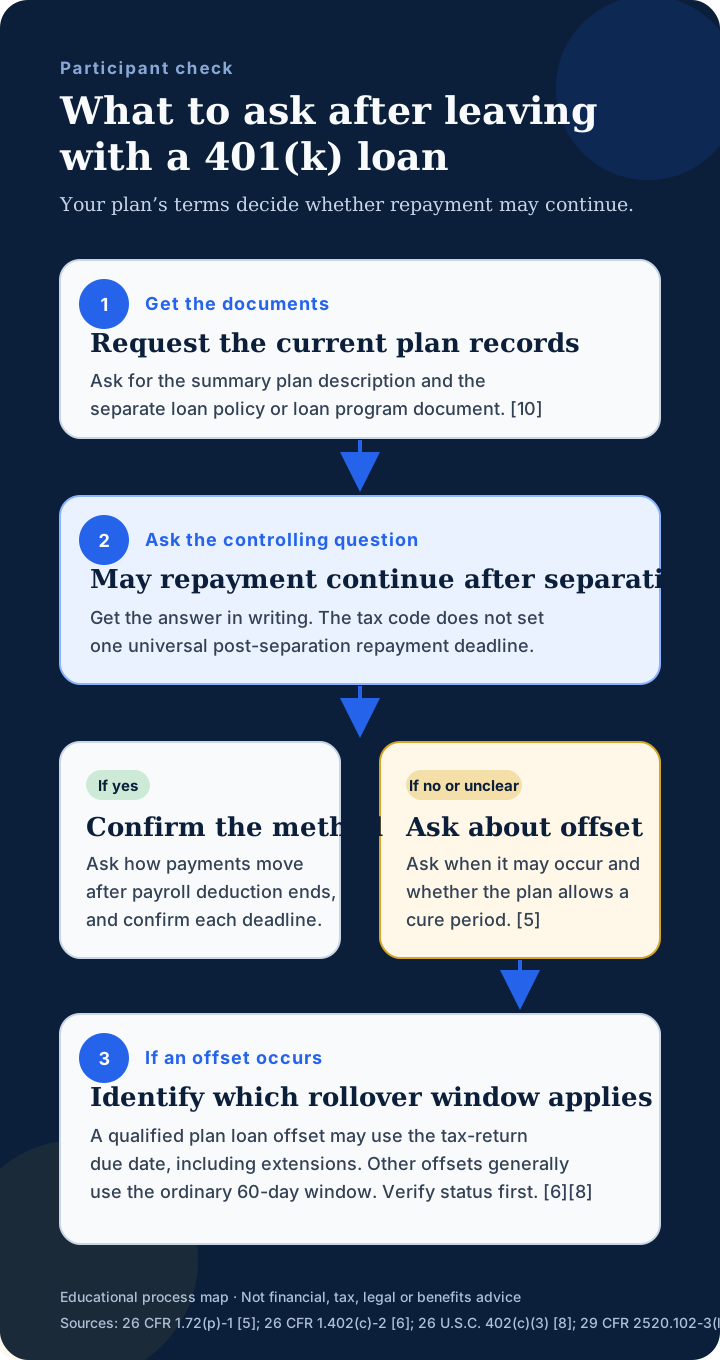
The statute also does not provide a suspension for leaving a job. The circumstances in which repayments may be suspended are enumerated in the regulation rather than the statute, at 26 CFR 1.72(p)-1, Q&A-9: a leave of absence of up to one year, and qualified military service under section 414(u)(4) [5]. Separation from employment is not among them.
So if nothing in the Code sets your deadline, something else does, and it is your plan's terms. That is why the surveys earlier on this page measure what plans permit rather than what the law requires: the law leaves this to the plan, and the plan document is the only place the answer exists. It is also why the answer differs between two people who left comparable jobs in the same month.
Citations in this section are to the Code and the regulation. The statute is cited from the govinfo USCODE-2023 edition and the regulation from eCFR Title 26, up to date as of 1 October 2026.
What Happens If You Stop Paying: Offset, and the Rollover Window
The previous section answers whether anything compels repayment. This section answers a different question: what the tax treatment is if repayment stops, and how long you then have to move the money. Keeping them apart matters, because the first is about obligation and the second is about consequence.
If the loan is not repaid and the plan reduces your account balance by the outstanding amount, that is an offset. The regulation is explicit about its character: an offset “is an actual distribution, not a deemed distribution under section 72(p)” [6].
The IRS states the same thing for a participant audience: “A qualified plan loan offset occurs when a plan loan in good standing is offset because your employer plan terminates, or because you have a severance from employment.” [7]
That distinction has a practical consequence. Because an offset is an actual distribution, the amount can be rolled over, which is what keeps it out of your taxable income for the year. A deemed distribution under section 72(p) cannot be. Where the regulation and a participant-facing IRS publication differ in wording, the regulation states the rule.
For a qualified plan loan offset, the window to roll the amount over is longer than the familiar sixty days. It runs to “the due date (including extensions) for filing the return of tax for the taxable year in which such amount is treated as distributed” [8].
For someone whose offset falls early in a tax year, that can be well over a year of runway, and it is the single most useful thing on this page for a reader who has already stopped paying.
Two qualifications belong with it, and both are easy to get wrong.
First, the extended window belongs to a qualified plan loan offset. Other offsets carry the ordinary sixty-day rollover window, and the two are not interchangeable.
Second, being offset within twelve months of leaving does not by itself make an offset qualified. An offset within 12 months of severance is not a qualified plan loan offset unless the loan satisfied the section 72(p)(2) conditions immediately before the severance [6].
The regulation's own examples separate two distinct failure modes that are often run together: one example fails because the loan had already breached level amortization before the severance, and a different example fails because the offset fell outside the 12-month window. A late offset and a bad loan are different defects, and only one of them is about timing.
There may also be a cure period before an offset happens at all, but it is permissive rather than automatic. A plan administrator may allow a cure period, which cannot continue beyond the last day of the calendar quarter following the quarter in which the installment was due [5]. That is a discretion the administrator has, not a right you can require, so it is worth asking whether your plan uses one rather than assuming it does.
The IRS also maintains a plan-loan-offset page aimed at practitioners, last reviewed or updated 27 June 2026 [9], which is a useful cross-check on the mechanics above.
Citations in this section are to the Code, the regulations and IRS publications: eCFR Title 26, up to date as of 1 October 2026; the govinfo USCODE-2023 edition; and IRS Publication 575 (2025).
The Document That Has to Tell You
There is a document that already has to describe the circumstances in which your benefits can be reduced, you are entitled to a copy of it, and almost nothing written for departing participants mentions it. It is your plan's summary plan description.
The disclosure regulation for summary plan descriptions requires a statement identifying circumstances that may result in offset of benefits a participant might otherwise reasonably expect [10]. In the regulation's own words, the summary plan description must include a:
statement clearly identifying circumstances which may result in disqualification, ineligibility, or denial, loss, forfeiture, suspension, offset, reduction, or recovery (e.g., by exercise of subrogation or reimbursement rights) of any benefits that a participant or beneficiary might otherwise reasonably expect the plan to provide on the basis of the description of benefits required by paragraphs (j) and (k) of this section
Be precise about how far that goes, because this is a reading of a general requirement rather than a rule written about loans. The regulation requires disclosure of circumstances that may result in offset of benefits generically, and a plan-loan offset is plainly such a circumstance.
The section itself never names plan loans: the word “loan” appears exactly once in it, in an unrelated passage about PBGC financial assistance to insolvent multiemployer plans. So this is a well-founded reading of a generic disclosure duty, not a provision obliging your summary plan description to answer the continued-repayment question specifically.
That still makes the document the right thing to ask for, and it tells you what you are looking for in it.
What to ask for. Ask the plan administrator for the current summary plan description, and ask specifically for the plan loan provisions and any separate loan policy or loan program document. The loan terms are often in a loan policy that sits alongside the summary plan description rather than inside it, so asking only for the one can get you a document that does not cover it.
What the wording looks like. In the loan section, look for what happens on termination of employment: language about the loan becoming due and payable, about the outstanding balance being offset against your account, about whether repayment may continue after separation, and about the method of repayment after you are off payroll.
If the document says repayment may continue, it will usually also say how, since payroll deduction is no longer available: typically by direct debit or coupon.
What to do with a verbal answer. Get it in writing, or get the document that supports it. As the earlier section showed, a meaningful share of sponsors are unsure about their own plan's provision, so a confident answer on the phone is worth confirming against the document. Asking in writing also dates the answer, which matters if the provision is changed later.
The regulation is cited from eCFR Title 29, up to date as of 1 October 2026, latest amended 30 September 2026.
What the Guidance You'll Meet Actually Says
If you search this question, the pages you land on are mostly consistent with each other and mostly tell you the same thing: that you have a short window to repay in full. That is worth looking at directly, because it explains why so many people believe there is a rule.
A recordkeeper's participant-education page puts it this way: “When you leave your job, you typically have a limited time—usually 60 to 90 days—to repay the loan in full.” [11] And a provider describing its own plan arrangements is more specific still: “You must pay off the loan in full no later than 90 days from the termination date.” [12]
Neither statement is wrong, and reading them as wrong is the mistake to avoid here.
The second one speaks for that provider's own plan arrangements, where it is a statement of fact about how those plans work. It is evidence of that provider's practice and of nothing wider, and it is a concrete reminder that plans which require repayment in full on a short deadline genuinely exist.
The first is a general education page, and general education pages describe the common case. The notable part is that the same firm's recordkeeping report gives 48% of plans in its own universe as permitting terminating participants with an outstanding loan to continue repayment, on data as of 31 December 2025, with the report leaving unresolved what that percentage is a percentage of [2].
That is a difference of purpose, not a contradiction. An education page written for every reader describes what most readers will meet and keeps the guidance simple and safe, while a recordkeeping report counts provisions across a book of plans. One is calibrated to the typical case and the other is a measurement, and they are answering different questions for different audiences.
It also explains the pattern this whole page is about. If the default guidance a leaver meets is calibrated to the stricter case, and the measured provision in the populations that have been counted is more permissive than that, then a reader who takes the default guidance at face value may never ask the question their own plan would answer differently.
One limit on all of this. Five provider sources were intended for this research and two were reached and content-verified, those being the two quoted above; Empower, TIAA and Fidelity were blocked, two of them under an HTTP 200 carrying a block page. That is this research's own fetch outcome and nothing else: it supports no claim about what those three publish, and it is not a share of providers.
A Different Question: Whether Your Plan Has an Offset Policy
One further figure is worth reporting on its own, precisely because it answers a different question from everything above and should not be read as part of the same series.
PSCA's February 2026 Question of the Week found that 63% of plans have a loan offset policy of some kind, among PSCA member respondents [13]. PSCA's published wording is: “The results of last week's QOTW show that 63 percent of plans have a loan offset policy of some kind.”
That measures whether a documented offset policy exists, which is a different question from whether continued repayment after separation is permitted. A plan can have a documented offset policy and permit continued repayment, or have one and not permit it.
The figure is kept in its own section here for that reason, and it is not compared with the prevalence measurements earlier on the page.
What it is useful for is the practical question of what to expect in writing. The published responses behind it are heterogeneous: sponsors described offset timing at 30, 60 and 90 days, cure period timing, and distribution timing, which is to say there is no single standard practice to expect.
If your plan has such a policy, that policy is where the timing of an offset is written down, and it is one of the documents worth asking for alongside the summary plan description.
This figure comes from the same PSCA lineage as the 55% earlier on this page rather than from an independent source. Both pages were rechecked live in a residential browser on 4 October 2026 because psca.org blocks the server this research ran from.
Frequently Asked Questions
Can I keep making payments on my 401(k) loan after I leave my job?
Sometimes, and it depends entirely on your plan. Three surveys measured versions of this question in three different populations. Among plans that offered loans in PSCA's August 2025 member poll, 55% allowed participants to continue repayment after separation.
In Vanguard's own recordkeeping universe, 48% of plans permitted terminating participants with an outstanding loan to continue repayment, on data as of 31 December 2025; Vanguard does not resolve what that percentage is a percentage of. Among PLANSPONSOR's 2,900 401(k)-industry respondents, 20.1% did on self-reported data as of 30 June 2025.
Each of these three figures describes its own group of plans, measured at its own date and by its own question, so none of them is your odds.
Is there a law that makes me repay a 401(k) loan immediately when I leave?
No. Section 72(p)(2) of the Internal Revenue Code sets conditions on the loan itself when it is made: a limit of $50,000 or one-half of the vested balance, a five-year repayment term with an exception for a principal-residence loan, and substantially level amortization with payments not less frequently than quarterly.
It is silent on separation from employment, and separation is not one of the circumstances in which the regulation allows repayments to be suspended, which are a leave of absence of up to one year and qualified military service. Any deadline you are given after you leave therefore comes from your plan's own loan terms rather than from the tax code.
What happens if I stop paying after I leave?
The plan reduces your account balance by the outstanding amount, which is a plan loan offset. The regulation treats an offset as an actual distribution rather than a deemed distribution under section 72(p), and that is what allows the amount to be rolled over.
Where the offset is a qualified plan loan offset, the window to roll it over runs to the due date, including extensions, for filing your return for the tax year in which the amount is treated as distributed, which can be far longer than the familiar 60 days. Other offsets carry the ordinary 60-day window, and the two are not interchangeable.
What did the one published breakdown by plan size show?
One survey has published this question broken out by plan size. Within PLANSPONSOR's 401(k)-industry column, the share of respondents reporting the provision was lowest among plans with under $5 million in assets, at 11.6%, and highest among plans with over $1 billion, at 62.4%, rising across each band in between: a 5.4-fold difference between those two bands, on self-reported data as of 30 June 2025.
That is an association PLANSPONSOR observed among its own respondents. It is not a finding that plan size determines whether continued repayment is allowed, and it does not tell you what your former employer's plan permits. Only your plan document does.
How do I find out what my own plan allows?
Ask the plan administrator for the current summary plan description, and ask separately for the plan's loan policy or loan program document, because the loan terms often sit in that separate document.
The disclosure regulation requires a summary plan description to identify circumstances that may result in offset of benefits a participant might otherwise reasonably expect, and a plan-loan offset is such a circumstance.
That is a well-founded reading of a generic disclosure duty rather than a rule written about loans: the section never mentions plan loans, so how fully your own document answers this particular question will differ from plan to plan.
In the loan section, look for what happens on termination of employment: whether the balance becomes due and payable, whether repayment may continue, and how payments are made once payroll deduction has stopped. Ask in writing, so the answer is both documented and dated.
Why does everyone tell me to ask my employer?
Because the plan document holds the answer and no survey can supply it for your plan. The limit of that advice has been measured. When PLANSPONSOR put the continued-repayment question to its 401(k)-industry respondents, 16.0% answered that they were unsure what their own plan allowed, on self-reported data as of 30 June 2025, across a base of 2,900 respondents.
Roughly one respondent in six could not answer a question about their own plan, which is a fair reason to treat a verbal answer as a starting point and the document as the settled one.
How long do I actually have before the loan is offset?
Whatever your plan document says. Two published statements show how little a general figure settles for any particular reader. One provider states, for its own plan arrangements, that the loan must be paid off in full no later than 90 days from the termination date. A recordkeeper's participant education page describes a typical window of 60 to 90 days.
Each is describing its own arrangements or the common case rather than a legal deadline, and neither tells you whether your plan is one that lets you keep paying instead. Your plan may also allow a cure period before an offset happens, but that is a discretion the administrator may exercise rather than a right you can require.
Is a loan offset the same as defaulting on the loan?
No, and the difference decides whether you can undo it. A deemed distribution arises when a loan breaks the section 72(p) conditions, for example by missing the level amortization requirement, and it cannot be rolled over. An offset reduces your account to clear the loan, counts as an actual distribution, and can be rolled over within the applicable window.
One qualification is easy to miss: being offset within 12 months of leaving does not by itself make the offset a qualified one, because the loan must have satisfied the section 72(p)(2) conditions immediately before the severance.
Methodology, Sources and Limits
This page is built from primary documents and published survey reports, read directly. The research date is 4 October 2026, and every source below was accessed on that date. This section records what each figure counts, how each source was reached, what could not be reached, and what remains unresolved. It is written so the page can be audited and maintained in place.
What each measurement counts
Three surveys have measured a version of the continued-repayment question. They are reported separately throughout this page because they asked different questions, of different populations, at different dates. No figure here is averaged with another, combined into a range, or used to infer anything about another, and no single headline number is offered for the question.
PSCA, the page's lead figure. 55% of surveyed plans that offered loans allowed participants to continue repayment after separation, among Plan Sponsor Council of America member respondents, in the Question of the Week published August 2025 [1]. The universe is part of the figure: it is a share of surveyed plans that offered loans, not of all 401(k) plans and not of all employers.
PSCA discloses no sample size on that page, so the figure carries no margin of error and no precision claim, and no sample size has been imported from anywhere else to supply one. The complement, 45%, belongs to the same universe. The same page separately reports 85% of plans allowing loans at all, which PSCA attributes to its Annual Survey, a different instrument from the Question of the Week poll, and that larger figure is not a base for the smaller one.
Vanguard. 48% of plans permitted terminating participants with an outstanding loan to continue repayment, on data as of 31 December 2025, across Vanguard defined contribution plans: more than 1,300 qualified plans and nearly 5 million participants for which Vanguard directly provides recordkeeping services [2]. Vanguard leaves the denominator unresolved in its own report. The figure sits in a table headed for Vanguard defined contribution plans while the adjacent table is headed for plans offering loans, and the report does not say which population the percentage belongs to. This page therefore does not pick a reading, does not describe the 48% as a figure for loan-offering plans, and carries the caveat wherever the figure appears. The ambiguity is permanent and only Vanguard can settle it.
The same report supplies the five-year series for the same instrument, each year dated, and the 82% and 13% figures quoted on this page.
PLANSPONSOR. 20.1% of respondents reported the provision, among all 401(k)-industry respondents to the PLANSPONSOR 2026 DC Survey Plan Benchmarking Report, base 2,900, of which 66.9% were micro and small plans, on data as of 30 June 2025 [3]. The responses are self-reported, and PLANSPONSOR states its data is impossible to independently verify.
Every PLANSPONSOR figure on this page is attributed to PLANSPONSOR by name and carries that base and date: the 3.3% and 60.6% response shares, the 16.0% unsure share, the respondent-base composition, and the plan-size breakdown.
PLANSPONSOR material is used here under a cite-and-attribute-only permission. The report's licence condition states that it may not be given in its entirety to any third party and that usage is limited to the terms of its licensing agreement, so this page cites and attributes its figures and reproduces none of its tables, charts, wording at length, or the report itself.
One further PSCA figure, kept separate. 63% of plans have a loan offset policy of some kind, among PSCA member respondents, in the Question of the Week published February 2026 [13]. That measures whether a documented policy exists, which is a different question from whether continued repayment is permitted, so it is reported in its own section and is not set beside the prevalence figures.
PSCA, ASPPA and NAPA-Net are one evidence lineage, not three sources. The August 2025 poll was covered by both trade outlets, and that coverage is reporting of the same PSCA member poll rather than independent corroboration of it. Only PSCA is cited for the figure.
The legal sources, and the question they answer
The legal spine of this page cites the Internal Revenue Code and the governing regulations, and carries no survey figure at all. A survey never settles what the law requires, and the Code never measures what plans do in practice.
The statute is cited from the govinfo USCODE-2023 annual edition [4] [8]. The regulations are cited from the eCFR: Title 26 up to date as of 1 October 2026 [5] [6], and Title 29 up to date as of 1 October 2026, latest amended 30 September 2026 [10].
IRS Publication 575 is the 2025 edition, for use in preparing 2025 returns [7], and the IRS Issue Snapshot carries a page last reviewed or updated date of 27 June 2026 rather than a data vintage [9].
One reading is flagged as a reading. 29 CFR 2520.102-3(l) requires a summary plan description to identify circumstances that may result in offset of benefits a participant might otherwise reasonably expect. The section never mentions plan loans: the word appears once in it, in an unrelated passage about PBGC financial assistance to insolvent multiemployer plans.
Applying the provision to plan-loan offsets is a well-founded reading of a generic disclosure duty, and this page states it as that rather than as a rule obliging a summary plan description to answer the continued-repayment question specifically.
Unresolved points are left unresolved. Where a primary source leaves a question open, this page states the limit instead of answering it. The Vanguard denominator is the clearest case: the two figures printed either side of it cannot settle it, because borrowing the scope of an adjacent figure to resolve the one that lacks it would be circular.
How each source was reached
Most sources were fetched directly and matched in the retrieved content, including the Vanguard, PLANSPONSOR and IRS Publication 575 PDFs, which were extracted to text before matching.
Two PSCA pages were initially read from preserved residential captures because the datacenter research host receives HTTP 403. A fresh residential real-browser recheck on 4 October 2026 rendered both pages after their managed browser challenge and confirmed the same evidence.
A 403 is a block on one network, never a finding about what a publisher does or does not disclose. The recheck confirmed the 2025 page's 55% statement with its plans-that-allow-loans universe, the separate 85% Annual Survey sentence and the absence of a disclosed sample size. It also confirmed that the 2026 page's 63% is an offset-policy measurement and that its 55% sentence is explicitly a backward reference to the prior year's different question.
A government HTTP 200 was not treated as proof of content. The eCFR answers a plain script with a request-access interstitial under HTTP 200, and uscode.house.gov served a maintenance page under HTTP 200 for both statutes.
Every capture relied on here was therefore checked with a positive control, a phrase that must appear if the page is genuine, and a negative control where a zero would have been load-bearing, with whitespace normalized before matching because a phrase wrapping across extracted lines returns no match and imitates a failed control. The statutes were taken from govinfo after the maintenance page was caught by its control.
What could not be reached, stated at the level actually tested
Blocked sources are recorded as blocks. A block licenses no claim about what the blocked publisher publishes, and no null on this page is attributed to one.
The gap this page fills. Of 18 fetch attempts against participant-facing pages, 9 returned HTTP 200. Of those 9, one was a guessed URL that failed its positive control and was discarded, so 8 pages were actually tested.
None of the 8 reachable, content-verified pages publishes any of these prevalence measurements with its universe stated. Eight sources returned HTTP 403 and one returned HTTP 429: those nine were blocked or rate-limited and never tested, so they are excluded from that denominator rather than counted. The check is point-in-time, dated 3 October 2026, and is not a permanent clearance.
Provider pages. 2 of the 5 intended provider sources were reached and content-verified for this research, namely the Guideline help page [12] and the Vanguard participant education page [11]. Empower, TIAA and Fidelity were blocked, two of them under HTTP 200 carrying a block page or a navigation shell. That is this research's own fetch outcome and nothing more: it supports no claim about what those three publish, and it is not a share of providers.
Government and independent measurement produced nothing usable here. BLS was blocked across three URLs with no archived snapshot available, and no EBRI source was obtained. No figure on this page comes from that kind of source, and that is a limit of the evidence base rather than a finding about what those bodies publish. It is also why the page's lead figure comes from a sponsor survey: no government measurement of this plan provision was available to this research.
Anecdotal material is demand evidence only. Forum threads and sponsor free-text comments show that the question is asked constantly and answered inconsistently. Nothing on this page turns them into a rate, a median or a frequency.
Verification, reported as three separate counts
The evidence base is 52 recorded facts. Fact identifiers are unique and deliberately non-contiguous: five identifiers in the sequence were never assigned, and their absence is by design rather than a gap.
- 41 content-verified, being 11 verified against a verbatim quotation and 30 verified against the value on the page.
- 8 liveness-only, which are the composite FAQ rows: the recorded URL was live, which is not a test of the prose. Each figure inside those answers was instead checked against the content-verified fact that owns it.
- 3 expected by construction, which are rows computed or self-referential by nature and are expected rather than failures.
These three counts are reported apart and are never added together. There is no single combined verification number for this asset, because the three mean different things. The verification script's own total of 34 is inflated and superseded: it counted liveness-only rows as verified, and it is named here only to record that it is not the figure to quote.
Every fact carries a source URL. No fact was dropped, and no value or quotation was edited at any stage. Four quotations from the eCFR were initially scored as not found by the verification script, which cannot detect a block page served under HTTP 200; all four were confirmed present verbatim on browser captures with controls, and they stand as recorded.
One figure on this page is computed rather than published: the 5.4-fold difference between PLANSPONSOR's lowest and highest asset bands is 62.4% divided by 11.6%, with both inputs independently matched in the same published column of PLANSPONSOR's 401(k)-industry respondents, base 2,900, on self-reported data as of 30 June 2025.
Degraded conditions during this research, named in full
Named at the start of the research and recorded again here.
- The image-generation service used by the research pipeline was unavailable for the entire run, which set the run to degraded mode from the outset.
- One of 12 search queries in an early stage failed with a server error and was marked failed rather than treated as a zero-result query. No conclusion rests on it.
- The video-platform leg of the recency sweep was partly unreliable: a relevance guard dropped most results for one query, leaving thin coverage.
- The web leg of the recency sweep returned no dates on any item, so the date window was enforced by the provider's own filter and no undated item was treated as in-window evidence.
- The short-video window filter is coarse: most returned items fell outside the window and were removed locally. No material from it entered the evidence base.
- One provider site served a JavaScript shell rather than content and was recorded unverified and not cited.
- psca.org and asppa-net.org return HTTP 403 to this datacenter IP address, the degradation that reached the evidence hardest, and the reason for the preserved-capture route above.
- BLS was blocked across three URLs with no archived snapshot. No BLS figure is cited and no claim is made about what BLS publishes.
- Empower, TIAA and Fidelity were blocked, two of them under HTTP 200.
- EBRI, Principal and Schwab sources were not obtained: guessed URLs returned 404 and were not pursued further rather than risk archiving a wrong page under a right-looking name.
- uscode.house.gov served a maintenance page under HTTP 200 for both statutes, caught by a positive control and replaced with the govinfo edition.
- Browser-based rendering is not installed on the research host, which affects a later rendering check and not the evidence here.
- The research was initially halted at the first stage by a credential permission that had not been granted, costing time rather than any paid call.
- The verification script cannot detect a block page served under HTTP 200. This is a defect in the tooling rather than in this evidence base, and it is what produced the four false negatives recorded above.
- One guessed URL returned HTTP 200 and failed its positive control, which is why the gap check above is stated at 8 pages actually tested rather than 9 responses received.
A standing condition rather than a one-off failure: the research host is a datacenter IP address and Reddit's public interface refuses it, so the demand-side research depended entirely on a third-party retrieval service. Material gathered that way is demand evidence only and was never upgraded into a rate.
Research accounting
This stage of the work spent zero API credits: nothing was re-fetched and no paid call was made. Across the whole research run, the retrieval service recorded 48 requests, of which 47 were charged and 1 returned no charge figure, confirmed by parsing the run's own credit log rather than taken from any summary.
Search queries are counted at two levels, so the level is named here: 7 queries in the verification stage, and 25 across the whole run, of which one failed.
Sources last reviewed: 4 October 2026. How figures on this site are produced and checked is set out in the research methodology, and errors are handled under the corrections policy.
Sources
Thirteen sources, each with its edition or version and the date it was accessed. Commercial sources are cited as plain text and are not linked. Government sources are linked under this site's standing nofollow treatment.
- [1] — Plan Sponsor Council of America (PSCA), “Repaying Loans After Separation” Edition: Question of the Week, August 2025. Accessed 2026-10-04. The source for the page's lead figure and its loan-offering universe. A fresh residential real-browser recheck on 2026-10-04 confirmed the 55% statement, its plans-that-allow-loans universe, the separate 85% Annual Survey sentence, and that the page discloses no sample size. psca.org still blocks the datacenter research host; that 403 is a network block, never a finding about what PSCA publishes. Commercial source: cited as plain text, not linked. https://www.psca.org/news/psca-news/2025/8/repaying-loans-after-separation/
- [2] — Vanguard, “How America Saves 2026, Figure 101, 'Plan loans, 2025', p. 94” Edition: 25th edition, report year 2026; data as of 31 December 2025. Accessed 2026-10-04. The source for the 48%, the five-year series, the 82% and 13% scope figures and the average loan balance. The report does not resolve what the 48% is a percentage of, and that caveat travels with the figure wherever it appears. Access route: direct PDF fetch, HTTP 200, 8,358,115 bytes, sha256 df79916eaa0664923bb15c99c4cc1481019a9f97c55a90b6fc880d99ae758c79. Commercial source: cited as plain text, not linked. https://workplace.vanguard.com/content/dam/inst/iig-transformation/has/2026/pdf/HowAmericaSaves2026.pdf
- [3] — PLANSPONSOR, “2026 DC Survey Plan Benchmarking Report, 401(k) Plans industry column, p. 30” Edition: 2026 report; source line reads 'PLANSPONSOR 2025 Defined Contribution (DC) Survey. Valid through December 2026.' Fielded via Qualtrics June to September 2025; all data as of 30 June 2025. Accessed 2026-10-04. The source for the 20.1% and for every other PLANSPONSOR figure on this page, each attributed to PLANSPONSOR by name in its own record, with its base of 2,900 401(k)-industry respondents and its 30 June 2025 data date. Responses are self-reported and PLANSPONSOR states its data is impossible to independently verify. Access route: direct PDF fetch, HTTP 200, 3,417,656 bytes, sha256 f22e890883d3d2ce34a73ceb226d294e2d781bd92c5e50d0f2adb61c5d29dd59. Commercial source: cited as plain text, not linked, and the PDF is not linked or mirrored. Licence condition: May not be given in its entirety to any third party. Usage limited to terms in licensing agreement. Daniel approved cite-and-attribute-only publication on 4 October 2026; the evidence remains secondary and provisionally verified.
- [4] — U.S. Government Publishing Office (govinfo), “26 U.S.C. 72(p), Loans treated as distributions” Edition: USCODE-2023 annual edition. Accessed 2026-10-04. The statute that sets conditions on the loan itself and is silent on separation from employment. Taken from govinfo after uscode.house.gov served a maintenance page under HTTP 200, caught by a positive control.
- [5] — Electronic Code of Federal Regulations (eCFR), “26 CFR 1.72(p)-1, Loans treated as distributions (Q&A), Q&A-3, 4, 9, 10, 11, 12, 13, 22” Edition: eCFR current edition; Title 26 up to date as of 1 October 2026, latest amended 30 September 2026. Accessed 2026-10-04. The source for the enumerated suspension circumstances, which do not include separation from employment, and for the permissive cure period.
- [6] — Electronic Code of Federal Regulations (eCFR), “26 CFR 1.402(c)-2, Treatment of plan loan offset amounts, paragraph (g)” Edition: eCFR current edition; Title 26 up to date as of 1 October 2026. Accessed 2026-10-04. The source for an offset being an actual distribution rather than a deemed distribution, and for the condition that a loan must have satisfied the section 72(p)(2) requirements immediately before severance.
- [7] — Internal Revenue Service, “Publication 575 (2025), Pension and Annuity Income, for use in preparing 2025 Returns, Catalog Number 15142B” Edition: 2025 edition. Accessed 2026-10-04. Participant-facing treatment of plan loan offsets. Where this publication and the regulation differ in wording, the regulation states the rule.
- [8] — U.S. Government Publishing Office (govinfo), “26 U.S.C. 402(c)(3), Time limit on transfers, including 402(c)(3)(C) rollover of certain plan loan offset amounts” Edition: USCODE-2023 annual edition. Accessed 2026-10-04. The source for the extended rollover window that applies to a qualified plan loan offset.
- [9] — Internal Revenue Service, “Plan loan offsets (Issue Snapshot)” Edition: Page last reviewed or updated 27 June 2026. Accessed 2026-10-04. A practitioner-facing cross-check on the offset mechanics. The page carries a last-reviewed date rather than a data vintage.
- [10] — Electronic Code of Federal Regulations (eCFR), “29 CFR 2520.102-3(l), Contents of summary plan description” Edition: eCFR current edition; Title 29 up to date as of 1 October 2026, latest amended 30 September 2026. Accessed 2026-10-04. The generic disclosure duty this page reads as covering plan-loan offsets. The section never mentions plan loans, and the page states the reading as a reading.
- [11] — Vanguard investor education, “What happens to your 401(k) when you quit?” Edition: No visible revision date on the page; accessed edition recorded by access date. Accessed 2026-10-04. A general participant-education page, quoted as evidence of what the common guidance says. Commercial source: cited as plain text, not linked. https://investor.vanguard.com/investor-resources-education/article/what-happens-401k-when-you-quit
- [12] — Guideline (Gusto Retirement Help Center), “What happens to my 401(k) loan if I leave my employer or my employer cancels the plan?” Edition: Article dated 23 February 2024. Accessed 2026-10-04. A provider describing its own plan arrangements. Evidence of that provider's practice and of nothing wider. Commercial source: cited as plain text, not linked. https://help.guideline.com/en/articles/8605073-what-happens-to-my-401-k-loan-if-i-leave-my-employer-or-my-employer-cancels-the-plan
- [13] — PSCA, “Plan Loan Offset Policies” Edition: Question of the Week, February 2026. Accessed 2026-10-04. The source for the offset-policy figure, which answers a different question from continued repayment and is reported in its own section. A fresh residential real-browser recheck on 2026-10-04 confirmed the 63% offset-policy statement and that the page's 55% sentence is explicitly a backward reference to the prior year's different question. Commercial source: cited as plain text, not linked. https://www.psca.org/news/psca-news/2026/2/plan-loan-offset-policies/
PLANSPONSOR material on this page is used under a cite-and-attribute-only permission. May not be given in its entirety to any third party. Usage limited to terms in licensing agreement. The report itself is neither linked nor mirrored here.
How to Cite This Page
Source: 401ktogoldira.org — Can You Keep Paying a 401(k) Loan After
You Leave Your Job?
https://401ktogoldira.org/401k-loan-repayment-after-leaving/
(sources last reviewed 4 October 2026)
Figures compiled on this page are attributed to the organisation that produced them, and each one travels with its own universe.
Quote PSCA's 55% as a share of surveyed plans that offered loans, never as a share of all plans. Quote Vanguard's 48% with the note that Vanguard does not resolve what the percentage is a percentage of.
Attribute PLANSPONSOR's figures to PLANSPONSOR by name, with its base of 2,900 401(k)-industry respondents and its 30 June 2025 data date.
The three are not alternative estimates of one number and must not be averaged, ranged or compared.
This page is educational and does not evaluate any reader's plan, account or circumstances. It reports published survey figures and quotes federal statutes, regulations and IRS publications, and it cannot establish what any individual plan's loan provisions allow; that is answered only by the plan administrator and the plan's own documents. Readers should consult the plan administrator and a qualified tax professional about their own account.
Reviewed and edited by Daniel M. — Editor, 401kToGoldIRA.org. Last verified: 4 October 2026.
Update History
- October 2026: Initial draft. The three prevalence measurements are reported separately with their own universes and dates, with no combined figure, range or comparison. PSCA's loan-offering denominator travels with its 55%, and Vanguard's unresolved-denominator caveat travels with its 48% and with every year of the five-year series. Verification is recorded as three separate counts.
- Maintenance hook: re-check when PSCA's 69th Annual Survey publishes and when Vanguard's next edition of How America Saves lands, retesting each figure by its own instrument rather than treating a newer edition as superseding a different survey. A maintainer on a residential connection should re-verify the two PSCA pages live.
Explore More Retirement Research
The research on this site closest to this page:
Related research
 How 401(k) Rollovers Are Actually DeliveredWhat a federal survey found about who handles the money once a rollover starts.
 ESOP Payout After Leaving a CompanyThe other departure event with a plan document, not a statute, setting the timetable.
 ESOP Rollover to an IRAHow a distribution from an employer plan moves, and which windows apply.