Educational only: This reference explains federal retirement-plan rules from published statutes, Treasury regulations, IRS guidance and a Tax Court decision. It does not recommend a plan provider, document service, custodian, depository, dealer or product, and it is not financial, tax, legal or ERISA advice. A business owner considering physical metal inside a qualified plan should have the plan document, trust arrangement and proposed custody structure reviewed by a qualified tax professional or ERISA attorney before transacting. Past performance does not guarantee future results.
Key takeaways
- §408(m) is not IRA-only. It expressly reaches an individually directed account under a §401(a) plan.
- Bullion custody is settled. Qualifying bullion must be in the physical possession of a §408(a)-described trustee — a bank or an IRS-approved nonbank trustee.
- Being your plan's trustee is not the same status. IRS guidance permits an owner to serve as plan trustee; §408(a)(2) describes a different, narrower role.
- The coin question is genuinely open. The named-coin exception has no possession clause, and no source reviewed fills that gap. Silence is not approval.
- McNulty does not answer it. That case concerned an IRA and IRA custody rules, and it did not decide the qualified-plan trustee question.
- §4975 still applies, but the consequence differs: the excise-tax regime, not the IRA-specific account-disqualification rule in §408(e)(2).
- Eligibility can end without a hiring decision feeling decisive. SECURE 2.0 shortened the long-term part-time service test.
Three Separate Questions, Asked in Order
Marketing tends to compress this topic into a single claim: a Solo 401(k) can own gold. That skips the decisions that actually control the outcome, and it is why owners occasionally buy metal the plan could not properly hold.
- The plan. “Solo 401(k)” is the market name for what the IRS calls a one-participant 401(k). It is not a separate type of 401(k) and follows the same fundamental qualification rules.
- The investment authority. A 401(k) operates under a written plan document. The document, the trust or custodial arrangement, and the provider's operational menu together determine what is actually available. IRS guidance on individually directed qualified accounts notes expressly that plan provisions may allow participant choice or restrict investments to specified options.
- The custody. Even where the plan permits metals, §408(m) applies to individually directed qualified-plan accounts, and for qualifying bullion the statute imposes a specific physical-possession condition.
Answering them out of order is how an owner ends up holding an asset the arrangement cannot support.
What a One-Participant 401(k) Actually Is
The IRS uses the term one-participant 401(k) plan and acknowledges the market labels: Solo 401(k), Solo-k, Uni-k and one-participant k. It describes the arrangement as a traditional 401(k) covering a business owner with no employees, or the owner and spouse (IRS — One-Participant 401(k) Plans).
The defining feature is coverage rather than any special tax status. Publication 560 also recognises owner and partner-only structures, including partners and their spouses.
Who Qualifies — and What Ends It
A plan does not remain owner-only because the document or the provider calls it “Solo.” If the employer has employees who satisfy the plan's eligibility rules, the IRS states those eligible employees must generally be included, and the owner-only nondiscrimination-testing advantage disappears unless another exception applies.
The familiar full-time threshold is no longer the whole screen. SECURE 2.0 shortened the Code's long-term part-time test, so that for plan years beginning after 31 December 2024 the relevant rule generally uses two consecutive 12-month periods with at least 500 hours of service in each. As at the research date for this page, IRS materials still described the final §401(k) long-term part-time regulations as forthcoming, so the statutory change is already relevant while implementation details may be clarified later.
The safer screening question is therefore not “does anyone work 1,000 hours?” but whether any non-owner worker satisfies the plan's current eligibility conditions, including the long-term part-time rules that apply to it.
ERISA Status: Owner-Only Does Not Mean No Rules
DOL regulation 29 C.F.R. §2510.3-3 excludes a plan whose only participants are an owner and spouse from the Title I definition of an employee benefit plan, and DOL guidance explains that the exclusion ends once one or more common-law employees participate.
That is a coverage rule, not a licence to disregard the Internal Revenue Code. The plan must still satisfy its tax-qualification requirements, follow its governing documents, comply with the collectibles rule for individually directed accounts, and avoid prohibited transactions. It also does not, by itself, establish any creditor-protection advantage — that would require separate bankruptcy, federal non-ERISA and state-law analysis this page does not attempt.
Plan Document, Trust, Trustee and Reporting
The IRS identifies four basic actions when establishing a 401(k): adopt a written plan, arrange a trust for plan assets, establish a recordkeeping system, and provide plan information to participants. The employer is bound by the terms of the plan document (IRS — establishing a 401(k) plan).
For a metals decision, that means inspecting the actual adoption agreement, basic plan document, trust or custodial agreement and any provider investment restrictions — not a marketing page.
The owner can be the plan trustee — and that does not answer the bullion question
A 401(k) trust must have at least one trustee responsible for contributions, plan investments and distributions. IRS guidance states that trustees “might include the business owner, an employee, or a financial or trust institution” (IRS — 401(k) resource guide).
This is the point at which two different statuses get conflated, so it is worth separating them plainly. General plan-trustee status is what allows owner control over plan administration. It does not make that owner the specific type of trustee cross-referenced by §408(m)(3)(B) for physical bullion. Section 408(a)(2) describes a bank, or another person that has demonstrated to the Secretary that it will administer the trust consistently with §408 — and the IRS maintains a public list of approved nonbank trustees and custodians for that purpose.
Form 5500-EZ
The IRS states that Form 5500-EZ is generally required when the combined assets of all one-participant plans the employer maintains exceed $250,000 at the end of the plan year. The threshold is based on those combined assets rather than a separate figure per account or per investment, and a final return is required for the final plan year even below the threshold. That figure is current guidance and should be re-checked rather than assumed permanent.
Contributions, briefly
A self-employed owner contributes in two capacities: as employee through elective deferrals, and as employer through employer contributions, applying both the annual deferral limit and the overall annual-additions limit, with a special earned-income computation for the self-employed. For 2026 the IRS lists a regular elective-deferral limit of $24,500 and an overall defined-contribution limit of $72,000 before applicable catch-up amounts. Those are 2026 figures, not permanent features of the plan type.
One distinction is worth keeping in view: contribution mechanics and investment eligibility are different questions. Being permitted to contribute an amount says nothing about whether the plan may invest it in a particular asset.
Solo 401(k) Versus Self-Directed IRA: the Structural Differences
The practical error is treating a one-participant plan as “an IRA without a custodian.” It is a different governing structure — yet some rules, notably §408(m) and §4975, cross over.
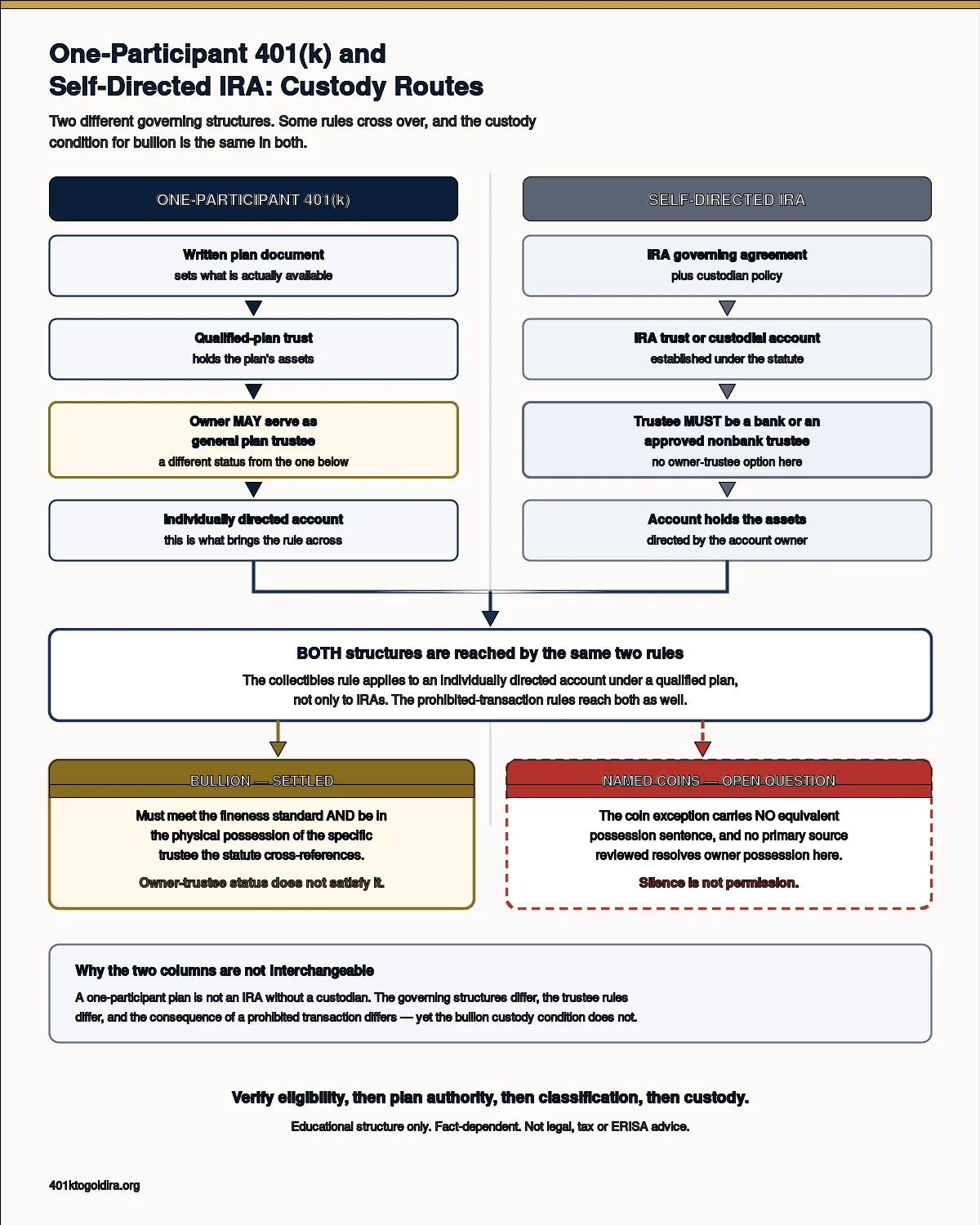
Owner-trustee status is not the trustee status the bullion exception asks for.
| Question | One-participant 401(k) | Self-directed IRA |
|---|---|---|
| Governing structure | Qualified employer plan under §§401(a) and 401(k) | IRA trust or custodial arrangement under §408 |
| What sets investment availability | The plan document, trust arrangement and provider menu | The IRA agreement and custodian policy, within §408 |
| Who may be general trustee | IRS guidance says the business owner may serve | §408(a)(2) requires a bank or approved nonbank trustee |
| Does §408(m) apply | Yes — to an individually directed account under a §401(a) plan | Yes |
| Bullion exception | Fineness rule plus physical possession by a §408(a)-described trustee | The same statutory condition |
| Prohibited transactions | §4975 applies; excise taxes can fall on participating disqualified persons | §4975 applies, and an owner transaction can also trigger §408(e)(2) account disqualification |
Can a One-Participant 401(k) Hold Physical Metals?
The collectibles rule reaches qualified-plan accounts
This is the part most commonly misstated. IRC §408(m)(1) applies when either an individual retirement account or an individually directed account under a plan described in §401(a) acquires a collectible, treating the acquisition as a distribution from that account equal to its cost (Cornell LII — 26 U.S.C. §408). The IRS publishes an Issue Snapshot addressing collectibles in exactly those accounts, and indicates the amount should be reported to the participant on Form 1099-R.
Metals and coins fall inside the statutory collectible definition unless an exception applies.
Certain coins are excepted
Section 408(m)(3)(A) excludes specified United States gold, silver and platinum coins, and coins issued under the laws of any state. The exact statutory categories matter: “a gold coin” is not a sufficient description, because the exception operates by cross-reference to particular provisions rather than by purity or popularity.
Qualifying bullion carries an additional, express condition
Section 408(m)(3)(B) excludes gold, silver, platinum or palladium bullion only where the fineness standard is met and — in the statute's own words — “such bullion is in the physical possession of a trustee described under subsection (a) of this section.”
The IRS translates that condition for qualified-plan accounts as bullion of the required fineness held in the physical possession of a bank or an approved nonbank trustee.
This is the clearest available answer to the home-storage claim as it applies to bullion: naming the owner as trustee of the one-participant plan does not, by itself, make that owner a bank or an IRS-approved nonbank trustee under §408(a)(2).
The Owner-Held Coin Question — Genuinely Unresolved
Here the primary sources support caution rather than a categorical answer either way, and it is worth being explicit about why.
The named-coin exception in §408(m)(3)(A) does not contain the physical-possession sentence that appears in the bullion subparagraph. The IRS Issue Snapshot likewise states the bank or approved-nonbank possession condition specifically in connection with bullion. That textual asymmetry is real and it is not obviously accidental.
McNulty should not be stretched to fill the gap. In McNulty v. Commissioner the Tax Court held that an IRA owner who took actual, unfettered possession of coins purchased through an IRA-owned LLC received taxable distributions, and its reasoning rested on the IRA custody and trustee requirements of §408 (U.S. Tax Court — McNulty, Docket No. 1377-19). The case did not decide whether an owner serving as trustee of a one-participant qualified-plan trust may personally hold plan-owned coins falling within §408(m)(3)(A). Applying an IRA custody holding to a qualified-plan trust would be an extension, not a citation.
So the publishable conclusion is deliberately narrow: the primary sources reviewed do not provide a general approval for a one-participant plan owner to store qualifying plan-owned coins at home. Statutory silence on a possession condition is not the same as permission, and a reader should verify the plan document, trust structure, asset classification and proposed custody arrangement with a qualified professional before purchasing anything. Anyone offering a confident yes on this question should be asked which primary source they are relying on.
Prohibited Transactions Still Apply
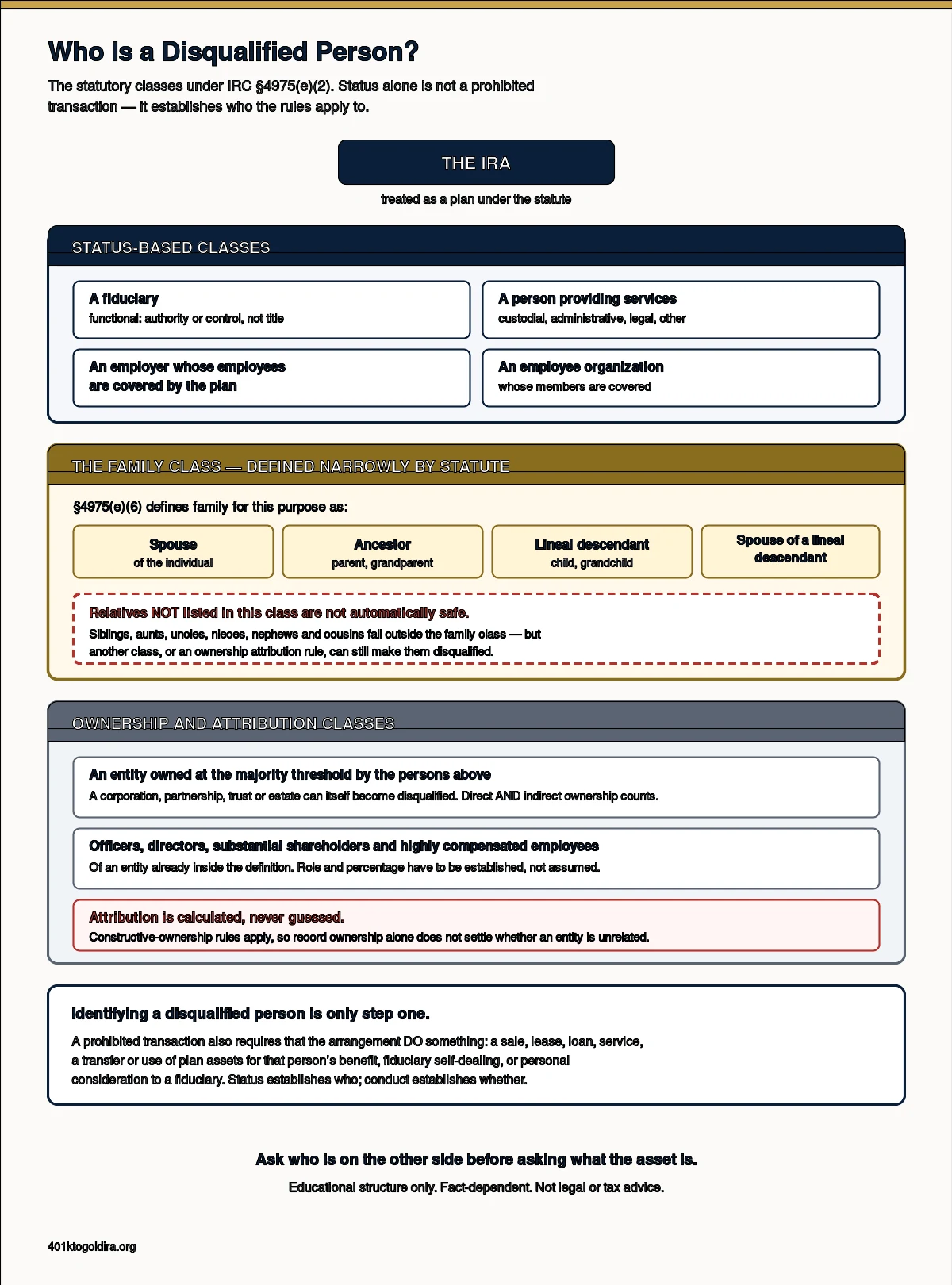
Flexibility over investments does not remove §4975. That section includes a qualified trust described in §401(a) within its definition of a plan, and prohibits direct or indirect dealings with disqualified persons: sales and exchanges, loans and extensions of credit, furnishing goods, services or facilities, transferring or using plan assets for a disqualified person's benefit, and fiduciary self-dealing.
An owner of a one-participant plan may be employer, participant, plan trustee and fiduciary simultaneously. Holding those roles is not itself a prohibited transaction — the question is what the person does with plan income or assets, and who benefits.
The consequence differs from the IRA rule. For a qualified plan, §4975 imposes excise taxes on participating disqualified persons: an initial tax on the amount involved for each year or part-year in the taxable period, and a substantially larger additional tax where the transaction is not corrected in time. The account-disqualification rule in §408(e)(2) — under which an IRA can cease to be an IRA as of the first day of the taxable year — is IRA-specific and should not be described as the automatic consequence for a one-participant plan. The general framework is set out in the self-directed IRA prohibited transactions reference.
What to Verify in the Plan Document Before Buying Metal
Before treating physical metals as available, the sponsor should be able to answer each of these from the governing documents or written provider terms:
- Does the plan permit participant-directed or trustee-directed investments beyond a preset platform menu?
- Does any provision prohibit collectibles or tangible personal property more broadly than federal law does?
- Does the trust or custodial agreement allow the proposed metal-holding arrangement?
- Who is the named trustee, and who has authority to purchase, value, hold, sell and distribute the asset?
- If bullion is proposed, which bank or IRS-approved nonbank trustee will have physical possession for §408(m)(3)(B) purposes?
- How will annual fair market value be documented for plan reporting and distributions?
- What transaction records, invoices, ownership records and custody statements will the plan retain?
- Does the provider operationally support the asset even where the plan document does not expressly prohibit it?
A plan document may permit broader investment authority than a provider's platform actually offers. Those are different constraints and both bind in practice.
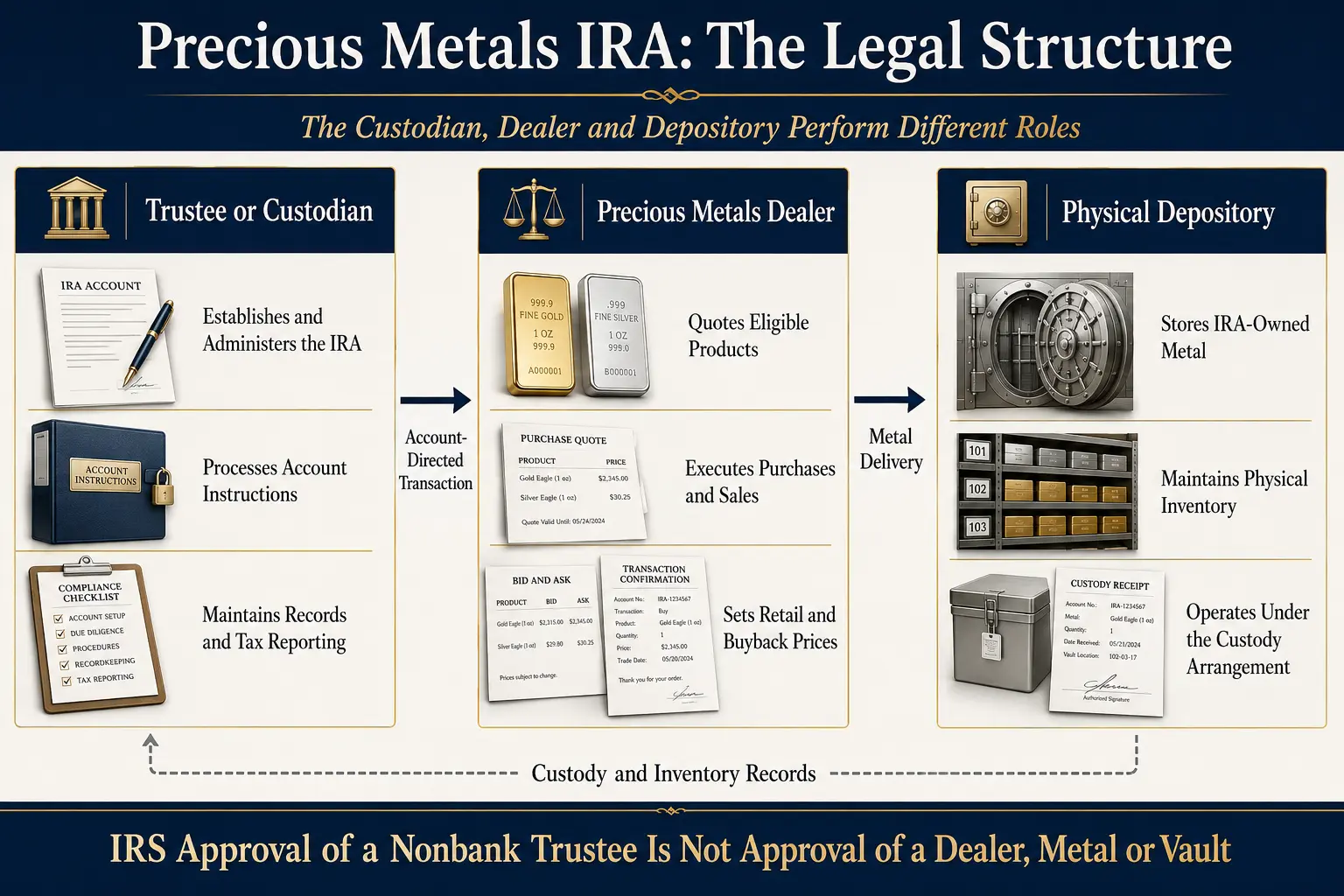
A related point on provider roles: a one-participant plan can involve document drafting, administration or recordkeeping, trust services, custody, transaction processing and storage — potentially across different entities. For bullion, the relevant question is not who sold the plan document but who will have physical possession, and whether that party satisfies the §408(a) cross-reference. The same verification discipline applied to IRA custodians is set out in the custodian due-diligence guide, and the provider-versus-custodian distinction in the provider verification framework.
Cost Categories to Inspect
The decision is not simply metal versus no metal. A physical-asset structure can create several separate cost layers depending on the provider and custody arrangement: plan document setup or restatement, annual administration or recordkeeping, trustee or custodial charges, transaction or wire charges, dealer premium or spread, physical storage, insurance or safeguarding charges, and valuation or special-asset processing.
No average should be assumed. The sponsor should request the current written schedule from each party in the chain and identify which charges are fixed, asset-based, transaction-based or embedded in a dealer's price. The mechanics of embedded dealer compensation are covered on the dealer markup data page.
When a One-Participant Plan Is the Wrong Tool
A one-participant plan is not automatically the better structure simply because it can offer broad investment authority. It may be a poor fit where the business has employees who must enter the plan, where the owner would prefer simpler administration, where fixed plan and custody costs are large relative to the balance, or where a self-directed IRA achieves the intended exposure with less operational complexity.
The point is not that one account type is superior. The decision rests on eligibility, governing documents, rollover needs, contribution objectives, custody requirements, administration and total cost — and for a smaller balance, the fixed costs often decide it.
Rollovers in and out
An eligible traditional IRA amount may generally be rolled into a qualified plan if the receiving plan accepts that rollover type. The IRS is explicit that a plan is not required to accept rollover contributions, so the document controls availability. Eligible distributions from a qualified plan can generally be rolled to another eligible plan or an IRA, subject to the statutory exclusions and the receiving arrangement's own rules. Account-to-account detail is handled by the rollover eligibility matrix.
Once the plan-document, classification and custody questions above are answered, a reader comparing providers that administer self-directed retirement accounts holding metals may find the provider comparison useful.
Comparing self-directed precious-metals providers?
Goldco is a precious metals company. Customers can request a free Gold & Silver Kit at signup. Goldco markets a buyback program; customers should request current written terms directly.
Minimum investment: $25k · BBB rating: A+
Owners of this website may be paid to recommend Goldco. The content on this website, including any positive reviews of Goldco and other reviews, may not be neutral or independent.
Frequently Asked Questions
Can a Solo 401(k) buy physical gold?
Potentially, but not merely because the account is called a Solo 401(k). Three conditions have to hold together: the plan document must permit the investment, IRC §408(m) must not treat the specific asset as a collectible, and qualifying bullion must satisfy the statutory physical-possession condition. Each is a separate question and all three are decided before any purchase.
Can a Solo 401(k) owner store the plan's gold at home?
The primary sources do not support a general yes. For qualifying bullion, §408(m)(3)(B) requires physical possession by a trustee described in §408(a), which the IRS describes as a bank or an approved nonbank trustee. For qualifying coins the position is different but not permissive: no primary source reviewed provides a general approval for owner-home storage of plan-owned coins in a one-participant plan, so this page does not treat that silence as permission.
Can the business owner be trustee of the Solo 401(k)?
Yes. IRS guidance states that a 401(k) trustee may be the business owner, an employee, or a financial or trust institution. That general plan-trustee status should not be confused with the separate §408(a)-trustee status the bullion exception cross-references, which §408(a)(2) limits to a bank or another person approved for that role.
Does IRC §408(m) apply only to IRAs?
No, and this is the point most commonly got wrong. Section 408(m)(1) expressly applies to an individual retirement account or an individually directed account under a plan described in §401(a). The IRS also publishes an Issue Snapshot addressing collectibles specifically in individually directed qualified-plan accounts.
What happens if a Solo 401(k) account buys a collectible?
For an individually directed qualified-plan account, §408(m) treats the acquisition as a distribution from that account equal to the account's cost of the collectible. The IRS indicates the amount should be reported to the participant on Form 1099-R.
Is a Solo 401(k) exempt from the prohibited-transaction rules?
No. IRC §4975 includes a qualified trust described in §401(a) within its definition of a plan, and it prohibits specified direct or indirect dealings with disqualified persons. An owner who is simultaneously employer, participant, trustee and fiduciary occupies several roles at once, which makes transaction design more important rather than less.
Does a prohibited transaction terminate a Solo 401(k) the way it can terminate an IRA?
Not by the same mechanism. The account-disqualification rule in §408(e)(2), under which an IRA can cease to be an IRA as of the first day of the taxable year, is IRA-specific. For a qualified plan the consequence discussed in §4975 is the excise-tax regime on participating disqualified persons, alongside any separate plan-qualification or fiduciary issues the facts create.
Is a Solo 401(k) exempt from ERISA?
That shorthand is too loose. DOL regulation 29 C.F.R. §2510.3-3 excludes a plan whose only participants are an owner and spouse from the Title I definition of an employee benefit plan, and DOL guidance explains that the exclusion ends once one or more common-law employees participate. It is a Title I coverage rule, not permission to disregard the Internal Revenue Code, and it does not by itself establish any creditor-protection claim.
Can a traditional IRA be rolled into a Solo 401(k)?
Eligible traditional IRA amounts may be rolled into a qualified plan if the receiving plan accepts that type of rollover. The IRS is explicit that a retirement plan is not required to accept rollover contributions, so the plan document and the administrator's rules decide whether it is available.
Does hiring one employee automatically end a Solo 401(k)?
Not on the hiring date itself. The question is whether a non-owner worker satisfies the plan's eligibility conditions. Once an employee must be included, the arrangement is no longer the owner-only plan the IRS describes as a one-participant 401(k). The screen is also broader than the familiar full-time threshold, because SECURE 2.0 shortened the long-term part-time service test.
Bottom Line
A one-participant 401(k) can provide broad investment authority, but “self-directed” is not an exemption from the plan document, §408(m) or §4975. The clean sequence is to verify eligibility, then plan-document authority, then asset classification, then custody, and finally prohibited-transaction exposure before the plan commits funds.
For physical bullion the statute draws the clearest line available: qualifying bullion must be in the physical possession of a trustee described in §408(a), and an owner-trustee does not acquire that status by being named in the plan document. For qualifying coins the source record is less explicit about owner possession in a one-participant plan — and this page does not convert that silence into permission.
The broader account structure is explained in the precious metals IRA reference, product eligibility in IRA-eligible precious metals, and the IRA-owned LLC variant in the checkbook-control IRA LLC guide. Audience-specific context for self-employed readers is on the owner-operator and skilled-trades pages.
This page is educational and does not evaluate any reader's business, plan documents or proposed transaction. Outcomes depend on the plan's governing terms, the asset's exact statutory classification, the custody arrangement and the parties involved, and one significant question addressed here is not settled by the primary sources. Readers should consult a qualified tax professional or ERISA attorney before adopting a plan or acquiring metal inside one. Figures identified as current-year require annual review. Past performance does not guarantee future results.