Educational only: This article is general educational information for construction workers and the skilled trades. It is not financial, tax, legal, pension, investment, insurance, or retirement-planning advice. Union agreements, plan documents, business structures, state laws, and personal circumstances differ. Customers should speak to a financial or tax advisor before making decisions. Goldco does not offer tax or legal advice. Past performance does not guarantee future results.
64% of private-industry union workers had access to a defined-benefit pension in March 2025 — versus just 9% of nonunion workers. In the trades, the retirement path depends heavily on union status.
Source: U.S. Bureau of Labor Statistics. These figures cover private industry broadly, not construction alone, but show why the two paths differ.
Key takeaways
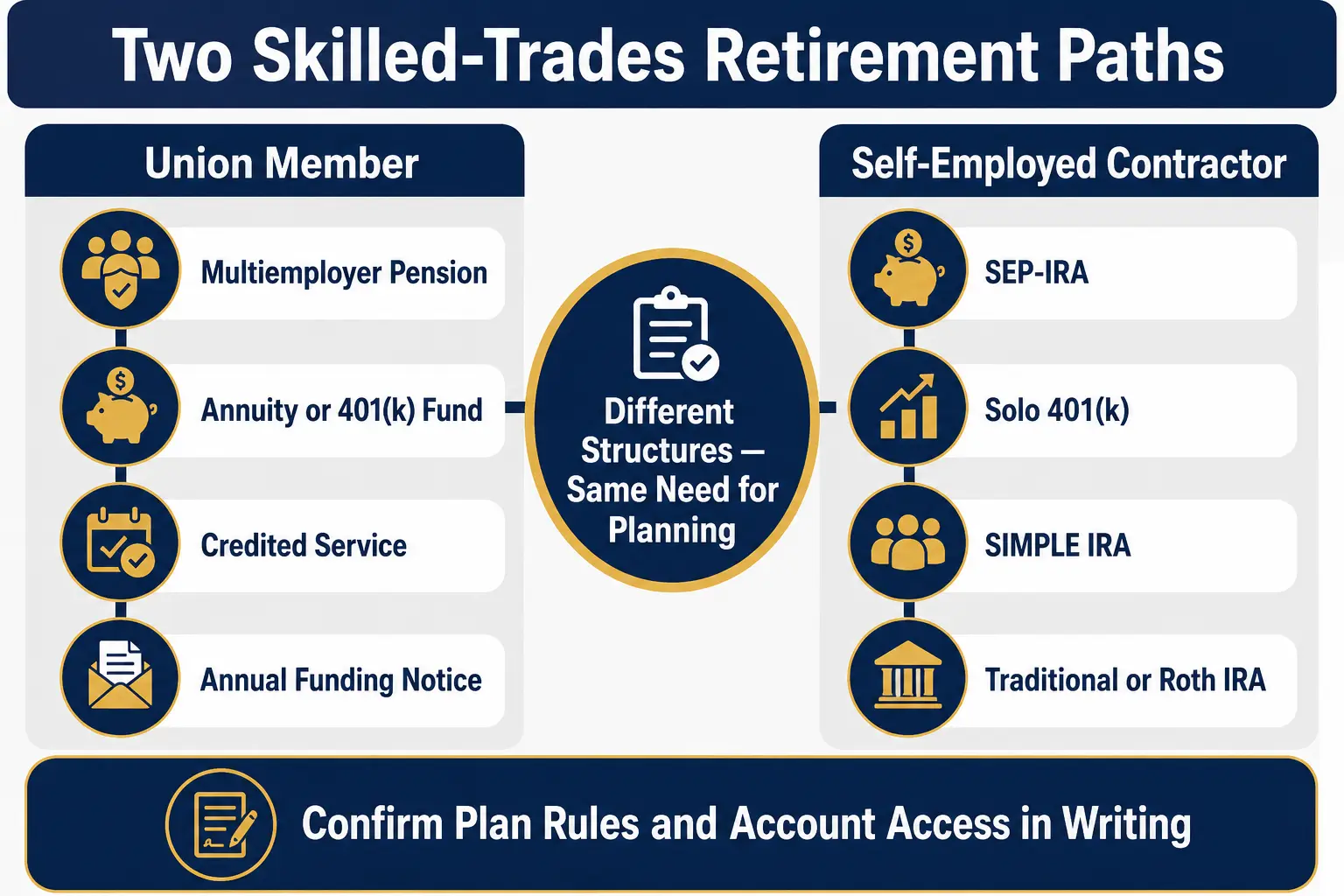
- Two paths: union members earn a multiemployer pension plus an annuity/401(k) fund; self-employed contractors build their own SEP, SIMPLE, Solo 401(k), or IRA.
- Read the annual funding notice and track credited service — a pension statement is not a personal brokerage account.
- A pension and an annuity fund are different: one is formula-based income; the other is an individual balance (PBGC insures the pension, not the annuity fund).
- Physical work argues for flexibility — test an earlier work-exit date, keep a cash reserve, and plan health coverage before Medicare.
- Gold is a modest diversifier at most. It does not fix an underfunded pension or replace a broad portfolio.
Quick answer: Union tradespeople should understand both the pension and any annuity or 401(k) fund, read the annual funding notice, and track credited service. Independent contractors should compare business retirement plans based on net self-employment income and employee rules. Precious metals belong, if at all, in a modest supporting role after pension rights, account access, emergency reserves, health coverage, and retirement income have been reviewed. Gold does not repair an underfunded pension or replace a broad retirement portfolio.
Why Is Retirement Planning Different for Construction Workers?
Construction is a large and varied labor market. BLS reported about 6.4 million construction and extraction jobs in May 2025, with the largest groups including construction laborers, first-line supervisors, electricians, and carpenters (U.S. Bureau of Labor Statistics). Retirement coverage is uneven: in March 2025, 70% of civilian workers in construction, extraction, farming, fishing, and forestry occupations had access to at least one retirement benefit, while 52% participated (U.S. Bureau of Labor Statistics). Union status changes the picture sharply: across private industry, 64% of union workers had access to a defined-benefit plan and 65% to a defined-contribution plan, while among nonunion private-industry workers defined-benefit access was 9% and defined-contribution access was 70% (U.S. Bureau of Labor Statistics).
Construction income can also move with weather, projects, overtime, and the business cycle. BLS notes that cold weather can limit construction activity in northern climates, and some equipment operators work irregular or seasonal schedules (U.S. Bureau of Labor Statistics; U.S. Bureau of Labor Statistics). A practical plan therefore needs more than an account balance — it should identify pension service and vesting, individual-account balances, expected retirement age under several physical-capacity scenarios, seasonal cash-flow needs, health coverage before Medicare, disability and emergency reserves, and Social Security and other household income. The site's Gold IRA guide for first responders addresses another occupation group in which physical demands can affect the retirement timeline.
What Retirement Plans Do Union Construction Workers Usually Have?
Many union construction workers participate in multiemployer plans. PBGC defines a multiemployer plan as a collectively bargained plan maintained by more than one employer, usually within the same or related industries, and a labor union — often called Taft-Hartley plans, and most governed by a board with equal labor and employer representation (Pension Benefit Guaranty Corporation). This structure fits the building trades because a worker may move among contributing contractors while staying in the same craft and geographic plan, and PBGC states that multiemployer plans can preserve service when a participant moves from one contributing employer to another, with some plans also using reciprocity arrangements across geographic areas.
How does the multiemployer pension work?
A multiemployer defined-benefit pension usually converts employer contributions and credited service into a plan-defined retirement benefit. The collective bargaining agreement commonly sets an employer contribution formula, such as a stated amount for each covered hour, while the trustees determine benefits under the plan document and funding rules (Pension Benefit Guaranty Corporation). The pension statement should not be treated as a personal brokerage account — the plan formula, vesting rules, retirement age, service credits, survivor election, and plan funding determine the benefit. Important records include the Summary Plan Description, annual benefit or service statements, credited-hour records, vesting status, normal and early-retirement rules, disability-retirement provisions, reciprocity agreements, and the annual funding notice.
What is a building-trades annuity or 401(k) fund?
Some collectively bargained benefit packages pair the pension with a separate defined-contribution plan that may be called an annuity fund, savings plan, or 401(k) fund. A defined-contribution plan holds an individual account whose value reflects contributions, investment results, fees, and distributions, and the exact legal type must be confirmed in the plan documents rather than inferred from the word "annuity" (Internal Revenue Service). PBGC protects private-sector defined-benefit pensions through its insurance programs, but it does not insure defined-contribution plans such as 401(k) and profit-sharing plans (Pension Benefit Guaranty Corporation). That means a union member may have two retirement resources with different jobs: a pension fund providing formula-based retirement income, and an annuity or 401(k) fund holding an individual balance that can support rollovers, withdrawals, or later income under plan rules.
How Stable Are Multiemployer Pension Funds?
There is no single answer for every building-trades pension. PBGC's multiemployer insurance program covers private-sector multiemployer defined-benefit plans, and PBGC reported that the program protects about 11.1 million workers and retirees in roughly 1,300 plans, subject to statutory limits that differ from the single-employer program (Pension Benefit Guaranty Corporation; Pension Benefit Guaranty Corporation). Some plans are well funded; others have faced demographic, employer-base, investment, or contribution challenges. The American Rescue Plan Act created PBGC's Special Financial Assistance program for eligible financially troubled multiemployer plans, which PBGC states can help eligible plans pay retirement benefits without reduction for many years and restore certain previously suspended benefits — and the program does not mean every multiemployer plan has a funding problem (Pension Benefit Guaranty Corporation).
Federal law generally requires PBGC-covered defined-benefit plans to provide an annual funding notice. The Department of Labor's current multiemployer model includes the plan's funded percentage, assets, liabilities, participant data, funding policy, PBGC information, and any applicable financial-status disclosures (U.S. Department of Labor). A calm review should focus on the specific plan rather than headlines about the entire pension system, asking: What is the current funded percentage? Has the plan reported endangered, critical, or critical-and-declining status? Has the benefit formula changed? Are employer contribution rates changing? Has the plan received Special Financial Assistance? What portion of the stated benefit falls within PBGC protection limits? How would early retirement affect the monthly amount? PBGC insurance should not be read as a promise that every dollar of a plan's stated benefit will be paid by PBGC — the multiemployer program has legal limits, and the plan administrator remains the main source for benefit estimates (Pension Benefit Guaranty Corporation).
What Can Self-Employed or Non-Union Tradespeople Use?
A self-employed carpenter, electrician, plumber, remodeler, equipment operator, or subcontractor may be able to establish a business retirement plan, with the right option depending on net earnings, business structure, employees, contribution goals, and administrative capacity. A SEP-IRA allows an employer, including a self-employed individual, to contribute to SEP-IRAs for eligible participants; for 2026 the limit is generally the lesser of 25% of compensation or $72,000, with special calculations for self-employed owners, and no employee salary deferrals or age-50 catch-up contributions (Internal Revenue Service). A SEP can suit variable business income because an employer is not required to contribute every year, though when contributions are made, eligible employees generally must receive the same percentage used for the owner.
A one-participant 401(k) (Solo 401(k)) covers a business owner with no common-law employees, or the owner and spouse, who contributes in employee and employer roles; for 2026 the employee deferral limit is $24,500 and the overall defined-contribution limit is $72,000 before age-based catch-up contributions, subject to net-earnings calculations, and Form 5500-EZ is generally required when plan assets reach $250,000 at year-end (Internal Revenue Service). A SIMPLE IRA may suit a small employer with no more than 100 employees; for 2026 the standard employee salary-reduction limit is $17,000 with a $4,000 age-50 catch-up, and the employer must make a matching or nonelective contribution each year (Internal Revenue Service). Finally, traditional and Roth IRAs have a 2026 combined limit of $7,500 ($8,600 at age 50 or older), subject to compensation and income rules; participation in a business or union plan can affect traditional IRA deductibility, and Roth eligibility is income-limited (Internal Revenue Service). An IRA may serve as a starting account or a supplement, usually with a lower annual limit than a business plan.
How Do Physical Demands and Irregular Income Change the Plan?
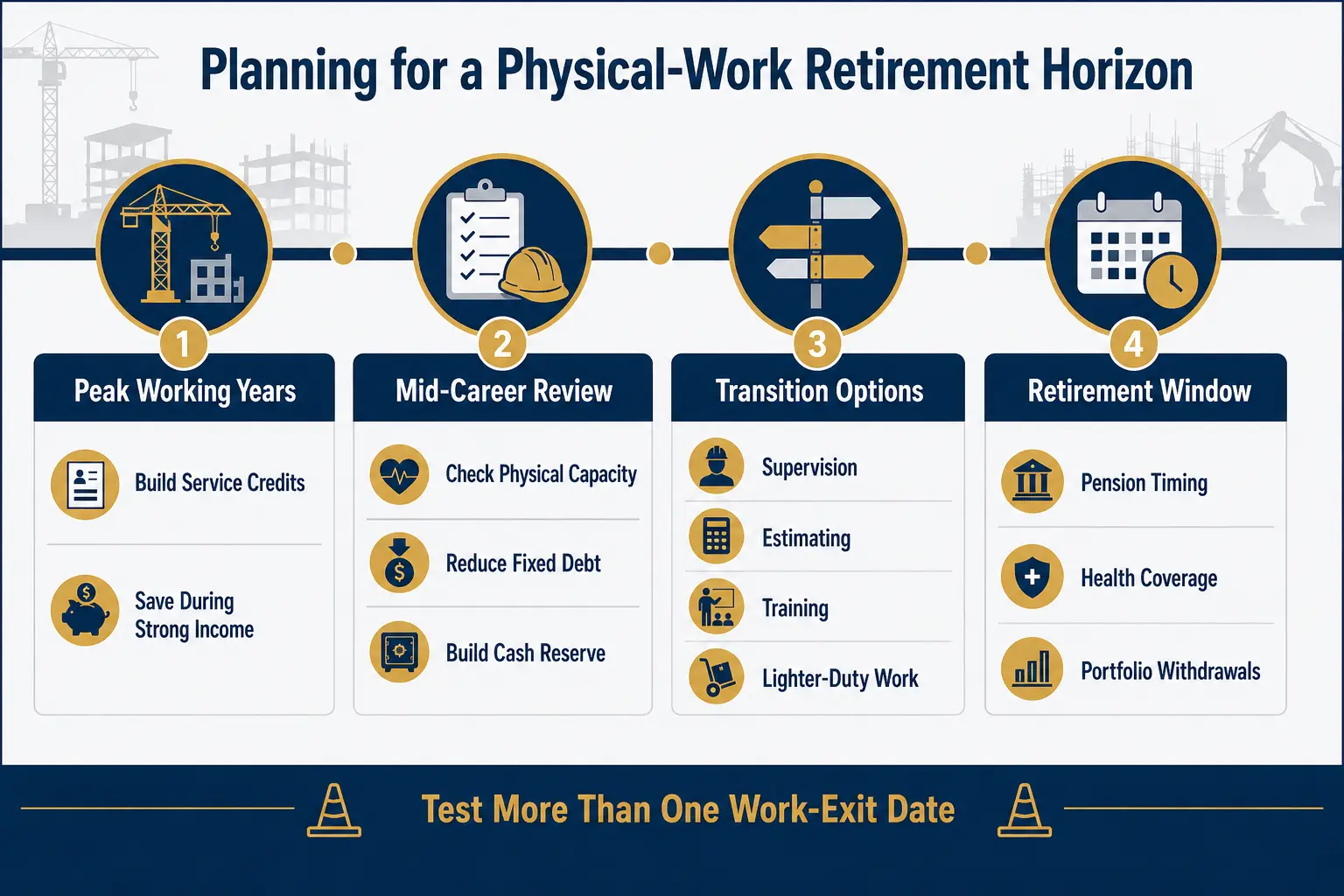
Construction retirement planning should not assume that full earnings will continue to a fixed age. BLS found that construction and extraction workers spent 79.5% of the workday standing on average, while low-posture work was required for 90.9% and structure-related climbing for 52.4% — findings that support a planning inference: a tradesperson may benefit from testing a retirement plan under an earlier work-exit date, even when the intended retirement age is later (U.S. Bureau of Labor Statistics). A practical physical-demand plan may include a retirement projection at several possible exit ages, a cash reserve separate from retirement accounts, health-insurance planning before Medicare, a disability-coverage review, a transition path into supervision, estimating, inspection, training, or lighter-duty work, and lower fixed debt before the intended retirement date.
Irregular income also changes the contribution schedule. A contractor can use a baseline monthly amount, a percentage of net business income, and a year-end true-up after tax and equipment costs are clearer — and retirement contributions should be based on plan compensation and net self-employment earnings rather than gross contract receipts (Internal Revenue Service). The site's retirement portfolio longevity guide covers the separate question of turning accumulated assets into sustainable retirement spending.
Where Could a Self-Directed or Gold IRA Fit?
A Gold IRA is a common label for a self-directed IRA holding qualifying physical precious metals. The IRS generally treats metals and coins as collectibles, but certain coins and sufficiently refined gold, silver, platinum, and palladium bullion can qualify for an exception, and qualifying bullion must remain in the physical possession of a bank or IRS-approved nonbank trustee (Internal Revenue Service; Internal Revenue Service). A self-directed IRA may be funded by regular IRA contributions, an IRA-to-IRA transfer, or an eligible rollover distribution from a plan that permits it; a direct rollover sends an eligible plan distribution to the receiving IRA without federal withholding from the transferred amount (Internal Revenue Service).
A union pension is not automatically transferable. A defined-contribution annuity or 401(k) balance may become eligible after separation, retirement, or another plan-permitted event, and the plan administrator must confirm the distribution and rollover rules in writing. The IRA-to-gold-and-silver transfer guide explains the mechanics, and the retirement gold-allocation guide addresses allocation without assigning one percentage to every tradesperson. Customers should speak to a financial or tax advisor before making decisions about a pension election, rollover, retirement-plan contribution, or asset allocation. Goldco does not offer tax or legal advice.
What Are the Trade-Offs, and What Should Be Checked First?
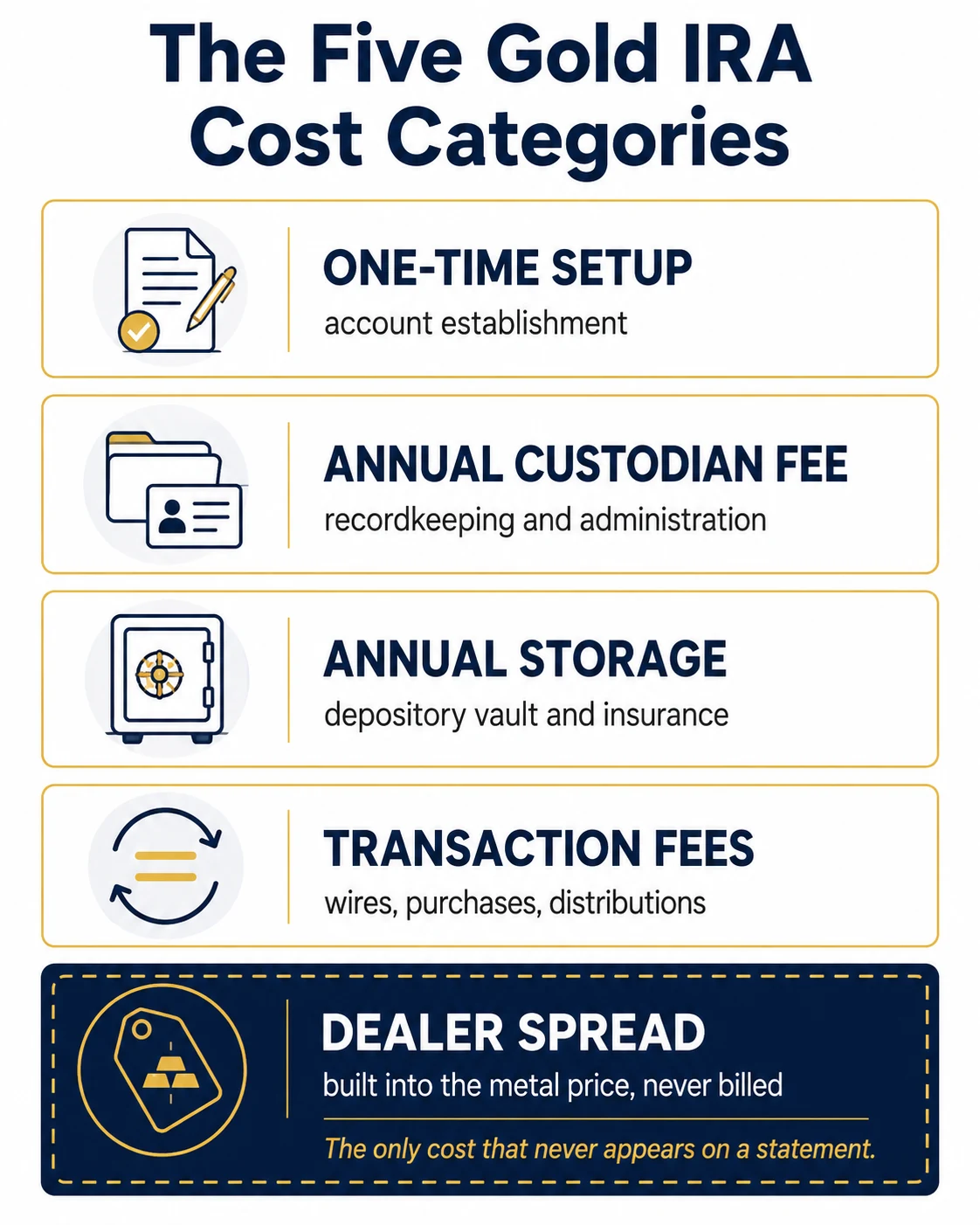
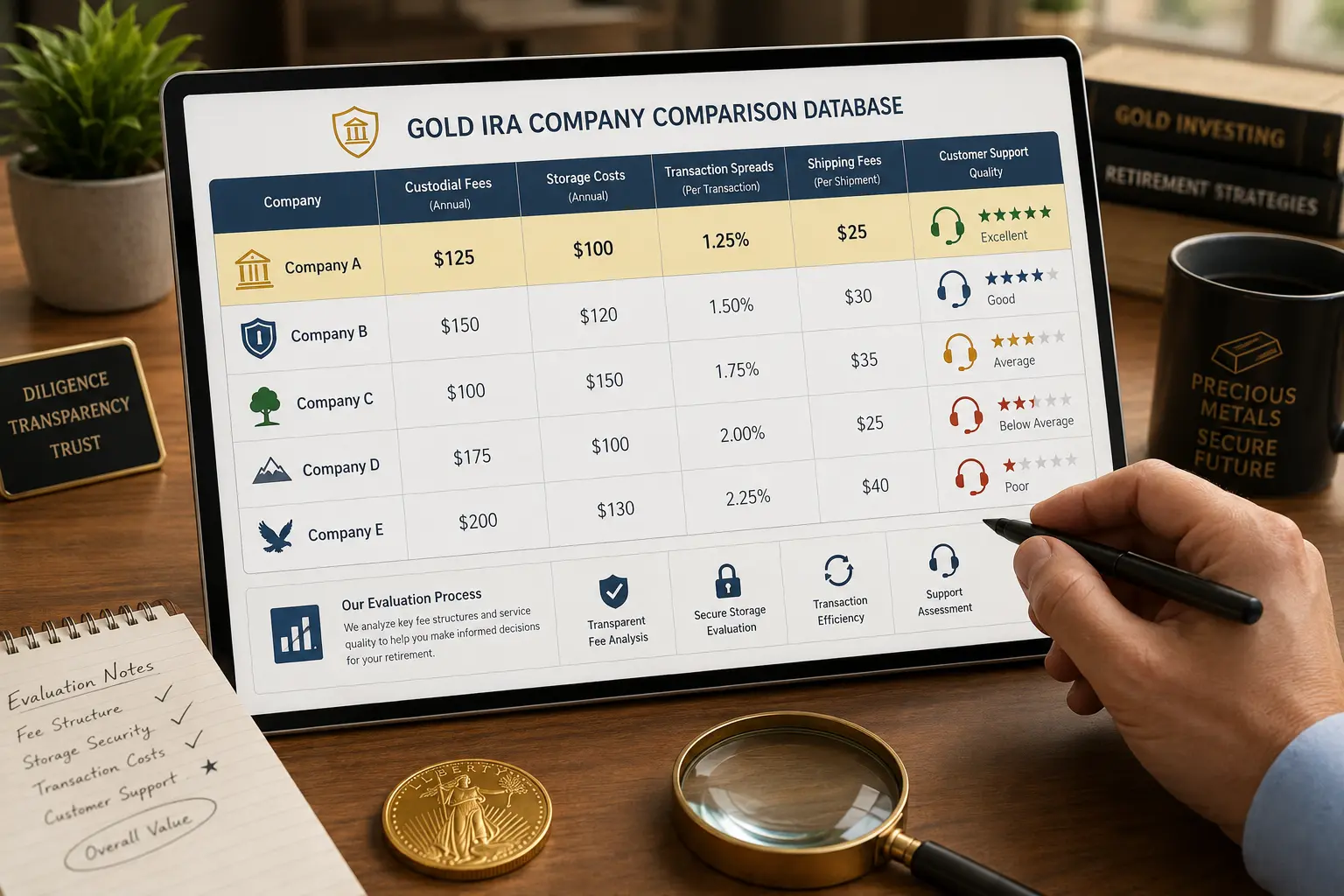
Precious metals can add a different source of price movement to a portfolio, but they do not produce pension service credits, employer contributions, interest, or dividends. The CFTC and FINRA advise customers to obtain all dealer prices, fees, commissions, storage costs, insurance costs, and buyback terms in writing, and explain that dealers normally sell above spot and buy below spot, creating a spread — while physical metals in a self-directed IRA also involve trustee or custodian administration and storage (Commodity Futures Trading Commission and FINRA). Before any rollover or metals purchase, a construction worker or contractor should check:
- Pension rights: vested service, early-retirement reduction, survivor options, and funding notice.
- Annuity or 401(k) terms: current balance, fees, investment options, and distribution eligibility.
- Business-plan alternatives: SEP, SIMPLE IRA, and one-participant 401(k) contribution potential.
- Cash needs: taxes, tools, vehicles, equipment, health coverage, and emergency reserves.
- Rollover consequences: plan protections, loan rights, withdrawal access, and fees that may be lost.
- Gold IRA costs: dealer spread, custodian administration, depository storage, transactions, and exit process.
- Portfolio concentration: the metals position should be evaluated against the full household plan.
- Liquidity: physical metal generally requires a dealer bid and custodian process before cash is available.
The gold-versus-cash guide explains why a liquid reserve and a metals position serve different purposes. The Gold IRA decision quiz can organize account-structure questions but does not provide individualized advice.
What Are Common Questions About Skilled-Trades Retirement Planning?
What is a Taft-Hartley pension?
It is a multiemployer pension created through collective bargaining between a union and more than one employer, usually in the same or related industries. Most plans are jointly governed by labor and employer trustees (Pension Benefit Guaranty Corporation).
Is a union annuity fund the same as a pension?
Not necessarily. A pension is generally a defined-benefit plan. An annuity, savings, or 401(k) fund may be a separate defined-contribution plan with an individual balance. The plan's Summary Plan Description identifies the legal structure.
Does PBGC protect a construction union pension?
PBGC's multiemployer program covers eligible private-sector multiemployer defined-benefit plans. Protection is subject to legal limits and does not cover defined-contribution annuity or 401(k) balances (Pension Benefit Guaranty Corporation).
What retirement account can a self-employed contractor use?
Common options include a SEP-IRA, SIMPLE IRA, one-participant 401(k), traditional IRA, and Roth IRA. Eligibility and contribution limits depend on net earnings, employees, age, and plan rules (Internal Revenue Service).
Can a union annuity fund be rolled into an IRA?
An eligible distribution may be rolled into an IRA when the plan permits the distribution. The plan administrator must confirm eligibility, and a direct rollover generally avoids federal withholding from the transferred amount (Internal Revenue Service).
Does a physically demanding job require an earlier retirement age?
No single age applies. Physical capacity, health, pension rules, savings, and access to lighter-duty work differ by person. BLS physical-demand data support testing earlier-exit scenarios, but they do not predict when one worker will retire (U.S. Bureau of Labor Statistics).
Can gold fix a pension funding concern?
No. A metals allocation does not change a pension plan's assets, liabilities, employer contributions, or benefit rules. It can only be considered as one separate portfolio holding.
Bottom Line
Construction and skilled-trades retirement planning begins with the worker's actual path. Union members should understand the pension, any annuity or 401(k) fund, credited service, reciprocity, early-retirement rules, and annual funding notice. Self-employed contractors should compare SEP-IRAs, SIMPLE IRAs, one-participant 401(k)s, and individual IRAs using net business income and employee rules. Physical demands and uneven work schedules make flexibility important, so a plan should remain workable if full-time field work ends earlier than expected. A self-directed Gold IRA may have a small diversification role, but it is not a pension substitute, an emergency fund, or a solution to plan funding. The core plan remains pension rights, diversified savings, liquidity, health coverage, and realistic retirement timing.
Sources
- U.S. Bureau of Labor Statistics. Occupational employment and wages · Retirement benefit access · Benefits by bargaining status · Construction physical demands.
- U.S. Bureau of Labor Statistics. Construction laborers and helpers · Construction equipment operators.
- Pension Benefit Guaranty Corporation. Multiemployer introduction · Multiemployer program · How PBGC operates · Special Financial Assistance · PBGC coverage · Multiemployer benefit limits.
- U.S. Department of Labor. Multiemployer annual funding notice model · Reporting and disclosure guide.
- Internal Revenue Service. SEP plans · One-participant 401(k) · SIMPLE IRA · Publication 590-A (IRA limits).
- Internal Revenue Service. Self-employed contribution calculation · Retirement plans for self-employed people · Rollovers · Investments in collectibles · IRA FAQs.
- CFTC and FINRA. 10 things about precious-metals IRAs.
Reviewed and edited by Daniel M. — editor, 401kToGoldIRA.org. Educational only; sourced to the U.S. Bureau of Labor Statistics, the Pension Benefit Guaranty Corporation, the U.S. Department of Labor, the IRS, and the CFTC/FINRA. Not financial, tax, or investment advice.