Educational only: This article is general educational information for truck drivers and owner-operators. It is not financial, tax, legal, business, investment, or retirement-planning advice. Plan eligibility, contribution calculations, deadlines, employee rules, and tax treatment depend on individual and business facts. Customers should speak to a financial or tax advisor before making decisions. Goldco does not offer tax or legal advice. Past performance does not guarantee future results.
The U.S. had about 2,235,100 heavy and tractor-trailer truck-driver jobs in 2024 — and roughly 7% were self-employed owner-operators who must set up their own retirement plan.
Source: U.S. Bureau of Labor Statistics. An owner-operator has no employer to choose a plan, run payroll deductions, or provide a match.
Key takeaways
- The account depends on the work: W-2 drivers may have an employer 401(k); owner-operators build their own plan.
- The self-employed toolkit is SEP-IRA, SIMPLE IRA, Solo 401(k), and traditional or Roth IRA — each suits a different income and employee situation.
- A SEP fits variable income (flexible, no yearly requirement); a Solo 401(k) can allow more at moderate income but needs more admin.
- Contributions use net earnings, not gross settlements — base saving on business cash flow after fuel, taxes, and reserves.
- Gold is one limited diversifier, only after the main plan, tax reserve, maintenance fund, and emergency cash are in place.
Quick answer: A solo owner-operator with variable income may compare a SEP-IRA with a Solo 401(k). A small carrier with employees may also compare a SIMPLE IRA. A traditional or Roth IRA can supplement the business plan. The decision depends on net self-employment income, employees, contribution goals, administration, and cash flow. A self-directed IRA may hold a wider range of assets, including qualifying precious metals, but physical metals are only one diversification choice and should not replace emergency cash, tax reserves, truck-maintenance funds, or a broad retirement portfolio.
What Are the Main Trucker Retirement Savings Options?
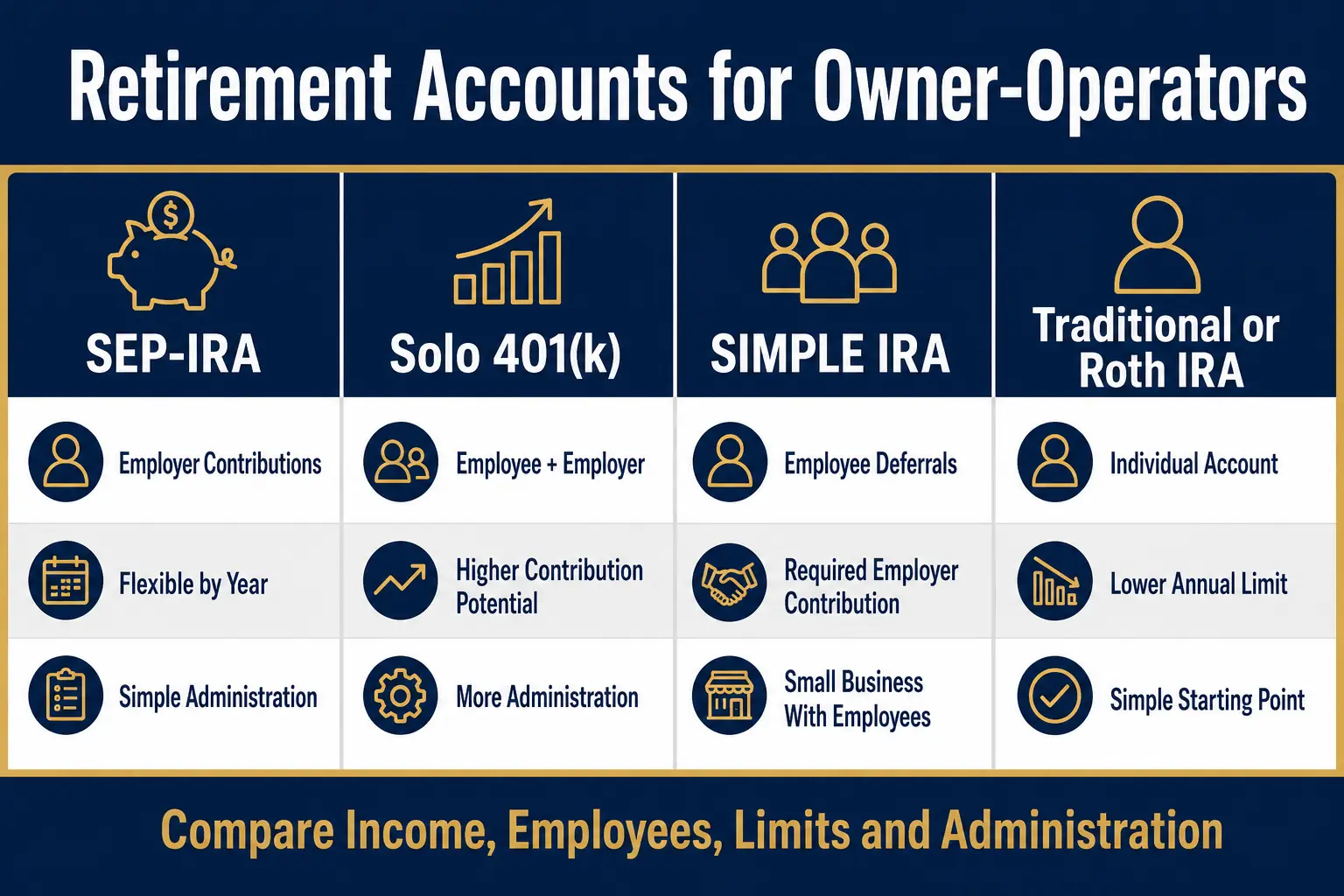
The main trucker retirement savings options depend on whether a driver is a company employee or a self-employed owner-operator. A W-2 driver may have access to an employer 401(k) or another workplace plan. An owner-operator usually must establish and fund a retirement plan through the trucking business. The self-employed toolkit includes the SEP-IRA, the SIMPLE IRA, the one-participant or Solo 401(k), the traditional IRA, and the Roth IRA when income rules permit. A SEP-IRA offers flexible employer contributions and simple administration; a Solo 401(k) lets an eligible business owner contribute in employee and employer roles; a SIMPLE IRA may fit a small trucking company with employees; and traditional and Roth IRAs have lower limits but can serve as a starting point or an additional savings layer.
Why Do Many Truckers Lack an Employer Retirement Plan?
The trucking workforce includes employees and independent business owners. The Bureau of Labor Statistics reported about 2,235,100 heavy and tractor-trailer truck-driver jobs in 2024, listed self-employed workers as 7% of that occupation, and explains that some long-haul drivers, known as owner-operators, buy or lease trucks and operate their own businesses (U.S. Bureau of Labor Statistics). An owner-operator does not have a separate employer that automatically chooses a plan, handles payroll deductions, or provides a match — the driver and the business must select and maintain the plan.
The challenge is not a lack of tax-advantaged choices. The IRS provides several retirement-plan options for self-employed individuals and small businesses (Internal Revenue Service). The challenge is variable net income: fuel, insurance, repairs, tires, permits, truck payments, and downtime can reduce the money available after a strong gross settlement.
What Retirement Accounts Can a Self-Employed Trucker Use?
How does a SEP-IRA work for an owner-operator?
A Simplified Employee Pension allows a business to make employer contributions to SEP-IRAs established for eligible participants. The IRS states that a business of any size, including a self-employed business, can establish a SEP; only the employer contributes, and ordinary employee salary deferrals and catch-up contributions are not permitted (Internal Revenue Service). For 2026, the maximum employer contribution cannot exceed the lesser of 25% of compensation or $72,000, and a self-employed person's calculation is more complex because compensation is based on net earnings after deducting one-half of self-employment tax and the owner's contribution (Internal Revenue Service; Internal Revenue Service).
The IRS states that a SEP employer does not have to contribute every year and describes flexible annual contributions as useful when cash flow changes — which can suit an owner-operator whose net income moves with freight rates, equipment costs, or downtime. A strong year may support a larger contribution; a weak year may support a smaller contribution or none. The main limitation: when a business has eligible employees, the same contribution percentage generally must be used for each eligible participant, and contributions are immediately vested. A SEP may fit a solo owner-operator who values simplicity but can become expensive when the business hires eligible workers.
How does a Solo 401(k) work for a trucker?
A one-participant 401(k), often called a Solo 401(k), covers a business owner with no common-law employees, or the owner and spouse. The IRS states that the owner acts as employee and employer and may make an employee elective deferral and an employer nonelective contribution (Internal Revenue Service). For 2026, the basic employee deferral limit is $24,500, the overall defined-contribution limit is $72,000 before catch-up contributions (subject to earned-income calculations), and the general catch-up limit for participants age 50 or older is $8,000, with a higher limit at ages 60 through 63 (Internal Revenue Service). The maximum is not automatic — self-employed contributions depend on net earnings after required adjustments.
The employee-deferral feature may allow a solo owner to contribute more at moderate income than an employer-only SEP formula would permit, though the exact result requires a tax calculation because the plans can produce different limits from the same net profit. A Solo 401(k) requires a plan document and ongoing compliance: the IRS states that a one-participant plan generally must file Form 5500-EZ when assets exceed $250,000 at year-end, and the one-participant treatment changes when eligible common-law employees are hired. A Solo 401(k) may fit a driver who wants employee and employer contributions and accepts more administration than a SEP.
How does a SIMPLE IRA work for a trucking business?
A SIMPLE IRA combines employee salary deferrals with required employer contributions. The IRS states that a SIMPLE IRA is generally available to employers, including self-employed individuals, with no more than 100 employees who earned at least $5,000 in the prior year, and that the employer generally cannot maintain another retirement plan at the same time (Internal Revenue Service). For 2026, the basic employee salary-reduction limit is $17,000 (some qualifying plans may use a higher limit under SECURE 2.0), and the standard catch-up is $4,000 for participants age 50 or older, with a higher catch-up at ages 60 through 63 (Internal Revenue Service). The employer must contribute each year through either a matching contribution, generally up to 3% of compensation, or a 2% nonelective contribution (Internal Revenue Service). A SIMPLE IRA may fit a small carrier with employees that wants a payroll-based plan, but it is less flexible than a SEP because the employer contribution is required each year.
How do traditional and Roth IRAs fit?
A traditional or Roth IRA is an individual account, not an employer plan. For 2026, the combined limit across all traditional and Roth IRAs is $7,500, or $8,600 for someone age 50 or older, and contributions cannot exceed taxable compensation (Internal Revenue Service). A driver can contribute to an IRA while participating in a SEP, SIMPLE IRA, Solo 401(k), or employer plan, though traditional IRA deductibility may be limited when a taxpayer or spouse is covered by a workplace plan, and Roth eligibility may be limited by income. An IRA may be enough when business income is low or the driver is not ready to establish a business plan, but its lower annual limit makes it less powerful as the only account for a profitable owner-operator.
How Does Variable 1099 Income Change the Approach?
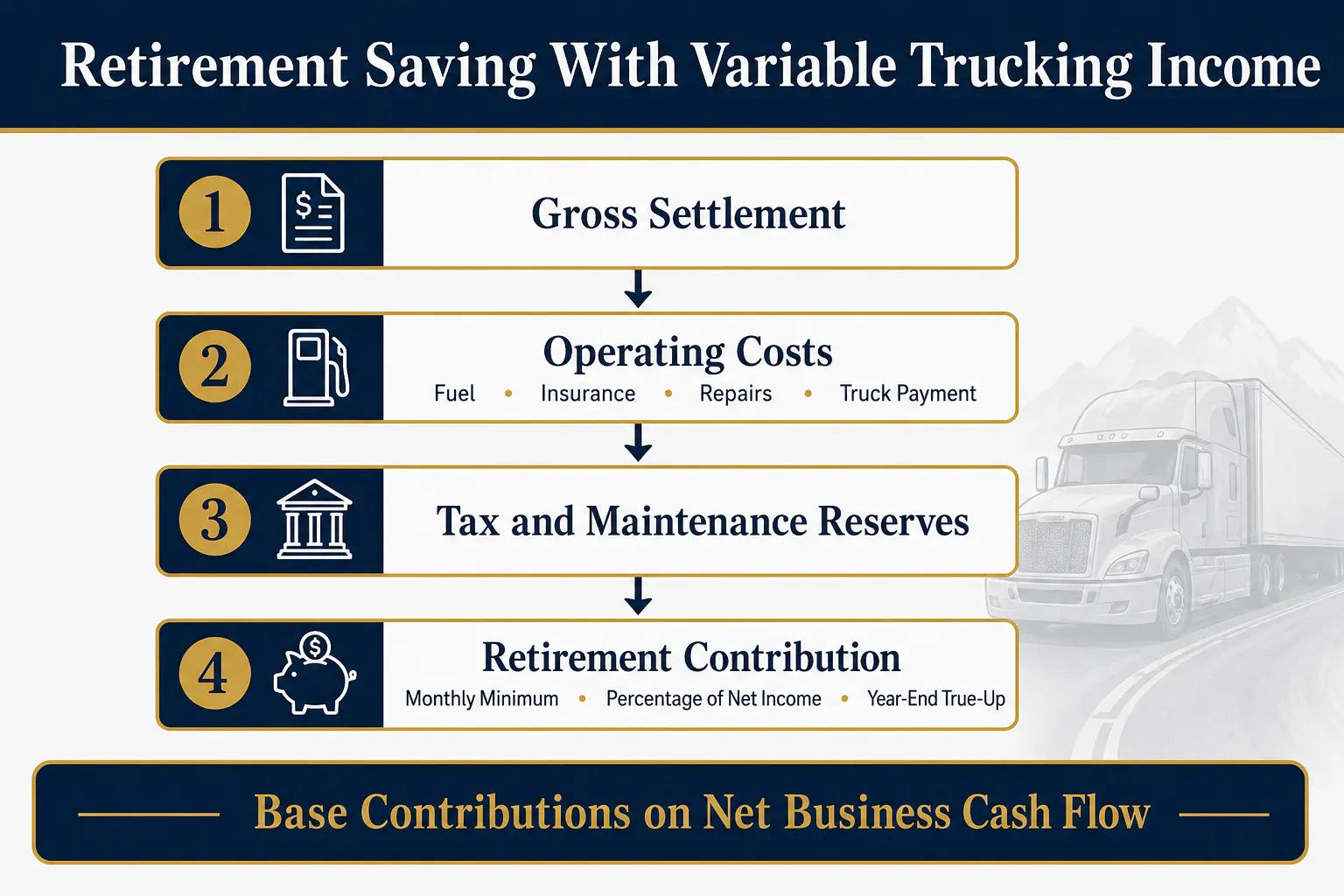
Variable income changes the saving schedule more than the long-term goal. A driver may have strong gross revenue but low net income after operating costs, and self-employed retirement contributions use eligible compensation or net earnings, not gross settlements. The IRS states that self-employed contributions require special calculations, with net earnings adjusted for one-half of self-employment tax and, depending on the plan, the owner's contribution (Internal Revenue Service). A practical system can use three levels: a monthly minimum (a small automatic amount that continues during slow months without interfering with fuel, taxes, repairs, or insurance); a percentage of net business cash flow (set aside after operating costs and estimated taxes rather than from gross revenue); and a year-end true-up (an additional contribution once net earnings are clearer). A SEP is especially suited to a year-end true-up because contributions are flexible, while a Solo 401(k) requires earlier attention to employee-deferral elections and plan deadlines.
Retirement money is not a substitute for a maintenance reserve. An engine repair, insurance deductible, or period without loads can require immediate cash, and pulling money from a retirement account may create income tax and an additional tax. Separate reserves should cover estimated taxes, maintenance, insurance deductibles, personal emergencies, and slow freight periods. Customers should speak to a financial or tax advisor before selecting a plan, calculating self-employed contributions, or changing an allocation. Goldco does not offer tax or legal advice.
What Options Do Company W-2 Drivers Have?
A company driver may receive access to an employer 401(k), profit-sharing plan, pension, or another workplace benefit. The plan controls eligibility, matching contributions, vesting, loans, distributions, and investment choices. A W-2 driver should review the employer match, vesting schedule, fees, Roth availability, beneficiary information, and rollover rules after leaving the employer. An IRA may supplement the workplace plan, subject to contribution and income rules. A former employer plan may become eligible for rollover after separation, and the destination should be selected only after comparing costs, investment choices, creditor protections, and withdrawal access.
Where Could a Self-Directed or Gold IRA Fit?
A self-directed IRA allows investments outside the standard menu offered by many banks and brokerages. A "Gold IRA" is a common label for a self-directed IRA holding qualifying physical precious metals. The IRS generally treats metals and coins as collectibles, but specific qualifying coins and bullion receive an exception, and qualifying bullion must remain in the physical possession of a bank or IRS-approved nonbank trustee (Internal Revenue Service; Internal Revenue Service). A self-directed IRA may be funded through regular IRA contributions, an IRA transfer, an eligible rollover from a former employer plan, or a permitted transfer from a SEP-IRA. The site's IRA-to-gold-and-silver transfer guide explains the process.
A limited metals position may add a different return driver to a portfolio holding stocks, bonds, and cash — but that does not make metals a retirement solution. Gold produces no operating income, interest, or dividend, and physical ownership inside an IRA adds dealer, custodian, storage, and transaction layers. The position should not use money needed for truck repairs, taxes, living costs, or emergency reserves. The retirement gold-allocation guide discusses allocation without assigning one percentage to every saver, and the Gold IRA calculator can organize costs and assumptions.
What Are the Trade-Offs of a Self-Directed Gold IRA?
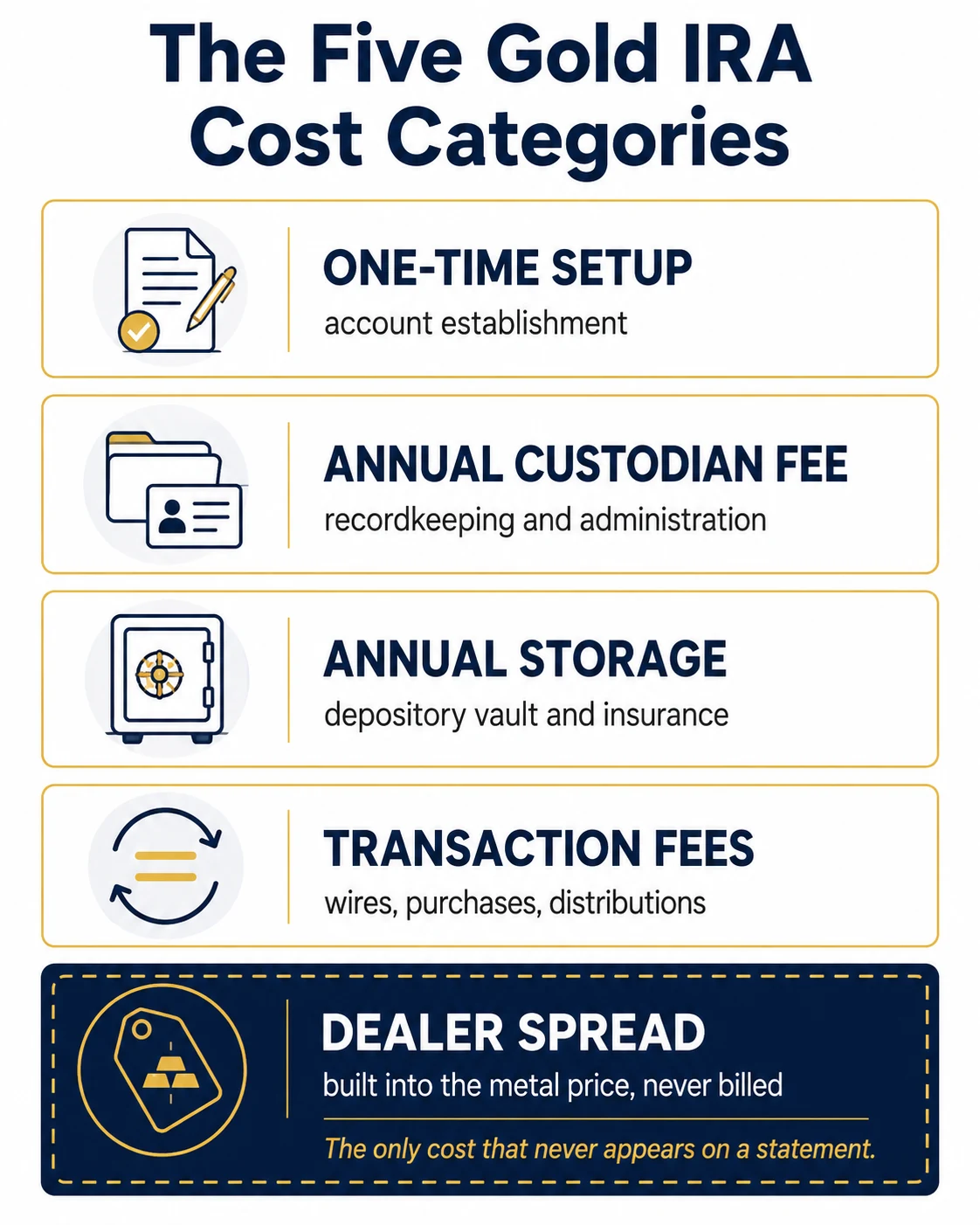
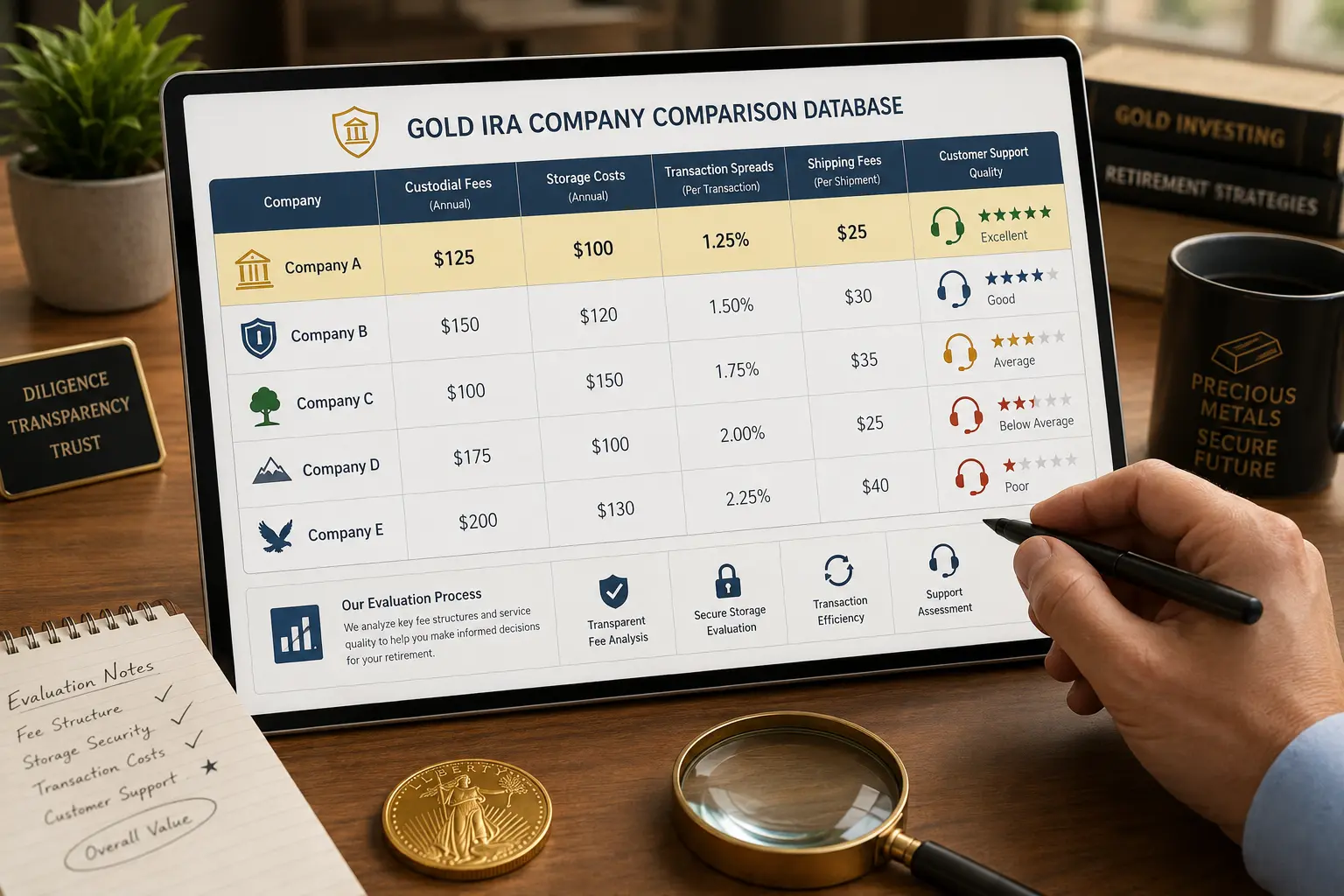
The CFTC and FINRA advise customers to obtain all fees, commissions, retail prices, and buyback terms in writing, identify dealer spreads, storage, insurance, administration, and possible tax consequences as important costs, and note that self-directed IRA fees are typically higher than directed-IRA fees (Commodity Futures Trading Commission and FINRA). On dealer pricing, a dealer normally sells above spot and buys below spot, and each dealer sets its own spread. On storage and custody, IRA metal must remain with the trustee or custodian under the approved structure, creating ongoing costs. On liquidity, physical bullion requires a dealer bid and custodian process before cash becomes available, and collectible or so-called semi-numismatic products may be harder to sell than standard bullion. On concentration and business cash, a large metal position can increase dependence on one price, and a physical IRA should not function as the business emergency fund. The gold-versus-cash guide explains why cash and gold perform different jobs, and the retirement portfolio longevity guide covers the broader need for growth, liquidity, and sustainable withdrawals.
What Should an Owner-Operator Check Before Choosing a Plan?
A written comparison should answer these questions:
- Is the driver a W-2 employee or genuinely self-employed?
- Does the business have eligible employees?
- How stable is net income?
- How much administration is acceptable?
- Are tax, maintenance, and emergency reserves funded?
- What accounts already exist in the household?
- Are all Gold IRA costs separated in writing?
- Is enough liquidity available for near-term needs?
A SEP may fit highly variable income and simple administration. A Solo 401(k) may support larger contributions at moderate earnings but requires more compliance. A SIMPLE IRA may fit a business with employees, but employer contributions are required. The Gold IRA decision quiz can organize account-structure questions. It does not provide personalized advice.
What Are Common Questions About Retirement Savings for Truckers?
What plan is commonly compared by a solo owner-operator?
A SEP-IRA and Solo 401(k) are common options to compare. A SEP offers flexible employer contributions. A Solo 401(k) allows employee and employer contributions but has more plan requirements.
Can an owner-operator contribute when income changes each year?
Yes, subject to plan limits and net-earnings calculations. SEP contributions can change from year to year, and the employer does not have to contribute every year (Internal Revenue Service).
Can a trucker have a business plan and an IRA?
Yes. Participation in a SEP, SIMPLE IRA, Solo 401(k), or employer plan does not automatically prevent an IRA contribution. Traditional IRA deductibility and Roth eligibility may be limited (Internal Revenue Service).
Is a Solo 401(k) available after hiring another driver?
The one-participant treatment changes when eligible common-law employees are hired. Eligible employees may need to be included, and additional compliance rules can apply (Internal Revenue Service).
Does a SIMPLE IRA require an employer contribution?
Yes. The employer generally must provide either a matching or nonelective contribution each year (Internal Revenue Service).
Is a Gold IRA a separate tax category?
No. It is a self-directed IRA holding qualifying precious metals under the IRA framework.
Bottom Line
Truckers do not have one standard retirement plan. A company driver may begin with an employer plan and an IRA. A solo owner-operator may compare a SEP-IRA with a Solo 401(k). A small carrier with employees may also consider a SIMPLE IRA. The strongest plan fits net income, employee structure, cash reserves, contribution goals, and administrative capacity. Precious metals can appear only as one limited diversification choice after the main retirement system, tax reserve, truck-maintenance reserve, and emergency fund are in place.
Sources
- U.S. Bureau of Labor Statistics. Heavy and tractor-trailer truck drivers.
- Internal Revenue Service. Retirement plans for self-employed people · SEP plans · SEP contribution limits.
- Internal Revenue Service. Calculating your own retirement-plan contribution · One-participant 401(k) plans · COLA increases for 2026 limits.
- Internal Revenue Service. SIMPLE IRA FAQs · SIMPLE IRA plan · SIMPLE IRA contribution limits.
- Internal Revenue Service. IRA contribution limits · Investments in collectibles · IRA FAQs.
- CFTC and FINRA. 10 things about precious-metals IRAs.
Reviewed and edited by Daniel M. — editor, 401kToGoldIRA.org. Educational only; sourced to the U.S. Bureau of Labor Statistics, the IRS, and the CFTC/FINRA. Not financial, tax, or investment advice.