Affiliate disclosure: Some links on this page may be sponsor links. The site owners may be compensated if customers request information from companies mentioned here. This page is educational only and does not provide financial, tax, or legal advice. Customers should speak with a financial or tax advisor before making decisions. Goldco does not offer tax or legal advice. Past performance does not guarantee future results.
Quick Answer: Fit Depends on Goals, Risk, Liquidity, Fees, and Tax Rules
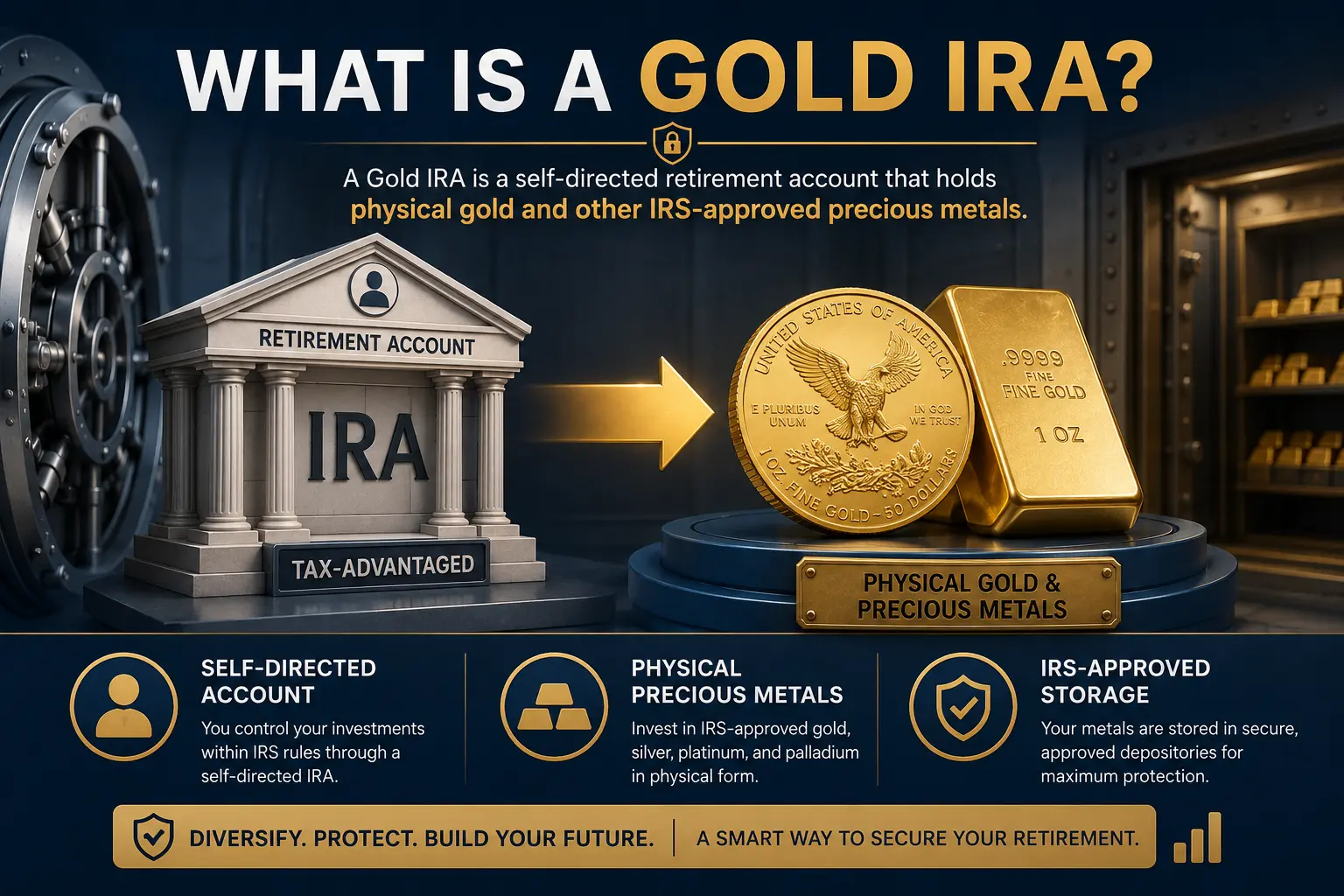
A Gold IRA is a self-directed IRA that holds gold and other precious metals that meet the standards in IRC §408(m)(3) under special custody and storage rules. Whether it fits comes down to a few core trade-offs: potential diversification and inflation-hedge benefits; higher fees and spreads than many brokerage IRAs plus depository storage; less liquidity and no income, because metals pay no interest or dividends; and extra complexity around rollovers, RMDs, and in-kind distributions.
The framework below works through these trade-offs as seven decision factors. It mirrors many common suitability questions while staying neutral — the goal is to help think, not to recommend. When ready, the 2-minute quiz, the calculator, and the gated comparison workbook go deeper.
How the Guide Should Be Used: Education, Not a Recommendation
Online Gold IRA quizzes and readiness checklists typically ask about age, risk tolerance, existing retirement accounts, and comfort with alternative investments. These tools are educational screens, not suitability determinations or personalized advice. A decision guide can help clarify personal priorities (growth vs stability, income vs diversification), show where the pros and cons matter most given current finances, and prepare better questions for advisors and providers. Results should be combined with independent advice, not used alone to decide.
Decision Factor 1: Eligible Retirement Assets and Account Type
Does the investor have eligible retirement assets that can be rolled or transferred to a self-directed IRA? Gold IRAs are typically not built from small annual contributions; they more often use rollovers from existing IRA or 401(k) balances. Rollovers must follow IRS rules on direct trustee-to-trustee transfers, 60-day windows, and annual rollover limits, and some employer plans restrict in-service rollovers until separation or retirement. Investors without meaningful balances may find the fixed cost structure harder to justify. See the gated rollover guide and questions to ask before opening a Gold IRA. Customers should speak to a financial or tax advisor before planning any rollover.
Decision Factor 2: Investment Time Horizon
Is the investor thinking in terms of a multi-year retirement horizon, not short-term trading? Gold often functions as a long-term diversification and hedge asset, with returns that can be lumpy over shorter periods. The upfront effort and costs — custodian, storage, dealer spreads — generally make more sense over longer time frames. Investors with very short horizons or pending large expenditures may prefer more liquid, income-oriented assets.
Decision Factor 3: Risk Tolerance and Volatility Comfort
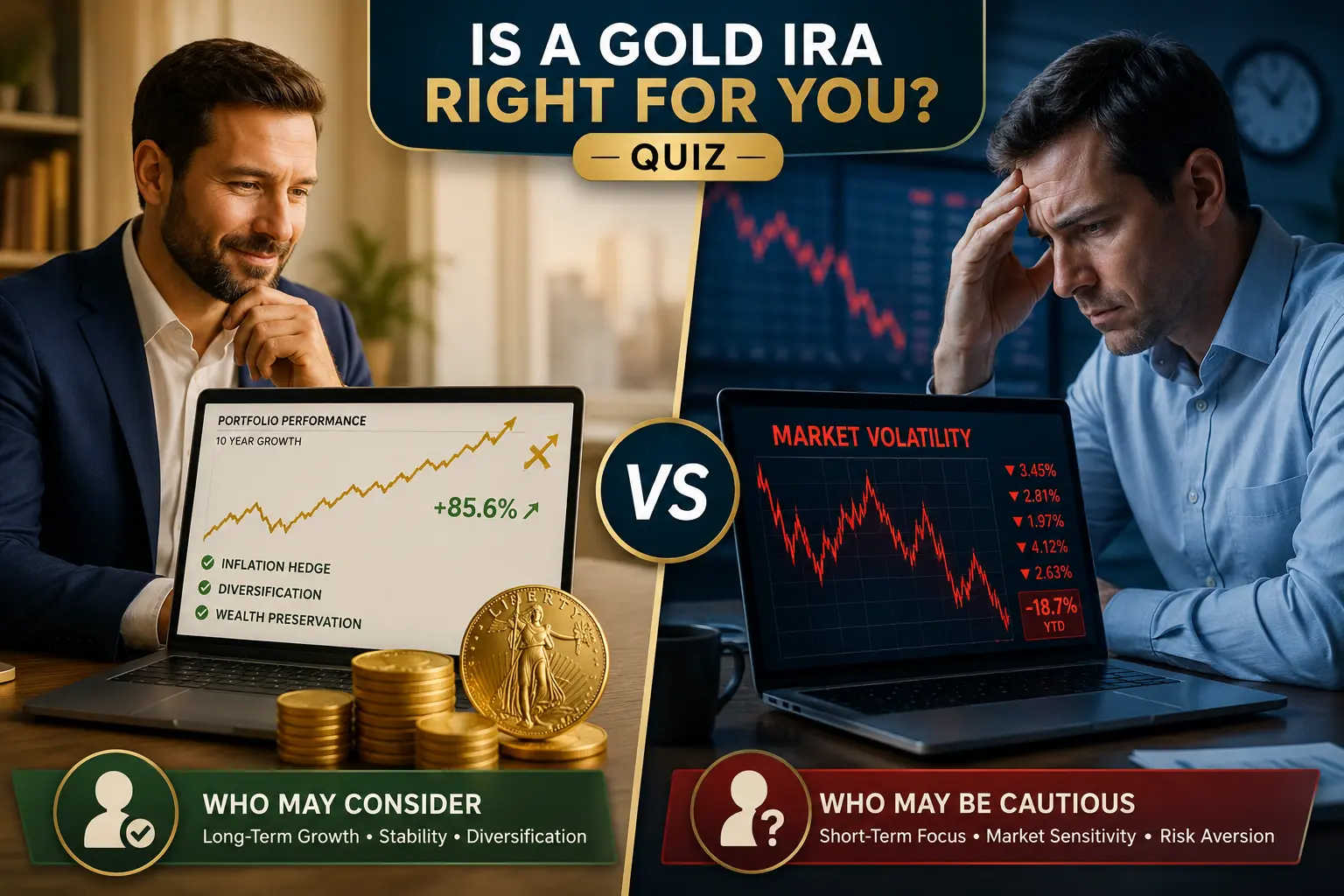
How does the investor react when markets are volatile, and how much drawdown is acceptable? Gold tends to behave differently from stocks and bonds, sometimes rising during stress and sometimes moving with macro trends and interest rates. It is not a risk-free asset; metal prices can decline, and concentration in metals can raise portfolio risk if allocation is too high. Investors who react strongly to volatility or want smooth income may prefer only modest gold exposure, if any. The calculator can help visualize how different allocations change volatility.
Decision Factor 4: Liquidity Needs and Cash Reserves
Are short-term cash needs and emergency reserves already covered by other assets? Gold IRAs require metals to be sold or distributed in kind before cash is available — not as quick as selling a money-market fund. Investors who may need funds soon for major expenses generally should not lock significant amounts in a less-liquid, fee-laden structure. Common guidance is to address emergency savings and near-term spending before allocating retirement assets to a Gold IRA. Exit mechanics are covered in exit strategies and what happens if cash is needed.
Decision Factor 5: Allocation Size and Diversification Goals
Is the investor thinking about gold as a small to moderate allocation, not a dominant holding? Advisor and institutional commentary often situates gold exposure around a modest share of total assets, varying by risk profile. Treating gold as a diversification tool rather than a core growth engine keeps expectations realistic and preserves room for stocks, bonds, and other assets. Very high gold allocations can reduce portfolio income and long-term growth, especially for retirees who need distributions. The allocation framework covers the common ranges. Customers should speak to a financial or tax advisor before deciding on any allocation.
Decision Factor 6: Fees, Spreads, Storage, and Minimums
Is the investor willing to evaluate and accept Gold IRA fees, spreads, storage costs, and minimums? Gold IRAs generally involve a one-time setup fee, an annual custodian fee, storage fees at a depository under the trustee's control, and dealer spreads plus potential buyback costs. Reported spreads often run roughly 2–8% over spot for standard bullion (far higher for premium coins), and annual custodian-plus-storage costs commonly range from about $150 to several hundred dollars. Many providers set minimums in the $10,000–$50,000 range or higher, making Gold IRAs better suited to larger balances. Verify all-in costs with the fee calculator, the fees benchmark, and the dealer markup data.
Decision Factor 7: Rollover, Tax, and RMD Complexity
Is the investor prepared to handle rollover documentation, RMD rules, and tax implications — or to work closely with professionals? A Gold IRA is still an IRA, so contribution limits, distribution rules, RMD ages, and rollover requirements follow standard IRA law; the physical metals add logistics. Rollovers should be structured as direct trustee-to-trustee transfers when possible. Traditional Gold IRAs face RMDs starting at RMD age, met by selling metals or taking in-kind distributions. SECURE Act rules, including the 10-year rule for many non-spouse heirs, apply for inheritance. Common pitfalls are on tax mistakes, RMD strategy, and beneficiary rules. Goldco does not offer tax or legal advice.
Sample Result Categories
A neutral decision guide ends with categories, not firm recommendations:
- "Worth researching further" — stable emergency reserves, a multi-year horizon, interest in diversification, moderate risk tolerance, and comfort comparing providers. A Gold IRA may be one of several tools worth exploring with the companies comparison and calculator.
- "Needs advisor review before any next step" — complex existing plans, large balances or pending RMDs, an unclear tax situation, or a desire to make substantial allocation changes. Professional advice is particularly important here.
- "May not fit right now" — limited emergency savings, short-term liquidity needs, very small balances relative to typical minimums, or a strong preference for simple, low-fee, high-liquidity accounts. Other retirement adjustments may be more pressing.
Turn the framework into a 2-minute quiz
The quiz walks through these factors and points to educational next steps. It is educational and makes no recommendation.
Take the Free Gold IRA Quiz →Next Steps: Quiz, Calculator, Comparison, Advisor Questions
Rather than a single action, a sequence usually helps: take the suitability quiz; experiment with allocation on the calculator; compare providers side by side with the gated comparison workbook; model costs with the fee calculator and markups and spreads; and prepare due-diligence questions from questions to ask before opening a Gold IRA. Customers should speak to a financial or tax advisor before acting on any quiz result or calculator output, especially with large balances or complex estates.
FAQ
What is the main goal of an "is a Gold IRA right for you" quiz?
Most Gold IRA quizzes help investors clarify whether their goals, risk tolerance, liquidity, and comfort with self-directed accounts justify further research. They highlight decision factors and trade-offs rather than giving a yes/no recommendation.
Are Gold IRAs always a good inflation hedge?
Gold is often described as a potential hedge against inflation and economic stress, but performance varies by period and conditions. A Gold IRA can be part of a broader inflation-aware allocation, but it is not a guaranteed solution and is one component among many.
Do Gold IRAs have higher fees than regular IRAs?
Gold IRAs typically carry higher, more layered fees than standard brokerage IRAs, including setup, annual custodian, storage, and dealer spreads. A fee calculator or provider comparison can help quantify these costs first.
Is a Gold IRA suitable for short-term investing?
Gold IRAs are generally framed as long-term retirement diversification vehicles, not short-term trading accounts. The setup, fees, and storage requirements make them more appropriate for multi-year strategies.
Should investors rely only on a quiz to decide about a Gold IRA?
No. Suitability quizzes are educational; they help investors ask better questions but cannot provide personalized financial, tax, or legal advice. Professional advice and a detailed review of fees, tax rules, and alternatives remain essential. Goldco does not offer tax or legal advice.
Article reviewed and edited by Daniel M. — editor, 401kToGoldIRA.org.