
Affiliate disclosure: Some links on this page may be sponsor links. The site owners may be compensated if customers request information from companies mentioned here. This page is educational only and does not provide financial, tax, or legal advice. Customers should speak with a financial or tax advisor before making retirement-account decisions. Past performance does not guarantee future results.
Quick Answer: What First-Time Investors Should Know
A Gold IRA — sometimes called a precious metals IRA — is a type of self-directed IRA that can hold approved gold, silver, platinum, and palladium bullion alongside or instead of traditional paper assets. It follows the same tax rules as other IRAs but adds extra steps, including a specialized custodian, a depository under the trustee's control, and a precious metals dealer.
For a gold IRA for first-time investors, the key idea is diversification, not replacement of a full retirement strategy. Gold does not pay interest or dividends, so any return comes only from price changes and must be weighed against higher fees, storage costs, and more complex rules. Past performance does not guarantee future results.
What a Gold IRA Is
A Gold IRA is a self-directed individual retirement account designed to hold physical precious metals that meet IRS standards, such as bullion coins and bars with specific purity levels. Instead of owning only assets that appear on a brokerage statement, a Gold IRA owns tangible metal stored in a secure vault, but still within a tax-advantaged retirement account.
Gold IRAs can be set up as traditional (pre-tax), Roth (after-tax), or SEP IRAs, and they share the same annual contribution limits as other IRAs. Contribution limits, income eligibility, and required minimum distribution (RMD) rules can change year to year, so investors should confirm exact numbers with current IRS guidance. Withdrawals, early-withdrawal penalties, and RMDs generally follow regular IRA rules, but may involve special tax treatment because physical gold can be taxed at a collectibles rate that can reach 28 percent when distributed and sold. Customers should speak to a financial or tax advisor before making decisions.
Gold IRAs are typically used to add an allocation to metals as a possible hedge against inflation, market volatility, or currency risk rather than as a full retirement plan on their own. Because gold prices may move independently of many stock and bond markets, some investors use a small portion of an overall portfolio in metals to diversify risk.
How a Self-Directed IRA Differs From a Regular Brokerage IRA
A self-directed IRA (SDIRA) expands the menu of allowed assets beyond public stocks, mutual funds, and ETFs. With the right custodian, a self-directed IRA can hold physical gold and silver, real estate, private placements, and other alternative investments that a standard brokerage IRA does not support.
In a regular brokerage IRA, the brokerage firm acts as both platform and custodian, and holdings are usually financial securities selected from a set list. In a Gold IRA built on a self-directed structure, an IRS-approved custodian specializes in alternative assets and works with outside dealers and depositories to buy, move, and store metals. The investor directs the strategy, but the custodian must execute transactions and maintain records to keep the account compliant with IRS rules.
Self-directed IRAs demand more responsibility and due diligence, including understanding prohibited transactions, disqualified-persons rules, and custody requirements. Many traditional brokerages do not support physical metals in IRA form, so investors typically work with custodians and Gold IRA companies that focus on this niche.
How Gold IRAs Work: Custodian, Dealer, Depository, Approved Metals
A Gold IRA involves four main parts: the self-directed IRA custodian, the precious metals dealer, the depository, and the approved metals themselves.
- Custodian. The custodian opens and administers the self-directed IRA, keeps records, reports to the IRS, and authorizes purchases and sales of metals. The custodian must be an IRS-approved financial institution, such as a specialized trust company or bank.
- Dealer. The metals dealer supplies the actual bullion coins and bars that meet IRS standards. Dealers quote prices, explain available products, and coordinate delivery of metals into the depository under instructions from the custodian.
- Depository. Gold IRA rules generally require that metals be stored in a depository under the trustee's control, not in a home safe or safety deposit box. Depositories provide secure vault storage, insurance coverage, and independent verification of stored metals.
- metals that qualify under IRC §408(m). Gold IRA assets must meet strict purity and product requirements — usually 99.5 percent purity for gold bullion, 99.9 percent for silver, and 99.95 percent for platinum and palladium — with only certain coins such as the American Gold Eagle exempt from the standard purity rule.
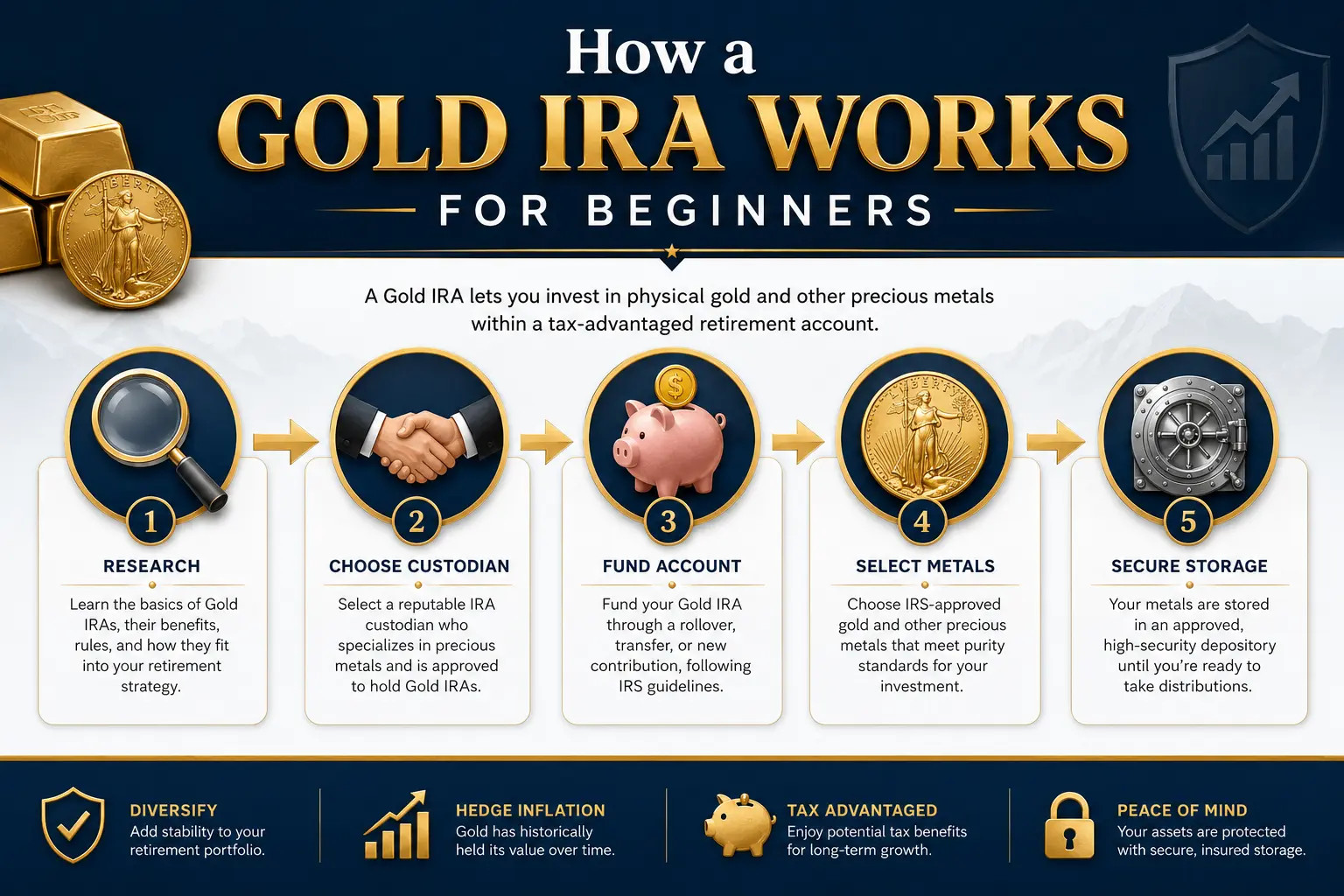
In practice, a beginner Gold IRA investor typically first opens a self-directed IRA with a custodian, then funds it by rollover, transfer, or contribution, and finally works with a dealer to purchase coins that qualify under IRC §408(m) or bars that ship directly to the depository. The custodian records each purchase, while the depository handles storage and periodic reporting on holdings.
Educational video: Gold IRA basics
A clear educational overview can help first-time investors see how these four roles fit together and how a self-directed precious metals IRA differs from a standard brokerage account. The approved Gold IRA education video below explains the process in simple terms for retirement savers evaluating this type of account.
Video published by Goldco on YouTube — a company this site has an affiliate relationship with. Embedded as a third-party explanation; not produced, endorsed or independently verified by this site.
Gold IRA for First-Time Investors: The Main Decisions to Make
For a first-time gold investor using an IRA, the biggest decisions are allocation size, account type, metal selection, and provider choice.
- Allocation size. Many educational sources suggest treating gold as a diversifier rather than a core holding, often a modest percentage of the overall retirement portfolio rather than a majority. The right allocation depends on risk tolerance, investment horizon, and overall financial plan.
- Account type. A Gold IRA can be structured as a traditional, Roth, or SEP IRA, each with different tax treatment on contributions and withdrawals. Traditional accounts are funded with pre-tax dollars and taxed on withdrawal, while Roth accounts use after-tax contributions and can provide tax-free qualified withdrawals.
- Metal mix. Some beginners focus on gold alone; others add silver or other metals. IRS rules allow gold, silver, platinum, and palladium bullion that meets purity standards, so an investor must decide how much to place in each.
- Providers and counterparties. A Gold IRA requires working with at least one custodian, one depository, and one dealer, and sometimes a specialized company that coordinates these relationships. Many retirement savers compare providers on experience, transparency, fee structure, and educational support, which is where a resource such as best Gold IRA companies can help.
Investors who want an organized way to compare providers, fees, and offerings often use a workbook or checklist before speaking with sales representatives, which is the purpose of the gated comparison workbook. A structured list such as questions to ask before opening a Gold IRA can also help a beginner clarify what matters most in advance.
Rollovers, Transfers, and Contribution Basics
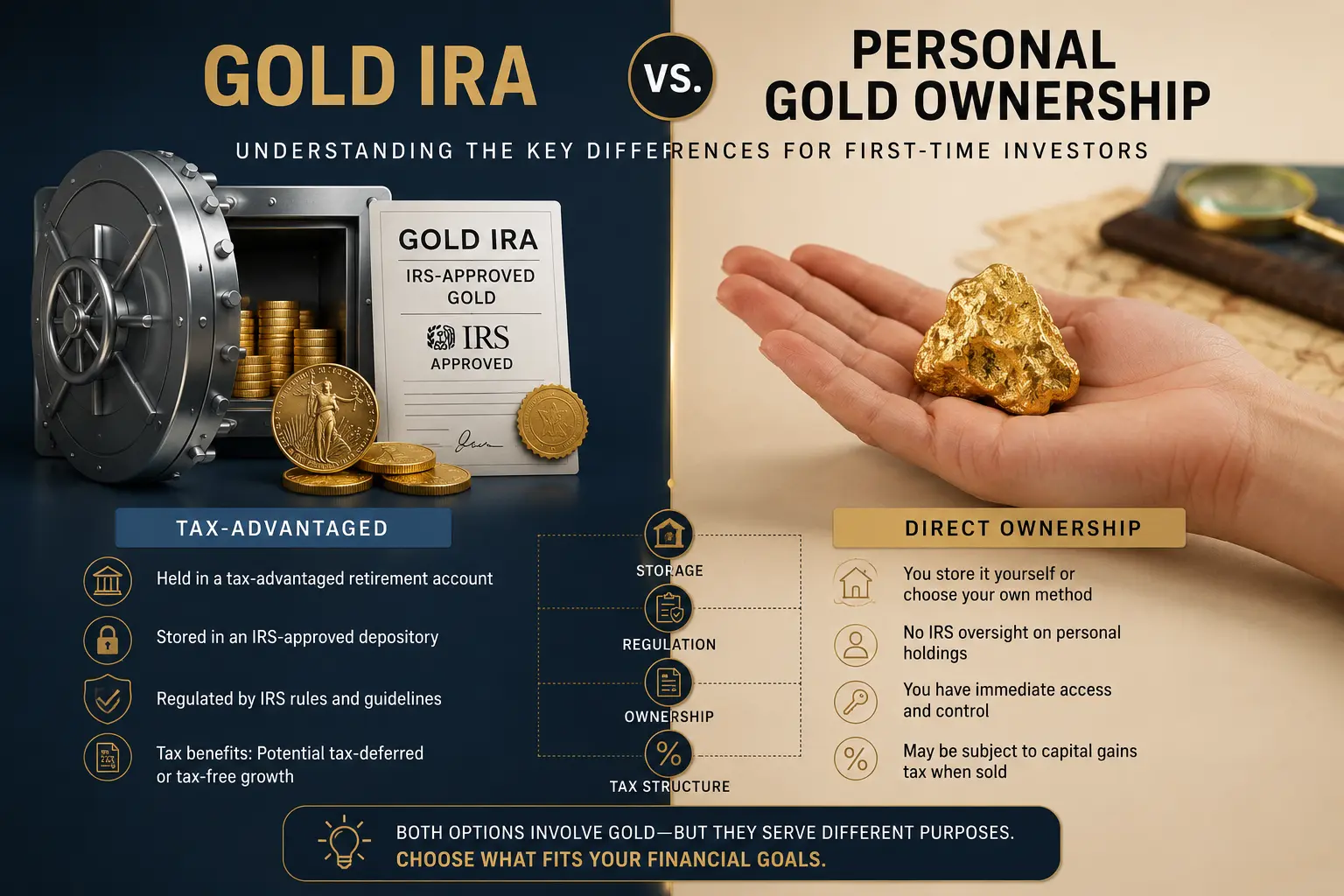
Most Gold IRAs are funded by moving money from existing retirement accounts rather than by new contributions alone. A gold IRA rollover is the process of taking eligible assets from plans such as old 401(k)s, traditional IRAs, Roth IRAs, or SEP IRAs and placing them into a new self-directed IRA that can hold physical metals.
Educational rollover guides emphasize several points. Direct rollovers from a 401(k) to an IRA and trustee-to-trustee transfers between IRAs generally reduce the risk of tax withholding or accidental early distributions. Old employer plans are often easier to roll over than current employer plans, which may have restrictions. There is usually no IRS cap on the total amount that can be rolled over into a Gold IRA, although standard annual contribution limits still apply to new contributions once the account is open. Some custodians and companies set minimum rollover amounts, often ranging from a few thousand to tens of thousands of dollars.
For direct annual contributions, Gold IRAs follow the same IRS contribution limits as other IRAs, including higher limits for individuals age 50 and older. Contribution amounts, income eligibility for Roth contributions, and RMD rules for traditional accounts can change over time, so retirement savers should confirm current IRS guidance or consult professional advice. Customers should speak to a financial or tax advisor before making decisions. Goldco does not offer tax or legal advice. Step-by-step rollover education is available on the gated rollover guide.
Fees, Spreads, Storage, and Liquidation Costs
Gold IRAs involve more layers of cost than a typical low-fee brokerage IRA, and those costs can significantly affect long-term results.
- Account setup and annual custodian fees. Self-directed IRA custodians often charge an initial setup fee plus ongoing annual administration fees for handling alternative assets.
- Storage and insurance fees. Depositories charge for secure vault storage and often include insurance coverage; fees can be flat or percentage-based.
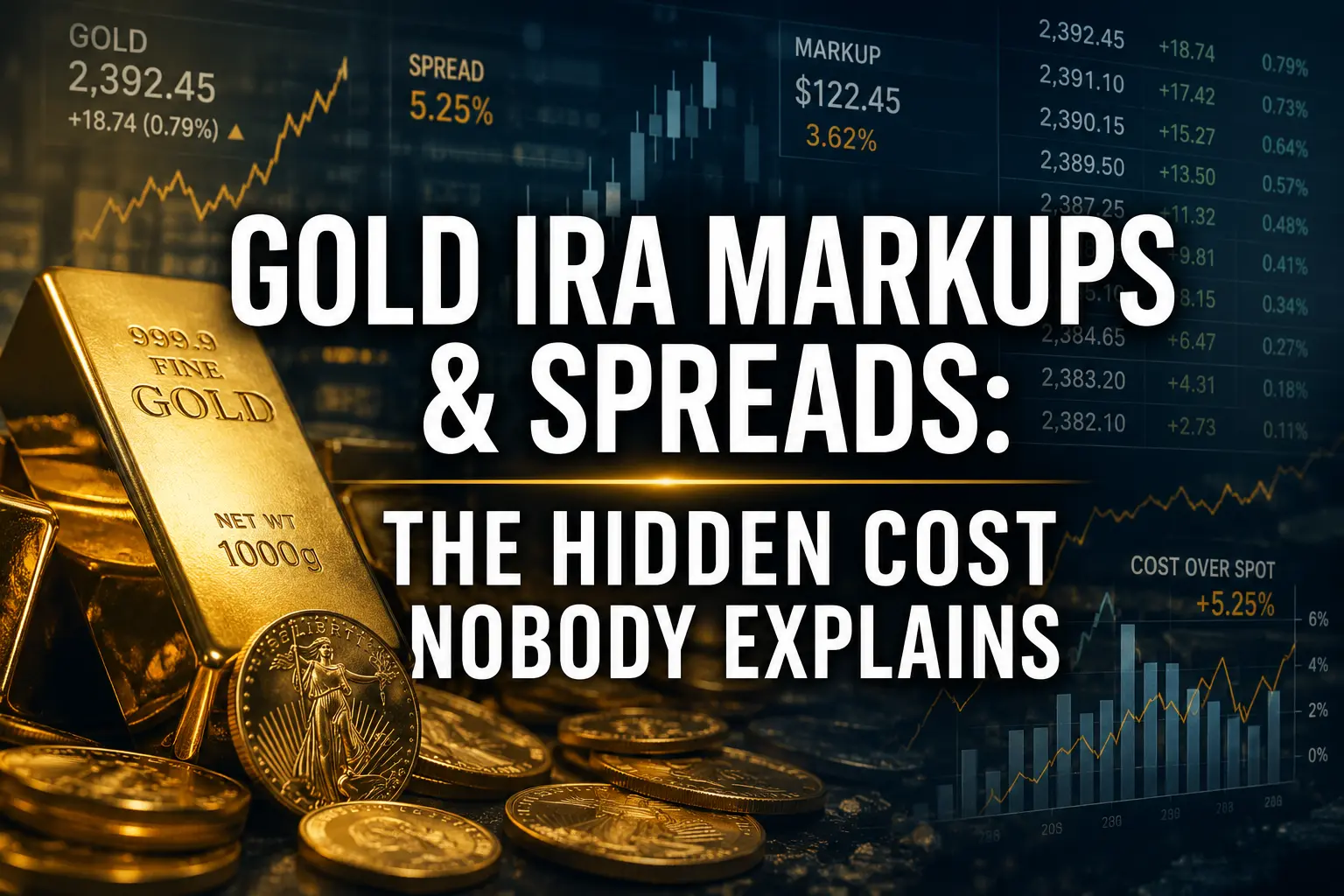
- Dealer markups and spreads. Dealers earn money through the difference between wholesale and retail prices, and spreads can vary significantly by product type, size, and brand. Gold IRA markups and spreads explains how retail premiums, bid-ask spreads, and product choices affect cost per ounce.
- Minimum investments. Many companies require minimums that may range from around $5,000 to $25,000, $50,000, or more depending on the firm, while some publish no fixed minimum at all. Some custodians also set minimums for new accounts or rollovers.
- Liquidation and shipping costs. Selling metals held in a depository can involve shipping, assay, or transaction fees, and the spread between buy and sell prices determines how much value is lost on each round trip.
The fee calculator and the gated fees guide help investors estimate ongoing costs under different scenarios, while the Gold IRA calculator allows retirement savers to model possible allocations and fee impacts over time.
Approved Metals vs Collectible Coins
IRS rules for Gold IRAs are strict about which metals qualify and which do not. Approved metals must meet specific fineness standards and usually take the form of bullion coins, bars, or rounds produced by government mints or accredited refiners, assayers, or manufacturers.
- Gold must generally be 99.5 percent pure (.995 fineness) or higher to qualify for an IRA, with the American Gold Eagle coin as a notable exception allowed despite being about 91.67 percent pure because of its legal-tender status.
- Silver used in IRAs must generally be at least 99.9 percent pure (.999 fineness).
- Platinum and palladium must generally be at least 99.95 percent pure and produced to recognized manufacturing standards.
Collectible coins, rare numismatic issues, and jewelry generally do not qualify as Gold IRA assets, even if they contain significant precious metal. The IRS distinguishes between bullion valued mostly for metal content and collectibles valued for rarity, age, or numismatic features, and only bullion meeting defined purity thresholds is allowed in IRAs. Beginners who want exposure to metals but do not want to risk buying ineligible products often focus on widely recognized bullion options and rely on dealers and custodians that handle IRA-approved products every day.
Storage Rules: Segregated vs Commingled, Approved Depositories
Storage is one of the most important topics in any beginner gold IRA guide because mistakes can lead to disqualification of the IRA and unintended taxes. The IRS generally requires that IRA metals be held in custody by an approved institution and stored at authorized depositories, not in personal possession. Gold owned inside an IRA generally cannot be kept at home or in a personal safe; doing so usually counts as a distribution and can trigger taxes and penalties.
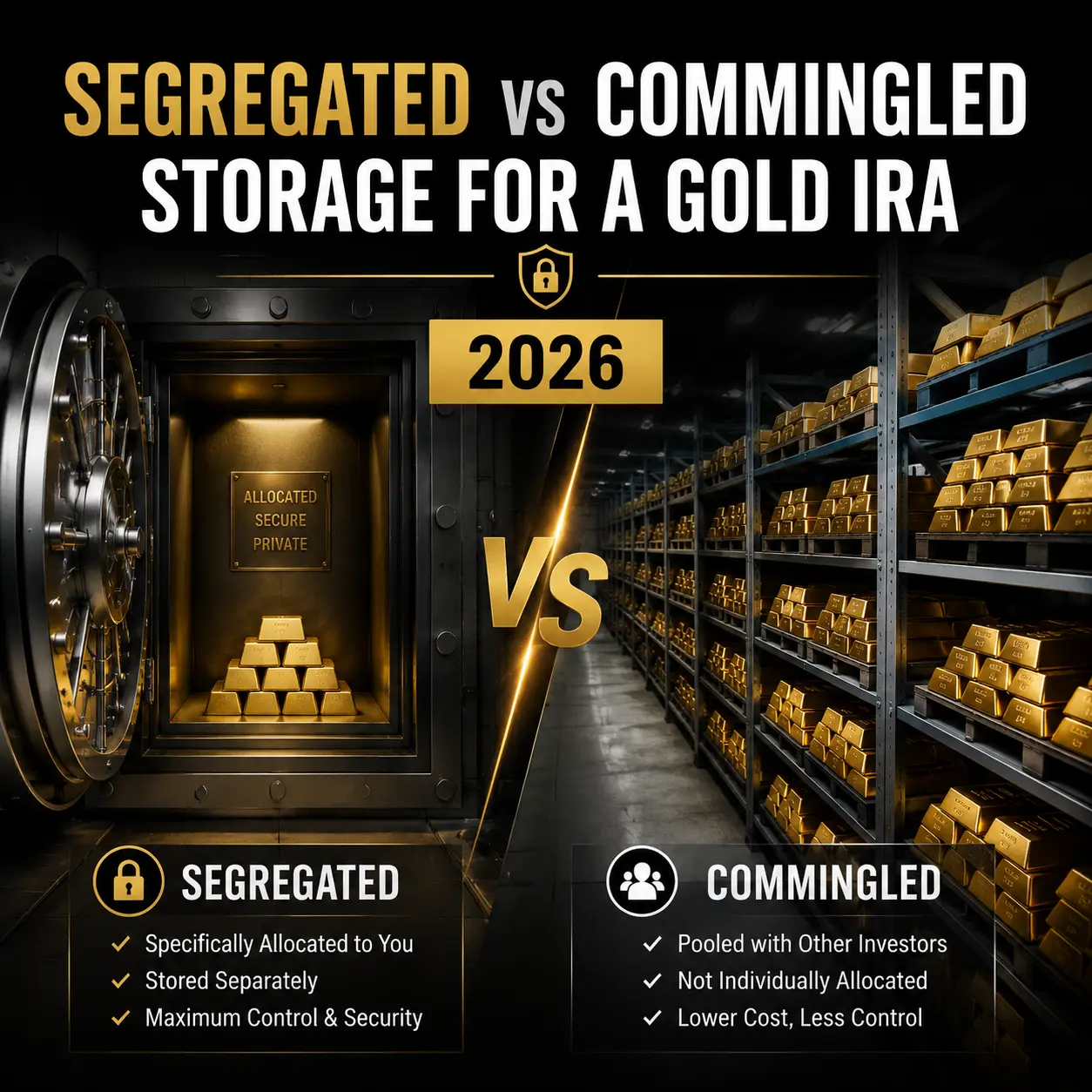
Within approved depositories, storage is typically offered as either segregated (metals stored in separate spaces labeled for a specific IRA account) or commingled (metals of the same type and specification stored together in pooled vault areas, with records tracking each investor's share). Each approach has different costs and benefits, explained in more depth on segregated vs commingled storage. Depositories also provide insurance and independent verification so each IRA owner can receive periodic confirmations of holdings and audit reports.
Gold IRA storage rules emphasize that account holders generally cannot take physical possession of metals while they remain inside the IRA without triggering a distribution. Only after a distribution or in-kind withdrawal can an investor legally keep the metals personally, and that action may be taxable depending on age, account type, and circumstances.
Risks and Trade-offs: Volatility, No Yield, Fees, Liquidity, Tax Rules
No investment is risk-free, and a thorough gold IRA beginner guide must explain the main trade-offs clearly.
- Price volatility. Gold and other metals can rise and fall significantly over time, sometimes moving opposite to stock markets and sometimes with them. Large swings can help or hurt a retirement portfolio depending on timing and allocation.
- No yield. Gold does not pay interest, dividends, or rental income, so all return depends on price changes. This makes metals different from bonds and many stocks, which provide ongoing cash flows.
- Higher fees. Gold IRAs include additional layers of cost: custodial administration, storage, insurance, and dealer spreads. These fees can reduce net returns compared with low-cost index funds held in a traditional brokerage IRA.
- Liquidity and execution. Selling metals within a Gold IRA requires working through the custodian and depository and may take longer than selling a stock or ETF. Spreads between bid and ask prices can be larger for physical bullion than for highly liquid securities.
- Tax complexity. Gains on physical gold may be taxed at collectibles rates up to 28 percent when distributed and sold. Early withdrawals before age 59½ can face a 10 percent penalty in many cases, and traditional Gold IRAs must observe RMD rules later in retirement.
Customers should speak to a financial or tax advisor before making decisions. Goldco does not offer tax or legal advice. Educational tools such as the Gold IRA calculator, the fee calculator, and the gated comparison workbook can help retirement savers model different scenarios and compare Gold IRA strategies against other retirement options.
Beginner Checklist Before Speaking With a Provider
A first-time gold investor considering a Gold IRA benefits from a simple checklist to organize questions and information before talking with any company.
- Clarify overall retirement goals and risk tolerance. Know whether the goal is inflation hedging, volatility management, or long-term diversification, and how much overall risk feels acceptable.
- Decide on a target allocation range. Defining a range — for example, a small percentage of total retirement assets — helps keep the plan balanced.
- List current retirement accounts and rollover eligibility. A simple inventory of old 401(k)s, IRAs, and other plans helps determine which accounts can fund a Gold IRA. The rollover guide offers a step-by-step framework.
- Compare custodians and Gold IRA companies. Key factors include fees, precious-metals experience, storage partners, educational resources, and support quality. The best Gold IRA companies page and the comparison workbook help build side-by-side comparisons.
- Understand storage options and depositories. Verify which depository will hold metals, whether storage is segregated or commingled, and how insurance and audits work. See segregated vs commingled storage.
- Review fee schedules and markups. Ask for the complete fee list, including setup, annual, storage, and transaction fees, and ask about dealer spreads. See gold IRA markups and spreads and the fee calculator.
- Confirm metals that qualify under IRC §408(m) and product lists. Know which coins and bars qualify, what purity standards apply, and whether the provider focuses on bullion rather than collectibles.
- Prepare structured questions. Using questions to ask before opening a Gold IRA helps investors arrive at calls with specific, written questions on fees, storage, buyback policies, and service standards.
Not sure a Gold IRA is the right fit?
The quiz is educational and does not make a recommendation. It can help a first-time investor think through goals, timing, and options before any call.
Take the Free Gold IRA Quiz →FAQ
What is a Gold IRA?
A Gold IRA is a self-directed individual retirement account that holds physical gold and other precious metals that meet the standards in IRC §408(m)(3) instead of only traditional paper investments. Metals must meet strict purity standards and be stored in depositories used under a trustee's custody arrangements under the supervision of a qualified custodian.
Who is a Gold IRA for?
Gold IRAs are typically used by retirement savers who want to diversify a portion of their portfolio into tangible assets such as gold and silver as a possible hedge against inflation or market volatility. They are not usually designed to replace diversified portfolios of stocks and bonds, but to complement them.
How does a Gold IRA rollover work for beginners?
A Gold IRA rollover moves eligible funds from existing accounts such as 401(k)s or IRAs into a new self-directed IRA that can hold precious metals. Educational guides recommend using direct rollovers or trustee-to-trustee transfers when possible and reviewing all fees and IRS rules before funding.
What metals are approved for Gold IRAs?
metals that qualify under IRC §408(m) include certain gold, silver, platinum, and palladium bullion coins and bars that meet defined fineness standards, such as 99.5 percent purity for gold and 99.9 percent for silver. Collectible or numismatic coins and jewelry generally do not qualify for IRA use even if they contain significant precious metal.
Can Gold IRA metals be stored at home?
Gold IRA rules generally prohibit storing metals at home or in personal safety deposit boxes while they remain in the IRA. All IRA metals must be held by an IRS-approved custodian and stored at authorized depositories; personal possession usually counts as a taxable distribution.
What are the main risks of Gold IRAs?
Gold IRAs carry risks such as price volatility, lack of yield, higher fees, and more complex tax treatment. Liquidity depends on dealers and depositories, and spreads between buy and sell prices can materially affect results. Customers should speak to a financial or tax advisor before making decisions. Goldco does not offer tax or legal advice. Past performance does not guarantee future results.
Article reviewed and edited by Daniel — independent precious-metals retirement researcher.
Further Reading
 21 Questions to Ask Before Opening a Gold IRAArrive at provider calls with specific, written questions on fees, storage, and buyback terms.
 Segregated vs Commingled StorageUnderstand how IRA metals are stored, insured, and verified at approved depositories.
 Gold IRA Markups and SpreadsSee how premiums, spreads, and product choices affect cost per ounce for beginners.