
Affiliate disclosure: Some links on this page may be sponsor links. The site owners may be compensated if customers request information from companies mentioned here. This page is educational only and does not provide financial, tax, or legal advice. Customers should speak with a financial or tax advisor before making retirement-account decisions. Past performance does not guarantee future results.
There is no single "correct" gold percentage for retirement. Educational frameworks commonly discuss modest ranges — often cited as 2–5%, 5–10%, or 10–15% in specific circumstances — sized to the individual plan, not applied as a universal rule.
Source: World Gold Council (an industry body — weigh with independent analysis). No neutral primary source establishes one optimal allocation for every retiree.
Key takeaways
- Use ranges, not one universal number — the right allocation depends on income needs, risk tolerance, liquidity, time horizon, and the rest of the portfolio.
- Commonly discussed educational bands are 2–5%, 5–10%, and 10–15%, with larger allocations trading growth for more downside protection.
- Gold produces no income and carries premiums, spreads, and storage costs — a sleeve should have a defined job, not a default size.
- A Gold IRA changes the account structure, storage, and distribution rules, but it does not dictate a specific percentage.
- Any allocation figure from an industry source should be weighed with independent analysis and a qualified advisor.
Quick Answer: Use Ranges, Not One Universal Gold Percentage
The common answer to “how much gold should investors own in retirement?” is not one fixed number. Many educational frameworks discuss modest ranges such as 2–5%, 5–10%, or 10–15% in specific circumstances. Those ranges are examples for planning conversations, not recommendations.
A retirement saver’s appropriate gold exposure depends on total assets, income needs, age, time horizon, volatility tolerance, tax status, account type, liquidity, existing inflation-sensitive assets, and whether physical metals are held inside a Gold IRA, taxable account, ETF, or another structure.
There Is No Single Right Percentage
Major financial publishers, advisors, and institutional research generally treat gold allocation as a range-based discussion. A gold allocation that fits one household can be unsuitable for another because spending needs, pensions, account balances, debt, risk tolerance, and tax circumstances differ.
Gold can behave differently from stocks and bonds and may support diversification in some periods. It can also be volatile, does not pay interest or dividends, and can involve storage, spreads, and transaction costs when held physically. That is why allocation decisions are better framed as scenarios than as one prescriptive percentage.
Common Gold Allocation Ranges
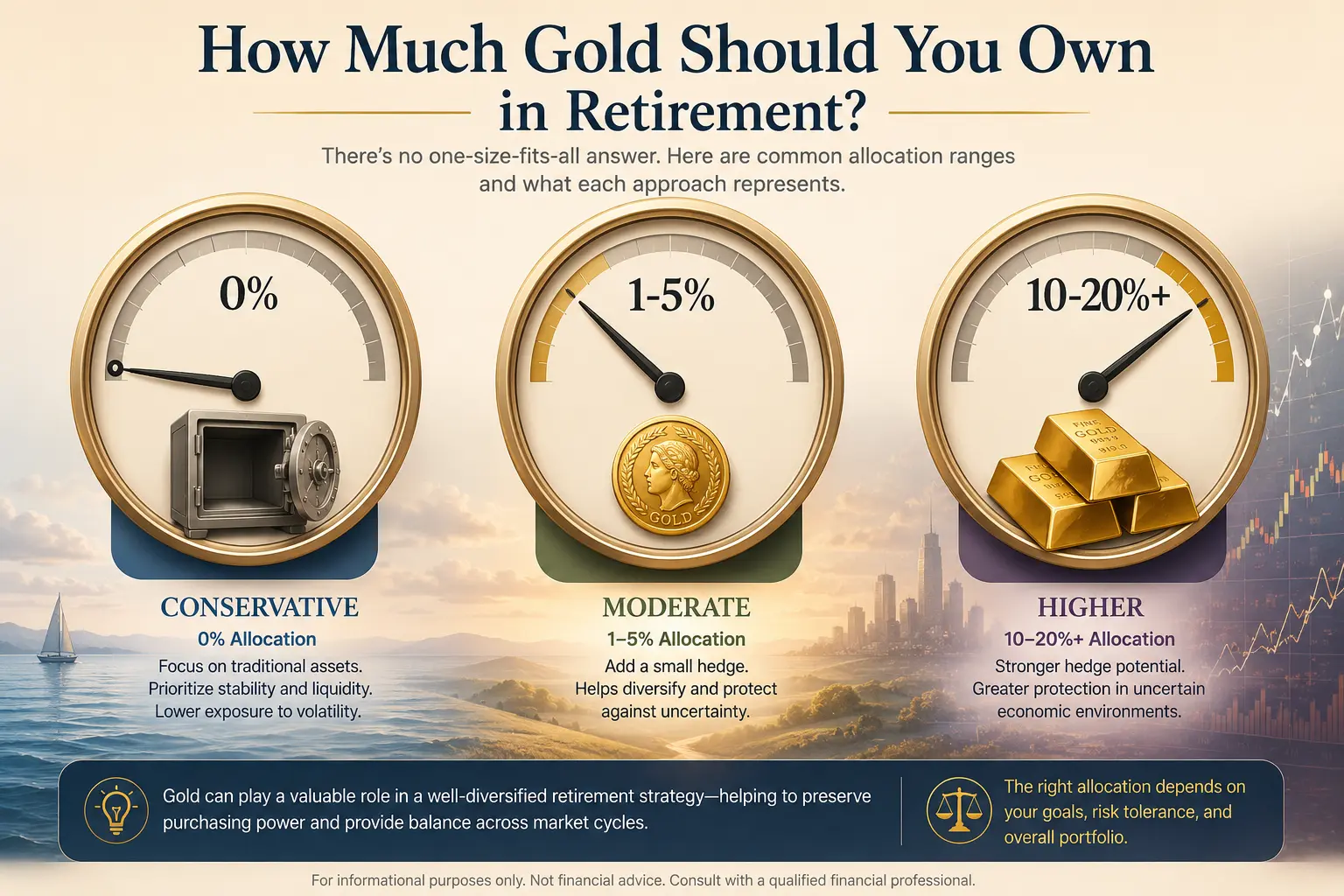
Educational retirement discussions often group gold allocation into three broad ranges. These are not instructions; they are planning examples to help structure advisor conversations.
2–5%: Conservative gold exposure
A 2–5% range may suit investors who want some gold exposure while keeping most assets in income-producing or growth-oriented holdings. This range may be used for diversification or psychological comfort without making gold a central portfolio driver.
5–10%: Moderate diversification range
A 5–10% range is commonly discussed as a moderate precious-metals sleeve within a diversified portfolio. It may be large enough to affect portfolio behaviour, but still limited enough that stocks, bonds, cash, and other assets remain the main retirement engine.
10–15% or more: Higher allocation in specific cases
A 10–15% allocation, or higher in some cases, may appear in discussions for investors with strong inflation concerns, high net worth, ample income from other sources, or a deliberate alternatives sleeve. This level requires extra care because gold does not produce income and can underperform for long periods.
Gold Allocation Frameworks for Retirement Portfolios
A practical framework starts with the role gold is meant to play. For some households, gold is a modest diversifier. For others, it is part of an alternatives sleeve. For others, it is a store-of-value asset held alongside cash, bonds, equities, real estate, and annuities.
The core diversification framework treats gold as a small satellite allocation that may behave differently from equities and bonds. The risk-budget framework places gold inside a broader alternatives category. The inflation-aware framework treats gold as one possible inflation-sensitive holding alongside assets such as TIPS, real estate, and cash reserves.
Gold IRA Allocation Video and Tools
The approved educational video can help explain self-directed IRA mechanics and how gold may fit into broader retirement planning.
Video published by Goldco on YouTube — a company this site has an affiliate relationship with. Embedded as a third-party explanation; not produced, endorsed or independently verified by this site.
Factors That Affect Retirement Gold Allocation
Age and time horizon
Time horizon matters because retirement can last decades. Longer horizons may require growth assets, while shorter horizons can place more emphasis on liquidity, income, and risk control. Gold allocation should not crowd out assets needed for long-term growth or near-term spending.
Income needs and liquidity
Gold does not pay dividends or interest. Retirees who rely heavily on portfolio income may need cash, bonds, dividend stocks, pensions, annuities, or other income sources before increasing gold exposure. Physical metals may also require a sale process before cash is available.
Volatility tolerance
Gold prices can move sharply. A portfolio allocation that looks reasonable on paper may be difficult to hold if volatility causes emotional decisions. This is one reason modest ranges are often used in educational frameworks.
Existing assets, debts, and tax status
Existing real estate, commodities, inflation-linked bonds, cash reserves, debt, and taxable accounts can all affect how much gold is reasonable. Customers should speak with a financial or tax advisor before changing allocations, especially when IRA rollovers, taxable sales, or RMDs are involved.

Gold IRA vs Taxable Metals vs ETFs
Gold allocation can be held in several ways. A Gold IRA holds physical metals that meet the standards in IRC §408(m)(3) in a self-directed retirement account with approved custody and storage. It can involve tax-advantaged account treatment, but also custodian fees, storage fees, IRA rules, RMDs, and distribution procedures.
Taxable physical gold can provide direct ownership outside an IRA, but sale spreads, storage, insurance, and collectibles tax treatment may apply. Gold ETFs or mutual funds can be easier to trade and rebalance, but they do not provide the same physical ownership experience as bars or coins.
The right structure depends on tax status, liquidity needs, storage preferences, and how gold fits into the broader retirement plan. Related context appears in Are Gold Bars a Good Investment? and Gold IRA RMD Strategy.
What Too Little Gold or Too Much Gold Can Mean
Holding little or no gold may leave a portfolio without that specific diversifying exposure. That does not automatically make the portfolio wrong, because many investors use other diversifiers or inflation-aware assets.
Holding too much gold can create different problems. Large gold allocations may reduce income, reduce exposure to growth assets, increase concentration risk, and make withdrawals or RMDs more difficult if metals need to be sold or distributed. Gold should be evaluated as part of the total plan, not in isolation.
Example Allocation Scenarios
| Scenario | Example range | Planning logic |
|---|---|---|
| Conservative income-focused retiree | 2–5% | Uses gold as a small diversifier while prioritising income and liquidity. |
| Balanced diversification-focused retiree | 5–10% | Uses gold as a moderate sleeve alongside stocks, bonds, cash, and other assets. |
| Higher-allocation retiree with other income sources | 10–15% or more in specific cases | May have pensions, annuities, or other income streams, but should review concentration and liquidity risk carefully. |
These scenarios are educational examples only. They are not recommendations, and actual allocations may be higher, lower, or zero depending on circumstances.
Questions for a Financial Advisor
- How does gold fit within the total asset allocation, including equities, bonds, cash, annuities, and real estate?
- What gold range aligns with income needs, liquidity needs, and risk tolerance?
- Should gold be held through a Gold IRA, taxable physical metals, ETFs, or a mix?
- How would RMDs and tax treatment affect a Gold IRA allocation?
- How often should the allocation be reviewed and rebalanced?
Customers should speak with a financial or tax advisor before making decisions about adding, reducing, or restructuring gold allocations in retirement.
FAQ
Is gold always an effective inflation hedge in retirement?
No. Gold’s inflation-hedging behaviour can vary by time period and market environment. Many frameworks treat gold as one part of a broader inflation-aware plan, not a complete hedge.
Does a Gold IRA change how much gold belongs in a portfolio?
A Gold IRA changes account structure, custody, storage, tax rules, and distribution mechanics, but it does not dictate one specific allocation percentage.
Can ETFs substitute for physical gold?
Gold ETFs can provide easier trading and rebalancing, while physical gold may appeal to investors who value tangible metals. The choice depends on liquidity, tax, storage, and account preferences.
How often should gold allocation be reviewed?
Many retirement plans are reviewed annually or after major life changes. Gold allocation may also need review when price movement causes the percentage to drift materially from the intended range.
Where can investors learn more?
Related educational pages include Best Gold IRA Companies, Are Gold Bars a Good Investment?, and Gold IRA Calculator.
Sources
- World Gold Council. The Relevance of Gold as a Strategic Asset.
- World Gold Council. Gold Market Primer: Market Size and Structure.
- Internal Revenue Service. Retirement Plans FAQs Regarding IRAs.
Further Reading
 The 4 Percent Rule and Gold IRAsSee how physical metals can affect withdrawal planning and retirement income assumptions.
 Gold Price TimingReview timing, staged purchases, and allocation discipline before funding.
 Gold IRA RMD StrategyPlan required minimum distributions when an IRA holds physical metals.