Affiliate disclosure: Some links on this page may be sponsor links. The site owners may be compensated if customers request information from companies mentioned here. This page is educational only and does not provide financial, tax, or legal advice. Customers should speak with a financial or tax advisor before making decisions. Goldco does not offer tax or legal advice. Past performance does not guarantee future results.
A Gold IRA passes by its beneficiary designation form — which overrides the will. If no beneficiary is named, the account can fall into probate, and most non-spouse heirs then face the 10-year distribution rule.
Source: IRS — Required Minimum Distributions for IRA Beneficiaries. Beneficiary forms should be reviewed after every major life event.
Key takeaways
- The beneficiary designation form controls — it overrides the will, so an outdated form can send the account to the wrong person.
- Name primary and contingent beneficiaries; leaving it blank or naming the estate can force the account into probate.
- A spouse can roll the account into their own IRA; most non-spouse heirs must empty it within 10 years.
- Physical metals can be inherited, liquidated, or distributed in kind — the custodian's process and valuation should be confirmed.
- Naming a trust as beneficiary is possible but requires legal review, because trust drafting affects the distribution timeline and tax outcome.
Quick Answer: What Gold IRA Beneficiary Rules Control
Gold IRA beneficiary rules control three big areas: who inherits, how long the inherited account can stay tax-deferred, and how withdrawals or in-kind metal distributions work over time. A Gold IRA follows the same basic IRA beneficiary framework as any other traditional or Roth IRA, with special logistics because the assets are physical metals held at a custodian.
Beneficiaries fall into categories — spouse, eligible designated beneficiary, other designated beneficiary, and non-designated beneficiary — which determine whether the 10-year rule, life-expectancy payouts, or a 5-year rule applies. The categories and the distribution rules attached to each are set out in Retirement topics — Beneficiary and in Publication 590-B, Distributions from Individual Retirement Arrangements. For Gold IRAs, inherited assets can often be sold for cash inside the IRA, or distributed in kind as coins or bars whose fair market value is treated as a taxable distribution. Customers should speak to a financial or tax advisor before making decisions about beneficiary designations, estate planning, or inherited IRA distributions.
Why Beneficiary Designations Matter More Than the Will
For IRAs, including Gold IRAs, the beneficiary form on file with the custodian usually overrides the will. The account is a contract between the owner and the custodian, and that contract directs the custodian to pay the account balance to the named beneficiaries when the owner dies.
If beneficiary designations are complete and current, most IRAs pass outside of probate and go directly to the named heirs. Probate typically becomes an issue only when no beneficiary is named, when the estate is named, or when all named beneficiaries have died without a contingent beneficiary listed. This means a Gold IRA owner who assumes the will controls inheritance, but never updates beneficiary forms, can unintentionally send the account through probate or to an unintended recipient. Regular reviews of the beneficiary forms and contingent beneficiaries are a core part of coordinated estate planning. Goldco does not offer tax or legal advice.
Gold IRA Beneficiary Rules: Spouse vs Non-Spouse
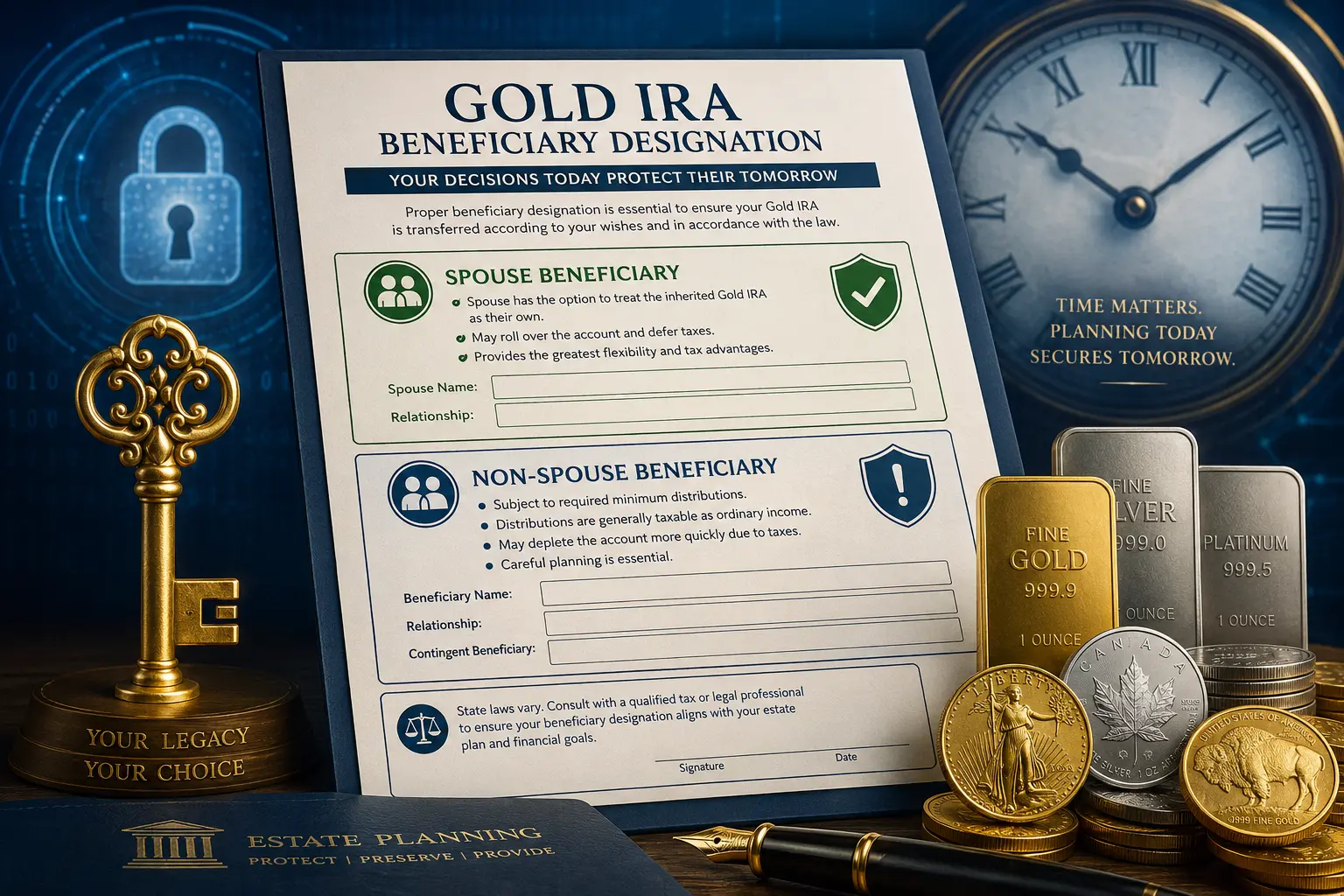
The rules depend heavily on whether the primary beneficiary is a spouse or a non-spouse.
Spouse beneficiary options
Publication 590-B and custodian guidance describe several main options when a surviving spouse inherits an IRA, including a Gold IRA:
- Treat the IRA as the spouse's own. The surviving spouse can roll the inherited Gold IRA into an IRA in the spouse's own name. Standard IRA rules then apply, including required minimum distributions (RMDs) starting at the applicable age — 73 for owners who reach 73 before 2033, rising to 75 for people born in 1960 or later.
- Keep it as an inherited (beneficiary) IRA. This can make earlier penalty-free access possible before age 59½, but comes with its own RMD timing rules.
- Disclaim the inheritance. If a spouse formally disclaims the account under estate rules, the IRA can pass to contingent beneficiaries per the beneficiary form.
In a Gold IRA, these options exist alongside metal-specific choices, such as whether to keep metals invested, shift some holdings to cash within the IRA, or later take in-kind distributions of coins and bars.
Non-spouse beneficiary rules
Non-spouse beneficiaries — adult children, other relatives, and most individual heirs — face stricter rules after the SECURE Act. A non-spouse beneficiary generally cannot roll an inherited Gold IRA into a personal IRA or contribute to the inherited account; assets usually must move into an inherited (beneficiary) IRA in the heir's name; and for most non-spouse designated beneficiaries of IRAs inherited after 2019, the account must be emptied by the end of the 10th year following the original owner's death. Non-spouse heirs typically owe income tax on distributions from inherited traditional Gold IRAs, but no 10% early-withdrawal penalty applies even if the beneficiary is under age 59½. Customers should speak to a financial or tax advisor before deciding between lump-sum, staged, or in-kind approaches.
The 10-Year Rule and Eligible Designated Beneficiaries
The SECURE Act and later guidance introduced the 10-year rule for many inherited IRAs and defined which beneficiaries qualify for more flexible life-expectancy payouts. The statutory distribution requirements sit in 26 U.S. Code § 401(a)(9), and the current administrative position is in the Retirement plan and IRA required minimum distributions FAQs. Custodians now use three main categories:
- Eligible designated beneficiaries (EDBs): generally surviving spouses, minor children of the account owner (until majority), disabled or chronically ill individuals, and beneficiaries no more than 10 years younger than the decedent. EDBs may use life-expectancy payout schedules.
- Designated beneficiaries (DBs): most individual non-spouse heirs who do not meet EDB criteria — generally must deplete the account by the end of the 10th year.
- Non-designated beneficiaries: estates, charities, and some non-qualifying trusts — often face a 5-year rule if the owner died before starting RMDs, or accelerated payouts if RMDs had begun.
A key nuance is whether the owner died before or after the required beginning date (RBD) for RMDs. If the owner died before the RBD, many designated beneficiaries can empty the account at any time within the 10 years as long as the full balance is withdrawn by year 10. If the owner died on or after the RBD, recent IRS guidance indicates some beneficiaries must both follow the 10-year rule and take annual RMDs in years 1–9. These rules apply to Gold IRAs regardless of metal type. Customers should speak to a financial or tax advisor.
How Physical Metals Can Be Inherited, Liquidated, or Distributed In Kind
Inherited Gold IRAs add a layer of decision-making because the account typically holds physical bullion or coins at a depository under the trustee's control. A beneficiary can usually transfer the account into an inherited IRA that continues to hold physical metals, subject to the new beneficiary's distribution schedule — with RMDs funded by selling a portion of the metal or by taking in-kind distributions.
Some beneficiaries prefer to sell metals inside the IRA and take cash distributions instead. Distributions from inherited traditional Gold IRAs are generally taxed as ordinary income to the beneficiary, whether metals or cash are taken, because tax treatment follows IRA rules rather than collectibles rules. Others take an in-kind distribution: the custodian reports the fair market value of the metal on the distribution date as a taxable distribution, and the metal then becomes the beneficiary's personal property, subject to future capital-gains rules rather than IRA rules. The mechanics are explained in Gold-specific terms on inherited Gold IRA rules and Gold IRA exit strategies. Customers should speak to a financial or tax advisor before choosing cash versus in-kind.
Trusts as IRA Beneficiaries: Why Legal Review Matters
Trusts can be named as beneficiaries of Gold IRAs, but the rules are complex and the SECURE Act changed how many trusts are treated. Owners use trusts when beneficiaries are minors, have special needs, or may struggle to manage money; to control the pace of distributions; or to coordinate with other estate and creditor-protection goals. For Gold IRAs, a trust can also specify how metals are sold or allocated among multiple heirs.
For a trust to receive "see-through" treatment and use life-expectancy payouts, all trust beneficiaries generally must be identifiable individuals and the trust must meet several IRS conditions. Under SECURE Act rules, even qualifying see-through trusts often must follow the 10-year rule unless all beneficiaries are eligible designated beneficiaries. If a trust fails see-through requirements, or names non-individuals such as charities or the estate, it may be treated as a non-designated beneficiary and face a 5-year or accelerated schedule. Because Gold IRAs involve in-kind distributions and valuation questions, trust language may need to spell out how to handle specific coins or bars. Customers should speak to a financial or tax advisor — and often an estate planning attorney — before naming a trust. Goldco does not offer tax or legal advice.
Probate, Beneficiary Forms, and Account Titling
Most Gold IRAs are set up to pass outside probate when beneficiary forms are properly completed and updated. When a retirement account has valid primary and contingent beneficiaries, custodians generally transfer assets directly to those beneficiaries upon receiving proof of death, so those assets may never enter the probate estate. Probate becomes necessary mainly when no beneficiary is named, all named beneficiaries have died with no contingents listed, or the estate is named as beneficiary.
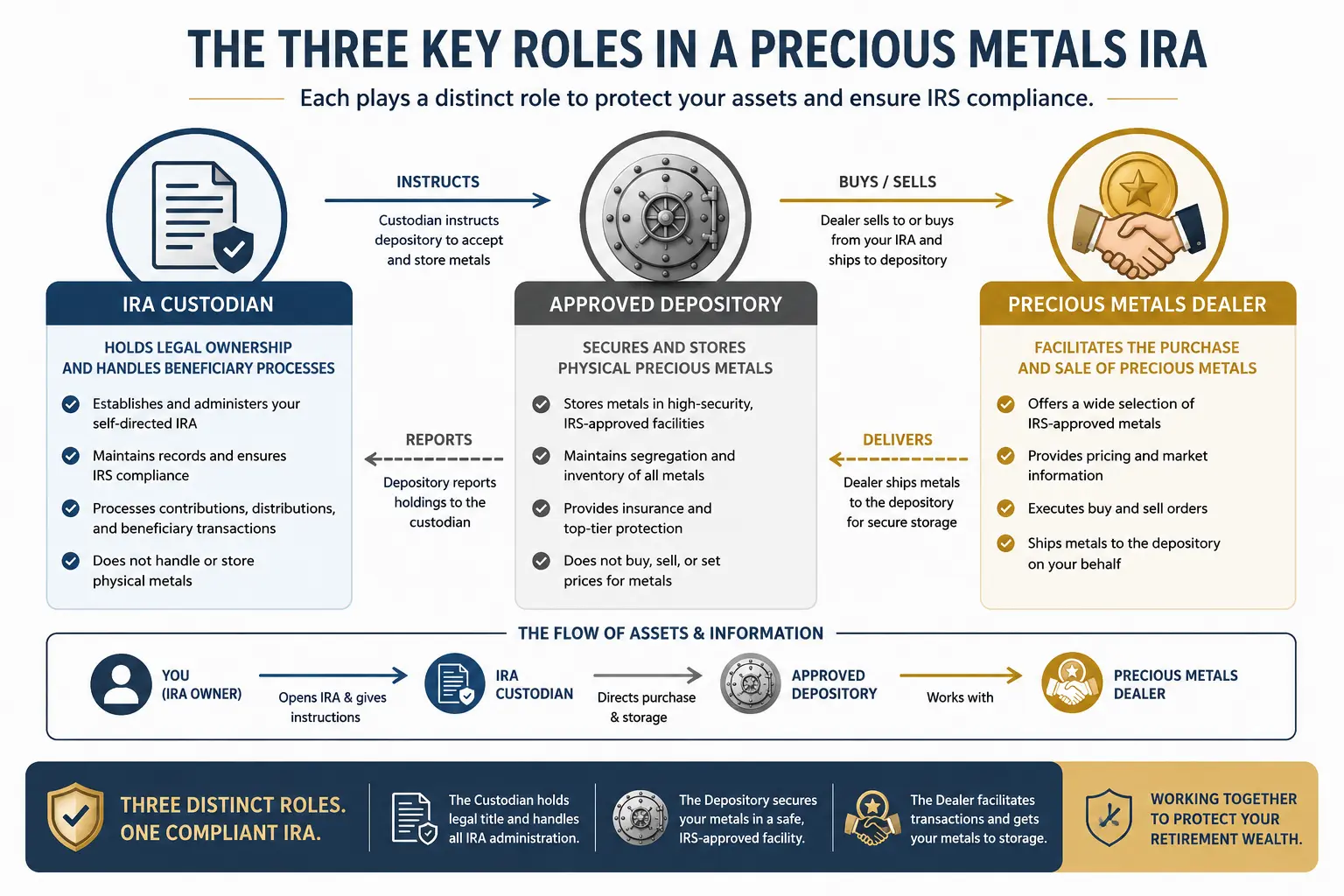
After death, custodians generally retitle inherited IRAs to reflect both the decedent and the beneficiary, for example "John Smith (deceased) IRA FBO Mary Smith, Beneficiary" — and this titling applies to a Gold IRA even though the assets are metals. Regular reviews of beneficiary forms, contingents, and titling keep Gold IRA inheritance aligned with the estate plan. State law also matters: creditor protection by state can affect how inherited IRAs are treated. Customers should speak to a financial or tax advisor.
RMDs for Inherited Gold IRAs
Required minimum distributions for inherited Gold IRAs follow general inherited IRA rules, but physical metals change how RMDs are satisfied in practice. The original owner's final-year RMD (if not taken before death) still must be withdrawn. Spouse beneficiaries who treat the IRA as their own follow standard RMD rules based on their own age, starting at the applicable age — 73, rising to 75 for people born in 1960 or later. Beneficiaries using life-expectancy payouts calculate RMDs from the IRS Single Life Expectancy Tables. Under updated SECURE Act guidance, many non-spouse beneficiaries subject to the 10-year rule must both deplete the account by year 10 and take annual RMDs in years 1–9 if the decedent died after starting RMDs.
For Gold IRAs, RMD calculations typically use the end-of-year fair market value of the metals. The required amount can be met by selling enough metal to generate the cash distribution, or by taking an in-kind distribution of metals whose fair market value equals or exceeds the RMD. Because metal prices fluctuate, planning RMDs often involves coordination between the custodian, dealer, and tax professional — see Gold IRA RMD strategy and exit strategies. Past performance does not guarantee future results.
Common Mistakes in Gold IRA Beneficiary Planning
- Outdated or missing beneficiary forms — failing to update after marriage, divorce, birth, or death can send the account to unintended heirs or into probate, regardless of the will. Where an account was itself divided in a divorce, the separate transfer mechanics are covered in the IRA transfer incident to divorce guide.
- Naming the estate unintentionally — this can subject the Gold IRA to probate and limit distribution options to 5-year or accelerated schedules.
- Assuming stretch payouts still apply broadly — many non-spouse beneficiaries can no longer stretch RMDs over a lifetime; the 10-year rule usually applies.
- Ignoring the 10-year rule's impact on metals — heirs sometimes wait until late in the window, then must sell or distribute large metal positions quickly.
- Relying on general rules without state-law review — creditor protection, community-property, and trust rules differ by state.
Related pitfalls are covered on Gold IRA tax mistakes and creditor protection by state. Goldco does not offer tax or legal advice.
Checklist for Account Holders and Heirs
For current Gold IRA account holders:
- Confirm primary and contingent beneficiaries are listed and match the broader estate plan.
- Note whether any beneficiary is a minor, disabled, or an entity such as a trust or charity, where SECURE Act rules may differ.
- Decide in advance whether a spouse will treat the account as a personal IRA or an inherited IRA, and document that intent.
- Consider whether a trust is appropriate and, if so, arrange legal review of trust language and see-through requirements.
- Coordinate with RMD strategy and exit paths via RMD strategy, exit strategies, and best Gold IRA companies.
For heirs and potential beneficiaries:
- Obtain copies of the custodian's beneficiary forms and confirm listed and contingent beneficiaries.
- After death, work with the custodian to establish any required inherited IRA, confirm which schedule applies, and identify the first RMD deadline.
- Decide, with professional guidance, whether to sell metals, take in-kind distributions, or use a mix — weighing tax, liquidity, and timing.
- Track all distribution amounts and deadlines to avoid missed RMDs or failure to empty the account in time, which can trigger penalties.
- Review inherited Gold IRA rules and tax mistakes before instructing the custodian.
Plan the account before the estate needs it
Compare providers and model costs before funding — the quiz is educational and makes no recommendation.
Take the Free Gold IRA Quiz →FAQ
What happens to a Gold IRA when the owner dies?
The custodian transfers the account to the named beneficiaries according to the beneficiary form, not the will. Depending on whether the beneficiary is a spouse, eligible designated beneficiary, or other heir, inherited IRA rules such as the 10-year rule or life-expectancy payouts determine how long the account can remain open and how distributions must be taken.
Do Gold IRA beneficiary rules differ from regular IRA rules?
They follow the same IRS framework as other traditional or Roth IRAs, including SECURE Act rules, RMD ages, and 10-year or 5-year limits. The main difference is practical: the account holds precious metals that must be valued, sold, or distributed in kind to meet deadlines.
How does the 10-year rule apply to inherited Gold IRAs?
For most non-spouse designated beneficiaries inheriting after 2019, the account must be fully distributed by the end of the 10th year after death. Recent guidance also requires annual RMDs in many cases when the decedent had already begun RMDs.
Can a trust be the beneficiary of a Gold IRA?
Yes, but SECURE Act rules and IRS see-through requirements make it complex. If the trust qualifies and its beneficiaries are eligible designated beneficiaries, life-expectancy payouts may be possible; otherwise a 10-year or 5-year schedule may apply. Legal review is important.
Does a Gold IRA go through probate?
With properly completed beneficiary designations, it usually passes directly to beneficiaries outside probate. If no beneficiary is named, or the estate is listed, it may become part of the probate estate. Customers should speak to a financial or tax advisor. Goldco does not offer tax or legal advice.
Article reviewed and edited by Daniel M. — editor, 401kToGoldIRA.org.