Educational only: This guide teaches how to compare storage arrangements; it does not declare one option best and it is not financial, tax, or legal advice. It summarizes IRS and FINRA guidance and published depository disclosures in general terms, each of which can change and should be re-checked directly. Customers should speak to a financial or tax advisor before making decisions. Goldco does not offer tax or legal advice. Past performance does not guarantee future results.
The IRS states that qualifying IRA bullion must remain in the physical possession of a bank or an IRS-approved nonbank trustee, and that the same rule applies when an IRA-owned limited liability company acquires the metal (IRS: Retirement Plans FAQs Regarding IRAs).
How to Compare Gold IRA Storage Options: Quick Answer
A gold IRA storage comparison should examine at least nine items:
- Custody: Which bank or IRS-approved nonbank trustee administers the IRA?
- Depository: Which facility physically holds the metals?
- Ownership record: Are the metals allocated to the account?
- Physical arrangement: Are the metals segregated by customer or stored with like-kind bullion?
- Fees: Are storage charges flat, percentage-based, tiered, or subject to minimums?
- Insurance: What risks, limits, exclusions, and valuation methods are disclosed?
- Audits and controls: Are inventories reconciled, and are internal or external audits described?
- Withdrawal process: Will an in-kind distribution return the same pieces or equivalent like-kind products?
- Location: Which vault, state, and shipping route apply?
The IRS maintains a current list of entities approved to act as nonbank trustees or custodians. It does not publish a simple consumer list labeling every commercial vault as an "approved Gold IRA depository." That phrase is often used in marketing, but the more precise process is to verify the trustee or custodian and then confirm the storage facility accepted under that custodian's program (IRS: Approved Nonbank Trustees and Custodians). Customers should speak to a financial or tax advisor before making decisions involving an IRA, rollover, custody arrangement, distribution, or taxes. Goldco does not offer tax or legal advice.
Segregated vs. Commingled Storage
What Segregated Storage Means
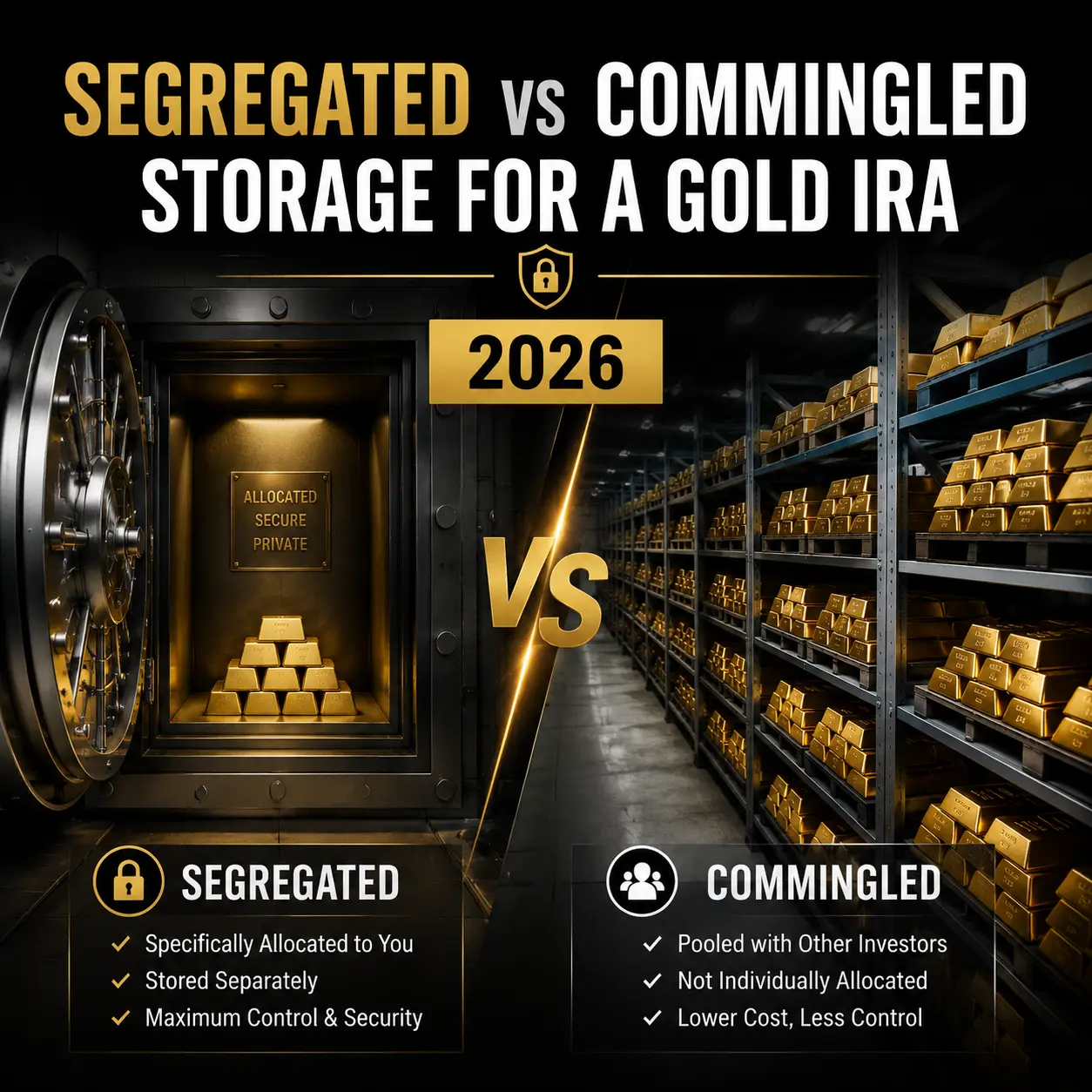
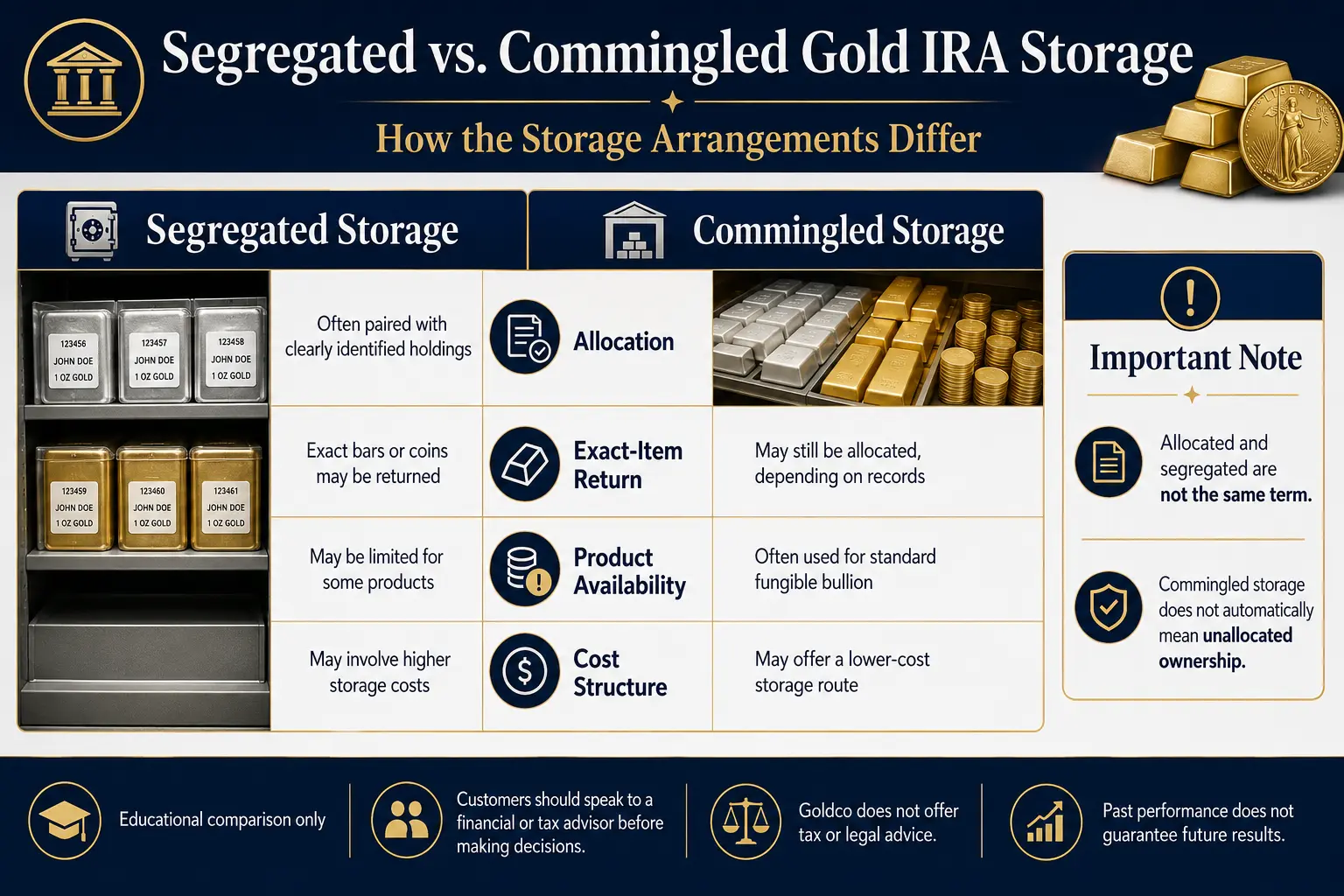
Delaware Depository describes segregated storage as an arrangement in which bullion is inspected, packaged, labeled, and kept physically separate from other customers' metal, and states that the exact bars or coins deposited are returned when the holdings are withdrawn. It also states that segregated storage costs more because it requires additional labor and vault space (Delaware Depository: Storage Options). Segregated storage can matter when the account holds a specific mint year, a particular serial-numbered bar, a specialty product, a graded or numismatic item held outside an IRA, a product with personal or collector significance, or metal for which exact-item return is important. The term does not mean the account has a private room or a separate vault — a depository may use an individually labeled container or a client-specific area inside a larger secured facility.
What Commingled or Non-Segregated Storage Means
Delaware Depository describes non-segregated, or commingled, storage as the bulk storage of fungible products: a one-ounce Gold American Eagle owned by one customer may be stored with the same product owned by other customers, with the depository's records identifying the quantity owed to each account, though the exact piece originally deposited may not be the piece later returned. The same depository states that all bullion in both arrangements is fully allocated on its system and that it does not lend or lease customer metal — an important distinction: commingled storage does not automatically mean unallocated ownership (Delaware Depository: FAQs). Commingled storage may be practical for standard, interchangeable bullion; segregated storage may provide stronger exact-item identification. The decision depends on product type, cost, withdrawal expectations, and the custodian's available options. The separate segregated versus commingled storage guide provides a more detailed side-by-side explanation.
Allocated vs. Unallocated Storage
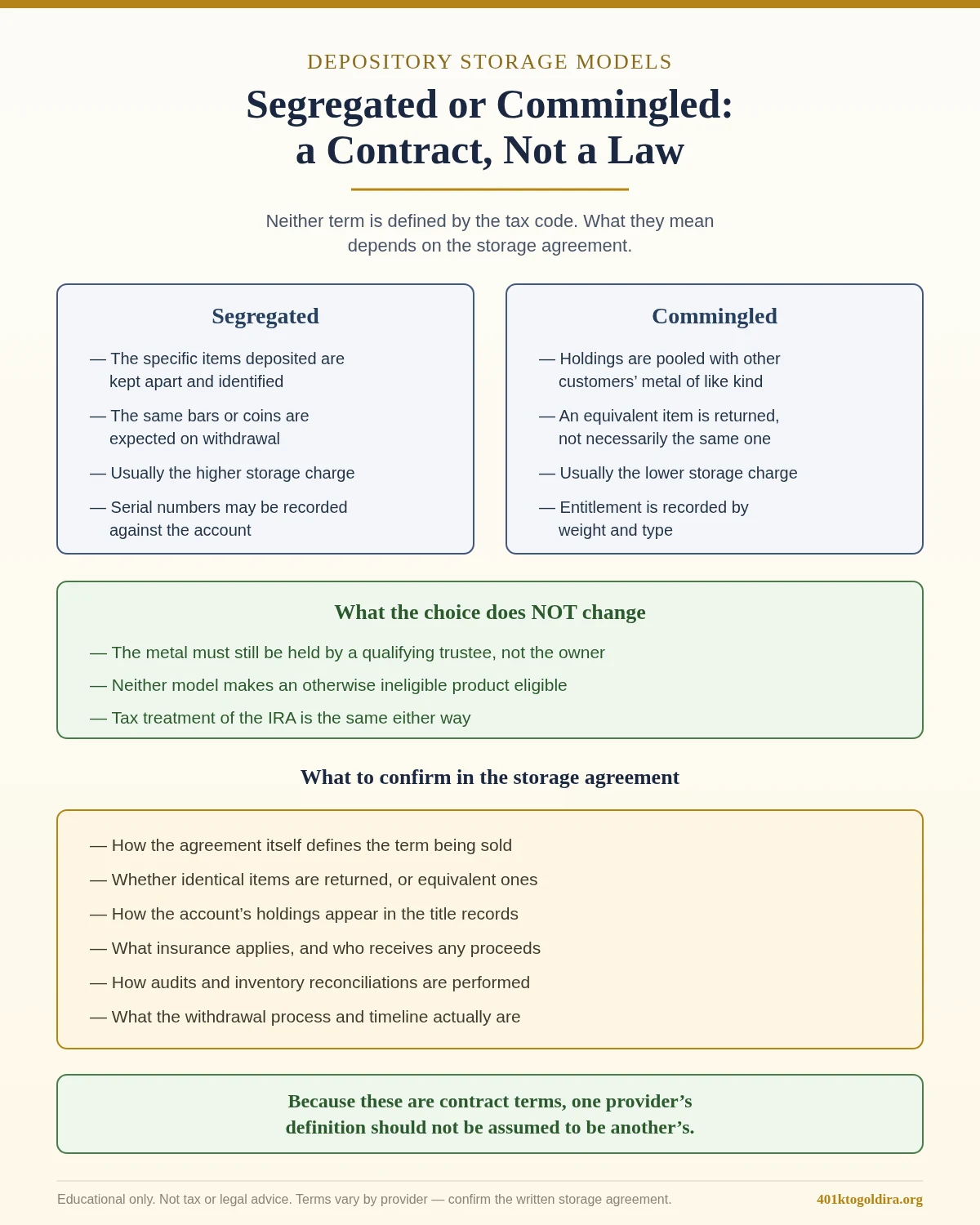
Allocated and segregated describe different things. The London Bullion Market Association states that an allocated account is backed by specific bars, while an unallocated account records a contractual metal balance rather than title to specific bars (LBMA: Precious Metal Accounts). The Royal Mint similarly describes allocated gold as metal earmarked for an owner, while unallocated gold generally creates an entitlement to metal value rather than ownership of specified bullion (The Royal Mint: The Question of Ownership). These terms should not be blended with segregated and commingled:
| Term | Main question answered |
|---|---|
| Allocated | Is physical metal identified as property held for the account? |
| Unallocated | Is the holder owed a metal balance rather than assigned identified bullion? |
| Segregated | Is the account's metal physically separated from other customers' metal? |
| Commingled | Is allocated, fungible metal stored with identical products belonging to others? |
International Depository Services states that client assets at its Delaware facility are held in client-specific custody accounts and remain off the company's balance sheet, and that it also offers segregated storage in which each customer's metals are stored separately (International Depository Services: IDS of Delaware). A storage contract should therefore answer both ownership and physical-placement questions. A statement that metal is "allocated" does not necessarily prove that it is physically segregated, and a statement that it is "commingled" does not necessarily mean that the customer owns only an unsecured metal claim. For a physical Gold IRA, the account file should identify the metals held for the IRA, the custodian's records, and the depository arrangement. Any use of "unallocated" should receive written clarification from the custodian and a tax professional before retirement funds move.
Approved Depositories and How to Verify One
Verify the Trustee or Custodian First
The IRS maintains and updates a list of approved nonbank trustees and custodians under Treasury Regulation Section 1.408-2(e), and banks can also serve as IRA trustees or custodians under the applicable rules. The verification file should record the legal custodian name, whether the custodian is a bank or appears on the current IRS nonbank list, the IRA account agreement, the depository named in the account documents, the depository address and specific facility, the storage type selected, the party that sends account statements, and the party responsible for authorizing shipments and distributions. The IRS list can change as entities are added, removed, renamed, or updated, so the search should be repeated before an account is opened or transferred.
Confirm the Custodian–Depository Relationship
A depository may provide vault services without serving as the IRA trustee. The custodian remains responsible for IRA administration and records, while the depository handles physical custody under the program's agreements. GoldStar Trust states that IRA metals must remain in the custody of the IRA custodian until distribution, lists several facilities used within its program, describes which offer commingled or segregated storage for different metals, and notes that the dealer often influences which listed depository is used — these are GoldStar's program terms, not universal rules for every custodian (GoldStar Trust: Precious Metals IRA). A choosing gold IRA depository review should therefore request written confirmation from the custodian, not rely only on a dealer's statement or a depository logo.
Do Not Assume Every Product Has Every Storage Option
GoldStar's public page states that Delaware Depository offers segregated storage for gold, platinum, palladium, and 1,000-ounce silver bars within that program, while smaller silver products use commingled storage, and lists other facilities with different available arrangements. Availability can vary by metal, bar or coin size, product type, custodian, depository facility, account size, and current operational policy. The written storage election should name the exact product and confirm the available arrangement.
Gold IRA Storage Fees: Flat vs. Percentage-Based
Flat Annual Fees
A flat storage fee charges the same stated amount within the covered account or value range. It can be easier to forecast because the dollar charge does not automatically rise with every increase in metal value. A flat price may still have conditions: a minimum account charge, a separate segregated-storage surcharge, higher fees above a value threshold, separate custodian and depository invoices, shipping/handling/distribution fees, or charges for additional locations or account types. A "flat" custodian fee does not prove that the depository fee is also flat.
Percentage and Tiered Fees
Texas Precious Metals Depository publishes a percentage-based schedule that changes by metal type and account value. Its July 2026 pricing page showed annual rates beginning at 0.5% for gold, platinum, and palladium holdings up to $100,000 and 0.6% for silver in the same value band, with lower percentages in higher tiers and a minimum monthly charge; those terms can change and should be re-checked directly (Texas Precious Metals Depository: Pricing). GoldStar states that some precious-metals IRA maintenance or storage charges may change with the account's market value before the billing period. Percentage fees can become more expensive as the metal value rises, but they can also be lower in smaller accounts than a high flat minimum. A gold IRA storage cost comparison should model the same account value under each schedule.
Compare the Entire Annual Cost
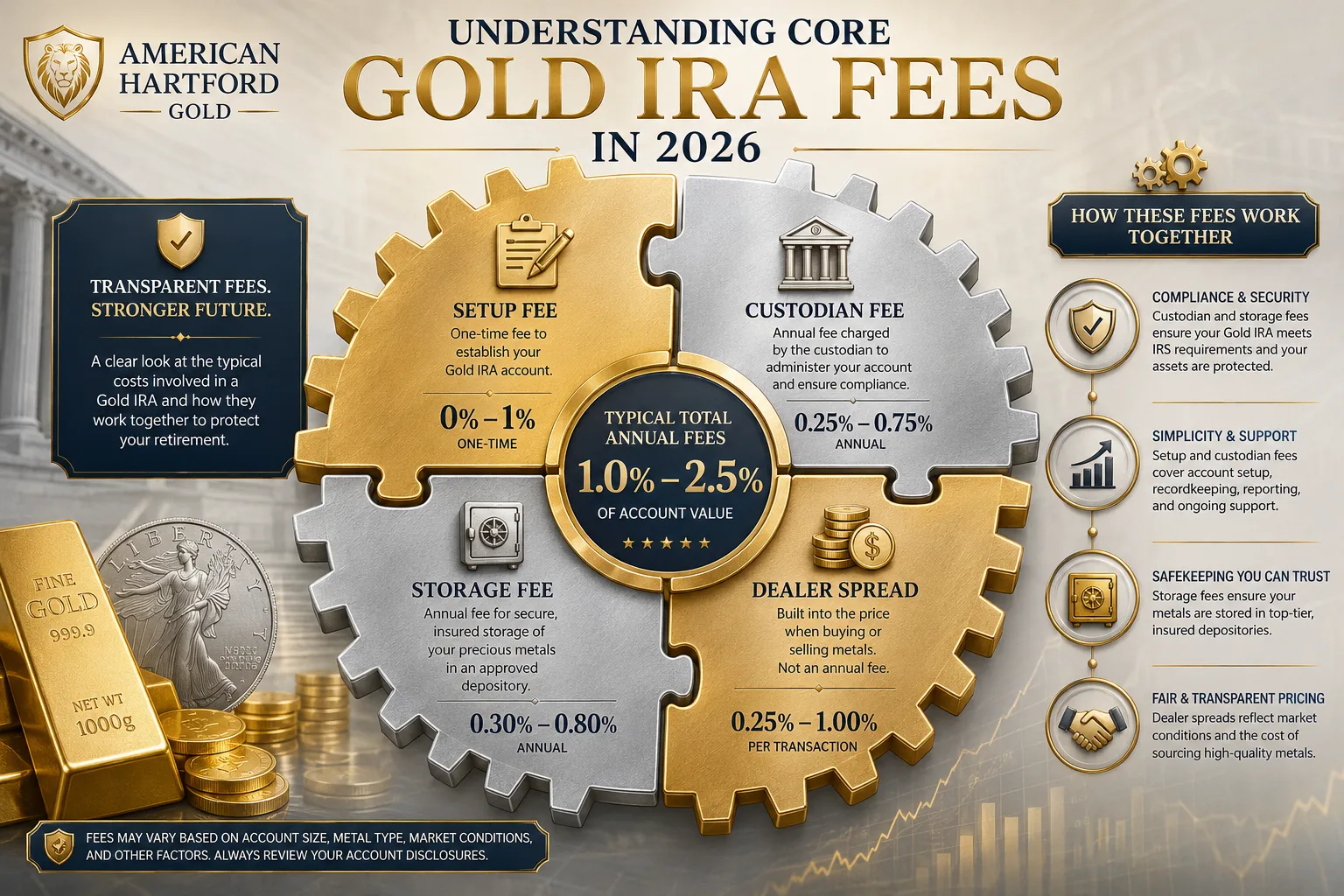
The storage line is only one part of the account cost. A written comparison can include the IRA establishment fee, annual custodian or maintenance fee, storage fee, segregated-storage surcharge, asset-value charge, insurance charge (if separate), wire and check charges, purchase or sale transaction fees, shipping and handling, in-kind distribution fee, and account termination or transfer fee. The Gold IRA fees benchmark can provide a broader framework, and the Gold IRA quote checklist can be used to collect the quoted figures in one place. No market-wide "typical" storage fee is stated here because pricing differs by custodian, depository, account value, metal, and storage arrangement — a current written schedule is more useful than an unsourced industry average.
Insurance, Audit Practices, and Security
Insurance Questions
The word "insured" does not explain the full protection. A gold IRA storage insurance review should request the insurer name, type of policy, whether coverage is per facility or per account, total policy limit, replacement-value or market-value method, covered events, exclusions, deductibles, whether metal in transit is covered, when transit coverage begins and ends, the claims procedure, and whether the account holder can receive evidence of coverage. Texas Precious Metals Depository states that its holdings are insured for full replacement value through an all-risk Lloyd's of London policy and marked to market daily using an LBMA reference price, listing external theft, employee theft, fire, flood, and severe natural disasters among covered events (Texas Precious Metals Depository). International Depository Services states that its locations and contents are insured by Lloyd's of London, though its public page does not provide every account-level policy detail, so a customer still needs the custodian's and depository's written coverage terms. These are company disclosures and should be confirmed in current documents.
Audit and Inventory Questions
A gold IRA storage audit can refer to physical inventory counts, internal control testing, financial-statement audit work, independent inventory verification, custodian reconciliation, depository reconciliation, SOC reporting, or state/regulatory oversight. Delaware Depository states that non-segregated bullion is subject to frequent recurring audits and independently audited internal controls, and that the organization is SSAE 18 SOC 1 Type 1 audited. IDS describes internal and external inventory audits and dual-control procedures for segregated storage. Texas Precious Metals Depository states that client accounts are audited annually by an independent accounting firm. These statements should lead to follow-up questions: the comparison should ask what is audited, how often, by whom, and whether a report or confirmation is available to the custodian or account holder.
Security Questions
Public security descriptions may include vault ratings, surveillance, access control, employee screening, dual control, alarm systems, and disaster planning; detailed security information may be limited for valid operational reasons. The useful comparison is not the number of marketing phrases — it is whether the facility describes layered controls, inventory accountability, insurance, shipment procedures, and independent oversight in a way the custodian can confirm. Location also matters: a gold IRA depository options review can compare distance from common dealer shipping routes, state law and regulatory structure, exposure to weather or natural hazards, availability of multiple facilities, processing times for liquidation or distribution, and costs for transferring metal to another approved arrangement. No location removes every operational risk.
The Gold IRA Home-Storage Risk
The IRS directly addresses the gold IRA home storage myth. Its IRA FAQ states that qualifying bullion must be in the physical possession of a bank or IRS-approved nonbank trustee, and that the rule also applies when an IRA-owned LLC buys the bullion. The IRS also states that an investment in a nonqualifying collectible is treated as a distribution in the year of purchase and may create an additional early-distribution tax (IRS: Investments in Collectibles in Individually Directed Accounts). A 2021 Tax Court case involving IRA-owned gold coins stored at a taxpayer's home resulted in taxable IRA distributions; the Journal of Accountancy summarized the decision and the court's conclusion that personal possession failed the IRA custody requirement (Journal of Accountancy). The safe approach is not to rely on a marketing phrase such as "checkbook control," "LLC storage," or "home storage IRA" — the exact structure should receive independent tax and legal review before a purchase or transfer. Customers should speak to a financial or tax advisor before making decisions involving IRA custody, an LLC, home storage, distributions, or taxes. Goldco does not offer tax or legal advice.
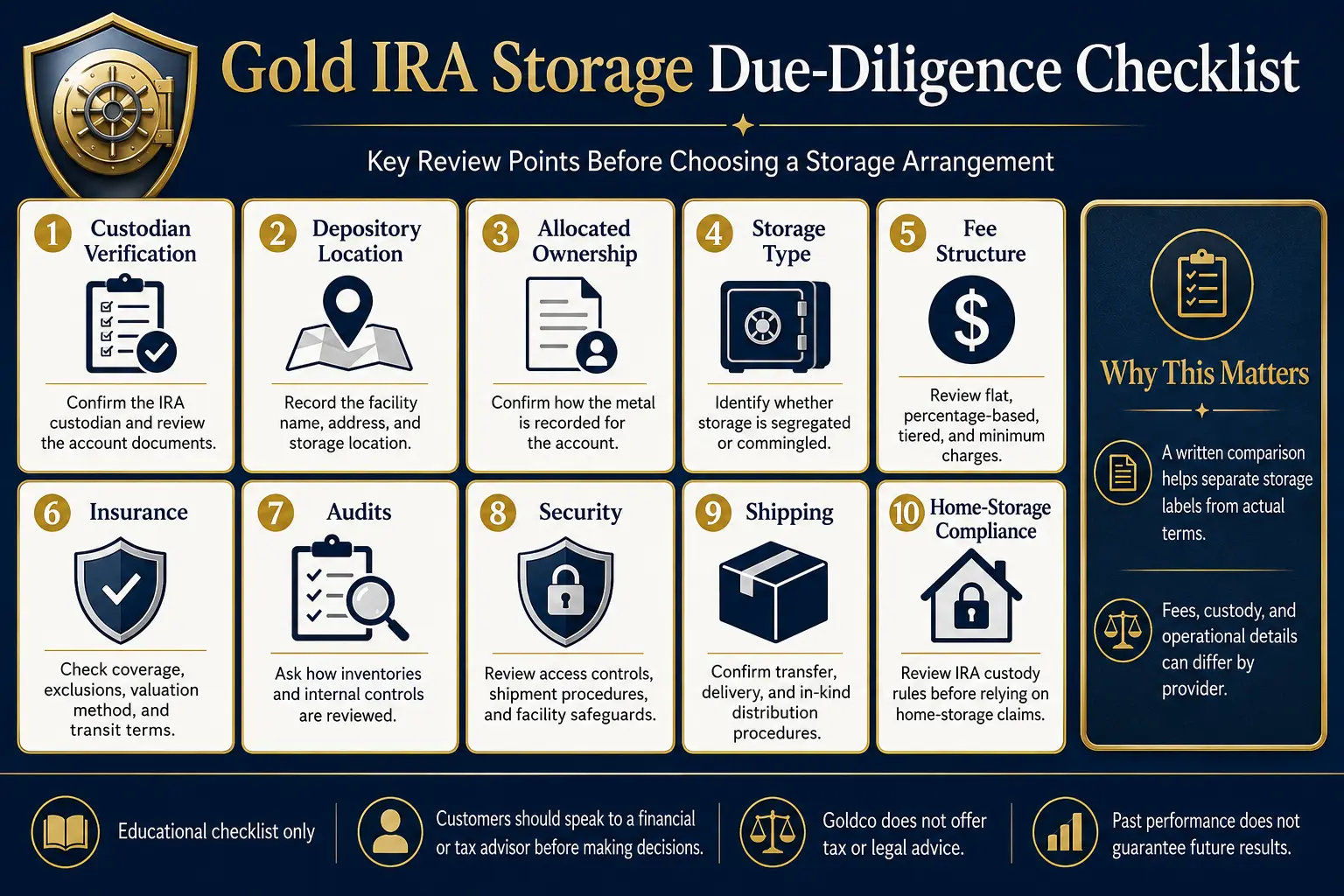
A Written Gold IRA Storage Due-Diligence Checklist
The following checklist can be applied to each proposed arrangement.
Custodian and legal structure: record the custodian's exact legal name; check the current IRS nonbank trustee list when the custodian is not a bank; obtain the IRA agreement and fee schedule; confirm that the custodian accepts the proposed metals and depository; identify who authorizes purchases, sales, transfers, and distributions.
Depository and location: record the depository's legal name and facility address; confirm the relationship directly with the custodian; identify the specific vault location; ask whether the metal can be moved to another facility; request transfer and withdrawal procedures.
Ownership and storage type: confirm whether the metals are allocated; identify whether storage is segregated or commingled; ask whether exact pieces or like-kind pieces are returned; confirm which products cannot receive segregated storage; obtain the storage election in writing.
Fees: obtain every flat, tiered, percentage, and minimum charge; calculate the cost at current value and several higher values; separate custodian, storage, insurance, shipping, and transaction charges; identify when fees are billed and whether they can be paid from IRA cash; record liquidation, transfer, and in-kind distribution charges.
Insurance and audit: request the current insurance summary; identify limits, exclusions, valuation, and transit coverage; ask what inventory and controls are audited; record audit frequency and auditor type; ask whether the custodian receives reconciliation or audit reports.
Security and operations: review access controls, dual-control procedures, and shipment protocols; confirm delivery signatures and insurance during transit; ask how damaged, missing, or disputed shipments are handled; identify business-continuity and disaster procedures; record estimated processing times.
Final Comparison
The comparison should be placed in one table rather than reviewed from separate sales calls.
| Factor | Option A | Option B | Option C |
|---|---|---|---|
| Custodian | — | — | — |
| Depository and location | — | — | — |
| Allocated ownership | — | — | — |
| Segregated or commingled | — | — | — |
| Exact-item return | — | — | — |
| Annual storage fee | — | — | — |
| Value-based charges | — | — | — |
| Insurance disclosure | — | — | — |
| Audit disclosure | — | — | — |
| Shipping and distribution cost | — | — | — |
| Transfer flexibility | — | — | — |
The questions to ask before opening a Gold IRA can supplement this checklist. The best Gold IRA companies page can support a broader provider comparison, while the Gold IRA quiz can help organize research priorities.
Frequently Asked Questions
Must Gold IRA metals be stored outside the home?
The IRS states that qualifying IRA bullion must be in the physical possession of a bank or IRS-approved nonbank trustee. It applies the rule to direct purchases and indirect acquisitions through an IRA-owned LLC.
Is segregated storage the same as allocated storage?
No. Allocated storage concerns ownership of identified physical metal. Segregated storage concerns physical separation from other customers' metal. Delaware Depository states that both its segregated and non-segregated arrangements are allocated.
Does commingled storage mean the metals are unsecured?
Not necessarily. A commingled arrangement can still involve allocated metal recorded for the IRA and stored with identical fungible products. The contract and custodian records should confirm ownership.
Is segregated storage always more expensive?
Delaware Depository states that its segregated storage costs more because of additional labor and space. Actual pricing depends on the custodian, depository, product, and account value.
How can an approved Gold IRA depository be verified?
The IRS list verifies approved nonbank trustees and custodians, not every vault under a simple consumer "depository" label. The custodian should confirm the depository used under its program, and the depository's legal name, address, storage type, insurance, and audit disclosures should be checked directly.
Are Gold IRA storage fees flat?
Some arrangements use flat charges, while others use percentage or tiered schedules. Texas Precious Metals Depository publishes percentage-based pricing, and GoldStar states that certain charges may change with account value. A written quote should show all account and storage costs.
Conclusion
The strongest method for how to compare Gold IRA storage options is to separate the decision into custody, ownership, physical arrangement, cost, protection, and operations. Segregated and commingled describe how metal is physically stored; allocated and unallocated describe the ownership or account claim — the terms should not be treated as interchangeable. The IRS requires qualifying IRA bullion to remain in the physical possession of a bank or approved nonbank trustee, and in practice the custodian may use one of several accepted depositories, each with different product limits, fee schedules, insurance disclosures, audit practices, and locations. No storage choice should be selected from a single marketing label. A written comparison should identify the custodian, depository, exact storage type, full fee schedule, insurance terms, audit details, withdrawal process, and home-storage compliance treatment. Customers should speak to a financial or tax advisor before making decisions involving an IRA, rollover, custody, home storage, distribution, or taxes. Goldco does not offer tax or legal advice.
Sources
- Internal Revenue Service. Retirement Plans FAQs Regarding IRAs.
- Internal Revenue Service. Investments in Collectibles in Individually Directed Qualified Plan Accounts.
- Internal Revenue Service. Approved Nonbank Trustees and Custodians.
- FINRA. 10 Things to Ask Before Buying Physical Gold, Silver or Other Metals.
- Delaware Depository. Storage Options.
- Delaware Depository. Frequently Asked Questions.
- International Depository Services. IDS of Delaware.
- Texas Precious Metals Depository. Homepage.
- Texas Precious Metals Depository. Pricing.
- GoldStar Trust Company. Precious Metals IRA.
- London Bullion Market Association. Precious Metal Accounts.
- The Royal Mint. The Question of Ownership.
- Journal of Accountancy. Gold Coins Kept at Taxpayer's Home Caused Taxable IRA Distributions.
Article reviewed and edited by Daniel M. — editor, 401kToGoldIRA.org. Sourced to the IRS, FINRA, the LBMA, the Royal Mint, and published depository disclosures; educational only, not tax or legal advice. Depository terms and fees can change and should be re-checked directly.