
Affiliate disclosure: Some links on this page may be sponsor links. The site owners may be compensated if customers request information from companies mentioned here. This page is educational only and does not provide financial, tax, or legal advice. Customers should speak with a qualified tax professional before making retirement-account decisions. Past performance does not guarantee future results.
Key takeaways
- The complaint destination depends on the custodian's legal charter, not its marketing brand.
- No federal complaint route reviewed promises to compel a release. A regulator may review compliance and act supervisorily without ordering an individual transfer.
- The IRS nonbank-trustee list verifies tax qualification, not consumer dispute resolution.
- ACATS timing is not a benchmark for physical precious-metal IRA transfers.
- A trustee-to-trustee transfer is the tax-preserving default when an existing IRA moves to another custodian.
- Missing statements are an evidence problem before they become a tax problem.
- Private counsel can pursue remedies a complaint portal cannot, including an enforceable order.
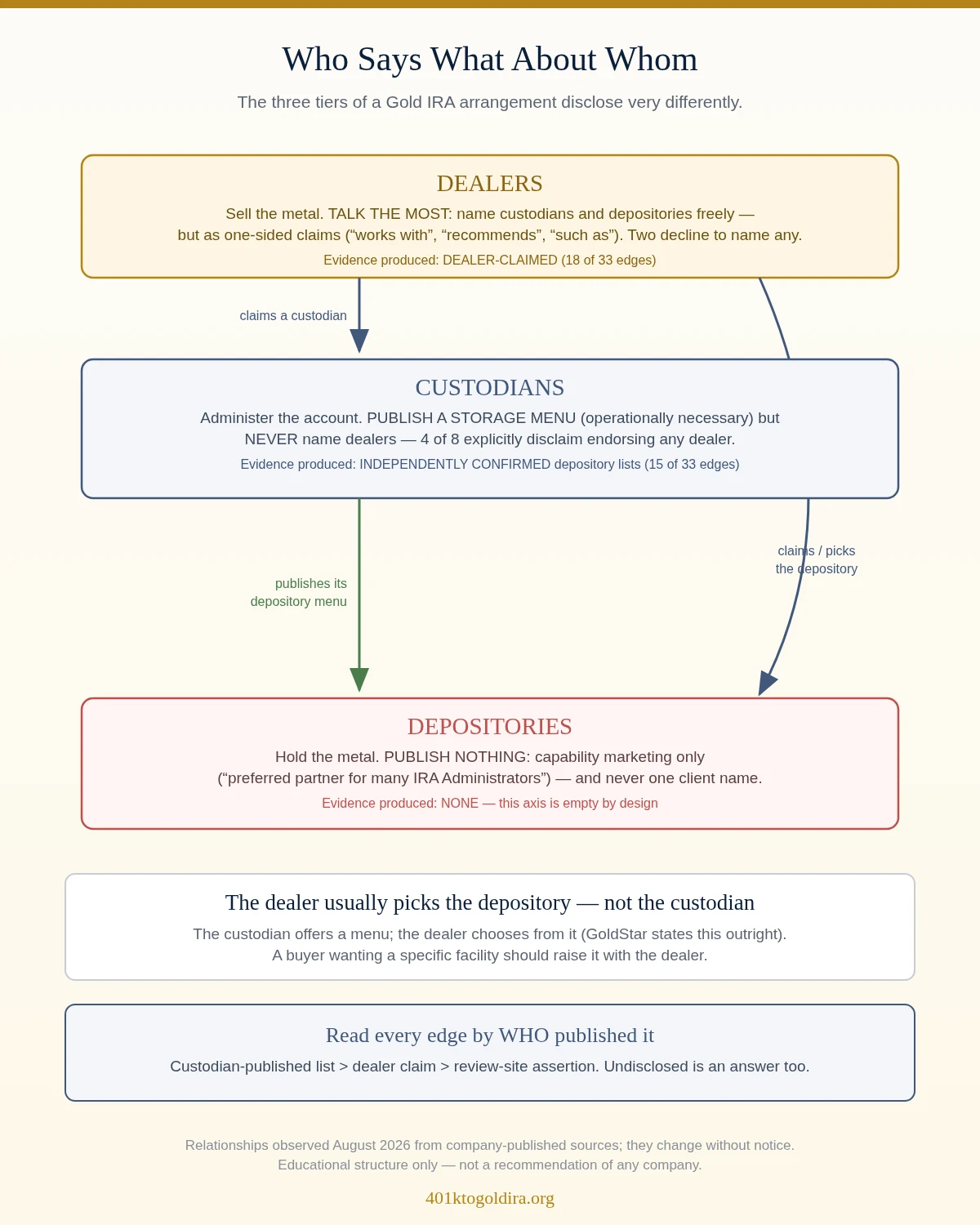
Checking that entity’s standing before opening an account is covered in the custodian selection guide. A self-directed IRA can involve several companies, but only one entity is the trustee or custodian named in the IRA documents. Federal guidance describes that custodian as the party holding and administering the IRA assets; it generally does not evaluate the investment itself. An administrator, dealer, or depository may be operationally important without having authority to release the IRA. (SEC/Investor.gov; CFTC)
Which institution is actually responsible?
The custodian is the legal starting point
An IRA must have a qualifying trustee or custodian. Internal Revenue Code section 408 permits a bank or another person satisfying Treasury requirements to serve, while Treasury Regulation section 1.408-2 governs approved nonbank trustees. The regulation requires approved nonbank trustees to keep fiduciary records, full information for each account, and written records of account acceptance, relinquishment or closing and the assets held. (26 U.S.C. § 408; 26 C.F.R. § 1.408-2)
The adoption agreement, custodial agreement, account statement and tax reporting should identify the legal trustee or custodian. Marketing names should not substitute for that legal entity. The IRS also maintains a list of approved nonbank trustees and custodians. Presence on that list confirms nonbank approval; absence does not prove that an entity is unqualified if it qualifies instead as a bank under section 408. (IRS approved nonbank trustees and custodians)
The administrator, dealer, and depository have different jobs
A non-custodial administrator may collect forms, operate a portal and coordinate transactions while another legal entity remains trustee or custodian. The dealer is the trade counterparty. The depository stores metal under the custody arrangement. SEC, NASAA and CFTC materials describe self-directed IRA custodians as limited administrative and holding entities and distinguish those functions from investment evaluation and precious-metals sales. (SEC/Investor.gov; NASAA; CFTC)
A depository may be able to confirm storage records within its contract, but storage alone does not make it the IRA custodian. It ordinarily acts on custody instructions rather than independently redesignating the IRA or moving it to a new trustee. (26 U.S.C. § 408(m)(3))
Which regulator receives the complaint?
The complaint route follows the institution's charter. Public records should be checked before filing: OCC lists identify national banks, federal savings associations and federal trust banks; FDIC and FFIEC records help identify banking regulators and institution types; state charter records identify state trust companies; and the IRS list verifies approved nonbank trustee status. (OCC financial institution lists; IRS approved nonbank trustees)
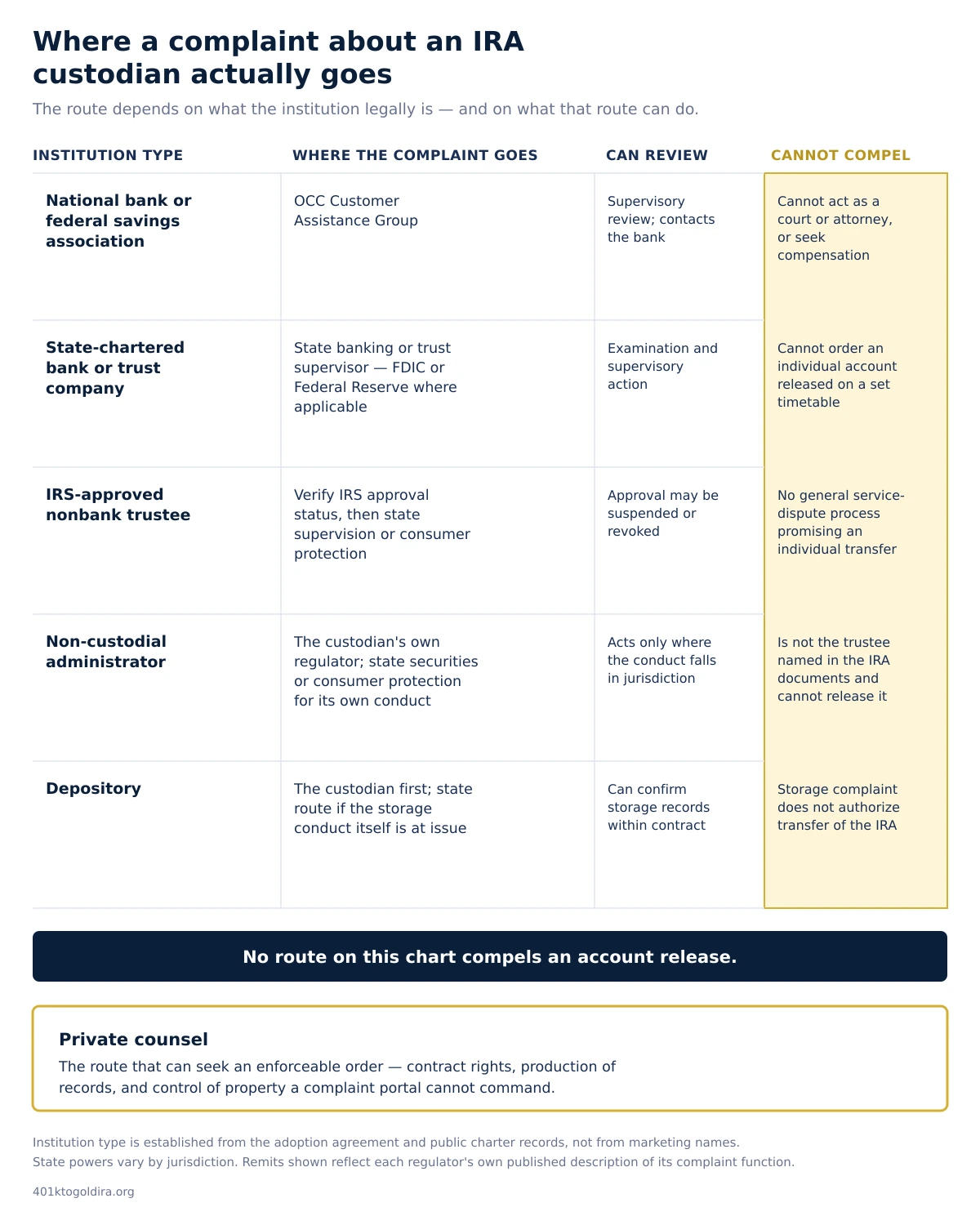
| Institution type | Complaint route | What that route does not guarantee |
|---|---|---|
| National bank or federal savings association | OCC Customer Assistance Group | OCC can review matters in its jurisdiction and contact the bank, but states that it cannot act as a court or attorney, advocate for a party, or seek monetary compensation. |
| State-chartered nonmember bank | FDIC Consumer Complaint Process plus the state banking regulator | FDIC investigates complaints involving banks it supervises; its process should not be treated as a guaranteed private order compelling a particular transfer. |
| State-chartered Federal Reserve member bank | Federal Reserve Consumer Help plus the state regulator | The Federal Reserve states that regulators may not provide the requested resolution and cannot directly award damages, settle fee disputes, or act as an attorney. |
| State-chartered trust company or nondepository trust company | State trust or banking supervisor, found through the CSBS state agency directory | State powers vary; no universal state rule was found promising an individualized order to release an IRA on a particular timetable. |
| IRS-approved nonbank trustee that is not a bank | Verify status on the IRS list, then identify applicable state supervision or consumer-protection authority | IRS approval can be suspended or revoked under Treasury rules, but the reviewed IRS materials do not provide a general service-dispute process promising to compel an individual transfer. |
| Non-custodial administrator | The custodian's regulator for the custody issue; state securities regulator or state consumer-protection authority if the administrator's own conduct falls within that jurisdiction | An administrator should not be mistaken for the trustee or custodian named in the IRA documents. |
| Depository | The custodian first; applicable state route if the storage provider's own conduct is at issue | A storage complaint does not itself authorize transfer of the IRA. |
State-chartered entities require state-specific routing. CSBS maintains a directory of state banking agencies, NASAA identifies state securities regulators, and USAGov identifies state consumer-protection offices. (CSBS; NASAA; USAGov)
When does delay justify escalation?
SEC guidance says a clean ACATS transfer can take approximately three to five business days and that a transfer outside ACATS can take up to 30 days. FINRA likewise explains that non-ACATS transfers are manual and can take longer. Those figures concern securities-account processes; they do not create a universal deadline for physical metal held in a self-directed IRA. (Investor.gov transfer bulletin; FINRA)
Physical-metal transfers can require successor-custodian acceptance, precise asset descriptions, current-custodian instructions and storage coordination. American Estate & Trust, "How do I transfer assets out of my AET SDIRA?", is one commercial example: its published process tells account holders to confirm that the successor custodian will hold the asset and to submit transfer documents accurately listing it. That is an institution-specific procedure, not an industry deadline.
Escalation becomes reasonable when a complete request has been received but no status or deficiency notice is provided, repeated written requests go unanswered, records cannot identify the assets, or the custodian refuses action without stating the contractual or legal basis. SEC transfer guidance likewise points delayed account-transfer problems toward compliance personnel and regulators. (Investor.gov)
What should be documented?
The evidence packet should let a regulator, successor custodian, tax professional or attorney reconstruct the incident without relying on memory. It should contain the adoption agreement, custodial agreement, fee schedule, recent statements, transfer request, proof of submission, deficiency notices, portal screenshots, emails, letters, call notes, reference numbers, asset descriptions, storage information and successor-custodian acceptance documents. Treasury rules for approved nonbank trustees make complete account-level records especially relevant. (26 C.F.R. § 1.408-2(e))
A phone call should be converted into a written record by sending or saving a dated recap naming the department, request and promised next step. USAGov recommends keeping originals, sending copies of supporting documents, stating the requested resolution, setting a response date and preserving proof of delivery. (USAGov complaint-letter guidance)
What should the written demand contain?
The demand should separate a records request from a transfer instruction. The records request should identify the IRA, request current statements and transaction history, request the current asset or inventory record, ask for copies of any hold or deficiency notice, and request the legal custodian's full entity name and charter. For an approved nonbank trustee, the request can reference the account-record obligations in Treasury Regulation section 1.408-2(e). (26 C.F.R. § 1.408-2(e))
The transfer instruction should identify the receiving custodian, successor account registration, assets to move, cash or in-kind treatment, and completed successor paperwork. It should request either processing or a written statement of each missing item and the specific agreement term or legal restriction preventing action. No universal response deadline was verified for physical-metal IRA transfers, so any requested response date should be presented as a practical deadline, not a statutory one.
Proof of receipt matters. Federal consumer guidance recommends certified mail with return receipt and preserving a screenshot or other confirmation for online submissions. (USAGov)
What is the escalation order?
Internal compliance first
The first escalation should go to a supervisor, transfer-out team, trust operations function or compliance office, with the chronology and requested remedy attached. SEC transfer guidance similarly directs delayed account-transfer problems to compliance personnel. (Investor.gov)
Then the actual custodian's regulator
The external complaint should follow the charter table above and include the legal entity name, account type, request, dates, proof of receipt, missing records, current status and requested resolution. OCC guidance specifically directs complainants to supply supporting documents and retain originals. (OCC complaint guidance)
The limits matter. OCC says its complaint function cannot act as a court or attorney or seek compensation. Federal Reserve Consumer Help states that regulators may not provide the requested resolution and cannot directly award damages or settle fee disputes. FDIC materials describe investigation of complaints and their use in supervision. None of those pages promises an individualized order forcing a specific IRA release by a specified date. (OCC; Federal Reserve; FDIC)
Then state consumer protection or private counsel when needed
A state attorney general or consumer-protection office can provide an additional business-practice route, while a state securities regulator is relevant when the conduct falls within securities jurisdiction. (USAGov; NASAA)
An attorney is the appropriate next step when the custodian expressly refuses release, ownership or location of assets is disputed, material records cannot be produced, litigation is underway, a limitations period may matter, or an enforceable order is needed. Court records involving precious-metal custody disputes show why private litigation can address contracts, record production and control of property in a way a complaint portal may not. (U.S. Courts opinion via GovInfo; OCC litigation guidance)
What if records or metal inventory cannot be reconciled?
Treasury rules for approved nonbank trustees require fiduciary records to be separate and sufficiently complete to contain full information for each account. They also require written records of account closing or relinquishment and, in covered custody circumstances, permanent records of assets placed in or withdrawn from a vault. (26 C.F.R. § 1.408-2(e))
For precious metals, the reconciliation should compare the custodian's statement, purchase records, asset description, quantity or weight, available storage record, and any sale or transfer instructions. CFTC guidance states that the custodian provides an IRA statement showing metal value and recommends reviewing the statement against the bullion purchased. (CFTC)
The individual is the IRA owner, but the assets remain inside the custody arrangement rather than ordinary personal possession. For qualifying bullion under section 408(m)(3), the statute requires physical possession by a qualifying trustee. A discrepancy between custodian and storage records should therefore be preserved in writing and reconciled before any personal delivery is accepted. (26 U.S.C. § 408(m)(3); IRS Publication 590-B)
How can the IRA be moved without a taxable distribution?
Trustee-to-trustee transfer is the default
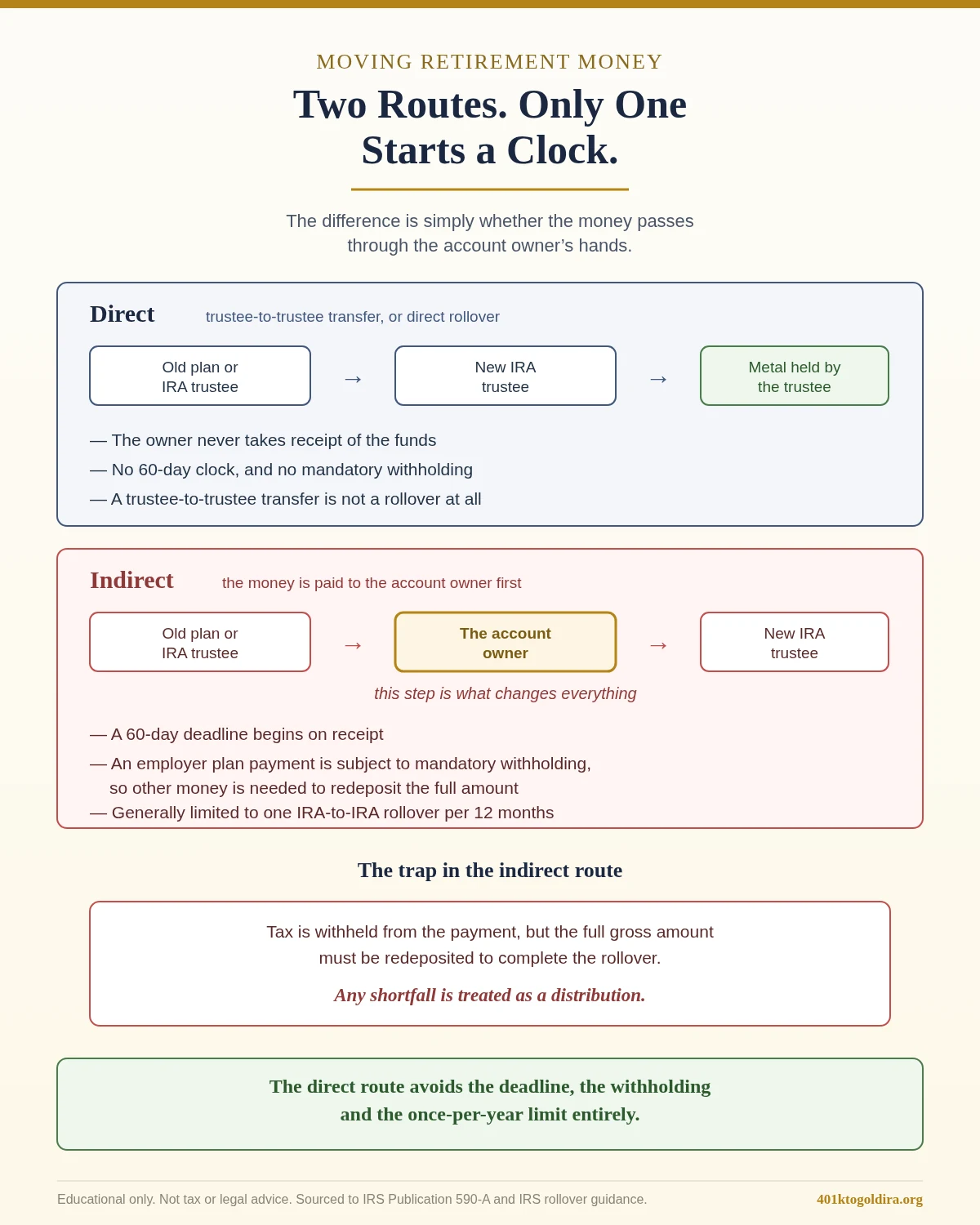
IRS Publication 590-A states that a transfer from one IRA trustee directly to another is not a rollover. Because there is no distribution to the account owner, it is tax-free and is not subject to the one-rollover-per-year limitation. (IRS Publication 590-A)
The receiving custodian can open the successor IRA, confirm asset acceptance, prepare paperwork and request the assets. It cannot independently take control of property held under another custodian. The sending custodian or authorized successor must still process the transfer or instruct the movement of cash or metal.
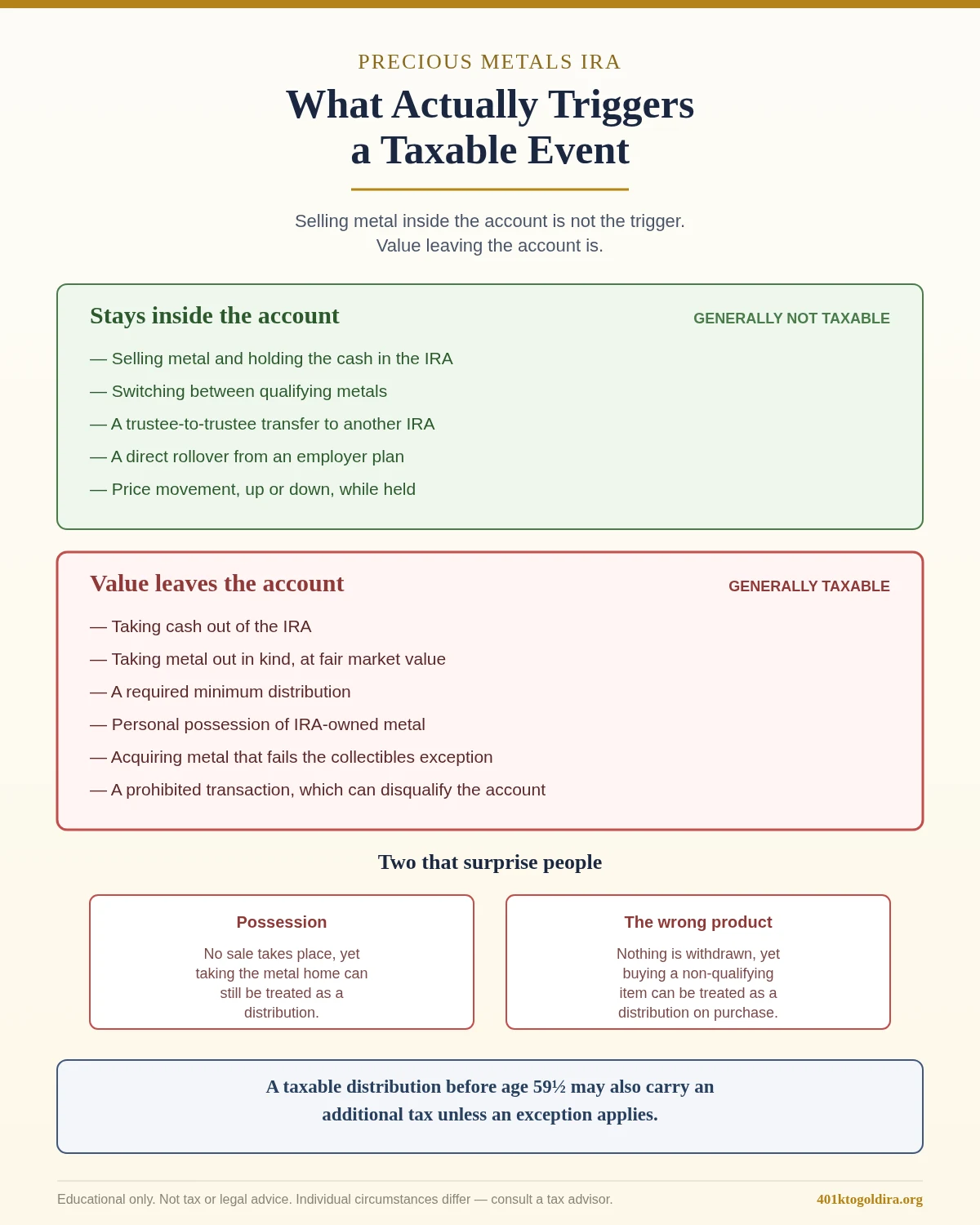
An in-kind transfer can keep the metal inside the IRA custody chain if both custodians can accept and process it. If metal is sold inside the existing IRA and cash then moves directly to the successor trustee, the sale itself is not the same as a distribution to the individual. The tax boundary is whether money or property leaves the IRA for the account owner. (IRS Publication 590-A; IRS Publication 590-B)
Indirect rollover adds a clock and another limitation
If a distribution is paid to the account owner, the general rollover window is 60 days. The one-rollover-per-year limitation can also apply across an individual's IRAs, while trustee-to-trustee transfers are excluded. The IRS can waive the 60-day requirement in qualifying circumstances but cannot waive the one-rollover-per-year rule. A service failure therefore should not be assumed to create a tax exception. (IRS Publication 590-A; IRS rollover guidance)
The mechanics of a normal, uncontested move are covered separately in the guide to transferring an IRA to gold and silver. This page assumes that process has already broken down.
Considering Goldco?
Goldco is a precious metals company. Customers can request a free Gold & Silver Kit at signup. Goldco markets a buyback program; customers should request current written terms directly.
Minimum investment: $25k · BBB rating: A+
Owners of this website may be paid to recommend Goldco. The content on this website, including any positive reviews of Goldco and other reviews, may not be neutral or independent.
What if fees, liquidation, or personal possession enter the dispute?
Transfer-out, closing, storage and administrative charges depend on the custodial agreement and fee schedule. SEC transfer guidance notes that retirement-account transfers can carry transfer-out or custodial fees, but the existence and amount of any precious-metals IRA fee should be verified from the actual contract. (Investor.gov)
A liquidation demand does not automatically create a taxable distribution. Metal can be sold inside the IRA and the resulting cash transferred directly between trustees. Whether a custodian can require liquidation before transfer is not established by a universal federal rule; it depends on the account documents, transferability, successor-custodian acceptance and applicable law.
Personal possession is different. Section 408(m)(3) requires qualifying bullion to be in the physical possession of a qualifying trustee, and Publication 590-B states that if the owner or beneficiary takes possession of IRA coins, the coins are treated as distributed. A distribution can be taxable and an additional tax may apply to an early distribution unless an exception applies. (26 U.S.C. § 408(m)(3); IRS Publication 590-B)
How are closure, merger, resignation, or insolvency different?
Formal closure, merger, resignation or receivership creates a different problem from unanswered customer service. Treasury Regulation section 1.408-2(e) permits suspension or revocation of nonbank trustee approval when an entity is unable or unwilling to administer fiduciary accounts consistently with the rule, and it requires a substitution mechanism when the Commissioner requires another trustee. (26 C.F.R. § 1.408-2(e))
If a bank fails, a receiver and banking regulators may control the transition. Publication 590-A includes special rules for frozen deposits and a narrow exception to the one-rollover-per-year limitation for certain IRA distributions made by the FDIC as receiver of a failed financial institution. Those rules should not be generalized to an ordinary unresponsive-custodian dispute. (IRS Publication 590-A)
A merger or resignation should be traced through formal notices, the custodial agreement, charter records and successor instructions. No universal resignation timetable was verified for all IRA custodians.
What should not happen while the dispute is unresolved?
The account owner should not request personal delivery of metal merely to break a stalemate, accept a check payable personally without reviewing rollover consequences, assume that a 60-day waiver will be available, or initiate another indirect IRA-to-IRA rollover without checking the one-rollover-per-year limitation. A liquidation or distribution form also should not be signed when the intended transaction is a trustee-to-trustee transfer. (IRS Publication 590-A; IRS Publication 590-B)
Marketing descriptions of regulatory status should not substitute for public records, and missing account history should not be reconstructed from memory as fact. The evidence packet should identify gaps and preserve the distinction between verified records and unresolved questions.
What should the verification checklist contain?
| Item | Evidence | Question | Satisfactory result |
|---|---|---|---|
| Legal custodian | Adoption agreement, custodial agreement, statement | Which legal entity is trustee or custodian? | Entity matches a public charter, bank record or IRS nonbank trustee status. |
| Institution type | OCC, FDIC/FFIEC, state charter, IRS list | What type of custodian is it? | Primary regulator and charter are independently identified. |
| Transfer request | Signed form and proof of receipt | Was a complete direct-transfer request received? | Custodian confirms receipt or identifies deficiencies in writing. |
| Receiving IRA | Successor account documents | Will the successor accept the exact assets? | Registration and asset acceptance are confirmed. |
| Asset record | Statements, trade confirmations, inventory, storage data | What metal or cash is recorded now? | Custodian and storage information can be reconciled. |
| Fees or restrictions | Agreement and fee schedule | Is the asserted fee, hold or liquidation requirement documented? | Institution identifies the applicable written term. |
| Tax path | Transfer instructions and payee or title information | Will cash or metal reach the individual? | Assets stay custodian-to-custodian unless a separately evaluated distribution is intended. |
| Escalation record | Chronology, email, receipts, screenshots | Can an outside reviewer reconstruct the incident? | Request, receipt, response, deficiencies and unresolved issues appear in sequence. |
What could not be verified?
No primary source reviewed established a universal transfer-out deadline specifically for physical precious-metal self-directed IRAs. The SEC's ACATS benchmark and its discussion of non-ACATS transfers concern investment-account processes and do not establish a physical-metal deadline. (Investor.gov; FINRA)
No reviewed federal complaint page promised to compel a particular custodian to release an IRA or produce records on a consumer-selected timetable. OCC and Federal Reserve materials expressly describe limits on their consumer complaint functions; FDIC materials describe investigation and supervisory use of complaints. State powers and private remedies vary by jurisdiction. (OCC; Federal Reserve; FDIC; CSBS)
No universal federal rule reviewed required every precious-metals IRA custodian to permit an in-kind transfer of every metal position, gave an IRA owner an unconditional right to a separate depository statement where the depository contracts with the custodian, or set one successor-custodian timetable for resignation, merger or closure. Those questions require the specific agreement, asset acceptance, state law, storage arrangements and formal transition notices.
Frequently asked questions
Can the IRS force an unresponsive nonbank custodian to release an IRA?
Treasury Regulation section 1.408-2(e) allows the IRS to suspend or revoke nonbank trustee approval when an entity is unable or unwilling to administer fiduciary accounts consistently with the rule. The reviewed IRS materials do not provide a general consumer process promising an order that compels an individual transfer.
Is an administrator the same as the custodian?
Not necessarily. The custodian or trustee is the legal entity holding and administering the IRA. A separate administrator may provide portals, forms or transaction coordination without being the trustee. The custodial documents identify the legal trustee or custodian.
Does ACATS require a gold IRA transfer to finish in a few business days?
No. ACATS applies to eligible account transfers among participating firms, principally securities accounts. SEC and FINRA materials state that transfers outside ACATS can be manual and slower. No universal deadline specific to physical precious metals in a self-directed IRA was verified from primary sources.
Can the receiving custodian pull the metal from a silent custodian?
The receiving custodian can establish the successor IRA, verify that it will accept the specific assets and submit transfer documents. It cannot independently take control of property held under another custodian's authority. The sending custodian or an authorized successor must still process the movement.
Does selling the metal before a transfer automatically create tax?
Not if the sale occurs inside the IRA and the proceeds remain inside the retirement-account structure for direct transfer to the successor trustee. A distribution to the account owner is the separate tax event that has to be evaluated.
What happens if metal is delivered to the account owner?
IRS Publication 590-B states that IRA coins taken into the owner's or beneficiary's possession are treated as distributed, and section 408(m)(3) requires qualifying bullion to be held by a qualifying trustee. Tax and any additional tax depend on the facts and whether an exception applies.
When should an attorney become involved?
Counsel is particularly relevant when release is expressly refused, asset ownership or location is disputed, material records cannot be produced, litigation or limitation periods may matter, or an enforceable order may be needed. Federal complaint portals describe limits that differ from private legal representation.
Primary Sources
- Internal Revenue Service, Publication 590-A
- Internal Revenue Service, Publication 590-B
- Internal Revenue Service, Rollovers of Retirement Plan and IRA Distributions
- Internal Revenue Service, Approved Nonbank Trustees and Custodians
- Cornell Legal Information Institute, 26 U.S.C. § 408
- Cornell Legal Information Institute, 26 C.F.R. § 1.408-2
- SEC/Investor.gov, Self-Directed IRA Custodian Investor Alert
- SEC/Investor.gov, Investor Bulletin on Account Transfers
- FINRA, Customer Account Transfers
- NASAA, Third-Party Custodians of Self-Directed IRAs
- NASAA, State Securities Regulator Directory
- CFTC, Customer Advisory on Physical Precious Metals
- OCC, Financial Institution Lists
- OCC, File a Complaint
- FDIC, Consumer Complaint Process
- Federal Reserve Consumer Help, File a Complaint
- Conference of State Bank Supervisors, State Bank Agency Directory
- Consumer Financial Protection Bureau, Submit a Complaint
- USAGov, State Consumer Protection Offices
- USAGov, Sample Customer Complaint Letter
- U.S. Courts opinion via GovInfo, precious-metals custody and holding-statement dispute
- American Estate & Trust, "How do I transfer assets out of my AET SDIRA?" Commercial source intentionally unlinked.
This article is for educational purposes only and is not financial, tax, or legal advice. IRA tax consequences depend on the facts of the transaction, and regulatory jurisdiction depends on the legal status of the institution involved. A qualified tax professional is the appropriate next step before accepting a distribution or relying on a rollover exception. An attorney is the appropriate next step when asset release, records, ownership, contractual rights, litigation, or court-ordered relief must be evaluated.
Further Reading
 Transfer an IRA to Gold and SilverThe normal transfer process, start to finish, when nothing has gone wrong.Custodian & Depository DatabaseLook up custodians and depositories before choosing a replacement.
 Gold IRA Early Withdrawal PenaltyWhat a distribution costs if the account leaves the IRA structure.